Personality Psychology

Personality Psychology examines the psychological traditions through which scholars have sought to understand enduring individuality, characteristic patterns of thought and feeling, and the structures of selfhood that make persons recognizably themselves across time. In the history of psychology, the field has linked trait theory, temperament, psychometrics, development, identity, character, and personality assessment in ways that illuminate how human beings differ, how personality is formed and expressed, and how stable dispositions shape relationships, moral life, health, work, and social behavior.

This category explores the major theories, methods, and debates of personality psychology, including trait structure, temperament, the Five-Factor Model, personality development, measurement and assessment, narrative identity, character, typologies such as MBTI, and the distinction between categorical and dimensional models of individuality. It considers how personality is studied scientifically, how persons change across the lifespan, how enduring traits interact with situations and institutions, and how the field contributes to wider reflection on selfhood, agency, moral evaluation, and the structure of the person.

Personality psychology plays an important role in psychological and interdisciplinary inquiry because it provides one of the most rigorous vocabularies for thinking about individuality as both pattern and personhood. By engaging the field seriously, this category deepens understanding of human difference, character formation, identity, and the enduring question of what gives coherence to a life across time.

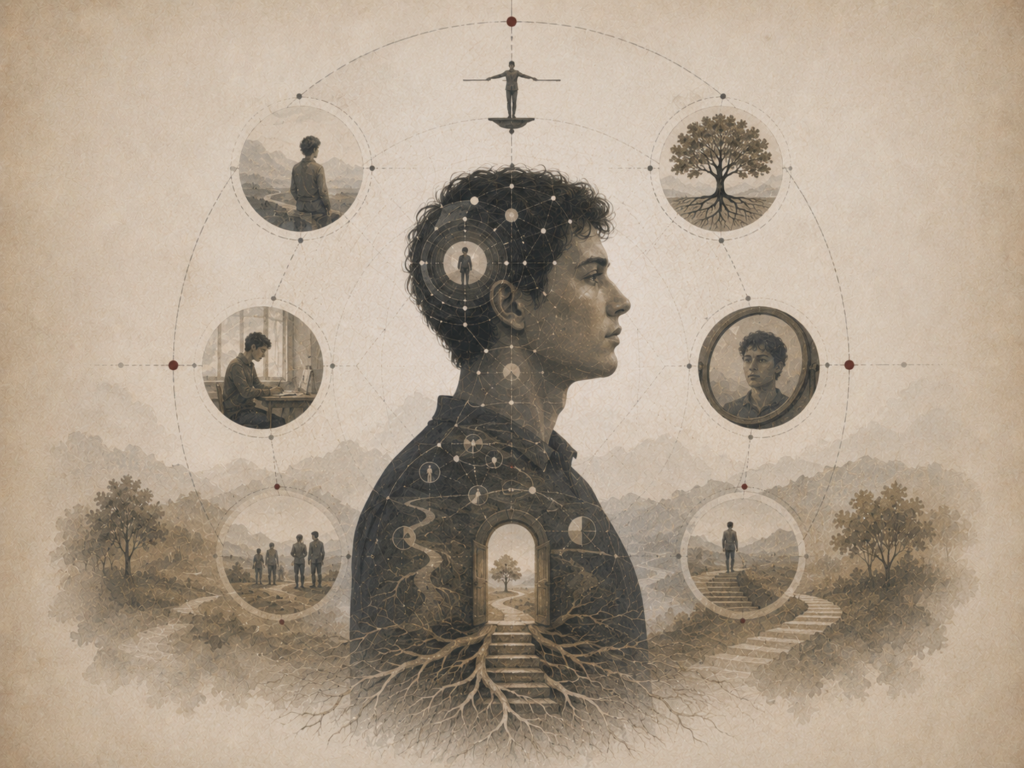
Restrained institutional illustration of a human profile surrounded by mirrors, roots, pathways, social scenes, and abstract diagrams representing self-concept, self-esteem, and self-knowledge.

Self-Concept, Self-Esteem, and Self-Knowledge

Self-concept, self-esteem, and self-knowledge are often treated as interchangeable, but they name different layers of personality. This article explains how people represent themselves, evaluate themselves, and attempt to know themselves with varying degrees of accuracy. It examines self-concept as an organized structure of identity, self-esteem as the evaluative dimension of selfhood, and self-knowledge as the problem of insight, blindness, and correspondence with reality. It also explores self-discrepancy, self-continuity, and the role of others in reflecting or distorting the self. The result is a more serious account of personality as reflexive and self-interpreting: shaped not only by traits and motives, but by how the person understands, judges, and narrates who they are.
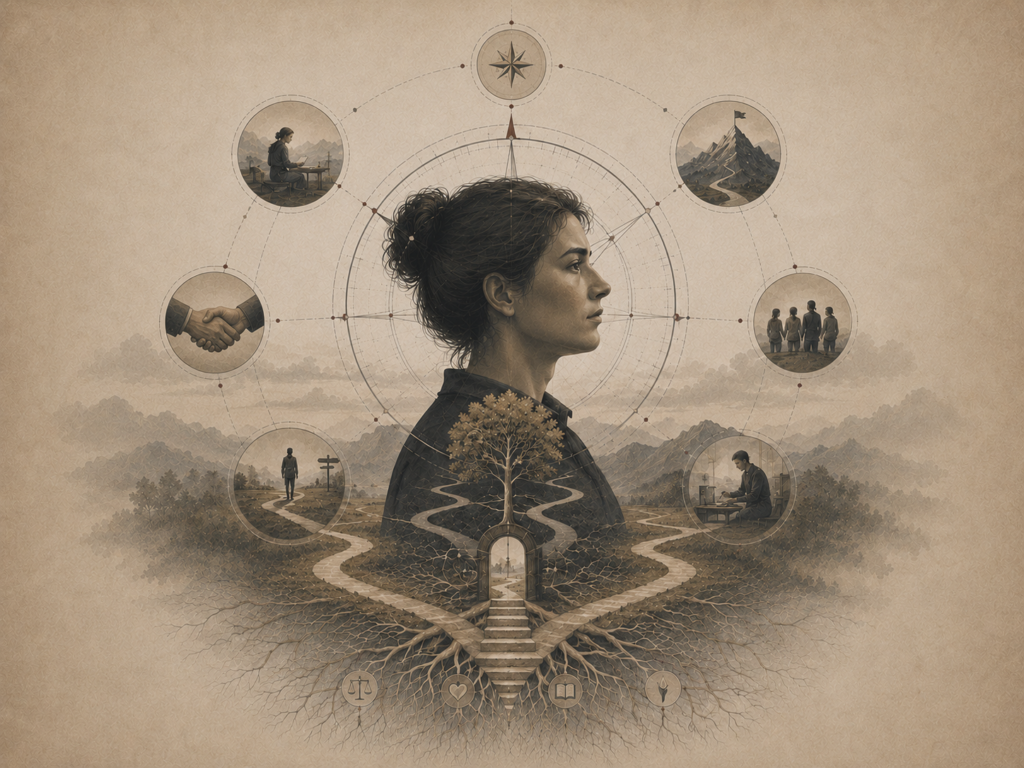

Restrained institutional illustration of a human profile surrounded by pathways, compass forms, roots, social scenes, and symbolic value markers representing values, strivings, and personality direction.

Values, Strivings, and the Direction of Personality

Personality is not only a matter of stable traits. It is also a matter of direction: what a person values, what they repeatedly strive for, and how their commitments organize conduct across time. This article examines values and personal strivings as central components of personality architecture, showing how broad evaluative priorities, recurring goals, and conflicts among them help explain the direction of a life. It draws on value theory, personal-strivings research, and self-determination theory to clarify how people differ not only in style, but in what they take to matter. The result is a more complete account of personality as purposive and morally organized, shaped by commitment, tradeoff, social context, and the patterned pursuit of what one judges worth seeking.

Restrained institutional illustration of a human profile surrounded by pathways, compass forms, goal symbols, mountains, roots, and circular diagrams representing motivation, goals, and desire.

Motivation, Goals, and the Architecture of Desire

Personality is not only a matter of traits. It is also a matter of direction: what a person wants, fears, pursues, delays, protects, and organizes life around. This article examines motivation, goals, and desire as central components of personality architecture, showing how enduring individuality is shaped not only by stable traits but by needs, goal systems, self-regulation, values, and identity. It explores Self-Determination Theory, goal hierarchy, motivational conflict, and the social shaping of desire, while arguing that personality becomes far more intelligible when its directed structure is taken seriously. The result is a more complete view of personality as not only patterned, but purposeful—organized through striving, tradeoff, and the moral and social worlds that teach people what to want.

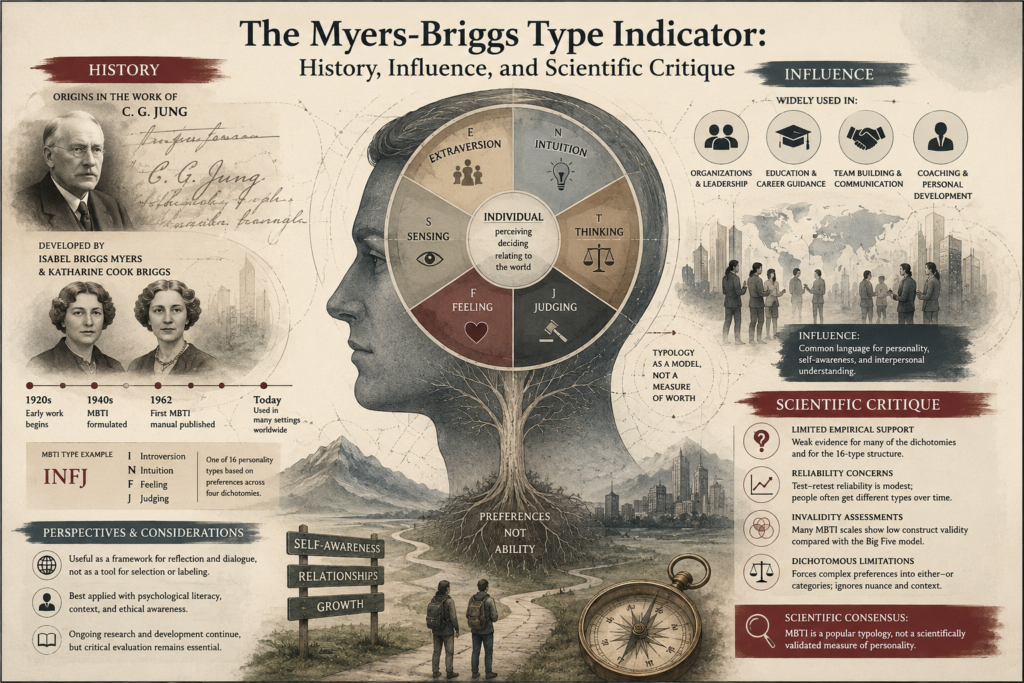
Infographic-style institutional illustration of the Myers-Briggs Type Indicator with a central human profile, typology wheel, historical figures, timeline elements, workplace influence symbols, and scientific critique panels.

The Myers-Briggs Type Indicator: History, Influence, and Scientific Critique

The Myers-Briggs Type Indicator is one of the most influential personality instruments ever created, yet also one of the most scientifically contested. This article examines the MBTI as both a historical phenomenon and a psychological framework, tracing its roots in Jungian typology through the work of Katharine Briggs and Isabel Briggs Myers and explaining why its four-letter system became so culturally durable. It also addresses the central scientific critique: that the MBTI’s typological structure, forced dichotomies, and uneven psychometric standing make it less defensible than dimensional trait models. The result is a balanced account of the instrument’s history, practical appeal, institutional influence, and scientific limits, without reducing either its cultural power or its methodological weaknesses to caricature.

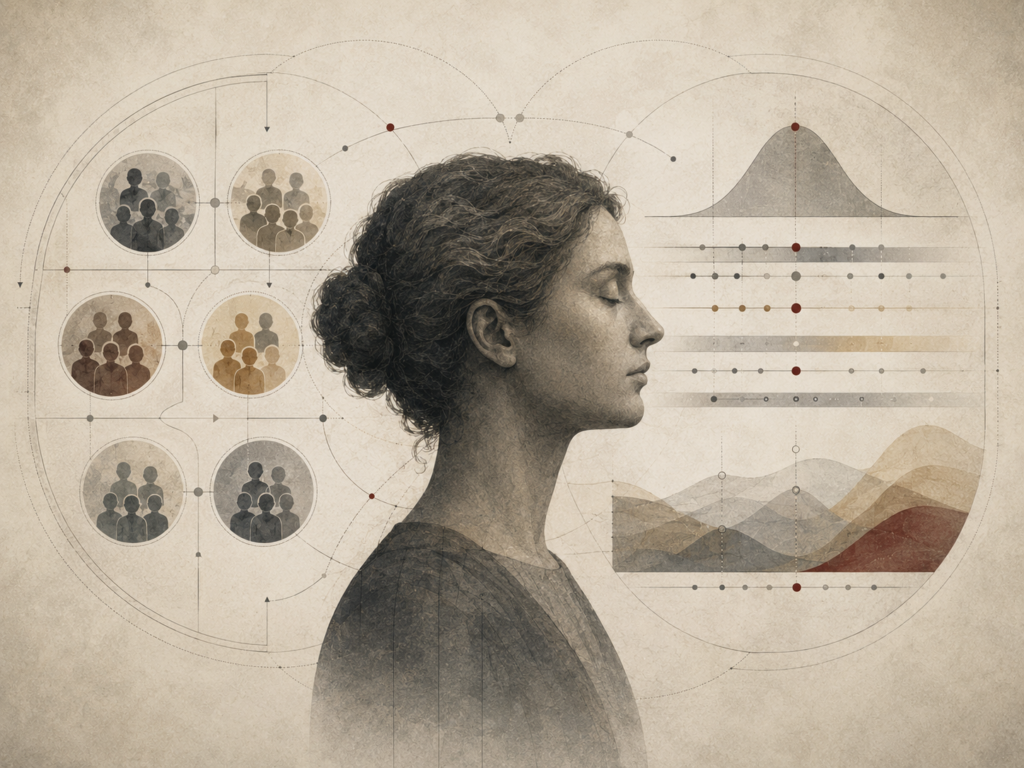
Restrained institutional illustration of a human profile between categorical personality type groupings and dimensional trait distributions, representing different models of personality structure.

Personality Types and Personality Traits: Categorical and Dimensional Models Compared

Personality types promise clarity by sorting people into recognizable kinds, while personality traits describe graded differences across continuous dimensions. This article compares these two major ways of modeling individuality, explaining why categorical approaches remain psychologically appealing even as dimensional trait models dominate modern personality science. It examines what types gain in memorability and narrative force, what they lose in precision, why traits better preserve variation and psychometric structure, and how person-centered profile methods partly bridge the divide. The result is a more serious account of the issue: not a simple rejection of type thinking, but a careful comparison of categorical and dimensional models as competing ways of representing personality, each useful for some purposes but not equally faithful to the graded nature of most human variation.

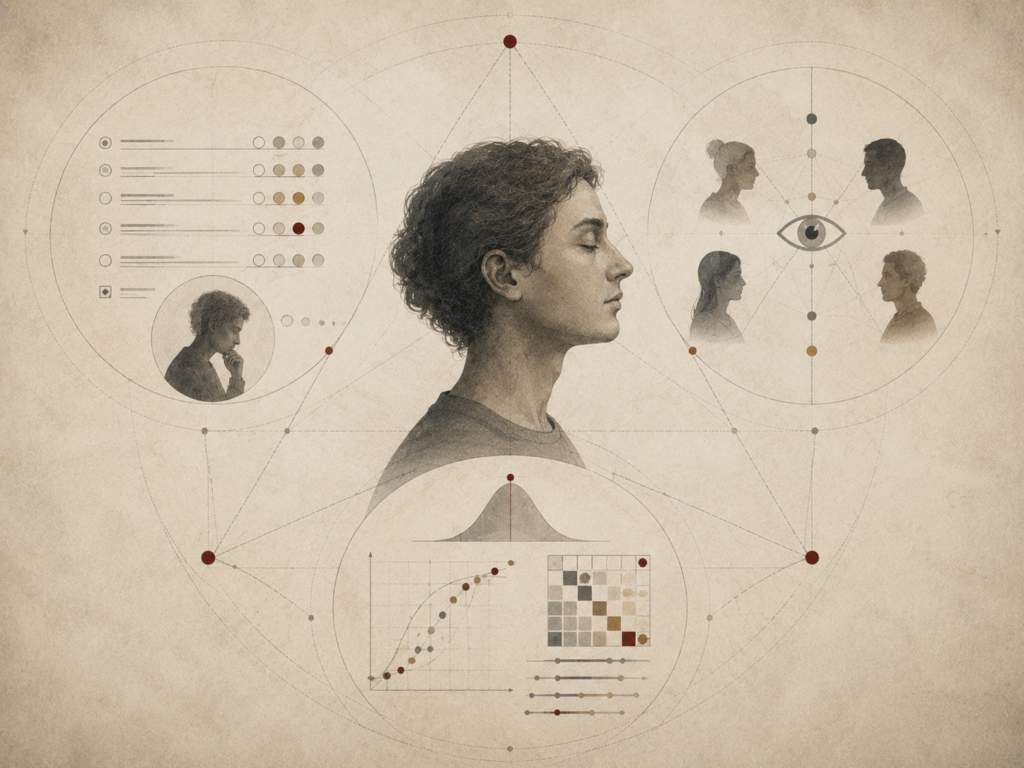
Restrained institutional illustration of a human profile surrounded by self-report forms, observer-rating diagrams, statistical charts, and psychometric measurement symbols.

Measurement in Personality Psychology: Self-Report, Observer Ratings, and Psychometrics

Measurement is one of the deepest problems in personality psychology because the field is always trying to infer enduring psychological structure from imperfect indicators. This article explains how personality is assessed through self-report inventories, observer ratings, and psychometric models, and why none of these methods can be treated as transparent by default. It examines the strengths and limits of self-knowledge, the value and bias of informant reports, the meaning of reliability and validity, the problem of faking and method effects, and the importance of measurement invariance across groups and contexts. The result is a more serious account of personality assessment as a fundamentally inferential practice—one that depends on conceptual precision, methodological discipline, and psychometric evidence rather than the mere existence of a questionnaire.

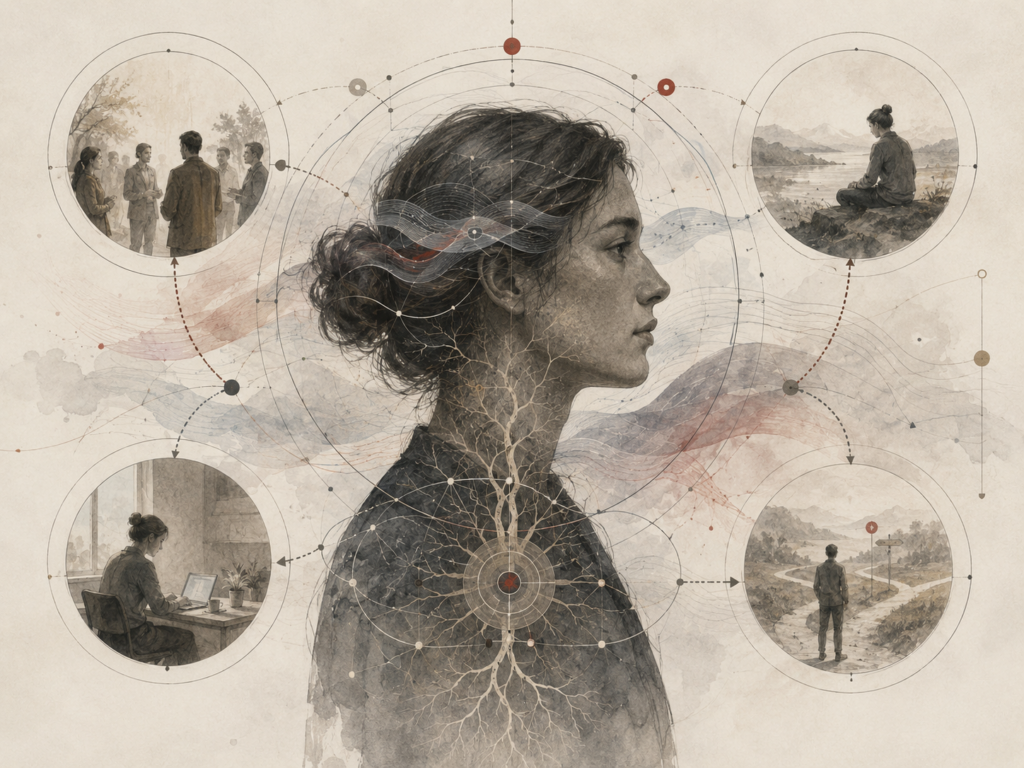
Restrained institutional illustration of a human profile surrounded by situational vignettes, flowing lines, branching networks, and circular diagrams representing traits, states, and personality variability.

Personality Dynamics: Traits, States, and Situational Variability

Personality dynamics asks how personality remains stable while behavior, feeling, and motivation vary so much across situations and moments. This article explains how traits, states, and situational variability fit together in contemporary personality psychology, moving beyond static views of disposition toward a more realistic account of patterned individuality in time. It examines the distinction between enduring trait levels and momentary state enactments, the role of situations in shaping expression, the importance of distributions and signatures rather than rigid behavioral sameness, and the contribution of Whole Trait Theory to integrating structure with process. The result is a dynamic view of personality as stable but not frozen: organized through variability, enacted in context, and shaped by repeated patterns that accumulate across everyday life.

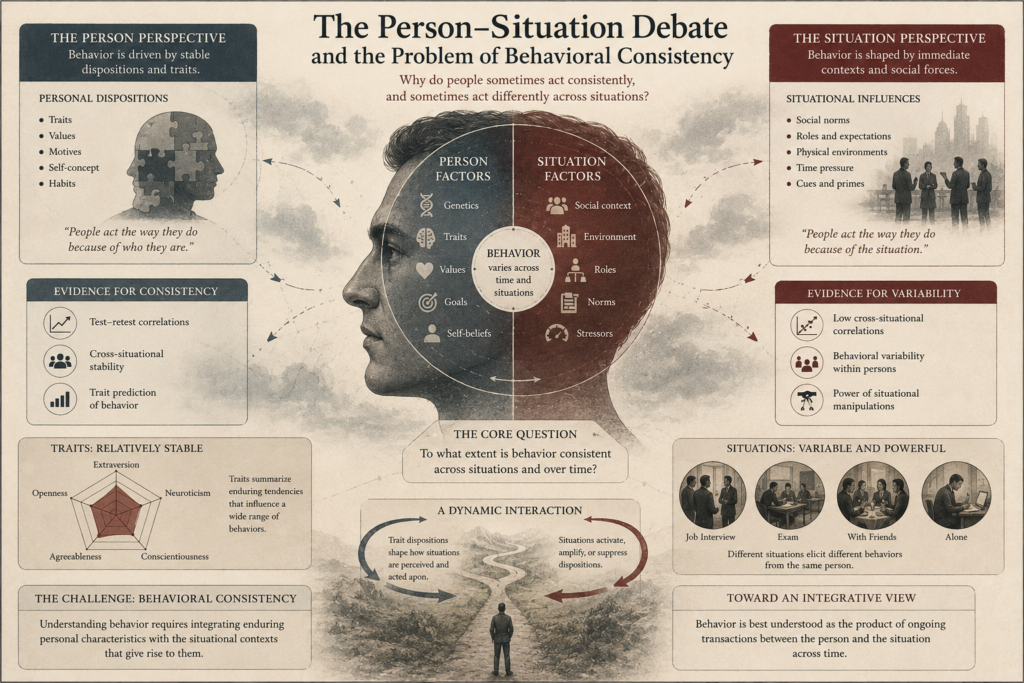
Detailed institutional infographic showing a central human profile divided between person factors and situation factors, surrounded by panels comparing traits, social context, behavioral consistency, and situational variability.

The Person–Situation Debate and the Problem of Behavioral Consistency

The person–situation debate became one of the defining controversies in modern personality psychology because it forced the field to confront a difficult question: what does it really mean to say that behavior is consistent? This article revisits Mischel’s challenge to broad trait claims, the problem of cross-situational uniformity, and the later theoretical developments that transformed the debate rather than ending it. It explains why behavioral consistency cannot be reduced to doing the same thing everywhere, how if–then signatures and density distributions reshaped trait theory, and why personality science now treats stable individuality as a matter of patterned variation across structured situations rather than simple behavioral repetition.

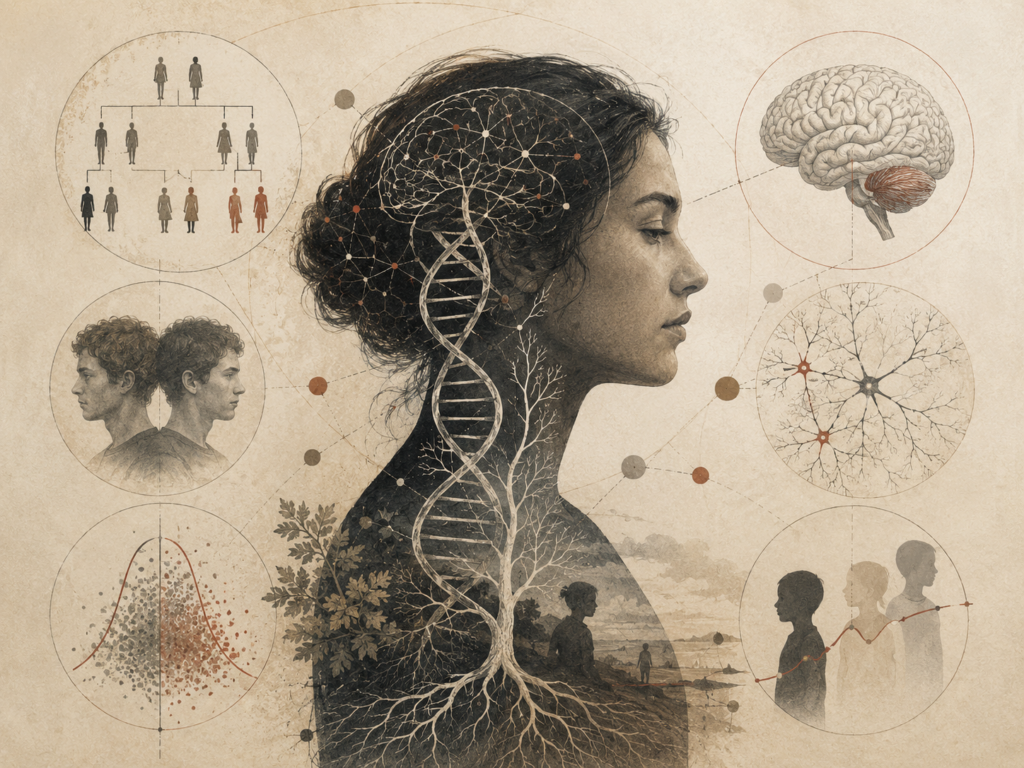
Restrained institutional illustration of a human profile with DNA, neural networks, family diagrams, twin imagery, brain structures, and distribution charts representing behavior genetics and personality biology.

Behavior Genetics and the Biological Basis of Personality

Behavior genetics changed personality psychology by showing that enduring individual differences are partly heritable without collapsing personality into biological fate. This article explains how twin, adoption, and family designs estimate genetic and environmental contributions to personality, why heritability is often misunderstood, and how gene–environment correlation and interaction complicate any simple nature-versus-nurture story. It also examines the developmental links between temperament and later personality, the limits of candidate-gene thinking, and the modern recognition that personality is shaped by many genetic influences of small effect. The result is a more serious account of the biological basis of personality: real, measurable, and developmentally important, yet always mediated by context, inequality, experience, and the social worlds in which persons actually become themselves.

Scroll to Top