
Last Updated May 22, 2026
The Myers-Briggs Type Indicator occupies a peculiar place in the history of personality psychology. It is one of the most influential personality instruments ever created, widely used in education, counseling, organizational development, career reflection, leadership workshops, and popular self-understanding. Yet it remains one of the most scientifically contested. Its endurance cannot be explained by measurement quality alone, and its weaknesses cannot be explained away by cultural popularity. The MBTI became powerful because it offered people a vivid, nonpathologizing language of difference at a moment when institutions increasingly wanted psychological tools for work, education, and identity.
The instrument’s appeal rests on several forces at once: its roots in Carl Jung’s typological theory, its elegant four-letter identities, its promise of normal personality difference rather than disorder, and its ability to turn self-reflection into a memorable symbolic code. For many users, an MBTI type feels less like a test result than a compact story of attention, decision-making, energy, and preferred life organization. For critics, however, the instrument’s forced dichotomies, categorical structure, limited predictive power, and disputed psychometric standing make it far less defensible than dimensional trait models.
This article argues that the MBTI should be understood neither as useless pseudoscience nor as a strong scientific model of personality. Its historical and cultural importance is real. Its reflective usefulness can be real. But its scientific authority is often overstated. A serious account must explain why the instrument became so influential, why many people find it personally meaningful, and why many personality psychologists remain unconvinced that it measures personality as well as modern dimensional trait approaches.
Main Library
Publications
Article Map
Personality Psychology
Related Topic
Cognitive Psychology
Related Topic
Developmental Psychology
Related Topic
Social Psychology
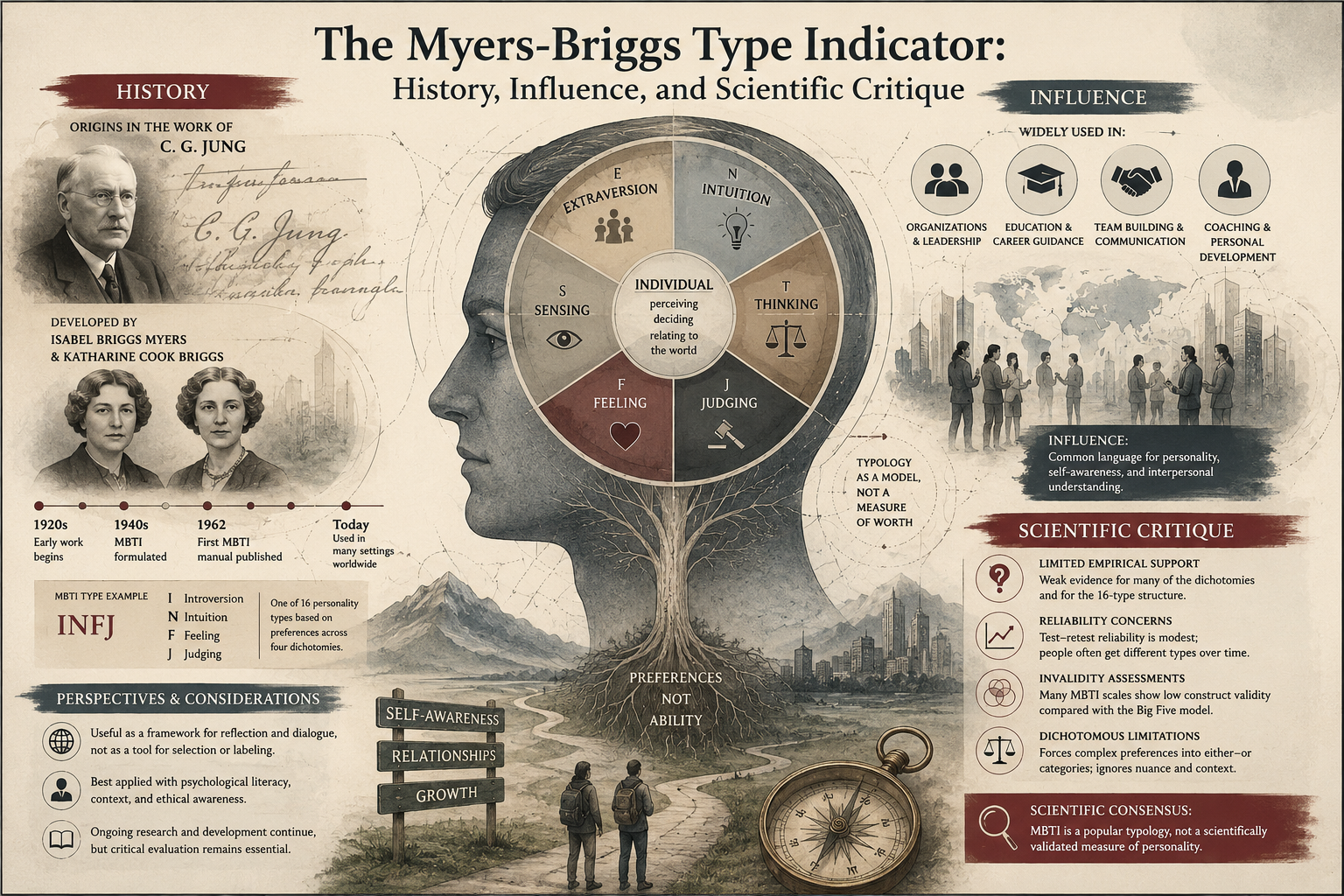
The MBTI’s place in personality psychology is best understood as a tension between cultural usefulness and scientific limitation. It gives people a language for personality difference that feels humane and memorable, but its four dichotomies and sixteen types compress continuous variation into categorical identities. That compression makes the system easy to use, but it also creates the central measurement problem: people are often treated as qualitatively different types when their underlying scores may differ only slightly.
Why the MBTI matters
The MBTI matters because it became one of the most widely recognized personality languages in modern culture. Even people who know little about psychometrics often know the four-letter type format. The instrument entered workplaces, schools, churches, counseling contexts, professional-development seminars, online communities, dating conversations, and self-help cultures. Its influence is not merely technical. It is linguistic and social. It gave people a portable way to name difference.
That cultural success deserves analysis. Many psychological instruments remain obscure because they require technical interpretation, clinical training, or statistical literacy. The MBTI succeeded because it translated personality into a small symbolic grammar. Four preference pairs generate sixteen recognizable identities. Those identities feel balanced, nonjudgmental, and easy to communicate. They allow people to say, “I am this kind of person,” without using the language of disorder, defect, or pathology.
This helps explain why the MBTI became institutionally useful even where its scientific standing was disputed. Organizations could use it to begin conversations about communication, conflict, planning, decision-making, leadership style, and team differences. Educators could use it to discuss learning preferences. Counselors and coaches could use it as an entry point into self-reflection. The instrument’s greatest strength was never that it offered the strongest measurement model of personality. Its strength was that it made personality difference discussable.
But this same accessibility is also part of the problem. A tool that feels meaningful can easily acquire more authority than its evidence supports. Type language can become reified. A person may start treating a four-letter code as an essence, destiny, or explanation for behavior. Institutions may treat type categories as if they reveal deep psychological structure. Popular users may forget that a reflective framework is not the same as a strong predictive model.
The MBTI therefore matters because it shows a recurring tension in personality psychology: the most culturally successful systems are not always the most scientifically powerful, and the most scientifically defensible systems are not always the most accessible. The MBTI sits exactly at that crossroads.
What the MBTI is
The Myers-Briggs Type Indicator is a typological personality instrument built around four preference pairs: Extraversion versus Introversion, Sensing versus Intuition, Thinking versus Feeling, and Judging versus Perceiving. These combinations yield sixteen possible personality types, conventionally represented by four-letter codes such as INFJ, ESTP, ENFP, or INTP. The instrument was designed to classify normal personality preferences rather than diagnose disorder or pathology.
In the MBTI framework, Extraversion and Introversion concern preferred orientation of energy and attention. Sensing and Intuition concern preferred ways of taking in information. Thinking and Feeling concern preferred modes of evaluation and decision. Judging and Perceiving concern preferred styles of organization, closure, openness, and orientation toward the outer world. Each person receives one preference from each pair, producing a four-letter type.
That structure is central to both the MBTI’s appeal and its difficulty. It offers users a vivid identity format. It makes the system easy to teach, remember, and discuss. But it also assumes that underlying variation can be meaningfully divided into discrete preferences. From a measurement standpoint, this is a strong assumption. Many personality characteristics are distributed continuously, with many people falling near the middle rather than clearly into one category or another.
The MBTI’s type language is therefore not simply a neutral reporting format. It shapes interpretation. A person who is only slightly more introverted than extraverted may receive an “I” rather than an “E,” and that letter can become part of identity. A person near the boundary between Thinking and Feeling may be classified as one or the other, even when their actual pattern is mixed. The code gives clarity, but it can also create artificial sharpness.
This is why the MBTI is best understood as a typological framework rather than as a comprehensive model of personality variation. It categorizes preference patterns. It does not preserve the full graded structure of individual differences in the way dimensional trait models do. The difference between categorizing and measuring is the central issue running through nearly every scientific debate about the instrument.
Historical origins: Jung, Briggs, and Myers
The MBTI’s intellectual roots lie in Carl Jung’s Psychological Types, published in 1921 and translated into English in 1923. Jung proposed that individuals differed in characteristic attitudes and mental functions, especially introversion and extraversion, along with contrasting ways of perceiving and judging. His typological theory belonged to a broader psychological and philosophical tradition that sought to classify forms of consciousness, attention, temperament, and psychic orientation.
Katharine Cook Briggs and her daughter Isabel Briggs Myers adapted Jung’s ideas into a practical assessment instrument. They were not initially academic psychometricians in the modern sense. Their work emerged from a belief that personality understanding could help people live and work more fittingly. They wanted to make psychological type useful outside the analytic setting, especially for everyday self-understanding, education, work, and human relationships.
The development of the MBTI was also tied to twentieth-century confidence in applied psychological classification. Schools, workplaces, militaries, counseling professions, and vocational-guidance systems increasingly sought tools for matching people to roles, improving organizational functioning, and understanding individual difference. The MBTI belonged to this wider movement: the translation of psychological theory into practical instruments for modern institutions.
This history matters because the MBTI was never only a scientific measurement project. It was also a social project. It carried a humanistic promise: people differ in normal ways, and understanding those differences can reduce conflict and improve fit. Its language was affirmative rather than pathologizing. Instead of telling users what was wrong with them, it told them that their preferences belonged to a recognizable pattern.
The historical problem is that an instrument can be culturally humane and scientifically limited at the same time. Jung’s typology was influential, but modern personality science moved increasingly toward empirically derived trait dimensions, factor analysis, construct validation, and dimensional measurement. The MBTI retained a typological architecture from an earlier theoretical tradition even as the field moved toward continuous models of personality structure.
That historical tension explains much of the MBTI’s contemporary status. It is historically significant, culturally durable, and personally meaningful to many users. But its roots lie in a typological tradition that does not align neatly with the strongest evidence base in modern personality measurement.
The four dichotomies and sixteen types
The MBTI organizes personality through four contrasts. Extraversion and Introversion describe the preferred orientation of attention and energy. Sensing and Intuition concern preferred ways of taking in information. Thinking and Feeling refer to preferred modes of evaluation and decision. Judging and Perceiving concern preferred styles of organization and orientation toward the outer world. Combining these four dichotomies yields sixteen types.
This architecture is elegant because it is combinatorial. A small number of distinctions produces a larger set of recognizable categories. The four-letter code feels compact but expressive. It appears to capture a person’s social orientation, information style, decision style, and organizational style all at once. That is why the system is so teachable. It offers a map rather than a long statistical report.
The sixteen types also encourage identification. A person may not remember a percentile score, but they remember “INTJ” or “ESFP.” The type code becomes a social object: something one can share, compare, explain, defend, or joke about. Online culture has amplified this identity quality. Type communities often build elaborate symbolic worlds around the sixteen codes, attaching characters, professions, aesthetic styles, relationship dynamics, and moral meanings to them.
Scientifically, however, the same structure creates difficulties. A dichotomy implies that people fall meaningfully into one side or the other. But if most people fall along a continuum, especially near the middle, then dichotomizing creates artificial divisions. Someone slightly above a cutoff and someone slightly below it may be treated as different types despite being highly similar. Someone far from the cutoff and someone barely above it may receive the same letter despite being very different in degree.
The problem compounds across four dimensions. Each dichotomous split loses information, and the four-letter type is built from all four. The resulting sixteen categories may feel precise, but they are produced by compressing continuous variation. The code therefore appears richer than it may be psychometrically. It gives a strong identity signal while discarding graded information that would matter for measurement and prediction.
The four dichotomies are therefore best interpreted cautiously. They may help users reflect on recurring preferences, but they should not be treated as hard boundaries in psychological nature. The type code is a summary, not an essence.
Why the MBTI became so influential
The MBTI became influential because it offered a rare combination of accessibility, personal resonance, and institutional usefulness. It gave users a language for describing difference without framing difference as deficiency. It was easy to remember, easy to communicate, and emotionally attractive because it often felt affirming rather than diagnostic. It told people that they had a type, and with that type came a pattern of strengths, preferences, frustrations, and interpersonal tendencies.
Its spread through workplaces, schools, coaching, counseling, ministry, and professional development reinforced this cultural power. Organizations found the MBTI useful as a discussion tool because it encouraged people to consider communication styles and work preferences without using the more stigmatizing language of pathology or incompetence. In a team workshop, saying “I prefer closure” or “I need more time to process information” can be less threatening than saying “you are disorganized” or “you are withholding.”
The MBTI also benefits from narrative economy. It gives people a short symbolic identity that feels explanatory. This is important because people often want personality knowledge that is memorable and socially usable. A type code provides a kind of identity shorthand. It can be used in conversation, self-description, team-building, or online community. Dimensional trait results may be more scientifically defensible, but they are often less narratively compact.
The instrument also succeeded because it avoided the harshness of deficit language. Many personality assessments implicitly rank people as more or less desirable on dimensions such as emotional stability, conscientiousness, or agreeableness. The MBTI, by contrast, presents preferences as differences rather than deficiencies. That nonpathologizing tone has real social value. People are often more willing to engage in self-reflection when the language does not immediately threaten their worth.
But influence should not be confused with scientific strength. The very features that make the MBTI culturally powerful—memorable categories, identity labels, affirmative language, and institutional ease—can also encourage overinterpretation. A four-letter type can become a story too quickly. It can make a person feel understood while leaving major dimensions of personality unmeasured. It can make teams feel that differences have been explained when the deeper interpersonal or institutional problem has not been addressed.
The MBTI became influential because it solved a social problem: people and institutions wanted an accessible, humane language of difference. Whether it solved the scientific problem of measuring personality well is a different question.
What supporters claim
Supporters of the MBTI emphasize its long history, technical revisions, practical value, and intended use as a tool for self-understanding rather than diagnosis. Official MBTI sources stress that the assessment has been revised over time, that newer forms use more sophisticated scoring procedures, and that the instrument is supported by technical manuals, reliability data, and a large applied literature. They often argue that critics attack simplified popular versions rather than the more careful professional use of the instrument.
This defense matters because many critiques of the MBTI do rely on caricature. Serious supporters do not usually claim that the MBTI captures the whole of personality, predicts all behavior, or functions as a clinical instrument. The strongest defense is more modest: that type preferences can serve as a useful language for self-reflection, communication, development, and interpersonal understanding. Under this interpretation, the MBTI is less a final scientific taxonomy than a structured tool for conversation.
Supporters also argue that type does not have to mean rigid determinism. In careful MBTI interpretation, a preference is not supposed to mean inability to use the opposite process. An Introversion preference does not mean a person cannot socialize. A Thinking preference does not mean a person lacks values or emotion. A Judging preference does not mean a person cannot adapt. The preferred side is meant to indicate a tendency, comfort zone, or orientation rather than an absolute limitation.
The strongest supportive case therefore rests on appropriate use. The MBTI may be most defensible when used as a reflective framework: a way to open discussion about preference, communication, attention, decision-making, and work style. It is less defensible when used to make strong predictions, assign roles rigidly, screen employees, explain away behavior, or treat type as destiny. The boundary between reflective use and overreach is crucial.
The scientific question remains whether the instrument’s structure is strong enough to support even its more modest claims. A reflective language can be useful while still being psychometrically weaker than dimensional alternatives. The MBTI’s defenders are right that the instrument should be judged according to its intended use, but critics are also right that popular and institutional use often exceeds those limits.
The fairest view is that the MBTI’s most defensible use is interpretive and developmental, not diagnostic, predictive, or classificatory in a strong scientific sense.
The scientific critique
The strongest scientific critique of the MBTI is not that it is meaningless, but that it models personality in ways that are psychometrically and conceptually weaker than dimensional trait approaches. The instrument forces individuals into one side of a dichotomy even when their actual scores may lie near the middle of a distribution. This creates artificial categories and can make nearly identical people appear qualitatively different if they fall on opposite sides of a cutoff.
This critique goes to the core of measurement. If personality variation is continuous, then dichotomizing it discards information. A person who is moderately extraverted, mildly introverted, or near the middle may be assigned a letter that implies stronger categorical identity than the data support. The same problem applies to each of the four dichotomies. By the time the four-letter code is generated, several layers of graded information have been compressed into a symbolic label.
Critics also question the empirical structure of the MBTI dimensions. Some dimensions overlap with better-established trait constructs, especially Extraversion and aspects of Openness or Conscientiousness. Others do not map cleanly onto the strongest factor-analytic models of personality. The MBTI therefore occupies an awkward position: it captures some real psychological variance, but organizes that variance through a typological framework that many researchers consider inferior to dimensional trait models.
Another critique concerns predictive validity. For personality assessment to be scientifically powerful, it should help explain or predict relevant outcomes better than simpler or better-validated alternatives. The MBTI is often used in contexts where prediction matters—career guidance, team composition, leadership development, or educational advising—even though the evidence for strong predictive use is limited. A reflective tool may not need high predictive validity, but an institutional sorting tool does.
The critique also concerns public authority. The MBTI’s popularity can lead people to treat it as more scientifically settled than it is. The four-letter code feels precise. The system looks comprehensive. The names are memorable. But precision of appearance is not the same as precision of measurement. In science, a model must be judged not by how satisfying it feels, but by how well it measures, predicts, replicates, and explains.
For this reason, many psychologists view the MBTI as historically important and practically interesting, but not as a strong contemporary model of personality structure. Its cultural life is larger than its scientific standing.
Types vs. traits and the dimensional challenge
The MBTI is best understood against the broader transition from typological to dimensional personality models. Earlier personality systems often classified people into types: temperaments, characters, constitutional categories, psychological orientations, or moral styles. Modern trait psychology generally favors continuous dimensions because these capture graded variation more faithfully. Instead of asking whether someone is one type or another, trait models ask where the person stands along dimensions such as extraversion, conscientiousness, agreeableness, neuroticism, openness, honesty-humility, or related facets.
This does not mean all typological thinking is useless. Types can be useful summaries. They can help communication. They can identify clusters in some contexts. They can provide memorable interpretive frameworks. But when the underlying variation is continuous, type categories should be treated as approximations, not natural kinds. A map can simplify reality usefully, but it becomes misleading when the simplification is mistaken for the terrain.
The dimensional challenge to the MBTI is structural. The instrument assumes that qualitative categories are primary, while much contemporary personality research suggests that continuous distributions are primary and categories are often secondary summaries imposed on those continua. This is especially important because personality traits often show normal or near-normal distributions, with many people near the middle. Dichotomies are least informative precisely where many people may be located.
Dimensional trait models also preserve degree. They can distinguish someone who is slightly above average in extraversion from someone who is extremely high. A type code may give both people the same letter. Dimensional models can also capture mixed profiles and facet-level nuance. Someone may be socially assertive but not especially warmth-seeking, orderly but not industrious, intellectually curious but not aesthetically sensitive. Typological systems often flatten such complexity.
The MBTI’s challenge is therefore not merely that it uses categories. Categories can be useful. The problem is that its categories can appear more psychologically definite than the underlying evidence warrants. A person’s four-letter type can feel like a deep identity even when it is partly the result of arbitrary thresholds on continuous variables.
The modern dimensional perspective does not require dismissing every MBTI insight. It does require demoting the type label from essence to heuristic. The four-letter code may be a conversation starter, but it should not replace dimensional measurement when scientific precision matters.
Reliability, validity, and psychometric disputes
Disputes over the MBTI often center on reliability and validity. Reliability concerns consistency: whether the instrument produces stable and internally coherent results. Validity concerns meaning: whether the instrument measures what it claims to measure and whether those measurements support the interpretations and uses attached to them. In public debate, these issues are often simplified, but they need to be distinguished.
Official MBTI materials emphasize internal consistency, test–retest evidence, and decades of technical development. Critics respond that even when some continuous preference scores show acceptable reliability, the type classifications themselves can become unstable, especially for individuals whose scores lie near a cutoff. This distinction is crucial. A scale score can be fairly stable while a categorical label derived from that score changes because the person crosses a threshold.
This is one reason test–retest criticism is so persistent. A person near the Extraversion–Introversion boundary can receive one letter at one time and another later without any deep personality transformation. The change may reflect measurement error, temporary state, context, mood, or small score fluctuation. A dimensional report would show a small shift. A typological report may show a changed type. The category makes the change look larger than it is.
Validity disputes are broader. Construct validity asks whether the MBTI dimensions represent coherent psychological constructs. Criterion validity asks whether they predict meaningful outcomes. Incremental validity asks whether they add useful information beyond better-established measures. The MBTI may capture some psychologically meaningful variance, but many critics argue that its structure and predictive power do not justify the strong interpretations often attached to it.
The issue is especially serious in institutional contexts. If the MBTI is used for team reflection, the validity threshold may be modest: does it stimulate useful conversation without doing harm? If it is used for career guidance, role assignment, leadership evaluation, or employee development, the threshold should be higher. If it is used for selection or exclusion, the use becomes much harder to defend. The more consequential the decision, the stronger the evidence must be.
The fair conclusion is not that every MBTI result is meaningless. It is that the instrument’s psychometric limitations should constrain its interpretation. Preference scores may support reflection; type labels should be treated cautiously; high-stakes use should be avoided; and dimensional alternatives should be preferred when measurement precision matters.
The MBTI in organizations, education, and popular culture
The MBTI’s influence cannot be understood only psychometrically. It has functioned as a social technology: a way of organizing difference in teams, classrooms, counseling settings, friendships, families, leadership programs, and online identity cultures. Its type language is powerful because it feels legible and nonthreatening. Saying that someone prefers Intuition or Judging can feel more usable in everyday conversation than describing them through percentile scores, factor loadings, or facet profiles.
In organizations, the MBTI often functions as a tool for discussion rather than prediction. Teams use it to talk about communication, planning, information processing, conflict, decision-making, and work preferences. In its best use, the instrument can lower defensiveness by framing difference as preference rather than incompetence. It can help people notice that colleagues may approach ambiguity, deadlines, meetings, and feedback differently.
In education and counseling, the MBTI has often been used to support reflection about learning, vocation, interpersonal style, and self-understanding. Its nonpathologizing language can be attractive in settings where people need a vocabulary for difference that does not immediately rank them. This helps explain why the MBTI remains popular even among users who know that trait models are scientifically stronger.
Popular culture has amplified the instrument even further. MBTI type codes circulate online as identity markers. People compare fictional characters, celebrities, relationship pairings, career paths, aesthetic styles, and moral temperaments through type language. In these settings, the MBTI often becomes less an assessment instrument and more a symbolic identity system. It functions like a folk taxonomy of selfhood.
This cultural life is not trivial. People need languages for describing personality difference. They need ways to recognize patterns in themselves and others. They need frameworks that make interpersonal friction less mysterious. The MBTI provides such a language. But because it feels meaningful, it can also become overextended. A person may use type to excuse behavior, essentialize themselves, stereotype others, or avoid more difficult self-knowledge.
The MBTI’s institutional and popular success therefore reveals both promise and danger. It can support reflection when used lightly and contextually. It can mislead when treated as destiny, evidence of ability, or deep scientific classification.
Why type language feels powerful
Type language feels powerful because it condenses complexity into identity. A four-letter code can seem to explain many aspects of a person at once: social energy, information style, decision style, organization, relationships, work habits, and even life purpose. This compression is psychologically attractive. It gives people a sense of recognition. It converts diffuse self-experience into a named pattern.
Type language also reduces ambiguity. Personality is complex, inconsistent, and context-dependent. People may feel one way at work, another at home, another under stress, and another in private imagination. A type code offers coherence. It says: beneath variation, there is a pattern. This can be reassuring, especially for people who have felt misunderstood, unusual, conflicted, or difficult to place.
The MBTI also feels powerful because it avoids harsh hierarchy. Many type descriptions emphasize strengths, blind spots, preferences, and growth paths rather than defects. Users can identify with a type without feeling ranked as better or worse. This is one reason the system has such emotional durability. It gives people a dignifying mirror.
But type language can also produce an illusion of explanatory depth. A label may feel like an explanation even when it simply redescribes the behavior. If someone avoids parties and says, “I do that because I am an introvert,” the type label may clarify a preference, but it may not explain the full cause. The behavior could also involve anxiety, sensory sensitivity, social fatigue, trauma history, preference for deep conversation, cultural norms, or current stress. Type is rarely the whole explanation.
Type language also invites confirmation bias. Once someone identifies with a type, they may notice confirming examples and ignore disconfirming ones. They may interpret flexible behavior through the type rather than revising the type understanding. They may overfit themselves to the description. A useful mirror can become a script.
The power of type language is therefore both psychological and social. It helps people find pattern, dignity, and vocabulary. But it can also freeze complexity into identity. The challenge is to use type language as a provisional interpretive tool rather than a final account of the person.
What the MBTI still offers
Despite the critique, the MBTI still offers something real: a structured invitation to reflection. It encourages people to think about recurring differences in attention, decision style, interpersonal orientation, and preferred environments. As a guided language for nonpathologizing self-description, it can be useful. It often helps people recognize that not everyone approaches work, relationship, conflict, or meaning in the same way.
The MBTI may be most valuable when used as a conversation framework rather than as a measurement authority. In that role, it can help people ask useful questions: Do I prefer to process information internally or through conversation? Do I attend first to concrete details or broad patterns? Do I make decisions by emphasizing impersonal criteria, relational effects, or value commitments? Do I prefer structure and closure, or openness and adaptation? These questions can be helpful even if the type label is not scientifically definitive.
The instrument can also help people distinguish preference from deficiency. Someone who needs solitude may not be antisocial. Someone who prefers structure may not be rigid. Someone who values harmony may not be irrational. Someone who enjoys improvisation may not be irresponsible. This kind of reframing can reduce moralizing interpretations of difference.
MBTI-based discussion can also support interpersonal humility. People often assume that their own preferred mode is the obvious or mature one. Type language can remind them that others may genuinely prefer different ways of gathering information, making decisions, planning, or interacting. Used well, this can soften conflict and create space for adaptation.
But the instrument’s usefulness depends on restraint. It should not be used to make high-stakes decisions. It should not be treated as a complete personality model. It should not be used to stereotype people, excuse harmful behavior, or ignore development. It should not replace better-validated trait measures when scientific measurement is needed.
The MBTI still offers a reflective vocabulary. Its limitation is that vocabulary is not the same as evidence. It can begin a conversation, but it should not end one.
Limits and risks of type thinking
Type thinking becomes risky when it hardens into essence. A person may begin to think, “I am this type, therefore this is what I can or cannot do.” A team may begin to assign roles based on type rather than skill, experience, interest, or development. A manager may interpret conflict through personality categories instead of addressing workload, power, unclear expectations, or poor communication. A reflective tool can become a substitute for harder analysis.
Another risk is stereotyping. Type labels can make people seem more homogeneous than they are. Not all INFPs, ESTJs, or ENTPs are alike. People with the same type may differ profoundly in maturity, values, culture, trauma history, emotional regulation, intelligence, social position, creativity, moral commitments, mental health, and life experience. A type code is far too coarse to capture the full person.
Type thinking can also obscure development. People change. They learn skills that do not match their preferences. They adapt to roles, relationships, cultures, and responsibilities. They become more flexible in response to maturity, failure, illness, leadership, parenting, study, spiritual practice, therapy, or social struggle. A type label can become limiting if it is treated as a fixed boundary rather than a starting point for growth.
In organizations, the risks are especially important. Personality tools can be used to reduce blame and improve understanding, but they can also be used to individualize structural problems. A team’s conflict may not be caused by type differences. It may be caused by unrealistic deadlines, power imbalance, unclear roles, poor leadership, discrimination, or lack of resources. Type language can become a polite way to avoid institutional accountability.
There is also a risk of false precision. Sixteen types may look like a nuanced system, but the categories are still broad. They can create the impression of deep specificity while leaving out major dimensions of personality, including emotional stability, honesty-humility, trauma, attachment, values, self-regulation, moral character, and social context. A type label may explain less than it appears to explain.
The safest use of MBTI-style type thinking is therefore modest, reflective, and non-deterministic. It can help people ask better questions about preference. It should not be used to define ability, worth, destiny, or the boundaries of personhood.
Mathematical lens: typological cuts on continuous variation
The psychometric problem of the MBTI becomes especially clear when written formally. Suppose an underlying preference dimension is continuous and represented by a latent variable \(T\). A dimensional trait model would preserve that variation directly. A typological model instead applies a threshold \(c\):
C =
\begin{cases}
1, & \text{if } T \ge c \\
0, & \text{if } T < c
\end{cases}
\]
Interpretation: \(C\) is a categorical assignment created by cutting a continuous trait \(T\) at threshold \(c\). This converts degree into category.
This means that people with nearly identical latent standing can be assigned to opposite categories if they fall on opposite sides of the threshold. A person with \(T=0.01\) and another with \(T=-0.01\) may be treated as different types even though their actual standing is nearly the same.
T_1 = 0.01,\qquad T_2 = -0.01,\qquad |T_1 – T_2| = 0.02
\]
Interpretation: The two people are extremely close on the underlying continuum, yet a dichotomous threshold can assign them to different categories.
The same issue appears across multiple dimensions. If a person is represented by four continuous latent variables, one for each MBTI-style preference pair, then:
\mathbf{T}_i = (t_{i1}, t_{i2}, t_{i3}, t_{i4})
\]
Interpretation: \(\mathbf{T}_i\) represents person \(i\)’s standing across four continuous preference dimensions. A dimensional model preserves these scores directly.
An MBTI-style type label is produced by dichotomizing each dimension and concatenating the results into a four-letter category:
f(\mathbf{T}_i) \rightarrow \{1,\dots,16\}
\]
Interpretation: The function \(f\) maps a continuous four-dimensional space into one of sixteen cells. The result is memorable, but information is lost at each cut.
Reliability also becomes fragile near boundaries. If the observed score is:
X = T + E
\]
Interpretation: \(X\) is the observed score, \(T\) is the underlying trait standing, and \(E\) is measurement error or transient fluctuation.
Then small changes in \(E\) can move a person from one side of a threshold to the other even when \(T\) is nearly unchanged:
C(X_1) \ne C(X_2)\quad \text{even when}\quad |T_1 – T_2| \approx 0
\]
Interpretation: Category assignment can change even when the underlying trait has not meaningfully changed, especially when scores are near the cutoff.
Information loss can be represented as the difference between the variance preserved in the continuous score and the variance preserved after categorization. The categorical variable can be useful, but it cannot retain all the information contained in the original distribution:
I(T) \ge I(C)
\]
Interpretation: The information in the continuous trait \(T\) is greater than or equal to the information in the category \(C\). Categorization simplifies interpretation but discards detail.
These equations clarify why dimensional models usually dominate scientific personality research. They retain graded structure, estimate individual differences more precisely, and avoid treating small differences near thresholds as categorical differences in kind.
R: comparing MBTI-style categories with trait continua
The R example below illustrates how dichotomizing a continuous variable changes interpretation. It simulates a continuous trait, applies a categorical cutoff, identifies boundary cases, and compares the information retained by the continuous and categorical versions.
# Myers-Briggs Type Indicator: Typological Cuts on Continuous Variation
# R workflow for comparing dimensional and categorical personality summaries

# Install packages if needed
# install.packages(c("dplyr", "ggplot2", "readr", "broom"))

library(dplyr)
library(ggplot2)
library(readr)
library(broom)

set.seed(123)

# Simulate four continuous latent preference dimensions
n <- 1000

data <- data.frame(
  person_id = paste0("P", sprintf("%04d", 1:n)),
  extraversion_introversion = rnorm(n, mean = 0, sd = 1),
  sensing_intuition = rnorm(n, mean = 0, sd = 1),
  thinking_feeling = rnorm(n, mean = 0, sd = 1),
  judging_perceiving = rnorm(n, mean = 0, sd = 1)
)

# Apply MBTI-style dichotomous thresholds at zero
data <- data %>%
  mutate(
    ei_letter = ifelse(extraversion_introversion >= 0, "E", "I"),
    sn_letter = ifelse(sensing_intuition >= 0, "S", "N"),
    tf_letter = ifelse(thinking_feeling >= 0, "T", "F"),
    jp_letter = ifelse(judging_perceiving >= 0, "J", "P"),
    type_code = paste0(ei_letter, sn_letter, tf_letter, jp_letter)
  )

# Inspect type frequencies
type_frequencies <- data %>%
  count(type_code, sort = TRUE)

print(type_frequencies)

# Identify cases close to at least one boundary
data <- data %>%
  mutate(
    min_absolute_distance_to_boundary = pmin(
      abs(extraversion_introversion),
      abs(sensing_intuition),
      abs(thinking_feeling),
      abs(judging_perceiving)
    ),
    near_boundary = min_absolute_distance_to_boundary < 0.10
  )

boundary_summary <- data %>%
  summarise(
    n = n(),
    near_boundary_n = sum(near_boundary),
    near_boundary_percent = mean(near_boundary) * 100
  )

print(boundary_summary)

# Show boundary cases where very small changes could alter type assignment
boundary_cases <- data %>%
  filter(near_boundary) %>%
  select(
    person_id,
    type_code,
    extraversion_introversion,
    sensing_intuition,
    thinking_feeling,
    judging_perceiving,
    min_absolute_distance_to_boundary
  ) %>%
  arrange(min_absolute_distance_to_boundary)

print(head(boundary_cases, 25))

# Compare continuous variation inside the same type
within_type_summary <- data %>%
  group_by(type_code) %>%
  summarise(
    n = n(),
    ei_mean = mean(extraversion_introversion),
    ei_sd = sd(extraversion_introversion),
    sn_mean = mean(sensing_intuition),
    sn_sd = sd(sensing_intuition),
    tf_mean = mean(thinking_feeling),
    tf_sd = sd(thinking_feeling),
    jp_mean = mean(judging_perceiving),
    jp_sd = sd(judging_perceiving),
    .groups = "drop"
  )

print(within_type_summary)

# Simulate an outcome predicted by the continuous dimensions
data <- data %>%
  mutate(
    collaboration_score =
      50 +
      4.0 * extraversion_introversion +
      2.0 * sensing_intuition -
      1.5 * thinking_feeling +
      1.0 * judging_perceiving +
      rnorm(n, mean = 0, sd = 5)
  )

# Model using continuous dimensions
model_continuous <- lm(
  collaboration_score ~ extraversion_introversion +
    sensing_intuition +
    thinking_feeling +
    judging_perceiving,
  data = data
)

# Model using categorical type code
model_type <- lm(
  collaboration_score ~ type_code,
  data = data
)

continuous_fit <- glance(model_continuous)
type_fit <- glance(model_type)

model_comparison <- data.frame(
  model = c("continuous_dimensions", "type_categories"),
  r_squared = c(continuous_fit$r.squared, type_fit$r.squared),
  adjusted_r_squared = c(
    continuous_fit$adj.r.squared,
    type_fit$adj.r.squared
  )
)

print(model_comparison)

# Plot continuous distribution with threshold
ggplot(data, aes(x = extraversion_introversion)) +
  geom_histogram(bins = 40) +
  geom_vline(xintercept = 0, linetype = "dashed") +
  labs(
    title = "Continuous Dimension with Typological Cutpoint",
    x = "Latent Extraversion-Introversion Dimension",
    y = "Count"
  )

# Save outputs
write_csv(data, "mbti_dimensional_vs_typological_demo.csv")
write_csv(type_frequencies, "mbti_type_frequencies.csv")
write_csv(boundary_cases, "mbti_boundary_cases.csv")
write_csv(within_type_summary, "mbti_within_type_variation.csv")
write_csv(model_comparison, "mbti_model_comparison.csv")
This workflow makes the central issue visible: a type category may be easy to interpret, but it is often produced by slicing an underlying continuum that contains more information than the category preserves. The continuous scores allow more precise modeling, while the type categories provide a memorable but compressed summary.
Python: exploring information loss in typological classification
The Python example below performs a parallel demonstration. It simulates four continuous dimensions, generates MBTI-style type codes, identifies boundary cases, and compares a model using continuous dimensions with one using type categories.
# Myers-Briggs Type Indicator: Information Loss in Typological Classification
# Python workflow for comparing continuous dimensions and categorical types

# Install packages if needed:
# pip install pandas numpy statsmodels

import numpy as np
import pandas as pd
import statsmodels.formula.api as smf

np.random.seed(123)

# Simulate four continuous latent preference dimensions
n = 1000

df = pd.DataFrame(
    {
        "person_id": [f"P{i:04d}" for i in range(1, n + 1)],
        "extraversion_introversion": np.random.normal(0, 1, n),
        "sensing_intuition": np.random.normal(0, 1, n),
        "thinking_feeling": np.random.normal(0, 1, n),
        "judging_perceiving": np.random.normal(0, 1, n),
    }
)

# Apply MBTI-style dichotomous thresholds at zero
df["ei_letter"] = np.where(df["extraversion_introversion"] >= 0, "E", "I")
df["sn_letter"] = np.where(df["sensing_intuition"] >= 0, "S", "N")
df["tf_letter"] = np.where(df["thinking_feeling"] >= 0, "T", "F")
df["jp_letter"] = np.where(df["judging_perceiving"] >= 0, "J", "P")

df["type_code"] = (
    df["ei_letter"]
    + df["sn_letter"]
    + df["tf_letter"]
    + df["jp_letter"]
)

# Inspect type frequencies
type_frequencies = (
    df["type_code"]
    .value_counts()
    .rename_axis("type_code")
    .reset_index(name="n")
)

print(type_frequencies)

# Identify cases close to any dichotomous boundary
dimension_columns = [
    "extraversion_introversion",
    "sensing_intuition",
    "thinking_feeling",
    "judging_perceiving",
]

df["min_absolute_distance_to_boundary"] = (
    df[dimension_columns]
    .abs()
    .min(axis=1)
)

df["near_boundary"] = df["min_absolute_distance_to_boundary"] < 0.10

boundary_summary = pd.DataFrame(
    {
        "n": [len(df)],
        "near_boundary_n": [int(df["near_boundary"].sum())],
        "near_boundary_percent": [float(df["near_boundary"].mean() * 100)],
    }
)

print(boundary_summary)

boundary_cases = (
    df[df["near_boundary"]]
    .loc[
        :,
        [
            "person_id",
            "type_code",
            "extraversion_introversion",
            "sensing_intuition",
            "thinking_feeling",
            "judging_perceiving",
            "min_absolute_distance_to_boundary",
        ],
    ]
    .sort_values("min_absolute_distance_to_boundary")
)

print(boundary_cases.head(25))

# Summarize continuous variation within each type
within_type_summary = (
    df.groupby("type_code")[dimension_columns]
    .agg(["count", "mean", "std", "min", "max"])
)

print(within_type_summary)

# Simulate an outcome predicted by the continuous dimensions
df["collaboration_score"] = (
    50
    + 4.0 * df["extraversion_introversion"]
    + 2.0 * df["sensing_intuition"]
    - 1.5 * df["thinking_feeling"]
    + 1.0 * df["judging_perceiving"]
    + np.random.normal(0, 5, n)
)

# Model using continuous dimensions
model_continuous = smf.ols(
    "collaboration_score ~ extraversion_introversion + "
    "sensing_intuition + thinking_feeling + judging_perceiving",
    data=df,
).fit()

# Model using categorical type code
model_type = smf.ols(
    "collaboration_score ~ C(type_code)",
    data=df,
).fit()

model_comparison = pd.DataFrame(
    {
        "model": ["continuous_dimensions", "type_categories"],
        "r_squared": [model_continuous.rsquared, model_type.rsquared],
        "adjusted_r_squared": [
            model_continuous.rsquared_adj,
            model_type.rsquared_adj,
        ],
        "aic": [model_continuous.aic, model_type.aic],
        "bic": [model_continuous.bic, model_type.bic],
    }
)

print(model_comparison)

# Estimate how much continuous variation remains inside type groups
within_type_variation = (
    df.groupby("type_code")[dimension_columns]
    .std()
    .reset_index()
)

print(within_type_variation)

# Save outputs
df.to_csv("mbti_dimensional_vs_typological_demo_python.csv", index=False)
type_frequencies.to_csv("mbti_type_frequencies_python.csv", index=False)
boundary_summary.to_csv("mbti_boundary_summary_python.csv", index=False)
boundary_cases.to_csv("mbti_boundary_cases_python.csv", index=False)
within_type_variation.to_csv("mbti_within_type_variation_python.csv", index=False)
model_comparison.to_csv("mbti_model_comparison_python.csv", index=False)
This demonstration helps clarify why dimensional models usually dominate scientific personality research. They retain graded structure, model individual differences more precisely, and avoid turning small threshold differences into categorical differences in kind. Type categories may be useful for conversation, but they are usually less efficient for measurement.
GitHub repository
The companion GitHub repository provides reproducible research scaffolding for this article, including synthetic typology-versus-trait data, documentation, validation materials, and multi-language workflows for examining dichotomization, boundary instability, information loss, type-frequency summaries, within-type variation, dimensional prediction, and MBTI-style typological classification.
Complete Code Repository
Access the full companion repository for this article, including reproducible analysis materials and multi-language code workflows for MBTI-style categories, typological classification, dimensional trait continua, threshold effects, reliability near cutpoints, information loss, and model comparison.
Responsible interpretation
Research and discussion involving the MBTI require interpretive restraint because personality labels can shape self-understanding, workplace perception, educational guidance, and interpersonal expectations. Even when a tool is intended for reflection, people can internalize its categories as identity. A type label can help someone feel recognized, but it can also become a limiting script.
The first principle is non-reduction. A person cannot be reduced to a four-letter code. Type labels do not capture the full complexity of traits, motives, values, culture, development, self-regulation, mental health, intelligence, creativity, moral character, trauma history, or social context. A type code may describe a preference pattern, but it does not define the person.
The second principle is proportional use. The MBTI may be useful as a discussion framework, but it should not be used for high-stakes decisions. It should not determine hiring, promotion, educational placement, clinical interpretation, leadership potential, relationship compatibility, or moral worth. The more consequential the decision, the stronger the evidence must be. The MBTI’s evidence base does not justify strong gatekeeping uses.
The third principle is dimensional humility. Many personality differences are matters of degree. People near type boundaries should not be treated as categorically different from those just across the line. People who share a type should not be assumed to be deeply alike. Type categories simplify continuous variation, and that simplification should remain visible.
The fourth principle is developmental openness. A person’s preferences are not destiny. People can build skills outside their comfort zones, adapt to roles, mature across the lifespan, and revise their self-understanding. A type label should never be used to excuse harmful behavior, avoid growth, or declare that certain forms of development are unavailable.
The fifth principle is institutional care. In workplaces and schools, type frameworks can be used to individualize problems that are actually structural. Team conflict may reflect workload, unclear authority, discrimination, poor management, inequitable expectations, or inadequate resources. Personality language should not be used to conceal institutional responsibility.
This article and its companion code are educational and research-oriented. They do not provide clinical assessment, diagnosis, treatment planning, personality testing for selection, workplace screening, educational placement, legal evaluation, relationship matching, or individual prediction. Their purpose is to support disciplined analysis of the MBTI’s history, influence, scientific critique, and measurement limitations while preserving the dignity and complexity of persons.
Conclusion
The Myers-Briggs Type Indicator remains historically important because it translated Jungian typology into one of the most influential personality languages of the modern era. It gave millions of people a vivid, affirmative way of talking about difference, and it provided institutions with a practical framework for reflection, conversation, and developmental coaching. Its influence is real and deserves explanation, not dismissal.
But scientific influence and cultural influence are not the same thing. The strongest critique of the MBTI is that its typological architecture imposes categories on variation that is more plausibly dimensional, and that its psychometric standing does not match the strength of its public authority. Forced dichotomies can create artificial boundaries. Type labels can overstate difference. Four-letter identities can feel more precise than the evidence warrants.
The fairest conclusion is therefore neither reverence nor ridicule. The MBTI is best understood as a historically powerful and practically useful typological framework whose cultural success exceeds its scientific standing. It can be useful as a reflective language when used modestly, contextually, and non-deterministically. It should not be treated as a comprehensive theory of personality, a strong predictive instrument, or a basis for consequential decisions.
The MBTI’s greatest lesson may be broader than the instrument itself: people need humane languages for personality difference, but those languages must remain accountable to evidence. The challenge for personality psychology is to preserve the dignity and accessibility that made the MBTI attractive while grounding self-understanding in stronger, more nuanced, and more scientifically responsible models of individual difference.
Related articles
- Personality Types and Personality Traits: Categorical and Dimensional Models Compared
- What Is a Trait? Stability, Disposition, and the Logic of Individual Difference
- The History of Personality Psychology: From Characterology to Personality Science
- The Five-Factor Model and the Architecture of Personality
- Measurement in Personality Psychology: Self-Report, Observer Ratings, and Psychometrics
- The Lexical Hypothesis and the Emergence of Trait Structure
- Beyond the Big Five: HEXACO, Hierarchies, and Alternative Structural Models
Further reading
- Jung, C.G. (1971) Psychological Types. Princeton, NJ: Princeton University Press.
- Myers, I.B., McCaulley, M.H., Quenk, N.L. and Hammer, A.L. (1998) MBTI Manual: A Guide to the Development and Use of the Myers-Briggs Type Indicator, 3rd edn. Palo Alto, CA: Consulting Psychologists Press.
- Pittenger, D.J. (2005) ‘Cautionary comments regarding the Myers-Briggs Type Indicator’, Consulting Psychology Journal: Practice and Research, 57(3), pp. 210–221.
- Emre, M. (2018) The Personality Brokers: The Strange History of Myers-Briggs and the Birth of Personality Testing. New York: Doubleday.
- Furnham, A. (1996) ‘The Big Five versus the Big Four: The relationship between the Myers-Briggs Type Indicator and NEO-PI five factor model of personality’, Personality and Individual Differences, 21(2), pp. 303–307.
- McCrae, R.R. and Costa, P.T. (1989) ‘Reinterpreting the Myers-Briggs Type Indicator from the perspective of the five-factor model of personality’, Journal of Personality, 57(1), pp. 17–40.
- Boyle, G.J. (1995) ‘Myers-Briggs Type Indicator: Some psychometric limitations’, Australian Psychologist, 30(1), pp. 71–74.
References
- Boyle, G.J. (1995) ‘Myers-Briggs Type Indicator: Some psychometric limitations’, Australian Psychologist, 30(1), pp. 71–74.
- Emre, M. (2018) The Personality Brokers: The Strange History of Myers-Briggs and the Birth of Personality Testing. New York: Doubleday.
- Furnham, A. (1996) ‘The Big Five versus the Big Four: The relationship between the Myers-Briggs Type Indicator and NEO-PI five factor model of personality’, Personality and Individual Differences, 21(2), pp. 303–307.
- Jung, C.G. (1971) Psychological Types. Princeton, NJ: Princeton University Press.
- McCrae, R.R. and Costa, P.T. (1989) ‘Reinterpreting the Myers-Briggs Type Indicator from the perspective of the five-factor model of personality’, Journal of Personality, 57(1), pp. 17–40.
- Myers & Briggs Foundation (n.d.) ‘Our Legacy’. Available at: https://www.myersbriggs.org/about-us/myers-briggs-jung-legacy/.
- Myers & Briggs Foundation (n.d.) ‘Validity and Reliability’. Available at: https://www.myersbriggs.org/research-and-library/validity-reliability/.
- Myers, I.B., McCaulley, M.H., Quenk, N.L. and Hammer, A.L. (1998) MBTI Manual: A Guide to the Development and Use of the Myers-Briggs Type Indicator, 3rd edn. Palo Alto, CA: Consulting Psychologists Press.
- Pittenger, D.J. (2005) ‘Cautionary comments regarding the Myers-Briggs Type Indicator’, Consulting Psychology Journal: Practice and Research, 57(3), pp. 210–221.
- Randall, K., Isaacson, M. and Ciro, C. (2017) ‘Validity and reliability of the Myers-Briggs Personality Type Indicator: A systematic review and meta-analysis’, Journal of Best Practices in Health Professions Diversity, 10(1), pp. 1–27.
- The Myers-Briggs Company (n.d.) ‘History, Reliability and Validity of the Myers-Briggs Assessment’. Available at: https://www.themyersbriggs.com/en-us/support/validity-of-the-myers-briggs-assessment.
- The Myers-Briggs Company (n.d.) ‘Our Story’. Available at: https://www.themyersbriggs.com/en-us/about-us/our-story.
- Woods, R.A. and Anderson, J.L. (2022) ‘Myers-Briggs Type Indicator’, StatPearls. Available at: https://www.ncbi.nlm.nih.gov/books/NBK554596/.
- Zárate-Torres, R. and Matviuk, S. (2023) ‘How good is the Myers-Briggs Type Indicator for predicting leadership-related behaviors?’, Behavioral Sciences, 13(4), 311. Available at: https://pmc.ncbi.nlm.nih.gov/articles/PMC10017728/.