Personality Psychology

Personality Psychology examines the psychological traditions through which scholars have sought to understand enduring individuality, characteristic patterns of thought and feeling, and the structures of selfhood that make persons recognizably themselves across time. In the history of psychology, the field has linked trait theory, temperament, psychometrics, development, identity, character, and personality assessment in ways that illuminate how human beings differ, how personality is formed and expressed, and how stable dispositions shape relationships, moral life, health, work, and social behavior.

This category explores the major theories, methods, and debates of personality psychology, including trait structure, temperament, the Five-Factor Model, personality development, measurement and assessment, narrative identity, character, typologies such as MBTI, and the distinction between categorical and dimensional models of individuality. It considers how personality is studied scientifically, how persons change across the lifespan, how enduring traits interact with situations and institutions, and how the field contributes to wider reflection on selfhood, agency, moral evaluation, and the structure of the person.

Personality psychology plays an important role in psychological and interdisciplinary inquiry because it provides one of the most rigorous vocabularies for thinking about individuality as both pattern and personhood. By engaging the field seriously, this category deepens understanding of human difference, character formation, identity, and the enduring question of what gives coherence to a life across time.

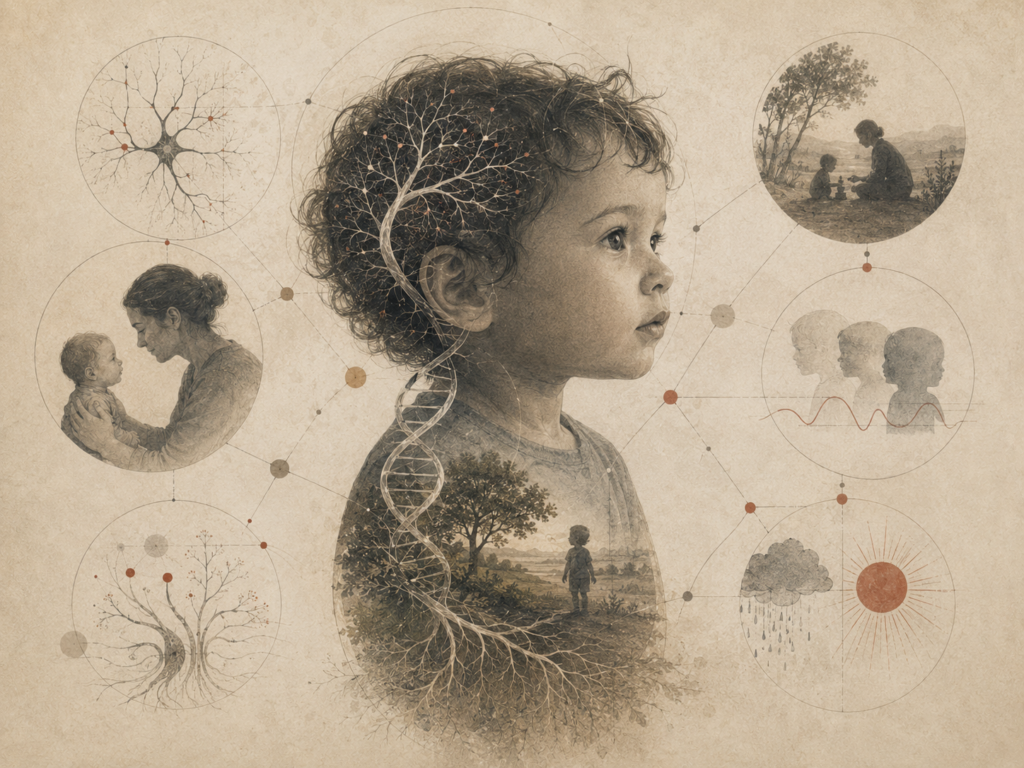
Restrained institutional illustration of a young child surrounded by DNA, neural branching, caregiver interaction, environmental symbols, and developmental diagrams representing temperament and early personality foundations.

Temperament, Biology, and the Early Foundations of Personality

Temperament names some of the earliest visible differences among human beings: differences in reactivity, regulation, attention, fearfulness, activity, and the capacity to be soothed or overwhelmed. This article examines temperament as one of the biological and developmental foundations of personality, clarifying how early emotional and attentional biases relate to later trait development without collapsing infancy into destiny. It explores major traditions in temperament research, including behavioral inhibition, effortful control, and goodness of fit, while showing how caregiving, stress, culture, and institutional context shape what early dispositions become over time. The result is a more serious developmental account of personality’s beginnings: biologically grounded, socially mediated, and always unfolding through transaction rather than simple inheritance.

Restrained institutional illustration of a human profile overlaid with hierarchical diagrams, concentric trait layers, branching nodes, and tree imagery representing personality trait structure and facets.

Trait Hierarchies, Facets, and the Architecture of Personality

Personality traits do not exist at only one scale. Broad domains such as extraversion, conscientiousness, and neuroticism are powerful for large-scale description, but they are internally differentiated systems composed of narrower facets and related subcomponents. This article explains why trait hierarchies matter in personality psychology, how domains, aspects, and facets fit together, and what is gained or lost at different levels of granularity. It also examines how hierarchical models improve prediction, clarify interpretation, and reveal developmental change that broad domain scores can obscure. The result is a more realistic account of personality architecture: layered, nested, and structurally richer than any flat list of broad traits can capture.

Restrained institutional illustration of a human profile surrounded by trait wheels, hierarchy diagrams, network structures, and dimensional models representing alternatives to the Big Five personality framework.

Beyond the Big Five: HEXACO, Hierarchies, and Alternative Structural Models

The Big Five provided personality psychology with a durable broad architecture, but it did not end debate about how personality is best structured. This article examines the major alternatives and expansions that emerged in response, especially the HEXACO model, hierarchical trait frameworks, facet-rich architectures, and other structural approaches that challenge or refine five-domain thinking. It shows how HEXACO reorganizes familiar personality content through Honesty-Humility, Emotionality, and a revised Agreeableness, why hierarchical models treat personality as nested rather than flat, and why structural debates matter for prediction, explanation, moral behavior, and cross-cultural comparison. The goal is not to discard the Big Five, but to understand what newer models reveal about the architecture personality science may have previously compressed or overlooked.

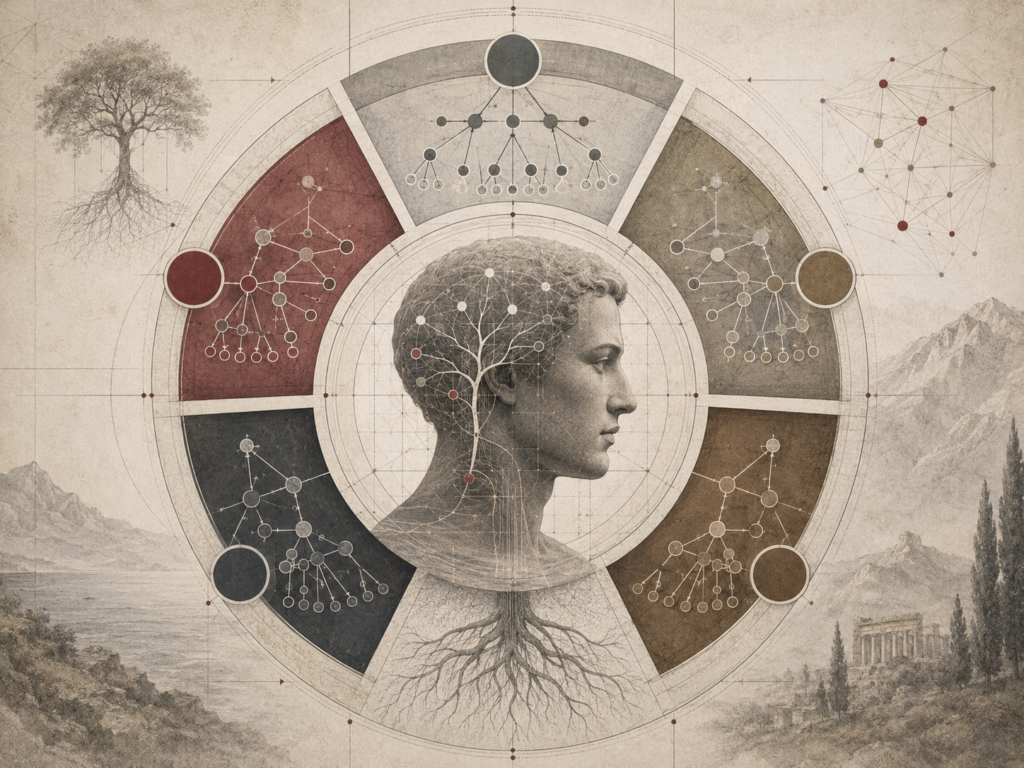
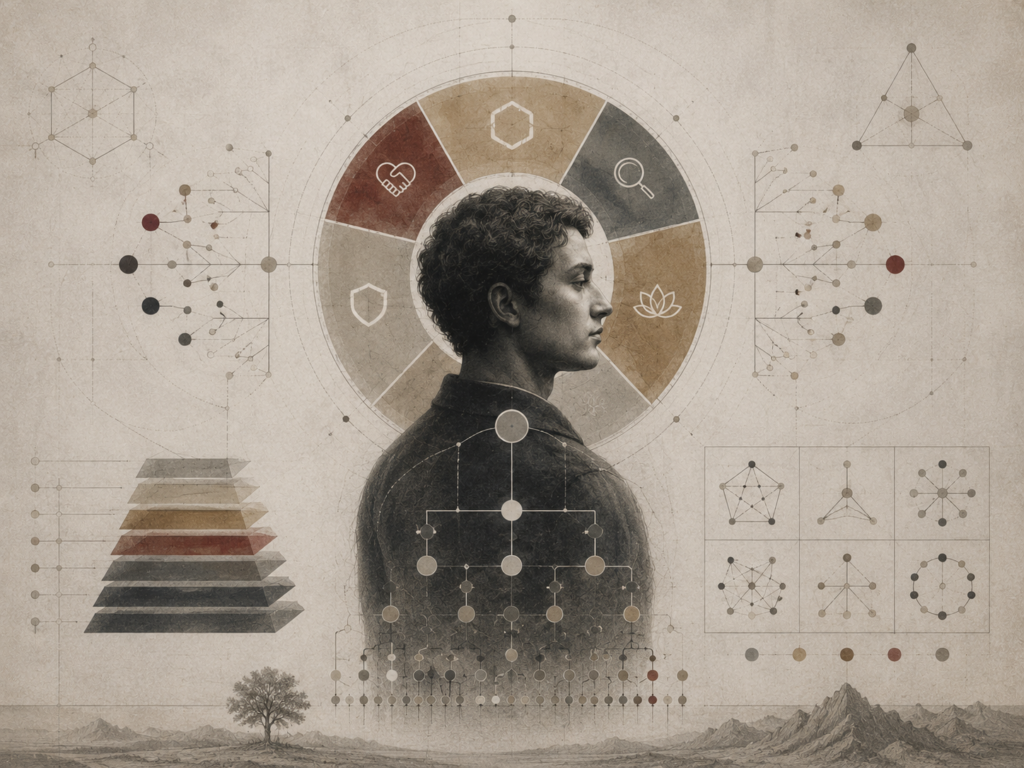
Restrained institutional illustration of a human profile surrounded by five segmented trait domains, hierarchy diagrams, branching nodes, and measurement structures representing the Five-Factor Model of personality.

The Five-Factor Model and the Architecture of Personality

The Five-Factor Model became central to personality psychology because it offered a durable architecture for describing broad individual differences without reducing persons to rigid types or isolated traits. Rather than claiming to explain the whole person, the model organizes a large share of personality variation around five major domains—extraversion, agreeableness, conscientiousness, neuroticism, and openness to experience—each with its own internal facets, developmental trajectories, and social consequences. This article examines the Five-Factor Model as a structural map of personality, clarifying its hierarchical logic, its relation to the Big Five, its descriptive strengths, and its conceptual limits. It also situates the model within broader debates about explanation, culture, development, life outcomes, and the difficulty of capturing human individuality through trait architecture alone.

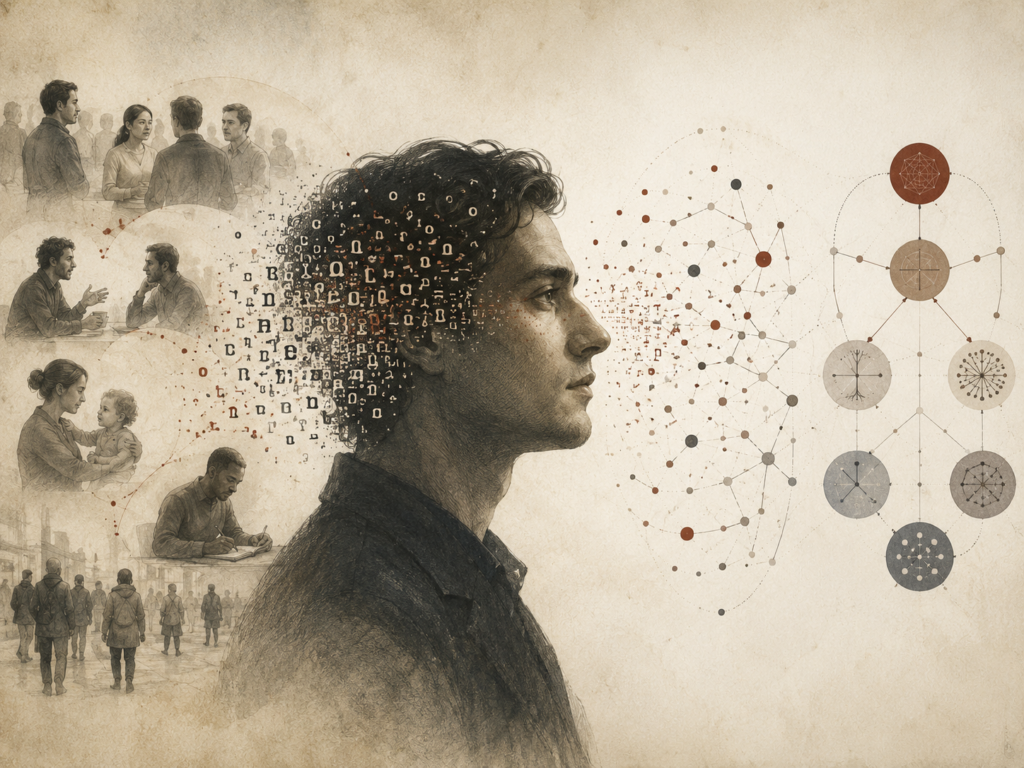
Restrained institutional illustration of a human profile with letter-like fragments emerging into network diagrams, social observation scenes, and hierarchical trait structures representing the lexical hypothesis.

The Lexical Hypothesis and the Emergence of Trait Structure

The lexical hypothesis offers one of personality psychology’s most important bridges between language, social life, and empirical trait structure. It begins from a simple but powerful idea: personality differences that matter in human communities tend to become encoded in ordinary language. Over time, words for reliability, sociability, anxiety, curiosity, dominance, kindness, and emotional volatility become cultural tools for describing patterns of behavior. Researchers then use these trait terms, ratings, and statistical methods to identify broader dimensions of personality. This article examines how social observation becomes language, how language becomes data, and how models such as the Five-Factor Model emerged from attempts to organize personality-relevant words into coherent psychological structures.

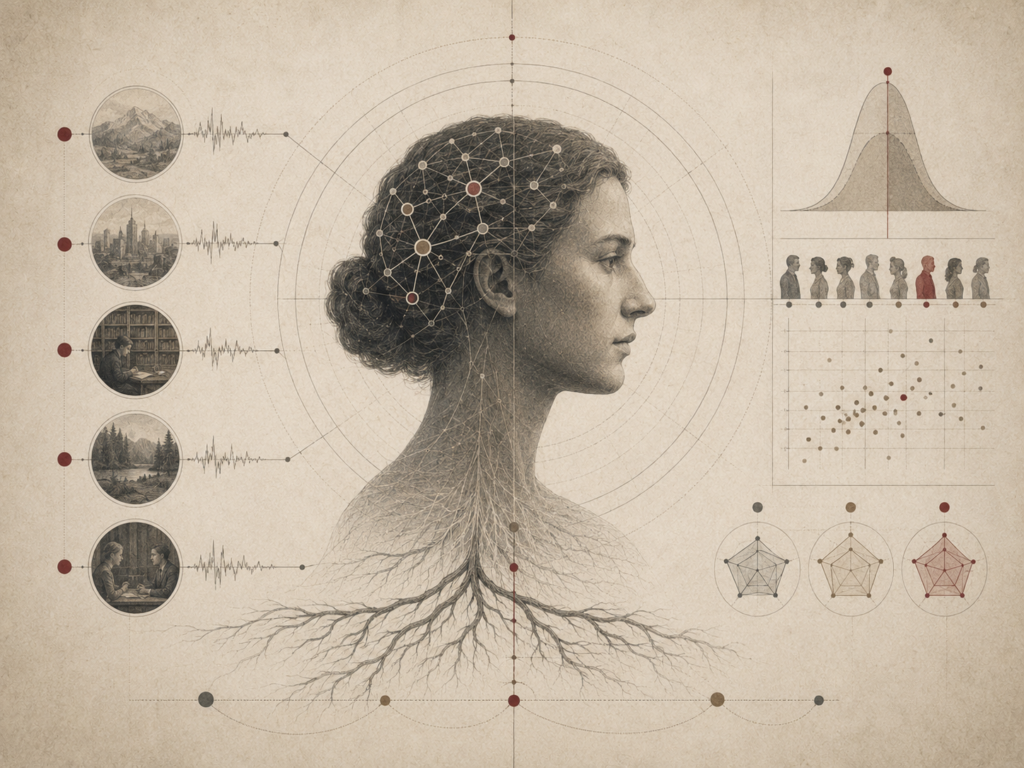
Restrained institutional illustration of a human profile with branching roots, neural networks, situational vignettes, distribution curves, and measurement diagrams representing traits, stability, disposition, and individual differences.

What Is a Trait? Stability, Disposition, and the Logic of Individual Difference

A trait is one of personality psychology’s core concepts: a relatively stable disposition that helps explain why people differ in patterned ways across time, situations, and social contexts. Traits are not single behaviors, fixed labels, or moral verdicts. They are inferred from recurring tendencies in thought, emotion, motivation, and action. This article examines how traits help researchers describe individual differences, why stability does not mean rigidity, and how dispositions interact with context, development, culture, and measurement. By distinguishing traits from momentary states, habits, roles, and stereotypes, it clarifies the logic behind trait theory and shows why personality must be understood as both structured and dynamic.

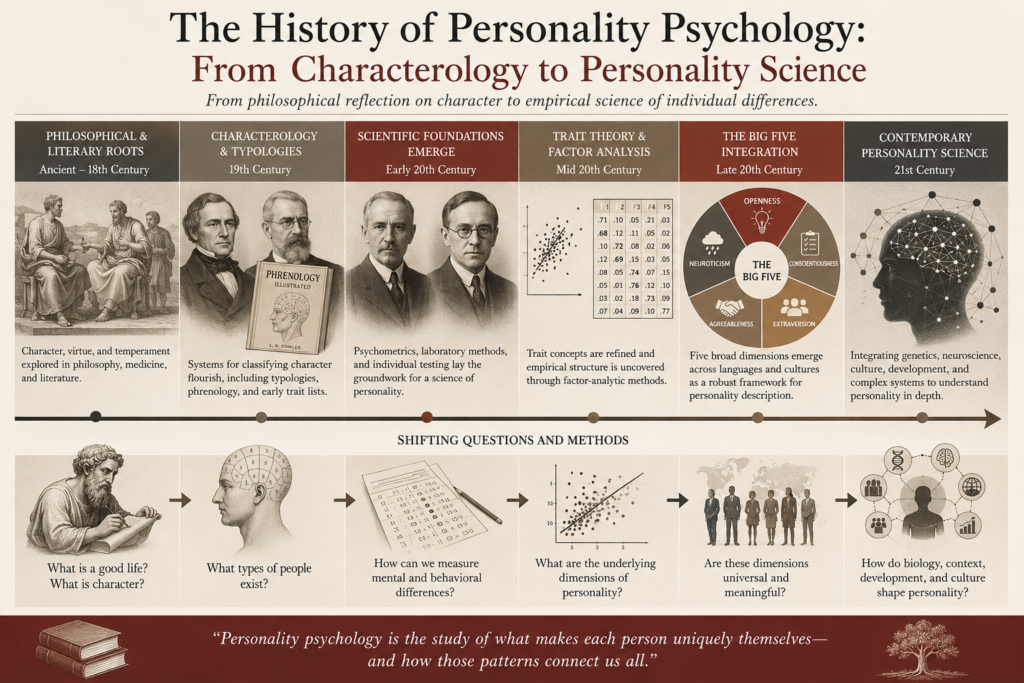
Vintage institutional infographic timeline showing the development of personality psychology from philosophical characterology and typologies to trait theory, factor analysis, the Big Five, and contemporary personality science.

The History of Personality Psychology: From Characterology to Personality Science

Personality psychology has a long intellectual history, beginning with philosophical, medical, and literary attempts to understand character, temperament, virtue, and human difference. Over time, these early reflections gave way to typologies, characterology, psychometrics, trait theory, factor analysis, and contemporary personality science. This article traces that development from ancient questions about moral character and individual nature to modern research on traits, biology, culture, development, and measurement. It examines how personality psychology moved from speculative systems of classification toward empirical models of individual difference, including the emergence of the Five-Factor Model and later integrative approaches. The history of the field shows a continuing effort to understand what makes people distinctive while recognizing that personality is shaped by both enduring dispositions and changing social, biological, and cultural contexts.

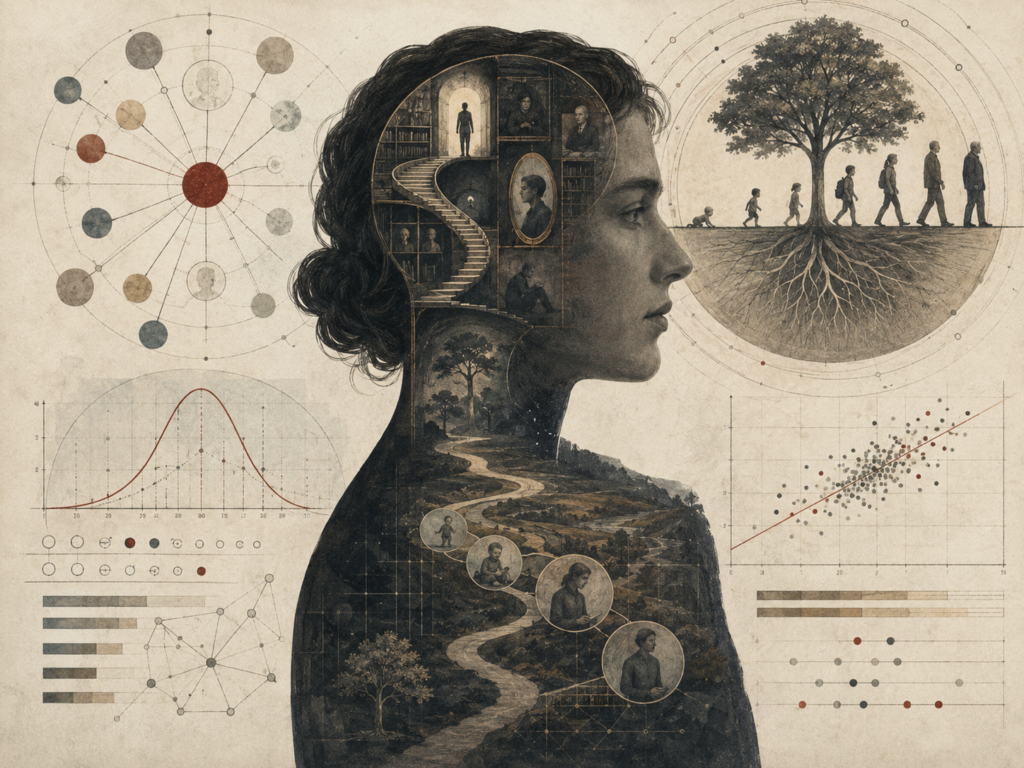
Restrained institutional illustration of a human profile containing symbolic inner architecture, life-course pathways, trait diagrams, developmental scenes, and psychometric measurement charts.

What Is Personality Psychology? Traits, Identity, Development, and Measurement

Personality psychology studies the patterned ways people think, feel, act, relate, develop, and understand themselves across time and social context. It asks why people differ from one another, how stable those differences are, how personality changes across the lifespan, and how traits, identity, motives, values, biology, culture, and environment interact. This article introduces personality psychology as a field concerned not only with traits, but also with selfhood, development, measurement, clinical structure, and moral evaluation. It explains how personality researchers use interviews, self-report, observer ratings, longitudinal studies, behavioral data, and psychometric models to study individual differences while avoiding simplistic labels. Personality is neither fixed destiny nor pure social construction; it is a dynamic structure shaped by disposition, experience, agency, relationship, and context.

Editorial scientific illustration of personality psychology as a structured model of personhood, showing trait architecture, temperament, identity, self-concept, psychometrics, motivation, development, pathology, and personality change.

Personality Psychology: Traits, Character, Identity, and the Structure of the Person

Personality psychology examines the enduring patterns through which human beings think, feel, desire, interpret, and act. This strongest-sense expansion upgrades the pillar from a solid trait-centered overview into a fuller map of the field by integrating motivation, selfhood, narrative identity, personality dynamics, biology and behavior genetics, maladaptive personality, morality and dark traits, health, institutions, culture, and advanced psychometrics. It also adds a mathematical lens, a semi-formal conceptual model, and substantial R and Python sections for readers interested in modeling personality organization, adaptation, pathology, and long-run life outcomes. The result is a broader and more research-driven account of personality as patterned personhood rather than trait description alone.

Scroll to Top