
Last Updated May 22, 2026
Behavior genetics transformed personality psychology by showing that enduring individual differences are not only socially observed and psychometrically measured, but also biologically patterned. The field’s central claim is not that genes determine personality in a simple, isolated, or destiny-like way. It is that genetic variation contributes meaningfully to differences in temperament and personality traits, and that those differences unfold through complex developmental interaction with environments rather than through one-way biological command.
This matters because personality psychology has long struggled against two opposite distortions: the fantasy that character is purely self-authored, and the fantasy that biology is destiny. Behavior genetics rejects both. It offers a disciplined framework in which personality is understood as heritable, probabilistic, developmentally mediated, environmentally embedded, and inseparable from gene–environment interplay.
This article argues that behavior genetics is most useful when interpreted as developmental science rather than genetic fatalism. Heritability estimates clarify sources of variation in populations; they do not reduce persons to genes. Twin, adoption, family, and molecular-genetic studies show that personality has a biological basis, but they also show that this basis is polygenic, context-sensitive, historically situated, and always expressed through environments, relationships, institutions, and life-course conditions.
Main Library
Publications
Article Map
Personality Psychology
Related Topic
Developmental Psychology
Related Topic
Biology
Related Topic
Cognitive Psychology
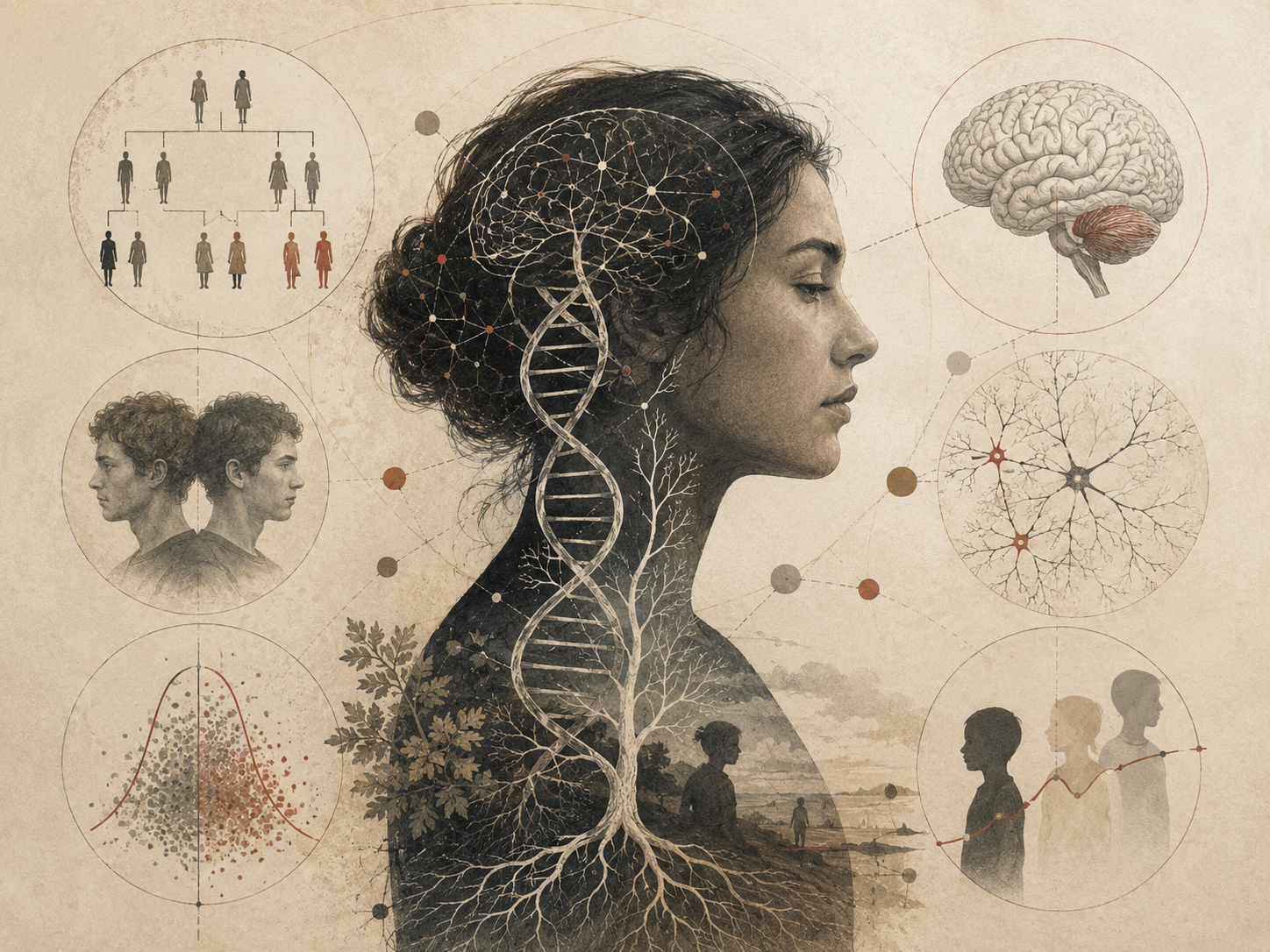
The strongest behavior-genetic view is neither biological reduction nor environmental denial. It is an interactionist account of developmental individuality. Genes influence dispositions, but dispositions are expressed through bodies, brains, families, peers, cultures, institutions, stressors, opportunities, and self-directed life choices. Personality is biologically grounded, but it is not biologically sealed.
What behavior genetics studies
Behavior genetics studies how genetic differences among individuals contribute to differences in behavior, temperament, personality, cognition, mental health, and development. In personality psychology, its task is not to identify a single “gene for” extraversion, neuroticism, conscientiousness, openness, or agreeableness. Rather, it asks how much variation in personality traits is associated with genetic variation, how much is associated with environmental variation, and how those sources of influence become entangled across development.
This makes behavior genetics less a doctrine of biological causation than a set of methods for studying patterned variation. It asks why individuals differ, how relatives resemble one another, how similarity changes across levels of genetic relatedness, how environments contribute to difference, and how inherited propensities become expressed through social experience. The unit of analysis is usually variance in a population, not the total explanation of any one person’s life.
The field became especially important because personality traits show enough stability, coherence, and predictive power to invite questions about their biological basis. If personality traits are real and consequential, then psychology needs some account of why they differ across persons so reliably. Behavior genetics provides one of the strongest empirical answers available: stable individual differences in personality are partly heritable, but their development depends on more than inheritance alone.
Behavior genetics also changed the way psychologists think about environments. Environments are not simply external forces imposed on passive individuals. People partly select, evoke, interpret, and modify their environments in ways related to their dispositions. A sociable child may elicit more interaction; a fearful child may receive more protection; a curious adolescent may seek different peer networks, books, tools, or risks. The environment is not independent of the developing person.
The field’s value is therefore conceptual as well as statistical. It pushes personality psychology beyond the crude opposition of nature and nurture. Personality emerges from developmental systems in which genes, environments, bodies, relationships, institutions, and choices are mutually involved. The more serious the behavior-genetic account, the less compatible it is with simplistic genetic determinism.
Heritability and what it does not mean
Heritability is one of the most misunderstood concepts in psychology. In behavior genetics, heritability refers to the proportion of variation in a trait within a population that is statistically associated with genetic differences among individuals in that population. It does not mean the proportion of a person’s trait caused by genes. It does not imply immutability. It does not mean a trait is biologically simple. It does not license the claim that environmental influences are unimportant.
This distinction matters because personality traits are often discussed in ordinary language as though “genetic” meant fixed and “environmental” meant flexible. Behavior genetics rejects that simplification. Heritability is a population statistic under particular conditions. It says something about how variation is distributed within a studied population at a given time. It does not tell us whether intervention, education, caregiving, institutions, therapy, stress reduction, social policy, or cultural change can alter developmental outcomes.
A trait can be heritable and still environmentally responsive. Height is strongly heritable in many populations, yet nutrition, illness, deprivation, and public health conditions affect height. Personality traits work differently from height, but the same conceptual point matters: heritability does not mean inevitability. It means genetic differences help explain variation under the conditions being studied.
Heritability estimates can also change across contexts. If environments are highly similar, genetic variation may explain a larger share of observed differences. If environments vary widely, environmental differences may explain more. If social conditions constrain opportunities, suppress expression, or amplify stress, genetic propensities may develop differently. Heritability is therefore not a universal constant engraved in nature. It is an estimate tied to population, measurement, age, historical period, and environmental range.
Heritability also says little by itself about mechanism. A heritability estimate does not reveal which genes matter, how they operate, what biological pathways are involved, or how development transforms inherited propensities. It partitions variance; it does not provide a complete causal story. That is why heritability should be interpreted as a starting point for developmental explanation, not as the conclusion of personality science.
The most responsible interpretation is therefore proportional: personality traits show meaningful genetic influence, but genetic influence is probabilistic, distributed, and developmentally mediated. Heritability is evidence of biological patterning, not a declaration of fate.
Twin, adoption, and family designs
The classic tools of behavior genetics are twin, adoption, and family designs. Twin studies compare the similarity of monozygotic twins, who share nearly all of their segregating genetic variation, with dizygotic twins, who share on average roughly half. Adoption studies compare similarity between adopted children and biological versus adoptive relatives. Family studies examine resemblance across generations and kinship structures more broadly. These designs do not read genes directly, but they allow researchers to infer the relative contribution of genetic and environmental sources of variance.
Twin studies are influential because they provide a natural contrast in genetic relatedness. If monozygotic twins are more similar than dizygotic twins on a personality trait, genetic influence is implicated. If both kinds of twins are similarly alike, shared environmental influence may be implicated. If monozygotic twins are far from perfectly similar, nonshared environment and measurement error remain important. This logic is simple in outline, but serious interpretation requires attention to assumptions, sampling, measurement, and model specification.
Adoption designs add another line of evidence because they separate genetic relatedness from rearing environment. If adopted children resemble biological relatives more than adoptive relatives on a trait, that supports genetic influence. If they resemble adoptive relatives, that supports environmental influence from the rearing context. Adoption studies are powerful but not perfect; adoption placement, selective placement, prenatal effects, and restricted family environments can complicate interpretation.
Family designs broaden the analysis by examining resemblance across parents, siblings, cousins, and generations. They can help researchers examine assortative mating, transmission patterns, and broader kinship similarity. They also make clear that resemblance is not always simple. Family members share genes, but they also share environments, histories, social class, neighborhoods, institutions, cultural practices, and sometimes trauma or privilege.
The strength of behavior genetics lies in convergent logic. No single design is perfect, but repeated overlap across twin, adoption, family, and molecular-genetic evidence has made the field cumulative. The strongest conclusions are not based on one clever design alone. They emerge when different designs point toward the same broad pattern: personality traits are moderately heritable, shared family environment is often smaller than lay intuition expects, and nonshared environmental influences remain substantial.
These designs also remind us that behavior genetics is not only about genes. It is a method for distinguishing and relating sources of variation. The question is not “nature or nurture,” but how inherited and environmental influences jointly organize development.
How heritable is personality?
Across twin and family studies, personality traits are often found to be moderately heritable. Broad estimates frequently cluster around 40–60 percent of variance, though estimates vary by trait, age, measure, sample, model, and study design. The important conclusion is not the exact number for every trait in every population. It is that personality cannot be seriously studied without recognizing meaningful genetic contribution to individual differences.
This finding applies across many major trait frameworks. Extraversion, neuroticism, conscientiousness, agreeableness, openness, and related temperament dimensions generally show genetic influence. Some traits may show stronger or weaker estimates depending on measurement and developmental stage. Facets may differ from broad domains. Maladaptive traits may follow somewhat different patterns from normal-range traits. The field should therefore avoid treating any single heritability value as a universal constant.
The phrase “moderately heritable” should be interpreted carefully. It does not mean genes explain half of a person’s personality. It means that, in many studied populations, genetic differences account for a substantial proportion of observed variation among individuals. A person’s actual development is not partitioned internally into genetic and environmental slices. The person develops as an integrated organism in context.
The heritability of personality also does not make personality fixed. Trait rank-order stability increases across development, but personality continues to change across life. People mature, adapt, suffer, recover, learn, migrate, enter new roles, form relationships, experience trauma, undergo therapy, take on responsibilities, and inhabit institutions that shape expression. Genetic influence coexists with plasticity.
Heritability also should not be used to rank the importance of genes against environments in a moral or political sense. Environmental influences that produce little variance in a particular study may still be essential for development. A highly uniform environment can be developmentally necessary even if it explains little variation. Similarly, severe deprivation may radically alter outcomes even if not represented in the studied sample.
The best interpretation is that personality traits have a robust biological component, but the biological component is embedded in development. Heritability tells us personality is partly rooted in inherited differences. It does not tell us that persons are genetically predetermined.
Shared and nonshared environment
One of the most striking findings in behavior genetics is that shared family environment often explains less personality variance than many people assume. Siblings raised in the same household can differ sharply in personality even when they share parents, neighborhood, schools, religion, class position, and many institutional conditions. This does not mean family life is irrelevant. It means that shared household conditions do not translate straightforwardly into shared personality outcomes.
Shared environment refers to influences that make family members more similar to one another. These may include household socioeconomic conditions, broad parenting style, neighborhood, family culture, or shared institutional context. Nonshared environment refers to influences that make family members different from one another. These may include differential treatment, unique friendships, illness, accidents, teachers, peer groups, birth order dynamics, timing effects, private interpretations, and idiosyncratic experiences.
Nonshared environment is often misunderstood as a residual category. It does include measurement error, but it is not merely statistical leftover. It points to the reality that development is individualized even inside the same family. Two siblings can experience the same parent differently, occupy different family roles, enter different peer cultures, respond differently to stress, or encounter life events at different developmental moments. The same household can contain multiple developmental worlds.
This insight has major consequences for personality theory. It weakens simplistic family-determinist explanations while preserving the importance of relational experience. It suggests that development depends not only on what environments objectively provide, but on how individuals encounter, interpret, evoke, and respond to those environments. A parenting practice may affect one child differently from another because the children differ in temperament, timing, vulnerability, expectations, or relationship history.
Shared and nonshared environment also need to be interpreted in relation to social structure. A family can be embedded in poverty, security, discrimination, institutional support, neighborhood violence, religious community, elite opportunity, or migration. Some environmental influences are shared broadly, some are distributed unequally within the household, and some are personally specific. Behavior genetics can partition variance, but interpretation still requires social and developmental theory.
The nonshared-environment finding does not make environments less important. It makes them more complex. It tells us that personality development is not a simple imprint of family background. It is a person-specific developmental pathway through shared and unshared worlds.
Gene–environment correlation and interaction
Behavior genetics has moved well beyond the crude question of “genes or environment?” by showing that genes and environments are often correlated and interactive. Gene–environment correlation refers to the fact that individuals partly shape, select, and evoke their own environments in ways related to heritable dispositions. Gene–environment interaction refers to the fact that genetic propensities may have different effects under different environmental conditions, and environmental exposures may have different effects depending on inherited disposition.
Gene–environment correlation is often divided into passive, evocative, and active forms. Passive gene–environment correlation occurs when parents provide both genes and environments. A musically inclined, intellectually curious, emotionally reactive, or highly organized parent may transmit genetic propensities while also creating a home environment that reflects those same tendencies. Evocative gene–environment correlation occurs when a child’s disposition elicits responses from others. A bold child may receive more autonomy; an anxious child may receive more protection; a difficult child may elicit harsher discipline. Active gene–environment correlation occurs when individuals seek environments compatible with their dispositions.
This changes the meaning of environment. Environments are not simply independent inputs. They are partly organized around the developing person. A sociable adolescent may select socially dense peer groups. A curious adolescent may seek books, tools, communities, or experiments. A conscientious adolescent may choose structured activities. A sensation-seeking adolescent may seek risk. These choices then feed back into development, amplifying or modifying the original disposition.
Gene–environment interaction adds another layer. The same genetic propensity may unfold differently in supportive, punitive, deprived, chaotic, safe, or opportunity-rich environments. A biologically influenced sensitivity to threat may lead to vigilance under danger but empathy or carefulness under supportive conditions. A disposition toward high activity may be channeled into sport, leadership, disruption, or risk depending on context. Biological influence has developmental meaning only within conditions.
These concepts are especially important for personality because personality is not only inherited tendency, but enacted life pattern. People inhabit environments partly related to who they are, and those environments then shape who they become. The gene–environment relationship is circular, developmental, and socially structured.
The result is a much richer account than nature versus nurture. Genes influence environments; environments moderate genetic expression; persons select and evoke conditions; institutions distribute opportunities and constraints. Personality emerges from that loop.
Molecular genetics and polygenicity
Early personality genetics often pursued candidate-gene explanations, hoping to find a small number of specific genes with large effects on traits such as novelty seeking, neuroticism, impulsivity, or reward sensitivity. That program largely failed to replicate reliably. More recent genomic work has pushed the field toward a different conclusion: personality is genetically influenced, but through many variants of very small effect rather than a few simple causal switches.
This is the many-small-effects problem. Twin and family studies strongly support heritability, but molecular studies show that the underlying architecture is highly polygenic and statistically diffuse. A personality trait is not usually shaped by one gene, one neurotransmitter, one receptor, or one pathway. It reflects many biological systems interacting across development.
Genome-wide association studies have improved the field by moving away from speculative candidate-gene narratives. Instead of testing one or a few favored variants, genome-wide approaches scan large numbers of variants across large samples. The results tend to show that personality traits are influenced by many loci with small effects, and that very large samples are needed to detect reliable associations. This makes the biology more credible but less narratively simple.
Polygenic scores are one attempt to summarize many small genetic associations into an aggregate predictor. They can be useful in research, but their predictive power for complex personality traits remains limited, context-dependent, ancestry-sensitive, and not appropriate for individual assessment. A polygenic score is not a destiny score. It is a probabilistic research tool whose meaning depends on sample, population structure, measurement, and validation.
Molecular genetics therefore strengthens the anti-reductionist lesson. The biological basis of personality is real, but it is distributed, complex, and indirect. There is no credible route from one gene to a full personality trait. Biology contributes through networks of small effects, developmental pathways, neural systems, endocrine processes, environmental exposures, and life-course feedback loops.
The best modern view is therefore genetically informed but skeptical of gene-centered storytelling. Personality biology exists, but it does not fit the simplistic “gene for” model that popular culture often wants.
Temperament, development, and biological foundations
Behavior genetics intersects strongly with developmental temperament research. Temperament refers to early-emerging individual differences in emotional reactivity, activity level, attentional control, sociability, inhibition, irritability, regulatory capacity, and related patterns. These early differences are not identical to adult personality traits, but they provide one of the earliest windows into the biological foundations of personality.
Twin and sibling studies indicate that many dimensions of infant and child temperament are genetically influenced. Early differences in activity, emotionality, inhibition, fearfulness, effortful control, and regulatory style often show heritable components. This does not mean infant temperament mechanically becomes adult personality. It means that biological differences appear early and help organize later developmental pathways.
The developmental path from temperament to personality is complex. A highly inhibited child may become socially anxious, quietly observant, academically focused, artistically private, morally careful, or socially confident after supportive experiences. A highly active child may become athletic, disruptive, entrepreneurial, exploratory, or dysregulated depending on relationships and institutions. Temperament creates bias and sensitivity, not a finished self.
Parenting, schooling, peer response, culture, neighborhood safety, economic conditions, trauma, disability, language, and institutional expectations all shape how temperamental tendencies are interpreted and channeled. A child’s reactivity may be punished in one environment and understood in another. Persistence may be cultivated or exploited. Curiosity may be rewarded or suppressed. Sensitivity may become vulnerability or moral attunement depending on context.
Temperament also interacts with self-regulation. Early emotional or attentional tendencies become more personality-like as children develop executive function, language, identity, goals, social understanding, and strategies for regulating themselves. Biology is therefore transformed by development. The adult personality is not simply temperament plus time.
Temperament research supports a developmental view of behavior genetics. Personality has biological roots, but roots are not blueprints. They grow through soil, weather, cultivation, injury, constraint, and opportunity.
Personality neuroscience and biological systems
Behavior genetics points toward biological influence, but genes do not act directly as personality traits. They influence molecular, neural, hormonal, physiological, and developmental systems that shape tendencies in emotion, motivation, attention, reward sensitivity, threat processing, self-regulation, social orientation, and cognitive control. Personality neuroscience therefore provides an important bridge between heritability estimates and lived psychological patterns.
For example, extraversion has often been discussed in relation to reward sensitivity, approach motivation, positive affect, and social engagement. Neuroticism is often linked to threat sensitivity, negative emotionality, stress reactivity, and affective instability. Conscientiousness involves self-regulation, effortful control, planning, persistence, and executive function. Openness involves curiosity, exploration, imagination, cognitive flexibility, and aesthetic or intellectual engagement. Agreeableness involves affiliative tendencies, empathy, conflict regulation, and social valuation.
These links are not one-to-one biological mappings. A broad personality trait is not located in a single brain region. Neural systems are distributed, interactive, plastic, and context-sensitive. A person’s trait profile reflects many biological processes operating together with learning, identity, relationships, and culture. A biologically grounded trait is still psychologically and socially mediated.
This is why behavior genetics and neuroscience need each other, but neither replaces the other. Twin studies can estimate variance components without identifying biological mechanism. Neuroscience can examine systems involved in threat, reward, control, or social cognition without explaining population-level heritability. Together, they support a layered account of personality biology.
The biological basis of personality should therefore be understood as system-level influence rather than gene-to-trait determinism. Genetic differences contribute to biological systems; biological systems shape tendencies; tendencies are expressed through environments; environments feed back into development. Each level matters.
A serious biological personality science does not collapse personhood into the genome or brain. It uses biology to explain part of how stable individuality becomes possible.
Culture, inequality, and developmental context
Behavior-genetic findings should always be interpreted in developmental and social context. Heritability estimates are produced in populations with particular histories, institutions, inequalities, measurement tools, and environmental ranges. They do not float above society. A trait’s apparent heritability can depend on whether environments are homogeneous or unequal, whether opportunities are broadly available or restricted, and whether institutions amplify or suppress individual differences.
This is especially important because biological language has often been misused to naturalize inequality. If a trait is heritable, some may assume that social conditions no longer matter. That is a serious error. Heritability does not explain whether a society is fair, whether institutions are humane, whether opportunities are distributed justly, or whether stressors are preventable. Genetic influence on individual differences does not justify unequal conditions.
Culture also shapes the meaning of personality traits. Assertiveness, emotional restraint, sociability, autonomy, obedience, curiosity, discipline, and sensitivity do not carry identical meanings across cultural and institutional contexts. A heritable tendency toward behavioral inhibition may be interpreted as respectfulness in one context, shyness in another, pathology in another, and prudence in another. Biology is expressed through meaning systems.
Inequality can also shape gene–environment processes. People do not select environments from equal menus of possibility. A child’s temperament may lead to different developmental pathways depending on poverty, safety, discrimination, school quality, family stress, disability accommodation, social support, and institutional trust. Genetic propensity is not experienced outside social structure.
This does not weaken behavior genetics. It makes interpretation more responsible. The biological basis of personality is real, but it is always expressed under conditions. A genetically informed personality science should therefore be more—not less—attentive to environments, institutions, and unequal developmental worlds.
The strongest view is that biology contributes to difference while society structures possibility. Personality emerges where those forces meet.
Limits of biological reduction
Behavior genetics is indispensable, but it is not a complete philosophy of the person. Heritability estimates do not explain motive, meaning, identity, moral judgment, life narrative, creativity, responsibility, spirituality, relational history, or institutional formation. They do not tell us why certain environments are unequal, why some traits are rewarded and others punished, or how a person interprets their own history. A genetically informed personality science is stronger than a biologically reductionist one.
The limits of reduction are especially important because biological findings are often socially misused. Heritability can be turned into fatalism. Genetic influence can be confused with legitimacy or inevitability. Polygenic scores can be overinterpreted as individual destiny. Biological explanation can be used to deflect attention from institutions, trauma, poverty, exclusion, or preventable stress. The field’s best work moves in the opposite direction: it clarifies probabilistic influence while insisting on developmental contingency.
Another limit is that variance partitioning does not answer all causal questions. An ACE model can estimate additive genetic, shared environmental, and nonshared environmental components, but it does not fully explain developmental process. It does not tell us which experiences matter, how they matter, whether they are modifiable, or how the person transforms them. Variance decomposition is powerful, but it is not the same as life explanation.
Biological reduction also risks ignoring agency. People are shaped by inherited tendencies and environments, but they also reflect, choose, practice, resist, reinterpret, and change. Agency itself is not outside biology or environment; it develops through them. But personality psychology loses something essential if it treats persons only as outputs of causal components.
The best behavior-genetic account is therefore disciplined but humble. It recognizes that personality has biological roots, that inherited differences matter, and that traits are partly heritable. But it also recognizes that persons are developmental beings embedded in meaning, culture, institutions, relationships, and history.
Behavior genetics becomes most valuable when it helps explain complexity rather than flatten it.
Professional use and applied boundaries
Behavior-genetic concepts can be professionally useful in research, teaching, counseling education, science communication, developmental psychology, public-health thinking, and responsible discussion of individual differences. They help professionals understand heritability, variance decomposition, family resemblance, nonshared environment, gene–environment interplay, polygenicity, and the limits of nature-versus-nurture thinking.
A behavior-genetic scaffold can support professional education by showing how twin-style data are structured, how rough ACE estimates work, how gene–environment interaction can be modeled, and why biological influence does not imply determinism. These uses are appropriate when the goal is conceptual clarification, research prototyping, methodological demonstration, or low-stakes professional learning.
But professional use does not mean unrestricted assessment use. A synthetic twin-style dataset is not evidence about real people. A heritability estimate is not an individual diagnosis. A polygenic score is not a personality verdict. A gene–environment model is not a hiring tool. Behavior-genetic information should not be used casually to rank, sort, select, exclude, pathologize, or predict individuals.
Any consequential use involving real people would require validated instruments, qualified review, privacy protections, genetic-data governance, informed consent, anti-discrimination safeguards, documented intended use, fairness analysis, careful communication of uncertainty, and appropriate ethical and legal oversight. The sensitivity of genetic information raises the standard for responsible use.
Professional use is appropriate for education, research prototyping, reproducible workflow development, consulting support, organizational learning, science communication, and methodological demonstration. It is not appropriate as a standalone system for hiring, promotion, termination, clinical diagnosis, educational placement, legal evaluation, insurance decisions, relationship matching, surveillance, genetic screening, or individual prediction.
The intended use is analytic, educational, methodological, and reflective. The purpose is to reason more carefully about biology and personality—not to convert genetic influence into a new form of classification or gatekeeping.
Mathematical lens: variance decomposition and developmental interplay
Behavior genetics becomes clearer when written formally. In the classical twin framework, variance in a trait can be decomposed as:
V_P = V_A + V_C + V_E
\]
Interpretation: \(V_P\) is total phenotypic variance, \(V_A\) is additive genetic variance, \(V_C\) is shared environmental variance, and \(V_E\) is nonshared environmental variance plus measurement error. The model partitions variance statistically; it does not claim that a person is made of separable genetic and environmental pieces.
Heritability in the narrow sense can be represented as:
h^2 = \frac{V_A}{V_P}
\]
Interpretation: \(h^2\) is the proportion of population variance associated with additive genetic differences. It is not the proportion of an individual person caused by genes.
A rough twin-style heritability estimate can be expressed as:
h^2 \approx 2(r_{MZ} – r_{DZ})
\]
Interpretation: \(r_{MZ}\) is the monozygotic-twin correlation and \(r_{DZ}\) is the dizygotic-twin correlation. If monozygotic twins are substantially more similar than dizygotic twins, genetic influence is implicated.
Shared environmental influence is often approximated as:
c^2 \approx 2r_{DZ} – r_{MZ}
\]
Interpretation: \(c^2\) estimates variance associated with environmental influences that make twins similar to one another, under simplified model assumptions.
Nonshared environmental influence and measurement error are often approximated as:
e^2 \approx 1 – r_{MZ}
\]
Interpretation: \(e^2\) captures influences that make monozygotic twins different from one another, along with measurement error. It should not be dismissed as unimportant residual noise.
Gene–environment correlation can be represented by allowing genotype \(G\) and environment \(E\) to covary:
\mathrm{Cov}(G,E) \ne 0
\]
Interpretation: Genetic propensities and environmental exposures are not always independent. People may inherit, evoke, or select environments related to their dispositions.
Gene–environment interaction is present when the effect of genotype depends on the environment:
Y = \beta_0 + \beta_1G + \beta_2E + \beta_3(G \times E) + \varepsilon
\]
Interpretation: If \(\beta_3 \ne 0\), the developmental meaning of genetic propensity changes across environments. This is one reason heritability alone is never the whole story.
A developmental feedback loop can be represented more broadly as:
P_{t+1} = f(P_t, G, E_t, G \times E_t, rGE_t, X_t)
\]
Interpretation: Later personality \(P_{t+1}\) depends on earlier personality \(P_t\), genetic propensities \(G\), environments \(E_t\), gene–environment interaction, gene–environment correlation, and additional developmental conditions \(X_t\). Personality develops recursively rather than by one-way genetic command.
These equations clarify the discipline of behavior genetics. Genetic influence is real, but the models describe variance, probability, and developmental interplay—not fixed individual destiny.
R: estimating heritability with twin-style data
The R example below illustrates a twin-style analysis for a personality trait. It estimates twin correlations, derives rough ACE-style quantities, checks uncertainty with bootstrap resampling, and models an environmental moderator. The example is intentionally simplified for instructional use; serious behavior-genetic work typically uses structural equation models and richer assumptions.
# Behavior Genetics and the Biological Basis of Personality
# R workflow for twin-style ACE estimation and environmental moderation

# Install packages if needed:
# install.packages(c("readr", "dplyr", "purrr", "broom", "ggplot2"))

library(readr)
library(dplyr)
library(purrr)
library(broom)
library(ggplot2)

# -------------------------------------------------------------------
# Load twin-style data
# -------------------------------------------------------------------

# Expected columns:
# pair_id
# zygosity: "MZ" or "DZ"
# twin1_trait
# twin2_trait
# family_stress
# social_support
# socioeconomic_security

twin_data <- read_csv("personality_twin_data.csv")

glimpse(twin_data)
summary(twin_data)

# -------------------------------------------------------------------
# Twin correlations by zygosity
# -------------------------------------------------------------------

cor_by_group <- twin_data %>%
  group_by(zygosity) %>%
  summarise(
    n_pairs = n(),
    twin_correlation = cor(
      twin1_trait,
      twin2_trait,
      use = "pairwise.complete.obs"
    ),
    .groups = "drop"
  )

print(cor_by_group)

r_mz <- cor_by_group %>%
  filter(zygosity == "MZ") %>%
  pull(twin_correlation)

r_dz <- cor_by_group %>%
  filter(zygosity == "DZ") %>%
  pull(twin_correlation)

# -------------------------------------------------------------------
# Rough ACE-style estimates
# -------------------------------------------------------------------

h2 <- 2 * (r_mz - r_dz)
c2 <- 2 * r_dz - r_mz
e2 <- 1 - r_mz

ace_summary <- data.frame(
  component = c(
    "additive_genetic_h2",
    "shared_environment_c2",
    "nonshared_environment_e2"
  ),
  estimate = c(h2, c2, e2)
)

print(ace_summary)

# -------------------------------------------------------------------
# Bootstrap uncertainty for rough ACE estimates
# -------------------------------------------------------------------

bootstrap_ace <- function(data, n_boot = 1000) {
  map_dfr(seq_len(n_boot), function(i) {
    sampled <- data %>%
      group_by(zygosity) %>%
      slice_sample(prop = 1, replace = TRUE) %>%
      ungroup()

    boot_cor <- sampled %>%
      group_by(zygosity) %>%
      summarise(
        twin_correlation = cor(
          twin1_trait,
          twin2_trait,
          use = "pairwise.complete.obs"
        ),
        .groups = "drop"
      )

    boot_mz <- boot_cor %>%
      filter(zygosity == "MZ") %>%
      pull(twin_correlation)

    boot_dz <- boot_cor %>%
      filter(zygosity == "DZ") %>%
      pull(twin_correlation)

    data.frame(
      replicate = i,
      h2 = 2 * (boot_mz - boot_dz),
      c2 = 2 * boot_dz - boot_mz,
      e2 = 1 - boot_mz
    )
  })
}

set.seed(123)
boot_results <- bootstrap_ace(twin_data, n_boot = 500)

boot_summary <- boot_results %>%
  summarise(
    h2_mean = mean(h2, na.rm = TRUE),
    h2_lower = quantile(h2, 0.025, na.rm = TRUE),
    h2_upper = quantile(h2, 0.975, na.rm = TRUE),
    c2_mean = mean(c2, na.rm = TRUE),
    c2_lower = quantile(c2, 0.025, na.rm = TRUE),
    c2_upper = quantile(c2, 0.975, na.rm = TRUE),
    e2_mean = mean(e2, na.rm = TRUE),
    e2_lower = quantile(e2, 0.025, na.rm = TRUE),
    e2_upper = quantile(e2, 0.975, na.rm = TRUE)
  )

print(boot_summary)

# -------------------------------------------------------------------
# Pair-level dataset for environmental moderation
# -------------------------------------------------------------------

person_pair_data <- twin_data %>%
  mutate(
    trait_mean = (twin1_trait + twin2_trait) / 2,
    trait_difference = abs(twin1_trait - twin2_trait),
    zygosity_mz = if_else(zygosity == "MZ", 1, 0),
    stress_centered = family_stress - mean(family_stress, na.rm = TRUE),
    support_centered = social_support - mean(social_support, na.rm = TRUE),
    security_centered = socioeconomic_security -
      mean(socioeconomic_security, na.rm = TRUE)
  )

# Does family stress moderate zygosity-linked resemblance?
moderation_model <- lm(
  trait_difference ~ zygosity_mz * stress_centered +
    support_centered +
    security_centered,
  data = person_pair_data
)

summary(moderation_model)

moderation_summary <- tidy(moderation_model)

# -------------------------------------------------------------------
# Plot rough ACE bootstrap distribution
# -------------------------------------------------------------------

boot_long <- boot_results %>%
  tidyr::pivot_longer(
    cols = c(h2, c2, e2),
    names_to = "component",
    values_to = "estimate"
  )

ggplot(boot_long, aes(x = estimate)) +
  geom_histogram(bins = 30) +
  facet_wrap(~ component, scales = "free") +
  labs(
    title = "Bootstrap Distribution of Rough ACE Estimates",
    x = "Estimate",
    y = "Count"
  )

# -------------------------------------------------------------------
# Save outputs
# -------------------------------------------------------------------

write_csv(cor_by_group, "behavior_genetics_twin_correlations_r.csv")
write_csv(ace_summary, "behavior_genetics_rough_ace_summary_r.csv")
write_csv(boot_results, "behavior_genetics_ace_bootstrap_r.csv")
write_csv(boot_summary, "behavior_genetics_ace_bootstrap_summary_r.csv")
write_csv(person_pair_data, "behavior_genetics_pair_level_data_r.csv")
write_csv(moderation_summary, "behavior_genetics_moderation_model_r.csv")
This workflow makes the basic grammar of behavior genetics visible: compare resemblance across known relatedness structures, estimate rough variance components, examine uncertainty, and test whether environmental conditions modify observed patterns. It should be used for methodological understanding, not for individual classification.
Python: modeling genetic and environmental components
The Python example below performs a parallel twin-style analysis. It estimates monozygotic and dizygotic twin correlations, calculates rough ACE-style estimates, bootstraps uncertainty, creates pair-level summaries, and fits an environmental moderation model.
# Behavior Genetics and the Biological Basis of Personality
# Python workflow for twin-style ACE estimation and environmental moderation

# Install packages if needed:
# pip install pandas numpy statsmodels

from pathlib import Path

import numpy as np
import pandas as pd
import statsmodels.formula.api as smf

# -------------------------------------------------------------------
# Load twin-style data
# -------------------------------------------------------------------

# Expected columns:
# pair_id
# zygosity: "MZ" or "DZ"
# twin1_trait
# twin2_trait
# family_stress
# social_support
# socioeconomic_security

data_path = Path("personality_twin_data.csv")
df = pd.read_csv(data_path)

print(df.head())
print(df.info())
print(df.describe(include="all"))

# -------------------------------------------------------------------
# Twin correlations by zygosity
# -------------------------------------------------------------------

def twin_correlation(frame):
    return frame[["twin1_trait", "twin2_trait"]].corr().iloc[0, 1]

cor_rows = []

for zygosity, group in df.groupby("zygosity"):
    cor_rows.append(
        {
            "zygosity": zygosity,
            "n_pairs": len(group),
            "twin_correlation": twin_correlation(group),
        }
    )

cor_by_group = pd.DataFrame(cor_rows)
print(cor_by_group)

r_mz = cor_by_group.loc[
    cor_by_group["zygosity"] == "MZ",
    "twin_correlation",
].iloc[0]

r_dz = cor_by_group.loc[
    cor_by_group["zygosity"] == "DZ",
    "twin_correlation",
].iloc[0]

# -------------------------------------------------------------------
# Rough ACE-style estimates
# -------------------------------------------------------------------

h2 = 2 * (r_mz - r_dz)
c2 = 2 * r_dz - r_mz
e2 = 1 - r_mz

ace_summary = pd.DataFrame(
    {
        "component": [
            "additive_genetic_h2",
            "shared_environment_c2",
            "nonshared_environment_e2",
        ],
        "estimate": [h2, c2, e2],
    }
)

print(ace_summary)

# -------------------------------------------------------------------
# Bootstrap uncertainty
# -------------------------------------------------------------------

rng = np.random.default_rng(123)

boot_rows = []

for replicate in range(500):
    sampled_groups = []

    for zygosity, group in df.groupby("zygosity"):
        sampled = group.sample(
            n=len(group),
            replace=True,
            random_state=int(rng.integers(0, 1_000_000)),
        )
        sampled_groups.append(sampled)

    boot_df = pd.concat(sampled_groups, ignore_index=True)

    boot_mz = twin_correlation(boot_df[boot_df["zygosity"] == "MZ"])
    boot_dz = twin_correlation(boot_df[boot_df["zygosity"] == "DZ"])

    boot_rows.append(
        {
            "replicate": replicate + 1,
            "h2": 2 * (boot_mz - boot_dz),
            "c2": 2 * boot_dz - boot_mz,
            "e2": 1 - boot_mz,
        }
    )

boot_results = pd.DataFrame(boot_rows)

boot_summary = pd.DataFrame(
    {
        "component": ["h2", "c2", "e2"],
        "mean": [
            boot_results["h2"].mean(),
            boot_results["c2"].mean(),
            boot_results["e2"].mean(),
        ],
        "lower_95": [
            boot_results["h2"].quantile(0.025),
            boot_results["c2"].quantile(0.025),
            boot_results["e2"].quantile(0.025),
        ],
        "upper_95": [
            boot_results["h2"].quantile(0.975),
            boot_results["c2"].quantile(0.975),
            boot_results["e2"].quantile(0.975),
        ],
    }
)

print(boot_summary)

# -------------------------------------------------------------------
# Pair-level data and environmental moderation
# -------------------------------------------------------------------

pair_data = df.copy()

pair_data["trait_mean"] = (
    pair_data["twin1_trait"] + pair_data["twin2_trait"]
) / 2

pair_data["trait_difference"] = (
    pair_data["twin1_trait"] - pair_data["twin2_trait"]
).abs()

pair_data["zygosity_mz"] = (pair_data["zygosity"] == "MZ").astype(int)

for variable in [
    "family_stress",
    "social_support",
    "socioeconomic_security",
]:
    pair_data[f"{variable}_centered"] = (
        pair_data[variable] - pair_data[variable].mean()
    )

# Does family stress moderate zygosity-linked resemblance?
moderation_model = smf.ols(
    "trait_difference ~ zygosity_mz * family_stress_centered + "
    "social_support_centered + socioeconomic_security_centered",
    data=pair_data,
).fit()

print(moderation_model.summary())

moderation_coefficients = pd.DataFrame(
    {
        "term": moderation_model.params.index,
        "estimate": moderation_model.params.values,
        "standard_error": moderation_model.bse.values,
        "p_value": moderation_model.pvalues.values,
    }
)

# -------------------------------------------------------------------
# Save outputs
# -------------------------------------------------------------------

cor_by_group.to_csv(
    "behavior_genetics_twin_correlations_python.csv",
    index=False,
)

ace_summary.to_csv(
    "behavior_genetics_rough_ace_summary_python.csv",
    index=False,
)

boot_results.to_csv(
    "behavior_genetics_ace_bootstrap_python.csv",
    index=False,
)

boot_summary.to_csv(
    "behavior_genetics_ace_bootstrap_summary_python.csv",
    index=False,
)

pair_data.to_csv(
    "behavior_genetics_pair_level_data_python.csv",
    index=False,
)

moderation_coefficients.to_csv(
    "behavior_genetics_moderation_model_python.csv",
    index=False,
)
This workflow is useful because it shows the logic of genetic and environmental components without pretending that rough formulas are a full behavior-genetic model. It also makes environmental moderation explicit, which is essential for avoiding simplistic nature-versus-nurture interpretation.
GitHub repository
The companion GitHub repository provides reproducible research scaffolding for this article, including synthetic twin-style data, documentation, validation materials, and multi-language workflows for examining heritability, ACE-style variance decomposition, twin correlations, shared and nonshared environment, gene–environment interaction, environmental moderation, and responsible interpretation of behavior-genetic evidence.
Complete Code Repository
Access the full companion repository for this article, including reproducible analysis materials and multi-language code workflows for behavior genetics, personality heritability, twin-style analysis, ACE variance decomposition, environmental moderation, gene–environment interaction, and developmental interpretation.
Responsible interpretation
Behavior genetics requires unusually careful interpretation because genetic language carries social, ethical, and political weight. A heritability estimate can easily be misunderstood as fate. A genetic association can be overread as destiny. A polygenic score can be treated as more precise than it is. A biological explanation can be misused to naturalize inequality, excuse institutional failure, or reduce persons to inherited propensities.
The first principle is non-reduction. A person cannot be reduced to genes, heritability estimates, family resemblance, polygenic scores, temperament, brain systems, or variance components. These tools can reveal patterns of influence, but they do not exhaust identity, agency, moral responsibility, culture, development, trauma, education, relationships, social position, or institutional context.
The second principle is population-statistical humility. Heritability is a statistic about variation in a population under specific conditions. It is not a statement about the proportion of an individual caused by genes. It is not proof of immutability. It is not a ranking of moral worth. It is not a verdict about what social intervention can or cannot do.
The third principle is developmental interpretation. Genetic influence is expressed through time. Temperament, parenting, peer response, institutions, stress, opportunity, culture, and self-regulation all shape how dispositions develop. Biology matters, but it matters through developmental systems.
The fourth principle is environmental seriousness. Shared and nonshared environments, social inequality, family dynamics, schooling, neighborhood conditions, discrimination, culture, and institutional trust all matter. Even when a trait is heritable, environments can shape expression, development, suffering, adaptation, and opportunity.
The fifth principle is genetic-data caution. Genetic information is sensitive. It should not be used casually for employment, insurance, education, legal judgment, relationship matching, surveillance, or individual prediction. Any real-world use involving genetic or behavior-genetic data requires strong consent, privacy, anti-discrimination, governance, validation, and oversight standards.
This article and its companion code are suitable for professional education, research prototyping, methodological demonstration, consulting support, organizational learning, and reproducible workflow development. They are not standalone assessment systems for hiring, promotion, termination, clinical diagnosis, educational placement, legal evaluation, insurance decisions, relationship matching, genetic screening, surveillance, or individual prediction. Any consequential use involving real people would require validated instruments, qualified review, privacy safeguards, documented intended use, informed consent, fairness analysis, and appropriate ethical and legal oversight.
Behavior genetics should deepen understanding of personality. It should not become a language for fatalism, reduction, or gatekeeping.
Conclusion
Behavior genetics established that personality has a real biological basis, but it also clarified what that basis is not. It is not a simple blueprint, not a fixed inheritance of fate, and not a substitute for development, culture, or social structure. The strongest evidence shows that personality traits are moderately heritable, shaped by many genetic variants of small effect, and continually formed through interaction with environments that people partly inherit, partly evoke, partly select, and partly transform.
The enduring value of behavior genetics lies in disciplined complexity. It forces personality psychology to take biology seriously without permitting biological reduction. It gives the field a way to study inherited differences while preserving the reality of developmental contingency, environmental structure, and unequal social conditions.
The mature conclusion is therefore neither “genes determine personality” nor “environment writes personality from scratch.” Personality develops through biological possibility, environmental condition, social meaning, institutional context, and personal history. Behavior genetics is most powerful when it helps us understand that interplay with precision and humility.
Related articles
- Temperament, Biology, and the Early Foundations of Personality
- Personality Neuroscience, Brain Systems, and Individual Difference
- What Is a Trait? Stability, Disposition, and the Logic of Individual Difference
- Personality Stability and Change Across the Life Course
- Trait Hierarchies, Facets, and the Architecture of Personality
- Genes, Environment, and Developmental Plasticity
- Developmental Systems Theory and the Ecology of Human Growth
Further reading
- Plomin, R., DeFries, J.C., Knopik, V.S. and Neiderhiser, J.M. (2016) ‘Top 10 replicated findings from behavioral genetics’, Perspectives on Psychological Science, 11(1), pp. 3–23.
- Vukasović, T. and Bratko, D. (2015) ‘Heritability of personality: A meta-analysis of behavior genetic studies’, Psychological Bulletin, 141(4), pp. 769–785.
- Sanchez-Roige, S., Gray, J.C., MacKillop, J., Chen, C.-H. and Palmer, A.A. (2020) ‘The genetics of human personality’, Genes, Brain and Behavior, 17(3), e12439.
- Saudino, K.J. (2005) ‘Behavioral genetics and child temperament’, Journal of Developmental and Behavioral Pediatrics, 26(3), pp. 214–223.
- Jaffee, S.R. and Price, T.S. (2007) ‘Gene–environment correlations: A review of the evidence and implications for prevention of mental illness’, Molecular Psychiatry, 12, pp. 432–442.
- Johnson, W., Turkheimer, E., Gottesman, I.I. and Bouchard, T.J. Jr. (2009) ‘Beyond heritability: Twin studies in behavioral research’, Current Directions in Psychological Science, 18(4), pp. 217–220.
- Dick, D.M. (2011) ‘Gene–environment interaction in psychological traits and disorders’, Annual Review of Clinical Psychology, 7, pp. 383–409.
References
- Dick, D.M. (2011) ‘Gene–environment interaction in psychological traits and disorders’, Annual Review of Clinical Psychology, 7, pp. 383–409. Available at: https://pmc.ncbi.nlm.nih.gov/articles/PMC3647367/.
- Jaffee, S.R. and Price, T.S. (2007) ‘Gene–environment correlations: A review of the evidence and implications for prevention of mental illness’, Molecular Psychiatry, 12, pp. 432–442. Available at: https://pmc.ncbi.nlm.nih.gov/articles/PMC3703541/.
- Johnson, W., Turkheimer, E., Gottesman, I.I. and Bouchard, T.J. Jr. (2009) ‘Beyond heritability: Twin studies in behavioral research’, Current Directions in Psychological Science, 18(4), pp. 217–220. Available at: https://pmc.ncbi.nlm.nih.gov/articles/PMC2899491/.
- Krueger, R.F. and Johnson, W. (2008) ‘The heritability of personality is not always 50%’, Journal of Personality, 76(6), pp. 1485–1522. Available at: https://pmc.ncbi.nlm.nih.gov/articles/PMC2593100/.
- Lee, K. and Ashton, M.C. (2009) ‘Genetics of personality’, in Corr, P.J. and Matthews, G. (eds.) The Cambridge Handbook of Personality Psychology. Cambridge: Cambridge University Press. Available at: https://www.cambridge.org/core/books/cambridge-handbook-of-personality-psychology/genetics-of-personality/0B72DC6D3F4D8675751C64765282612E.
- Matteson, L.K., McGue, M. and Iacono, W.G. (2013) ‘Shared environmental influences on personality: A combined twin and adoption approach’, Behavior Genetics, 43, pp. 491–504. Available at: https://pmc.ncbi.nlm.nih.gov/articles/PMC3868213/.
- Plomin, R., DeFries, J.C., Knopik, V.S. and Neiderhiser, J.M. (2016) ‘Top 10 replicated findings from behavioral genetics’, Perspectives on Psychological Science, 11(1), pp. 3–23. Available at: https://pmc.ncbi.nlm.nih.gov/articles/PMC4739500/.
- Sahu, M. and Prasuna, J.G. (2016) ‘Twin studies: A unique epidemiological tool’, Indian Journal of Community Medicine, 41(3), pp. 177–182. Available at: https://pmc.ncbi.nlm.nih.gov/articles/PMC4919929/.
- Sanchez-Roige, S., Gray, J.C., MacKillop, J., Chen, C.-H. and Palmer, A.A. (2020) ‘The genetics of human personality’, Genes, Brain and Behavior, 17(3), e12439. Available at: https://pmc.ncbi.nlm.nih.gov/articles/PMC7012279/.
- Saudino, K.J. (2005) ‘Behavioral genetics and child temperament’, Journal of Developmental and Behavioral Pediatrics, 26(3), pp. 214–223. Available at: https://pmc.ncbi.nlm.nih.gov/articles/PMC1188235/.
- Saudino, K.J. (2015) ‘Emerging trends in behavioral genetic studies of child temperament’, Child Development Perspectives, 9(3), pp. 144–148. Available at: https://pmc.ncbi.nlm.nih.gov/articles/PMC4582767/.
- Vukasović, T. and Bratko, D. (2015) ‘Heritability of personality: A meta-analysis of behavior genetic studies’, Psychological Bulletin, 141(4), pp. 769–785. Available at: https://doi.org/10.1037/bul0000017.