Obedience, Authority, and Social Power: Compliance, Hierarchy, and Moral Responsibility
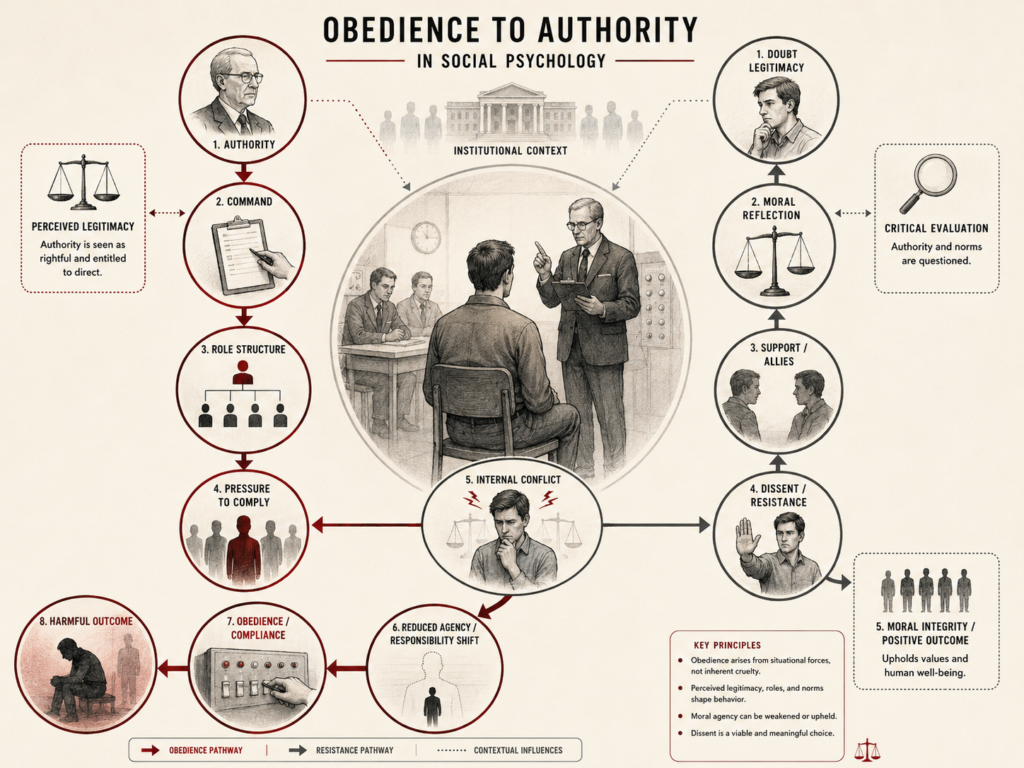
Obedience to authority examines how individuals comply with directives issued by perceived authority figures, even when those directives conflict with private moral judgment. In social psychology, it is one of the central mechanisms through which hierarchical institutions coordinate behavior, enforce norms, and maintain social order, making it essential not only for understanding cooperation within organized systems but also for explaining how ordinary individuals can become participants in harmful institutional processes. The study of obedience became especially urgent in the aftermath of the Second World War, when scholars confronted the question of whether atrocities required uniquely pathological actors or whether destructive action could arise from ordinary people placed under institutional pressure. Research beginning with postwar debates about authority and culminating in Stanley Milgram’s experiments showed that obedience is often not simply a matter of personality. It is shaped by situational structure, institutional legitimacy, role expectations, escalating demands, and the displacement of responsibility. Obedience helps us understand how social systems shape moral action, how institutions can normalize harmful conduct, and why the line between coordination and moral failure is often far thinner than individuals imagine.