
Last Updated May 21, 2026
Cognitive dissonance theory explains how people respond when beliefs, values, attitudes, behavior, commitments, or identity claims come into conflict. Originally proposed by Leon Festinger in 1957, the theory argues that psychological inconsistency creates an aversive state of tension that people are motivated to reduce. They may change behavior, revise beliefs, reinterpret evidence, justify past action, seek social support, avoid contradiction, or affirm some other part of the self.
The theory became one of the most influential frameworks in social psychology because it challenged the idea that people simply update beliefs in response to evidence or reinforcement. Festinger showed that people are active interpreters of their own behavior. Once they have acted, chosen, sacrificed, committed, or publicly identified with a position, they may reconstruct their attitudes in order to preserve coherence.
A serious treatment of cognitive dissonance must therefore connect attitude change to self-concept, moral identity, public commitment, social belonging, ideology, organizational inertia, and institutional legitimacy. Dissonance is not only a private discomfort. It is one of the mechanisms through which people and institutions defend prior choices, preserve narratives, rationalize harm, and resist correction when correction would threaten identity or status.
Main Library
Publications
Article Map
Social Psychology
Related Topic
Stewardship & Ethics
Related Topic
Behavioral Economics
Related Topic
Institutions & Governance
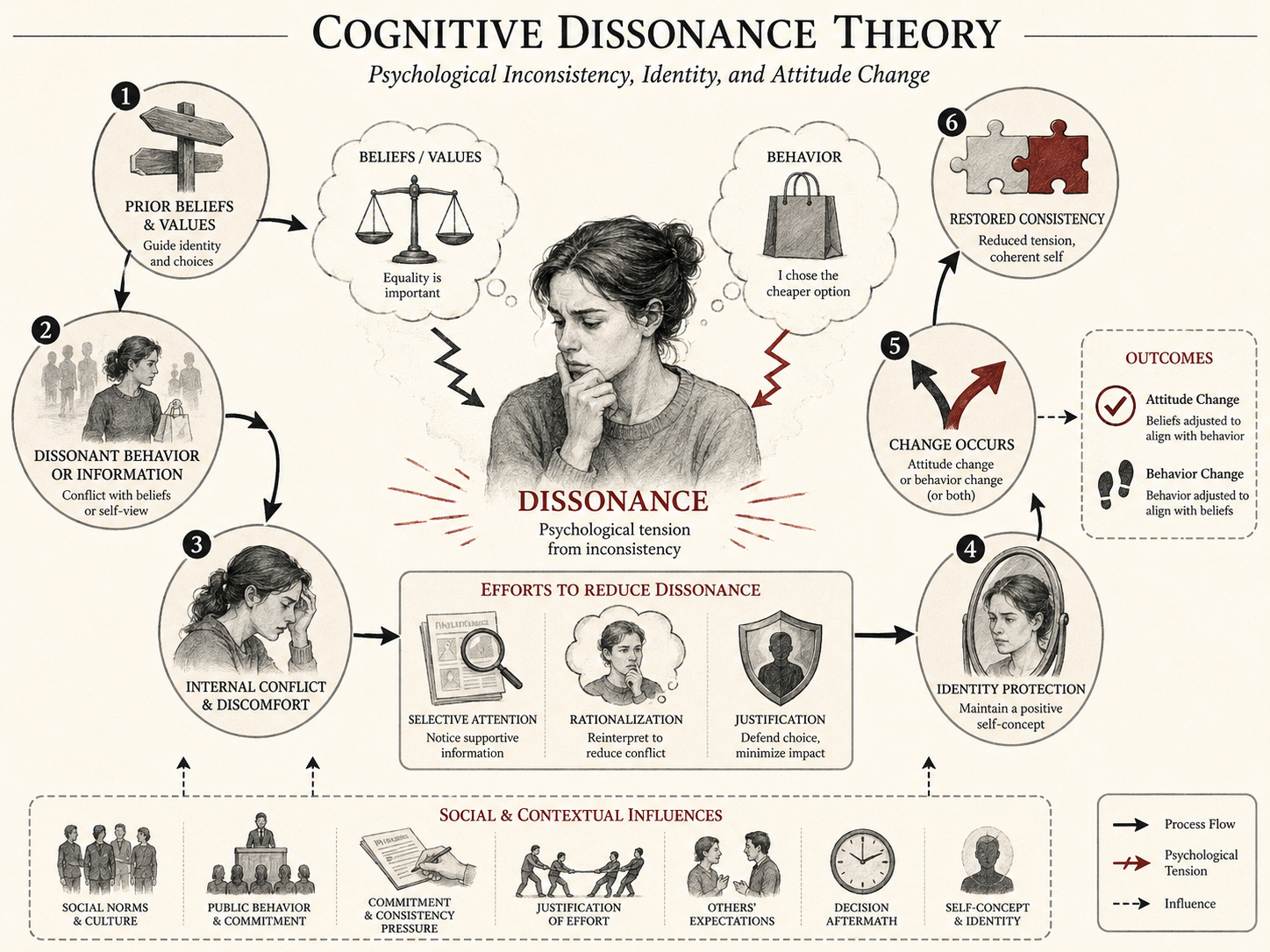
Cognitive dissonance theory remains central because it reveals that human beings are not neutral processors of contradiction. People often move toward coherence before they move toward truth. That does not mean dissonance always produces error. Sometimes it motivates ethical repair, apology, behavior change, learning, and responsibility. But it can also motivate denial, rationalization, selective exposure, moral disengagement, ideological hardening, and institutional self-protection.
This article connects directly to social cognition, attribution theory, self-serving bias, heuristics and biases, cognitive biases and decision-making, moral disengagement, conformity and social influence, social identity theory, groupthink, Behavioral Economics, and Institutions & Governance. Together these frameworks explain why contradiction does not automatically produce correction, and why people often defend the very beliefs, choices, or systems that create psychological tension.
What is cognitive dissonance theory?
Cognitive dissonance theory explains the discomfort people experience when cognitions conflict. A cognition can be a belief, attitude, value, memory, perception, identity claim, behavior, commitment, or piece of knowledge about the world. Dissonance occurs when two or more cognitions are psychologically inconsistent.
The classic examples are simple: a person values honesty but lies; a person believes smoking is dangerous but continues to smoke; a person sees themselves as fair but benefits from an unfair arrangement; a person sacrifices heavily for a group and later discovers the group is disappointing; a person publicly supports a policy and later encounters evidence that it caused harm.
Festinger’s core claim was that dissonance is motivational. People do not simply notice inconsistency. They feel pressure to reduce it. That pressure may lead to learning and repair, but it may also lead to rationalization, denial, selective exposure, attitude change, blame-shifting, trivialization, or defensive reinterpretation.
Cognitive dissonance is therefore not merely inconsistency. It is inconsistency that matters psychologically. It becomes especially powerful when the contradiction involves personal responsibility, public commitment, moral identity, social belonging, prior sacrifice, or an important sense of self.
The theory helps explain why people sometimes change beliefs after behavior, why commitment often deepens after sacrifice, why decisions become more attractive after they are made, why failed predictions may intensify belief, and why institutions often defend past decisions long after evidence suggests reversal.
Why cognitive dissonance matters
Cognitive dissonance matters because contradiction is everywhere in social life. People hold moral ideals while acting imperfectly. Organizations proclaim values while pursuing incentives that undermine them. Political groups encounter evidence that challenges their narratives. Consumers justify purchases. Professionals rationalize harmful routines. Institutions defend policies that no longer work.
The theory matters because it explains why evidence alone often fails to change belief. When evidence threatens identity, prior sacrifice, belonging, public reputation, or moral self-image, people may reinterpret the evidence rather than revise the commitment.
Dissonance also matters because it can produce either responsibility or avoidance. A person who experiences dissonance after harming someone may apologize, make amends, and change behavior. Another person may deny the harm, blame the victim, minimize the event, or reinterpret the action as justified. The same psychological tension can move people toward moral repair or moral evasion.
For institutions, dissonance helps explain inertia. A school, government agency, company, movement, hospital, political party, or nonprofit may continue defending a failing policy because admitting error would threaten legitimacy, leadership identity, public reputation, or prior investment. Institutional narratives can become coherence-preserving systems.
For social psychology, cognitive dissonance is a foundational bridge between cognition, motivation, identity, and power. It shows that people interpret reality through the need to preserve coherence, and that coherence is often bound up with who they think they are.
Theoretical foundations
Festinger’s original theory begins with the idea that cognitive elements can stand in three broad relations to one another:
- consonant, when two cognitions fit together;
- dissonant, when two cognitions conflict;
- irrelevant, when two cognitions have no meaningful relation.
Dissonance occurs when one cognition implies the opposite of another. A belief that “I am an honest person” conflicts with a memory of having lied for personal advantage. A belief that “our institution protects the vulnerable” conflicts with evidence that the institution ignored harm. A belief that “my political group is uniquely principled” conflicts with evidence of hypocrisy within that group.
Festinger compared the motivation to reduce dissonance to drive states. People seek psychological equilibrium. When inconsistency creates tension, they are motivated to restore coherence.
This was a major theoretical shift. Earlier behaviorist approaches emphasized reinforcement, reward, and punishment. Dissonance theory showed that people may change attitudes not because they were rewarded for a new belief, but because their own behavior created pressure to justify itself.
The theory also helped make social psychology more dynamic. Attitudes do not simply precede behavior. Behavior can reshape attitudes after the fact. People often become defenders of what they have done, chosen, endured, or publicly supported.
The formal structure of dissonance
Festinger proposed that the magnitude of dissonance depends on both the number and importance of dissonant cognitions relative to consonant ones. A minor inconsistency may be easy to ignore. A contradiction involving moral identity, social belonging, or a public commitment is harder to dismiss.
Several factors intensify dissonance:
- importance, when the conflicting cognitions involve valued beliefs or high-stakes outcomes;
- responsibility, when a person feels personally responsible for the action or consequence;
- choice, when the person believes the action was freely chosen;
- public commitment, when the position has been expressed before others;
- identity relevance, when the inconsistency threatens self-concept or group identity;
- effort or sacrifice, when the person has already invested heavily;
- low external justification, when there is no obvious excuse, reward, or coercion to explain the behavior.
This framework explains why the same contradiction can produce different levels of discomfort. If a person acts under coercion, dissonance may be reduced because responsibility is low. If a person freely chooses a counter-attitudinal action for little external reward, the inconsistency is harder to explain away. The person may then shift attitude to make the behavior appear more reasonable.
Dissonance is therefore not simply logical contradiction. It is psychologically weighted contradiction. Its force depends on importance, choice, responsibility, identity, and social context.
Mechanisms of dissonance reduction
People reduce dissonance through several recurrent strategies:
- behavior change, when conduct is altered to align with belief;
- attitude change, when beliefs or evaluations shift to justify behavior;
- adding consonant cognitions, when new justifications are introduced;
- trivialization, when the inconsistency is minimized;
- selective exposure, when people seek confirming information and avoid contradiction;
- denial, when evidence is rejected as false or irrelevant;
- externalization, when responsibility is shifted to others or circumstances;
- moral reframing, when the action is reinterpreted as necessary, loyal, pragmatic, or justified;
- self-affirmation, when another valued part of the self is emphasized to restore integrity.
These mechanisms show why dissonance reduction can be adaptive or harmful. A person may reduce dissonance by becoming more consistent with their values. But they may also reduce dissonance by weakening the value, dismissing the evidence, blaming the harmed party, or joining a group that validates the rationalization.
The important point is that dissonance reduction is directed toward coherence, not necessarily truth. Psychological consistency can support ethical growth when the person confronts the conflict honestly. It can support distortion when the person protects identity at the expense of evidence or responsibility.
This is why cognitive dissonance remains essential for understanding motivated reasoning, moral disengagement, ideological persistence, organizational denial, and institutional self-protection.
Forced compliance and counter-attitudinal behavior
The forced-compliance paradigm is one of the classic demonstrations of cognitive dissonance. In this design, participants are induced to say or do something that conflicts with their private attitude. The key question is whether they later change their attitude to align with the behavior.
Festinger and Carlsmith’s 1959 study asked participants to perform a dull task and then tell another person that the task was enjoyable. Some participants received a small payment, while others received a larger payment. The counterintuitive result was that participants who received the smaller payment later reported more positive attitudes toward the task.
The dissonance explanation is that a large external reward provides sufficient justification: “I said it was enjoyable because I was well paid.” A small reward does not provide enough justification. The person must explain why they freely said something they did not believe. One way to reduce the dissonance is to revise the attitude: perhaps the task was not so bad after all.
This result helped establish one of the theory’s most important claims: under some conditions, people change beliefs to justify behavior. Attitude does not always cause action. Action can cause attitude.
The forced-compliance paradigm remains relevant for understanding political messaging, workplace compliance, ethical compromise, public performance, hazing, propaganda, professional socialization, and institutional cultures where people gradually come to believe what they once only performed.
Belief disconfirmation and the doomsday prophecy study
One of the most famous field studies of dissonance appeared in Festinger, Riecken, and Schachter’s When Prophecy Fails. The researchers observed a small religious group that predicted an apocalyptic event and expected rescue before destruction arrived.
When the prophecy failed, the belief system did not simply collapse. Some members intensified commitment and began proselytizing. Festinger interpreted this as dissonance reduction. Members had sacrificed time, reputation, social ties, and identity for the prophecy. To abandon the belief would mean acknowledging that those sacrifices had been made for a false claim.
Belief disconfirmation is powerful because it threatens not only a proposition, but the person or group built around the proposition. The failed prediction creates dissonance between “we were right” and “the event did not happen.” The group can reduce dissonance by abandoning the belief, but it can also reinterpret the failure as evidence of mercy, hidden success, spiritual testing, elite deception, or delayed fulfillment.
This pattern appears far beyond religious prophecy. Political ideologies, conspiracy systems, organizational strategies, investment decisions, failed wars, public policies, and professional paradigms can all generate dissonance when evidence contradicts commitment.
The central lesson is sobering: disconfirming evidence does not automatically weaken belief. Under high commitment, it may intensify rationalization unless people have a face-saving path toward revision.
Decision-based dissonance and spreading of alternatives
Decision-based dissonance occurs after people choose between alternatives. When two options are close in value, choosing one creates dissonance because the chosen option has disadvantages and the rejected option has advantages. The person has to live with the tension of having rejected something attractive and chosen something imperfect.
One common response is spreading of alternatives. After making a decision, people often increase their evaluation of the chosen option and decrease their evaluation of the rejected option. The decision becomes psychologically easier to live with because the chosen option now appears better and the rejected option worse.
This process can be adaptive. People need to move forward after decisions. Constantly reopening every choice would be paralyzing. Post-decision rationalization can support commitment and action.
But the same process can distort judgment. People may become overly attached to past choices, dismiss valid criticism, exaggerate the flaws of alternatives, or interpret new evidence through the need to defend a decision already made.
Decision-based dissonance helps explain consumer behavior, career choices, political commitments, institutional strategies, medical decisions, public policy, and escalation of commitment. Once a choice becomes part of a person’s or institution’s identity, reconsidering it becomes psychologically costly.
Effort justification
Effort justification occurs when people increase the perceived value of an outcome after investing significant effort, discomfort, sacrifice, or cost to obtain it. The classic Aronson and Mills initiation study found that participants who underwent a severe initiation later evaluated the group more positively than those who experienced mild or no initiation.
The logic is straightforward. If someone suffers to gain access to a group, role, belief system, credential, or institution, and the outcome is disappointing, dissonance arises: “I went through something difficult for something unworthy.” One way to reduce the dissonance is to elevate the value of the outcome.
Effort justification helps explain initiation rituals, hazing, elite professional training, demanding organizations, high-cost movements, military and religious formation, difficult educational programs, startup cultures, and ideological communities. The more someone sacrifices, the harder it may become to admit that the object of sacrifice was flawed.
This does not mean all hard-won commitments are irrational. Effort can genuinely build skill, belonging, and meaning. But effort also creates pressure to justify. Systems that demand suffering may increase loyalty not because they are worthy, but because suffering itself makes exit psychologically harder.
A serious analysis must therefore ask when effort builds value and when it manufactures rationalization.
Self-concept and identity models
Elliot Aronson’s self-concept interpretation shifted attention from inconsistency alone to inconsistency that threatens a person’s view of the self. On this account, dissonance is especially powerful when behavior conflicts with a person’s identity as competent, rational, moral, kind, loyal, fair, intelligent, or responsible.
This explains why some contradictions are easy to ignore while others are deeply threatening. A factual error about a trivial topic may not matter much. Evidence that one has harmed someone, acted hypocritically, supported injustice, or misled oneself may threaten the self at a deeper level.
Self-concept models also explain why dissonance often becomes defensive. If acknowledging error would threaten moral identity, people may protect the self by denying responsibility, blaming others, trivializing the harm, or reframing the action as necessary.
This is where cognitive dissonance connects directly to moral psychology. A person may not be defending a belief because the belief is well supported. They may be defending a version of the self that depends on the belief being true.
Identity-based dissonance also operates at the group level. If a group sees itself as righteous, rational, oppressed, patriotic, scientific, humane, or chosen, evidence that contradicts that identity can produce collective defensiveness. Group identity can turn dissonance into ideology.
Self-affirmation theory
Claude Steele’s self-affirmation theory broadened dissonance research by arguing that people are motivated to maintain overall self-integrity. When one domain of the self is threatened, people may restore integrity by affirming another valued domain.
For example, a person confronted with evidence of hypocrisy may reduce threat by reflecting on being a caring parent, loyal friend, skilled professional, generous volunteer, or principled community member. This can reduce defensiveness because the self no longer depends entirely on denying the inconsistency.
Self-affirmation can support openness to threatening information. If people feel secure enough in their broader self-worth, they may be more willing to acknowledge error, accept evidence, or change behavior.
But self-affirmation can also become avoidance if it restores self-integrity without addressing the specific harm. A person may respond to criticism of misconduct by emphasizing unrelated good deeds. An institution may respond to evidence of failure by highlighting unrelated achievements. The self or organization feels restored while the original contradiction remains unresolved.
The strongest use of self-affirmation is therefore not to escape responsibility, but to make responsibility psychologically tolerable. People often need enough self-integrity to face the truth without collapsing into shame or defensiveness.
Action-based models and neuroscientific evidence
Eddie Harmon-Jones and colleagues developed an action-based model of dissonance. This model argues that dissonance is aversive because inconsistent cognitions interfere with effective action. People need coherent commitments in order to act decisively. Dissonance reduction helps remove conflict and support action orientation.
This account helps explain why dissonance often increases after commitment. A person who has chosen a path must act on it. Lingering conflict can impair motivation. Reinterpreting the choice as correct may help the person move forward.
Action-based models also connect dissonance to broader research on conflict monitoring, approach motivation, and cognitive control. Neuroscientific work has linked dissonance-related processes to brain systems involved in conflict, monitoring, and control, including areas such as the anterior cingulate cortex and prefrontal regions.
The action-based model does not replace Festinger’s theory. It reframes the function of dissonance reduction. Coherence is not only psychologically pleasant; it supports action.
This insight matters for institutions and politics. Groups often reduce dissonance in ways that preserve coordinated action. A movement, organization, or party may rationalize contradiction not only because members dislike inconsistency, but because uncertainty threatens mobilization, loyalty, and strategic direction.
Cultural variation
Early dissonance research often emphasized personal consistency. Later cross-cultural work suggests a more nuanced view. The motivation for coherence may be widespread, but the kinds of inconsistency that matter most can vary across cultural contexts.
In more individualistic settings, dissonance may be especially salient when personal choice, autonomy, and self-consistency are threatened. In more collectivist or interdependent settings, dissonance may be especially salient when relational obligations, social harmony, family expectations, role duties, or group commitments are violated.
This does not mean that people in one culture experience dissonance and people in another do not. It means that the self is culturally organized. If the self is understood as independent, inconsistency with personal preference may feel especially important. If the self is understood as relational, inconsistency with social obligation may carry greater psychological weight.
Cultural variation also matters for institutional analysis. What counts as hypocrisy, loyalty, responsibility, shame, apology, repair, or face-saving can vary across social contexts. A behavior that restores coherence in one setting may create tension in another.
Dissonance theory is strongest when it treats psychological consistency as embedded in culturally specific forms of selfhood, obligation, and moral meaning.
Ideology, polarization, and belief persistence
Cognitive dissonance plays a major role in ideological persistence. Political, moral, and religious beliefs often become tied to identity, belonging, status, community, and prior sacrifice. When evidence threatens those beliefs, it may also threaten the person’s place in a social world.
This helps explain motivated reasoning and selective exposure. People may avoid information that threatens group commitments and seek information that restores coherence. They may reinterpret contradictory evidence as biased, fake, malicious, elitist, corrupt, or incomplete.
Polarization intensifies dissonance because beliefs become socially anchored. Changing one belief may mean losing friends, betraying a group, admitting past error, weakening moral identity, or crossing a boundary between “us” and “them.” The cost of belief revision becomes social as well as cognitive.
Dissonance also helps explain why exposure to contradiction can sometimes harden commitment. When a belief is weakly held, contradiction may lead to revision. When a belief is deeply tied to identity and public commitment, contradiction may produce stronger defense.
Reducing ideological dissonance defensiveness requires more than fact correction. It often requires trust, face-saving pathways, identity-safe environments, cross-cutting relationships, and institutions that make revision compatible with dignity rather than humiliation.
Moral rationalization and harm
Cognitive dissonance is central to moral rationalization. People generally want to see themselves as decent, fair, compassionate, loyal, or principled. When they participate in harm, benefit from injustice, ignore suffering, or violate their stated values, dissonance can arise.
One response is moral repair: acknowledging the harm, apologizing, making restitution, changing behavior, and accepting accountability. Another response is moral evasion: denying harm, minimizing consequences, blaming victims, redefining the action as necessary, or claiming that critics are unreasonable.
Moral rationalization often takes recognizable forms:
- “It was not that serious.”
- “Everyone does it.”
- “They deserved it.”
- “I had no choice.”
- “The ends justify the means.”
- “The critics are hypocrites.”
- “Our side is still better than theirs.”
- “This is just how institutions work.”
These statements reduce dissonance by protecting the moral self or moral group. They may also preserve harmful systems.
This is where cognitive dissonance intersects with moral disengagement. Dissonance creates pressure. Moral disengagement provides tools for reducing that pressure without changing the harmful behavior.
The ethical importance of dissonance theory is that discomfort can become a doorway to responsibility or a pathway into deeper denial. The direction depends on context, support, accountability, and the availability of honest repair.
Organizations, institutions, and escalation of commitment
Dissonance does not operate only inside individuals. Organizations and institutions can show dissonance-like dynamics when public commitments, policies, missions, investments, or identities conflict with evidence.
A company may claim to value workers while tolerating harmful labor practices. A school may claim equity while maintaining unequal discipline. A public agency may defend a policy after evidence shows damage. A political party may reinterpret failure as proof of loyalty. A nonprofit may protect its reputation rather than confront misconduct.
Institutional dissonance becomes especially strong when leaders have made public commitments, when resources have already been invested, when reversal would threaten legitimacy, and when critics can be framed as hostile outsiders.
Common institutional dissonance-reduction strategies include:
- redefining failure as partial success;
- blaming external conditions;
- changing metrics after the fact;
- emphasizing symbolic achievements;
- discrediting critics;
- hiding unfavorable data;
- doubling down on prior strategy;
- claiming that reversal would betray the mission;
- turning sunk cost into moral proof of commitment.
Institutional accountability requires structures that make correction possible: transparent data, independent review, protected dissent, decision logs, sunset clauses, audit trails, appeal mechanisms, and leadership norms that distinguish revision from weakness.
An institution capable of learning must reduce the shame of changing course while increasing the cost of rationalizing harm.
Dissonance in digital environments
Digital environments reshape cognitive dissonance by making commitment public, searchable, shareable, and socially reinforced. A belief posted online becomes part of a visible identity. A public stance can accumulate likes, replies, followers, enemies, screenshots, and reputational consequences.
This changes the cost of revision. To change one’s mind online may feel like losing face before an audience. People may defend weak claims because admitting error would threaten public identity.
Platforms also create dissonance-reduction environments. Users can quickly find communities that validate their rationalizations. Algorithmic feeds can reduce exposure to contradictory evidence or present contradiction mostly in hostile outgroup form. This makes defensive reinterpretation easier.
Digital identity also intensifies sunk cost. A person who has posted repeatedly about a belief, built friendships around it, monetized it, or gained status from it may face enormous dissonance when evidence challenges the belief.
At the same time, digital environments can support correction when communities normalize revision, cite evidence, protect humility, and treat changing one’s mind as integrity rather than betrayal.
The platform question is therefore not only what information users see, but what kinds of identity and accountability digital systems reward.
Formalizing dissonance
Dissonance can be represented as a weighted inconsistency among cognitions. Let consonant cognitions be \(C_i\) and dissonant cognitions be \(D_j\), each weighted by subjective importance \(w\):
\Delta = \frac{\sum_{j=1}^{m} w_jD_j}{\sum_{i=1}^{n} w_iC_i+\sum_{j=1}^{m} w_jD_j}
\]
Interpretation: Dissonance magnitude \(\Delta\) rises when dissonant cognitions occupy a larger share of the weighted cognitive field.
The motivation to reduce dissonance can be modeled as a function of magnitude, perceived responsibility, and identity relevance:
M=f(\Delta,R,I)
\]
Interpretation: Motivation \(M\) increases when dissonance magnitude \(\Delta\), perceived responsibility \(R\), and identity relevance \(I\) are high.
Post-decision dissonance can be expressed as spreading of alternatives:
S=(V’_{chosen}-V_{chosen})-(V’_{rejected}-V_{rejected})
\]
Interpretation: Spreading \(S\) increases when the chosen option is revalued upward and the rejected option is revalued downward after commitment.
Forced-compliance attitude change can be represented as:
\Delta A_i=\beta_0+\beta_1B_i+\beta_2Ch_i+\beta_3R_i+\beta_4I_i-\beta_5J_i-\beta_6F_i+\varepsilon_i
\]
Interpretation: Attitude change \(\Delta A_i\) rises with counter-attitudinal behavior \(B\), choice \(Ch\), responsibility \(R\), and identity threat \(I\), and falls with external justification \(J\) and self-affirmation \(F\).
Institutional escalation can be modeled as reduced willingness to reverse course:
P(Rev_i=1)=\operatorname{logit}^{-1}(\alpha+\beta_1E_i+\beta_2A_i-\beta_3S_i-\beta_4P_i-\beta_5T_i)
\]
Interpretation: Policy reversal becomes more likely with evidence strength \(E\) and accountability \(A\), and less likely with sunk cost \(S\), public commitment \(P\), and institutional identity threat \(T\).
These models do not reduce the theory to equations. They clarify the variables that researchers can measure: inconsistency, responsibility, identity threat, justification, affirmation, public commitment, effort, evidence, and willingness to revise.
Alternative explanations and theoretical debates
Cognitive dissonance theory generated major theoretical debate. The most important alternative is Daryl Bem’s self-perception theory, which argues that people sometimes infer their attitudes by observing their own behavior and the circumstances in which it occurs. From this view, some attitude change may occur without an aversive dissonance state.
Self-perception theory is especially plausible when initial attitudes are weak, ambiguous, or uncertain. If a person does not know how they feel, they may infer an attitude from behavior much as an outside observer would.
Dissonance theory is especially powerful when behavior conflicts with strong attitudes, when choice is high, when responsibility is salient, when external justification is low, and when self-concept is threatened.
Other debates concern impression management and self-presentation. People may change public attitudes not because they experience private tension, but because they want to appear consistent, reasonable, or morally acceptable to others.
Cooper and Fazio’s “new look” emphasized aversive consequences and responsibility. Self-affirmation theory emphasized the maintenance of global self-integrity. The self-standards model integrated several self-based perspectives by asking which standards are used to judge the self.
These debates sharpen the theory. They suggest that not every attitude shift is dissonance reduction. Strong research should ask whether discomfort, responsibility, choice, identity threat, and insufficient justification are actually present.
Limits and interpretive cautions
Cognitive dissonance is a powerful concept, but it should not be used carelessly.
- Do not label every inconsistency as cognitive dissonance.
- Do not assume dissonance always produces attitude change.
- Do not ignore self-perception, impression management, habit, incentives, coercion, or social norms.
- Do not treat rationalization as always irrational; sometimes people add genuinely relevant context.
- Do not reduce institutional failure to psychology alone; material interests and power matter.
- Do not assume dissonance is always bad; it can motivate ethical repair.
- Do not shame people for experiencing dissonance; it is an ordinary psychological process.
- Do not overlook culture; different forms of selfhood produce different forms of consistency pressure.
- Do not confuse public consistency with moral integrity.
- Do not use dissonance theory to excuse harm; explanation is not absolution.
The best use of the concept is diagnostic. It helps identify when a person, group, or institution is defending coherence at the expense of truth, responsibility, or repair.
But cognitive dissonance can also be a beginning. The discomfort of inconsistency may signal that something needs attention. The question is whether the person or institution reduces the discomfort by changing reality, changing behavior, or changing the story.
Cognitive dissonance in the architecture of social influence
Within the broader architecture of social influence, cognitive dissonance explains why people defend prior commitments even when new evidence challenges them. Conformity explains how group norms shape behavior. Social identity theory explains why group membership becomes part of the self. Groupthink explains how cohesive groups suppress dissent. Cognitive dissonance explains why reversing course can feel psychologically threatening after commitment.
Dissonance also connects to moral disengagement. When people participate in harm, dissonance creates pressure. Moral disengagement provides rationalizations that reduce that pressure without changing behavior.
It connects to self-serving bias, because people often interpret outcomes in ways that protect self-esteem. It connects to attribution theory, because responsibility and causation shape dissonance intensity. It connects to Behavioral Economics, because sunk costs, commitment, loss aversion, and status quo bias can interact with rationalization.
The theory’s lasting contribution is to show that people often defend meaning, not just propositions. Beliefs are embedded in choices, sacrifices, roles, reputations, relationships, and institutions. That is why changing belief can feel like changing the self.
Measurement, data, and research design
Cognitive dissonance research can use laboratory experiments, forced-compliance paradigms, free-choice designs, effort-justification experiments, belief-disconfirmation field studies, self-affirmation interventions, response-time studies, political belief studies, organizational case studies, vignette experiments, and institutional simulations.
Key variables include:
- participant, session, group, scenario, site, and institutional identifiers;
- experimental paradigm;
- condition;
- pre-attitude and post-attitude;
- attitude change;
- counter-attitudinal behavior;
- perceived choice;
- perceived responsibility;
- identity threat;
- self-affirmation;
- external justification;
- public commitment;
- effort cost;
- outcome value;
- chosen and rejected option values;
- spreading of alternatives;
- belief disconfirmation strength;
- commitment strength;
- proselytizing intensity;
- coherence pressure;
- dissonance discomfort;
- response time;
- institutional identity threat;
- sunk cost;
- evidence strength;
- accountability;
- policy reversal willingness.
Strong designs should measure the psychological state, not only the outcome. If a study claims dissonance, it should ideally measure discomfort, perceived choice, responsibility, identity relevance, and external justification.
Research should also compare alternative explanations. If initial attitudes are weak, self-perception may explain attitude change. If behavior is public, impression management may matter. If incentives are strong, external justification may reduce dissonance.
Institutional research should combine psychological measures with organizational data: public commitments, sunk costs, accountability structures, dissent channels, evidence review procedures, leadership incentives, and decision-reversal history.
R code for cognitive dissonance research
The following R workflow models attitude change, spreading of alternatives, effort justification, belief disconfirmation, response latency, and institutional reversal willingness.
# Install packages if needed:
# pak::pak(c("tidyverse", "lme4", "lmerTest", "emmeans", "broom.mixed", "performance"))

library(tidyverse)
library(lme4)
library(lmerTest)
library(emmeans)
library(broom.mixed)
library(performance)

# Expected columns:
# participant, session_id, group_id, scenario_id, site_id,
# institution_context, paradigm, condition, trial,
# pre_attitude, post_attitude, counter_attitudinal_behavior,
# perceived_choice, perceived_responsibility, identity_threat,
# self_affirmation, external_justification, public_commitment,
# effort_cost, outcome_value, chosen_pre_value, chosen_post_value,
# rejected_pre_value, rejected_post_value, belief_disconfirmation_strength,
# commitment_strength, proselytizing_intensity, coherence_pressure,
# dissonance_discomfort, response_time_ms, institutional_identity_threat,
# sunk_cost, evidence_strength, accountability, policy_reversal_willingness

dat <- read_csv("dissonance_trials.csv") %>%
  mutate(
    participant = factor(participant),
    session_id = factor(session_id),
    group_id = factor(group_id),
    scenario_id = factor(scenario_id),
    site_id = factor(site_id),
    institution_context = factor(institution_context),
    paradigm = factor(paradigm),
    condition = factor(condition),
    attitude_change = post_attitude - pre_attitude,
    spreading_of_alternatives = (chosen_post_value - chosen_pre_value) -
      (rejected_post_value - rejected_pre_value),
    log_response_time = log(response_time_ms),
    dissonance_magnitude_index = (
      counter_attitudinal_behavior +
      perceived_choice +
      perceived_responsibility +
      identity_threat +
      public_commitment -
      external_justification -
      self_affirmation
    ) / 5,
    institutional_escalation_index = (
      sunk_cost +
      public_commitment +
      institutional_identity_threat -
      evidence_strength -
      accountability
    ) / 3
  )

summary_table <- dat %>%
  group_by(paradigm, condition) %>%
  summarise(
    n = n(),
    participants = n_distinct(participant),
    mean_attitude_change = mean(attitude_change, na.rm = TRUE),
    mean_spreading = mean(spreading_of_alternatives, na.rm = TRUE),
    mean_outcome_value = mean(outcome_value, na.rm = TRUE),
    mean_proselytizing = mean(proselytizing_intensity, na.rm = TRUE),
    mean_coherence_pressure = mean(coherence_pressure, na.rm = TRUE),
    mean_discomfort = mean(dissonance_discomfort, na.rm = TRUE),
    mean_policy_reversal = mean(policy_reversal_willingness, na.rm = TRUE),
    .groups = "drop"
  )

print(summary_table)

attitude_model <- lmer(
  attitude_change ~
    paradigm +
    condition +
    counter_attitudinal_behavior +
    perceived_choice +
    perceived_responsibility +
    identity_threat +
    self_affirmation +
    external_justification +
    public_commitment +
    (1 | participant) +
    (1 | scenario_id),
  data = dat,
  REML = FALSE
)

summary(attitude_model)
emmeans(attitude_model, ~ paradigm + condition)

spread_model <- lmer(
  spreading_of_alternatives ~
    perceived_choice +
    public_commitment +
    identity_threat +
    self_affirmation +
    external_justification +
    condition +
    (1 | participant) +
    (1 | scenario_id),
  data = dat,
  REML = FALSE
)

summary(spread_model)

effort_model <- lmer(
  outcome_value ~
    effort_cost +
    commitment_strength +
    public_commitment +
    identity_threat +
    self_affirmation +
    condition +
    (1 | participant) +
    (1 | scenario_id),
  data = dat,
  REML = FALSE
)

summary(effort_model)

belief_model <- lmer(
  proselytizing_intensity ~
    belief_disconfirmation_strength +
    commitment_strength +
    public_commitment +
    identity_threat +
    self_affirmation +
    condition +
    (1 | participant) +
    (1 | scenario_id),
  data = dat,
  REML = FALSE
)

summary(belief_model)

rt_model <- lmer(
  log_response_time ~
    coherence_pressure +
    identity_threat +
    belief_disconfirmation_strength +
    self_affirmation +
    condition +
    (1 | participant) +
    (1 | scenario_id),
  data = dat %>% filter(response_time_ms >= 150),
  REML = FALSE
)

summary(rt_model)

institutional_model <- lmer(
  policy_reversal_willingness ~
    evidence_strength +
    accountability +
    sunk_cost +
    public_commitment +
    institutional_identity_threat +
    condition +
    (1 | participant) +
    (1 | scenario_id),
  data = dat,
  REML = FALSE
)

summary(institutional_model)

condition_summary <- dat %>%
  group_by(condition) %>%
  summarise(
    n = n(),
    mean_attitude_change = mean(attitude_change, na.rm = TRUE),
    mean_spreading = mean(spreading_of_alternatives, na.rm = TRUE),
    mean_dissonance_discomfort = mean(dissonance_discomfort, na.rm = TRUE),
    mean_policy_reversal = mean(policy_reversal_willingness, na.rm = TRUE),
    .groups = "drop"
  )

write_csv(summary_table, "dissonance_summary.csv")
write_csv(condition_summary, "dissonance_condition_summary.csv")
write_csv(
  tidy(attitude_model, effects = "fixed", conf.int = TRUE),
  "dissonance_attitude_change_coefficients.csv"
)

ggplot(
  condition_summary,
  aes(x = reorder(condition, mean_attitude_change), y = mean_attitude_change, group = 1)
) +
  geom_line() +
  geom_point() +
  coord_flip() +
  labs(
    title = "Mean attitude change by dissonance condition",
    x = "Condition",
    y = "Mean attitude change"
  ) +
  theme_minimal()
This workflow supports cognitive dissonance research by separating perceived choice, responsibility, identity threat, external justification, self-affirmation, effort cost, belief disconfirmation, public commitment, spreading of alternatives, response latency, and institutional reversal willingness.
Python code for cognitive dissonance research
The Python workflow below parallels the R analysis and adds an institutional escalation simulation for studying sunk cost, public commitment, evidence strength, accountability, and policy reversal.
import numpy as np
import pandas as pd
import statsmodels.formula.api as smf
import matplotlib.pyplot as plt

# Expected columns:
# participant, session_id, group_id, scenario_id, site_id,
# institution_context, paradigm, condition, trial,
# pre_attitude, post_attitude, counter_attitudinal_behavior,
# perceived_choice, perceived_responsibility, identity_threat,
# self_affirmation, external_justification, public_commitment,
# effort_cost, outcome_value, chosen_pre_value, chosen_post_value,
# rejected_pre_value, rejected_post_value, belief_disconfirmation_strength,
# commitment_strength, proselytizing_intensity, coherence_pressure,
# dissonance_discomfort, response_time_ms, institutional_identity_threat,
# sunk_cost, evidence_strength, accountability, policy_reversal_willingness

df = pd.read_csv("dissonance_trials.csv")

for col in [
    "participant",
    "session_id",
    "group_id",
    "scenario_id",
    "site_id",
    "institution_context",
    "paradigm",
    "condition",
]:
    df[col] = df[col].astype("category")

df["attitude_change"] = df["post_attitude"] - df["pre_attitude"]

df["spreading_of_alternatives"] = (
    (df["chosen_post_value"] - df["chosen_pre_value"])
    - (df["rejected_post_value"] - df["rejected_pre_value"])
)

df["log_response_time"] = np.log(df["response_time_ms"])

df["dissonance_magnitude_index"] = (
    df["counter_attitudinal_behavior"]
    + df["perceived_choice"]
    + df["perceived_responsibility"]
    + df["identity_threat"]
    + df["public_commitment"]
    - df["external_justification"]
    - df["self_affirmation"]
) / 5

df["institutional_escalation_index"] = (
    df["sunk_cost"]
    + df["public_commitment"]
    + df["institutional_identity_threat"]
    - df["evidence_strength"]
    - df["accountability"]
) / 3

summary_table = (
    df.groupby(["paradigm", "condition"], observed=True)
    .agg(
        n=("participant", "size"),
        participants=("participant", "nunique"),
        mean_attitude_change=("attitude_change", "mean"),
        mean_spreading=("spreading_of_alternatives", "mean"),
        mean_outcome_value=("outcome_value", "mean"),
        mean_proselytizing=("proselytizing_intensity", "mean"),
        mean_coherence_pressure=("coherence_pressure", "mean"),
        mean_discomfort=("dissonance_discomfort", "mean"),
        mean_policy_reversal=("policy_reversal_willingness", "mean"),
    )
    .reset_index()
)

print(summary_table)

attitude_model = smf.ols(
    "attitude_change ~ paradigm + condition "
    "+ counter_attitudinal_behavior + perceived_choice "
    "+ perceived_responsibility + identity_threat "
    "+ self_affirmation + external_justification "
    "+ public_commitment",
    data=df
)

attitude_result = attitude_model.fit(
    cov_type="cluster",
    cov_kwds={"groups": df["participant"]}
)

print(attitude_result.summary())

spread_model = smf.ols(
    "spreading_of_alternatives ~ perceived_choice "
    "+ public_commitment + identity_threat "
    "+ self_affirmation + external_justification "
    "+ condition",
    data=df
)

spread_result = spread_model.fit(
    cov_type="cluster",
    cov_kwds={"groups": df["participant"]}
)

print(spread_result.summary())

effort_model = smf.ols(
    "outcome_value ~ effort_cost + commitment_strength "
    "+ public_commitment + identity_threat "
    "+ self_affirmation + condition",
    data=df
)

effort_result = effort_model.fit(
    cov_type="cluster",
    cov_kwds={"groups": df["participant"]}
)

print(effort_result.summary())

belief_model = smf.ols(
    "proselytizing_intensity ~ belief_disconfirmation_strength "
    "+ commitment_strength + public_commitment "
    "+ identity_threat + self_affirmation + condition",
    data=df
)

belief_result = belief_model.fit(
    cov_type="cluster",
    cov_kwds={"groups": df["participant"]}
)

print(belief_result.summary())

rt_df = df[df["response_time_ms"] >= 150].copy()

response_time_model = smf.ols(
    "log_response_time ~ coherence_pressure + identity_threat "
    "+ belief_disconfirmation_strength + self_affirmation "
    "+ condition",
    data=rt_df
)

response_time_result = response_time_model.fit(
    cov_type="cluster",
    cov_kwds={"groups": rt_df["participant"]}
)

print(response_time_result.summary())

institutional_model = smf.ols(
    "policy_reversal_willingness ~ evidence_strength + accountability "
    "+ sunk_cost + public_commitment "
    "+ institutional_identity_threat + condition",
    data=df
)

institutional_result = institutional_model.fit(
    cov_type="cluster",
    cov_kwds={"groups": df["participant"]}
)

print(institutional_result.summary())

def simulate_institutional_escalation(
    steps=80,
    seed=42
):
    rng = np.random.default_rng(seed)
    rows = []

    scenarios = [
        "low_sunk_cost_high_accountability",
        "high_sunk_cost_low_accountability",
        "public_commitment_high_identity_threat",
        "evidence_review_with_oversight",
        "face_saving_reversal_pathway",
    ]

    for scenario in scenarios:
        commitment = 0.45

        for step in range(1, steps + 1):
            if scenario == "low_sunk_cost_high_accountability":
                sunk, public, threat, evidence, accountability = 0.2, 0.2, 0.2, 0.8, 0.9
            elif scenario == "high_sunk_cost_low_accountability":
                sunk, public, threat, evidence, accountability = 0.9, 0.8, 0.7, 0.8, 0.2
            elif scenario == "public_commitment_high_identity_threat":
                sunk, public, threat, evidence, accountability = 0.7, 0.95, 0.95, 0.8, 0.3
            elif scenario == "evidence_review_with_oversight":
                sunk, public, threat, evidence, accountability = 0.5, 0.5, 0.4, 0.9, 0.9
            else:
                sunk, public, threat, evidence, accountability = 0.7, 0.8, 0.8, 0.8, 0.7

            rationalization_pressure = (
                sunk + public + threat - evidence - accountability
            )

            commitment = commitment + 0.06 * rationalization_pressure + rng.normal(0, 0.025)
            commitment = np.clip(commitment, 0, 1)

            reversal_probability = 1 / (1 + np.exp(4.0 * (commitment - 0.5)))

            rows.append({
                "scenario": scenario,
                "step": step,
                "commitment_escalation": commitment,
                "rationalization_pressure": rationalization_pressure,
                "reversal_probability": reversal_probability,
                "sunk_cost": sunk,
                "public_commitment": public,
                "identity_threat": threat,
                "evidence_strength": evidence,
                "accountability": accountability,
            })

    return pd.DataFrame(rows)

simulation = simulate_institutional_escalation()

condition_summary = (
    df.groupby("condition", observed=True)
    .agg(
        mean_attitude_change=("attitude_change", "mean"),
        mean_spreading=("spreading_of_alternatives", "mean"),
        mean_dissonance_discomfort=("dissonance_discomfort", "mean"),
        mean_policy_reversal=("policy_reversal_willingness", "mean"),
    )
    .reset_index()
)

fig, ax = plt.subplots(figsize=(8, 5))

ordered = condition_summary.sort_values("mean_attitude_change")
ax.plot(
    ordered["mean_attitude_change"],
    ordered["condition"].astype(str),
    marker="o"
)

ax.set_xlabel("Mean attitude change")
ax.set_ylabel("Condition")
ax.set_title("Mean attitude change by dissonance condition")
plt.tight_layout()
plt.show()

summary_table.to_csv("dissonance_summary.csv", index=False)
condition_summary.to_csv("dissonance_condition_summary.csv", index=False)
simulation.to_csv("institutional_escalation_simulation.csv", index=False)
This Python workflow supports cognitive dissonance research by modeling forced compliance, post-decision spreading, effort justification, belief disconfirmation, self-affirmation, response latency, and institutional escalation.
Research data architecture
Cognitive dissonance research often depends on relational data: participants, sessions, groups, scenarios, institutions, paradigms, conditions, pre-attitudes, post-attitudes, counter-attitudinal behavior, perceived choice, responsibility, identity threat, self-affirmation, external justification, public commitment, effort cost, outcome value, choice evaluations, belief disconfirmation, commitment strength, proselytizing, coherence pressure, discomfort, response time, sunk cost, evidence strength, accountability, and policy reversal willingness.
The companion GitHub repository includes a full SQL schema and example analytical queries for researchers who want to reproduce, inspect, or extend the data model. Keeping executable SQL in GitHub avoids WordPress hosting restrictions while preserving the technical infrastructure for readers who want to use the article as a reproducible research workflow.
The research data model supports questions such as:
- Does high perceived choice increase attitude change after counter-attitudinal behavior?
- Does strong external justification reduce dissonance-related attitude change?
- Does self-affirmation reduce defensive attitude change?
- Does public commitment increase spreading of alternatives?
- Does effort cost increase outcome value?
- Does belief disconfirmation increase proselytizing under high commitment?
- Does response latency increase under high coherence pressure?
- Does institutional sunk cost reduce willingness to reverse policy?
- Does accountability increase policy reversal when evidence is strong?
- Can face-saving reversal pathways reduce institutional escalation?
View the SQL research data architecture in GitHub.
GitHub repository
The companion repository provides reusable code and research scaffolding for studying cognitive dissonance, psychological inconsistency, forced compliance, post-decision spreading, effort justification, belief disconfirmation, self-affirmation, response latency, and institutional escalation.
Complete Code Repository
Access the full companion repository for this article, including reproducible analysis materials and multi-language code workflows for cognitive dissonance research.
Why cognitive dissonance matters for social psychology
Cognitive dissonance theory matters because it reveals how deeply human judgment is shaped by the need for coherence. People do not simply hold beliefs and then act. They also act, choose, sacrifice, defend, and belong — and then reshape belief around those commitments.
The theory explains why small rewards can produce large attitude change, why hard initiations can increase loyalty, why decisions become more attractive after they are made, why failed predictions can intensify belief, and why institutions defend choices long after correction would be wiser.
Its ethical importance lies in the fact that dissonance can lead in two directions. It can lead toward repair, responsibility, apology, learning, and behavior change. It can also lead toward rationalization, denial, selective exposure, moral disengagement, and institutional inertia.
Read alongside social cognition, attribution theory, self-serving bias, heuristics and biases, moral disengagement, social identity theory, groupthink, Behavioral Economics, and Institutions & Governance, cognitive dissonance becomes more than a theory of discomfort. It becomes a framework for understanding how people and institutions protect identity, defend commitment, resist contradiction, and sometimes find the courage to change.
Related articles
- Social Psychology
- Social Cognition
- Attribution Theory
- Self-Serving Bias
- Heuristics and Biases
- Cognitive Biases and Decision-Making
- Moral Disengagement
- Conformity and Social Influence
- Social Identity Theory
- Groupthink in Social Psychology
- Behavioral Economics
- Institutions & Governance
- Stewardship & Ethics
Further reading
- American Psychological Association (n.d.) ‘Cognitive dissonance’, APA Dictionary of Psychology. Available at: https://dictionary.apa.org/cognitive-dissonance.
- Aronson, E. and Mills, J. (1959) ‘The effect of severity of initiation on liking for a group’, Journal of Abnormal and Social Psychology, 59(2), pp. 177–181. Available at: https://web.mit.edu/curhan/www/docs/Articles/15341_Readings/Motivation/Aronson_Mills_1959_The_effect_of_severity_of_initiation.pdf.
- Bem, D.J. (1967) ‘Self-perception: An alternative interpretation of cognitive dissonance phenomena’, Psychological Review, 74(3), pp. 183–200. Available at: https://doi.org/10.1037/h0024835.
- Cooper, J. and Fazio, R.H. (1984) ‘A new look at dissonance theory’, Advances in Experimental Social Psychology, 17, pp. 229–266. Available at: https://doi.org/10.1016/S0065-2601(08)60121-5.
- Festinger, L. (1957) A Theory of Cognitive Dissonance. Stanford, CA: Stanford University Press. Available at: https://archive.org/details/byleonfestingert0000leon.
- Festinger, L. and Carlsmith, J.M. (1959) ‘Cognitive consequences of forced compliance’, Journal of Abnormal and Social Psychology, 58(2), pp. 203–210. Available at: https://psychclassics.yorku.ca/Festinger/.
- Harmon-Jones, E. and Mills, J. (eds.) (2019) Cognitive Dissonance: Reexamining a Pivotal Theory in Psychology. 2nd edn. Washington, DC: American Psychological Association. Introductory sample available at: https://www.apa.org/pubs/books/Cognitive-Dissonance-Intro-Sample.pdf.
- Harmon-Jones, E., Amodio, D.M. and Harmon-Jones, C. (2010) ‘Action-based model of dissonance: On cognitive conflict and attitude change’, Advances in Experimental Social Psychology, 42, pp. 119–166. Available at: https://doi.org/10.1016/S0065-2601(10)42003-6.
- Steele, C.M. (1988) ‘The psychology of self-affirmation: Sustaining the integrity of the self’, Advances in Experimental Social Psychology, 21, pp. 261–302. Available at: https://doi.org/10.1016/S0065-2601(08)60229-4.
- Stone, J. and Cooper, J. (2001) ‘A self-standards model of cognitive dissonance’, Journal of Experimental Social Psychology, 37(3), pp. 228–243. Available at: https://doi.org/10.1006/jesp.2000.1446.
References
- American Psychological Association (n.d.) ‘Cognitive dissonance’, APA Dictionary of Psychology. Available at: https://dictionary.apa.org/cognitive-dissonance.
- American Psychological Association (n.d.) ‘Self-affirmation theory’, APA Dictionary of Psychology. Available at: https://dictionary.apa.org/self-affirmation-theory.
- Aronson, E. and Mills, J. (1959) ‘The effect of severity of initiation on liking for a group’, Journal of Abnormal and Social Psychology, 59(2), pp. 177–181. Available at: https://web.mit.edu/curhan/www/docs/Articles/15341_Readings/Motivation/Aronson_Mills_1959_The_effect_of_severity_of_initiation.pdf.
- Bem, D.J. (1967) ‘Self-perception: An alternative interpretation of cognitive dissonance phenomena’, Psychological Review, 74(3), pp. 183–200. Available at: https://doi.org/10.1037/h0024835.
- Cooper, J. and Fazio, R.H. (1984) ‘A new look at dissonance theory’, Advances in Experimental Social Psychology, 17, pp. 229–266. Available at: https://doi.org/10.1016/S0065-2601(08)60121-5.
- Festinger, L. (1957) A Theory of Cognitive Dissonance. Stanford, CA: Stanford University Press. Available at: https://archive.org/details/byleonfestingert0000leon.
- Festinger, L. and Carlsmith, J.M. (1959) ‘Cognitive consequences of forced compliance’, Journal of Abnormal and Social Psychology, 58(2), pp. 203–210. Available at: https://psychclassics.yorku.ca/Festinger/.
- Festinger, L., Riecken, H.W. and Schachter, S. (1956) When Prophecy Fails. Minneapolis: University of Minnesota Press.
- Harmon-Jones, E. and Mills, J. (eds.) (2019) Cognitive Dissonance: Reexamining a Pivotal Theory in Psychology. 2nd edn. Washington, DC: American Psychological Association. Introductory sample available at: https://www.apa.org/pubs/books/Cognitive-Dissonance-Intro-Sample.pdf.
- Harmon-Jones, E., Amodio, D.M. and Harmon-Jones, C. (2010) ‘Action-based model of dissonance: On cognitive conflict and attitude change’, Advances in Experimental Social Psychology, 42, pp. 119–166. Available at: https://doi.org/10.1016/S0065-2601(10)42003-6.
- Steele, C.M. (1988) ‘The psychology of self-affirmation: Sustaining the integrity of the self’, Advances in Experimental Social Psychology, 21, pp. 261–302. Available at: https://doi.org/10.1016/S0065-2601(08)60229-4.
- Stone, J. and Cooper, J. (2001) ‘A self-standards model of cognitive dissonance’, Journal of Experimental Social Psychology, 37(3), pp. 228–243. Available at: https://doi.org/10.1006/jesp.2000.1446.