
Last Updated May 21, 2026
Implicit bias refers to automatic social associations that can shape perception, judgment, memory, interpretation, and behavior toward members of social groups, often without reflective awareness or explicit endorsement. It is one of the most consequential concepts in modern social psychology because it helps explain how unequal outcomes can persist even when many individuals consciously reject prejudice and affirm egalitarian principles.
Implicit bias should not be treated as a hidden moral essence, a permanent stain on character, or a complete explanation for discrimination. It is better understood as a learned pattern of association operating within ordinary cognition. Human beings categorize quickly, remember selectively, infer under uncertainty, and rely on prior associations when time, attention, or accountability is limited. In unequal societies, those ordinary cognitive processes are shaped by unequal cultural exposure, institutional practice, media representation, language, status hierarchy, and lived experience.
A serious treatment of implicit bias must therefore connect cognition to culture and institutions. The central issue is not only whether an individual carries automatic associations. The deeper question is how social environments teach those associations, how institutions create conditions in which automatic judgment becomes consequential, and how decision systems can be redesigned so that unequal associations are less likely to become unequal outcomes.
Main Library
Publications
Article Map
Social Psychology
Related Topic
Stewardship & Ethics
Related Topic
Behavioral Economics
Related Topic
Institutions & Governance
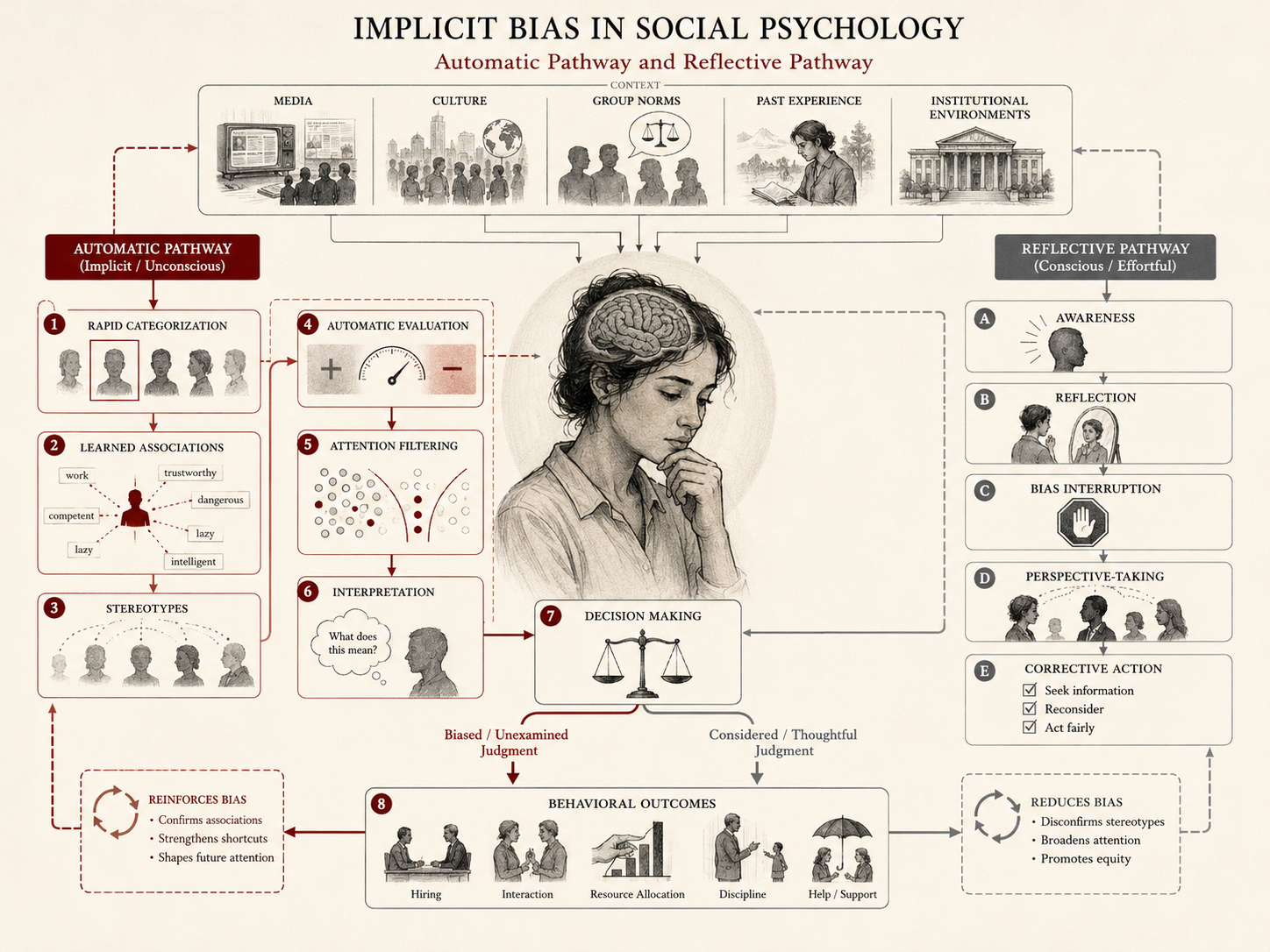
Research on implicit bias expanded rapidly beginning in the 1990s through work on implicit social cognition, automatic stereotyping, and the Implicit Association Test. It remains central to social cognition, intergroup relations, judgment and decision-making, organizational behavior, healthcare equity, education research, public administration, and institutional fairness.
Implicit bias connects directly to social cognition, heuristics and biases, stereotypes, prejudice, and discrimination, social identity theory, in-group bias, conformity and social influence, moral disengagement, contact hypothesis, and Institutions & Governance. Together these frameworks explain how categorization, culture, identity, group position, institutional design, and automatic evaluation shape unequal social judgment.
What is implicit bias?
Implicit bias refers to automatic associations or attitudes that influence perception, judgment, memory, interpretation, and behavior toward members of social groups, often outside conscious awareness. These associations may link groups with concepts such as competence, danger, warmth, trustworthiness, intelligence, criminality, dependence, authority, morality, professionalism, or deservingness.
Implicit bias differs from explicit prejudice. Explicit prejudice involves consciously endorsed attitudes, beliefs, or evaluations. Implicit bias may operate even when a person sincerely rejects prejudiced beliefs. A person may explicitly believe in equality while still having automatic associations shaped by repeated exposure to unequal cultural patterns.
Implicit bias also differs from stereotype knowledge. People may know that a stereotype exists in a culture without endorsing it. However, repeated cultural exposure can still make stereotypic associations cognitively accessible. Under some conditions, accessible associations may influence attention, interpretation, and judgment unless corrected by reflective control or institutional safeguards.
The concept matters because it complicates the simplistic distinction between “biased people” and “unbiased people.” Social cognition is not divided neatly between conscious fairness and unconscious neutrality. People think within environments saturated by social categories, status hierarchies, histories of exclusion, media images, institutional routines, and unequal expectations.
Implicit bias is therefore best understood as a social-cognitive process. It is individual in the sense that it operates through minds. It is social in the sense that the associations are learned from shared environments. It is institutional in the sense that its consequences depend on where discretionary judgment is allowed to shape outcomes.
Why implicit bias matters
Implicit bias matters because many socially consequential decisions are made under conditions that favor automatic judgment: limited time, incomplete information, stress, ambiguity, cognitive load, status assumptions, institutional routines, and pressure to act quickly. Hiring decisions, classroom discipline, patient assessment, threat perception, promotion evaluation, peer review, sentencing recommendations, customer service, performance appraisal, and public-benefit administration can all involve rapid judgment under uncertainty.
The significance of implicit bias is not that every unequal outcome can be traced to hidden prejudice. Inequality has many sources: explicit discrimination, wealth inequality, residential segregation, legal exclusion, institutional design, political power, cumulative advantage, historical violence, and unequal access to resources. Implicit bias is one mechanism within that larger ecology.
Its importance lies in showing how inequality can be reproduced even when explicit discriminatory intent is absent. Small judgment asymmetries, repeated across many decisions and many institutions, can accumulate. A single ambiguous evaluation may seem minor. Thousands of evaluations across hiring, discipline, treatment, lending, grading, policing, referral, mentoring, and promotion can become structurally consequential.
Implicit bias also matters because it reveals the limits of relying only on personal goodwill. Sincere egalitarian commitments are important, but they do not automatically erase automatic associations or redesign decision environments. Fairness requires reflective effort and institutional structure.
For social psychology, implicit bias is therefore a bridge concept. It links cognition, culture, identity, social hierarchy, institutional practice, and public policy. It asks how unequal worlds become encoded in ordinary perception and how decision systems can be changed so that automatic asymmetries do less harm.
Origins of implicit bias research
The modern study of implicit bias emerged most clearly in the 1990s as psychologists sought to understand forms of social cognition that could not be captured through self-report alone. A major milestone was Anthony Greenwald and Mahzarin Banaji’s 1995 essay on implicit social cognition, which argued that attitudes, stereotypes, self-concepts, and self-esteem can operate automatically and outside conscious introspection.
This shift was historically important because earlier research on prejudice often relied heavily on explicit attitudes. As open endorsement of discriminatory views became less publicly acceptable in many settings, social psychologists needed better ways to study how bias might persist in indirect, automatic, ambivalent, or context-sensitive forms.
Patricia Devine’s work on stereotypes and prejudice also helped establish the distinction between automatic activation and controlled response. Her research showed that culturally learned stereotypes may become automatically activated even among people who do not personally endorse them, while controlled processes can inhibit or correct biased responses.
The development of the Implicit Association Test by Greenwald, McGhee, and Schwartz gave researchers a practical tool for studying automatic associations through response latency. The IAT became one of the most widely known measures in social psychology and helped bring implicit cognition into public, institutional, and policy debate.
The field has since grown into a large, contested, and methodologically sophisticated research area. It includes support, critique, refinement, and disagreement. That debate is part of the field’s importance. Implicit bias research is strongest when it is precise about what is measured, cautious about individual diagnosis, and attentive to the gap between laboratory association and real-world outcome.
Cognitive foundations of implicit bias
Implicit bias emerges from the same cognitive architecture that makes rapid social judgment possible. Human beings constantly classify people, objects, events, and settings. Categorization allows people to navigate complex environments quickly. It reduces cognitive load and helps organize memory. But categorization also makes it possible for social meaning to attach to group membership.
Associative memory is central. Concepts that are repeatedly encountered together become easier to activate together. If cultural environments repeatedly associate certain groups with danger, dependence, incompetence, foreignness, criminality, poverty, authority, care, intelligence, beauty, or leadership, those associations can become cognitively accessible even when they are false, unjust, or explicitly rejected.
Implicit bias also depends on attention and interpretation. Automatic associations may influence what people notice, how ambiguous behavior is interpreted, what information is remembered, and which explanations seem plausible. The same behavior may be interpreted as confidence in one person and arrogance in another, as curiosity in one student and disruption in another, as pain in one patient and exaggeration in another.
These processes are not mysterious. They are ordinary cognitive processes operating in socially unequal environments. That is why implicit bias is so difficult to address through awareness alone. Awareness can help, but the deeper problem is that cognition is continuously shaped by cultural repetition and institutional practice.
Implicit bias belongs within the broader study of social cognition and heuristics and biases. It shows how cognitive efficiency can become socially asymmetric when the environment itself is saturated with unequal associations.
Automatic and controlled components of prejudice
A foundational distinction in implicit-bias research is the difference between automatic activation and controlled response. Automatic activation refers to the rapid accessibility of an association. Controlled response refers to reflective processes that can endorse, reject, inhibit, reinterpret, or correct an initial association.
This distinction helps explain how people can experience unwanted bias. A person may reject a stereotype at the level of principle but still experience automatic activation of culturally learned associations. The ethical question then becomes not only whether the association exists, but what the person and the institution do next.
Controlled processes are more likely to operate when people have time, motivation, accountability, clear standards, cognitive resources, and institutional support. They are less likely to operate under stress, fatigue, ambiguity, distraction, or high-speed discretionary decision-making.
This means that bias is not only a property of individuals. It is also a property of situations. A decision environment that demands rapid subjective judgment may amplify automatic associations. A decision environment that uses clear criteria, structured review, accountability, and time for reflection may reduce the influence of those associations.
The automatic-controlled distinction also avoids fatalism. Automatic activation does not determine behavior by itself. People can learn, correct, redesign procedures, use structured criteria, seek accountability, and build institutions that reduce the behavioral effect of biased associations.
The Implicit Association Test
One of the most widely used tools for studying implicit bias is the Implicit Association Test. The IAT measures the relative strength of associations between concepts, such as social categories, and evaluative or stereotype attributes, such as good, bad, competent, dangerous, scientific, or artistic.
The basic logic is response latency. Participants categorize stimuli using paired response keys. Responses tend to be faster when paired categories are more strongly associated in memory and slower when pairings are less strongly associated. For example, if a person responds faster when one social category shares a response key with positive words than when that category shares a key with negative words, researchers infer a stronger association between that category and positive evaluation.
The IAT became influential because it provided a practical method for studying associations that may not appear in self-report. People may be unwilling to report prejudice, unable to introspect automatic associations, or motivated to present themselves in egalitarian terms. Reaction-time methods provide a different window into social cognition.
The IAT is not the only implicit measure. Other approaches include evaluative priming, affective priming, the Go/No-Go Association Task, affect misattribution procedures, mouse-tracking, eye-tracking, and process-dissociation models. Each method has strengths and limitations.
The strongest use of the IAT is as a research instrument for examining associative patterns in cognition and group-level tendencies. It should be interpreted carefully at the level of individual diagnosis. A single score does not reveal a person’s moral essence, future behavior, or complete attitude structure.
How IAT results should and should not be interpreted
IAT results are often misunderstood. They should not be treated as a definitive verdict on whether a person is good or bad, prejudiced or unprejudiced, discriminatory or nondiscriminatory. They measure relative response-latency patterns under specific task conditions.
Several interpretive cautions are essential:
- The IAT measures associations, not hidden moral identity.
- IAT scores can vary across time, context, category, task design, and scoring procedure.
- The relationship between implicit measures and behavior is real but contested in size, meaning, and context.
- Implicit and explicit attitudes may diverge because they reflect different processes.
- A group-level pattern does not automatically diagnose any single individual.
- The social meaning of an IAT effect depends on the domain, task, population, and outcome studied.
At the same time, interpretive caution should not be confused with dismissal. The fact that an implicit measure is imperfect does not mean automatic associations are irrelevant. Many important psychological constructs are probabilistic, context-sensitive, and measured with error. The key is to use the instrument for the right purpose.
A careful interpretation treats IAT-style measures as evidence about associative accessibility. It then asks whether those associations predict judgment or behavior under specific conditions, whether they interact with explicit attitudes, whether they become more influential under time pressure or cognitive load, and whether institutional safeguards reduce their effects.
The best question is not “Does this test reveal who someone really is?” The better question is “Under what conditions do automatic associations influence judgment, and how can decision systems be designed to prevent unfair outcomes?”
Psychological mechanisms behind implicit bias
Several psychological mechanisms contribute to implicit bias, and they often operate together rather than separately.
- Automatic categorization — social perception begins with rapid classification into groups.
- Associative learning — repeated exposure to cultural narratives reinforces category-attribute pairings.
- Stereotype activation — group categories may activate culturally familiar beliefs or expectations.
- Attention filtering — people may notice stereotype-consistent information more readily.
- Interpretive ambiguity — the same behavior may be interpreted differently depending on group membership.
- Memory asymmetry — stereotype-consistent events may be remembered more easily or judged as more typical.
- Affect transfer — emotional associations attached to a group may influence evaluation before reflection.
- Cognitive load — limited attention can reduce the capacity to correct automatic responses.
- Motivated interpretation — people may preserve prior expectations by reinterpreting contradictory evidence.
- Normative reinforcement — group norms and institutional routines can stabilize automatic associations.
These mechanisms help explain why implicit bias can persist even among people who endorse fairness. Bias does not need to be consciously chosen to be cognitively real or socially consequential.
They also show why implicit bias is difficult to address through simple instruction. Telling people not to be biased may increase awareness, but awareness alone does not necessarily change exposure, attention, memory, time pressure, discretion, accountability, or institutional incentives.
Reducing the effect of implicit bias requires working at multiple levels: individual reflection, interpersonal contact, counter-stereotypical exposure, decision structure, accountability, data monitoring, and institutional redesign.
Formalizing implicit bias
Implicit bias can be represented as the strength of association between a social category and an evaluative or semantic attribute in memory. Let \(C\) denote a category and \(V\) an evaluative attribute:
A(C,V)
\]
Interpretation: \(A(C,V)\) represents the associative strength between a social category and an evaluative attribute.
Implicit bias is present when evaluative association strengths differ systematically across categories:
A(C_1,V^+) – A(C_2,V^+) \neq 0
\]
Interpretation: Bias appears when one category is more strongly associated with positive or negative attributes than another category.
The logic of the IAT can be expressed in latency terms. Let \(RT_{incong}\) be response time in an incongruent block and \(RT_{cong}\) response time in a congruent block:
D_i = \frac{\overline{RT}_{incong,i}-\overline{RT}_{cong,i}}{SD_i}
\]
Interpretation: A standardized D-score estimates the response-latency difference between incongruent and congruent pairings for participant \(i\).
Observed judgment can be modeled as a combination of explicit evaluation and implicit associative influence:
J_i=\alpha E_i+(1-\alpha)I_i+\varepsilon_i
\]
Interpretation: Observed judgment \(J_i\) reflects both explicit reflective evaluation \(E_i\) and implicit associative influence \(I_i\), with the balance shaped by context.
The influence of implicit associations may rise under conditions such as time pressure, ambiguity, or cognitive load:
P(B_i=1)=\operatorname{logit}^{-1}(\beta_0+\beta_1I_i+\beta_2L_i+\beta_3T_i-\beta_4A_i-\beta_5S_i)
\]
Interpretation: Biased outcome risk rises with implicit association \(I\), cognitive load \(L\), and time pressure \(T\), and falls with accountability \(A\) and structured decision support \(S\).
At the systems level, repeated small judgment differences can accumulate:
D_{sys}=\sum_{t=1}^{T} b_t
\]
Interpretation: System-level disparity \(D_{sys}\) can emerge from many small bias contributions \(b_t\) repeated across decisions.
This formal framing clarifies why implicit bias should be studied across levels. A small individual-level association may matter little in isolation, but repeated across many decision points it can become institutionally important.
Implicit bias in social and institutional systems
Implicit bias research has attracted sustained attention because it helps explain how unequal outcomes can persist within institutions even where explicit discrimination is publicly condemned. Institutions often rely on discretionary judgment: who seems promising, credible, threatening, difficult, talented, professional, compliant, risky, intelligent, deserving, or trustworthy.
Discretion is not inherently bad. Many decisions require judgment. But when discretion operates under ambiguity, time pressure, weak accountability, subjective criteria, or unequal cultural expectations, automatic associations can become consequential.
Institutional systems can amplify implicit bias in several ways:
- ambiguous criteria, where decision makers rely on vague concepts such as “fit,” “attitude,” “potential,” or “professionalism”;
- time pressure, where rapid judgment reduces reflective correction;
- cognitive load, where overloaded decision makers rely more heavily on heuristics;
- unequal priors, where historical inequalities shape expectations before evidence is reviewed;
- subjective evaluation, where unclear standards allow stereotypes to enter judgment;
- feedback loops, where earlier unequal outcomes influence later expectations;
- data blindness, where institutions do not monitor disparities across decisions;
- lack of accountability, where decision makers do not need to explain or justify judgments.
This is why implicit bias cannot be reduced to private cognition alone. Institutions shape whether automatic associations are corrected, amplified, ignored, or translated into outcomes.
A hiring committee with structured rubrics, calibrated criteria, independent scoring, and review of disparities creates a different decision environment than one that relies on unstructured impressions. A clinic with pain protocols, decision support, patient feedback, and outcome monitoring creates a different environment than one that relies entirely on rushed subjective assessment.
Implicit bias becomes socially consequential when cognition meets institutional discretion.
Healthcare, pain, credibility, and treatment
Healthcare has become one of the most important domains for implicit-bias research because clinical decisions often occur under uncertainty, urgency, cognitive load, and unequal histories of trust. Providers may need to interpret pain, credibility, adherence, risk, communication style, symptoms, or treatment preferences quickly.
Implicit associations can influence whether a patient is perceived as exaggerating, noncompliant, drug-seeking, resilient, confused, difficult, trustworthy, or in need of urgent care. These judgments may affect pain management, referral, diagnostic attention, communication quality, and treatment recommendations.
Healthcare inequality is not caused by implicit bias alone. It also reflects insurance structures, access barriers, residential segregation, environmental exposure, historical abuse, medical racism, language barriers, disability discrimination, poverty, and uneven institutional resources. But implicit bias may operate within clinical encounters and organizational routines as one mechanism among many.
The ethical stakes are high because healthcare decisions affect suffering, dignity, survival, and trust. A small interpretive difference in how pain or credibility is judged can have real consequences.
Mitigation in healthcare should therefore emphasize structure: standardized protocols, shared decision-making, patient-reported outcomes, diagnostic checklists, interpreter access, equity dashboards, clinical audit, culturally responsive communication, and accountability for disparities. Individual awareness is not enough if the clinical environment continues to reward speed, subjective impression, and unexamined discretion.
Education, discipline, and expectations
Education is another major domain in which implicit bias can shape outcomes. Teachers, administrators, and institutions make repeated judgments about ability, effort, discipline, attention, curiosity, disruption, maturity, language, family involvement, and future potential.
Implicit bias can influence how the same behavior is interpreted across students. A student may be seen as energetic or disruptive, curious or defiant, advanced or arrogant, quiet or disengaged, struggling or lazy, depending on racialized, gendered, classed, linguistic, disability-related, or cultural expectations.
These interpretations matter because educational trajectories are cumulative. Small differences in attention, encouragement, discipline, placement, recommendation, gifted identification, special education referral, or teacher expectation can compound across years.
Educational bias is also institutional. School funding, tracking, discipline policy, curriculum, representation, language access, disability accommodation, and segregation shape the context in which teacher judgment operates. Implicit bias research should never be used to reduce educational inequality to individual teacher psychology alone.
Better educational design includes structured discipline review, transparent criteria, restorative practices, culturally sustaining pedagogy, representative curriculum, teacher reflection, data monitoring, family partnership, and mechanisms for students to contest unfair interpretation.
The goal is not to accuse educators as individuals. The goal is to build educational environments where ambiguous behavior is interpreted carefully, where expectations are not socially prewritten, and where students are not forced to carry the burden of others’ associations.
Employment, leadership, and evaluation
Employment decisions are highly vulnerable to implicit bias because they often rely on subjective judgments: cultural fit, leadership presence, communication style, confidence, assertiveness, likability, professionalism, potential, polish, and commitment. These criteria can function as channels through which social expectations enter evaluation.
Implicit associations may shape whose ambition is interpreted as leadership, whose assertiveness is interpreted as aggression, whose quietness is interpreted as thoughtfulness or lack of confidence, whose accent is interpreted as expertise or deficiency, whose caregiving is interpreted as responsibility or lack of commitment, and whose background is interpreted as “nontraditional” rather than valuable.
Bias can appear across the full employment cycle:
- job description language;
- resume screening;
- interview evaluation;
- salary negotiation;
- assignment allocation;
- mentorship and sponsorship;
- performance review;
- promotion decisions;
- leadership identification;
- disciplinary processes;
- layoff decisions.
Workplace interventions should therefore focus on decision architecture. Structured interviews, job-relevant criteria, blinded review where appropriate, calibrated evaluation, documented decision reasons, diverse review panels, salary transparency, promotion rubrics, accountability for disparities, and regular audit are more reliable than generic awareness training alone.
Implicit bias becomes less consequential when institutions reduce unstructured discretion and require decision makers to connect judgments to evidence.
Law, public administration, and policy decisions
Implicit bias also matters for law, public administration, and policy because state institutions distribute rights, burdens, resources, penalties, credibility, and protection. Decisions about risk, threat, deservingness, compliance, fraud, neglect, danger, eligibility, and credibility are deeply consequential.
Public systems often claim neutrality through rules, forms, algorithms, and procedures. Yet discretion remains present in interpretation, enforcement, prioritization, documentation, exception handling, and credibility assessment. If automatic associations shape those discretionary points, inequality can persist under the appearance of neutral administration.
Examples include welfare eligibility judgments, immigration review, policing, sentencing recommendations, child welfare investigation, public housing enforcement, school discipline, public health communication, and emergency response. In each case, bias may combine with law, policy, resource scarcity, administrative burden, and political power.
Implicit bias should not be used to individualize structural injustice. A discriminatory policy remains discriminatory even if individual administrators are well intentioned. But implicit bias can help explain how unequal policy systems are implemented, normalized, or intensified through everyday judgment.
Fair public administration requires more than neutral language. It requires procedural transparency, appeal rights, data monitoring, participatory design, community oversight, clear criteria, anti-retaliation protections, and attention to how categories are interpreted in practice.
Implicit bias in digital and algorithmic environments
Implicit bias also appears in digital and algorithmic environments. Search systems, recommendation engines, automated screening tools, image classifiers, hiring platforms, predictive models, risk scores, and generative systems may reproduce social associations found in training data, labels, user behavior, institutional records, and historical patterns.
Algorithmic bias is not identical to implicit bias, but the two are related. Human associations can enter datasets. Institutional decisions can become training labels. Unequal historical outcomes can be treated as predictive signal. Automated systems can then scale and stabilize patterns that originated in biased human judgment or unequal institutional practice.
Digital systems can also shape implicit associations through repeated exposure. Ranking, autocomplete, recommendation, image search, and platform visibility can reinforce which groups are associated with authority, danger, beauty, competence, criminality, leadership, care, or expertise.
The risk is not only that machines are biased. The risk is that automated systems can make socially learned associations appear objective, technical, or inevitable. A biased score may carry authority precisely because it is produced by a system rather than a person.
Mitigation requires documentation, bias testing, representative evaluation, model cards, dataset audits, participatory review, domain-specific fairness metrics, human contestability, and attention to the institutional context in which automated outputs are used. Algorithmic systems should not become a way of laundering implicit or structural bias through technical language.
Debates, critiques, and methodological disputes
Implicit bias research remains influential, but it is also contested. The debates are important because they sharpen the concept and prevent overclaiming.
One major debate concerns prediction. To what extent do implicit measures predict real-world behavior? Meta-analyses have reached different conclusions depending on inclusion criteria, outcomes, domains, and analytic choices. Some find meaningful relationships between implicit measures and behavior; others argue that predictive validity is often small, especially for individual-level prediction.
A second debate concerns interpretation. Does an IAT score measure a personal attitude, cultural knowledge, task familiarity, salience, associative accessibility, extrapersonal association, or some combination of these? Different theoretical accounts lead to different uses of the measure.
A third debate concerns intervention. Can implicit bias be changed durably? Many short-term interventions produce immediate shifts in implicit measures, but the durability of those effects is often limited. This has led many scholars to emphasize mitigation of biased outcomes rather than assuming that associations can be permanently trained away through brief workshops.
A fourth debate concerns institutional uptake. Some organizations adopted implicit-bias training faster than the evidence justified. Awareness training can be useful, but it can also become symbolic if it is not paired with changes to decision systems, accountability, data monitoring, leadership incentives, and material conditions.
These critiques do not make implicit bias irrelevant. They make precision necessary. The strongest view treats implicit bias as one mechanism among many, useful for understanding automatic social cognition but insufficient as a complete theory of inequality.
Can implicit bias be reduced?
Researchers have explored many interventions designed to reduce implicit bias or change its behavioral consequences. These include counter-stereotypical exposure, perspective-taking, individuation, intergroup contact, implementation intentions, stereotype replacement, self-regulation training, accountability, structured decision-making, and bias-literacy approaches.
The evidence is mixed and should be interpreted carefully. Some interventions can shift implicit measures in the short term. Some broader habit-breaking interventions have shown more durable promise under specific conditions. But many brief interventions do not reliably produce lasting change, especially after delays.
This pattern suggests that implicit bias is not easily eliminated through one-time training. Automatic associations are learned through repeated exposure and social reinforcement. Changing them may require sustained counter-learning, meaningful contact, motivation, structural support, and repeated practice.
It is also important to distinguish reducing implicit associations from reducing biased outcomes. An institution may reduce bias in decisions by changing procedures even if individual associations remain imperfect. For example, structured interviews can reduce biased hiring effects by limiting unstructured impression. Clinical protocols can reduce unequal treatment by requiring consistent assessment. Blind review can reduce exposure to irrelevant category cues.
The most practical goal is often not to purify cognition, but to reduce opportunities for automatic asymmetry to shape decisions. Bias mitigation should therefore combine individual learning with institutional redesign.
Bias mitigation and institutional design
Bias mitigation is strongest when it changes decision environments. Awareness can help people recognize risk, but institutions need structures that reduce the impact of automatic judgment.
Useful safeguards include:
- structured criteria, so decisions are tied to explicit evidence rather than vague impressions;
- rubrics and scoring guides, especially in hiring, grading, evaluation, and promotion;
- blind review, when category information is irrelevant and can be removed;
- accountability requirements, where decision makers explain reasons before outcomes are finalized;
- calibration sessions, so evaluators align criteria before reviewing cases;
- decision logs, so patterns can be audited later;
- equity dashboards, to monitor disparities across stages;
- appeal and review mechanisms, so affected people can contest decisions;
- counter-stereotypical exposure, to change repeated cultural associations over time;
- intergroup contact, when contact is equal-status, cooperative, supported, and meaningful;
- time for reflection, especially in high-stakes ambiguous judgments;
- community oversight, where institutional decisions affect marginalized groups.
Mitigation should also avoid common failures. Generic training without institutional change can become performative. Shaming participants can produce defensiveness. Treating bias as only individual can obscure structural injustice. Treating algorithms as neutral can hide encoded inequality.
A stronger approach asks where bias can enter the decision chain and then redesigns that chain. The point is not simply to make decision makers feel more enlightened. The point is to make unfair outcomes less likely.
Power, inequality, and marginalized groups
Implicit bias has different consequences depending on power. An automatic association held by someone with little institutional authority is not equivalent to an association held by a teacher, clinician, judge, manager, police officer, loan officer, landlord, admissions officer, or algorithm designer. Bias becomes more consequential when it is attached to decision power.
Marginalized groups are often forced to live under the accumulated weight of others’ associations. They may be watched more closely, believed less readily, interpreted less generously, punished more severely, mentored less often, promoted more slowly, treated as less competent, or expected to perform emotional labor to counter stereotypes they did not create.
This is why implicit bias should not be framed as a problem of interpersonal awkwardness alone. It is tied to historical injustice, racial hierarchy, gender hierarchy, disability discrimination, class stigma, anti-immigrant politics, religious prejudice, colonial representation, and unequal institutional authority.
At the same time, implicit bias should not be used to soften or depoliticize explicit discrimination. Some inequality is produced by openly hostile ideology, exclusionary policy, material deprivation, and deliberate power. Implicit bias is not a polite substitute for naming racism, sexism, ableism, classism, xenophobia, homophobia, Islamophobia, antisemitism, or other forms of domination.
The concept is most useful when it deepens accountability. It shows that injustice can operate through routine perception as well as explicit hostility, through ordinary procedure as well as open exclusion, and through institutional design as well as private belief.
Implicit bias in the architecture of social influence
Within the broader architecture of social influence, implicit bias occupies a critical position. Social cognition explains the cognitive structures through which people interpret the social world. Stereotypes and prejudice explain how generalized group beliefs become evaluative and exclusionary. In-group bias explains how loyalty, trust, warmth, and benefit of the doubt become unevenly distributed. Implicit bias adds the mechanism through which these processes can operate rapidly, automatically, and outside explicit intention.
Implicit bias also intersects with conformity. People learn associations from group norms and public narratives. It intersects with obedience, authority, and social power because institutional authorities decide which judgments matter. It intersects with groupthink when organizations suppress evidence of unequal outcomes. It intersects with moral disengagement when people explain away harm as neutral procedure.
Seen in this wider framework, implicit bias is not a stand-alone theory of injustice. It is one mechanism through which social categories become behaviorally active in perception and judgment.
Its power lies precisely in the fact that it may operate quietly, routinely, and without overt ideological declaration. It shows how inequality can move through attention, interpretation, memory, confidence, and discretion before anyone experiences themselves as acting with discriminatory intent.
Limits and interpretive cautions
Implicit bias is a powerful concept, but it must be used carefully. Several cautions matter.
- Do not treat implicit bias as a complete explanation for inequality.
- Do not treat IAT scores as definitive moral diagnoses of individuals.
- Do not assume implicit measures always strongly predict behavior in every setting.
- Do not use implicit bias to avoid naming explicit discrimination or structural injustice.
- Do not assume short training sessions produce durable change.
- Do not treat awareness as equivalent to institutional reform.
- Do not reduce marginalized communities to passive victims of others’ cognition.
- Do not ignore power: the consequences of bias depend on authority and institutional position.
- Do not treat algorithms or structured systems as automatically neutral.
- Do not confuse cultural knowledge of a stereotype with personal endorsement.
The best use of implicit bias is precise and contextual. It asks what association is being measured, how reliable the measure is, what outcome is being predicted, what decision context is involved, what institutional safeguards exist, and whether disparities persist after those safeguards are introduced.
Implicit bias research should deepen moral and institutional seriousness. It should not become a simplistic test, a corporate ritual, or a way to individualize structural injustice.
Measurement, data, and research design
Implicit-bias research can use response-latency tasks, IAT-style designs, evaluative priming, affect misattribution procedures, eye-tracking, mouse-tracking, vignette experiments, audit studies, field experiments, organizational records, clinical decision data, and computational simulations of cumulative disparity.
Key variables include:
- participant, session, group, scenario, site, and institutional identifiers;
- institutional context;
- experimental condition;
- target category;
- attribute category;
- congruent and incongruent blocks;
- trial-level response time;
- accuracy;
- explicit attitude;
- judgment score;
- behavioral outcome;
- cognitive load;
- accountability;
- time pressure;
- counter-stereotypical exposure;
- perspective-taking condition;
- structured decision support;
- follow-up timing;
- D-score or latency-difference measure;
- disparity outcome across repeated decisions.
Strong designs should report exclusion criteria, latency trimming rules, scoring algorithms, reliability estimates, preregistered hypotheses, and sensitivity analyses. They should distinguish trial-level response time from participant-level scores. They should avoid overinterpreting single measurements and should test whether implicit measures predict meaningful outcomes beyond explicit attitudes.
Intervention studies should measure durability. Immediate post-intervention change is not enough. Researchers should test whether effects remain after delay and whether behavioral outcomes change, not only whether a response-latency score shifts.
Institutional research should connect implicit measures to decision architecture. The key question is not merely whether individuals show associations, but whether decision systems allow those associations to shape outcomes.
R code for implicit bias research
The following R workflow models IAT-style response latency, participant-level D-scores, judgment outcomes, behavioral outcomes, and intervention conditions. It is designed for ethical, simulated, or properly approved implicit-bias research, not for diagnostic labeling of individual participants.
# Install packages if needed:
# pak::pak(c("tidyverse", "lme4", "lmerTest", "emmeans", "broom.mixed", "performance"))

library(tidyverse)
library(lme4)
library(lmerTest)
library(emmeans)
library(broom.mixed)
library(performance)

# Expected columns:
# participant, session_id, group_id, scenario_id, site_id,
# institution_context, condition, trial, target_category,
# attribute_category, congruent_block, response_time_ms,
# accuracy, explicit_attitude, judgment_score, behavioral_outcome,
# cognitive_load, accountability, time_pressure,
# counter_stereotypical_exposure, perspective_taking,
# structured_decision_support, followup_days

dat <- read_csv("implicit_bias_trials.csv") %>%
  mutate(
    participant = factor(participant),
    session_id = factor(session_id),
    group_id = factor(group_id),
    scenario_id = factor(scenario_id),
    site_id = factor(site_id),
    institution_context = factor(institution_context),
    condition = factor(condition),
    congruent_block = as.integer(congruent_block),
    accuracy = as.integer(accuracy),
    log_response_time = log(response_time_ms),
    automaticity_risk_index = (
      cognitive_load +
      time_pressure -
      accountability -
      structured_decision_support
    ) / 4,
    mitigation_index = (
      accountability +
      counter_stereotypical_exposure +
      perspective_taking +
      structured_decision_support
    ) / 4
  )

rt_dat <- dat %>%
  filter(response_time_ms >= 250, accuracy == 1)

d_scores <- rt_dat %>%
  group_by(participant, condition, congruent_block) %>%
  summarise(
    mean_rt = mean(response_time_ms, na.rm = TRUE),
    .groups = "drop"
  ) %>%
  pivot_wider(
    names_from = congruent_block,
    values_from = mean_rt,
    names_prefix = "block_"
  ) %>%
  left_join(
    rt_dat %>%
      group_by(participant, condition) %>%
      summarise(
        pooled_sd = sd(response_time_ms, na.rm = TRUE),
        .groups = "drop"
      ),
    by = c("participant", "condition")
  ) %>%
  mutate(
    d_score = (block_0 - block_1) / pooled_sd
  )

print(d_scores)

summary_table <- dat %>%
  group_by(condition, institution_context) %>%
  summarise(
    n = n(),
    participants = n_distinct(participant),
    mean_rt = mean(response_time_ms, na.rm = TRUE),
    accuracy_rate = mean(accuracy, na.rm = TRUE),
    mean_explicit_attitude = mean(explicit_attitude, na.rm = TRUE),
    mean_judgment = mean(judgment_score, na.rm = TRUE),
    mean_behavioral_outcome = mean(behavioral_outcome, na.rm = TRUE),
    mean_automaticity_risk = mean(automaticity_risk_index, na.rm = TRUE),
    mean_mitigation = mean(mitigation_index, na.rm = TRUE),
    .groups = "drop"
  )

print(summary_table)

latency_model <- lmer(
  log_response_time ~
    congruent_block +
    explicit_attitude +
    cognitive_load +
    accountability +
    time_pressure +
    counter_stereotypical_exposure +
    perspective_taking +
    structured_decision_support +
    condition +
    institution_context +
    (1 + congruent_block | participant) +
    (1 | scenario_id),
  data = rt_dat,
  REML = FALSE
)

summary(latency_model)
emmeans(latency_model, ~ congruent_block)

judgment_model <- lmer(
  judgment_score ~
    congruent_block +
    explicit_attitude +
    automaticity_risk_index +
    mitigation_index +
    condition +
    institution_context +
    (1 | participant) +
    (1 | scenario_id),
  data = dat,
  REML = FALSE
)

summary(judgment_model)

behavior_model <- lmer(
  behavioral_outcome ~
    congruent_block +
    explicit_attitude +
    judgment_score +
    automaticity_risk_index +
    mitigation_index +
    condition +
    institution_context +
    (1 | participant) +
    (1 | scenario_id),
  data = dat,
  REML = FALSE
)

summary(behavior_model)

accuracy_model <- glmer(
  accuracy ~
    congruent_block +
    cognitive_load +
    time_pressure +
    accountability +
    structured_decision_support +
    condition +
    institution_context +
    (1 | participant) +
    (1 | scenario_id),
  data = dat,
  family = binomial(),
  control = glmerControl(optimizer = "bobyqa")
)

summary(accuracy_model)

d_summary <- d_scores %>%
  group_by(condition) %>%
  summarise(
    n = n(),
    mean_d_score = mean(d_score, na.rm = TRUE),
    sd_d_score = sd(d_score, na.rm = TRUE),
    .groups = "drop"
  )

write_csv(summary_table, "implicit_bias_summary.csv")
write_csv(d_scores, "implicit_bias_participant_d_scores.csv")
write_csv(d_summary, "implicit_bias_d_score_summary.csv")
write_csv(
  tidy(latency_model, effects = "fixed", conf.int = TRUE),
  "implicit_bias_latency_coefficients.csv"
)

ggplot(
  d_summary,
  aes(x = reorder(condition, mean_d_score), y = mean_d_score, group = 1)
) +
  geom_line() +
  geom_point() +
  coord_flip() +
  labs(
    title = "Mean implicit-association D-score by condition",
    x = "Condition",
    y = "Mean D-score"
  ) +
  theme_minimal()
This workflow supports implicit-bias research by separating response latency, congruent and incongruent task blocks, explicit attitude, cognitive load, accountability, time pressure, mitigation conditions, judgment outcomes, and behavioral outcomes.
Python code for implicit bias research
The Python workflow below parallels the R analysis and adds a cumulative institutional-disparity simulation to show how small repeated judgment asymmetries can become consequential across many decisions.
import numpy as np
import pandas as pd
import statsmodels.formula.api as smf
import statsmodels.api as sm
import matplotlib.pyplot as plt

# Expected columns:
# participant, session_id, group_id, scenario_id, site_id,
# institution_context, condition, trial, target_category,
# attribute_category, congruent_block, response_time_ms,
# accuracy, explicit_attitude, judgment_score, behavioral_outcome,
# cognitive_load, accountability, time_pressure,
# counter_stereotypical_exposure, perspective_taking,
# structured_decision_support, followup_days

df = pd.read_csv("implicit_bias_trials.csv")

for col in [
    "participant",
    "session_id",
    "group_id",
    "scenario_id",
    "site_id",
    "institution_context",
    "condition",
    "target_category",
    "attribute_category",
]:
    df[col] = df[col].astype("category")

df["congruent_block"] = df["congruent_block"].astype(int)
df["accuracy"] = df["accuracy"].astype(int)
df["log_response_time"] = np.log(df["response_time_ms"])

df["automaticity_risk_index"] = (
    df["cognitive_load"]
    + df["time_pressure"]
    - df["accountability"]
    - df["structured_decision_support"]
) / 4

df["mitigation_index"] = (
    df["accountability"]
    + df["counter_stereotypical_exposure"]
    + df["perspective_taking"]
    + df["structured_decision_support"]
) / 4

rt_df = df[(df["response_time_ms"] >= 250) & (df["accuracy"] == 1)].copy()

means = (
    rt_df.groupby(
        ["participant", "condition", "congruent_block"],
        observed=True
    )["response_time_ms"]
    .mean()
    .reset_index()
)

wide = means.pivot_table(
    index=["participant", "condition"],
    columns="congruent_block",
    values="response_time_ms"
).reset_index()

wide.columns = ["participant", "condition", "mean_incongruent", "mean_congruent"]

pooled_sd = (
    rt_df.groupby(["participant", "condition"], observed=True)["response_time_ms"]
    .std()
    .reset_index(name="pooled_sd")
)

d_scores = wide.merge(pooled_sd, on=["participant", "condition"], how="left")
d_scores["d_score"] = (
    d_scores["mean_incongruent"] - d_scores["mean_congruent"]
) / d_scores["pooled_sd"].replace(0, np.nan)

print(d_scores.head())

summary_table = (
    df.groupby(["condition", "institution_context"], observed=True)
    .agg(
        n=("participant", "size"),
        participants=("participant", "nunique"),
        mean_rt=("response_time_ms", "mean"),
        accuracy_rate=("accuracy", "mean"),
        mean_explicit_attitude=("explicit_attitude", "mean"),
        mean_judgment=("judgment_score", "mean"),
        mean_behavioral_outcome=("behavioral_outcome", "mean"),
        mean_automaticity_risk=("automaticity_risk_index", "mean"),
        mean_mitigation=("mitigation_index", "mean"),
    )
    .reset_index()
)

print(summary_table)

latency_model = smf.ols(
    "log_response_time ~ congruent_block + explicit_attitude "
    "+ cognitive_load + accountability + time_pressure "
    "+ counter_stereotypical_exposure + perspective_taking "
    "+ structured_decision_support + condition + institution_context",
    data=rt_df
)

latency_result = latency_model.fit(
    cov_type="cluster",
    cov_kwds={"groups": rt_df["participant"]}
)

print(latency_result.summary())

judgment_model = smf.ols(
    "judgment_score ~ congruent_block + explicit_attitude "
    "+ automaticity_risk_index + mitigation_index "
    "+ condition + institution_context",
    data=df
)

judgment_result = judgment_model.fit(
    cov_type="cluster",
    cov_kwds={"groups": df["participant"]}
)

print(judgment_result.summary())

behavior_model = smf.ols(
    "behavioral_outcome ~ congruent_block + explicit_attitude "
    "+ judgment_score + automaticity_risk_index "
    "+ mitigation_index + condition + institution_context",
    data=df
)

behavior_result = behavior_model.fit(
    cov_type="cluster",
    cov_kwds={"groups": df["participant"]}
)

print(behavior_result.summary())

accuracy_model = smf.glm(
    "accuracy ~ congruent_block + cognitive_load + time_pressure "
    "+ accountability + structured_decision_support "
    "+ condition + institution_context",
    data=df,
    family=sm.families.Binomial()
)

accuracy_result = accuracy_model.fit(
    cov_type="cluster",
    cov_kwds={"groups": df["participant"]}
)

print(accuracy_result.summary())

def simulate_institutional_disparity(
    decisions=10000,
    seed=42
):
    rng = np.random.default_rng(seed)
    rows = []

    scenarios = [
        "unstructured_discretion",
        "time_pressure",
        "accountability",
        "structured_decision_support",
        "combined_mitigation"
    ]

    for scenario in scenarios:
        cumulative = 0.0

        for decision in range(1, decisions + 1):
            if scenario == "unstructured_discretion":
                bias = rng.normal(0.018, 0.060)
            elif scenario == "time_pressure":
                bias = rng.normal(0.032, 0.070)
            elif scenario == "accountability":
                bias = rng.normal(0.010, 0.050)
            elif scenario == "structured_decision_support":
                bias = rng.normal(0.004, 0.040)
            else:
                bias = rng.normal(0.002, 0.035)

            cumulative += bias

            if decision % 100 == 0:
                rows.append({
                    "scenario": scenario,
                    "decision": decision,
                    "mean_bias_contribution": bias,
                    "cumulative_disparity": cumulative,
                })

    return pd.DataFrame(rows)

simulation = simulate_institutional_disparity()

d_summary = (
    d_scores.groupby("condition", observed=True)
    .agg(
        n=("participant", "count"),
        mean_d_score=("d_score", "mean"),
        sd_d_score=("d_score", "std"),
    )
    .reset_index()
)

fig, ax = plt.subplots(figsize=(8, 5))

ordered = d_summary.sort_values("mean_d_score")
ax.plot(
    ordered["mean_d_score"],
    ordered["condition"].astype(str),
    marker="o"
)

ax.set_xlabel("Mean D-score")
ax.set_ylabel("Condition")
ax.set_title("Mean implicit-association D-score by condition")
plt.tight_layout()
plt.show()

summary_table.to_csv("implicit_bias_summary.csv", index=False)
d_scores.to_csv("implicit_bias_participant_d_scores.csv", index=False)
d_summary.to_csv("implicit_bias_d_score_summary.csv", index=False)
simulation.to_csv("implicit_bias_institutional_disparity_simulation.csv", index=False)
This Python workflow supports implicit-bias research by modeling response latency, D-score-style association measures, explicit attitude, judgment, behavioral outcomes, intervention conditions, and cumulative institutional disparity.
Research data architecture
Implicit-bias research often depends on relational data: participants, sessions, trials, target categories, attribute categories, congruent and incongruent blocks, response latency, accuracy, explicit attitudes, judgment outcomes, behavioral outcomes, cognitive load, accountability, time pressure, counter-stereotypical exposure, perspective-taking, structured decision support, institutional context, and follow-up timing.
The companion GitHub repository includes a full SQL schema and example analytical queries for researchers who want to reproduce, inspect, or extend the data model. Keeping executable SQL in GitHub avoids WordPress hosting restrictions while preserving the technical infrastructure for readers who want to use the article as a reproducible research workflow.
The research data model supports questions such as:
- Do incongruent blocks produce longer response latency than congruent blocks?
- Do implicit-association scores predict judgment beyond explicit attitudes?
- Does time pressure increase the behavioral effect of implicit association?
- Does cognitive load reduce corrective control?
- Does accountability reduce biased judgment?
- Does structured decision support reduce outcome disparity?
- Do short-term interventions persist after delay?
- Do institutional contexts differ in automaticity risk?
- Do repeated small bias contributions accumulate into measurable disparity?
View the SQL research data architecture in GitHub.
GitHub repository
The companion repository provides reusable code and research scaffolding for studying implicit bias, automatic social cognition, IAT-style response latency, explicit attitudes, judgment outcomes, intervention design, and institutional disparity.
Why implicit bias matters for social psychology
Implicit bias matters because it shows how social inequality can enter cognition without announcing itself as explicit hostility. People do not judge from nowhere. They judge from within cultures, institutions, histories, media systems, group positions, and repeated patterns of association.
The concept transformed social psychology by showing that prejudice and discrimination cannot be understood only through conscious belief. Automatic associations, stereotype activation, attention, interpretation, memory, time pressure, and discretionary judgment all matter.
At the same time, implicit bias must be used carefully. It is not a complete explanation for injustice, not a substitute for structural analysis, and not a simple diagnostic label for individuals. Its value lies in showing how cognition and institutions interact: how unequal environments shape automatic associations, and how decision systems can either amplify or interrupt those associations.
Read alongside social cognition, stereotypes, prejudice, and discrimination, in-group bias, conformity and social influence, moral disengagement, contact hypothesis, Behavioral Economics, and Institutions & Governance, implicit bias becomes more than a hidden-attitude concept. It becomes a framework for studying how social power moves through ordinary perception, and how institutions can be redesigned so that automatic asymmetry does not become routine injustice.
Related articles
- Social Psychology
- Social Cognition
- Heuristics and Biases
- Stereotypes, Prejudice, and Discrimination
- Social Identity Theory
- In-Group Bias
- Conformity and Social Influence
- Moral Disengagement
- Contact Hypothesis
- Behavioral Economics
- Institutions & Governance
- Stewardship & Ethics
Further reading
- Blair, I.V. (2002) ‘The malleability of automatic stereotypes and prejudice’, Personality and Social Psychology Review, 6(3), pp. 242–261. Available at: https://doi.org/10.1207/S15327957PSPR0603_8.
- Devine, P.G. (1989) ‘Stereotypes and prejudice: Their automatic and controlled components’, Journal of Personality and Social Psychology, 56(1), pp. 5–18. Available at: https://doi.org/10.1037/0022-3514.56.1.5.
- Devine, P.G., Forscher, P.S., Austin, A.J. and Cox, W.T.L. (2012) ‘Long-term reduction in implicit race bias: A prejudice habit-breaking intervention’, Journal of Experimental Social Psychology, 48(6), pp. 1267–1278. Available at: https://doi.org/10.1016/j.jesp.2012.06.003.
- FitzGerald, C. and Hurst, S. (2017) ‘Implicit bias in healthcare professionals: A systematic review’, BMC Medical Ethics, 18, 19. Available at: https://doi.org/10.1186/s12910-017-0179-8.
- Forscher, P.S. et al. (2019) ‘A meta-analysis of procedures to change implicit measures’, Journal of Personality and Social Psychology, 117(3), pp. 522–559. Available at: https://doi.org/10.1037/pspa0000160.
- Greenwald, A.G. and Banaji, M.R. (1995) ‘Implicit social cognition: Attitudes, self-esteem, and stereotypes’, Psychological Review, 102(1), pp. 4–27. Available at: https://doi.org/10.1037/0033-295X.102.1.4.
- Greenwald, A.G., McGhee, D.E. and Schwartz, J.L.K. (1998) ‘Measuring individual differences in implicit cognition: The Implicit Association Test’, Journal of Personality and Social Psychology, 74(6), pp. 1464–1480. Available at: https://doi.org/10.1037/0022-3514.74.6.1464.
- Greenwald, A.G., Nosek, B.A. and Banaji, M.R. (2003) ‘Understanding and using the Implicit Association Test: I. An improved scoring algorithm’, Journal of Personality and Social Psychology, 85(2), pp. 197–216. Available at: https://doi.org/10.1037/0022-3514.85.2.197.
- Greenwald, A.G. et al. (2022) ‘Best research practices for using the Implicit Association Test’, Behavior Research Methods, 54, pp. 1161–1180. Available at: https://doi.org/10.3758/s13428-021-01624-3.
- Hall, W.J. et al. (2015) ‘Implicit racial/ethnic bias among health care professionals and its influence on health care outcomes: A systematic review’, American Journal of Public Health, 105(12), pp. e60–e76. Available at: https://doi.org/10.2105/AJPH.2015.302903.
- Kurdi, B. et al. (2019) ‘Relationship between the Implicit Association Test and intergroup behavior: A meta-analysis’, American Psychologist, 74(5), pp. 569–586. Available at: https://doi.org/10.1037/amp0000364.
- Lai, C.K. et al. (2014) ‘Reducing implicit racial preferences: I. A comparative investigation of 17 interventions’, Journal of Experimental Psychology: General, 143(4), pp. 1765–1785. Available at: https://doi.org/10.1037/a0036260.
- Lai, C.K. et al. (2016) ‘Reducing implicit racial preferences: II. Intervention effectiveness across time’, Journal of Experimental Psychology: General, 145(8), pp. 1001–1016. Available at: https://doi.org/10.1037/xge0000179.
- Oswald, F.L., Mitchell, G., Blanton, H., Jaccard, J. and Tetlock, P.E. (2013) ‘Predicting ethnic and racial discrimination: A meta-analysis of IAT criterion studies’, Journal of Personality and Social Psychology, 105(2), pp. 171–192. Available at: https://doi.org/10.1037/a0032734.
- Project Implicit (n.d.) ‘About the IAT’. Available at: https://implicit.harvard.edu/implicit/iatdetails.html.
References
- Blair, I.V. (2002) ‘The malleability of automatic stereotypes and prejudice’, Personality and Social Psychology Review, 6(3), pp. 242–261. Available at: https://doi.org/10.1207/S15327957PSPR0603_8.
- Devine, P.G. (1989) ‘Stereotypes and prejudice: Their automatic and controlled components’, Journal of Personality and Social Psychology, 56(1), pp. 5–18. Available at: https://doi.org/10.1037/0022-3514.56.1.5.
- Devine, P.G., Forscher, P.S., Austin, A.J. and Cox, W.T.L. (2012) ‘Long-term reduction in implicit race bias: A prejudice habit-breaking intervention’, Journal of Experimental Social Psychology, 48(6), pp. 1267–1278. Available at: https://doi.org/10.1016/j.jesp.2012.06.003.
- FitzGerald, C. and Hurst, S. (2017) ‘Implicit bias in healthcare professionals: A systematic review’, BMC Medical Ethics, 18, 19. Available at: https://doi.org/10.1186/s12910-017-0179-8.
- Forscher, P.S. et al. (2019) ‘A meta-analysis of procedures to change implicit measures’, Journal of Personality and Social Psychology, 117(3), pp. 522–559. Available at: https://doi.org/10.1037/pspa0000160.
- Greenwald, A.G. and Banaji, M.R. (1995) ‘Implicit social cognition: Attitudes, self-esteem, and stereotypes’, Psychological Review, 102(1), pp. 4–27. Available at: https://doi.org/10.1037/0033-295X.102.1.4.
- Greenwald, A.G., McGhee, D.E. and Schwartz, J.L.K. (1998) ‘Measuring individual differences in implicit cognition: The Implicit Association Test’, Journal of Personality and Social Psychology, 74(6), pp. 1464–1480. Available at: https://doi.org/10.1037/0022-3514.74.6.1464.
- Greenwald, A.G., Nosek, B.A. and Banaji, M.R. (2003) ‘Understanding and using the Implicit Association Test: I. An improved scoring algorithm’, Journal of Personality and Social Psychology, 85(2), pp. 197–216. Available at: https://doi.org/10.1037/0022-3514.85.2.197.
- Greenwald, A.G. et al. (2022) ‘Best research practices for using the Implicit Association Test’, Behavior Research Methods, 54, pp. 1161–1180. Available at: https://doi.org/10.3758/s13428-021-01624-3.
- Hall, W.J. et al. (2015) ‘Implicit racial/ethnic bias among health care professionals and its influence on health care outcomes: A systematic review’, American Journal of Public Health, 105(12), pp. e60–e76. Available at: https://doi.org/10.2105/AJPH.2015.302903.
- Kurdi, B. et al. (2019) ‘Relationship between the Implicit Association Test and intergroup behavior: A meta-analysis’, American Psychologist, 74(5), pp. 569–586. Available at: https://doi.org/10.1037/amp0000364.
- Lai, C.K. et al. (2014) ‘Reducing implicit racial preferences: I. A comparative investigation of 17 interventions’, Journal of Experimental Psychology: General, 143(4), pp. 1765–1785. Available at: https://doi.org/10.1037/a0036260.
- Lai, C.K. et al. (2016) ‘Reducing implicit racial preferences: II. Intervention effectiveness across time’, Journal of Experimental Psychology: General, 145(8), pp. 1001–1016. Available at: https://doi.org/10.1037/xge0000179.
- Oswald, F.L., Mitchell, G., Blanton, H., Jaccard, J. and Tetlock, P.E. (2013) ‘Predicting ethnic and racial discrimination: A meta-analysis of IAT criterion studies’, Journal of Personality and Social Psychology, 105(2), pp. 171–192. Available at: https://doi.org/10.1037/a0032734.
- Project Implicit (n.d.) ‘About the IAT’. Available at: https://implicit.harvard.edu/implicit/iatdetails.html.