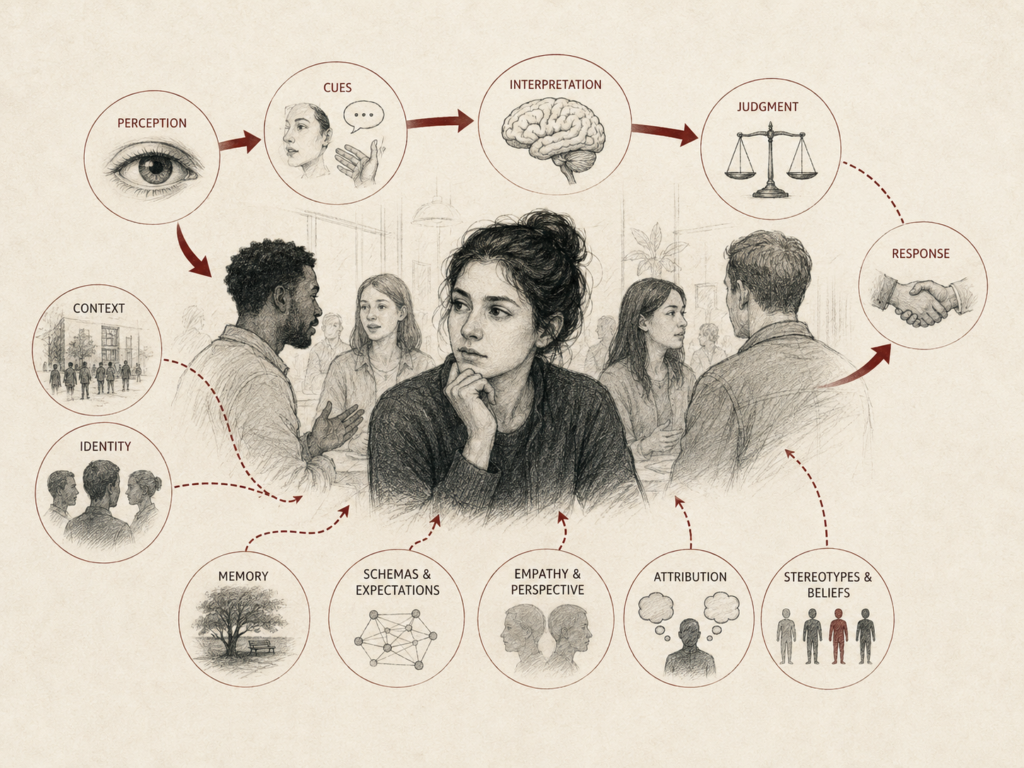
Social Cognition: How We Perceive and Interpret Others
Social cognition refers to the cognitive processes through which individuals perceive, interpret, remember, and use information about other people and social situations. It explains how human beings construct meaning from social environments, form impressions of others, infer intentions, assign responsibility, and evaluate behavior under conditions of uncertainty, time pressure, and incomplete information. Because social life is information-dense and often demands rapid judgment, people rely on schemas, heuristics, attributional reasoning, and identity-linked interpretation to make social environments intelligible. These mechanisms allow individuals to navigate interpersonal life efficiently, but they also make judgment vulnerable to predictable distortion, including stereotyping, confirmation bias, and attributional error. For that reason, social cognition occupies a foundational place within social psychology. It helps explain both how people understand one another and why social perception is so often shaped by prior beliefs, group categories, and contextual framing rather than by neutral observation alone.