
Last Updated May 21, 2026
Obedience, authority, and social power sit at the center of social psychology because they reveal how ordinary people act within hierarchies. Obedience is not only a matter of following orders. It is a broader social process through which legitimacy, role expectations, institutional pressure, moral responsibility, and social power shape human action.
Obedience can make organized life possible. Schools, hospitals, courts, governments, workplaces, research laboratories, public agencies, militaries, and emergency systems all depend on some degree of coordinated compliance. Yet the same structures that allow institutions to function can also produce harm when authority becomes insulated from accountability, when responsibility is displaced upward, when dissent is punished, or when ordinary people come to experience harmful action as merely “doing their job.”
A serious treatment of obedience must therefore go beyond the phrase “obedience to authority.” The deeper issue is how social power becomes legitimate, how hierarchy reorganizes moral judgment, how compliance is produced, how responsibility is shifted, and how people sometimes resist unjust commands. Obedience is not the opposite of morality; it is one of the social conditions under which moral agency is tested.
Main Library
Publications
Article Map
Social Psychology
Related Topic
Stewardship & Ethics
Related Topic
Behavioral Economics
Related Topic
Institutions & Governance
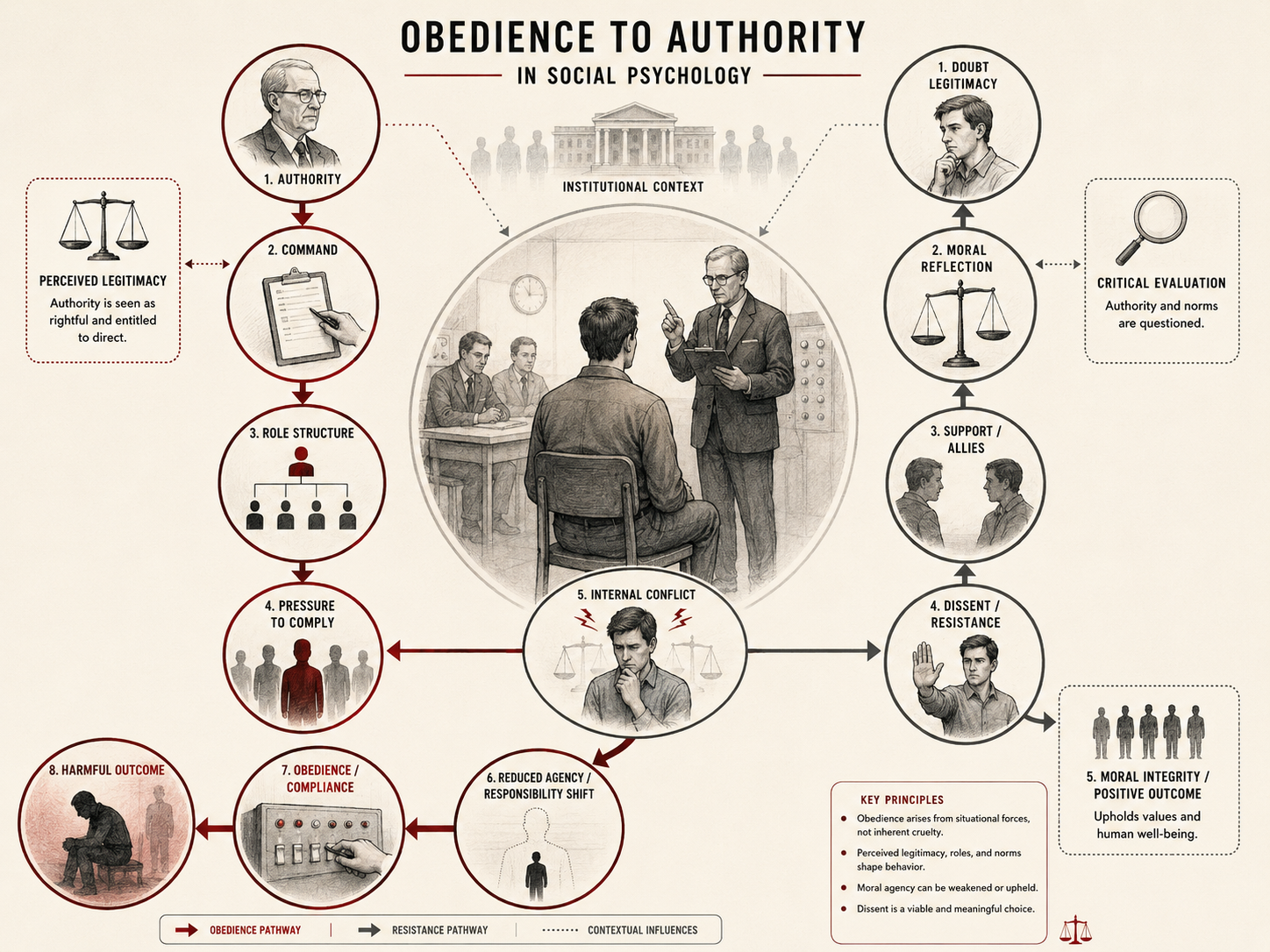
The study of obedience became especially urgent after the Second World War, when scholars confronted a foundational question of modern political and moral life: were atrocities committed only by unusually pathological individuals, or could ordinary people be induced to participate in destructive systems under institutional pressure? That question remains central to social psychology, political theory, organizational behavior, ethics, law, and institutional sociology.
Obedience connects directly to conformity and social influence, groupthink, diffusion of responsibility, moral disengagement, social identity theory, group polarization and collective judgment, intergroup conflict, and Institutions & Governance. Together these frameworks explain how social systems coordinate behavior, normalize authority, distribute responsibility, and sometimes make harmful action feel ordinary.
What is obedience?
Obedience is compliance with a directive issued by an authority figure or authority-bearing institution. In social psychology, obedience becomes especially important when the directive conflicts with personal judgment, private moral resistance, or ordinary standards of care.
Obedience differs from conformity. Conformity involves alignment with group norms, peer expectations, or majority behavior. Obedience involves a command relationship: one person or institution is perceived as having the right to direct action, and another person is expected to comply.
Obedience also differs from persuasion. Persuasion changes attitudes through argument, evidence, emotional appeal, credibility, or framing. Obedience may occur even when attitudes do not change. A person may privately disagree but still comply because the authority is legitimate, because refusal is costly, because responsibility appears to belong elsewhere, or because the situation defines compliance as the expected role behavior.
This distinction matters. People often obey while experiencing distress, hesitation, doubt, or moral conflict. Obedience is not always wholehearted agreement. It may involve internal resistance combined with external compliance.
Obedience is therefore a window into the social organization of agency. It asks: when people act under authority, do they experience themselves as moral authors of their behavior, as role occupants, as agents of an institution, or as instruments of someone else’s will?
Authority, hierarchy, and social power
Authority is a socially recognized claim to direct action. A command becomes powerful not only because someone issues it, but because the surrounding system makes that person or institution appear legitimate. Uniforms, titles, credentials, rituals, professional settings, legal rules, organizational charts, specialized language, and institutional settings all help produce the appearance of rightful authority.
Social power is broader than authority. Power includes the ability to reward, punish, exclude, define legitimacy, control information, shape roles, set norms, allocate resources, and decide whose voice counts. Authority is one form of social power, but obedience often depends on several forms at once.
For example, a supervisor may have formal authority, control over evaluation, access to institutional information, influence over career prospects, and the ability to define dissent as unprofessional. A doctor may have technical authority, professional status, institutional backing, and control over a patient’s options. A military officer may possess legal authority, coercive power, symbolic legitimacy, and command over role identity.
Hierarchy changes moral perception because it changes how action is interpreted. The same behavior may feel morally different when framed as personal choice, professional duty, legal compliance, emergency protocol, scientific procedure, or institutional policy. Social power does not only constrain action; it can redefine the meaning of action.
Obedience must therefore be studied as a relationship between the person, the authority, the institution, the task, the perceived legitimacy of the command, and the cost of refusal.
Historical and theoretical foundations
Obedience became a central topic in modern social psychology because it posed a profound challenge to liberal assumptions about individual moral autonomy. If people are capable of independent ethical judgment, under what conditions do they suspend that judgment in deference to authority?
One influential early answer came from Adorno, Frenkel-Brunswik, Levinson, and Sanford in The Authoritarian Personality. That work suggested that some individuals may possess enduring dispositions that incline them toward submission to authority and hostility toward outgroups. This framed obedience partly as a personality problem rooted in authoritarian character structure.
At the same time, postwar debates increasingly emphasized institutions rather than personality alone. Hannah Arendt’s analysis of Adolf Eichmann and her controversial formulation of the “banality of evil” suggested that destructive participation may emerge not only from exceptional sadism, but from routinized bureaucratic roles that normalize morally consequential action.
Stanley Milgram transformed the problem experimentally. Rather than asking only whether some individuals are authoritarian, he asked how ordinary people behave when placed in a structured situation involving legitimate authority, escalating demands, scientific framing, and apparent displacement of responsibility.
This shift changed the field. Obedience was no longer treated only as an attribute of certain personalities. It became a situational, institutional, and relational phenomenon.
The Milgram experiments
The most influential empirical investigation of obedience was conducted by Stanley Milgram at Yale University in the early 1960s. Milgram designed a laboratory paradigm to test whether participants would follow instructions that appeared to conflict with ordinary moral intuition.
Participants were instructed to administer increasingly intense electric shocks to a “learner” whenever incorrect answers were given during a memory task. Unknown to participants, the learner was a confederate and no actual shocks were delivered. As the experiment progressed, the learner protested, pleaded, complained of pain, and eventually became silent, while the experimenter calmly instructed the participant to continue.
Milgram’s findings became one of the most consequential demonstrations in modern psychology because they showed that many ordinary participants continued under authority pressure despite visible distress. The importance of the work lies not only in the obedience rates, but in the tension participants displayed. Many did not appear indifferent. They hesitated, protested, sweated, laughed nervously, trembled, questioned the procedure, and yet continued.
That tension is central. Milgram’s paradigm did not show that people lack conscience. It showed that conscience can be placed in conflict with institutional authority, role expectations, scientific legitimacy, escalation pressure, and responsibility displacement.
The experiments also demonstrated that obedience was sensitive to context. Obedience declined when the authority figure was less present, when institutional legitimacy weakened, when peers resisted, or when the victim was more immediate. This contextual variation remains one of Milgram’s most important contributions.
Milgram’s work should not be treated as a simple proof that “people blindly obey.” It is more disturbing and more useful than that. It shows how authority can structure action while moral conflict remains psychologically alive.
Psychological mechanisms of obedience
Research on obedience has identified several mechanisms that explain why hierarchical systems can produce compliance even when directives conflict with private moral judgment.
- Legitimacy of authority — people are socialized to treat certain authorities as rightful coordinators of action.
- Institutional framing — actions are interpreted through the language of science, law, medicine, security, professionalism, duty, or procedure.
- Gradual escalation — small acts of compliance increase the likelihood of later, more consequential acts.
- Responsibility displacement — responsibility appears to shift upward to the authority figure or institution.
- Role internalization — individuals act according to expectations attached to their assigned role.
- Cost of defiance — refusal may carry social, professional, legal, emotional, or reputational costs.
- Ambiguity — uncertainty allows people to defer judgment to the authority or procedure.
- Isolation — people are less likely to resist when they do not see others resisting.
- Moral reframing — harmful action may be reinterpreted as technical duty, rule-following, experiment completion, policy implementation, or professional responsibility.
These mechanisms are strongest when they converge. A legitimate authority in a structured institutional setting can redefine the action, distribute responsibility, normalize escalation, isolate the participant, and make refusal feel deviant.
Obedience is therefore not a single psychological switch. It is a social arrangement that changes the perceived meaning of action.
Formalizing obedience
Obedience can be represented as a decision process in which authority pressure, legitimacy, responsibility displacement, cost of defiance, peer support, and moral resistance interact. Let \(O\) denote obedience, \(L\) perceived legitimacy, \(R\) perceived personal responsibility, \(C\) cost of defiance, \(M\) private moral resistance, and \(D\) visible dissent:
P(O_i=1)=\operatorname{logit}^{-1}(\alpha+\beta_1L_i-\beta_2R_i+\beta_3C_i-\beta_4M_i-\beta_5D_i)
\]
Interpretation: Obedience becomes more likely when authority appears legitimate and defiance is costly, and less likely when personal responsibility, moral resistance, and visible dissent are strong.
Escalation can be modeled dynamically. If each act of compliance increases commitment to the next act, then:
O_{t+1}=O_t+\lambda E_t-\delta D_t
\]
Interpretation: Obedience at the next step increases with escalation pressure \(E_t\), but declines when visible dissent \(D_t\) interrupts the sequence.
Responsibility displacement can be represented as a shift in perceived agency. Let \(A_p\) be perceived personal agency and \(A_a\) perceived authority agency:
R_i^*=A_{p,i}-A_{a,i}
\]
Interpretation: Felt personal responsibility declines when authority agency is perceived to dominate personal agency.
At a systems level, harmful outcomes may emerge through chains of authorized action:
H=\sum_{i=1}^{n}a_i
\]
Interpretation: Harm \(H\) can emerge from many partial acts \(a_i\), each performed within a limited role, even when no single actor experiences full ownership of the outcome.
This is one reason obedience is central to institutional analysis. Harmful systems often operate through distributed compliance rather than singular intention.
The agentic state theory
Milgram proposed that obedience involves what he described as an agentic state. In this condition, individuals no longer experience themselves as fully autonomous authors of action. Instead, they perceive themselves as agents carrying out the will of an authority.
The theory is important because it focuses on responsibility. The agentic state reduces perceived personal accountability by transferring responsibility upward to the authority figure. A person may continue to act while privately disagreeing because the situation frames the action as authorized, required, or not fully one’s own.
This helps explain why harmful institutional processes can be carried out by people who do not experience themselves as personally malicious. The action is interpreted as role performance. The command is interpreted as legitimate. The responsibility is interpreted as belonging elsewhere.
The agentic-state account remains influential, but it should be used carefully. Many participants in obedience situations do not become passive machines. They may negotiate, resist, question, reinterpret, or identify with the authority’s purpose. Obedience can involve conflict, commitment, belief, uncertainty, and active sense-making.
The value of the agentic-state theory is that it draws attention to moral authorship. It asks whether people experience themselves as responsible agents or as instruments of an authorized system.
Situational determinants of obedience
Milgram’s most enduring contribution may have been to show that obedience is highly sensitive to situational variation. Participants did not obey at a fixed rate across all conditions. Their compliance changed when the authority, setting, peers, and victim relationship changed.
Several situational determinants are especially important:
- proximity of authority — obedience tends to be stronger when authority is physically and socially present;
- proximity of the victim — obedience tends to decline when the consequences of action are more immediate and personal;
- institutional prestige — obedience is stronger when the setting appears legitimate, expert, or officially sanctioned;
- peer behavior — visible dissent by others can reduce obedience dramatically;
- ambiguity of responsibility — obedience increases when responsibility appears to belong to the authority;
- escalation sequence — small increments make later compliance easier than a sudden demand for severe action;
- clarity of harm — the more visible and undeniable the harm, the harder obedience may become;
- social isolation — resistance becomes harder when the person is alone with authority.
These findings challenge explanations that locate obedience only in personality. People obey or resist partly because situations make certain actions appear legitimate, expected, costly, or morally ambiguous.
This does not erase personal responsibility. It makes responsibility more complex. Ethical action depends not only on character, but on the conditions that support or undermine moral judgment under pressure.
Engaged followership and identification
Modern reinterpretations of Milgram have challenged the idea that obedience is merely passive submission. Researchers such as Stephen Reicher, S. Alexander Haslam, and colleagues have argued that participants may comply not simply because they surrender agency, but because they identify with the authority’s goals and the institution’s mission.
From this perspective, obedience may involve engaged followership. People comply when they see the authority’s project as meaningful, legitimate, scientific, moral, patriotic, professional, protective, or socially valuable. The command is not experienced as bare coercion; it is embedded in a purpose.
This reinterpretation matters because it shifts the analysis from authority alone to authority plus identification. People are more likely to comply when they believe the authority represents a valued group, cause, institution, or moral project.
The distinction is crucial. If destructive obedience is framed only as blind submission, the solution appears to be more individual courage. If it is also framed as identification with a legitimized project, the solution must address institutional narratives, group identity, moral framing, and the social meanings attached to compliance.
Engaged followership also helps explain why appeals to duty, science, security, public order, national interest, organizational mission, or moral purification can be powerful. People may obey not because they stop thinking, but because they think the authority’s purpose justifies continued action.
Compliance, hierarchy, and moral responsibility
Obedience is morally complex because hierarchy changes how responsibility is experienced. People often distinguish between giving an order, carrying out an order, designing a system, following a procedure, enforcing a policy, and benefiting from the result. Institutions can exploit these distinctions by distributing responsibility across many roles.
In a hierarchy, each actor may feel responsible only for a limited task. One person writes the policy. Another approves it. Another implements it. Another records compliance. Another manages exceptions. Another communicates the decision. Another enforces the penalty. The final harm may emerge from the coordinated action of people who each experience their role as partial and procedural.
This is why obedience is not only a problem of dramatic commands. It is also a problem of routine administration. Harm can be normalized through paperwork, metrics, legal categories, professional protocols, software workflows, risk models, reporting chains, and bureaucratic language.
Moral responsibility does not disappear because action is distributed. It becomes harder to see. Social psychology helps explain how responsibility is psychologically displaced, but ethical analysis must still ask who had authority, who had knowledge, who had discretion, who benefited, who objected, and who was harmed.
The central moral danger of obedience is not that people become monsters. It is that they may remain ordinary, polite, competent, and procedural while participating in systems that produce harm.
Bureaucracy, role structure, and distributed harm
Bureaucracies coordinate action by dividing responsibility into specialized roles. This can improve fairness, consistency, and efficiency. But it can also make harm easier to produce because no single person experiences the full moral weight of the outcome.
Role structure narrows attention. A person may ask whether a form is complete, whether a policy was followed, whether a metric was met, whether a command was lawful, whether a case fits a category, or whether a procedure was correctly executed. Those questions may be necessary, but they can displace larger moral questions: who is harmed, whether the policy is just, whether the rule is legitimate, and whether compliance is ethically defensible.
Bureaucratic obedience is especially dangerous when language becomes abstract. People are not harmed; cases are processed. Families are not displaced; units are cleared. Patients are not denied care; eligibility criteria are applied. Workers are not punished; compliance pathways are enforced. Language can reduce moral immediacy.
Modern institutions add new layers. Algorithmic systems, automated workflows, performance dashboards, risk scores, and compliance tools can intensify responsibility diffusion. A person may obey not only a human authority, but a technical system that appears objective, neutral, or unavoidable.
For this reason, obedience research belongs in contemporary debates about governance, technology, bureaucracy, and institutional accountability. The problem is not only the commanding voice. It is the system that makes compliance feel normal.
Disobedience, dissent, and moral courage
The study of obedience must also study resistance. People do not always comply. They question, delay, refuse, expose, resign, protest, leak, organize, protect victims, reinterpret rules, and support others who resist.
Milgram’s variations showed that visible dissent matters. When peers resisted, obedience declined. This is one of the most important lessons of obedience research: resistance is socially contagious. A single act of refusal can make disobedience thinkable.
Resistance is easier when several conditions are present:
- the harm is visible and concrete;
- responsibility is clearly personal;
- others dissent publicly;
- the authority’s legitimacy is questioned;
- there are protected channels for refusal;
- the cost of dissent is reduced;
- alternative authorities support resistance;
- moral identity is tied to care, justice, or professional integrity;
- institutions protect whistleblowers and dissenters.
Moral courage is often treated as an individual trait, but it also has social conditions. People resist more effectively when they are not isolated. Institutions that depend on ethical action must therefore design support for refusal, not merely celebrate courage after the fact.
Obedience research is sometimes read pessimistically. But it also points toward hope: dissent changes situations. When people see others refuse, authority loses some of its inevitability.
Ethical controversies and research reform
The Milgram experiments generated major ethical controversy because participants experienced intense stress and were deceived about the true nature of the study. Many believed they might be seriously harming another person. These concerns became part of broader debates that reshaped human-subject research ethics.
Milgram’s work therefore has a double legacy. It transformed the psychology of obedience, but it also helped intensify scrutiny of deception, distress, informed consent, debriefing, participant welfare, and institutional review.
Modern researchers cannot simply repeat the original paradigm. Later work has used partial replications, analogues, archival analysis, virtual environments, survey experiments, behavioral simulations, and ethical modifications designed to protect participants while preserving scientific insight.
The ethical controversy is not separate from the theory. Milgram’s participants were placed under authority pressure in a research institution. The study itself therefore became an example of the very problem it examined: how far can a legitimate authority ask people to go in the name of science?
That question remains important. Research on obedience must study authority without reproducing avoidable harm under the cover of authority.
Obedience in modern institutions
Obedience has major implications for modern institutions. Governments, militaries, corporations, hospitals, schools, courts, public agencies, universities, technology companies, and bureaucratic systems all rely on structured compliance. Without some obedience, institutions cannot coordinate action at scale.
The question is not whether institutions require obedience. They do. The question is what kinds of obedience they cultivate and what safeguards prevent obedience from overwhelming judgment.
Institutions become dangerous when they define professionalism as unquestioning compliance, when they punish dissent, when they hide consequences from participants, when they fragment responsibility, or when they treat rules as substitutes for moral judgment.
Healthy institutions distinguish legitimate authority from absolute authority. They provide lawful procedures, ethical review, escalation channels, whistleblower protections, independent oversight, transparent accountability, and meaningful opportunities to refuse unlawful or harmful commands.
They also cultivate role morality carefully. Professional roles should clarify responsibility, not eliminate it. A physician, engineer, teacher, lawyer, soldier, analyst, researcher, manager, or public servant should understand that role obligations include ethical limits.
Obedience becomes safer when institutions make refusal possible before catastrophe requires it.
Obedience, legitimacy, and systems failure
At the systems level, obedience becomes dangerous when legitimacy, hierarchy, role structure, and organizational culture align in ways that suppress dissent. In such conditions, individuals may interpret compliance not as a moral compromise, but as professionalism, loyalty, duty, neutrality, or role fulfillment.
Systems fail not only when people disobey legitimate rules. They also fail when too few people resist illegitimate commands, harmful policies, corrupt procedures, or unjust norms.
Many institutional harms are not produced by a single malicious actor. They emerge through chains of authorized action in which each participant performs a limited role within a system that appears legitimate. One actor may gather data, another approve classification, another enforce policy, another process appeals, another manage communications, and another defend the system publicly. Harm becomes distributed.
Read alongside conformity, groupthink, moral disengagement, and diffusion of responsibility, obedience reveals how institutional failures become socially organized and morally normalized.
For democratic institutions, the lesson is especially important. Legitimate authority depends on accountability. Obedience without accountability is not civic order. It is domination disguised as procedure.
Limits and interpretive cautions
Obedience research is powerful, but it must be used carefully. Several cautions matter.
- Do not reduce obedience to blind submission; people often comply while thinking, doubting, negotiating, or identifying with a mission.
- Do not treat Milgram’s findings as proof that anyone will do anything under authority.
- Do not ignore situational variation; proximity, dissent, legitimacy, and institutional setting matter.
- Do not treat obedience as inherently bad; coordinated life often requires legitimate compliance.
- Do not detach obedience from power, law, hierarchy, class, race, gender, profession, or institutional vulnerability.
- Do not use obedience research to excuse harm by saying “the situation made them do it.” Explanation is not exoneration.
- Do not treat resistance as merely individual heroism; resistance has social and institutional conditions.
- Do not assume that ethical action is easy once harm is visible; authority can make moral perception unstable.
The strongest interpretation of obedience research is neither cynical nor naïve. It recognizes that people are morally responsible agents, but also that agency is shaped by institutions, roles, legitimacy, social support, and the perceived cost of refusal.
Obedience research should therefore deepen accountability, not weaken it. It shows why institutions must be designed so that ethical refusal is possible.
Measurement, data, and research design
Research on obedience can use laboratory paradigms, ethical analogues, vignette experiments, archival analysis, organizational case studies, survey experiments, virtual simulations, field studies, and computational models of authority, compliance, and resistance.
Key variables include:
- participant, session, group, scenario, site, and institutional identifiers;
- authority legitimacy;
- authority proximity;
- institutional prestige;
- command clarity;
- cost of refusal;
- escalation step;
- responsibility displacement;
- moral conflict;
- victim proximity;
- harm salience;
- peer dissent;
- peer compliance;
- role identification;
- mission identification;
- perceived scientific, legal, professional, or institutional purpose;
- obedience outcome;
- resistance outcome;
- delay, hesitation, protest, or negotiation;
- response time;
- post-decision justification;
- perceived responsibility after action.
Strong research should distinguish public compliance from private agreement. It should measure hesitation, protest, distress, resistance attempts, and responsibility attribution, not only final obedience.
It should also distinguish authority pressure from identification. A participant may comply because defiance feels costly, because responsibility seems displaced, because the authority appears legitimate, or because the institutional mission feels meaningful. These are different pathways and should be measured separately.
Finally, obedience research must be ethically designed. The goal is to understand authority without unnecessarily reproducing harmful authority pressure in the research setting itself.
R code for obedience research
The following R workflow models obedience, response time, escalation, authority legitimacy, peer dissent, responsibility displacement, moral conflict, and resistance. It is written for an ethically modified obedience dataset rather than a direct replication of Milgram’s original procedure.
# Install packages if needed:
# pak::pak(c("tidyverse", "lme4", "lmerTest", "emmeans", "broom.mixed", "performance"))

library(tidyverse)
library(lme4)
library(lmerTest)
library(emmeans)
library(broom.mixed)
library(performance)

# Expected columns:
# participant, session_id, condition, authority_legitimacy,
# authority_proximity, institutional_prestige, command_clarity,
# cost_of_defiance, escalation_step, responsibility_displacement,
# moral_conflict, victim_proximity, harm_salience,
# peer_dissent, peer_compliance, role_identification,
# mission_identification, obeyed, resisted, hesitation,
# protest, response_time_ms, perceived_responsibility_after

dat <- read_csv("obedience_trials.csv") %>%
  mutate(
    participant = factor(participant),
    session_id = factor(session_id),
    condition = factor(condition),
    obeyed = as.integer(obeyed),
    resisted = as.integer(resisted),
    protested = as.integer(protest),
    log_response_time = log(response_time_ms),
    authority_pressure_index = (
      authority_legitimacy +
      authority_proximity +
      institutional_prestige +
      command_clarity +
      cost_of_defiance +
      peer_compliance -
      peer_dissent
    ) / 6,
    moral_resistance_index = (
      moral_conflict +
      victim_proximity +
      harm_salience +
      peer_dissent +
      perceived_responsibility_after
    ) / 5,
    identification_index = (
      role_identification +
      mission_identification +
      institutional_prestige
    ) / 3
  )

summary_table <- dat %>%
  group_by(condition, escalation_step) %>%
  summarise(
    n = n(),
    obedience_rate = mean(obeyed, na.rm = TRUE),
    resistance_rate = mean(resisted, na.rm = TRUE),
    protest_rate = mean(protested, na.rm = TRUE),
    mean_authority_pressure = mean(authority_pressure_index, na.rm = TRUE),
    mean_moral_resistance = mean(moral_resistance_index, na.rm = TRUE),
    mean_identification = mean(identification_index, na.rm = TRUE),
    mean_responsibility_after = mean(perceived_responsibility_after, na.rm = TRUE),
    .groups = "drop"
  )

print(summary_table)

obedience_model <- glmer(
  obeyed ~
    authority_legitimacy +
    authority_proximity +
    institutional_prestige +
    command_clarity +
    cost_of_defiance +
    escalation_step +
    responsibility_displacement +
    moral_conflict +
    victim_proximity +
    harm_salience +
    peer_dissent +
    peer_compliance +
    role_identification +
    mission_identification +
    condition +
    (1 + escalation_step | participant),
  data = dat,
  family = binomial(),
  control = glmerControl(optimizer = "bobyqa")
)

summary(obedience_model)
emmeans(obedience_model, ~ condition, type = "response")

resistance_model <- glmer(
  resisted ~
    authority_pressure_index +
    moral_resistance_index +
    identification_index +
    peer_dissent +
    victim_proximity +
    perceived_responsibility_after +
    condition +
    (1 | participant),
  data = dat,
  family = binomial(),
  control = glmerControl(optimizer = "bobyqa")
)

summary(resistance_model)

response_time_model <- lmer(
  log_response_time ~
    authority_pressure_index +
    moral_resistance_index +
    responsibility_displacement +
    escalation_step +
    peer_dissent +
    condition +
    (1 | participant),
  data = dat %>% filter(response_time_ms >= 150),
  REML = FALSE
)

summary(response_time_model)

condition_summary <- dat %>%
  group_by(condition) %>%
  summarise(
    n = n(),
    obedience_rate = mean(obeyed, na.rm = TRUE),
    resistance_rate = mean(resisted, na.rm = TRUE),
    mean_hesitation = mean(hesitation, na.rm = TRUE),
    mean_authority_pressure = mean(authority_pressure_index, na.rm = TRUE),
    mean_moral_resistance = mean(moral_resistance_index, na.rm = TRUE),
    mean_identification = mean(identification_index, na.rm = TRUE),
    .groups = "drop"
  )

write_csv(summary_table, "obedience_escalation_summary.csv")
write_csv(condition_summary, "obedience_condition_summary.csv")
write_csv(
  tidy(obedience_model, effects = "fixed", conf.int = TRUE),
  "obedience_model_coefficients.csv"
)

ggplot(
  summary_table,
  aes(x = escalation_step, y = obedience_rate, color = condition)
) +
  geom_line() +
  geom_point() +
  labs(
    title = "Obedience across escalation steps",
    x = "Escalation step",
    y = "Obedience rate"
  ) +
  theme_minimal()
This workflow supports obedience research by distinguishing authority pressure, responsibility displacement, moral resistance, peer dissent, role identification, mission identification, escalation, resistance, and response time.
Python code for obedience research
The Python workflow below parallels the R analysis and adds simulation logic for authority legitimacy, escalation, peer dissent, and responsibility displacement.
import numpy as np
import pandas as pd
import statsmodels.formula.api as smf
import statsmodels.api as sm
import matplotlib.pyplot as plt

# Expected columns:
# participant, session_id, condition, authority_legitimacy,
# authority_proximity, institutional_prestige, command_clarity,
# cost_of_defiance, escalation_step, responsibility_displacement,
# moral_conflict, victim_proximity, harm_salience,
# peer_dissent, peer_compliance, role_identification,
# mission_identification, obeyed, resisted, hesitation,
# protest, response_time_ms, perceived_responsibility_after

df = pd.read_csv("obedience_trials.csv")

df["participant"] = df["participant"].astype("category")
df["session_id"] = df["session_id"].astype("category")
df["condition"] = df["condition"].astype("category")

df["authority_pressure_index"] = (
    df["authority_legitimacy"]
    + df["authority_proximity"]
    + df["institutional_prestige"]
    + df["command_clarity"]
    + df["cost_of_defiance"]
    + df["peer_compliance"]
    - df["peer_dissent"]
) / 6

df["moral_resistance_index"] = (
    df["moral_conflict"]
    + df["victim_proximity"]
    + df["harm_salience"]
    + df["peer_dissent"]
    + df["perceived_responsibility_after"]
) / 5

df["identification_index"] = (
    df["role_identification"]
    + df["mission_identification"]
    + df["institutional_prestige"]
) / 3

df["log_response_time"] = np.log(df["response_time_ms"])

summary_table = (
    df.groupby(["condition", "escalation_step"], observed=True)
    .agg(
        n=("participant", "size"),
        obedience_rate=("obeyed", "mean"),
        resistance_rate=("resisted", "mean"),
        protest_rate=("protest", "mean"),
        mean_authority_pressure=("authority_pressure_index", "mean"),
        mean_moral_resistance=("moral_resistance_index", "mean"),
        mean_identification=("identification_index", "mean"),
        mean_responsibility_after=("perceived_responsibility_after", "mean"),
    )
    .reset_index()
)

print(summary_table)

obedience_model = smf.glm(
    "obeyed ~ authority_legitimacy + authority_proximity "
    "+ institutional_prestige + command_clarity + cost_of_defiance "
    "+ escalation_step + responsibility_displacement "
    "+ moral_conflict + victim_proximity + harm_salience "
    "+ peer_dissent + peer_compliance "
    "+ role_identification + mission_identification + condition",
    data=df,
    family=sm.families.Binomial()
)

obedience_result = obedience_model.fit(
    cov_type="cluster",
    cov_kwds={"groups": df["participant"]}
)

print(obedience_result.summary())

resistance_model = smf.glm(
    "resisted ~ authority_pressure_index + moral_resistance_index "
    "+ identification_index + peer_dissent + victim_proximity "
    "+ perceived_responsibility_after + condition",
    data=df,
    family=sm.families.Binomial()
)

resistance_result = resistance_model.fit(
    cov_type="cluster",
    cov_kwds={"groups": df["participant"]}
)

print(resistance_result.summary())

rt_df = df[df["response_time_ms"] >= 150].copy()

response_time_model = smf.mixedlm(
    "log_response_time ~ authority_pressure_index "
    "+ moral_resistance_index + responsibility_displacement "
    "+ escalation_step + peer_dissent + condition",
    rt_df,
    groups=rt_df["participant"]
)

response_time_result = response_time_model.fit(method="lbfgs")
print(response_time_result.summary())

def simulate_obedience(
    participants=1000,
    escalation_steps=12,
    seed=42
):
    rng = np.random.default_rng(seed)
    rows = []

    conditions = [
        "high_legitimacy",
        "peer_dissent",
        "high_responsibility",
        "mission_identification",
        "low_legitimacy",
        "visible_harm"
    ]

    for condition in conditions:
        for participant in range(1, participants + 1):
            for step in range(1, escalation_steps + 1):
                authority_legitimacy = {
                    "high_legitimacy": 8.5,
                    "peer_dissent": 7.0,
                    "high_responsibility": 7.0,
                    "mission_identification": 8.0,
                    "low_legitimacy": 3.0,
                    "visible_harm": 7.0,
                }[condition] + rng.normal(0, 0.8)

                peer_dissent = {
                    "peer_dissent": 8.0,
                    "low_legitimacy": 4.0,
                    "visible_harm": 4.0,
                }.get(condition, 1.5) + rng.normal(0, 0.8)

                responsibility = {
                    "high_responsibility": 8.5,
                    "visible_harm": 7.5,
                }.get(condition, 3.0) + rng.normal(0, 0.8)

                moral_conflict = {
                    "visible_harm": 8.5,
                    "high_responsibility": 7.5,
                    "peer_dissent": 6.8,
                }.get(condition, 5.5) + rng.normal(0, 0.8)

                identification = {
                    "mission_identification": 8.8,
                    "high_legitimacy": 7.0,
                }.get(condition, 4.5) + rng.normal(0, 0.8)

                responsibility_displacement = np.clip(10 - responsibility, 0, 10)

                latent = (
                    -2.0
                    + 0.35 * authority_legitimacy
                    + 0.25 * identification
                    + 0.22 * step
                    + 0.30 * responsibility_displacement
                    - 0.35 * peer_dissent
                    - 0.30 * moral_conflict
                    - 0.25 * responsibility
                )

                probability = 1 / (1 + np.exp(-latent))
                obeyed = int(rng.random() < probability)

                rows.append({
                    "participant": f"P{participant:04d}",
                    "condition": condition,
                    "escalation_step": step,
                    "authority_legitimacy": np.clip(authority_legitimacy, 0, 10),
                    "peer_dissent": np.clip(peer_dissent, 0, 10),
                    "perceived_responsibility": np.clip(responsibility, 0, 10),
                    "responsibility_displacement": np.clip(responsibility_displacement, 0, 10),
                    "moral_conflict": np.clip(moral_conflict, 0, 10),
                    "identification": np.clip(identification, 0, 10),
                    "obedience_probability": probability,
                    "obeyed": obeyed,
                })

    return pd.DataFrame(rows)

simulation = simulate_obedience()

simulation_summary = (
    simulation.groupby(["condition", "escalation_step"])
    .agg(
        obedience_rate=("obeyed", "mean"),
        mean_probability=("obedience_probability", "mean"),
        mean_legitimacy=("authority_legitimacy", "mean"),
        mean_peer_dissent=("peer_dissent", "mean"),
        mean_moral_conflict=("moral_conflict", "mean"),
        mean_responsibility=("perceived_responsibility", "mean"),
    )
    .reset_index()
)

print(simulation_summary.tail())

fig, ax = plt.subplots(figsize=(8, 5))

for condition, group in simulation_summary.groupby("condition"):
    ax.plot(
        group["escalation_step"],
        group["obedience_rate"],
        marker="o",
        label=condition
    )

ax.set_xlabel("Escalation step")
ax.set_ylabel("Obedience rate")
ax.set_title("Simulated obedience across authority conditions")
ax.legend()
plt.tight_layout()
plt.show()

summary_table.to_csv("obedience_escalation_summary.csv", index=False)
simulation.to_csv("obedience_simulation.csv", index=False)
simulation_summary.to_csv("obedience_simulation_summary.csv", index=False)
This Python workflow supports obedience research by modeling legitimacy, escalation, responsibility displacement, moral conflict, identification, peer dissent, and resistance across conditions.
Research data architecture
Obedience research often depends on relational data: participants, sessions, authority conditions, institutional context, escalation steps, legitimacy, responsibility displacement, moral conflict, visible harm, peer dissent, mission identification, obedience, resistance, hesitation, protest, and post-decision responsibility attribution.
The companion GitHub repository includes a full SQL schema and example analytical queries for researchers who want to reproduce, inspect, or extend the data model. Keeping executable SQL in GitHub avoids WordPress hosting restrictions while preserving the technical infrastructure for readers who want to use the article as a reproducible research workflow.
A useful obedience data model supports questions such as:
- Does perceived legitimacy increase obedience after controlling for moral conflict?
- Does peer dissent reduce obedience across escalation steps?
- Does responsibility displacement predict compliance?
- Does mission identification explain obedience beyond simple authority pressure?
- Does visible harm increase response time, protest, or resistance?
- Does institutional prestige strengthen obedience?
- Do participants who obey attribute less responsibility to themselves afterward?
- Does escalation increase obedience after initial compliance?
- Which conditions produce hesitation without resistance?
View the SQL research data architecture in GitHub.
GitHub repository
The companion repository provides reusable code and research scaffolding for studying obedience, authority, hierarchy, legitimacy, responsibility displacement, moral conflict, peer dissent, resistance, escalation, and institutional safeguards.
Complete Code Repository
Access the full companion repository for this article, including reproducible analysis materials and multi-language code workflows for obedience, authority, and social-power research.
Why obedience matters for social psychology
Obedience, authority, and social power matter because they show how human action is shaped by hierarchy. People do not act only from private conviction. They act within roles, institutions, commands, expectations, and systems of legitimacy. Authority can coordinate care, public order, expertise, and collective work. It can also normalize harm when accountability fails.
The Milgram experiments remain powerful because they reveal moral conflict under authority pressure. Participants did not simply lack conscience. Many struggled. That struggle is the point. Social psychology must explain not only cruelty, but compliance under tension: the moment when a person knows something is wrong and still continues because the situation makes obedience feel required.
Modern reinterpretations deepen this lesson. People may obey not only because they are ordered to do so, but because they identify with a mission, trust an institution, accept a role, or believe the authority represents a worthy cause. Obedience is therefore not merely submission. It can be active, meaningful, and morally dangerous.
Read alongside conformity and social influence, groupthink, group polarization and collective judgment, moral disengagement, diffusion of responsibility, Behavioral Economics, and Institutions & Governance, obedience becomes more than a classic experiment. It becomes a framework for understanding how institutions organize action, how power becomes legitimate, how responsibility is distributed, and how moral agency can be protected under hierarchy.
Related articles
- Social Psychology
- Conformity and Social Influence
- Groupthink in Social Psychology
- Group Polarization and Collective Judgment
- Diffusion of Responsibility
- Moral Disengagement
- Social Identity Theory
- Intergroup Conflict in Social Psychology
- Cognitive Biases in Decision-Making
- Decision-Making in Cognitive Psychology
- Behavioral Economics
- Institutions & Governance
- Stewardship & Ethics
Further reading
- Adorno, T.W., Frenkel-Brunswik, E., Levinson, D.J. and Sanford, R.N. (1950) The Authoritarian Personality. New York: Harper. Available at: https://archive.org/details/authoritarianper0000ador.
- Arendt, H. (1963) Eichmann in Jerusalem: A Report on the Banality of Evil. New York: Viking Press. Available at: https://archive.org/details/eichmanninjerusa0000aren.
- Blass, T. (1999) ‘The Milgram paradigm after 35 years: Some things we now know about obedience to authority’, Journal of Applied Social Psychology, 29(5), pp. 955–978. Available at: https://doi.org/10.1111/j.1559-1816.1999.tb00134.x.
- Burger, J.M. (2009) ‘Replicating Milgram: Would people still obey today?’, American Psychologist, 64(1), pp. 1–11. Available at: https://doi.org/10.1037/a0010932.
- Haslam, S.A. and Reicher, S.D. (2012) ‘Contesting the “nature” of conformity: What Milgram and Zimbardo’s studies really show’, PLOS Biology, 10(11), e1001426. Available at: https://doi.org/10.1371/journal.pbio.1001426.
- Haslam, S.A., Reicher, S.D. and Birney, M.E. (2014) ‘Nothing by mere authority: Evidence that in an experimental analogue of the Milgram paradigm participants are motivated not by orders but by appeals to science’, Journal of Social Issues, 70(3), pp. 473–488. Available at: https://doi.org/10.1111/josi.12072.
- Milgram, S. (1963) ‘Behavioral study of obedience’, Journal of Abnormal and Social Psychology, 67(4), pp. 371–378. Available at: https://doi.org/10.1037/h0040525.
- Milgram, S. (1974) Obedience to Authority: An Experimental View. New York: Harper & Row.
- Packer, D.J. (2008) ‘Identifying systematic disobedience in Milgram’s obedience experiments: A meta-analytic review’, Perspectives on Psychological Science, 3(4), pp. 301–304. Available at: https://doi.org/10.1111/j.1745-6924.2008.00080.x.
- Zimbardo, P. (2007) The Lucifer Effect: Understanding How Good People Turn Evil. New York: Random House.
References
- Adorno, T.W., Frenkel-Brunswik, E., Levinson, D.J. and Sanford, R.N. (1950) The Authoritarian Personality. New York: Harper. Available at: https://archive.org/details/authoritarianper0000ador.
- Arendt, H. (1963) Eichmann in Jerusalem: A Report on the Banality of Evil. New York: Viking Press. Available at: https://archive.org/details/eichmanninjerusa0000aren.
- Blass, T. (1999) ‘The Milgram paradigm after 35 years: Some things we now know about obedience to authority’, Journal of Applied Social Psychology, 29(5), pp. 955–978. Available at: https://doi.org/10.1111/j.1559-1816.1999.tb00134.x.
- Burger, J.M. (2009) ‘Replicating Milgram: Would people still obey today?’, American Psychologist, 64(1), pp. 1–11. Available at: https://doi.org/10.1037/a0010932.
- Haslam, S.A. and Reicher, S.D. (2012) ‘Contesting the “nature” of conformity: What Milgram and Zimbardo’s studies really show’, PLOS Biology, 10(11), e1001426. Available at: https://doi.org/10.1371/journal.pbio.1001426.
- Haslam, S.A., Reicher, S.D. and Birney, M.E. (2014) ‘Nothing by mere authority: Evidence that in an experimental analogue of the Milgram paradigm participants are motivated not by orders but by appeals to science’, Journal of Social Issues, 70(3), pp. 473–488. Available at: https://doi.org/10.1111/josi.12072.
- Milgram, S. (1963) ‘Behavioral study of obedience’, Journal of Abnormal and Social Psychology, 67(4), pp. 371–378. Available at: https://doi.org/10.1037/h0040525.
- Milgram, S. (1974) Obedience to Authority: An Experimental View. New York: Harper & Row.
- Packer, D.J. (2008) ‘Identifying systematic disobedience in Milgram’s obedience experiments: A meta-analytic review’, Perspectives on Psychological Science, 3(4), pp. 301–304. Available at: https://doi.org/10.1111/j.1745-6924.2008.00080.x.
- Zimbardo, P. (2007) The Lucifer Effect: Understanding How Good People Turn Evil. New York: Random House.