Deindividuation in Social Psychology: Self-Awareness, Crowds, and Collective Behavior
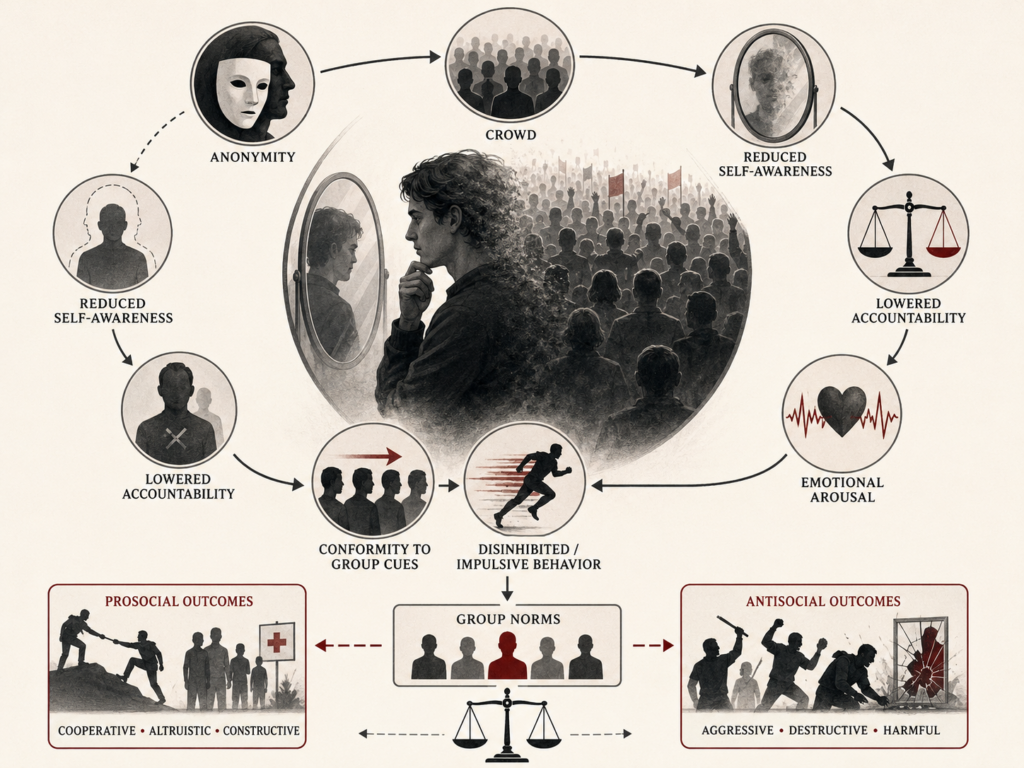
Deindividuation refers to a psychological state in which individuals experience reduced self-awareness and diminished concern for personal evaluation when immersed in a group. In social psychology, the concept helps explain how anonymity, crowd immersion, and collective identity can alter behavior in ways that differ markedly from how individuals act alone. Its importance lies in showing that group settings do not simply add social pressure from the outside. They can change the very basis on which behavior is regulated. When personal visibility and self-monitoring weaken, conduct may become less constrained by individual standards and more responsive to group norms, situational cues, and collective identities. This is why deindividuation is not best understood as a simple theory of losing control. It is a theory of shifting regulation. Modern research has moved beyond the older claim that anonymity automatically produces irrational or antisocial behavior. Instead, it shows that collective environments can intensify whatever norms become salient within them, whether destructive, disciplined, celebratory, or solidaristic. For that reason, deindividuation remains essential for understanding crowd behavior, institutional conduct, digital anonymity, and the broader ways group contexts reshape responsibility, identity, and action.