Cognitive Psychology

Cognitive psychology examines how the mind processes information, including how humans perceive the world, focus attention, form memories, reason about problems, and make decisions. As one of the central disciplines of modern psychological science, cognitive psychology investigates the internal mental processes that shape how individuals interpret experiences, solve problems, and construct knowledge.

Research in cognitive psychology explores topics such as attention, perception, memory, learning, language, reasoning, and decision-making. These processes form the foundation of human thought, influencing everything from everyday judgments to complex problem-solving and scientific discovery.

This category examines the core theories, experiments, and models that define cognitive psychology, highlighting how mental processes operate and how they influence behavior, learning, and decision-making across a wide range of real-world contexts.

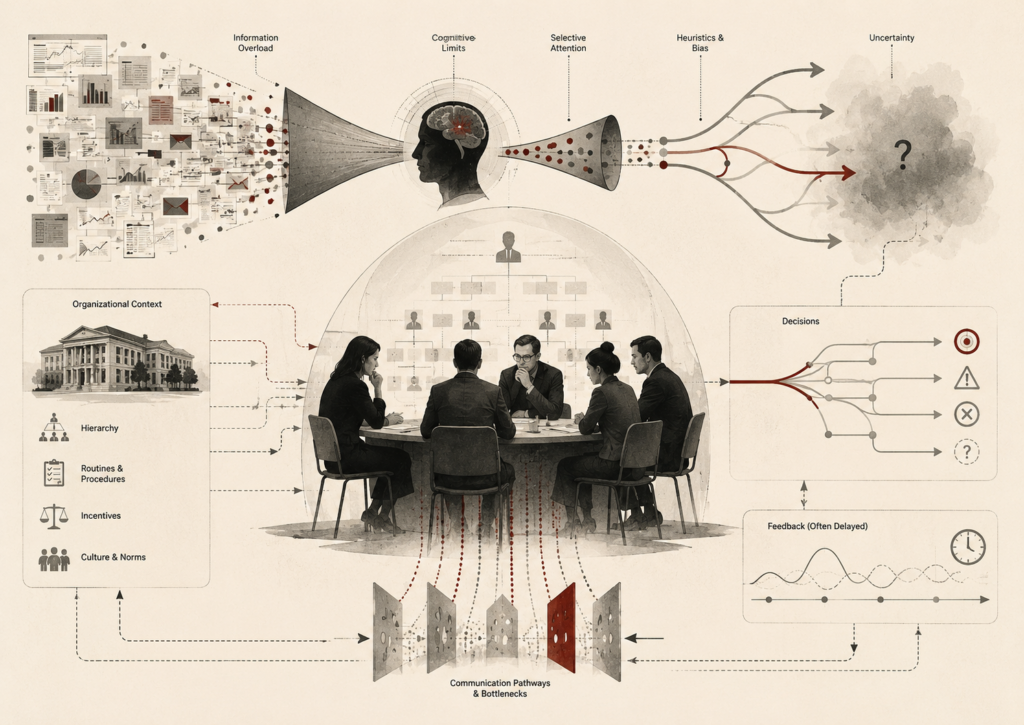
Institutional research illustration showing organizational decision making shaped by information overload, cognitive limits, selective attention, heuristics, uncertainty, feedback delays, hierarchy, routines, incentives, and communication bottlenecks.

Cognitive Constraints in Organizational Decision Making

Cognitive constraints in organizational decision making refer to the limits of human attention, memory, working memory, and judgment that shape how institutions interpret problems, evaluate alternatives, and act under uncertainty. In theory, organizations are often described as rational systems capable of processing information and choosing the best available course of action. In practice, however, they are composed of individuals and groups whose cognition is bounded, selective, and vulnerable to overload, bias, and framing effects. These limits do not remain confined to the level of individual psychology. They scale upward into organizational routines, reporting structures, strategic blind spots, and recurring patterns of coordination and misalignment. What appears as strategic drift, delay, overconfidence, or institutional rigidity is often rooted in what decision makers can actually notice, compare, remember, and revise under real conditions of complexity. For that reason, cognitive psychology offers a powerful framework for understanding organizations more realistically. It shows that institutional decision making is not simply a matter of information availability or formal authority, but of how bounded minds process information within systems that are themselves complex, distributed, and often cognitively demanding.
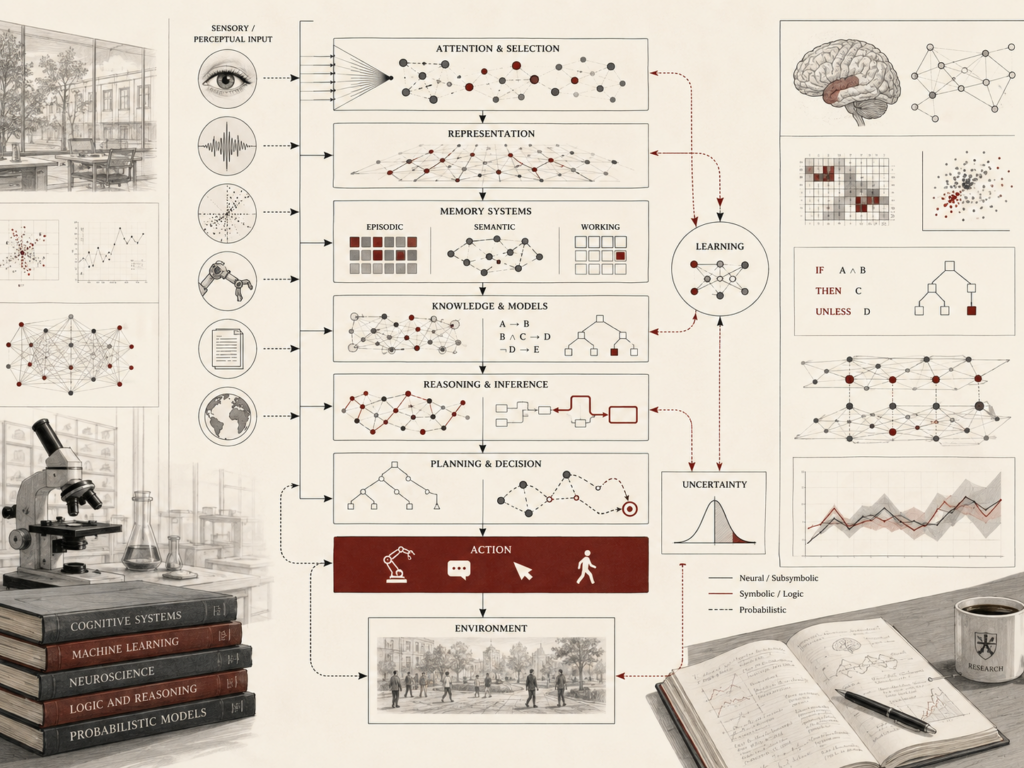
Research-grade cognitive architecture diagram showing AI systems that connect perception, attention, representation, memory, learning, reasoning, planning, uncertainty, action, and environmental feedback.

Cognitive Systems in Artificial Intelligence Research

Cognitive systems in artificial intelligence research examine how processes such as perception, learning, memory, reasoning, and decision making can be modeled, simulated, and integrated within computational systems. In cognitive psychology, this makes cognitive systems research important for two reasons at once. It offers a way of building artificial agents that can act intelligently in complex environments, and it provides a formal framework for thinking more clearly about intelligence as a structured process rather than a mysterious faculty. Early artificial intelligence drew heavily on psychological theories of problem solving, symbolic reasoning, and memory, while contemporary work extends those efforts through machine learning, reinforcement learning, neural networks, and hybrid architectures. What unites these approaches is the attempt to understand how an agent can represent information, retain relevant knowledge, update itself through experience, and select actions under uncertainty. For that reason, cognitive systems research sits at one of the most important intersections between cognitive psychology and computer science. It treats intelligence not as a single capacity, but as the coordinated interaction of representation, memory, inference, learning, and control, and it shows how the effort to build intelligent machines can also illuminate the structure, limits, and possibilities of mind itself.

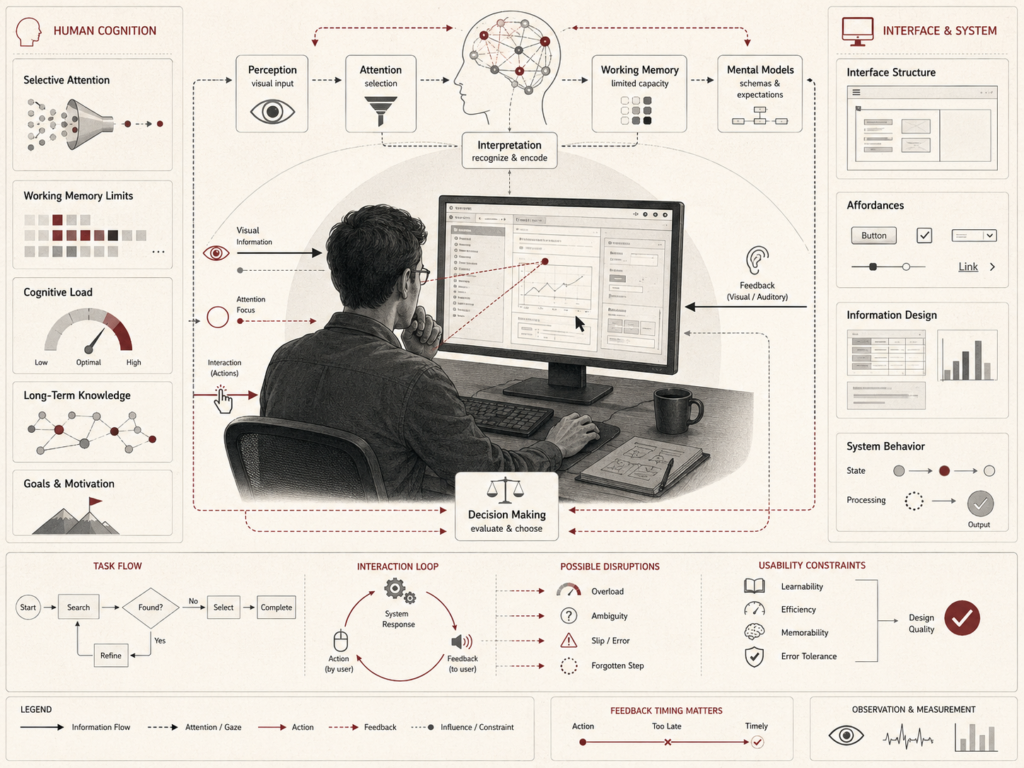
Research-grade human-computer interaction diagram showing a user working with a digital interface while perception, attention, working memory, mental models, decision-making, feedback, task flow, usability constraints, and system behavior shape the interaction.

Cognition in Human–Computer Interaction

Cognition in human–computer interaction concerns the way perception, attention, memory, working memory, and decision processes shape how people engage with digital systems. In cognitive psychology, HCI is not just about making interfaces attractive or technically functional. It is about designing environments that fit the structure and limits of the human mind. Users do not encounter software, platforms, and devices as neutral channels of information. They perceive selectively, attend unevenly, forget easily, rely on recognition more than recall, and make choices under conditions of limited time, uncertainty, and cognitive load. For that reason, effective interface design depends on aligning system structure with human cognitive architecture. When an interface supports perception, reduces unnecessary memory burden, matches user mental models, and guides attention without overload, interaction becomes more efficient, accurate, and intelligible. When it does not, confusion, error, hesitation, and mistrust emerge. HCI therefore occupies an important place within cognitive psychology because it shows how mental processes become operational in technologically mediated environments and how the design of digital systems can either support or disrupt human reasoning, learning, and action.

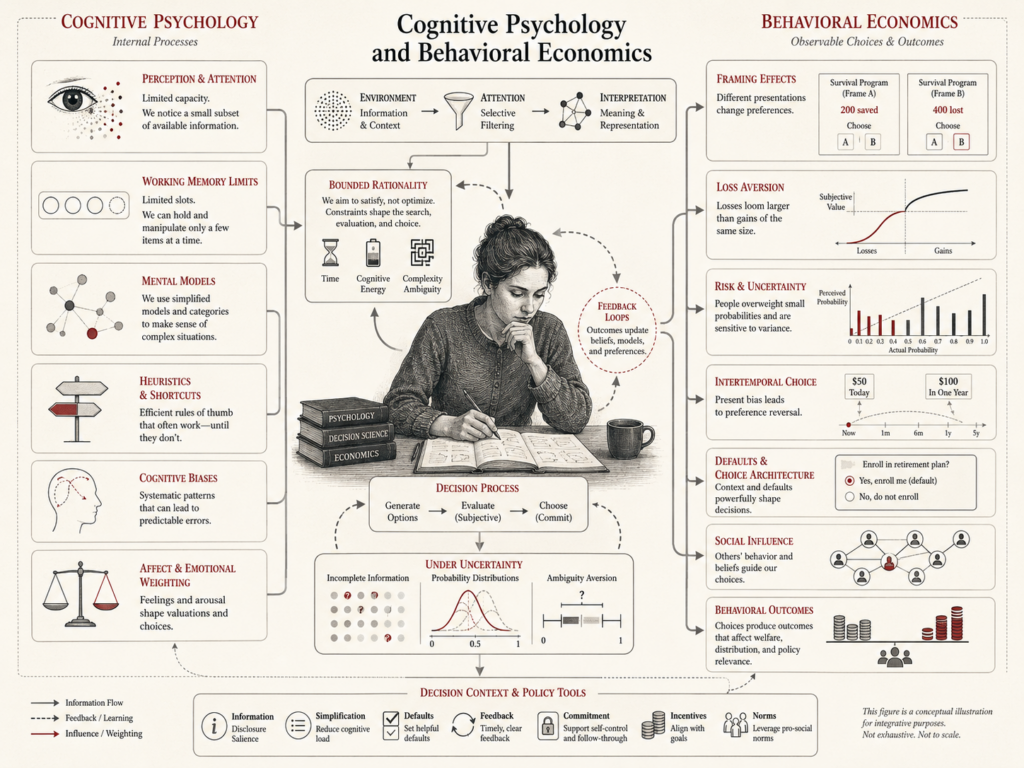
Research-grade conceptual diagram showing how cognitive psychology processes such as perception, attention, memory limits, heuristics, bounded rationality, bias, emotion, and mental models shape behavioral economics outcomes including framing effects, loss aversion, risk perception, intertemporal choice, defaults, social influence, and policy-relevant decisions.

Cognitive Psychology and Behavioral Economics

Cognitive psychology and behavioral economics are deeply interconnected because both fields seek to explain how people actually interpret information and make choices under conditions of uncertainty, limitation, and real-world constraint. Cognitive psychology provides the underlying account of the mental systems involved—attention, memory, working memory, reasoning, and judgment—while behavioral economics applies those insights to decisions about risk, value, time, incentives, and exchange. Together, they challenge the older image of the perfectly rational economic actor by showing that choice is shaped not only by preferences and prices, but by bounded attention, cognitive effort, framing, heuristics, and systematic bias. This makes economic behavior inseparable from the architecture of the mind that must carry it out. People do not evaluate every option with complete information and unlimited computation; they simplify, satisfice, rely on mental shortcuts, and interpret outcomes relative to reference points and perceived losses.

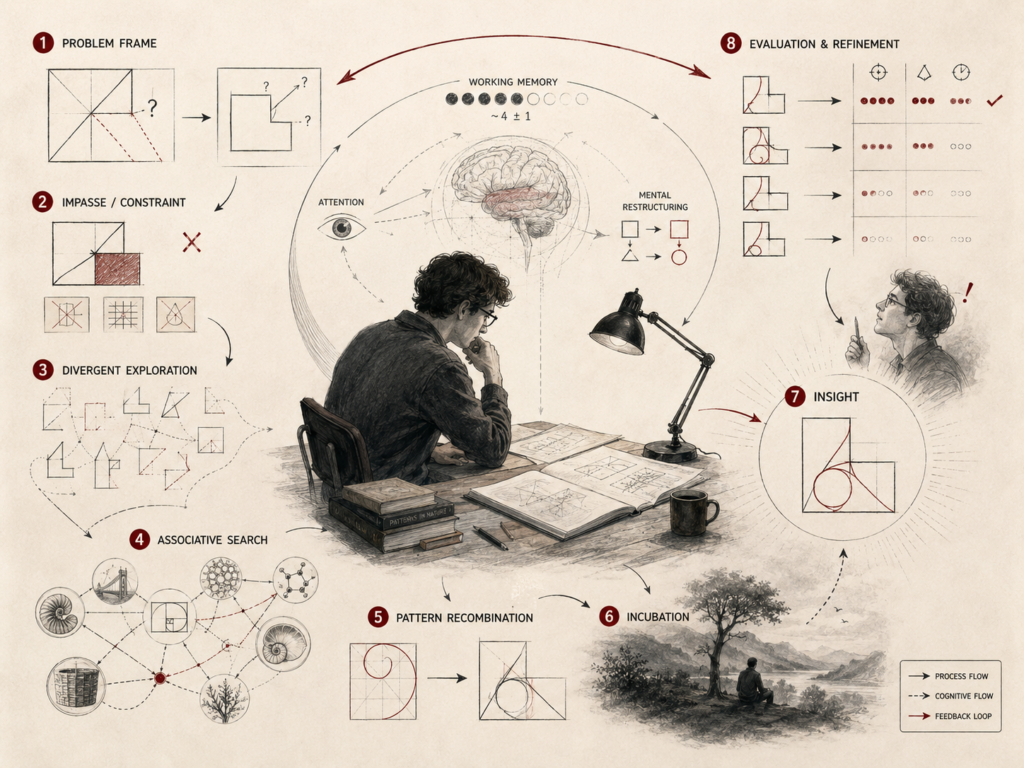
Research-grade conceptual illustration showing creative problem solving as a cognitive process involving problem framing, impasse, divergent exploration, associative search, pattern recombination, incubation, insight, evaluation, and refinement.

Insight and Creative Problem Solving

Insight refers to the sudden restructuring of a problem in a way that makes a solution newly visible without the feeling of having arrived there through a straightforward sequence of steps. In cognitive psychology, this makes insight one of the clearest examples of non-linear thought. Rather than extending an existing strategy one move at a time, the mind reaches a point at which the underlying representation of the problem changes, and with that change, what had seemed blocked or invisible becomes intelligible. Insight is therefore not simply a dramatic moment of realization. It is a cognitive event in which confusion is transformed by representational reorganization, constraint relaxation, and the sudden recognition of a new relation or possibility. This is why insight occupies such an important place in the study of creative problem solving. It helps explain how people overcome fixation, escape unproductive assumptions, and generate solutions that are not just incrementally better, but qualitatively different from what their earlier reasoning allowed. In this way, insight reveals that some of the mind’s most important advances do not come from thinking harder along the same path, but from learning to see the problem differently altogether.

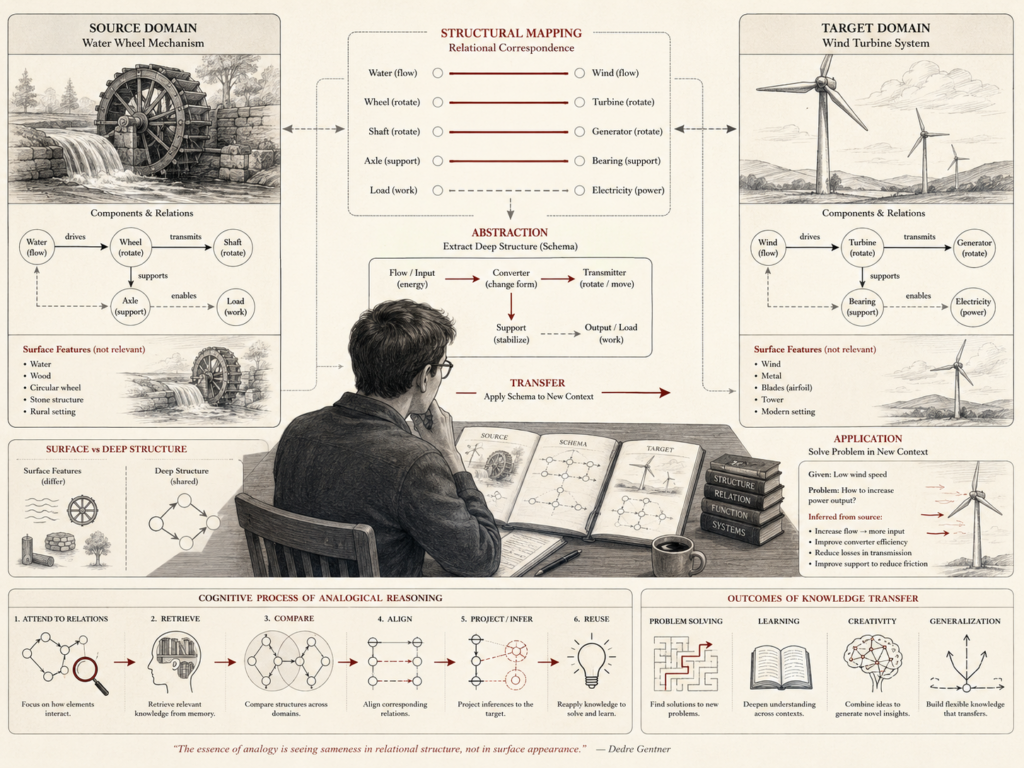
Research-grade conceptual diagram showing analogical reasoning as knowledge transfer from a source domain to a target domain through structural mapping, abstraction, relational correspondence, inference, and application

Analogical Reasoning and Knowledge Transfer

Analogical reasoning is the process through which the mind transfers knowledge from one domain to another on the basis of structural similarity. Rather than solving every new problem from first principles, cognition often works by drawing on a familiar source domain and mapping its relational structure onto a less familiar target. This makes analogy one of the most powerful mechanisms of knowledge transfer in cognitive psychology, because it allows previously acquired understanding to guide thought in novel situations. The key to effective analogy is not superficial resemblance alone, but the recognition of deeper correspondences among relations, constraints, and causal structure. For that reason, analogical reasoning is central to problem solving, learning, explanation, and discovery. It helps individuals move beyond local experience, build bridges across domains, and generate new inferences without starting from nothing. At the same time, analogy is also fragile: a poorly matched analogy can mislead just as easily as a well-formed one can illuminate. That dual character makes analogical reasoning especially important for understanding how knowledge becomes transferable, how mental models expand, and how the mind reuses structure to think through the unfamiliar.

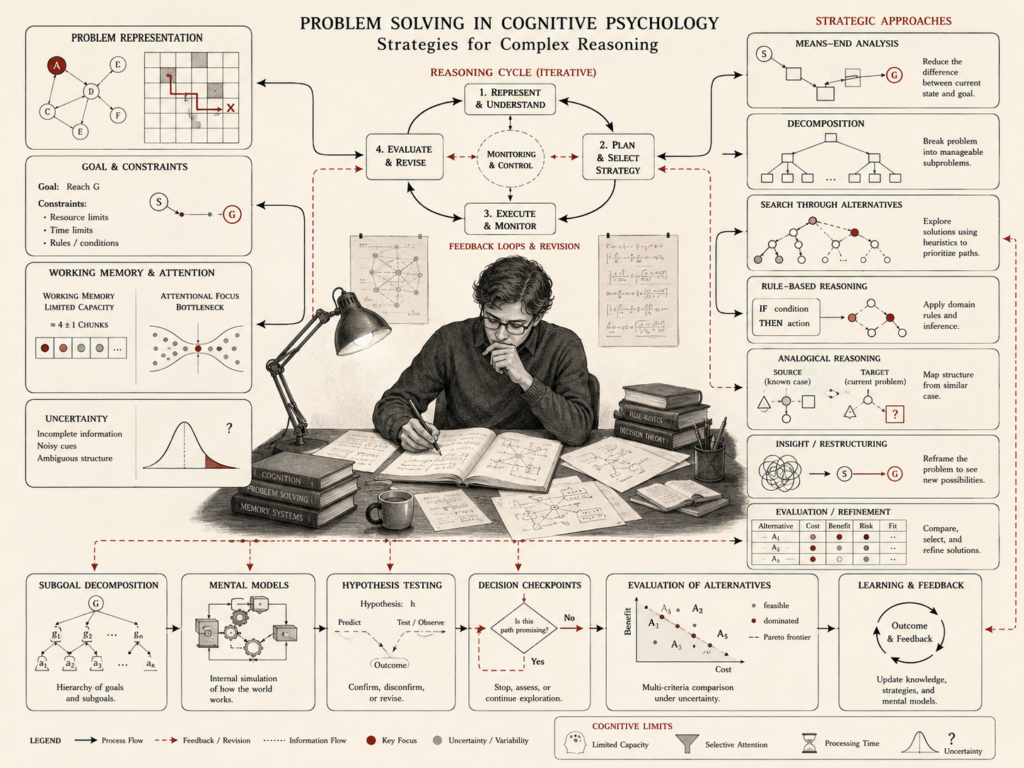
Research-grade cognitive psychology diagram showing complex problem solving through problem representation, goals, working memory, attention, uncertainty, reasoning cycles, strategy selection, decomposition, search, rule-based reasoning, analogical reasoning, insight, evaluation, and feedback.

Problem Solving in Cognitive Psychology: Strategies for Complex Reasoning

Problem solving refers to the processes through which individuals identify goals, represent problems, generate strategies, and evaluate possible solutions when answers are not immediately available. In cognitive psychology, it is one of the clearest expressions of flexible, goal-directed thought, because it requires the mind to move beyond routine response and construct a path through uncertainty, constraint, or complexity. Effective problem solving depends not only on knowledge, but on how a problem is represented internally, which strategies are considered, and how cognitive resources are allocated while progress is monitored. This is why problem solving draws so heavily on attention, working memory, memory, and metacognitive control. A poor representation can make a solvable problem seem impossible, while a more accurate or better-structured representation can reveal patterns, constraints, and solution paths that were previously hidden. For that reason, problem solving is not just about finding answers. It is about building the internal conditions under which an answer can become visible at all. In this sense, it occupies a central place in cognitive psychology because it shows how the mind adapts when no automatic solution is available and must instead reason its way through the unknown.

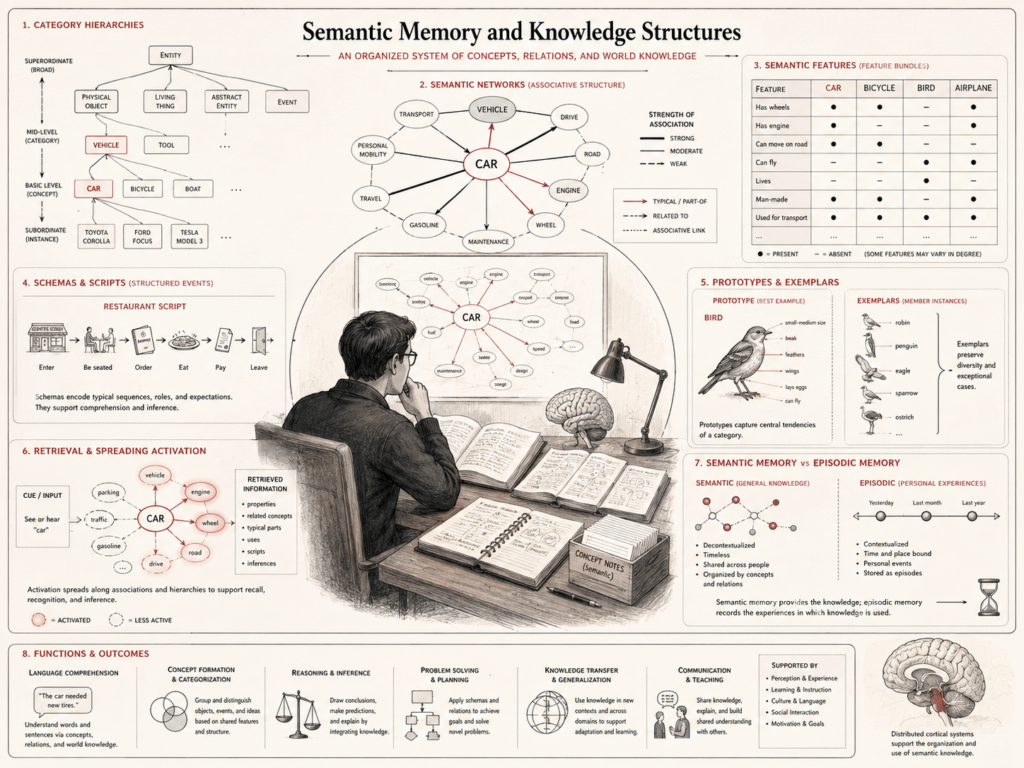
Research-grade cognitive science diagram showing semantic memory as organized knowledge structures, including category hierarchies, semantic networks, feature bundles, schemas, prototypes, exemplars, retrieval cues, spreading activation, and semantic versus episodic memory.

Semantic Memory and Knowledge Structures

Semantic memory is the long-term memory system through which the mind stores general knowledge about the world, including concepts, facts, meanings, and the relations among ideas. Unlike episodic memory, which is tied to specific personal experiences situated in time and place, semantic memory makes it possible to know things independently of when or where they were learned. It allows individuals to understand that Paris is the capital of France, that a dog is a kind of animal, or that justice, democracy, and gravity refer to larger conceptual structures rather than isolated observations. In cognitive psychology, semantic memory is therefore not treated as a passive storehouse of facts but as an organized and dynamic knowledge system that supports language comprehension, categorization, reasoning, and flexible understanding across contexts. It is one of the major systems through which experience becomes stable knowledge, enabling the mind to retrieve conceptual meaning, recognize relationships among ideas, and reason beyond what is immediately present. For that reason, semantic memory occupies a foundational place within cognition itself, linking language, concept formation, memory, and abstract thought into a broader architecture of meaning.

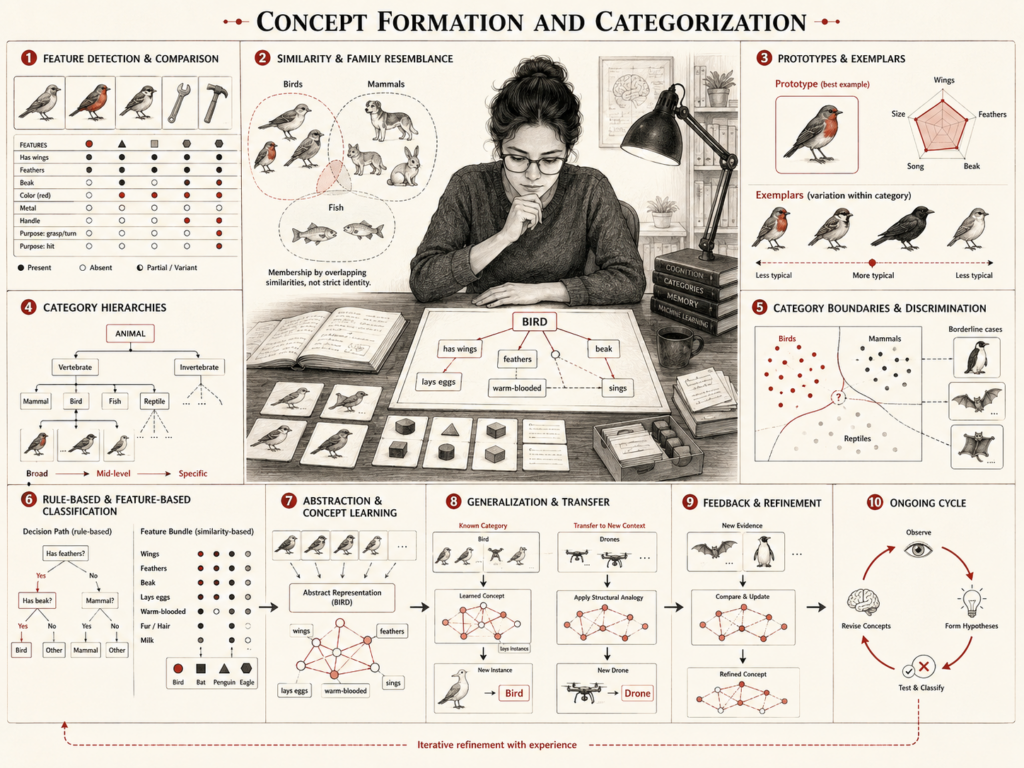
Research-grade cognitive science diagram showing concept formation and categorization through feature comparison, family resemblance, prototypes, exemplars, category hierarchies, boundaries, classification rules, abstraction, generalization, feedback, and refinement.

Concept Formation and Categorization

Concept formation refers to the processes through which the mind organizes experience into categories that make abstraction, generalization, and efficient reasoning possible. Rather than treating every object, event, or idea as wholly unique, cognition groups instances into meaningful classes, allowing people to recognize patterns, interpret new situations, and draw on prior knowledge without starting from scratch each time. In this sense, concepts are among the basic building blocks of thought itself. They reduce complexity by preserving what is cognitively relevant while setting aside incidental variation, and they make it possible to move from isolated encounters to broader knowledge about kinds, relations, and possibilities. Concept formation therefore sits near the center of cognitive psychology, linking perception, memory, language, and reasoning into a more unified system of knowledge representation. It also helps explain how learning becomes flexible rather than merely repetitive, since new information can be integrated into existing conceptual frameworks and used to guide judgment, prediction, and decision making across changing contexts.

Scroll to Top