
Last Updated May 20, 2026
Insight refers to a sudden restructuring of a problem that makes a solution newly visible without the feeling of having arrived there through a straightforward step-by-step path. In cognitive psychology, insight and creative problem solving are treated as non-linear forms of cognition that allow individuals to overcome constraints, reframe situations, and generate solutions that were previously unavailable within the existing representation of the problem.
While many problems can be solved through deliberate analysis, others resist linear reasoning and only yield when the problem is represented differently. In those cases, the solution does not emerge by adding one more logical step to the previous sequence. It emerges when the underlying structure of the problem is reorganized. This is one reason insight has been so important in cognitive psychology: it reveals that successful reasoning sometimes depends less on extending an existing strategy than on abandoning it and seeing the problem anew.
Insight draws on multiple cognitive systems, including memory, working memory, attention, metacognition, mental models, problem solving, and analogical reasoning. These systems help determine how a problem is represented, which constraints are treated as real, what associations are accessible, and whether a person can shift away from an unproductive mental set.
Main Library
Publications
Article Map
Cognitive Psychology
Related Topic
Artificial Intelligence Systems
Related Topic
Data Systems & Analytics
Related Topic
Behavioral Economics
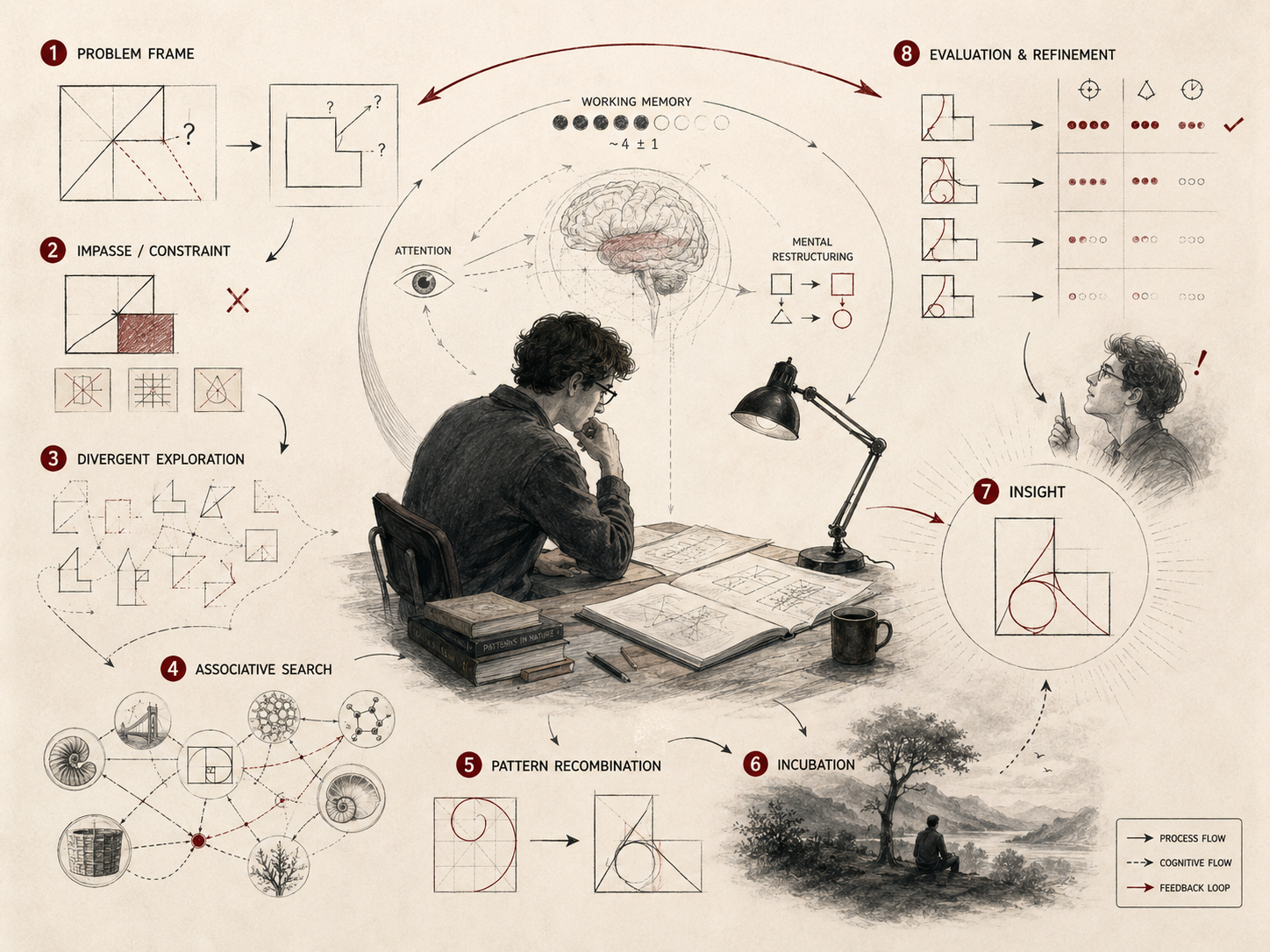
Contemporary research treats insight as closely related to creativity, associative restructuring, constraint relaxation, incubation, and the sudden selection of a promising idea from a broader field of partially activated possibilities. The subjective experience may feel immediate, but the cognitive background is often complex: prior knowledge, unnoticed associations, problem constraints, emotional readiness, attentional state, and metacognitive monitoring all contribute to whether insight becomes possible.
The nature of insight
Insight is often experienced as an “aha” moment: a rapid transition from impasse or confusion to a suddenly coherent solution. Unlike analytical reasoning, which feels incremental and traceable, insight often appears discontinuous from the point of view of experience. The person may not be able to describe the exact intermediate steps by which the solution emerged.
This does not mean that insight is irrational, mystical, or beyond study. It means that the critical transformation may occur through representational change rather than overt stepwise search. A solution can become available when previously hidden relations are noticed, when an assumed constraint is dropped, when a misleading interpretation is abandoned, or when elements are recombined in a new way.
Insight is therefore best understood as a cognitive event in which the structure of the problem changes. The solution was often unavailable not because the person lacked all relevant knowledge, but because that knowledge was organized in an unproductive way. The same pieces were present, but the relations among them had not yet been seen.
The experience of suddenness is important. It reflects the subjective transition from “I do not know how to solve this” to “now I see it.” But the suddenness of conscious awareness does not imply that nothing was happening cognitively beforehand. Search, spreading activation, memory retrieval, failed attempts, emotional tension, and unconscious recombination may all contribute to the eventual insight.
Insight research is therefore concerned with both phenomenology and mechanism. The phenomenology is the felt “aha.” The mechanism is the cognitive restructuring that allows a previously inaccessible solution path to become available.
Problem representation and restructuring
The way a problem is represented strongly influences whether it can be solved. In many cases, failure arises not from insufficient intelligence or effort, but from an inappropriate or overly rigid representation. A person may impose constraints that are not actually required, fixate on an unhelpful interpretation of the task, or overlook a relation that would reorganize the problem space.
Insight occurs when this representation changes. The problem is restructured in a way that reveals a path forward. This idea has been central to information-processing accounts of insight, especially approaches that treat insight as representational change after a period of impasse.
This process is closely related to mental models, because the internal representation of a problem determines which possibilities appear available. Changing the model can unlock solutions that were invisible under the earlier framing.
Representation shapes search. If a problem is represented as a calculation task, the solver searches for equations. If it is represented as a spatial task, the solver searches for relations among positions. If it is represented as a social problem, the solver looks for motives and constraints. If it is represented as a design problem, the solver explores functions, users, affordances, and constraints. The same objective situation can therefore produce different solution paths depending on how it is cognitively encoded.
Restructuring often involves at least one of four changes:
- Constraint relaxation, where an assumed limitation is dropped or revised.
- Re-encoding, where elements of the problem are interpreted differently.
- Chunk decomposition, where familiar units are broken apart into new components.
- Relational discovery, where a hidden relation among elements becomes salient.
The critical feature is that the solver no longer searches within the old representation. They search from a transformed one. This is why insight can feel like seeing the same problem for the first time.
Impasse, incubation, and sudden solution
Insight often follows impasse. Impasse occurs when a solver continues to apply an unproductive strategy or representation without progress. The person may feel stuck, frustrated, or convinced that the problem cannot be solved with the available information. In insight research, impasse is important because it signals that the existing representation is not supporting solution search.
Incubation refers to a period in which active work on a problem is interrupted before a later return to the task. During incubation, the solver may engage in another activity, rest, sleep, or shift attention elsewhere. Sometimes the later return produces a solution that was not available before the break.
Several mechanisms may contribute to incubation effects. A break can reduce fixation by weakening an unproductive strategy. It can allow misleading assumptions to lose activation. It can permit remote associations to become more accessible. It can also restore attention, reduce frustration, or create conditions for a new cue to be noticed.
Incubation should not be romanticized as passive magic. Breaks do not guarantee insight. Their value depends on the problem, prior effort, fixation strength, memory activation, emotional state, and the quality of later re-engagement. A break may be useful because it changes the cognitive conditions under which the problem is re-encountered.
This is one reason insight can be difficult to study experimentally. The breakthrough may appear sudden, but the preconditions can include long periods of preparation, failed attempts, partial representations, and background processing.
Formalizing insight: constraint relaxation, restructuring, and solution emergence
Insight can be formalized as a change in the representational structure used to search for a solution. Let a problem be represented as \(P_t = (S, C_t, G)\), where \(S\) is the current state space, \(C_t\) the set of active constraints at time \(t\), and \(G\) the goal. Under impasse, the active constraint set may make the solution unreachable:
\forall s \in S(C_t), \quad s \not\rightarrow G
\]
Interpretation: Within the currently constrained search space, no available state transition reaches the goal.
Insight occurs when the representation changes, often through constraint relaxation, re-encoding, or restructuring:
C_{t+1} = R(C_t)
\]
Interpretation: A restructuring operation \(R\) relaxes, revises, or reorganizes the active constraint set.
The effective search space then changes:
S(C_{t+1}) \supset S(C_t)
\]
Interpretation: A revised representation can expand the available search space, allowing solution paths that were previously inaccessible.
One can also describe insight as a shift in activation across candidate representations. If \(h_i\) are competing interpretations of the problem, then before insight the dominant representation may be suboptimal:
h^* = \arg\max_i a_i(t)
\]
Interpretation: The currently dominant hypothesis is the representation with the highest activation at time \(t\).
Insight can be modeled as a non-linear redistribution of activation such that a previously weak but more useful representation becomes dominant:
a_j(t+1) \gg a_j(t)
\]
Interpretation: A previously weak representation can rapidly gain activation and become the basis for solution.
The subjective “aha” experience can also be represented separately from correctness. Let \(I\) denote subjective insight intensity and \(Q\) objective solution quality:
\text{corr}(I, Q) \neq 1
\]
Interpretation: Aha experience and solution quality are related but not identical. A solution can feel insightful without being correct, and a correct solution can emerge without strong subjective insight.
This formal framing is useful because it captures the phenomenology of suddenness without implying that insight has no cognitive structure. A representational shift can be abrupt in awareness while still depending on prior search, memory activation, and constraint dynamics.
Insight and creative cognition
Creative problem solving often depends on the capacity to move beyond habitual patterns of thought. Insight plays a central role here because it allows the mind to recombine existing knowledge in new ways, identify hidden relations, and arrive at solutions that are both novel and useful.
Creative cognition often involves:
- recombining stored knowledge into new configurations;
- detecting previously unnoticed structural relations;
- breaking away from unproductive default assumptions;
- using analogy to transfer structure from one domain to another;
- balancing divergent exploration with later evaluation and refinement;
- transforming an ill-defined problem into a more tractable one.
These processes connect closely to analogical reasoning, where structural relations from one domain help reorganize understanding in another. Philosophical treatments of creativity also emphasize that creative cognition involves the production of things that are new and valuable, which fits closely with the role of insight in generating meaningful novelty.
Insight is not the whole of creativity. Creativity may also involve persistence, craft, expertise, domain knowledge, revision, collaboration, and evaluation. But insight is one of the key mechanisms by which creative change becomes possible. It allows a problem to be seen in a new light, after which analytical work can resume from a transformed position.
This means creative problem solving is not simply “thinking outside the box.” It is the cognitive work of discovering which box the mind had constructed and whether its walls are necessary.
Fixation and cognitive constraints
One of the main barriers to insight is fixation: the tendency to remain trapped within a familiar but unproductive way of seeing a problem. Functional fixedness is a classic example. Individuals may see an object or idea only in terms of its conventional use and therefore fail to recognize alternative functions or relations.
Fixation narrows the representational field. It makes some possibilities feel natural and others invisible. A person may keep applying the same rule, searching the same region of the problem space, or preserving an assumption that should be questioned. The problem is not lack of effort. Often, fixation is effort applied in the wrong representational direction.
Fixation can arise from many sources:
- Prior examples, which make one solution path overly salient.
- Habitual categories, which limit what an object, word, or relation can mean.
- Misleading assumptions, which impose constraints not actually present in the problem.
- Expertise effects, where deep knowledge supports rapid recognition but may also create entrenched patterns.
- Emotional pressure, which can narrow attention and reduce flexibility.
- Institutional norms, which define which solutions are considered legitimate.
These barriers are related to cognitive bias, because prior expectations and entrenched categories can shape what seems possible before the problem is even consciously evaluated. Overcoming fixation requires cognitive flexibility: the ability to loosen current assumptions, explore alternative interpretations, and reconfigure the problem space.
Insight research therefore has practical relevance wherever rigid assumptions block solution: education, science, engineering, design, policy, organizational strategy, conflict resolution, and creative work.
Insight and problem-solving systems
Insight does not replace analytical problem solving. It complements it. Analytical reasoning is systematic, traceable, and often reliable when rules are clear and stepwise search is feasible. Insight provides an alternative route when existing procedures stall or when the crucial step is not another move within the same structure, but a change in the structure itself.
These two modes often coexist within broader problem-solving systems. A person may analyze, reach impasse, step back, restructure, and then continue analytically from the new representation. Effective problem solving therefore often depends on the capacity to move between focused search and broader restructuring rather than relying on either mode alone.
Many real problems require both. In mathematics, a proof may require a sudden reframing followed by careful verification. In science, a hypothesis may emerge through analogy or conceptual restructuring but still require rigorous testing. In design, an idea may arrive as a breakthrough but must then be prototyped, evaluated, revised, and implemented. In policy, a systems insight may reveal a leverage point, but institutional work is needed to act on it.
Insight should therefore be seen as part of a larger cognitive cycle:
- initial framing;
- analytic search;
- impasse;
- constraint relaxation;
- associative exploration;
- representational shift;
- solution emergence;
- evaluation;
- refinement and transfer.
This cycle makes insight powerful but also disciplined. The “aha” moment matters, but it is not the end of thought. It is the beginning of a new phase of thought.
Neural mechanisms of insight
Neuroscientific research suggests that insight is associated with distinctive patterns of brain activity, particularly in regions involved in semantic integration, attentional reconfiguration, associative processing, and cognitive control. Reviews of the cognitive neuroscience of insight emphasize that insight involves interactions among multiple systems rather than a single isolated “insight center” in the brain.
Some work has linked insight to shifts away from narrowly constrained attention and toward broader associative processing, allowing previously weak or remote connections to become available. Other work emphasizes the role of top-down control in overcoming unhelpful default representations. What matters most is not a single mechanism, but the coordination of systems that permit constraint relaxation and novel integration.
This coordination is consistent with the cognitive profile of insight. To restructure a problem, the mind must maintain the task, inhibit misleading assumptions, access remote associations, detect a promising relation, and bring the new representation into awareness. These operations draw on attention, memory, semantic processing, executive control, and affective evaluation.
Neural research also helps explain why insight can feel emotionally powerful. The “aha” experience is often accompanied by surprise, confidence, pleasure, or release from tension. That phenomenology can make insight memorable and motivating. But it also creates a risk: a solution that feels compelling may still require objective evaluation.
The neuroscience of insight therefore supports a balanced view. Insight is real, structured, and cognitively meaningful, but it is not infallible. The brain can generate powerful feelings of discovery even when further testing is needed.
Insight in learning and expertise
Insight plays an important role in learning because it can reorganize knowledge rather than merely add more information to what is already there. A learner who suddenly sees why a proof works, why a causal relation matters, or why a system behaves as it does has often acquired a more flexible and transferable understanding than someone who only memorizes the result.
This process connects closely to cognitive learning and to expertise development. Experts may rely on insight not because they abandon knowledge, but because their knowledge is organized richly enough to support rapid restructuring and pattern recognition when a problem demands it.
In education, insight is especially valuable because it can mark a transition from procedural performance to conceptual understanding. A student may know how to execute a formula without understanding why it works. Insight occurs when the structure becomes visible. The learner can then transfer knowledge to new problems because they understand the relation, not only the procedure.
Teaching for insight therefore requires more than presenting answers. It requires helping learners examine assumptions, compare representations, encounter productive struggle, use analogies, and reflect on why a new solution path works. Too much guidance can prevent discovery; too little can leave learners stuck. The educational challenge is to create conditions where restructuring becomes possible.
Expertise also has an ambivalent relationship with insight. Experts have rich schemas that support rapid recognition, but those schemas can sometimes produce fixation. Creative expertise requires both deep knowledge and the flexibility to reorganize it.
Insight in innovation and systems thinking
Insight is fundamental to innovation because new ideas often emerge through the recombination of existing elements into a different structure. In complex systems, insight can reveal leverage points, hidden dependencies, structural bottlenecks, or causal relations that were previously obscured by a more fragmented view.
This makes insight particularly valuable in science, engineering, design, policy, and sustainability-oriented systems analysis. In such settings, the most important breakthrough is often not one more incremental fact, but a new way of seeing how the pieces fit together.
Systems insight differs from isolated cleverness. It involves recognizing patterns across levels: individuals, organizations, technologies, institutions, ecosystems, and feedback loops. A problem that appears technical may have institutional causes. A problem that appears behavioral may have infrastructural causes. A problem that appears local may be sustained by system-wide incentives.
Innovation depends on insight when existing categories are too narrow. A team may need to see a product as a service system, a policy as an attention environment, a climate problem as an infrastructure problem, or an organizational failure as a cognitive-design problem. The insight is not simply a new idea; it is a new structure for seeing the problem.
However, insight in innovation also requires evaluation. A compelling reframing must be tested against evidence, constraints, stakeholders, feasibility, and consequences. Creative problem solving becomes responsible when insight is joined to analysis, implementation, and accountability.
Aha experience, confidence, and solution quality
The subjective experience of insight can be intense. A solution may feel sudden, obvious, elegant, and true. This experience can increase confidence and make the solution memorable. But the “aha” feeling is not identical with correctness.
This distinction matters for research and practice. A person can feel insight when they have discovered a genuine solution. They can also feel insight when they have found a coherent but false pattern. Conspiracy thinking, misleading analogies, overfitted explanations, and persuasive but flawed ideas can all produce a feeling of sudden coherence.
Researchers therefore distinguish among several variables:
- Insight solution, whether the problem was solved through a restructuring-like process.
- Aha rating, the subjective intensity of suddenness, surprise, and clarity.
- Solution quality, the objective correctness, usefulness, originality, or expert-rated value of the solution.
- Confidence, the solver’s belief that the solution is correct.
- Metacognitive shift, the solver’s awareness that the problem representation changed.
These variables often correlate, but they should not be collapsed. Aha can be a useful signal of restructuring, but it is not a guarantee of truth. Good creative systems protect the energy of insight while still requiring evaluation.
This is especially important in science, policy, engineering, and organizational strategy, where a powerful reframing can mobilize action. Insight should be welcomed, but it should also be tested.
Contemporary research and interdisciplinary integration
Contemporary research on insight integrates cognitive psychology, neuroscience, creativity studies, education, design, computational modeling, artificial intelligence, philosophy, and organizational learning. The field has moved beyond the idea that insight is simply a mysterious flash. It now studies the conditions that support restructuring: fixation, constraint relaxation, memory activation, incubation, analogical transfer, semantic distance, affect, and metacognition.
Creativity research contributes the idea that creative products are not merely new, but valuable or appropriate within a domain. This is important because insight can generate novelty, but creative problem solving requires evaluation, usefulness, and refinement. Cognitive neuroscience contributes methods for studying the brain states that precede and accompany insight. Computational approaches contribute models of search, activation, representation, and constraint change.
Artificial intelligence adds a new comparative context. Generative systems can produce novel combinations, analogies, and candidate solutions, but the human problem of insight remains distinct. Human insight includes subjective restructuring, embodied context, affect, meaning, domain understanding, and responsibility for evaluation. AI may assist creative search, but it does not remove the need for human judgment.
Contemporary insight research is therefore both scientific and practical. It helps explain how people solve difficult problems, how education can support deeper understanding, how design teams can avoid fixation, how organizations can reframe strategy, and how computational tools can support rather than replace creative cognition.
R code for insight data
The following R workflow illustrates analyses relevant to insight and creative problem solving, including insight probability, fixation effects, representational shift, aha experience, solution quality, and response time.
# Install packages if needed:
# pak::pak(c("tidyverse", "lme4", "lmerTest", "emmeans", "broom.mixed"))

library(tidyverse)
library(lme4)
library(lmerTest)
library(emmeans)
library(broom.mixed)

# Expected columns:
# participant, condition, problem_id, problem_difficulty,
# fixation_level, constraint_strength, restructuring_score,
# incubation_minutes, divergent_exploration, analogical_cue,
# remote_association_strength, insight_solution,
# solution_quality, aha_rating, confidence,
# metacognitive_shift, response_time_ms

dat <- read_csv("insight_trials.csv") %>%
  mutate(
    participant = factor(participant),
    condition = factor(condition),
    problem_id = factor(problem_id),
    analogical_cue = as.integer(analogical_cue),
    insight_solution = as.integer(insight_solution),
    log_response_time = log(response_time_ms)
  )

# -----------------------------
# 1. Descriptive profile
# -----------------------------

condition_summary <- dat %>%
  group_by(condition) %>%
  summarise(
    n_trials = n(),
    participants = n_distinct(participant),
    mean_difficulty = mean(problem_difficulty, na.rm = TRUE),
    mean_fixation = mean(fixation_level, na.rm = TRUE),
    mean_constraint = mean(constraint_strength, na.rm = TRUE),
    mean_restructuring = mean(restructuring_score, na.rm = TRUE),
    mean_divergent_exploration = mean(divergent_exploration, na.rm = TRUE),
    analogical_cue_rate = mean(analogical_cue, na.rm = TRUE),
    insight_rate = mean(insight_solution, na.rm = TRUE),
    mean_solution_quality = mean(solution_quality, na.rm = TRUE),
    mean_aha = mean(aha_rating, na.rm = TRUE),
    mean_confidence = mean(confidence, na.rm = TRUE),
    mean_metacognitive_shift = mean(metacognitive_shift, na.rm = TRUE),
    mean_response_time_ms = mean(response_time_ms, na.rm = TRUE),
    .groups = "drop"
  )

print(condition_summary)

# -----------------------------
# 2. Insight-solution model
# -----------------------------

insight_model <- glmer(
  insight_solution ~
    condition +
    problem_difficulty +
    fixation_level +
    constraint_strength +
    restructuring_score +
    incubation_minutes +
    divergent_exploration +
    analogical_cue +
    remote_association_strength +
    (1 | participant) +
    (1 | problem_id),
  data = dat,
  family = binomial(),
  control = glmerControl(optimizer = "bobyqa")
)

summary(insight_model)
emmeans(insight_model, ~ condition, type = "response")

# -----------------------------
# 3. Aha-rating model
# -----------------------------

aha_model <- lmer(
  aha_rating ~
    condition +
    problem_difficulty +
    fixation_level +
    constraint_strength +
    restructuring_score +
    insight_solution +
    remote_association_strength +
    (1 | participant) +
    (1 | problem_id),
  data = dat,
  REML = FALSE
)

summary(aha_model)
anova(aha_model)
emmeans(aha_model, ~ condition)

# -----------------------------
# 4. Solution-quality model
# -----------------------------

quality_model <- lmer(
  solution_quality ~
    condition +
    problem_difficulty +
    fixation_level +
    restructuring_score +
    divergent_exploration +
    analogical_cue +
    insight_solution +
    aha_rating +
    (1 | participant) +
    (1 | problem_id),
  data = dat,
  REML = FALSE
)

summary(quality_model)
emmeans(quality_model, ~ condition)

# -----------------------------
# 5. Response-time model
# -----------------------------

rt_model <- lmer(
  log_response_time ~
    condition +
    problem_difficulty +
    fixation_level +
    constraint_strength +
    restructuring_score +
    divergent_exploration +
    insight_solution +
    (1 | participant) +
    (1 | problem_id),
  data = dat,
  REML = FALSE
)

summary(rt_model)

# -----------------------------
# 6. Visualization
# -----------------------------

ggplot(dat, aes(x = restructuring_score, y = aha_rating, color = condition)) +
  geom_point(alpha = 0.25) +
  geom_smooth(method = "lm", se = FALSE) +
  labs(
    title = "Restructuring and subjective aha experience",
    x = "Restructuring score",
    y = "Aha rating"
  ) +
  theme_minimal()
This workflow can be adapted for classic insight problems, remote-association tasks, functional-fixedness experiments, design-ideation studies, incubation experiments, educational problem solving, or expert-novice comparisons. Researchers should model participant and problem effects whenever possible because insight tasks often vary strongly in difficulty and prior familiarity.
Python code for insight data
The Python examples below parallel the R workflow and are useful for restructuring experiments, fixation studies, insight-problem analyses, response-time modeling, and creative-solution evaluation.
import numpy as np
import pandas as pd
import statsmodels.formula.api as smf
import statsmodels.api as sm
import matplotlib.pyplot as plt

# Expected columns:
# participant, condition, problem_id, problem_difficulty,
# fixation_level, constraint_strength, restructuring_score,
# incubation_minutes, divergent_exploration, analogical_cue,
# remote_association_strength, insight_solution,
# solution_quality, aha_rating, confidence,
# metacognitive_shift, response_time_ms

df = pd.read_csv("insight_trials.csv")

categorical_cols = ["participant", "condition", "problem_id"]
for col in categorical_cols:
    df[col] = df[col].astype("category")

df["analogical_cue"] = df["analogical_cue"].astype(int)
df["insight_solution"] = df["insight_solution"].astype(int)
df["log_response_time"] = np.log(df["response_time_ms"])

# -----------------------------
# 1. Descriptive profile
# -----------------------------

condition_summary = (
    df.groupby("condition")
    .agg(
        n_trials=("insight_solution", "size"),
        participants=("participant", "nunique"),
        mean_difficulty=("problem_difficulty", "mean"),
        mean_fixation=("fixation_level", "mean"),
        mean_constraint=("constraint_strength", "mean"),
        mean_restructuring=("restructuring_score", "mean"),
        mean_divergent_exploration=("divergent_exploration", "mean"),
        analogical_cue_rate=("analogical_cue", "mean"),
        insight_rate=("insight_solution", "mean"),
        mean_solution_quality=("solution_quality", "mean"),
        mean_aha=("aha_rating", "mean"),
        mean_confidence=("confidence", "mean"),
        mean_metacognitive_shift=("metacognitive_shift", "mean"),
        mean_response_time_ms=("response_time_ms", "mean"),
    )
    .reset_index()
)

print(condition_summary)

# -----------------------------
# 2. Insight-solution model
# -----------------------------

insight_model = smf.glm(
    "insight_solution ~ condition + problem_difficulty + fixation_level "
    "+ constraint_strength + restructuring_score + incubation_minutes "
    "+ divergent_exploration + analogical_cue + remote_association_strength",
    data=df,
    family=sm.families.Binomial(),
)

insight_result = insight_model.fit(
    cov_type="cluster",
    cov_kwds={"groups": df["participant"]},
)

print(insight_result.summary())

# -----------------------------
# 3. Aha-rating model
# -----------------------------

aha_model = smf.ols(
    "aha_rating ~ condition + problem_difficulty + fixation_level "
    "+ constraint_strength + restructuring_score + insight_solution "
    "+ remote_association_strength",
    data=df,
)

aha_result = aha_model.fit(
    cov_type="cluster",
    cov_kwds={"groups": df["participant"]},
)

print(aha_result.summary())

# -----------------------------
# 4. Solution-quality model
# -----------------------------

quality_model = smf.ols(
    "solution_quality ~ condition + problem_difficulty + fixation_level "
    "+ restructuring_score + divergent_exploration + analogical_cue "
    "+ insight_solution + aha_rating",
    data=df,
)

quality_result = quality_model.fit(
    cov_type="cluster",
    cov_kwds={"groups": df["participant"]},
)

print(quality_result.summary())

# -----------------------------
# 5. Response-time model
# -----------------------------

rt_model = smf.ols(
    "log_response_time ~ condition + problem_difficulty + fixation_level "
    "+ constraint_strength + restructuring_score + divergent_exploration "
    "+ insight_solution",
    data=df,
)

rt_result = rt_model.fit(
    cov_type="cluster",
    cov_kwds={"groups": df["participant"]},
)

print(rt_result.summary())

# -----------------------------
# 6. Visualization
# -----------------------------

fig, ax = plt.subplots(figsize=(8, 5))

for condition, group in df.groupby("condition"):
    ax.scatter(
        group["restructuring_score"],
        group["aha_rating"],
        alpha=0.35,
        label=str(condition),
    )

ax.set_xlabel("Restructuring score")
ax.set_ylabel("Aha rating")
ax.set_title("Restructuring and subjective insight experience")
ax.legend(title="Condition")
plt.tight_layout()
plt.show()
The Python workflow is intentionally transparent and extensible. It can be expanded with hierarchical Bayesian models, item-response models for problem difficulty, semantic-distance measures, process-tracing logs, eye-tracking features, verbal-protocol coding, or computational models of associative search and representational change.
GitHub Repository
The companion repository provides reusable code and research scaffolding for studying insight and creative problem solving, including workflows for fixation analysis, insight-solution modeling, aha-rating analysis, solution-quality evaluation, incubation effects, analogical cue modeling, response-time analysis, and computational simulations of associative restructuring.
Complete Code Repository
Access the full companion repository for this article, including reproducible analysis materials and multi-language code workflows for insight and creative problem-solving research.
Applications of insight research
Insight research matters across education, design, science, engineering, therapy, policy, organizational strategy, human-computer interaction, and innovation. It helps explain how people escape fixation, why some breakthroughs feel sudden, and how restructuring can produce qualitatively new solutions rather than incremental extensions of old ones.
In education, insight research can help teachers design problems that support conceptual restructuring rather than rote performance. In design, it can help teams avoid fixation on first ideas, familiar templates, or dominant user assumptions. In science and engineering, it can support hypothesis generation and cross-domain transfer. In therapy, insight can help clients reinterpret patterns, assumptions, and relationships. In policy, systems insight can reveal hidden constraints and leverage points.
Insight also matters for organizations. Teams often become trapped in inherited frames: the product frame, the budget frame, the compliance frame, the technical frame, the market frame, or the political frame. Creative problem solving becomes possible when teams can examine the frame itself rather than only optimize within it.
These applications matter because some of the most important cognitive advances occur not when we think harder along the same path, but when we learn to see the problem differently. Insight is not a shortcut around serious thinking. It is one of the ways serious thinking changes form.
Conclusion
Insight is the sudden restructuring of a problem that makes a solution newly available without the experience of purely stepwise reasoning. It is central to creative problem solving because it enables individuals to overcome fixation, revise representations, and recognize previously hidden relations.
Cognitive psychology shows that insight is not mysterious in the sense of being beyond explanation. It is a structured cognitive event involving representational change, constraint relaxation, associative activation, memory retrieval, attentional reconfiguration, and the reorganization of available knowledge. Understanding insight therefore helps explain how minds break through impasse, generate novelty, and transform confusion into understanding.
At the same time, insight must be evaluated. Aha experience can be powerful, but it is not identical with truth. Creative problem solving requires both the courage to restructure and the discipline to test, refine, and apply the new representation responsibly.
The central lesson is that not all thinking advances by continuing along the same path. Sometimes the mind must change the map.
Related articles
- Cognitive Psychology
- Problem Solving in Cognitive Psychology
- Mental Models in Cognitive Psychology
- Working Memory in Cognitive Psychology
- Attention in Cognitive Psychology
- Memory in Cognitive Psychology
- Metacognition: Thinking About Thinking
- Analogical Reasoning and Knowledge Transfer
- Heuristics in Problem Solving
Further reading
- Gaut, B. and Kieran, M. (2023) ‘Creativity’, Stanford Encyclopedia of Philosophy. Available at: https://plato.stanford.edu/entries/creativity/.
- Kounios, J. and Beeman, M. (2014) ‘The cognitive neuroscience of insight’, Annual Review of Psychology, 65, pp. 71–93. Available at: https://pubmed.ncbi.nlm.nih.gov/24405359/.
- Ohlsson, S. (1992) ‘Information-processing explanations of insight and related phenomena’, in Keane, M.T. and Gilhooly, K.J. (eds.) Advances in the Psychology of Thinking, Vol. 1. London: Harvester Wheatsheaf.
- Schooler, J.W. and Melcher, J. (1995) ‘The ineffability of insight’, in Smith, S.M., Ward, T.B. and Finke, R.A. (eds.) The Creative Cognition Approach. Cambridge, MA: MIT Press. PDF available at: https://labs.psych.ucsb.edu/schooler/jonathan/sites/labs.psych.ucsb.edu.schooler.jonathan/files/pubs/schooler_melcher_1995_-_ineffabiltity_of_insight.pdf.
- Laukkonen, R.E. and Tangen, J.M. (2023) ‘Insight and the selection of ideas’, Neuroscience & Biobehavioral Reviews, 154, 105417. Available at: https://www.sciencedirect.com/science/article/pii/S0149763423003329.
References
- Bowden, E.M., Jung-Beeman, M., Fleck, J. and Kounios, J. (2005) ‘New approaches to demystifying insight’, Trends in Cognitive Sciences, 9(7), pp. 322–328. Available at: https://www.sciencedirect.com/science/article/abs/pii/S1364661305001531.
- Gaut, B. and Kieran, M. (2023) ‘Creativity’, Stanford Encyclopedia of Philosophy. Available at: https://plato.stanford.edu/entries/creativity/.
- Kounios, J. and Beeman, M. (2014) ‘The cognitive neuroscience of insight’, Annual Review of Psychology, 65, pp. 71–93. Available at: https://pubmed.ncbi.nlm.nih.gov/24405359/.
- Laukkonen, R.E. and Tangen, J.M. (2023) ‘Insight and the selection of ideas’, Neuroscience & Biobehavioral Reviews, 154, 105417. Available at: https://www.sciencedirect.com/science/article/pii/S0149763423003329.
- Metcalfe, J. and Wiebe, D. (1987) ‘Intuition in insight and noninsight problem solving’, Memory & Cognition, 15, pp. 238–246.
- Ohlsson, S. (1992) ‘Information-processing explanations of insight and related phenomena’, in Keane, M.T. and Gilhooly, K.J. (eds.) Advances in the Psychology of Thinking, Vol. 1. London: Harvester Wheatsheaf.
- Schooler, J.W. and Melcher, J. (1995) ‘The ineffability of insight’, in Smith, S.M., Ward, T.B. and Finke, R.A. (eds.) The Creative Cognition Approach. Cambridge, MA: MIT Press. Available at: https://labs.psych.ucsb.edu/schooler/jonathan/sites/labs.psych.ucsb.edu.schooler.jonathan/files/pubs/schooler_melcher_1995_-_ineffabiltity_of_insight.pdf.