
Last Updated May 20, 2026
Analogical reasoning refers to the process of transferring knowledge from one domain to another on the basis of structural similarity. In cognitive psychology, it plays a central role in problem solving, learning, explanation, scientific discovery, decision making, and knowledge transfer by allowing individuals to use what they already know in order to think through what they do not yet fully understand. Rather than solving every problem from first principles, the mind often reasons by mapping a familiar structure onto a new case.
Analogical reasoning is one of the most powerful ways cognition escapes local experience. It allows a known source domain to inform an unfamiliar target domain, making possible explanation, invention, hypothesis generation, efficient strategy transfer, and conceptual learning. In cognitive psychology, this process depends on multiple systems working together, including memory, working memory, attention, metacognition, mental models, and structured knowledge representation.
What makes analogy especially important is that it does not merely repeat stored knowledge. It reuses structure. The key is not superficial resemblance, but deeper relational alignment between domains. This distinction has been foundational in the literature on structure mapping and analogical transfer: two cases can look very different on the surface while sharing a deep causal, functional, or logical pattern; two cases can also look similar while differing in the structure that actually matters.
Main Library
Publications
Article Map
Cognitive Psychology
Related Topic
Artificial Intelligence Systems
Related Topic
Data Systems & Analytics
Related Topic
Behavioral Economics
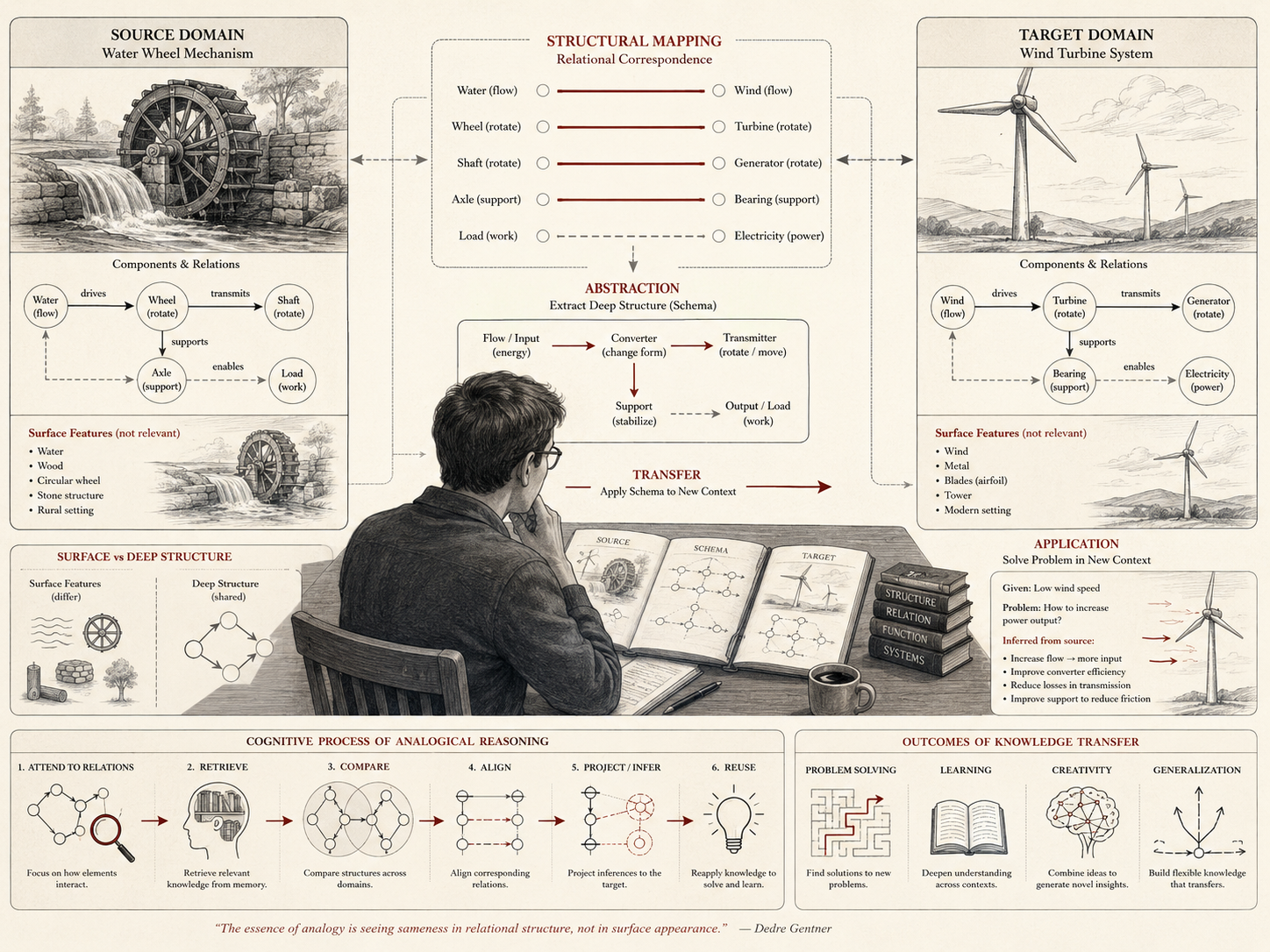
Analogical reasoning matters because many forms of intelligent thought depend on recognizing that a new problem has the same structure as an old one. A medical diagnosis may draw from a prior case. A scientific hypothesis may borrow structure from another field. A legal argument may rely on precedent. A student may learn an abstract mathematical relation through a familiar physical example. A designer may solve a technical problem by mapping a biological pattern onto an engineering challenge.
At the same time, analogy is fragile. A good analogy can illuminate deep structure. A bad analogy can distort judgment, exaggerate similarity, erase important differences, or carry misleading assumptions from one domain into another. Cognitive psychology therefore studies not only how analogies work, but also when they fail.
The nature of analogical reasoning
Analogical reasoning involves identifying similarities between two domains, usually called the source and the target. The source domain contains a known structure, while the target domain contains a new problem, concept, case, or situation. The reasoner attempts to project useful relations from the source onto the target.
The crucial point is that strong analogies depend more on relational similarity than on surface similarity. Two situations may look different yet share a common causal, functional, mathematical, social, or logical structure. Conversely, two cases may look similar on the surface while differing in the relations that actually matter. This distinction is one of the central insights of structure-mapping theory.
This matters because analogy is not merely decorative comparison. It is a cognitive tool for discovering structure, generating inferences, and extending knowledge into unfamiliar territory. A metaphor may help communicate an idea, but an analogy can also function as a reasoning process: it can suggest what should be true in the target domain if the mapped structure is valid.
Analogical reasoning typically involves several operations:
- Source retrieval, where a prior case or domain becomes available from memory.
- Mapping, where elements and relations in the source are aligned with corresponding elements and relations in the target.
- Inference projection, where unmapped knowledge from the source is proposed as a possible target-domain inference.
- Evaluation, where the reasoner tests whether the analogy is structurally appropriate.
- Abstraction, where a more general schema is extracted from the source-target comparison.
The same cognitive process can support learning, creativity, problem solving, explanation, and prediction. It can also mislead if the analogy is retrieved too easily, mapped too loosely, or trusted too strongly.
Structure mapping and knowledge transfer
One of the most influential theories of analogy is Dedre Gentner’s structure-mapping account. On this view, analogies are formed by aligning relational structures across domains rather than by simply counting shared attributes. A successful analogy preserves higher-order relations among elements even when the objects themselves differ substantially.
In structure mapping:
- elements in the source domain are matched to corresponding elements in the target;
- relations among source elements are mapped onto relations in the target;
- higher-order relational systems are given special importance;
- new inferences are projected from the source if the mapping is strong enough;
- the reasoner evaluates whether the transferred structure is valid in the target.
This process explains why analogical reasoning can be so powerful in science, mathematics, education, law, engineering, and everyday cognition. It allows individuals to transfer deeper principles rather than surface appearances alone. A student who understands electrical circuits by analogy to water flow is not simply comparing wires and pipes. The useful transfer depends on shared relations among flow, resistance, pressure, and constraint. A scientist who uses one physical system to model another is doing something similar at a higher level of abstraction.
Structure mapping also explains why analogy can fail. If the wrong relation is mapped, the analogy may produce false inference. If surface similarity dominates over structural similarity, the reasoner may retrieve a familiar but misleading case. If the mapping is partial but treated as complete, the analogy may overextend itself beyond its valid range.
Analogical reasoning therefore requires both generative and evaluative cognition. It must create correspondences, but it must also test them.
Source retrieval and the problem of noticing relevance
Before an analogy can be mapped, a useful source must be retrieved. This step is often harder than it appears. People may know a relevant prior case yet fail to notice that it applies to the current problem. In analogical transfer studies, participants often improve when an analogy is explicitly cued, but spontaneous transfer can be unreliable.
This reveals a central difficulty in analogical reasoning: relevant similarity is often structural, while memory retrieval is often driven by surface cues. A story about a military general may help solve a radiation-treatment problem because both share a convergence structure, but the surface domains are so different that the analogy may not be retrieved unless the relation is noticed.
Source retrieval depends on:
- source familiarity, because a known example is easier to retrieve;
- surface similarity, because shared labels or objects cue memory;
- structural similarity, because relational overlap makes transfer useful;
- schema abstraction, because general principles are easier to recognize across cases;
- working-memory capacity, because mapping requires maintaining several relations at once;
- metacognitive monitoring, because reasoners must notice when an analogy is worth testing.
This distinction between retrieval and mapping is important. A person may retrieve an example because it feels familiar, yet the example may not be structurally useful. Conversely, a structurally useful source may remain inaccessible because it lacks surface resemblance. Educational and expert systems can support transfer by helping learners encode examples relationally rather than only topically.
Formalizing analogical reasoning: mapping, similarity, and inference
Analogical reasoning can be represented as a mapping between two structured domains. Let the source domain be \(S = (E_S, R_S)\) and the target domain be \(T = (E_T, R_T)\), where \(E\) represents elements and \(R\) represents relations among them. An analogy proposes a mapping:
m: E_S \rightarrow E_T
\]
Interpretation: A mapping function \(m\) aligns source-domain elements with corresponding target-domain elements.
Such a mapping matters only if important relations are preserved. In simplified form, if \(R_S(a,b)\) holds in the source, then a good analogy suggests that the corresponding relation may hold in the target:
R_S(a,b) \Rightarrow R_T(m(a),m(b))
\]
Interpretation: Analogical reasoning is relational: mapped elements matter because relations among them are preserved or tested.
One can also express analogical quality as a weighted fit between mapped relations:
A(S,T) = \sum_{i=1}^{n} w_i \cdot \mathbf{1}[R_i^S \cong R_i^T]
\]
Interpretation: Analogical strength increases when important source relations correspond to target relations. The weight \(w_i\) captures the importance of each relation.
Candidate inference transfer can be described as:
P(q_T \mid S,T,m) \uparrow
\]
Interpretation: The plausibility of an unobserved target-domain proposition \(q_T\) increases if it follows from a well-supported source-target mapping.
The danger of superficial analogy can be represented by separating surface similarity \(F\) from structural similarity \(R\):
\text{risk} \uparrow \quad \text{when} \quad F(S,T) \gg R(S,T)
\]
Interpretation: A high-surface, low-structure analogy is cognitively tempting but inferentially risky.
These formalizations show why analogy is both powerful and risky. It can generate novel insight, but only if the underlying mapping is structurally sound. The cognitive challenge is not only to find similarity, but to identify the kind of similarity that supports valid transfer.
Analogical reasoning in problem solving
Analogical reasoning is one of the most powerful tools in problem solving. When individuals encounter an unfamiliar problem, they often search memory for a structurally similar case they have seen before. If a useful source can be retrieved and mapped correctly, the reasoner may solve the new problem far more efficiently than by beginning from scratch.
Classic experimental work by Gick and Holyoak demonstrated that analogical transfer can significantly improve problem solving, but also that spontaneous transfer is less reliable than one might assume. People often fail to use an analogy unless they notice the deeper relation between source and target.
Problem solving through analogy usually involves four steps:
- Recognizing the target problem, including its goals, constraints, and structure.
- Retrieving a source case, often from memory or instruction.
- Mapping the relation, aligning the source structure to the target structure.
- Adapting the solution, translating source-domain operations into target-domain action.
This process is especially important for ill-defined problems where rules are incomplete, constraints are ambiguous, or the correct strategy is not obvious. A reasoner may not know how to solve the target directly, but an analogy can reveal the relevant structure.
Analogical problem solving is also closely related to insight and creative problem solving. A useful analogy can restructure a problem, relax an assumption, or reveal a hidden relation. In many cases, the “aha” moment depends on realizing that the current problem is structurally like something already known.
Analogical reasoning and mental models
Analogies contribute to the development and revision of mental models. By transferring structure across domains, individuals can expand the internal models they use to understand systems, processes, and relationships.
This is especially important in science, policy, engineering, education, and public communication, where complex concepts are often first grasped through analogy. A new domain becomes more intelligible when it can be partially understood in terms of an older, better-understood one.
For example, people may understand electricity through water flow, memory through storage, the immune system through defense, markets through ecosystems, legal precedent through family resemblance, or climate systems through feedback loops. Each analogy highlights some relations and suppresses others. The educational power of analogy depends on making both the shared structure and the limits of the comparison explicit.
In that sense, analogical reasoning is not merely a shortcut for solving problems. It is also a way of building more powerful conceptual models. It helps learners move from isolated facts toward transferable schemas.
However, analogies can harden into misleading mental models when their limits are forgotten. A useful analogy should remain a tool, not become the thing itself. Good cognitive practice includes asking: where does this analogy work, and where does it stop working?
Learning and transfer of knowledge
One of the central functions of analogical reasoning is knowledge transfer. Learning becomes more powerful when what is acquired in one context can be applied in another. Analogy helps make that possible by highlighting deep correspondences across otherwise different situations.
This transfer depends on recognizing underlying principles rather than memorizing only specific examples. For that reason, analogical reasoning is closely related to cognitive learning and to concept formation, where patterns and relations are extracted from experience.
Analogical learning often benefits from comparison. When learners compare two examples that differ on surface details but share relational structure, they are more likely to abstract the deeper schema. This is why carefully paired examples can be more powerful than a single example. The comparison forces attention toward the relation, not only the objects.
Educationally, analogy can either deepen understanding or mislead it. Good analogies reveal structure. Bad analogies overstate correspondence and conceal important differences. Effective teaching therefore requires explicit guidance about what maps, what does not map, and what general principle should be abstracted.
Analogical transfer is especially important for expertise. Experts do not simply store more examples; they organize knowledge relationally. They can recognize that a new case belongs to a deeper family of problems even when surface features differ. This is one reason expert reasoning can appear fast: it is not random intuition, but structured retrieval and mapping from a richer knowledge base.
Analogical reasoning and decision making
Analogies also influence decision making by shaping how situations are interpreted and what prior cases are treated as relevant. Decision makers often draw on remembered precedents, past failures, or familiar scenarios when evaluating uncertain situations.
This can be useful when the analogy is structurally appropriate. A medical team may use a prior case to interpret a new presentation. A policymaker may compare a proposed intervention to a past program. A strategist may map a current market situation to an earlier competitive pattern. A person making a personal decision may ask, “What does this remind me of?”
But analogical decision making can also introduce distortion when an irrelevant precedent is treated as decisive or when a vivid but poorly matched comparison dominates judgment. In this way, analogical reasoning interacts directly with cognitive bias, because the choice of analogy can constrain what alternatives are even considered.
Decision environments are full of analogies: “this is another 2008,” “this is like a startup,” “this is a war,” “this is an ecosystem,” “this is a supply chain,” “this is a marketplace,” “this is a public-health problem.” Each analogy imports assumptions about causality, agency, risk, urgency, responsibility, and acceptable action.
Good decision making requires analogy discipline. Decision makers should ask whether the source case is structurally comparable, which relations transfer, what differences matter, and what evidence would falsify the comparison. A useful analogy opens inquiry; a dangerous analogy ends it too soon.
Analogy in science, explanation, and discovery
Analogical reasoning has long been central to scientific explanation and discovery. Scientists often use familiar systems to model unfamiliar ones, not because the systems are identical, but because they share relational structure. Scientific models frequently function analogically: they preserve selected relations while abstracting away irrelevant details.
Analogies can support scientific work in several ways:
- Hypothesis generation, by suggesting what might be true in a target system.
- Model building, by transferring structure from a better-understood domain.
- Explanation, by making unfamiliar mechanisms more intelligible.
- Experiment design, by suggesting what variables, relations, or constraints matter.
- Conceptual change, by reframing a phenomenon through a new relational model.
At the same time, scientific analogies must be controlled. A model is not the world. A source system may preserve some target relations while distorting others. Researchers must specify which aspects of the analogy are intended to transfer and which are not.
This discipline is especially important in public science communication. Analogies can make complex systems more understandable, but they can also oversimplify uncertainty, hide scale differences, or imply causal relations that are not established. Responsible analogy makes structure visible without pretending that comparison is proof.
Analogy, precedent, and legal reasoning
Analogical reasoning is also central to legal reasoning, especially in systems where precedent matters. Courts, lawyers, and legal scholars often reason from prior cases to current disputes. The key question is whether the current case is relevantly similar to or different from earlier cases.
Legal analogy is not merely a matter of finding any similarity. It requires identifying which similarities matter under the governing rule, doctrine, purpose, or principle. Two cases may be factually similar but legally different. Two cases may differ on the surface while sharing a legally decisive structure.
This makes legal reasoning a rich example of analogical cognition. It requires source retrieval, mapping, relevance judgment, principled distinction, and inference projection. It also shows that analogical reasoning is not value-neutral. Deciding which relations matter can depend on legal interpretation, institutional norms, moral reasoning, and social context.
Legal analogy also illustrates the power and risk of precedent. Analogy can promote consistency and predictability, but it can also preserve unjust structures if past cases are treated as controlling without critical examination. A research-grade understanding of analogy must therefore include both cognitive structure and institutional power.
Analogical reasoning in artificial intelligence
Analogical reasoning has long mattered in artificial intelligence, especially in case-based reasoning, transfer learning, model reuse, and systems designed to adapt prior knowledge to novel domains. These approaches mirror the broad cognitive logic of analogy: do not solve a new problem from nothing if a relevant prior structure can be adapted.
AI systems that reason analogically face many of the same challenges as human reasoners. They must retrieve a relevant source, represent source and target structure, align correspondences, project inferences, evaluate fit, and avoid misleading surface similarity. In computational terms, analogy is a problem of representation and mapping.
Contemporary AI raises renewed questions about analogy. Large models can generate analogies, compare cases, and propose cross-domain mappings. But generating an analogy is not the same as validating one. Systems may produce fluent comparisons that are structurally weak, overextended, or unsupported by evidence. Human oversight remains essential when analogies guide scientific, legal, educational, or policy reasoning.
Analogical reasoning therefore remains one of the clearest bridges between human cognition and computational intelligence. It shows that intelligence is not only pattern recognition or prediction. It is also the disciplined transfer of structure across contexts.
When analogies fail
Analogies fail when the transferred structure does not hold in the target domain. The failure may be subtle because the analogy can still feel compelling. Surface similarity, vividness, emotional salience, authority, and familiarity can all make a weak analogy persuasive.
Common forms of analogical failure include:
- Surface capture, where superficial resemblance overrides structural mismatch.
- Overextension, where a valid partial analogy is treated as complete.
- False mapping, where source elements are aligned with the wrong target elements.
- Missing boundary conditions, where relevant differences are ignored.
- Asymmetric inference, where the analogy transfers convenient implications but not limiting ones.
- Power-preserving analogy, where inherited comparisons normalize unequal or harmful arrangements.
Analogical failure is especially dangerous in high-stakes domains such as medicine, law, geopolitics, public policy, finance, and technology governance. A misleading analogy can shape attention, narrow options, and justify action before evidence is adequately examined.
The solution is not to avoid analogy. Analogy is too central to cognition for that. The solution is to evaluate analogies explicitly: what is the source? What is the target? Which relations map? Which do not? What inference is being projected? What evidence would show that the analogy has broken down?
Good analogical reasoning is creative, but also disciplined.
Analogical reasoning in contemporary research
Current research on analogical reasoning spans cognitive psychology, philosophy, education, neuroscience, artificial intelligence, linguistics, legal theory, and computational modeling. Philosophical work continues to clarify what counts as analogy and how analogical arguments function in inference. Psychological work continues to examine retrieval, mapping, relational complexity, and transfer, including how analogical skill depends on working-memory resources, relational representation, prior knowledge, and cueing.
Recent research also emphasizes that analogical reasoning is not a single operation. It includes source retrieval, mapping, evaluation, abstraction, and transfer. These processes can succeed or fail independently. A person may retrieve a source but map it poorly. They may map a structure accurately but draw a weak inference. They may solve the immediate problem but fail to abstract the schema for later transfer.
Educational research continues to examine how comparison, contrasting cases, worked examples, diagrams, and explicit relational language support analogical learning. AI research explores how computational systems can represent and transfer structure. Legal and policy research continues to show how analogy shapes interpretation and public reasoning.
Across these perspectives, one conclusion remains stable: analogical reasoning is both powerful and fragile. It enables deep transfer, but only when structural alignment is recognized accurately and evaluated carefully. It is a major source of learning and discovery, but also a major source of misleading inference when similarity is not disciplined by structure.
R code for analogical-reasoning data
The following R workflow illustrates analyses relevant to analogical reasoning, including source-target mapping success, transfer accuracy, relational complexity effects, inference quality, schema abstraction, and response time.
# Install packages if needed:
# pak::pak(c("tidyverse", "lme4", "lmerTest", "emmeans", "broom.mixed"))

library(tidyverse)
library(lme4)
library(lmerTest)
library(emmeans)
library(broom.mixed)

# Expected columns:
# participant, condition, source_id, target_id,
# source_familiarity, target_novelty, surface_similarity,
# structural_similarity, relational_complexity,
# working_memory_load, analogical_cue,
# mapping_accuracy, transfer_success,
# inference_quality, schema_abstraction,
# confidence, response_time_ms

dat <- read_csv("analogical_reasoning_trials.csv") %>%
  mutate(
    participant = factor(participant),
    condition = factor(condition),
    source_id = factor(source_id),
    target_id = factor(target_id),
    analogical_cue = as.integer(analogical_cue),
    mapping_accuracy = as.integer(mapping_accuracy),
    transfer_success = as.integer(transfer_success),
    log_response_time = log(response_time_ms)
  )

# -----------------------------
# 1. Descriptive profile
# -----------------------------

condition_summary <- dat %>%
  group_by(condition) %>%
  summarise(
    n_trials = n(),
    participants = n_distinct(participant),
    mean_source_familiarity = mean(source_familiarity, na.rm = TRUE),
    mean_target_novelty = mean(target_novelty, na.rm = TRUE),
    mean_surface_similarity = mean(surface_similarity, na.rm = TRUE),
    mean_structural_similarity = mean(structural_similarity, na.rm = TRUE),
    mean_relational_complexity = mean(relational_complexity, na.rm = TRUE),
    mean_working_memory_load = mean(working_memory_load, na.rm = TRUE),
    analogical_cue_rate = mean(analogical_cue, na.rm = TRUE),
    mapping_accuracy_rate = mean(mapping_accuracy, na.rm = TRUE),
    transfer_success_rate = mean(transfer_success, na.rm = TRUE),
    mean_inference_quality = mean(inference_quality, na.rm = TRUE),
    mean_schema_abstraction = mean(schema_abstraction, na.rm = TRUE),
    mean_confidence = mean(confidence, na.rm = TRUE),
    mean_response_time_ms = mean(response_time_ms, na.rm = TRUE),
    .groups = "drop"
  )

print(condition_summary)

# -----------------------------
# 2. Mapping-accuracy model
# -----------------------------

mapping_model <- glmer(
  mapping_accuracy ~
    condition +
    source_familiarity +
    target_novelty +
    surface_similarity +
    structural_similarity +
    relational_complexity +
    working_memory_load +
    analogical_cue +
    (1 | participant) +
    (1 | target_id),
  data = dat,
  family = binomial(),
  control = glmerControl(optimizer = "bobyqa")
)

summary(mapping_model)
emmeans(mapping_model, ~ condition, type = "response")

# -----------------------------
# 3. Transfer-success model
# -----------------------------

transfer_model <- glmer(
  transfer_success ~
    condition +
    source_familiarity +
    target_novelty +
    surface_similarity +
    structural_similarity +
    relational_complexity +
    working_memory_load +
    analogical_cue +
    mapping_accuracy +
    (1 | participant) +
    (1 | target_id),
  data = dat,
  family = binomial(),
  control = glmerControl(optimizer = "bobyqa")
)

summary(transfer_model)
emmeans(transfer_model, ~ condition, type = "response")

# -----------------------------
# 4. Inference-quality model
# -----------------------------

quality_model <- lmer(
  inference_quality ~
    condition +
    structural_similarity +
    surface_similarity +
    relational_complexity +
    working_memory_load +
    mapping_accuracy +
    transfer_success +
    schema_abstraction +
    (1 | participant) +
    (1 | target_id),
  data = dat,
  REML = FALSE
)

summary(quality_model)
emmeans(quality_model, ~ condition)

# -----------------------------
# 5. Schema-abstraction model
# -----------------------------

schema_model <- lmer(
  schema_abstraction ~
    condition +
    source_familiarity +
    structural_similarity +
    surface_similarity +
    mapping_accuracy +
    transfer_success +
    relational_complexity +
    (1 | participant) +
    (1 | target_id),
  data = dat,
  REML = FALSE
)

summary(schema_model)

# -----------------------------
# 6. Response-time model
# -----------------------------

rt_model <- lmer(
  log_response_time ~
    condition +
    relational_complexity +
    working_memory_load +
    source_familiarity +
    target_novelty +
    structural_similarity +
    analogical_cue +
    (1 | participant) +
    (1 | target_id),
  data = dat,
  REML = FALSE
)

summary(rt_model)

# -----------------------------
# 7. Visualization
# -----------------------------

ggplot(dat, aes(x = structural_similarity, y = inference_quality, color = condition)) +
  geom_point(alpha = 0.25) +
  geom_smooth(method = "lm", se = FALSE) +
  labs(
    title = "Structural similarity and analogical inference quality",
    x = "Structural similarity",
    y = "Inference quality"
  ) +
  theme_minimal()
This workflow can be adapted for structure-mapping experiments, source-retrieval studies, transfer-learning tasks, educational analogy studies, legal-reasoning experiments, scientific model-comparison studies, or AI-assisted analogy evaluation. Researchers should model participant and item effects whenever possible because analogical tasks often vary strongly in source familiarity, target novelty, and relational complexity.
Python code for analogical-reasoning data
The Python examples below parallel the R workflow and are useful for transfer studies, relational-complexity experiments, mapping-performance analysis, inference-quality modeling, and source-target comparison research.
import numpy as np
import pandas as pd
import statsmodels.formula.api as smf
import statsmodels.api as sm
import matplotlib.pyplot as plt

# Expected columns:
# participant, condition, source_id, target_id,
# source_familiarity, target_novelty, surface_similarity,
# structural_similarity, relational_complexity,
# working_memory_load, analogical_cue,
# mapping_accuracy, transfer_success,
# inference_quality, schema_abstraction,
# confidence, response_time_ms

df = pd.read_csv("analogical_reasoning_trials.csv")

categorical_cols = ["participant", "condition", "source_id", "target_id"]
for col in categorical_cols:
    df[col] = df[col].astype("category")

df["analogical_cue"] = df["analogical_cue"].astype(int)
df["mapping_accuracy"] = df["mapping_accuracy"].astype(int)
df["transfer_success"] = df["transfer_success"].astype(int)
df["log_response_time"] = np.log(df["response_time_ms"])

# -----------------------------
# 1. Descriptive profile
# -----------------------------

condition_summary = (
    df.groupby("condition")
    .agg(
        n_trials=("mapping_accuracy", "size"),
        participants=("participant", "nunique"),
        mean_source_familiarity=("source_familiarity", "mean"),
        mean_target_novelty=("target_novelty", "mean"),
        mean_surface_similarity=("surface_similarity", "mean"),
        mean_structural_similarity=("structural_similarity", "mean"),
        mean_relational_complexity=("relational_complexity", "mean"),
        mean_working_memory_load=("working_memory_load", "mean"),
        analogical_cue_rate=("analogical_cue", "mean"),
        mapping_accuracy_rate=("mapping_accuracy", "mean"),
        transfer_success_rate=("transfer_success", "mean"),
        mean_inference_quality=("inference_quality", "mean"),
        mean_schema_abstraction=("schema_abstraction", "mean"),
        mean_confidence=("confidence", "mean"),
        mean_response_time_ms=("response_time_ms", "mean"),
    )
    .reset_index()
)

print(condition_summary)

# -----------------------------
# 2. Mapping-accuracy model
# -----------------------------

mapping_model = smf.glm(
    "mapping_accuracy ~ condition + source_familiarity + target_novelty "
    "+ surface_similarity + structural_similarity + relational_complexity "
    "+ working_memory_load + analogical_cue",
    data=df,
    family=sm.families.Binomial(),
)

mapping_result = mapping_model.fit(
    cov_type="cluster",
    cov_kwds={"groups": df["participant"]},
)

print(mapping_result.summary())

# -----------------------------
# 3. Transfer-success model
# -----------------------------

transfer_model = smf.glm(
    "transfer_success ~ condition + source_familiarity + target_novelty "
    "+ surface_similarity + structural_similarity + relational_complexity "
    "+ working_memory_load + analogical_cue + mapping_accuracy",
    data=df,
    family=sm.families.Binomial(),
)

transfer_result = transfer_model.fit(
    cov_type="cluster",
    cov_kwds={"groups": df["participant"]},
)

print(transfer_result.summary())

# -----------------------------
# 4. Inference-quality model
# -----------------------------

quality_model = smf.ols(
    "inference_quality ~ condition + structural_similarity + surface_similarity "
    "+ relational_complexity + working_memory_load + mapping_accuracy "
    "+ transfer_success + schema_abstraction",
    data=df,
)

quality_result = quality_model.fit(
    cov_type="cluster",
    cov_kwds={"groups": df["participant"]},
)

print(quality_result.summary())

# -----------------------------
# 5. Schema-abstraction model
# -----------------------------

schema_model = smf.ols(
    "schema_abstraction ~ condition + source_familiarity + structural_similarity "
    "+ surface_similarity + mapping_accuracy + transfer_success "
    "+ relational_complexity",
    data=df,
)

schema_result = schema_model.fit(
    cov_type="cluster",
    cov_kwds={"groups": df["participant"]},
)

print(schema_result.summary())

# -----------------------------
# 6. Response-time model
# -----------------------------

rt_model = smf.ols(
    "log_response_time ~ condition + relational_complexity + working_memory_load "
    "+ source_familiarity + target_novelty + structural_similarity + analogical_cue",
    data=df,
)

rt_result = rt_model.fit(
    cov_type="cluster",
    cov_kwds={"groups": df["participant"]},
)

print(rt_result.summary())

# -----------------------------
# 7. Visualization
# -----------------------------

fig, ax = plt.subplots(figsize=(8, 5))

for condition, group in df.groupby("condition"):
    ax.scatter(
        group["structural_similarity"],
        group["inference_quality"],
        alpha=0.35,
        label=str(condition),
    )

ax.set_xlabel("Structural similarity")
ax.set_ylabel("Inference quality")
ax.set_title("Structural similarity and analogical inference quality")
ax.legend(title="Condition")
plt.tight_layout()
plt.show()
The Python workflow is intentionally transparent and extensible. It can be expanded with hierarchical Bayesian models, item-response models for target difficulty, semantic-similarity features, network representations of source-target relations, natural-language embeddings, transfer-learning comparisons, or computational models of structure mapping and source retrieval.
GitHub Repository
The companion repository provides reusable code and research scaffolding for studying analogical reasoning and knowledge transfer, including workflows for mapping-accuracy analysis, transfer-success modeling, relational-complexity effects, inference-quality evaluation, schema-abstraction modeling, source-retrieval simulation, and structure-mapping experiments.
Complete Code Repository
Access the full companion repository for this article, including reproducible analysis materials and multi-language code workflows for analogical-reasoning and knowledge-transfer research.
Applications of analogical-reasoning research
Analogical-reasoning research matters across education, science, law, design, engineering, public policy, artificial intelligence, organizational learning, and everyday decision making. It helps explain how people transfer knowledge, how they build bridges across domains, and why some comparisons illuminate while others mislead.
In education, analogy helps students grasp abstract concepts through familiar structures. In science, analogy supports model building and hypothesis generation. In engineering and design, analogy enables cross-domain innovation. In law, analogy supports precedent-based reasoning while also requiring careful distinction. In policy, analogy can clarify unfamiliar systems, but it can also distort public judgment when surface comparisons dominate structural analysis.
In artificial intelligence, analogical reasoning remains central to questions of transfer, adaptation, and reusable structure. A system that can identify relational correspondence across domains is closer to flexible cognition than one that only classifies surface patterns. But computational analogy also requires careful evaluation: generated comparisons are not necessarily valid mappings.
These applications matter because analogy is one of the mind’s most powerful ways of escaping local experience without abandoning structure. It allows knowledge to travel. The challenge is ensuring that what travels is the right structure.
Conclusion
Analogical reasoning is the cognitive process through which knowledge from one domain is transferred to another on the basis of structural similarity. It supports problem solving, learning, explanation, decision making, legal reasoning, scientific discovery, and creative thought by allowing previously acquired knowledge to inform novel situations.
Cognitive psychology shows that analogy is powerful not because it copies surface features, but because it maps relational structure. Understanding analogical reasoning therefore helps explain how minds move beyond direct experience, how knowledge becomes transferable, and how structural insight can guide thought in unfamiliar domains.
At the same time, analogy requires discipline. A compelling comparison is not necessarily a valid inference. Good analogical reasoning asks which relations map, which differences matter, what inferences are justified, and where the analogy breaks down.
The central lesson is that analogy is not merely a figure of speech. It is a cognitive architecture for transfer. It lets the mind use the known to approach the unknown — but only when similarity is governed by structure.
Related articles
- Cognitive Psychology
- Problem Solving in Cognitive Psychology
- Insight and Creative Problem Solving
- Mental Models in Cognitive Psychology
- Working Memory in Cognitive Psychology
- Memory in Cognitive Psychology
- Metacognition: Thinking About Thinking
- Concept Formation in Cognitive Psychology
- Cognitive Systems in Artificial Intelligence
Further reading
- Bartha, P. (2013) ‘Analogy and analogical reasoning’, Stanford Encyclopedia of Philosophy. Available at: https://plato.stanford.edu/entries/reasoning-analogy/.
- Gentner, D. (1983) ‘Structure-mapping: A theoretical framework for analogy’, Cognitive Science, 7(2), pp. 155–170. Available at: https://groups.psych.northwestern.edu/gentner/papers/Gentner83.2b.pdf.
- Gick, M.L. and Holyoak, K.J. (1980) ‘Analogical problem solving’, Cognitive Psychology, 12(3), pp. 306–355. Available at: https://reasoninglab.psych.ucla.edu/wp-content/uploads/sites/273/2021/04/Gick-Holyoak1980Analogical-Problem-Solving.pdf.
- Holyoak, K.J. (2012) ‘Analogy and relational reasoning’, in Holyoak, K.J. and Morrison, R.G. (eds.) The Oxford Handbook of Thinking and Reasoning. Available at: https://reasoninglab.psych.ucla.edu/wp-content/uploads/sites/273/2021/04/Holyoak_2012.pdf.
- Gentner, D. and Maravilla, F. (2018) ‘Analogical reasoning’, in Wixted, J.T. (ed.) Stevens’ Handbook of Experimental Psychology and Cognitive Neuroscience. Available at: https://groups.psych.northwestern.edu/gentner/papers/GentnerMaravilla_2018-Handbook.pdf.
References
- Bartha, P. (2013) ‘Analogy and analogical reasoning’, Stanford Encyclopedia of Philosophy. Available at: https://plato.stanford.edu/entries/reasoning-analogy/.
- Gentner, D. (1983) ‘Structure-mapping: A theoretical framework for analogy’, Cognitive Science, 7(2), pp. 155–170. Available at: https://groups.psych.northwestern.edu/gentner/papers/Gentner83.2b.pdf.
- Gentner, D. and Maravilla, F. (2018) ‘Analogical reasoning’, in Wixted, J.T. (ed.) Stevens’ Handbook of Experimental Psychology and Cognitive Neuroscience. Available at: https://groups.psych.northwestern.edu/gentner/papers/GentnerMaravilla_2018-Handbook.pdf.
- Gick, M.L. and Holyoak, K.J. (1980) ‘Analogical problem solving’, Cognitive Psychology, 12(3), pp. 306–355. Available at: https://reasoninglab.psych.ucla.edu/wp-content/uploads/sites/273/2021/04/Gick-Holyoak1980Analogical-Problem-Solving.pdf.
- Holyoak, K.J. (2012) ‘Analogy and relational reasoning’, in Holyoak, K.J. and Morrison, R.G. (eds.) The Oxford Handbook of Thinking and Reasoning. Available at: https://reasoninglab.psych.ucla.edu/wp-content/uploads/sites/273/2021/04/Holyoak_2012.pdf.
- Holyoak, K.J. and Thagard, P. (1995) Mental Leaps: Analogy in Creative Thought. Cambridge, MA: MIT Press.
- Lamond, G. (2006) ‘Precedent and analogy in legal reasoning’, Stanford Encyclopedia of Philosophy. Available at: https://plato.stanford.edu/entries/legal-reas-prec/.
- Richland, L.E. and Simms, N. (2015) ‘Analogy, higher order thinking, and education’, Wiley Interdisciplinary Reviews: Cognitive Science, 6(2), pp. 177–192.