
Last Updated May 20, 2026
Cognitive psychology and behavioral economics are deeply interconnected fields that examine how people perceive, interpret, value, and act on information under conditions of uncertainty, scarcity, time pressure, social influence, institutional design, and cognitive limitation. Cognitive psychology studies the mental processes underlying perception, attention, memory, working memory, reasoning, affect, judgment, learning, and decision making. Behavioral economics applies these insights to understand economic behavior in real-world contexts where people do not always optimize, calculate fully, or act according to the assumptions of classical rational-choice models.
Traditional economic theory often models individuals as rational agents who maximize utility based on stable preferences and available information. Behavioral economics challenges that idealized picture by showing that economic choices are shaped by bounded rationality, heuristics, framing effects, reference points, loss aversion, defaults, limited attention, social norms, present bias, overconfidence, and institutional context. These are not random deviations from rationality. They are patterned consequences of the way human cognition works.
The connection between cognitive psychology and behavioral economics runs through attention, memory, working memory, decision making, mental models, cognitive load, metacognition, and heuristics in problem solving. These processes collectively determine how individuals notice information, frame choices, estimate probabilities, evaluate trade-offs, respond to incentives, and make decisions in markets, institutions, households, workplaces, and public-policy environments.
Main Library
Publications
Article Map
Cognitive Psychology
Related Topic
Behavioral Economics
Related Topic
Economic Systems
Related Topic
Data Systems & Analytics
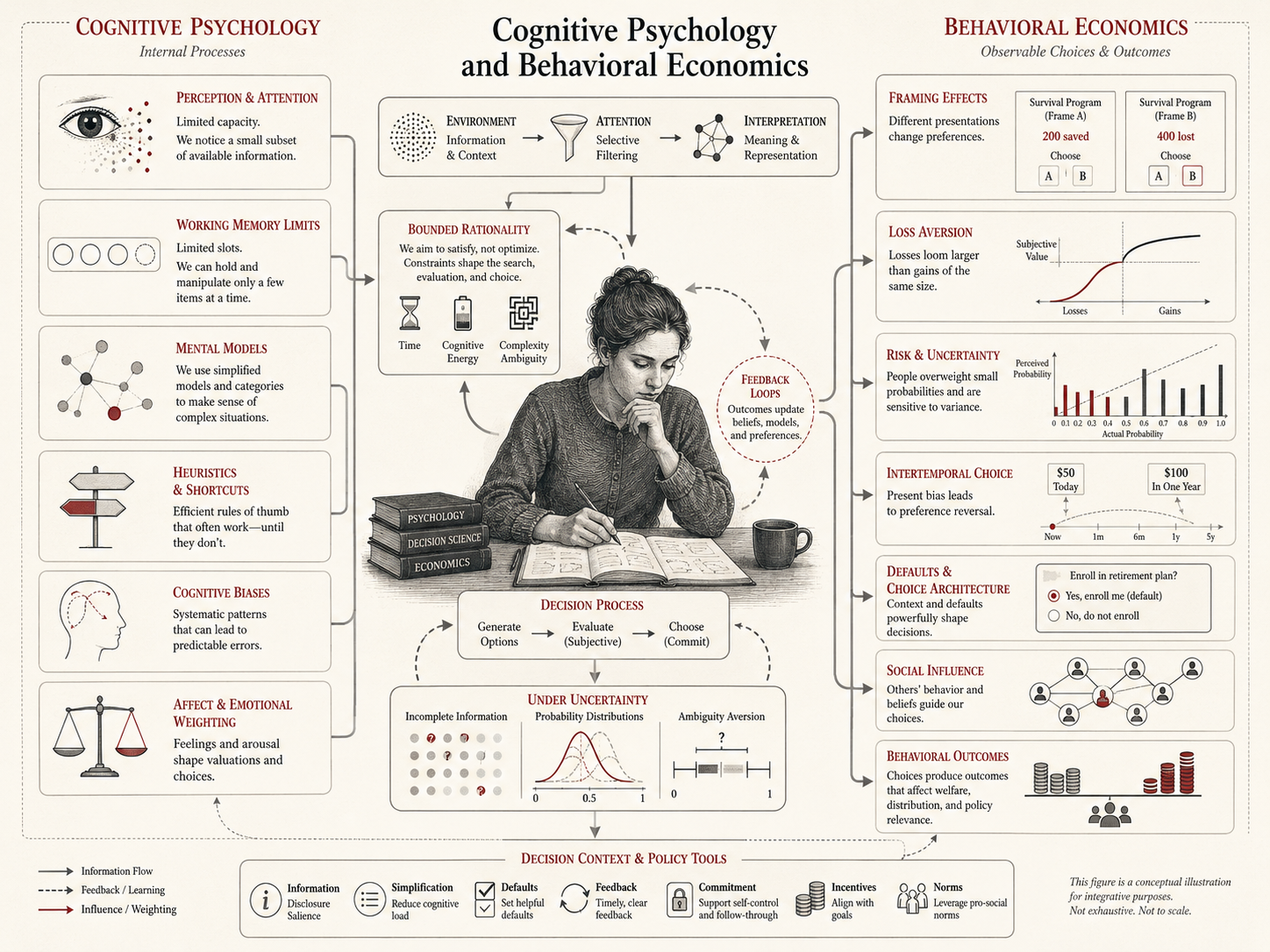
Behavioral economics matters because economic life is not made by abstract agents alone. It is made by people with limited time, limited attention, unequal resources, imperfect memory, emotional commitments, cultural expectations, institutional constraints, and social identities. Cognitive psychology provides the mechanisms; behavioral economics shows how those mechanisms shape saving, spending, risk taking, cooperation, consumption, health decisions, environmental behavior, public-policy response, market behavior, and institutional design.
Why cognitive psychology matters for behavioral economics
Behavioral economics begins with a basic observation: real economic decisions are made by cognitively limited people, not by perfectly informed optimization machines. People must choose under uncertainty, search under time constraints, compare imperfect alternatives, remember prior experiences, interpret institutional signals, manage emotional responses, and act within social environments.
Cognitive psychology explains the mechanisms behind those choices. Attention determines what information is noticed. Working memory limits how much information can be actively compared. Long-term memory shapes which experiences are retrieved. Perception organizes how options appear. Emotion affects salience and urgency. Mental models shape expectations. Metacognition determines whether people recognize the limits of their own judgment.
Behavioral economics takes these mechanisms into economic life. It asks why people under-save, over-borrow, misjudge risk, accept defaults, delay beneficial action, respond to framing, follow norms, overweight immediate rewards, avoid losses, overestimate their knowledge, or fail to act on information that would improve their welfare.
This does not mean that people are foolish. It means that economic behavior must be studied under realistic cognitive conditions. Many so-called biases are adaptive shortcuts in some environments and costly errors in others. A heuristic that works well in ordinary life may fail in complex financial markets, digital platforms, bureaucratic forms, or probabilistic risk environments.
The central contribution of cognitive psychology is therefore not merely that humans make mistakes. It is that human choice has structure. Behavioral economics studies that structure in contexts where decisions matter for welfare, markets, institutions, and public life.
From rational choice to bounded rationality
Classical economic models often assume decision makers who maximize utility across available alternatives. Such models can be powerful analytical tools, especially when they clarify incentives, constraints, equilibrium behavior, and trade-offs. But as descriptive accounts of human choice, they are incomplete. Real decision makers rarely have complete information, unlimited time, stable preferences, perfect calculation, or full awareness of all consequences.
Bounded rationality describes decision making under these limits. People are goal-directed, but they operate with finite cognitive resources. They search selectively, compare partially, stop when an option is good enough, and rely on simplified representations of complex problems. Herbert Simon’s idea of satisficing remains central: people often seek solutions that are adequate rather than optimal because exhaustive optimization is impossible or too costly.
In cognitive terms, bounded rationality reflects limits in attention, working memory, processing speed, learning, and environmental knowledge. A person choosing a health plan, mortgage, investment option, public service, privacy setting, or retirement contribution cannot evaluate every possible consequence. They depend on defaults, labels, advice, rankings, heuristics, prior beliefs, social cues, and institutional trust.
Behavioral economics extends bounded rationality into markets and policy. It asks how institutions should be designed when people face cognitive limits. A retirement system that assumes people will optimize long-term savings on their own may fail. A public-benefits system that assumes people can navigate complex paperwork without burden may exclude the people it intends to help. A market disclosure regime that assumes people read and understand all information may protect firms more than consumers.
Bounded rationality is therefore not only an individual cognitive concept. It is a design problem for economic systems.
Heuristics and decision making
Heuristics are mental shortcuts that simplify decision making under uncertainty. They reduce cognitive effort by allowing people to make judgments without exhaustive analysis. Heuristics are necessary because real environments are too complex to evaluate fully. They help people act quickly, infer from limited evidence, and navigate uncertainty.
Common heuristics include:
- Availability heuristic — judging likelihood based on how easily examples come to mind.
- Representativeness heuristic — judging probability based on similarity to a familiar category or prototype.
- Anchoring — relying too heavily on an initial value, estimate, price, or reference point.
- Affect heuristic — using emotional response as a shortcut for risk, value, or desirability.
- Recognition heuristic — treating familiar options as better or more reliable than unfamiliar ones.
- Status quo heuristic — preferring existing arrangements because change requires cognitive effort and uncertainty.
These processes are closely related to heuristics in problem solving, where simplified strategies help people navigate complex environments. Heuristics are not inherently irrational. They can be fast, frugal, and useful when environments are stable and feedback is meaningful. The problem arises when a heuristic is applied in an environment where it systematically misleads.
For example, availability can help people respond to vivid risks, but it can also produce distorted risk perception after dramatic news events. Anchoring can simplify price comparison, but it can also make consumers overly influenced by arbitrary list prices. Status quo bias can preserve stability, but it can also prevent people from changing harmful defaults.
Behavioral economics studies the conditions under which heuristics produce efficient decisions, predictable errors, or exploitable vulnerabilities.
Cognitive biases and economic behavior
Cognitive biases are systematic patterns of judgment that depart from idealized rational choice or statistical reasoning. In behavioral economics, biases help explain why people’s choices often diverge from what standard models predict. These biases influence how people perceive risk, evaluate outcomes, respond to incentives, and interpret information.
Important behavioral-economic biases include:
- Loss aversion, where losses are experienced more strongly than comparable gains.
- Confirmation bias, where people seek or interpret information in ways that support prior beliefs.
- Overconfidence, where people overestimate their knowledge, control, or predictive accuracy.
- Present bias, where immediate rewards are overvalued relative to future benefits.
- Endowment effect, where ownership increases the perceived value of an item.
- Mental accounting, where people categorize money into separate psychological accounts rather than treating all money as interchangeable.
- Default bias, where people disproportionately accept pre-selected options.
- Framing bias, where equivalent information leads to different choices depending on presentation.
These biases are explored in greater detail in cognitive biases in decision making, where they are examined as features of human cognition rather than simple moral or intellectual failures. Behavioral economics incorporates these insights to explain real-world economic behavior: why people may avoid beneficial investments, underestimate long-term risks, overreact to losses, follow defaults, or respond differently to equivalent incentives.
Biases become especially important when institutions know how to exploit them. Digital platforms can use scarcity cues, countdown timers, default subscriptions, social proof, and confusing cancellation flows. Financial products can rely on anchoring, complexity, and present bias. Public systems can unintentionally exclude people by imposing administrative burdens that overwhelm attention and working memory.
Understanding cognitive bias is therefore both analytical and ethical. It reveals not only how people decide, but how environments shape, guide, distort, or exploit decision making.
Prospect theory, reference points, and loss aversion
Prospect theory is one of the most influential contributions of behavioral economics. Developed by Daniel Kahneman and Amos Tversky, it describes how people evaluate gains and losses under risk. Instead of evaluating outcomes only in terms of final wealth, people often evaluate them relative to a reference point. Gains and losses are psychologically asymmetric: losses often loom larger than comparable gains.
The key insight is that value is not simply objective magnitude. It depends on cognitive representation. A $100 change may feel different depending on whether it is framed as a gain, a loss, a discount, a penalty, a refund, or a missed opportunity. The reference point changes how the outcome is experienced.
Prospect theory helps explain why people may be risk-averse in the domain of gains but risk-seeking in the domain of losses. A person facing a sure gain may prefer certainty. A person facing a sure loss may gamble to avoid realizing that loss. This pattern has implications for finance, insurance, health behavior, negotiation, litigation, consumer choice, and public policy.
Loss aversion also shapes institutional behavior. Organizations may resist abandoning failing projects because doing so would make losses explicit. Consumers may hold onto bad investments to avoid realizing a loss. Workers may respond more strongly to wage cuts than to equivalent missed gains. Citizens may react differently to policies framed as losing existing benefits versus gaining new ones.
Prospect theory remains important because it connects economic choice to cognitive representation. The same material outcome can produce different behavior depending on the reference point through which it is interpreted.
Framing effects and mental representation
Framing effects occur when equivalent information leads to different decisions depending on how it is presented. A medical treatment described as having a 90 percent survival rate may be evaluated differently from one described as having a 10 percent mortality rate, even though the statistical information is the same. A fee may be experienced differently if framed as a surcharge rather than the absence of a discount.
Framing effects reveal that people do not respond only to information. They respond to represented information. The linguistic, visual, numerical, emotional, and institutional form of a choice shapes how it is cognitively encoded.
These effects are closely related to mental models, because frames help define what kind of situation the decision maker believes they are in. Is the choice a risk, an opportunity, a loss, a moral duty, a default expectation, a social norm, or a personal preference? Different frames activate different interpretations and different actions.
Framing is not always manipulative. Good framing can clarify consequences, make risk understandable, and help people act in line with their own goals. But framing can also be used to obscure costs, exaggerate benefits, hide uncertainty, or steer users toward choices they would not otherwise make.
Behavioral economics therefore treats framing as a central part of choice architecture. Decisions are not made in a vacuum. They are made inside representational environments.
Dual-process theories of cognition
Behavioral economics has been strongly influenced by dual-process theories of cognition, which distinguish between fast, intuitive, automatic processes and slower, more deliberate, analytical processes. Popular accounts often describe these as System 1 and System 2.
- System 1 is fast, associative, intuitive, automatic, emotionally responsive, and often effortless.
- System 2 is slower, more deliberate, attention-demanding, reflective, and effortful.
This distinction helps explain why people may give intuitive answers that later reflection would correct, why cognitive load increases reliance on shortcuts, and why time pressure can change economic behavior. However, the distinction should not be treated as a rigid two-part machine inside the mind. Human cognition is more integrated, dynamic, and context-sensitive than any simple dual-process diagram suggests.
Dual-process theories are useful because they highlight the role of attention and metacognition. People often need cognitive resources to override intuitive responses, question assumptions, calculate trade-offs, or recognize that a problem requires deeper analysis. When attention is scarce or cognitive load is high, intuitive responses may dominate.
In behavioral economics, this helps explain why disclosures alone often fail. Giving people more information does not guarantee better decisions if they lack the time, attention, numeracy, trust, or working-memory capacity needed to use that information. Better decision environments must consider the cognitive process by which information is actually interpreted.
Intertemporal choice, self-control, and present bias
Intertemporal choice concerns decisions involving trade-offs between present and future outcomes. People often prefer smaller immediate rewards over larger delayed rewards, especially when the delayed benefit is abstract or uncertain. This pattern is central to saving, borrowing, education, health behavior, addiction, environmental behavior, retirement planning, and long-term investment.
Present bias refers to the tendency to give disproportionate weight to immediate costs and benefits. A person may intend to save, exercise, study, reduce energy use, or complete paperwork later, but immediate friction makes delay attractive. The future self is treated as if it will have more time, energy, discipline, or clarity than the present self.
Cognitive psychology helps explain this pattern. Future outcomes are less vivid than immediate experiences. Delayed consequences require imagination, memory, planning, and self-regulation. Immediate rewards are perceptually and emotionally available. Future benefits often remain abstract.
Behavioral economics studies how institutions can support better intertemporal decisions. Automatic savings plans, commitment devices, reminders, deadlines, simplified enrollment, default contributions, and timely feedback can help people act in line with long-term goals. But these tools must be designed carefully. The aim should be to support agency, not to manipulate people into choices that primarily serve institutional interests.
Intertemporal choice shows that economic behavior is not only about preferences. It is also about temporal cognition: how people imagine, value, and act for future selves and future communities.
Social preferences, norms, and fairness
Behavioral economics also challenges the assumption that people act only from narrow self-interest. Social preferences, fairness concerns, reciprocity, identity, trust, reputation, and norms often shape economic behavior. People may cooperate, punish unfairness, donate, share, follow norms, or reject offers that feel exploitative even when pure monetary payoff would suggest a different action.
Cognitive psychology contributes to this area by studying how people perceive social information, infer intentions, remember prior interactions, evaluate trust, and respond emotionally to fairness or betrayal. Economic behavior is often social cognition under conditions of exchange.
Norms can influence behavior through descriptive information about what others do and injunctive information about what others approve. A household may reduce energy use when it learns that neighbors use less. A taxpayer may comply when they believe compliance is common. A worker may contribute more when cooperation is visible and reciprocated.
Fairness concerns are especially important for institutions. People may accept difficult trade-offs when they believe procedures are fair, but resist even materially beneficial changes when they perceive disrespect, deception, or unequal treatment. Behavioral economics therefore connects cognition to legitimacy. Economic systems depend not only on incentives, but on perceived fairness and trust.
Choice architecture, defaults, and nudges
Choice architecture refers to the way options are structured, ordered, framed, timed, and presented. Every decision environment has a choice architecture, whether intentional or accidental. Defaults, labels, menus, warnings, reminders, rankings, deadlines, friction, and visual hierarchy all shape behavior.
Defaults are especially powerful because they reduce the cognitive effort required to choose. When a default is present, many people accept it because changing it requires attention, evaluation, confidence, and action. This can be beneficial when defaults help people save for retirement, enroll in beneficial programs, or avoid harmful omissions. But defaults can also exploit inertia, especially when they serve firms more than users.
Nudges are interventions that alter behavior by changing the decision environment without forbidding options or substantially changing economic incentives. Examples include automatic enrollment, simplified forms, reminders, social-norm messages, implementation prompts, salient warnings, and better sequencing of information.
From a cognitive perspective, nudges work because they interact with attention, memory, effort, salience, default bias, framing, and social cognition. This is why they must be evaluated ethically. A nudge that helps people act on their own considered goals differs from a dark pattern that exploits cognitive limits for institutional gain.
Choice architecture should therefore be judged not only by whether it changes behavior, but by whether it improves welfare, preserves agency, distributes burden fairly, and remains transparent enough for public accountability.
Behavioral economics in public policy
Behavioral economics has wide-ranging applications in public policy. Governments and public institutions use behavioral insights to improve saving, tax compliance, health behavior, education, energy conservation, environmental behavior, consumer protection, public-service delivery, vaccination, retirement enrollment, and administrative access.
These applications often begin from a simple insight: people may fail to act not because they reject a goal, but because the decision environment is cognitively difficult. Forms may be confusing. Deadlines may be easy to miss. Benefits may be hard to understand. Costs may be immediate while gains are delayed. Procedures may demand time, literacy, numeracy, internet access, or emotional energy that people do not have.
Behavioral policy can reduce these burdens by simplifying processes, improving reminders, designing better defaults, clarifying consequences, reducing friction, improving feedback, and making beneficial action easier. However, policy applications must avoid blaming individuals for problems created by structural inequality or institutional complexity.
The best behavioral policy does not treat citizens as defective decision makers. It treats institutions as responsible for designing environments that people can realistically navigate. This is especially important for marginalized communities, low-income households, disabled people, immigrants, older adults, and others who may face higher administrative burden and lower institutional power.
Behavioral economics becomes most valuable when it joins cognitive realism with institutional responsibility.
Behavioral economics and systems thinking
Behavioral economics extends cognitive insights into broader systems, where individual decisions aggregate into collective outcomes. Individual heuristics can shape markets. Defaults can shape retirement security. Present bias can shape public health. Risk perception can shape climate adaptation. Social norms can shape energy use, tax compliance, consumer behavior, and political participation.
Systems thinking matters because behavior is rarely isolated. People decide inside networks of institutions, incentives, norms, technologies, infrastructures, and histories. A consumer choice may depend on platform design, advertising, income, education, social norms, regulatory protection, and available alternatives. A health choice may depend on access, trust, time, transportation, insurance, language, and prior experience with institutions.
This means behavioral economics should not be reduced to individual psychology alone. Cognitive processes scale through systems, but systems also shape cognition. Attention is not only personal; it is organized by media, platforms, institutions, and markets. Defaults are not only convenient; they reflect power. Framing is not only linguistic; it is embedded in organizational and policy design.
These dynamics are closely related to problem solving and knowledge transfer, where individuals navigate complex environments and adapt behavior across contexts. Behavioral economics becomes stronger when it studies both minds and systems together.
Ethics, power, and the politics of behavioral design
Behavioral economics raises ethical questions because it studies how choices can be influenced. Any field that understands attention, defaults, framing, loss aversion, social norms, and cognitive limitation can be used either to support human welfare or to manipulate behavior.
This is why behavioral design must be evaluated through ethics and power. Who designs the choice environment? Whose goals are being served? What information is made visible or hidden? Are people helped to act on their own values, or steered toward outcomes that benefit firms, platforms, agencies, or political actors? Who bears the cost of cognitive burden?
Dark patterns are one example of behavioral insight used irresponsibly. Complicated cancellation flows, hidden fees, confusing privacy settings, manipulative scarcity messages, pre-checked boxes, and misleading defaults exploit predictable cognitive tendencies. These designs often look like ordinary interfaces, but they function as behavioral traps.
Public policy can also misuse behavioral tools if nudges substitute for structural reform. A reminder may help someone complete a benefits form, but it does not solve poverty. A savings nudge may improve enrollment, but it does not address wage stagnation. A health-behavior message may help some people, but it cannot replace equitable access to care.
Ethical behavioral economics should therefore combine cognitive realism with justice. It should reduce harmful burden, increase transparency, protect agency, and confront unequal power rather than merely optimizing behavioral uptake.
Formalizing behavioral-economic choice
Behavioral economics often formalizes how cognitive and contextual factors enter choice. One important framework is the prospect-theory value function. For an outcome \(x\), a simplified value function can be written as:
v(x)=
\begin{cases}
x^\alpha, & x \geq 0 \\
-\lambda(-x)^\beta, & x < 0
\end{cases}
\]
Interpretation: Gains and losses are evaluated relative to a reference point, with \(\lambda\) representing loss aversion. When \(\lambda > 1\), losses are weighted more heavily than comparable gains.
Intertemporal choice can be represented with a simple hyperbolic discounting function:
V = \frac{A}{1+kD}
\]
Interpretation: The present value \(V\) of a delayed amount \(A\) decreases as delay \(D\) increases. The parameter \(k\) represents the discount rate.
A behavioral-choice model can estimate the probability of selecting an option as a function of cognitive and contextual variables:
Pr(y_i=1)=\frac{1}{1+e^{-(\beta_0+\beta_1F_i+\beta_2D_i+\beta_3L_i+\beta_4N_i+\beta_5A_i)}}
\]
Interpretation: Choice probability can depend on framing \(F_i\), default exposure \(D_i\), cognitive load \(L_i\), social norm strength \(N_i\), and attention \(A_i\).
Behavioral welfare analysis can also compare observed choice \(C_o\) with a reflective or informed preference \(C_r\):
\Delta C = C_o – C_r
\]
Interpretation: The gap between observed choice and reflective choice helps distinguish behavior change from welfare improvement.
These formal tools do not eliminate the need for interpretation. They make assumptions explicit. The challenge is to model cognition without reducing human behavior to isolated parameters detached from social context, power, history, and institutional design.
Contemporary research and interdisciplinary integration
Modern research integrates cognitive psychology, behavioral economics, neuroscience, data science, public policy, political economy, organizational behavior, human-computer interaction, and artificial intelligence. The field has expanded far beyond laboratory demonstrations of bias. It now studies policy implementation, digital platforms, market design, climate behavior, health systems, financial decision making, administrative burden, algorithmic choice environments, and institutional trust.
Daniel Kahneman’s Nobel recognition highlighted the importance of psychological research for understanding economic decision making under uncertainty. Richard Thaler’s Nobel recognition further established behavioral economics as a major research field concerned with limited rationality, social preferences, and self-control. These recognitions matter because they show how deeply cognitive science has reshaped economics.
At the same time, contemporary research has become more critical and institutionally aware. Scholars increasingly ask when behavioral interventions work, for whom they work, whether effects replicate, whether nudges are ethically transparent, and whether individual-level interventions distract from structural problems.
Data science and AI have also changed the field. Digital platforms can run large-scale experiments, personalize choice environments, and optimize interfaces in real time. This creates new research opportunities and new ethical risks. Behavioral economics now intersects with algorithmic governance, recommender systems, dark patterns, consumer protection, and platform accountability.
The future of the field depends on maintaining its cognitive foundation while expanding its moral and institutional scope. Behavioral economics should not merely predict behavior. It should help design environments that respect human cognition, reduce harmful burden, and support more just economic systems.
R code for behavioral-economics data
The following R workflow illustrates analyses relevant to cognitive psychology and behavioral economics, including risky choice, default acceptance, willingness to pay, framing effects, cognitive load, social norms, and decision latency.
# Install packages if needed:
# pak::pak(c("tidyverse", "lme4", "lmerTest", "emmeans", "broom.mixed"))

library(tidyverse)
library(lme4)
library(lmerTest)
library(emmeans)
library(broom.mixed)

# Expected columns:
# participant, condition, choice_domain, gain_loss_frame,
# outcome_amount, probability, delay_days, cognitive_load,
# attention_score, default_present, social_norm_strength,
# loss_aversion_lambda, risky_choice, default_accepted,
# willingness_to_pay, decision_time_ms

dat <- read_csv("behavioral_economics_trials.csv") %>%
  mutate(
    participant = factor(participant),
    condition = factor(condition),
    choice_domain = factor(choice_domain),
    gain_loss_frame = factor(gain_loss_frame),
    default_present = as.integer(default_present),
    risky_choice = as.integer(risky_choice),
    default_accepted = as.integer(default_accepted),
    log_decision_time = log(decision_time_ms)
  )

# -----------------------------
# 1. Descriptive profile
# -----------------------------

condition_summary <- dat %>%
  group_by(condition) %>%
  summarise(
    n_trials = n(),
    participants = n_distinct(participant),
    mean_cognitive_load = mean(cognitive_load, na.rm = TRUE),
    mean_attention = mean(attention_score, na.rm = TRUE),
    risky_choice_rate = mean(risky_choice, na.rm = TRUE),
    default_acceptance_rate = mean(default_accepted, na.rm = TRUE),
    mean_wtp = mean(willingness_to_pay, na.rm = TRUE),
    mean_decision_time_ms = mean(decision_time_ms, na.rm = TRUE),
    mean_social_norm = mean(social_norm_strength, na.rm = TRUE),
    mean_lambda = mean(loss_aversion_lambda, na.rm = TRUE),
    .groups = "drop"
  )

print(condition_summary)

# -----------------------------
# 2. Risky-choice model
# -----------------------------

risky_model <- glmer(
  risky_choice ~
    condition +
    gain_loss_frame +
    probability +
    outcome_amount +
    cognitive_load +
    attention_score +
    social_norm_strength +
    loss_aversion_lambda +
    delay_days +
    (1 | participant),
  data = dat,
  family = binomial(),
  control = glmerControl(optimizer = "bobyqa")
)

summary(risky_model)
emmeans(risky_model, ~ condition, type = "response")
emmeans(risky_model, ~ gain_loss_frame, type = "response")

# -----------------------------
# 3. Default-acceptance model
# -----------------------------

default_model <- glmer(
  default_accepted ~
    condition +
    default_present +
    cognitive_load +
    attention_score +
    social_norm_strength +
    gain_loss_frame +
    (1 | participant),
  data = dat,
  family = binomial(),
  control = glmerControl(optimizer = "bobyqa")
)

summary(default_model)
emmeans(default_model, ~ condition, type = "response")

# -----------------------------
# 4. Willingness-to-pay model
# -----------------------------

wtp_model <- lmer(
  willingness_to_pay ~
    condition +
    gain_loss_frame +
    outcome_amount +
    probability +
    delay_days +
    cognitive_load +
    attention_score +
    social_norm_strength +
    risky_choice +
    (1 | participant),
  data = dat,
  REML = FALSE
)

summary(wtp_model)
emmeans(wtp_model, ~ condition)

# -----------------------------
# 5. Decision-time model
# -----------------------------

rt_model <- lmer(
  log_decision_time ~
    condition +
    gain_loss_frame +
    cognitive_load +
    attention_score +
    delay_days +
    probability +
    outcome_amount +
    (1 | participant),
  data = dat,
  REML = FALSE
)

summary(rt_model)

# -----------------------------
# 6. Visualization
# -----------------------------

ggplot(dat, aes(x = cognitive_load, y = as.numeric(risky_choice), color = gain_loss_frame)) +
  geom_jitter(height = 0.04, alpha = 0.25) +
  geom_smooth(method = "glm", method.args = list(family = "binomial"), se = FALSE) +
  labs(
    title = "Cognitive load and risky choice by frame",
    x = "Cognitive load",
    y = "Risky choice probability"
  ) +
  theme_minimal()
This workflow can be adapted for framing experiments, default-effect studies, intertemporal-choice tasks, public-policy experiments, financial decision studies, consumer behavior analysis, or field experiments. Researchers should define the welfare-relevant outcome carefully rather than assuming that behavior change alone equals success.
Python code for behavioral-economics data
The Python workflow below parallels the R analysis and is useful for behavioral-choice modeling, default-effect estimation, willingness-to-pay analysis, decision-latency modeling, prospect-theory simulation, and policy-relevant behavioral research.
import numpy as np
import pandas as pd
import statsmodels.formula.api as smf
import statsmodels.api as sm
import matplotlib.pyplot as plt

# Expected columns:
# participant, condition, choice_domain, gain_loss_frame,
# outcome_amount, probability, delay_days, cognitive_load,
# attention_score, default_present, social_norm_strength,
# loss_aversion_lambda, risky_choice, default_accepted,
# willingness_to_pay, decision_time_ms

df = pd.read_csv("behavioral_economics_trials.csv")

categorical_cols = ["participant", "condition", "choice_domain", "gain_loss_frame"]
for col in categorical_cols:
    df[col] = df[col].astype("category")

df["default_present"] = df["default_present"].astype(int)
df["risky_choice"] = df["risky_choice"].astype(int)
df["default_accepted"] = df["default_accepted"].astype(int)
df["log_decision_time"] = np.log(df["decision_time_ms"])

# -----------------------------
# 1. Descriptive profile
# -----------------------------

condition_summary = (
    df.groupby("condition")
    .agg(
        n_trials=("risky_choice", "size"),
        participants=("participant", "nunique"),
        mean_cognitive_load=("cognitive_load", "mean"),
        mean_attention=("attention_score", "mean"),
        risky_choice_rate=("risky_choice", "mean"),
        default_acceptance_rate=("default_accepted", "mean"),
        mean_wtp=("willingness_to_pay", "mean"),
        mean_decision_time_ms=("decision_time_ms", "mean"),
        mean_social_norm=("social_norm_strength", "mean"),
        mean_lambda=("loss_aversion_lambda", "mean"),
    )
    .reset_index()
)

print(condition_summary)

# -----------------------------
# 2. Risky-choice model
# -----------------------------

risky_model = smf.glm(
    "risky_choice ~ condition + gain_loss_frame + probability + outcome_amount "
    "+ cognitive_load + attention_score + social_norm_strength "
    "+ loss_aversion_lambda + delay_days",
    data=df,
    family=sm.families.Binomial(),
)

risky_result = risky_model.fit(
    cov_type="cluster",
    cov_kwds={"groups": df["participant"]},
)

print(risky_result.summary())

# -----------------------------
# 3. Default-acceptance model
# -----------------------------

default_model = smf.glm(
    "default_accepted ~ condition + default_present + cognitive_load "
    "+ attention_score + social_norm_strength + gain_loss_frame",
    data=df,
    family=sm.families.Binomial(),
)

default_result = default_model.fit(
    cov_type="cluster",
    cov_kwds={"groups": df["participant"]},
)

print(default_result.summary())

# -----------------------------
# 4. Willingness-to-pay model
# -----------------------------

wtp_model = smf.ols(
    "willingness_to_pay ~ condition + gain_loss_frame + outcome_amount "
    "+ probability + delay_days + cognitive_load + attention_score "
    "+ social_norm_strength + risky_choice",
    data=df,
)

wtp_result = wtp_model.fit(
    cov_type="cluster",
    cov_kwds={"groups": df["participant"]},
)

print(wtp_result.summary())

# -----------------------------
# 5. Decision-time model
# -----------------------------

rt_model = smf.ols(
    "log_decision_time ~ condition + gain_loss_frame + cognitive_load "
    "+ attention_score + delay_days + probability + outcome_amount",
    data=df,
)

rt_result = rt_model.fit(
    cov_type="cluster",
    cov_kwds={"groups": df["participant"]},
)

print(rt_result.summary())

# -----------------------------
# 6. Prospect-theory utility helpers
# -----------------------------

def prospect_value(x, alpha=0.88, beta=0.88, lam=2.25):
    x = np.asarray(x)
    gains = np.power(np.maximum(x, 0), alpha)
    losses = -lam * np.power(np.maximum(-x, 0), beta)
    return np.where(x >= 0, gains, losses)

df["prospect_value"] = prospect_value(
    df["outcome_amount"],
    lam=df["loss_aversion_lambda"].mean()
)

# -----------------------------
# 7. Visualization
# -----------------------------

fig, ax = plt.subplots(figsize=(8, 5))

for frame, group in df.groupby("gain_loss_frame"):
    ax.scatter(
        group["cognitive_load"],
        group["risky_choice"],
        alpha=0.35,
        label=str(frame),
    )

ax.set_xlabel("Cognitive load")
ax.set_ylabel("Risky choice")
ax.set_title("Cognitive load and risky choice by frame")
ax.legend(title="Frame")
plt.tight_layout()
plt.show()
The Python workflow is intentionally transparent and extensible. It can be expanded with hierarchical models, Bayesian estimation, prospect-theory parameter recovery, causal inference for field experiments, heterogeneous-treatment-effect estimation, calibration plots, or simulation-based policy evaluation.
GitHub Repository
The companion repository provides reusable code and research scaffolding for studying cognitive psychology and behavioral economics, including workflows for risky-choice modeling, default-effect analysis, framing experiments, prospect-theory simulation, decision-latency modeling, intertemporal-choice analysis, social-norm effects, and policy-relevant behavioral research.
Complete Code Repository
Access the full companion repository for this article, including reproducible analysis materials and multi-language code workflows for cognitive and behavioral-economics research.
Applications of cognitive-behavioral economics
Cognitive psychology and behavioral economics have applications across public policy, health, finance, education, environmental behavior, technology design, consumer protection, organizational decision making, labor markets, and digital platforms. These applications matter because many real-world problems depend not only on incentives, but on how people perceive, remember, interpret, and act on those incentives.
In health, behavioral insights can improve vaccination, medication adherence, preventive care, and patient communication. In finance, they can improve retirement savings, debt management, fee transparency, and consumer protection. In environmental policy, they can support energy conservation, sustainable consumption, and climate-risk communication. In education, they can reduce administrative barriers, improve persistence, and support better timing of interventions.
In digital environments, behavioral economics helps explain how interface design shapes choice. Defaults, notifications, recommendation systems, pricing displays, privacy settings, and cancellation flows can all alter behavior. This connects behavioral economics to human-computer interaction and cognitive systems in artificial intelligence.
The practical value of the field lies in designing systems that work with realistic human cognition. But practical value must be measured carefully. A behavioral intervention should not be judged only by uptake, clicks, conversions, or compliance. It should be judged by welfare, fairness, transparency, autonomy, and whether it reduces or increases unequal burden.
Conclusion
Cognitive psychology and behavioral economics are connected by a shared concern with how people make decisions under real conditions of uncertainty, limitation, and context. Cognitive psychology provides the mechanisms: attention, memory, working memory, mental models, affect, heuristics, reasoning, and metacognition. Behavioral economics shows how those mechanisms shape economic choices, market behavior, policy response, and institutional outcomes.
The importance of behavioral economics is not simply that people are irrational. It is that human rationality is bounded, situated, and structured. People reason with limited information, limited attention, limited time, social influence, institutional framing, emotional salience, and unequal resources. These conditions shape saving, spending, risk perception, cooperation, health behavior, environmental decisions, and public-policy participation.
Understanding this relationship helps explain why better information alone is often insufficient. Decision environments must be designed for the minds that actually use them. But this insight carries ethical responsibility. Behavioral tools can reduce burden and support welfare, or they can manipulate attention and exploit cognitive limits.
The central question is therefore not only how cognition shapes economic behavior. It is how institutions, markets, platforms, and public systems should be designed once we know that human beings are cognitively limited, socially embedded, and morally entitled to transparent, fair, and humane decision environments.
Related articles
- Cognitive Psychology
- Attention in Cognitive Psychology
- Memory in Cognitive Psychology
- Working Memory in Cognitive Psychology
- Decision Making in Cognitive Psychology
- Mental Models in Cognitive Psychology
- Cognitive Biases in Decision Making
- Heuristics in Problem Solving
- Cognition and Human-Computer Interaction
Further reading
- Kahneman, D. (2011) Thinking, Fast and Slow. New York: Farrar, Straus and Giroux.
- Kahneman, D. and Tversky, A. (1979) ‘Prospect theory: An analysis of decision under risk’, Econometrica, 47(2), pp. 263–291. Available at: https://www.jstor.org/stable/1914185.
- Nobel Prize (2002) Daniel Kahneman — Facts. Available at: https://www.nobelprize.org/prizes/economic-sciences/2002/kahneman/facts/.
- Nobel Prize (2017) Richard H. Thaler — Facts. Available at: https://www.nobelprize.org/prizes/economic-sciences/2017/thaler/facts/.
- OECD (2017) Behavioural Insights and Public Policy: Lessons from Around the World. Available at: https://www.oecd.org/en/publications/behavioural-insights-and-public-policy_9789264270480-en.html.
- Thaler, R.H. (2015) Misbehaving: The Making of Behavioral Economics. New York: W.W. Norton.
- Thaler, R.H. and Sunstein, C.R. (2008) Nudge: Improving Decisions About Health, Wealth, and Happiness. New Haven: Yale University Press.
References
- Ariely, D. (2008) Predictably Irrational: The Hidden Forces That Shape Our Decisions. New York: HarperCollins.
- Kahneman, D. (2011) Thinking, Fast and Slow. New York: Farrar, Straus and Giroux.
- Kahneman, D. and Tversky, A. (1979) ‘Prospect theory: An analysis of decision under risk’, Econometrica, 47(2), pp. 263–291. Available at: https://www.jstor.org/stable/1914185.
- Nobel Prize (2002) Daniel Kahneman — Facts. Available at: https://www.nobelprize.org/prizes/economic-sciences/2002/kahneman/facts/.
- Nobel Prize (2017) Richard H. Thaler — Facts. Available at: https://www.nobelprize.org/prizes/economic-sciences/2017/thaler/facts/.
- OECD (2017) Behavioural Insights and Public Policy: Lessons from Around the World. Paris: OECD Publishing. Available at: https://www.oecd.org/en/publications/behavioural-insights-and-public-policy_9789264270480-en.html.
- Simon, H.A. (1997) Administrative Behavior: A Study of Decision-Making Processes in Administrative Organizations. 4th edn. New York: Free Press.
- Thaler, R.H. (2015) Misbehaving: The Making of Behavioral Economics. New York: W.W. Norton.
- Thaler, R.H. and Sunstein, C.R. (2008) Nudge: Improving Decisions About Health, Wealth, and Happiness. New Haven: Yale University Press.
- Tversky, A. and Kahneman, D. (1974) ‘Judgment under uncertainty: Heuristics and biases’, Science, 185(4157), pp. 1124–1131.