Physics

Physics examines the fundamental principles that govern matter, energy, motion, force, space, and time. It seeks to explain how physical reality is structured, how natural phenomena arise, and how systems behave across scales ranging from subatomic particles to the largest observable features of the universe.

This field brings together the study of mechanics, thermodynamics, electromagnetism, relativity, quantum phenomena, and the mathematical laws that describe stability, interaction, symmetry, and change. It provides the conceptual foundations for understanding causation, measurement, motion, and the general behavior of physical systems.

Physics plays a foundational role in the natural sciences because it establishes many of the basic principles on which other scientific disciplines depend. By clarifying how matter behaves, how energy is transferred, and how physical systems evolve over time, it shapes human understanding of the material order of nature and the intelligibility of the universe itself.

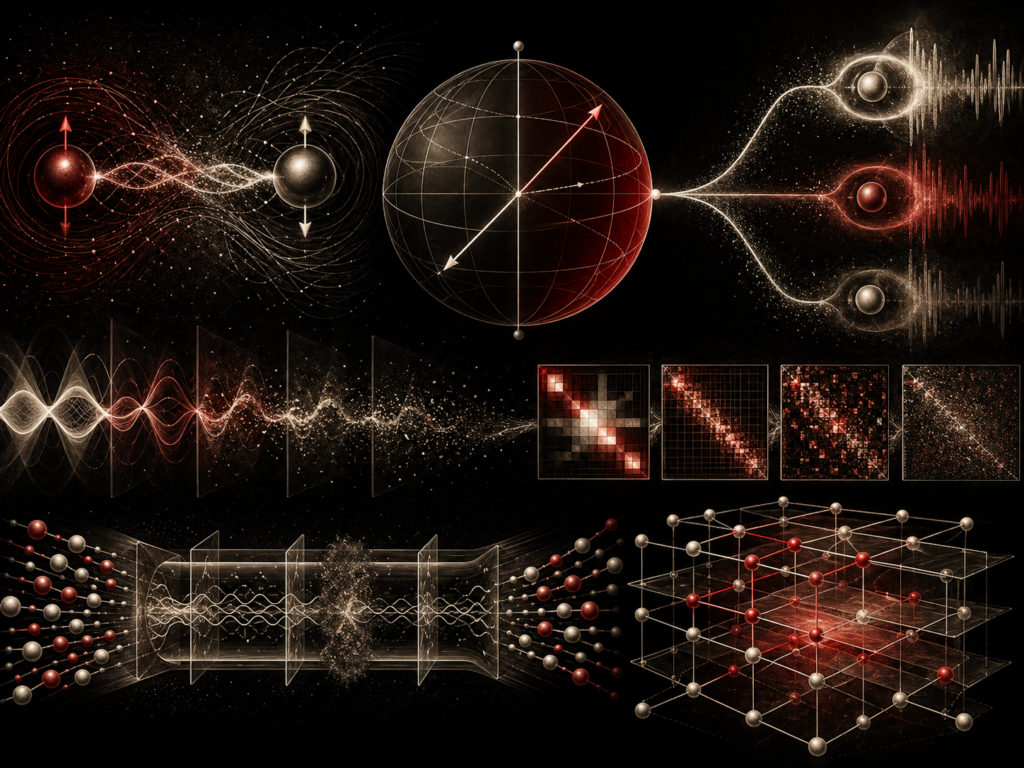
Editorial scientific illustration showing abstract qubits, entangled particles, Bloch-sphere geometry, branching measurement paths, fading coherence waves, matrix-like textures, and lattice structures.

Quantum Information, Decoherence, and Measurement

Quantum information, decoherence, and measurement explain how physical systems can store information in quantum states, how measurement turns amplitudes into outcomes, and how interaction with the environment destroys fragile quantum coherence. This article examines qubits, superposition, Hilbert space, density matrices, pure and mixed states, entanglement, the Born rule, projective measurement, generalized measurement, quantum channels, decoherence, dephasing, relaxation, entropy, no-cloning, teleportation, quantum error correction, fault tolerance, quantum algorithms, quantum communication, and the measurement problem. Selected R and Python workflows model binary entropy, measurement uncertainty, density-matrix dephasing, purity, and von Neumann entropy, while the linked GitHub repository expands the article with advanced computational scaffolding for reproducible quantum-information workflows.
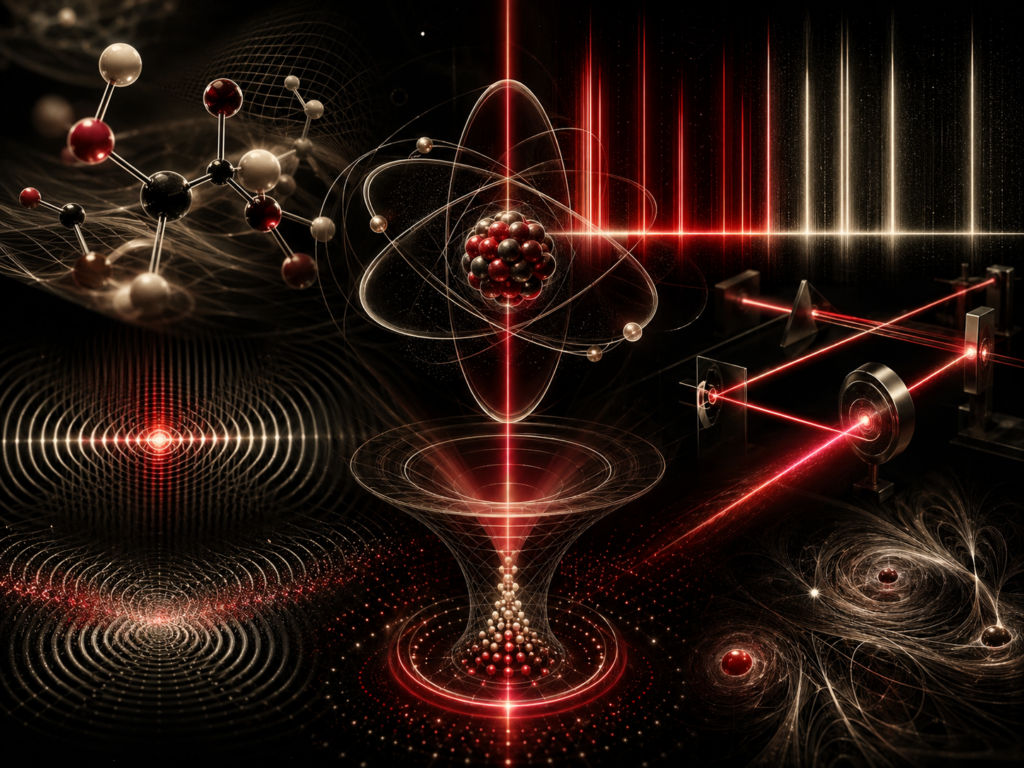
Editorial scientific illustration showing abstract atoms, molecular structures, photon beams, spectral light bands, laser paths, optical interference patterns, and cold-atom trap forms.

Atomic, Molecular, and Optical Physics

Atomic, molecular, and optical physics studies the quantum structure of matter and light: atoms, molecules, photons, spectra, lasers, optical transitions, precision measurement, cold gases, and controlled light–matter interaction. This article examines atomic structure, electronic energy levels, the Schrödinger equation, hydrogen spectra, the Rydberg formula, angular momentum, selection rules, fine and hyperfine structure, Zeeman and Stark effects, molecular rotation and vibration, spectroscopy, spontaneous and stimulated emission, lasers, Rabi oscillations, quantum optics, cold atoms, optical traps, precision clocks, and quantum technologies. Selected R and Python workflows model Boltzmann rotational populations and hydrogen spectral lines, while the linked GitHub repository expands the article with advanced computational scaffolding for reproducible AMO-physics workflows.

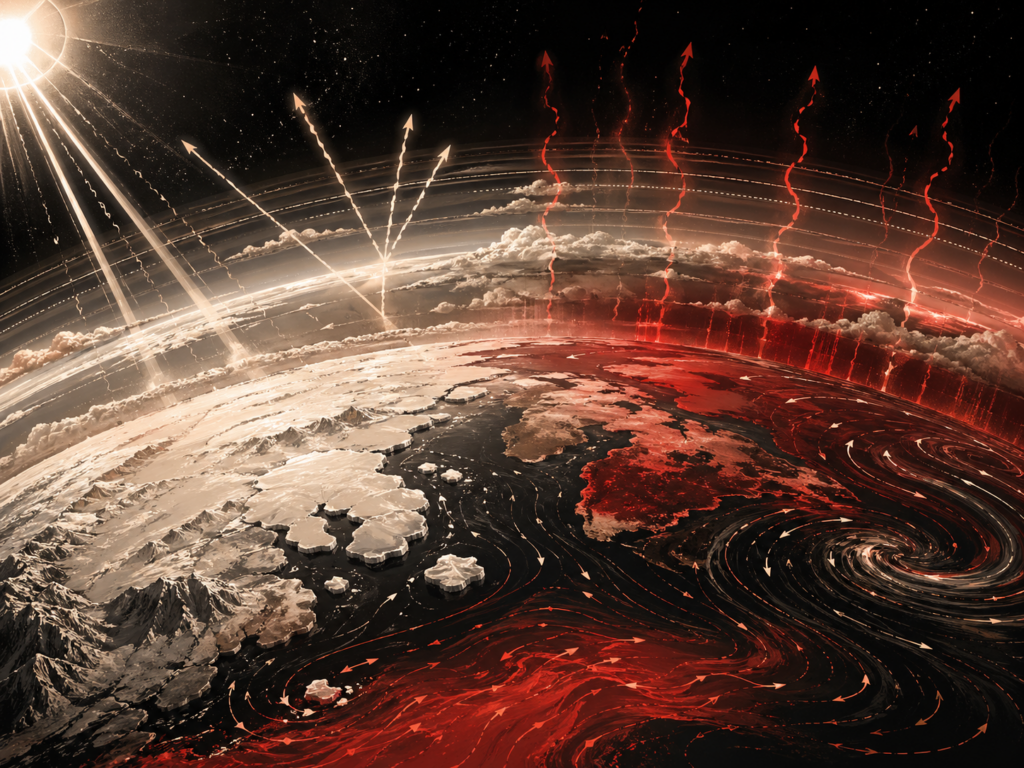
Editorial scientific illustration showing an Earth-like planet with incoming solar radiation, reflected light, outgoing infrared radiation, atmospheric layers, clouds, ocean heat gradients, and ice–albedo contrast.

Climate Physics and Planetary Energy Balance

Climate physics and planetary energy balance explain how radiation, temperature, atmospheric composition, albedo, feedbacks, oceans, ice, clouds, and planetary geometry determine whether a world warms, cools, or remains near equilibrium. This article examines solar radiation, planetary albedo, absorbed shortwave radiation, outgoing longwave radiation, effective emission temperature, the Stefan–Boltzmann law, greenhouse physics, radiative forcing, climate feedbacks, heat capacity, ocean heat uptake, equilibrium climate sensitivity, transient response, orbital forcing, aerosols, clouds, cryosphere feedbacks, planetary habitability, and reduced energy-balance models. Selected R and Python workflows model albedo sensitivity, radiative forcing, and time-dependent climate response, while the linked GitHub repository expands the article with advanced computational scaffolding for reproducible climate-physics workflows.

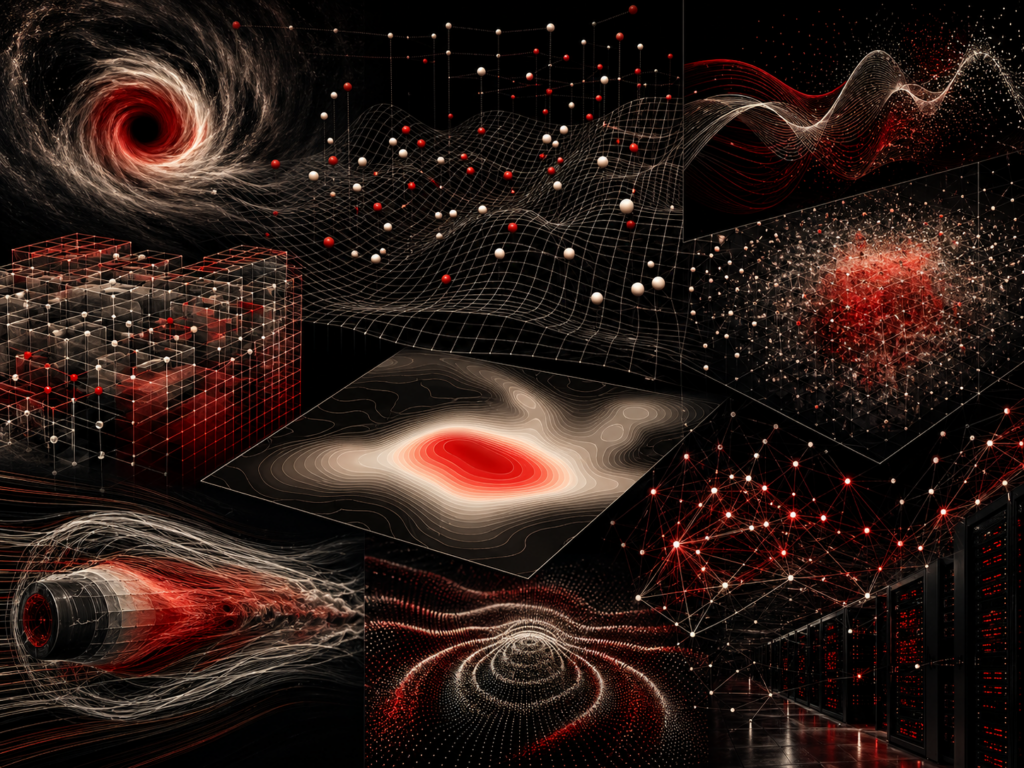
Editorial scientific illustration showing numerical grids, simulation fields, particle trajectories, wave patterns, heat-diffusion contours, Monte Carlo points, and high-performance computing nodes.

Computational Physics and Scientific Simulation

Computational physics and scientific simulation use numerical methods, algorithms, data structures, uncertainty analysis, and reproducible software to study physical systems that cannot be solved by hand alone. This article examines computational modeling, numerical approximation, discretization, floating-point arithmetic, ordinary differential equation solvers, partial differential equation methods, finite difference methods, finite element and finite volume ideas, Monte Carlo simulation, molecular dynamics, particle methods, verification, validation, uncertainty quantification, reproducibility, high-performance computing, visualization, and scientific software practice. Selected R and Python workflows model Monte Carlo uncertainty propagation and finite-difference diffusion, while the linked GitHub repository expands the article with advanced computational scaffolding for reproducible scientific-simulation workflows.

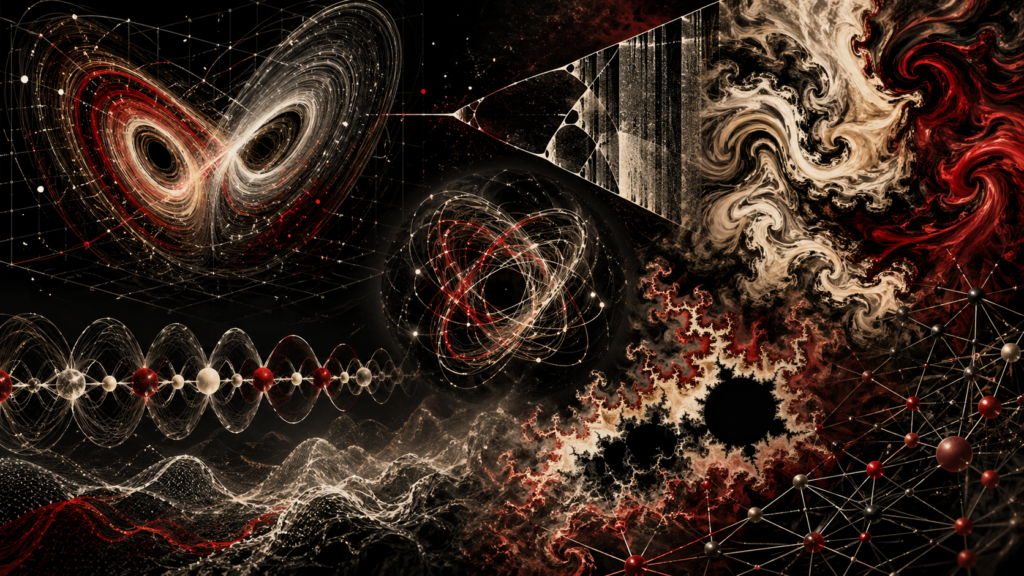
Editorial scientific illustration showing strange attractor loops, bifurcation-like branching, turbulent flow, fractal structures, coupled oscillators, and computational network nodes.

Nonlinear Dynamics, Chaos, and Complex Physical Systems

Nonlinear dynamics, chaos, and complex physical systems explain how deterministic laws can generate feedback, instability, bifurcation, pattern formation, sensitive dependence, and behavior that is difficult to predict even when the governing equations are known. This article examines nonlinear equations, phase space, fixed points, stability, bifurcations, limit cycles, chaos, sensitive dependence, the logistic map, the Lorenz system, strange attractors, Lyapunov exponents, fractals, intermittency, synchronization, pattern formation, turbulence, complex systems, and computational modeling. Selected R and Python workflows model logistic-map bifurcation behavior, Lorenz-system integration, and trajectory separation, while the linked GitHub repository expands the article with advanced computational scaffolding for reproducible nonlinear-dynamics workflows.

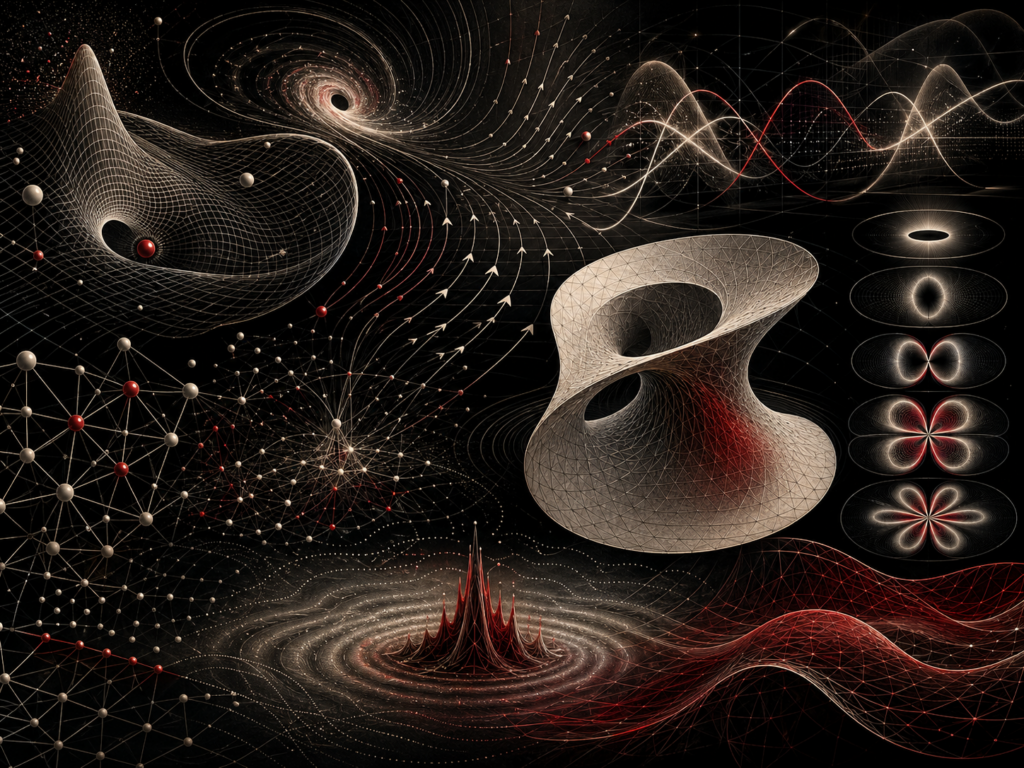
Editorial scientific illustration showing abstract mathematical structures, coordinate grids, vector-field arrows, waveforms, eigenmode patterns, tensor-like surfaces, and computational network forms.

Mathematical Methods in Physics

Mathematical methods in physics provide the language through which physical systems are described, modeled, solved, approximated, simulated, and interpreted. This article examines dimensional analysis, calculus, vector algebra, vector calculus, linear algebra, differential equations, boundary-value problems, Fourier analysis, complex numbers, tensors, probability, statistics, variational methods, numerical methods, computational workflows, and the role of mathematical modeling in physical reasoning. Selected R and Python workflows model uncertainty propagation, ODE integration, eigenvalue analysis, and Fourier spectra, while the linked GitHub repository expands the article with advanced computational scaffolding for reproducible mathematical-physics workflows.

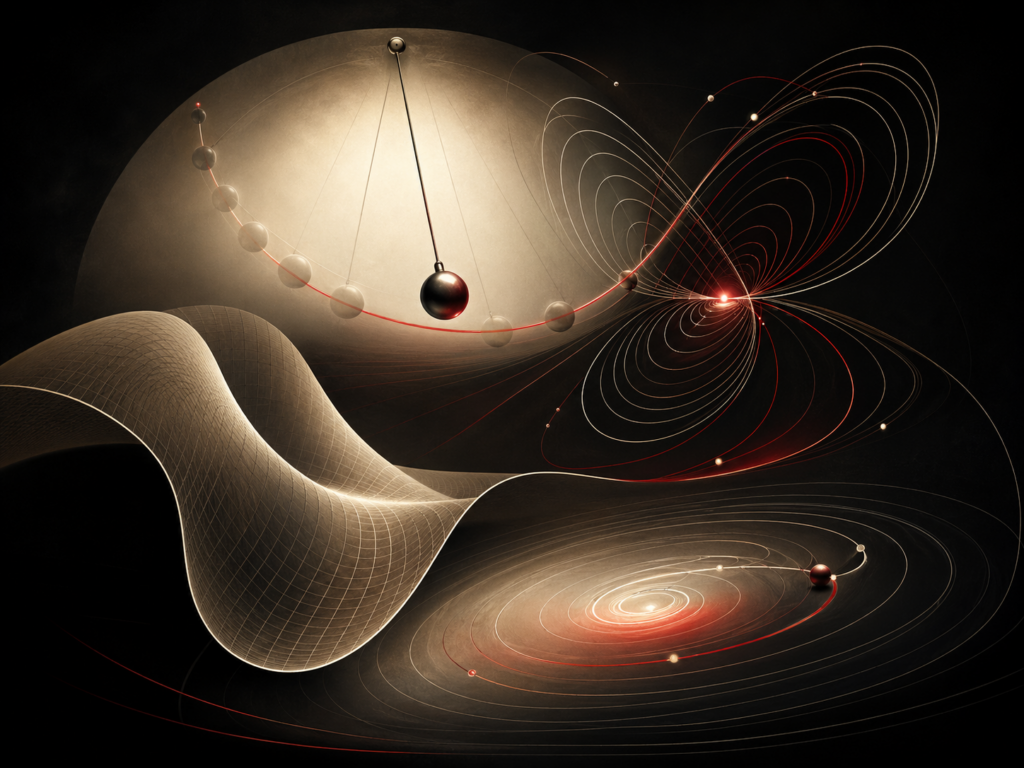
Editorial scientific illustration showing a pendulum trajectory, abstract phase-space curves, smooth geometric manifolds, orbit-like paths, and energy-surface contours.

Lagrangian and Hamiltonian Mechanics

Lagrangian and Hamiltonian mechanics reformulate classical physics around action, energy, constraints, symmetry, generalized coordinates, and phase space. This article examines generalized coordinates, degrees of freedom, constraints, the principle of stationary action, Euler–Lagrange equations, canonical momentum, cyclic coordinates, conservation laws, Hamiltonians, Hamilton’s equations, phase space, Poisson brackets, canonical transformations, symplectic structure, small oscillations, constrained systems, and computational integration. Selected R and Python workflows model pendulum phase-space energy, Hamiltonian dynamics, and symplectic Euler integration, while the linked GitHub repository expands the article with advanced computational scaffolding for reproducible analytical-mechanics workflows.

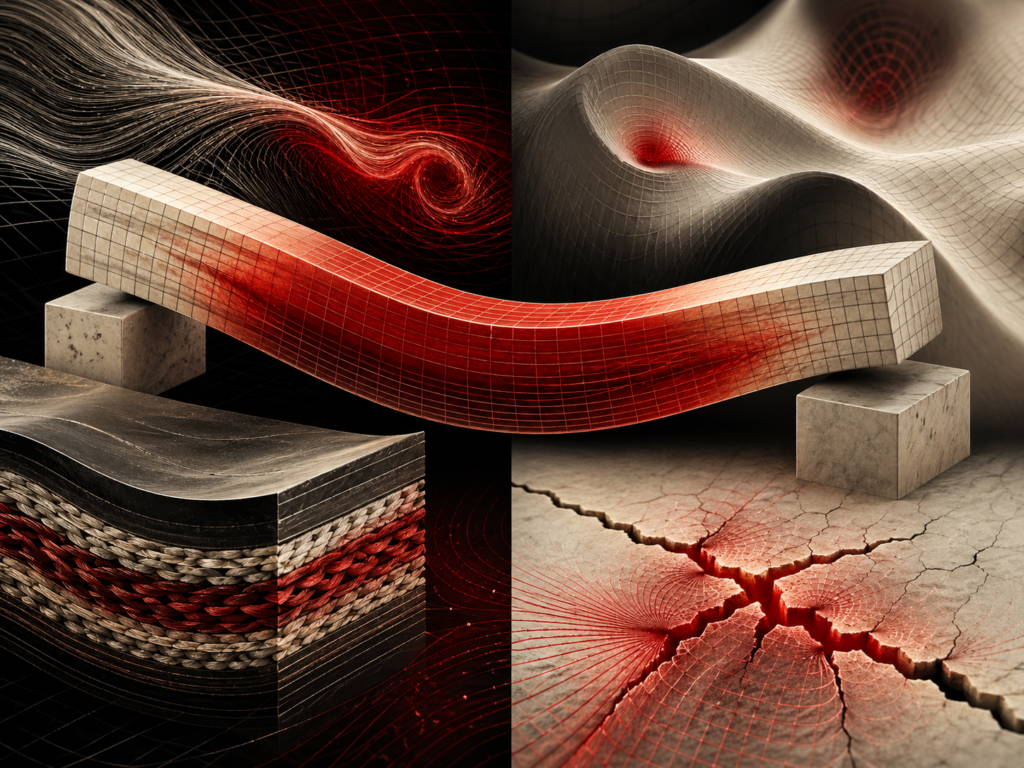
Editorial scientific illustration showing a bending beam under stress, layered composite material, abstract deforming surfaces, and a glowing crack pattern representing stress, strain, and material failure.

Continuum Physics and Material Behavior

Continuum physics and material behavior explain how extended matter deforms, carries load, stores elastic energy, flows slowly, yields, fractures, relaxes, and responds to force across space and time. This article examines the continuum hypothesis, displacement fields, deformation gradients, strain, stress, traction, equilibrium, momentum balance, constitutive laws, linear elasticity, isotropic material parameters, elastic energy, plastic deformation, yield criteria, viscoelasticity, fracture, fatigue, anisotropy, composites, multiphysics coupling, and computational material modeling. Selected R and Python workflows model stress–strain analysis, elastic modulus estimation, stress tensor diagnostics, principal stresses, and von Mises stress, while the linked GitHub repository expands the article with advanced computational scaffolding for reproducible continuum-mechanics workflows.

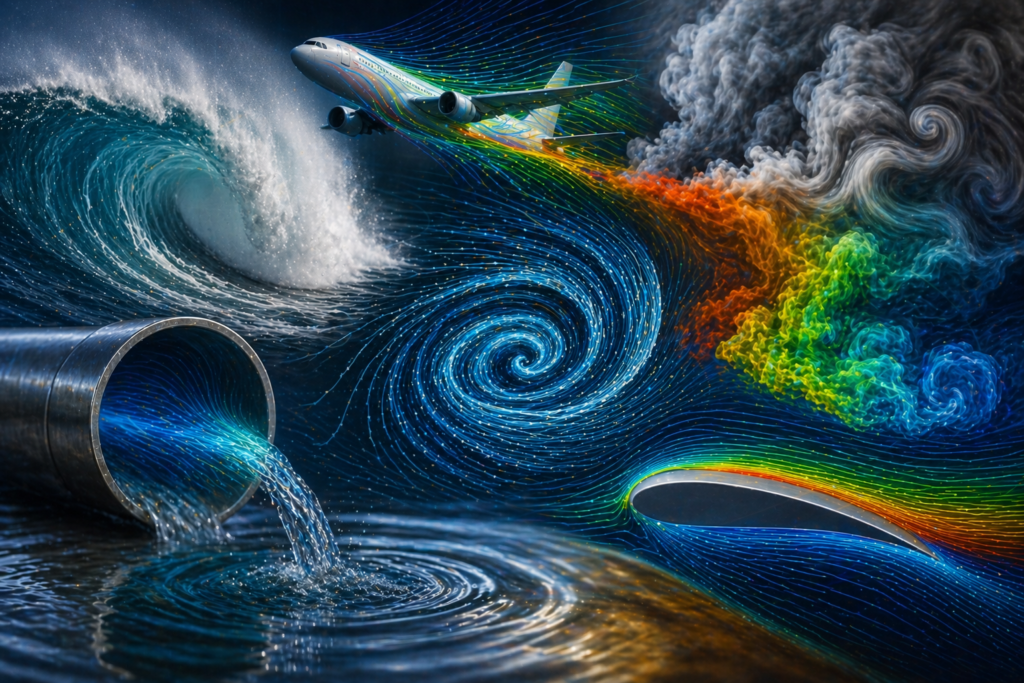
Cinematic scientific illustration showing ocean waves, pipe flow, aerodynamic streamlines, smoke vortices, and colorful flow-field patterns representing fluid dynamics and turbulence.

Fluid Dynamics and the Physics of Flow

Fluid dynamics studies how liquids and gases move, deform, transmit forces, transport momentum, generate pressure, form vortices, and transition to turbulence. This article examines fluids and continua, density, pressure, hydrostatics, velocity fields, the material derivative, conservation of mass, Bernoulli’s equation, viscosity, Newtonian fluids, momentum balance, Navier–Stokes equations, Reynolds number, laminar and turbulent flow, boundary layers, drag, lift, vorticity, circulation, dimensional analysis, environmental flow, biological flow, engineering flow, and computational fluid dynamics. Selected R and Python workflows model Reynolds-number classification and vorticity-field diagnostics, while the linked GitHub repository expands the article with advanced computational scaffolding for reproducible fluid-dynamics workflows.

Scroll to Top