
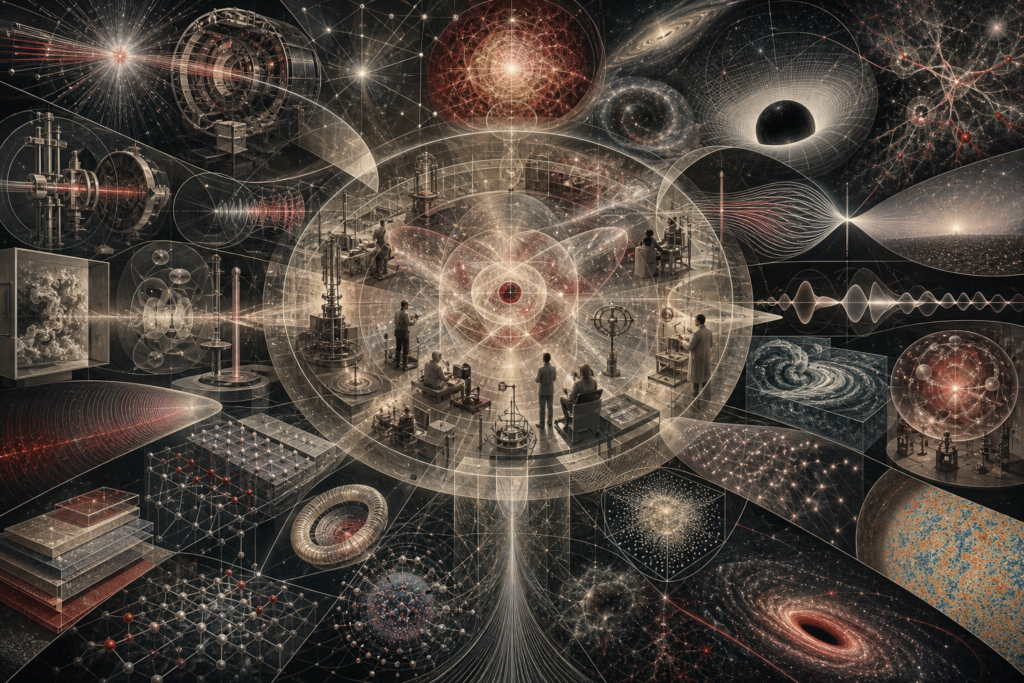
Physics: Foundations, Laws, Matter, Energy, and the Universe
Physics examines the fundamental principles that govern matter, energy, motion, force, fields, space, time, measurement, and physical reality across every scale of nature. This pillar brings together classical mechanics, thermodynamics, electromagnetism, relativity, quantum mechanics, statistical physics, condensed matter, plasma physics, biophysics, cosmology, experimental practice, numerical methods, and physics-informed scientific computing. It frames physics not merely as a collection of topics, but as one of the most disciplined ways human beings relate observation to law, measurement to theory, and mathematical structure to the material universe. From rotational dynamics and celestial mechanics to quantum field theory, general relativity, topological matter, nonequilibrium systems, and machine-learning-assisted scientific computation, the Physics pillar provides a rigorous map of how physical inquiry explains causation, constraint, scale, uncertainty, symmetry, emergence, and the lawful architecture of nature.