
Last Updated May 28, 2026
Quantum information, decoherence, and measurement explain how physical systems can store information in quantum states, how measurement turns amplitudes into outcomes, and how interaction with the environment destroys fragile quantum coherence. Classical information is usually represented by bits that take values such as 0 or 1. Quantum information is represented by quantum states that can exist in superpositions, become entangled, evolve unitarily, respond probabilistically to measurement, and degrade through noise. The same mathematical framework that describes electrons, photons, atoms, spins, ions, superconducting circuits, and optical modes also describes the physical limits of computation, communication, sensing, and measurement.
Quantum information is not simply computer science written in quantum notation. It is physics. A qubit must be embodied in a physical system. A gate must be implemented by a controlled Hamiltonian or effective interaction. A measurement must be performed by an apparatus that couples to the system. A memory must survive environmental noise. A computation must finish before decoherence destroys the relevant correlations. An error-correcting code must detect and repair errors without directly measuring the unknown quantum state. The information is abstract, but the carrier is physical.
This article develops Quantum Information, Decoherence, and Measurement as a research-grade article within the Physics knowledge series. It explains qubits, superposition, Hilbert space, density matrices, pure and mixed states, entanglement, the Born rule, projective measurement, generalized measurement, quantum channels, decoherence, dephasing, relaxation, open quantum systems, entropy, no-cloning, teleportation, quantum error correction, fault tolerance, quantum algorithms, quantum communication, and the measurement problem. Selected R and Python workflows appear here, while the full GitHub repository contains expanded computational resources for qubit states, Bloch vectors, density matrices, projective measurement, decoherence channels, amplitude damping, phase damping, entanglement entropy, Bell states, simple error-correction logic, SQL metadata, C/C++/Fortran/Rust examples, and reproducible quantum-information workflows.
Main Library
Publications
Article Map
Physics
Related Topic
Mathematics
Related Topic
Data Systems & Analytics
Related Topic
Astronomy
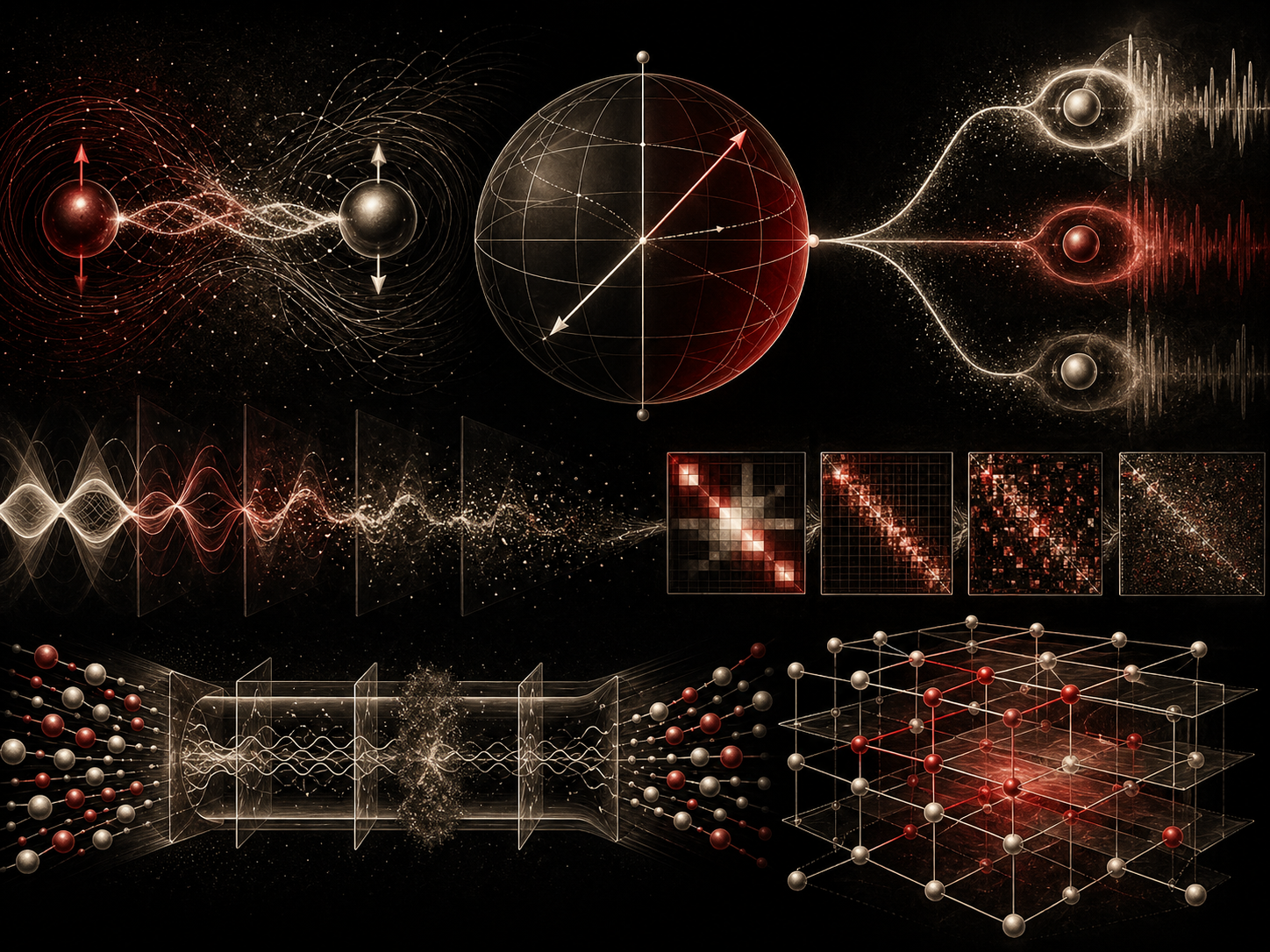
Why Quantum Information Matters
Quantum information matters because information is physical. It must be stored, transformed, transmitted, measured, protected, and erased by physical systems. Classical information theory clarified how messages can be encoded, compressed, transmitted, and protected from noise. Quantum information extends this logic into the quantum domain, where the basic carriers of information obey superposition, entanglement, unitary evolution, measurement disturbance, and uncertainty.
The consequences are profound. A quantum computer can process amplitudes in ways unavailable to classical bits. A quantum communication protocol can use entanglement as a resource. A quantum sensor can exploit coherence to improve measurement. A quantum error-correcting code can protect fragile states without copying them directly. A quantum cryptographic protocol can use measurement disturbance to reveal eavesdropping. A quantum simulator can represent many-body systems that are difficult for classical computers to emulate.
Yet quantum information is also fragile. Coherence can be lost when a system becomes entangled with its environment. Measurement can destroy superposition in the measured basis. Noise can corrupt gates. Thermal fluctuations, stray fields, photon loss, material defects, spontaneous emission, charge noise, magnetic noise, and control errors can all degrade quantum states. Decoherence is therefore not a peripheral complication. It is one of the central physical obstacles that quantum technologies must overcome.
For the Physics knowledge series, this article is important because it connects quantum mechanics, atomic and optical physics, condensed matter, statistical physics, computation, information theory, and measurement science. It shows that quantum theory is not only a theory of microscopic matter; it is also a theory of what can be known, transmitted, computed, and preserved under physical law.
Classical Information and Quantum Information
A classical bit can take one of two values:
0
\quad \text{or} \quad
1
\]
Interpretation: A classical bit has one of two definite values.
A classical probabilistic bit can be described by probabilities:
p(0),\quad p(1)
\]
Interpretation: A probabilistic classical bit assigns probabilities to the two possible outcomes.
with:
p(0)+p(1)=1
\]
Interpretation: Classical probabilities for mutually exclusive bit outcomes sum to one.
A qubit is different. It can be in a superposition of two basis states:
|\psi\rangle
=
\alpha |0\rangle
+
\beta |1\rangle
\]
Interpretation: A qubit state is a coherent superposition of basis states with complex amplitudes.
where \(\alpha\) and \(\beta\) are complex amplitudes satisfying:
|\alpha|^2+|\beta|^2=1
\]
Interpretation: Qubit amplitudes are normalized so measurement probabilities sum to one.
The probabilities of measurement outcomes are obtained from the squared magnitudes of amplitudes, but the amplitudes themselves contain phase information. That phase information can interfere constructively or destructively. This is why a qubit is not merely a classical bit with uncertain value. It has coherent structure.
Quantum information also differs from classical information because it cannot generally be copied, inspected, or measured without disturbance. An unknown quantum state cannot be cloned perfectly. Measurement probabilities depend on basis. Entangled systems can have correlations that cannot be explained by assigning pre-existing local classical values to each subsystem. These features make quantum information powerful but delicate.
Qubits, Superposition, and Hilbert Space
A qubit is the simplest quantum information unit. Its state belongs to a two-dimensional complex Hilbert space. A common computational basis is:
|0\rangle
=
\begin{bmatrix}
1\\
0
\end{bmatrix},
\qquad
|1\rangle
=
\begin{bmatrix}
0\\
1
\end{bmatrix}
\]
Interpretation: The computational basis represents the two basis states of a qubit as column vectors.
A general pure qubit state is:
|\psi\rangle
=
\alpha |0\rangle
+
\beta |1\rangle
\]
Interpretation: A pure qubit state is a normalized vector in a two-dimensional complex Hilbert space.
The coefficients \(\alpha\) and \(\beta\) are complex amplitudes. Normalization requires:
\langle \psi|\psi\rangle = 1
\]
Interpretation: A normalized quantum state has total probability one.
or:
|\alpha|^2+|\beta|^2=1
\]
Interpretation: Squared amplitude magnitudes give normalized measurement probabilities in the computational basis.
Superposition is not ignorance about whether the system is really in \(|0\rangle\) or \(|1\rangle\). It is a coherent quantum state that can produce interference. A state such as:
|+\rangle
=
\frac{|0\rangle+|1\rangle}{\sqrt{2}}
\]
Interpretation: The \(|+\rangle\) state is an equal-amplitude coherent superposition.
gives equal probabilities for \(|0\rangle\) and \(|1\rangle\) in the computational basis, but it is not equivalent to a classical coin flip. If measured in the \(|+\rangle,|-\rangle\) basis, it gives a definite result.
The basis-dependence of quantum measurement is central. A quantum state has physical content that cannot be reduced to classical probabilities in one fixed basis. This is why Hilbert space geometry matters.
State Vectors, Density Matrices, and Mixed States
Pure quantum states can be represented by state vectors. But many physical situations require density matrices. A density matrix represents pure states, statistical mixtures, and subsystems of entangled systems.
For a pure state \(|\psi\rangle\), the density matrix is:
\rho
=
|\psi\rangle\langle\psi|
\]
Interpretation: A pure-state density matrix is the outer product of the state with its dual.
For a statistical mixture of states \(|\psi_i\rangle\) with probabilities \(p_i\):
\rho
=
\sum_i p_i |\psi_i\rangle\langle\psi_i|
\]
Interpretation: A mixed-state density matrix represents an ensemble of possible state preparations.
A pure state satisfies:
\rho^2=\rho
\]
Interpretation: A pure-state density matrix is idempotent.
and:
\mathrm{Tr}(\rho^2)=1
\]
Interpretation: Purity equals one for a pure state.
A mixed state generally satisfies:
\mathrm{Tr}(\rho^2)<1
\]
Interpretation: Purity below one indicates a mixed state.
Density matrices are essential for open systems, decoherence, measurement theory, quantum statistical mechanics, and quantum information. They allow physicists to represent loss of coherence, partial knowledge, entanglement with unobserved systems, noise channels, and ensemble preparations.
For a qubit in the equal superposition state:
|+\rangle
=
\frac{|0\rangle+|1\rangle}{\sqrt{2}}
\]
Interpretation: The \(|+\rangle\) state is coherent in the computational basis.
the density matrix is:
\rho_+
=
\frac{1}{2}
\begin{bmatrix}
1 & 1\\
1 & 1
\end{bmatrix}
\]
Interpretation: The off-diagonal density-matrix elements represent coherence.
The off-diagonal elements represent coherence in the computational basis. Decoherence often appears as the decay of these off-diagonal elements.
The Bloch Sphere
A single qubit state can be visualized using the Bloch sphere. Up to an overall physically irrelevant global phase, a pure qubit state can be written as:
|\psi\rangle
=
\cos\left(\frac{\theta}{2}\right)|0\rangle
+
e^{i\phi}
\sin\left(\frac{\theta}{2}\right)|1\rangle
\]
Interpretation: The angles \(\theta\) and \(\phi\) locate a pure qubit state on the Bloch sphere.
where \(\theta\) and \(\phi\) specify a point on the surface of a sphere. The north pole corresponds to \(|0\rangle\), the south pole to \(|1\rangle\), and equatorial states represent equal-amplitude superpositions with different relative phases.
A general single-qubit density matrix can be written as:
\rho
=
\frac{1}{2}
\left(
I+\mathbf{r}\cdot\boldsymbol{\sigma}
\right)
\]
Interpretation: A qubit density matrix can be represented through a Bloch vector and Pauli matrices.
where \(\mathbf{r}\) is the Bloch vector and \(\boldsymbol{\sigma}\) represents the Pauli matrices. Pure states have:
|\mathbf{r}|=1
\]
Interpretation: Pure qubit states lie on the surface of the Bloch sphere.
Mixed states have:
|\mathbf{r}|<1
\]
Interpretation: Mixed qubit states lie inside the Bloch sphere.
Decoherence can be visualized as shrinkage or distortion of the Bloch vector. Dephasing damps transverse components. Relaxation moves the state toward the ground state or thermal equilibrium. The Bloch sphere is therefore both a geometric representation and a diagnostic tool for quantum state evolution.
Measurement and the Born Rule
The Born rule connects quantum amplitudes to measurement probabilities. If a system is in state \(|\psi\rangle\) and is measured in an orthonormal basis \(\{|a_i\rangle\}\), the probability of outcome \(a_i\) is:
P(a_i)
=
|\langle a_i|\psi\rangle|^2
\]
Interpretation: Measurement probabilities are squared projection amplitudes onto outcome states.
For a qubit:
|\psi\rangle
=
\alpha |0\rangle
+
\beta |1\rangle
\]
Interpretation: The computational-basis amplitudes determine the corresponding measurement probabilities.
measurement in the computational basis gives:
P(0)=|\alpha|^2
\]
Interpretation: The probability of outcome 0 is the squared magnitude of \(\alpha\).
P(1)=|\beta|^2
\]
Interpretation: The probability of outcome 1 is the squared magnitude of \(\beta\).
The Born rule is one of the central postulates of quantum mechanics. It tells us how to predict outcome probabilities, not deterministic individual outcomes. This probabilistic structure is not merely a statement about experimental ignorance in the classical sense. It is built into the standard quantum formalism.
Measurement also changes the state. If the outcome is \(|0\rangle\), the post-measurement state becomes \(|0\rangle\). If the outcome is \(|1\rangle\), the post-measurement state becomes \(|1\rangle\). Measurement therefore both reveals and prepares: it produces an outcome and updates the quantum state used for future predictions.
Projective Measurement and Generalized Measurement
Projective measurement is the simplest idealized measurement model. A set of projection operators \(\{P_i\}\) satisfies:
P_iP_j=\delta_{ij}P_i
\]
Interpretation: Orthogonal projectors multiply to zero for distinct outcomes and remain unchanged when squared.
and:
\sum_i P_i = I
\]
Interpretation: A complete projective measurement resolves the identity.
For a density matrix \(\rho\), the probability of outcome \(i\) is:
p_i
=
\mathrm{Tr}(P_i\rho)
\]
Interpretation: Projective measurement probabilities are computed by tracing the projector against the state.
After obtaining outcome \(i\), the state updates to:
\rho_i’
=
\frac{P_i\rho P_i}{\mathrm{Tr}(P_i\rho)}
\]
Interpretation: The post-measurement state is the normalized projected state associated with the observed outcome.
Real measurements can be more general. Generalized measurements are described by positive operator-valued measures, or POVMs. A POVM consists of positive operators \(\{E_i\}\) satisfying:
\sum_i E_i = I
\]
Interpretation: A POVM is a complete set of positive measurement-effect operators.
The outcome probabilities are:
p_i
=
\mathrm{Tr}(E_i\rho)
\]
Interpretation: POVM outcome probabilities are computed from measurement effects and the density matrix.
Generalized measurements are important because laboratory measurements may involve auxiliary systems, imperfect detectors, weak measurements, loss, coarse-graining, indirect measurement, or partial information. They also show that measurement is a physical interaction, not merely an abstract readout.
Entanglement and Nonclassical Correlation
Entanglement is one of the defining features of quantum information. A bipartite pure state is entangled if it cannot be written as a product of states belonging to each subsystem. For example, the Bell state:
|\Phi^+\rangle
=
\frac{|00\rangle+|11\rangle}{\sqrt{2}}
\]
Interpretation: A Bell state is an entangled two-qubit state that cannot be factored into independent subsystem states.
cannot be factored into a state of the first qubit times a state of the second qubit. The joint system has a well-defined pure state, but each subsystem alone is described by a mixed state.
Entanglement produces correlations that are stronger than classical correlations in precise operational senses. Bell inequalities show that certain quantum correlations cannot be reproduced by local hidden-variable theories. In quantum information, entanglement becomes a resource. It can support teleportation, quantum communication, quantum cryptography, error correction, measurement-based computation, and many-body quantum phases.
Entanglement also connects directly to decoherence. When a quantum system becomes entangled with its environment, the system alone may appear mixed. Coherence between alternatives can become inaccessible locally because phase information has spread into environmental degrees of freedom. From the perspective of the reduced system, this looks like loss of coherence.
Quantum Channels and Open Systems
A closed quantum system evolves unitarily:
\rho(t)
=
U(t)\rho(0)U^\dagger(t)
\]
Interpretation: Closed-system density matrices evolve by unitary conjugation.
where \(U\) is a unitary operator. But real systems are rarely perfectly closed. They interact with environments, measurement devices, control electronics, thermal baths, electromagnetic modes, substrates, and other degrees of freedom. Open quantum systems require a broader description.
A quantum channel is a completely positive trace-preserving map that transforms density matrices:
\rho’
=
\mathcal{E}(\rho)
\]
Interpretation: A quantum channel maps an input density matrix to an output density matrix.
One common representation uses Kraus operators \(\{K_i\}\):
\mathcal{E}(\rho)
=
\sum_i K_i\rho K_i^\dagger
\]
Interpretation: Kraus operators represent the action of a quantum channel on a state.
with:
\sum_i K_i^\dagger K_i = I
\]
Interpretation: The Kraus completeness condition ensures trace preservation.
Quantum channels describe noise, decoherence, loss, measurement, reset, relaxation, dephasing, and imperfect gates. They are central to quantum computing because every physical operation is noisy to some degree. A gate is not merely an ideal unitary; experimentally, it is a quantum channel approximating a desired unitary.
Decoherence, Dephasing, and Relaxation
Decoherence is the loss of quantum coherence due to interaction with an environment. It often appears as the decay of off-diagonal density-matrix elements in a particular basis. For a qubit density matrix:
\rho
=
\begin{bmatrix}
\rho_{00} & \rho_{01}\\
\rho_{10} & \rho_{11}
\end{bmatrix}
\]
Interpretation: A qubit density matrix contains populations on the diagonal and coherences off the diagonal.
pure dephasing may leave the populations \(\rho_{00}\) and \(\rho_{11}\) unchanged while reducing coherence:
\rho_{01}(t)
=
\rho_{01}(0)e^{-t/T_2}
\]
Interpretation: Pure dephasing causes off-diagonal coherence to decay over the \(T_2\) time scale.
Relaxation, often associated with \(T_1\), changes populations as energy is exchanged with the environment. For a two-level system relaxing toward the ground state, the excited-state population may decay as:
P_e(t)
=
P_e(0)e^{-t/T_1}
\]
Interpretation: Relaxation causes excited-state population to decay over the \(T_1\) time scale.
In many physical systems, coherence time \(T_2\) is limited by both relaxation and pure dephasing. Decoherence is therefore not one mechanism but a family of processes by which quantum phase relationships become inaccessible or destroyed.
Decoherence is central to quantum technology. A qubit may be beautifully prepared, but if coherence decays before computation, sensing, or communication is complete, the quantum advantage is lost. Quantum engineering is therefore the art of creating systems that can be controlled strongly enough to compute or measure, but isolated well enough to preserve coherence.
Entropy, Information, and Irreversibility
Entropy links quantum information to thermodynamics and statistical physics. The von Neumann entropy of a density matrix is:
S(\rho)
=
-\mathrm{Tr}(\rho\log \rho)
\]
Interpretation: Von Neumann entropy quantifies quantum-state mixedness and information content.
If the logarithm is base 2, entropy is measured in bits. A pure state has zero von Neumann entropy:
S(\rho)=0
\]
Interpretation: Pure states have zero von Neumann entropy.
A maximally mixed single-qubit state:
\rho
=
\frac{I}{2}
\]
Interpretation: The maximally mixed qubit state assigns equal weight to two orthogonal basis states.
has entropy:
S(\rho)=1
\]
Interpretation: A maximally mixed single-qubit state has one bit of entropy when logarithms are base 2.
Entanglement entropy is the entropy of a subsystem obtained by tracing out the rest of a larger pure state. If a bipartite pure state is entangled, each subsystem can have nonzero entropy even though the combined system has zero entropy.
This is important because information loss can be local rather than global. A system may appear decohered because information about its phase has flowed into an environment. The total system-environment state may still evolve unitarily, but the subsystem becomes mixed when the environment is ignored. Decoherence therefore links entropy, entanglement, irreversibility, and practical loss of control.
The No-Cloning Theorem
The no-cloning theorem states that an arbitrary unknown quantum state cannot be copied perfectly by a universal physical operation. Suppose there were a unitary operation \(U\) that could clone any state:
U|\psi\rangle|0\rangle
=
|\psi\rangle|\psi\rangle
\]
Interpretation: A hypothetical cloning operation would copy an unknown state into a blank register.
and:
U|\phi\rangle|0\rangle
=
|\phi\rangle|\phi\rangle
\]
Interpretation: A universal cloner would have to work for every possible input state.
Linearity then creates a contradiction for superpositions. If the machine works on \(|\psi\rangle\) and \(|\phi\rangle\), it cannot also clone arbitrary linear combinations in the required way.
No-cloning distinguishes quantum information from classical information. Classical bits can be copied freely. Unknown quantum states cannot. This limitation shapes quantum communication, cryptography, error correction, and measurement. Quantum error correction cannot work by simply copying a qubit three times. It must encode quantum information into entangled subspaces so that certain errors can be detected and corrected without learning the encoded state itself.
No-cloning is not only a restriction. It is also a resource. Quantum cryptography relies partly on the fact that unknown quantum states cannot be copied by an eavesdropper without disturbance.
Quantum Teleportation and Communication
Quantum teleportation transfers an unknown quantum state from one system to another using shared entanglement and classical communication. It does not transmit matter, energy, or information faster than light. The sender and receiver must share an entangled pair, and the sender must send classical measurement results to the receiver.
The basic structure uses an unknown qubit:
|\psi\rangle
=
\alpha|0\rangle+\beta|1\rangle
\]
Interpretation: Quantum teleportation begins with an unknown qubit state to be transferred.
and an entangled pair shared between sender and receiver. After a joint measurement by the sender and classical communication of the result, the receiver applies a correction operation to recover \(|\psi\rangle\). The original state is destroyed by the measurement process, so teleportation does not violate no-cloning.
Teleportation shows that quantum information is not simply attached to a material object in the classical sense. It can be transferred through entanglement-assisted protocols. This idea is central to quantum networks, quantum repeaters, distributed quantum computing, and quantum communication.
Quantum Error Correction and Fault Tolerance
Quantum error correction protects quantum information from noise without directly measuring the encoded state. The challenge is severe: quantum states are continuous, cannot be cloned, and can be damaged by measurement. Yet error correction is possible because errors can be detected through syndromes that reveal what kind of error occurred without revealing the logical quantum information.
A simple conceptual example is the three-qubit bit-flip code:
|\psi\rangle
=
\alpha|0\rangle+\beta|1\rangle
\]
Interpretation: The original logical qubit is an arbitrary superposition.
encoded as:
|\psi_L\rangle
=
\alpha|000\rangle+\beta|111\rangle
\]
Interpretation: The logical state is encoded across three physical qubits without copying an unknown state directly.
If one physical qubit flips, parity measurements can identify which qubit changed without measuring \(\alpha\) and \(\beta\) directly. More realistic quantum codes must protect against bit flips, phase flips, and general errors. Important families include stabilizer codes, surface codes, concatenated codes, color codes, bosonic codes, and topological codes.
Fault tolerance extends error correction to computation. It asks whether quantum gates, measurements, state preparation, and error correction can be performed reliably even when every component is noisy. Threshold theorems show that, under appropriate assumptions, arbitrarily long quantum computation is possible if physical error rates are below a threshold and sufficient overhead is used.
Quantum error correction turns decoherence from an absolute barrier into an engineering challenge. The cost is high: many physical qubits may be required to build a single protected logical qubit. But without error correction, scalable quantum computation is unlikely.
Measurement Problem and the Emergence of Classicality
The measurement problem asks how definite outcomes arise from quantum theory. The Schrödinger equation describes smooth, unitary evolution of quantum states. Measurement appears to produce a definite outcome and an apparent collapse of the state. How these two descriptions relate remains a foundational issue.
Decoherence helps explain why macroscopic superpositions become effectively unobservable. When a system interacts with a large environment, phase information between alternatives can spread into environmental degrees of freedom. The reduced density matrix of the system becomes approximately diagonal in a preferred pointer basis. Interference between macroscopically distinct alternatives becomes practically inaccessible.
However, decoherence by itself does not necessarily solve every aspect of the measurement problem. It explains the suppression of interference and the emergence of effectively classical alternatives, but debates remain about how or whether one definite outcome is selected. Different interpretations of quantum mechanics address this issue in different ways.
For physics practice, decoherence is indispensable regardless of interpretation. It explains why classical behavior emerges in many macroscopic systems, why quantum devices require isolation and control, why measurement records become stable, and why quantum coherence is difficult to preserve at large scales.
Measurement, Units, and SI Interpretation
Quantum information uses both dimensionless information measures and physical units. A qubit state is dimensionless as a normalized vector in Hilbert space. Probabilities are dimensionless. Entropies may be measured in bits when logarithms are base 2. But physical qubits have frequencies, energies, coherence times, gate times, error rates, temperatures, fields, and couplings.
Energy and frequency are related by:
E=h\nu
\]
Interpretation: Energy and ordinary frequency are related by Planck’s constant.
Angular frequency is:
\omega=2\pi\nu
\]
Interpretation: Angular frequency is ordinary frequency multiplied by \(2\pi\).
Energy and angular frequency are related by:
E=\hbar\omega
\]
Interpretation: Energy and angular frequency are related by the reduced Planck constant.
Relaxation and dephasing times are measured in seconds:
T_1,\ T_2\ \mathrm{in}\ \mathrm{s}
\]
Interpretation: Quantum coherence and relaxation time scales are measured in seconds.
Rates are measured in inverse seconds:
\Gamma = \frac{1}{T}
\]
Interpretation: Decay rates are inverse time scales.
Gate fidelities and error probabilities are dimensionless. Temperature enters through thermal occupation and Boltzmann factors:
e^{-E/(k_B T)}
\]
Interpretation: Thermal occupation depends on the ratio of energy to thermal energy.
Unit consistency matters because quantum hardware often uses mixed conventions: hertz, radians per second, joules, electronvolts, kelvin, microseconds, nanoseconds, gigahertz, and dimensionless error probabilities. A reproducible quantum-information workflow should document all unit conversions explicitly.
Mathematical Lens
A mathematics-first view of quantum information begins with state space. A pure qubit is:
|\psi\rangle
=
\alpha|0\rangle+\beta|1\rangle
\]
Interpretation: A pure qubit is a normalized superposition in a two-dimensional Hilbert space.
with:
|\alpha|^2+|\beta|^2=1
\]
Interpretation: Amplitude normalization ensures valid probabilities.
A density matrix is:
\rho
=
\sum_i p_i|\psi_i\rangle\langle\psi_i|
\]
Interpretation: Density matrices represent ensembles, mixed states, and reduced states.
Unitary evolution is:
\rho’
=
U\rho U^\dagger
\]
Interpretation: Ideal closed-system evolution is unitary.
Projective measurement probability is:
p_i
=
\mathrm{Tr}(P_i\rho)
\]
Interpretation: Projective measurement probabilities are obtained from the trace rule.
A quantum channel is:
\mathcal{E}(\rho)
=
\sum_i K_i\rho K_i^\dagger
\]
Interpretation: A channel transforms a quantum state through Kraus operators.
with:
\sum_i K_i^\dagger K_i = I
\]
Interpretation: Kraus operators satisfy a completeness condition for trace preservation.
Pure dephasing can be represented schematically as:
\rho_{01}(t)
=
\rho_{01}(0)e^{-t/T_2}
\]
Interpretation: Coherence decays exponentially in a simple dephasing model.
Relaxation can be represented schematically as:
P_e(t)
=
P_e(0)e^{-t/T_1}
\]
Interpretation: Excited-state population decays exponentially in a simple relaxation model.
Von Neumann entropy is:
S(\rho)
=
-\mathrm{Tr}(\rho\log_2\rho)
\]
Interpretation: Von Neumann entropy measures quantum information entropy in bits when the logarithm is base 2.
For a bipartite state \(\rho_{AB}\), the reduced state of subsystem \(A\) is:
\rho_A
=
\mathrm{Tr}_B(\rho_{AB})
\]
Interpretation: Partial trace removes subsystem \(B\) to obtain the state of subsystem \(A\).
This mathematical lens shows that quantum information is the study of states, maps, measurements, correlations, and noise. Computation is not separate from physics; it is the controlled transformation of quantum states under physical constraints.
Variables, Units, and Physical Interpretation
Quantum information uses variables that describe states, probabilities, operators, channels, coherence, noise, and information content. The table below summarizes several central quantities.
| Symbol or Term | Meaning | Typical Unit | Physical Interpretation |
|---|---|---|---|
| \(|\psi\rangle\) | Pure quantum state | dimensionless | State vector in Hilbert space |
| \(\alpha,\beta\) | Complex amplitudes | dimensionless | Probability amplitudes for basis states |
| \(\rho\) | Density matrix | dimensionless | Represents pure states, mixed states, and subsystems |
| \(U\) | Unitary operator | dimensionless | Closed-system quantum evolution or ideal gate |
| \(P_i\) | Projection operator | dimensionless | Ideal measurement outcome operator |
| \(K_i\) | Kraus operator | dimensionless | Operator representation of a quantum channel |
| \(T_1\) | Relaxation time | s | Energy relaxation time scale |
| \(T_2\) | Coherence time | s | Dephasing or transverse coherence time scale |
| \(\Gamma\) | Decay rate | s⁻¹ | Rate of relaxation, dephasing, or emission |
| \(S(\rho)\) | Von Neumann entropy | bits or nats | Quantum information entropy of a state |
| \(F\) | Fidelity | dimensionless | Closeness between quantum states or operations |
| \(p\) | Error probability | dimensionless | Probability of a physical or logical error |
Note: Quantum information requires both abstract and physical quantities. State vectors are dimensionless, but every real implementation has frequencies, lifetimes, error rates, temperatures, and measurement times.
Worked Example: Decoherence of a Qubit Superposition
Consider the equal superposition state:
|+\rangle
=
\frac{|0\rangle+|1\rangle}{\sqrt{2}}
\]
Interpretation: The initial state is an equal coherent superposition of computational-basis states.
The density matrix is:
\rho(0)
=
|+\rangle\langle+|
=
\frac{1}{2}
\begin{bmatrix}
1 & 1\\
1 & 1
\end{bmatrix}
\]
Interpretation: The off-diagonal elements encode phase coherence in the computational basis.
Suppose the qubit undergoes pure dephasing in the computational basis. Populations remain unchanged, while coherences decay:
\rho_{01}(t)=\rho_{01}(0)e^{-t/T_2}
\]
Interpretation: One off-diagonal coherence term decays exponentially over the dephasing time.
and:
\rho_{10}(t)=\rho_{10}(0)e^{-t/T_2}
\]
Interpretation: The conjugate coherence term decays at the same rate in this symmetric model.
The density matrix becomes:
\rho(t)
=
\frac{1}{2}
\begin{bmatrix}
1 & e^{-t/T_2}\\
e^{-t/T_2} & 1
\end{bmatrix}
\]
Interpretation: Pure dephasing preserves populations while shrinking coherence terms.
At \(t=0\), the state is pure and fully coherent. As \(t\) increases, the off-diagonal terms shrink. In the long-time limit:
\rho(\infty)
=
\frac{1}{2}
\begin{bmatrix}
1 & 0\\
0 & 1
\end{bmatrix}
\]
Interpretation: Complete dephasing produces a maximally mixed state in the computational basis.
This final state is a maximally mixed state in the computational basis. It has the same measurement probabilities as the original \(|+\rangle\) state in the computational basis, but it has lost the phase coherence that would allow deterministic measurement in the \(|+\rangle,|-\rangle\) basis. Decoherence therefore destroys not merely information about outcomes, but the ability of alternatives to interfere.
Computational Modeling
Computational modeling helps turn quantum information into reproducible workflows. A qubit can be represented by a vector. A density matrix can represent a mixed state. A measurement can be simulated through projection probabilities. A quantum channel can be represented with Kraus operators. Decoherence can be modeled by dephasing or amplitude damping. Entanglement entropy can be computed by partial tracing. A simple error-correction model can track physical and logical error rates. A metadata system can preserve states, channels, measurements, assumptions, and sources.
The selected examples below focus on binary entropy and a density-matrix dephasing channel because they are foundational and readable. The GitHub repository extends the same logic into richer computational scaffolding: Python qubit states, density matrices, Bloch vectors, projective measurement, dephasing channels, amplitude damping, Bell states, entanglement entropy, simple stabilizer-style syndrome logic, R entropy and uncertainty workflows, Julia quantum-state calculations, C++ channel sweeps, Fortran density-matrix tables, SQL quantum-information metadata, Rust command-line utilities, C examples, documentation, and reproducible sample data.
R Workflow: Binary Entropy and Measurement Uncertainty
R is useful for probability tables, entropy summaries, uncertainty reporting, and reproducible analysis. The following workflow computes binary entropy for measurement outcomes as a function of probability.
# Binary Entropy and Measurement Uncertainty
#
# This workflow computes the Shannon entropy of a binary measurement:
#
#   H(p) = -p log2(p) - (1 - p) log2(1 - p)
#
# where:
#   p = probability of outcome 1
#
# The entropy is zero when the outcome is certain and maximal when
# p = 1/2. In quantum measurement, p can arise from the Born rule.

library(tibble)
library(dplyr)

binary_entropy <- function(p) {
  ifelse(
    p == 0 | p == 1,
    0,
    -p * log2(p) - (1 - p) * log2(1 - p)
  )
}

measurement_table <- tibble(
  probability_one = seq(0, 1, by = 0.01)
) %>%
  mutate(
    probability_zero = 1 - probability_one,
    binary_entropy_bits = binary_entropy(probability_one),
    measurement_regime = case_when(
      binary_entropy_bits < 0.25 ~ "low_uncertainty",
      binary_entropy_bits < 0.75 ~ "moderate_uncertainty",
      TRUE ~ "high_uncertainty"
    )
  )

summary_table <- measurement_table %>%
  summarise(
    max_entropy_bits = max(binary_entropy_bits),
    probability_at_max_entropy =
      probability_one[which.max(binary_entropy_bits)],
    mean_entropy_bits = mean(binary_entropy_bits)
  )

print(measurement_table)
print(summary_table)
This workflow separates two ideas that are often blurred. A quantum state supplies probabilities through the Born rule, while entropy summarizes uncertainty in the resulting probability distribution. Entropy is not the same as measurement itself, but it provides a useful information-theoretic summary of possible outcomes.
Python Workflow: Density Matrix Dephasing Channel
Python is especially useful for matrix operations, quantum-state simulation, channels, entropy calculations, and reproducible computational physics. The following workflow simulates pure dephasing of an initial \(|+\rangle\) qubit state and computes coherence, purity, and entropy over time.
"""
Density Matrix Dephasing Channel

This workflow starts with the pure qubit state:

    |+> = (|0> + |1>) / sqrt(2)

and models pure dephasing in the computational basis:

    rho_01(t) = rho_01(0) exp(-t / T2)

The workflow computes:
    - density matrix elements
    - coherence magnitude
    - purity Tr(rho^2)
    - von Neumann entropy in bits

This is a compact teaching example for decoherence.
"""

import numpy as np
import pandas as pd

T2_SECONDS = 5.0e-6

def von_neumann_entropy_bits(rho: np.ndarray) -> float:
    """
    Compute von Neumann entropy S(rho) = -Tr(rho log2 rho).

    Small negative eigenvalues from numerical roundoff are clipped.
    """
    eigenvalues = np.linalg.eigvalsh(rho)
    eigenvalues = np.clip(eigenvalues.real, 0.0, 1.0)

    nonzero = eigenvalues[eigenvalues > 0.0]
    return float(-np.sum(nonzero * np.log2(nonzero)))

def dephased_density_matrix(time_s: float) -> np.ndarray:
    """
    Return density matrix for a dephased |+> state at time t.
    """
    coherence_factor = np.exp(-time_s / T2_SECONDS)

    return np.array(
        [
            [0.5, 0.5 * coherence_factor],
            [0.5 * coherence_factor, 0.5],
        ],
        dtype=np.complex128,
    )

def main() -> None:
    """
    Simulate dephasing and print diagnostic values.
    """
    time_values_s = np.linspace(0.0, 25.0e-6, 101)

    rows = []

    for time_s in time_values_s:
        rho = dephased_density_matrix(time_s)

        purity = np.trace(rho @ rho).real
        coherence_magnitude = abs(rho[0, 1])
        entropy_bits = von_neumann_entropy_bits(rho)

        rows.append(
            {
                "time_s": time_s,
                "time_microseconds": time_s * 1.0e6,
                "rho_00": rho[0, 0].real,
                "rho_11": rho[1, 1].real,
                "coherence_abs_rho_01": coherence_magnitude,
                "purity_tr_rho_squared": purity,
                "von_neumann_entropy_bits": entropy_bits,
            }
        )

    table = pd.DataFrame(rows)

    print("Dephasing channel diagnostics:")
    print(table.iloc[::10, :].round(8).to_string(index=False))

if __name__ == "__main__":
    main()
This workflow shows how decoherence changes the density matrix. The populations stay fixed at one half, but coherence decays, purity falls, and entropy rises. The state becomes less useful for interference even though the computational-basis outcome probabilities do not change.
GitHub Repository
The article body includes only selected computational examples so the conceptual and mathematical argument remains readable. The full repository contains the expanded computational infrastructure: Python qubit states, density matrices, Bloch vectors, projective measurement, dephasing channels, amplitude damping, Bell states, entanglement entropy, simple error-correction logic, R entropy and uncertainty workflows, Julia quantum-state calculations, C++ channel sweeps, Fortran density-matrix tables, SQL quantum-information metadata, Rust command-line utilities, C examples, documentation, and reproducible sample data.
Complete Code Repository
The full code distribution for this article, including selected article examples and expanded computational resources for qubit states, density matrices, quantum measurement, decoherence channels, entanglement entropy, quantum noise, error-correction logic, quantum-information metadata, reproducibility documentation, and performance-oriented scientific computing, is available on GitHub.
From Quantum Information to Quantum Technologies
Quantum information shows how the abstract structure of quantum mechanics becomes a practical architecture for computation, communication, sensing, and measurement. Qubits make superposition operational. Entanglement becomes a resource. Measurement becomes an information-producing physical interaction. Decoherence becomes a design constraint. Error correction becomes the route from fragile devices to scalable systems.
Within the Physics knowledge series, this article belongs after Quantum Mechanics and the Limits of Classical Intuition, Atomic, Molecular, and Optical Physics, Light, Waves, and the Physics of Radiation, and Computational Physics and Scientific Simulation. It shows how quantum states become information-bearing physical systems and why measurement, noise, and environment cannot be ignored.
The next conceptual steps are natural. Quantum Fields, Particles, and the Standard Model extends quantum structure into fields and particles. Condensed Matter and the Physics of Materials connects quantum information to solid-state platforms. Symmetry, Law, and the Search for Physical Order provides the deeper structural language behind conserved quantities, state spaces, and transformations.
Related Articles
- Physics
- What Is Physics?
- Measurement, Mathematics, and the Structure of Physical Inquiry
- Mathematical Methods in Physics
- Quantum Mechanics and the Limits of Classical Intuition
- Atomic, Molecular, and Optical Physics
- Atoms, Molecules, and the Structure of Matter
- Light, Waves, and the Physics of Radiation
- Electromagnetism and the Unification of Fields
- Quantum Fields, Particles, and the Standard Model
- Condensed Matter and the Physics of Materials
- Computational Physics and Scientific Simulation
- Symmetry, Law, and the Search for Physical Order
- Systems Modeling
- Data Systems & Analytics
- Natural Science
Further Reading
- Bacciagaluppi, G. (2020) ‘The Role of Decoherence in Quantum Mechanics’, The Stanford Encyclopedia of Philosophy. Available at: https://plato.stanford.edu/entries/qm-decoherence/ (Accessed: 25 April 2026).
- Bub, J. (2019) ‘Quantum Entanglement and Information’, The Stanford Encyclopedia of Philosophy. Available at: https://plato.stanford.edu/entries/qt-entangle/ (Accessed: 25 April 2026).
- Caltech (1998) John Preskill: Lecture Notes for Physics 229, Quantum Information and Computation. Available at: https://www.preskill.caltech.edu/ph229/ (Accessed: 25 April 2026).
- MIT OpenCourseWare (2006) Quantum Information Science. Available at: https://ocw.mit.edu/courses/mas-865j-quantum-information-science-spring-2006/ (Accessed: 25 April 2026).
- MIT OpenCourseWare (2016) Quantum Physics III: Chapter 3, Entanglement, Density Matrices, and Decoherence. Available at: https://ocw.mit.edu/courses/8-06-quantum-physics-iii-spring-2016/resources/mit8_06s16_chap3/ (Accessed: 25 April 2026).
- MIT OpenCourseWare (2018) Quantum Information Science I. Available at: https://ocw.mit.edu/courses/8-370x-quantum-information-science-i-spring-2018/ (Accessed: 25 April 2026).
- Nielsen, M.A. and Chuang, I.L. (2010) Quantum Computation and Quantum Information, 10th anniversary edn. Cambridge: Cambridge University Press. Available at: https://www.cambridge.org/highereducation/books/quantum-computation-and-quantum-information/01E10196D0A682A6AEFFEA52D53BE9AE (Accessed: 25 April 2026).
- NIST (2025) Quantum Computing Explained. Available at: https://www.nist.gov/quantum-information-science/quantum-computing-explained (Accessed: 25 April 2026).
- NIST (2025) What Is Decoherence? Available at: https://www.nist.gov/video/what-decoherence (Accessed: 25 April 2026).
- NIST (2026) Quantum Information Science. Available at: https://www.nist.gov/quantum-information-science (Accessed: 25 April 2026).
- Preskill, J. (1998) Lecture Notes for Physics 229: Quantum Information and Computation. Available at: https://web.gps.caltech.edu/~rls/book.pdf (Accessed: 25 April 2026).
- Schlosshauer, M. (2007) Decoherence and the Quantum-to-Classical Transition. Berlin: Springer. Available at: https://link.springer.com/book/10.1007/978-3-540-35775-9 (Accessed: 25 April 2026).
References
- Bacciagaluppi, G. (2020) ‘The Role of Decoherence in Quantum Mechanics’, The Stanford Encyclopedia of Philosophy. Available at: https://plato.stanford.edu/entries/qm-decoherence/ (Accessed: 25 April 2026).
- Bub, J. (2019) ‘Quantum Entanglement and Information’, The Stanford Encyclopedia of Philosophy. Available at: https://plato.stanford.edu/entries/qt-entangle/ (Accessed: 25 April 2026).
- Caltech (1998) John Preskill: Lecture Notes for Physics 229, Quantum Information and Computation. Available at: https://www.preskill.caltech.edu/ph229/ (Accessed: 25 April 2026).
- MIT OpenCourseWare (2006) Quantum Information Science. Available at: https://ocw.mit.edu/courses/mas-865j-quantum-information-science-spring-2006/ (Accessed: 25 April 2026).
- MIT OpenCourseWare (2016) Quantum Physics III: Chapter 3, Entanglement, Density Matrices, and Decoherence. Available at: https://ocw.mit.edu/courses/8-06-quantum-physics-iii-spring-2016/resources/mit8_06s16_chap3/ (Accessed: 25 April 2026).
- MIT OpenCourseWare (2018) Quantum Information Science I. Available at: https://ocw.mit.edu/courses/8-370x-quantum-information-science-i-spring-2018/ (Accessed: 25 April 2026).
- NIST (2025) Quantum Computing Explained. Available at: https://www.nist.gov/quantum-information-science/quantum-computing-explained (Accessed: 25 April 2026).
- NIST (2025) What Is Decoherence? Available at: https://www.nist.gov/video/what-decoherence (Accessed: 25 April 2026).
- NIST (2026) Quantum Information Science. Available at: https://www.nist.gov/quantum-information-science (Accessed: 25 April 2026).