Physics

Physics examines the fundamental principles that govern matter, energy, motion, force, space, and time. It seeks to explain how physical reality is structured, how natural phenomena arise, and how systems behave across scales ranging from subatomic particles to the largest observable features of the universe.

This field brings together the study of mechanics, thermodynamics, electromagnetism, relativity, quantum phenomena, and the mathematical laws that describe stability, interaction, symmetry, and change. It provides the conceptual foundations for understanding causation, measurement, motion, and the general behavior of physical systems.

Physics plays a foundational role in the natural sciences because it establishes many of the basic principles on which other scientific disciplines depend. By clarifying how matter behaves, how energy is transferred, and how physical systems evolve over time, it shapes human understanding of the material order of nature and the intelligibility of the universe itself.

Editorial scientific illustration showing neural network structures integrated with simulation grids, surrogate model surfaces, uncertainty bands, inverse-problem loops, and physics-constrained computational pathways in a black, cream, white, and deep red palette.

Physics-Informed Machine Learning and Scientific Computing

Physics-informed machine learning and scientific computing combine mechanistic physical law, numerical simulation, data-driven approximation, differentiable programming, and uncertainty-aware inference into a single computational framework for studying complex physical systems. This article examines physics-informed neural networks, scientific machine learning, neural ordinary differential equations, universal differential equations, differentiable simulators, neural operators, Fourier neural operators, DeepONets, surrogate modeling, reduced-order modeling, inverse problems, data assimilation, conservation constraints, dimensional analysis, PDE residual losses, automatic differentiation, adjoint sensitivity, uncertainty quantification, identifiability, optimization pathologies, verification, validation, reproducibility, and scientific software workflows. Selected R and Python examples model physics-informed residual diagnostics and a PINN for exponential decay, while the linked GitHub repository expands the article with reproducible scientific machine learning workflows.
High-detail editorial scientific illustration of numerical methods in physics showing computational grids, finite-difference stencil structures, diffusion and wave fields, sparse matrices, convergence curves, stability regions, eigenmode surfaces, Monte Carlo samples, and layered reproducible simulation workflows.

Numerical Methods in Physics

Numerical methods in physics turn physical law into computable approximation. This article examines how differential equations, conservation laws, Hamiltonian systems, quantum eigenvalue problems, stochastic processes, and field equations become reliable computational models through discretization, nondimensionalization, truncation error, roundoff error, convergence, consistency, stability, conditioning, interpolation, quadrature, root finding, finite differences, finite volumes, finite elements, spectral methods, ODE solvers, symplectic integrators, PDE solvers, sparse linear systems, eigenvalue problems, Monte Carlo methods, stochastic simulation, optimization, inverse problems, verification, validation, uncertainty quantification, and reproducible scientific software workflows. Selected R and Python examples model finite difference convergence and heat-equation stability, while the linked GitHub repository expands the article with reproducible numerical-physics workflows.

High-detail editorial scientific illustration of nonequilibrium statistical mechanics showing evolving probability distributions, stochastic particle trajectories, Markov-state network cycles, diffusion fields, transport gradients, and far-from-equilibrium emergent structures in black, cream, white, and deep red.

Non-equilibrium Statistical Mechanics

Nonequilibrium statistical mechanics studies how macroscopic irreversibility, transport, dissipation, fluctuations, and organized behavior emerge from microscopic dynamics when systems are not at thermal equilibrium. This article examines microscopic reversibility and macroscopic irreversibility, Liouville dynamics, BBGKY hierarchy, Boltzmann equation, H-theorem, master equations, detailed balance, Markov processes, Langevin equations, Fokker–Planck equations, Brownian motion, fluctuation–dissipation relations, Onsager reciprocity, Green–Kubo formulas, entropy production, nonequilibrium steady states, stochastic thermodynamics, fluctuation theorems, Jarzynski equality, Crooks relation, kinetic theory, hydrodynamic limits, transport coefficients, reaction networks, active matter, driven systems, and computational stochastic workflows. Selected R and Python examples model Markov jump entropy production and overdamped Langevin dynamics, while the linked GitHub repository expands the article with reproducible nonequilibrium workflows.

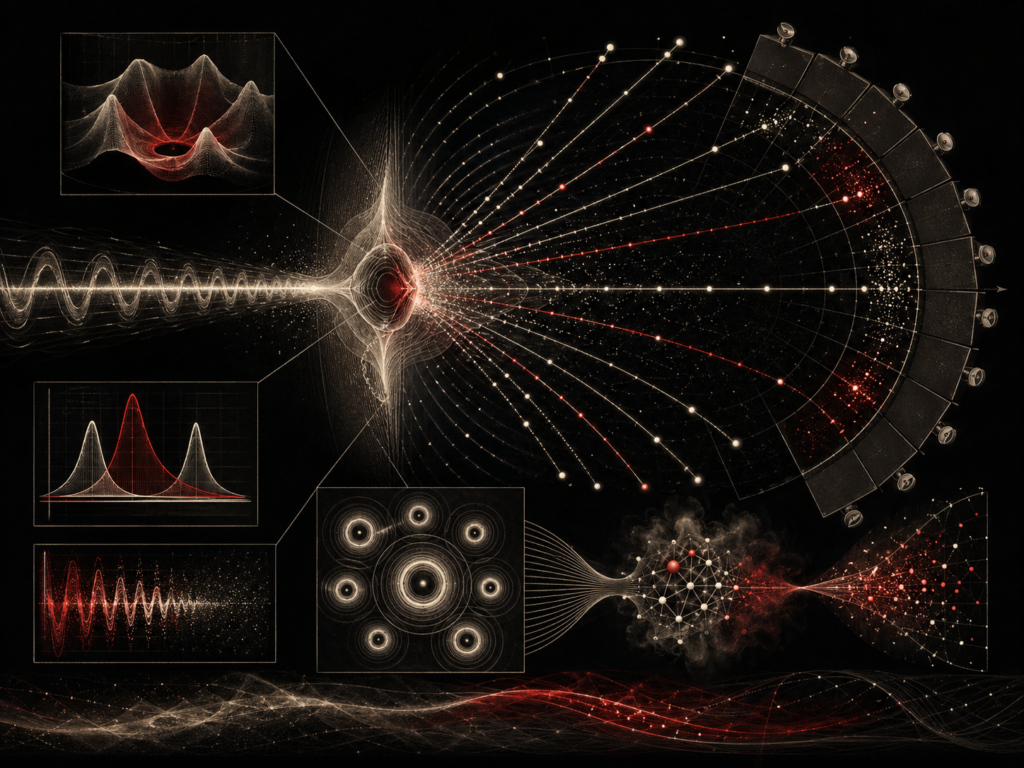
Editorial scientific illustration showing an incoming wave beam scattering from an abstract target potential into angular paths, detector-array arcs, resonance peaks, partial-wave rings, event-count patterns, and inference textures.

Scattering Theory, Cross Sections, and Physical Inference

Scattering theory is one of the central inference engines of physics: it translates invisible interactions into measurable angular distributions, energy spectra, event counts, cross sections, resonances, and outgoing states. This article examines incoming and outgoing states, scattering amplitudes, differential and total cross sections, probability current, flux, the S-matrix, T-matrix, Born approximation, partial-wave expansion, phase shifts, optical theorem, resonances, Breit–Wigner forms, inelastic scattering, coupled channels, Rutherford scattering, quantum field theory scattering, Feynman amplitudes, luminosity, event rates, detector efficiency, acceptance, unfolding, likelihood inference, uncertainty, and inverse scattering. Selected R and Python workflows model angular integration and resonance fitting, while the linked GitHub repository expands the article with reproducible scattering workflows.

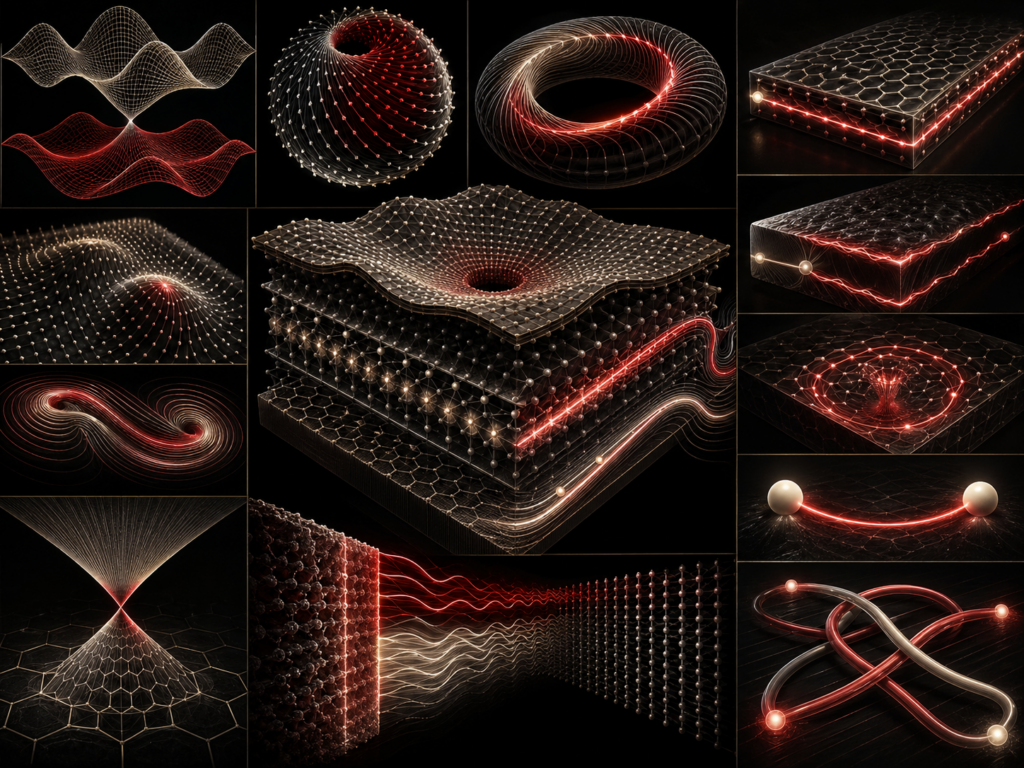
Editorial scientific illustration showing abstract band-structure surfaces, Berry-curvature textures, winding geometries, protected boundary channels, quantum Hall edge pathways, Majorana-like end states, anyonic braids, and layered quantum material structures.

Topological Matter and Quantum Phases

Topological matter and quantum phases show that matter can be classified not only by symmetry, order parameters, and local microscopic structure, but also by global properties of quantum states that remain stable under continuous deformation. This article examines topology in physics, adiabatic deformation, energy gaps, Berry phase, Berry curvature, Chern numbers, quantum Hall effects, fractional quantum Hall fluids, anyons, topological insulators, topological superconductors, Majorana modes, symmetry-protected topological phases, intrinsic topological order, bulk-boundary correspondence, edge and surface states, topological phase transitions, disorder, entanglement, experimental signatures, and computational band-topology workflows. Selected R and Python examples model SSH winding numbers and two-band Chern models, while the linked GitHub repository expands the article with reproducible topological-matter workflows.

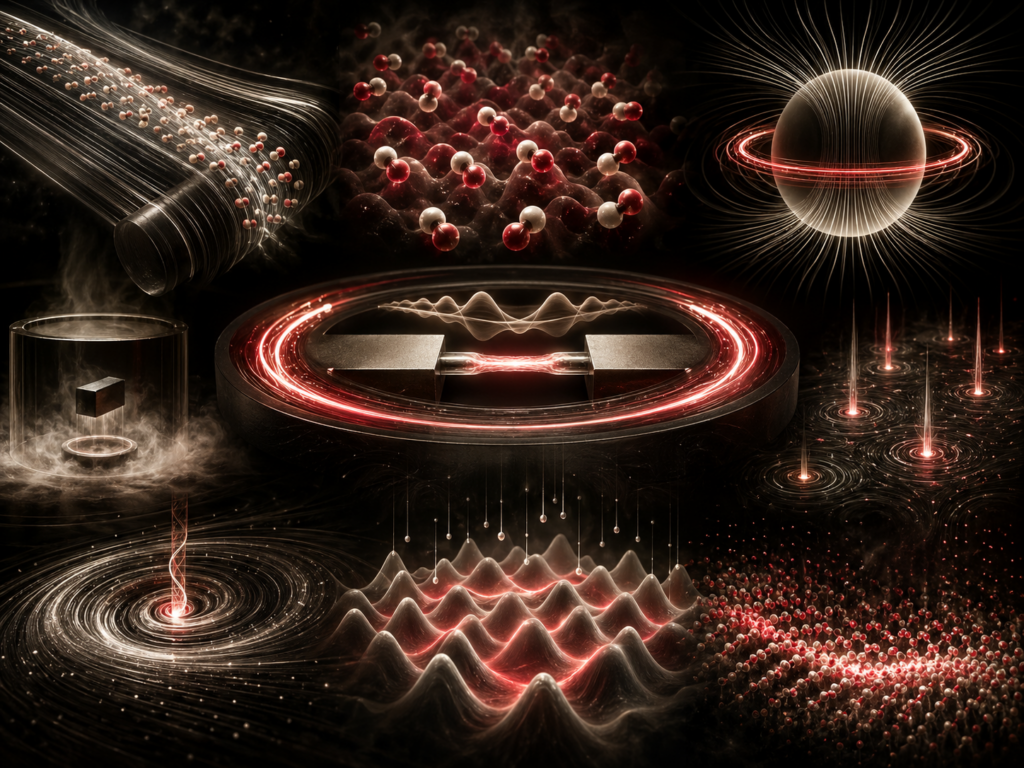
Editorial scientific illustration showing coherent quantum flow, paired-particle condensates, superconducting current loops, magnetic-field expulsion, quantized vortices, superfluid vortex lines, Josephson-junction structures, and many-body quantum order.

Superconductivity, Superfluidity, and Macroscopic Quantum Order

Superconductivity and superfluidity are macroscopic quantum states in which quantum coherence becomes visible at the scale of matter itself. This article examines superconductivity, superfluidity, broken U(1) symmetry, complex order parameters, phase coherence, Cooper pairing, BCS theory, Ginzburg–Landau theory, London equations, Meissner effect, penetration depth, coherence length, type-I and type-II superconductivity, Abrikosov vortices, flux quantization, Josephson effects, SQUIDs, Bose–Einstein condensation, helium-4 superfluidity, helium-3 paired-fermion superfluidity, Landau’s criterion, quantized circulation, two-fluid behavior, unconventional superconductivity, quantum fluids, and macroscopic quantum devices. Selected R and Python workflows model Ginzburg–Landau free energy and Josephson phase dynamics, while the linked GitHub repository expands the article with reproducible macroscopic-quantum-order workflows.

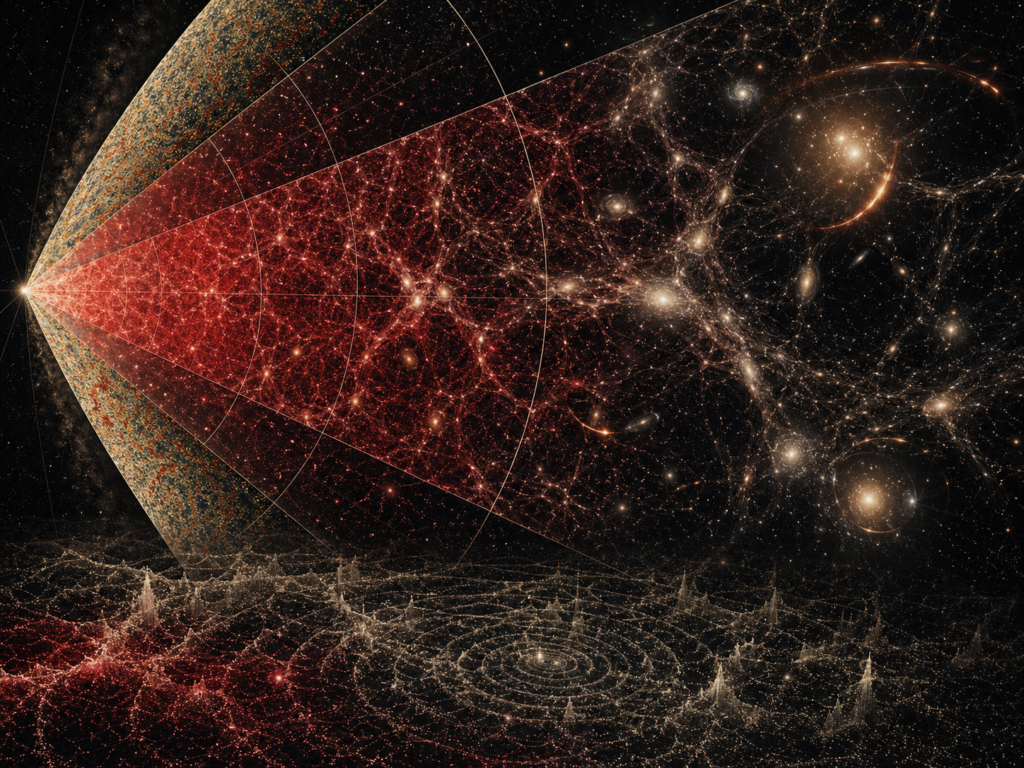
Editorial scientific illustration showing an expansive cosmic web of galaxies, clusters, filaments, voids, dark matter halo structures, cosmic microwave background texture, redshift-depth geometry, lensing arcs, and survey-map forms.

Cosmology and the Large-Scale Structure of the Universe

Cosmology studies the universe as a physical system: its origin, expansion, composition, geometry, thermal history, structure formation, and large-scale distribution of matter. This article examines the cosmological principle, FLRW spacetime, scale factor, redshift, Hubble expansion, Friedmann equations, ΛCDM, radiation, baryons, cold dark matter, dark energy, inflation, primordial perturbations, the cosmic microwave background, acoustic peaks, baryon acoustic oscillations, galaxy surveys, weak lensing, cosmic web morphology, linear perturbation growth, transfer functions, matter power spectra, halo formation, N-body simulations, hydrodynamic simulations, observational tensions, DESI-era dark-energy questions, and the future of survey cosmology. Selected R and Python workflows model FLRW expansion, distance-redshift relations, linear growth, and toy matter power spectra, while the linked GitHub repository expands the article with reproducible cosmology workflows.

Editorial scientific illustration showing branching quantum paths, layered spacetime histories, action-like surface landscapes, lattice grids, propagator arcs, and Monte Carlo sampling structures in black, cream, white, and deep red.

Path Integrals and the Functional Formulation of Physics

Path integrals and the functional formulation of physics recast dynamics as a sum over histories, assigning amplitudes or statistical weights to entire paths, fields, and configurations. This article examines propagators, quantum amplitudes, classical action, stationary phase, time slicing, configuration-space and phase-space path integrals, Euclidean continuation, partition functions, Gaussian functional integrals, generating functionals, source terms, correlation functions, Wick’s theorem, perturbation theory, Feynman diagrams, effective actions, saddle-point methods, instantons, fermionic Grassmann integrals, gauge fixing, lattice path integrals, Monte Carlo sampling, stochastic path integrals, and the conceptual limits of functional methods. Selected R and Python workflows model discretized Euclidean actions and harmonic oscillator path sampling, while the linked GitHub repository expands the article with reproducible path-integral workflows.

Editorial scientific illustration showing abstract symmetry transformations, rotating geometric structures, group-orbit paths, representation spaces, angular-momentum spheres, spinor-like geometry, crystal symmetry patterns, gauge-field arcs, and tensor-network-like structures.

Group Theory and Representation Theory in Physics

Group theory and representation theory provide the mathematical language of symmetry in physics, explaining how rotations, translations, spin, crystals, tensors, conservation laws, selection rules, gauge fields, and particle states are organized. This article examines groups, subgroups, conjugacy classes, group actions, representations, irreducible representations, characters, Schur’s lemma, tensor products, Lie groups, Lie algebras, generators, SO(3), SU(2), angular momentum, spinors, Lorentz and Poincaré symmetry, internal symmetries, gauge groups, particle multiplets, point groups, space groups, Bloch theory, tensors, spectroscopy, and computational representation workflows. Selected R and Python examples model character orthogonality and SU(2) angular-momentum matrices, while the linked GitHub repository expands the article with reproducible symmetry workflows.

Scroll to Top