Physics

Physics examines the fundamental principles that govern matter, energy, motion, force, space, and time. It seeks to explain how physical reality is structured, how natural phenomena arise, and how systems behave across scales ranging from subatomic particles to the largest observable features of the universe.

This field brings together the study of mechanics, thermodynamics, electromagnetism, relativity, quantum phenomena, and the mathematical laws that describe stability, interaction, symmetry, and change. It provides the conceptual foundations for understanding causation, measurement, motion, and the general behavior of physical systems.

Physics plays a foundational role in the natural sciences because it establishes many of the basic principles on which other scientific disciplines depend. By clarifying how matter behaves, how energy is transferred, and how physical systems evolve over time, it shapes human understanding of the material order of nature and the intelligibility of the universe itself.

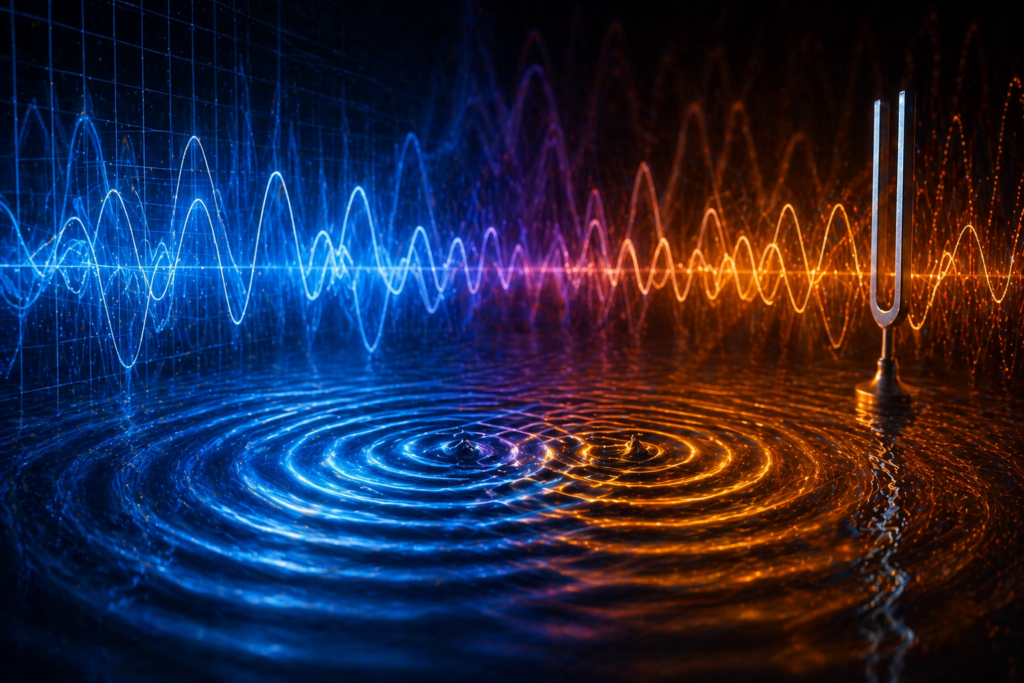
Abstract physics illustration showing glowing waveforms, circular water ripples, and a tuning fork to represent oscillations, resonance, interference, and wave propagation.

Waves, Oscillations, and Resonance

Waves, oscillations, and resonance form one of the great connective structures of physics because they show how systems repeat, transmit energy, respond to frequency, and form collective patterns across space and time. This article examines simple harmonic motion, damping, driven oscillators, resonance, phase, frequency, amplitude, coupled oscillators, normal modes, mechanical waves, the wave equation, standing waves, interference, beats, Fourier decomposition, dispersion, sound, light, and the broader role of wave reasoning across physics. Selected R and Python workflows model resonance curves and damped driven oscillator behavior, while the linked GitHub repository expands the article with advanced computational scaffolding for reproducible wave-physics workflows.
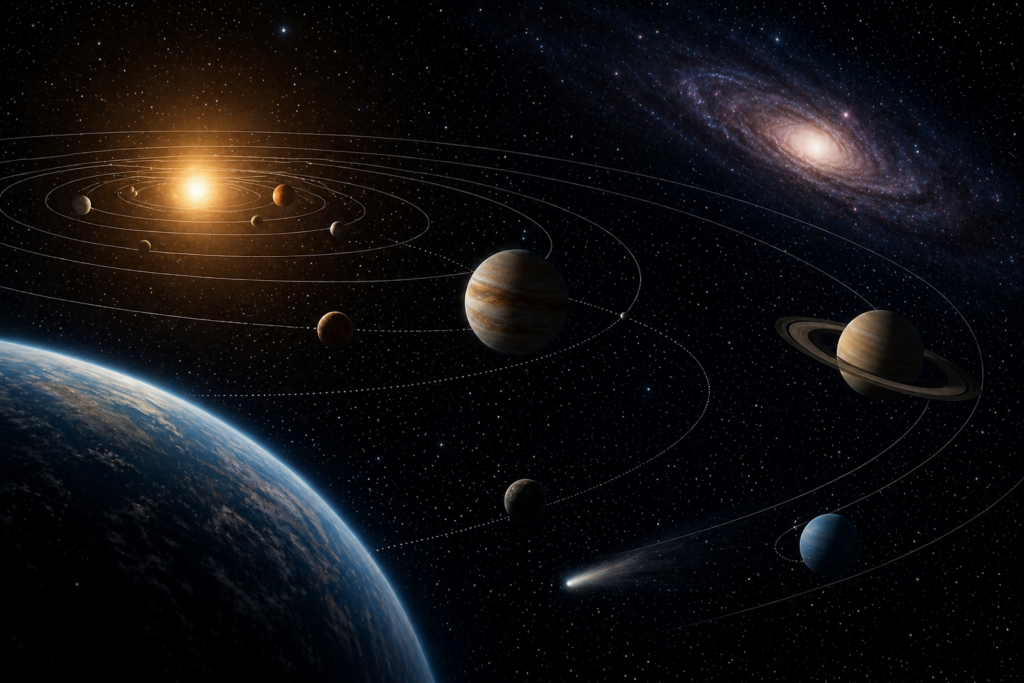
Cinematic space illustration showing planets, elliptical orbital paths, a glowing star, a comet, Earth, and a distant spiral galaxy to represent gravitation, orbital motion, and celestial mechanics.

Gravitation, Orbits, and Celestial Mechanics

Gravitation, orbits, and celestial mechanics show how classical physics extends from falling bodies on Earth to planets, moons, satellites, comets, stars, and spacecraft moving through space. This article examines Newtonian gravitation, Kepler’s laws, central-force motion, the two-body problem, orbital energy, angular momentum, circular orbits, escape speed, the vis-viva equation, orbital elements, perturbations, tides, resonances, many-body dynamics, and basic orbital-transfer reasoning. Selected R and Python workflows model circular orbits, escape speed, orbital period scaling, and two-body integration, while the linked GitHub repository expands the article with advanced computational scaffolding for reproducible celestial-mechanics workflows.

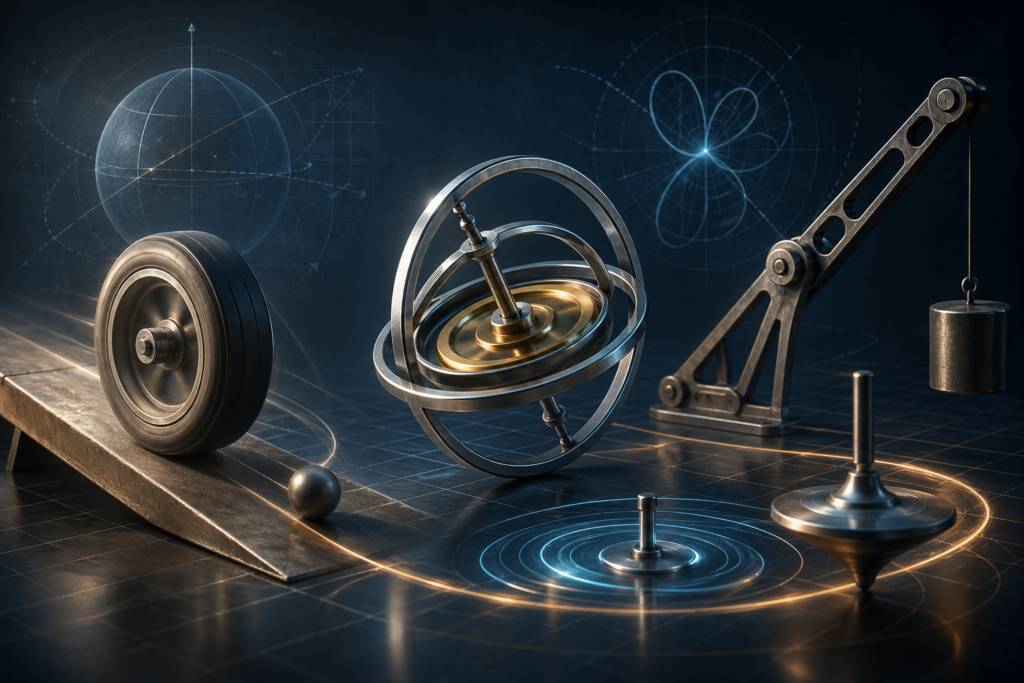
Editorial physics illustration showing a gyroscope, rolling wheel, inclined plane, rotating top, and torque arm to represent rotational dynamics, angular momentum, and rolling motion.

Rotational Dynamics, Torque, and Angular Momentum

Rotational dynamics extends classical mechanics beyond linear motion by explaining how bodies turn, spin, roll, precess, and conserve angular momentum. This article examines angular position, angular velocity, angular acceleration, torque, moment of inertia, rotational kinetic energy, rolling without slipping, angular impulse, gyroscopic behavior, and angular momentum conservation. It shows how rotational motion deepens the classical mechanics sequence by moving from point-particle models to extended bodies with shape, axes, constraints, and mass distribution. Selected R and Python workflows compare rolling objects, energy partition, torque-driven rotation, angular momentum, and rotational kinetic energy, while the linked GitHub repository expands the article with advanced computational scaffolding for reproducible rotational-dynamics workflows.

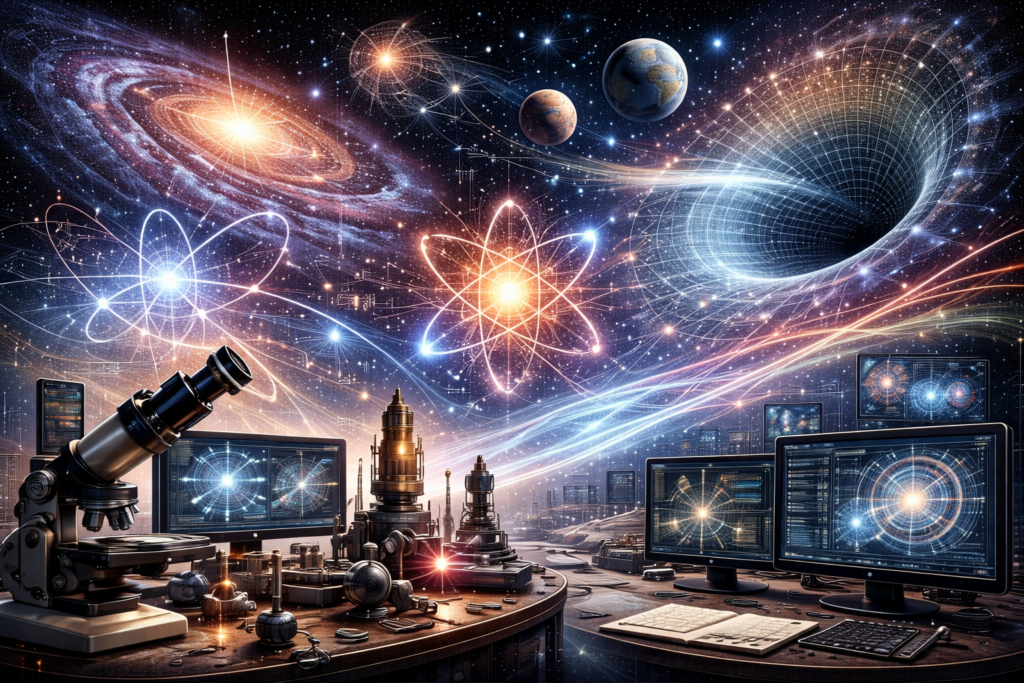
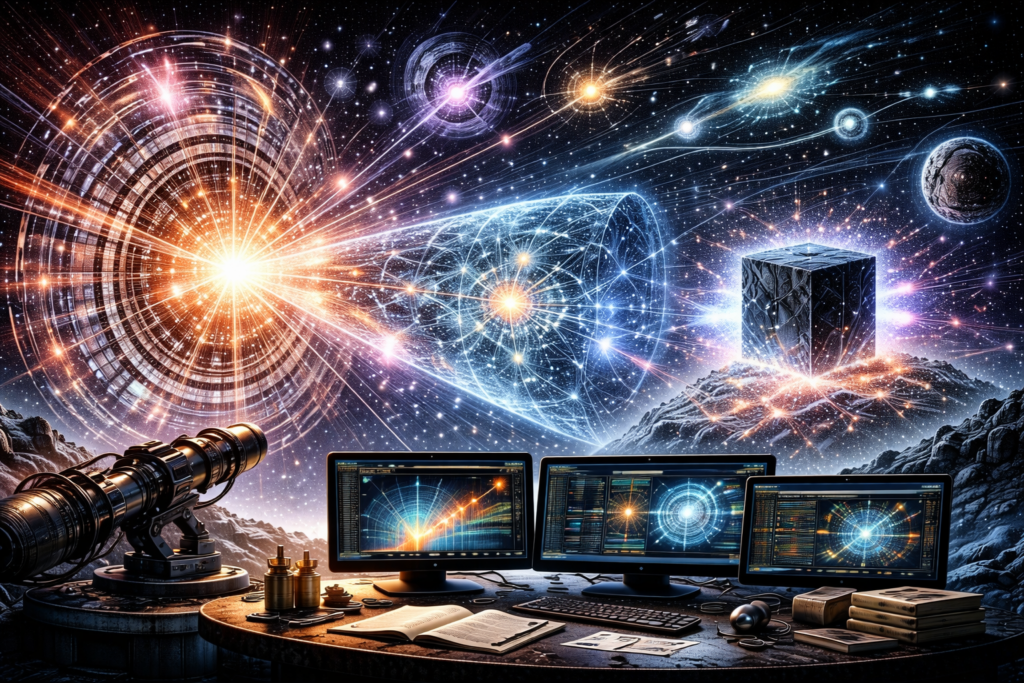
Editorial illustration of physics featuring scientific instruments, atomic and field-like structures, cosmic systems, curved spacetime imagery, and computational analysis displays.

What Is Physics?

Physics is the disciplined study of matter, energy, motion, fields, measurement, and structure across scales, from subatomic particles to galaxies. This article introduces physics as more than a list of topics: it is a way of knowing built from measurement, mathematics, experiment, modeling, uncertainty, and computation. It explains why units, constants, and standards matter; how physical laws connect measurable quantities; how theory and experiment interact; and how branches such as mechanics, thermodynamics, electromagnetism, relativity, quantum theory, condensed matter, particle physics, and cosmology form a connected field. The article also introduces a computational physics lens through selected Python and R workflows, with expanded research-style code available through the accompanying GitHub repository.

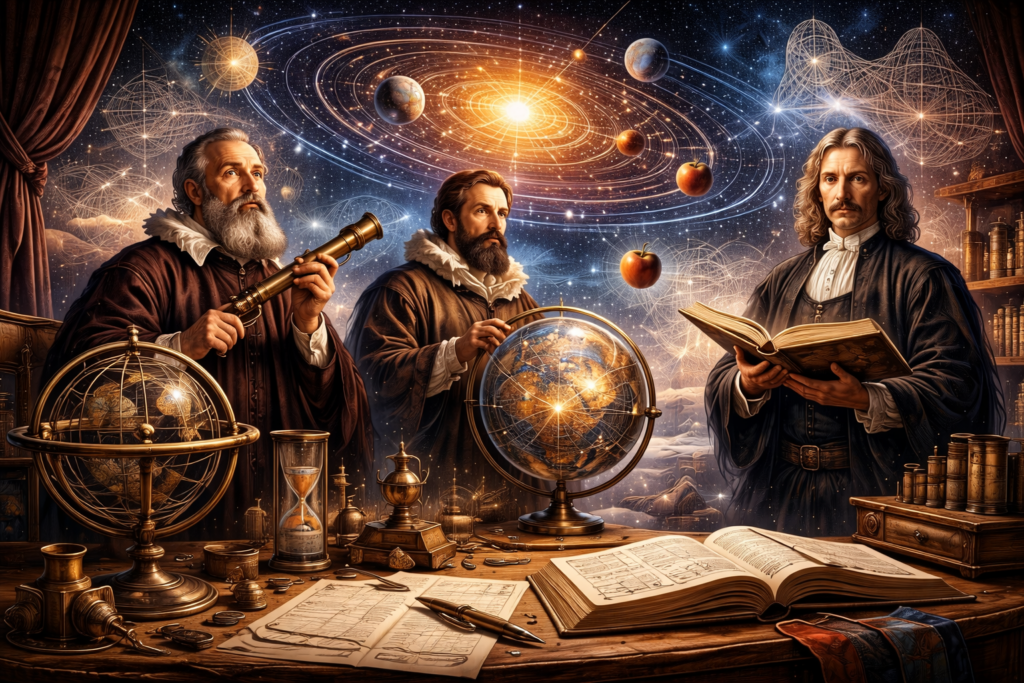
Editorial illustration of the Scientific Revolution featuring early modern scientific instruments, astronomical models, manuscripts, telescopic observation, planetary motion imagery, and a study-like setting associated with the rise of physical law.

The Scientific Revolution and the Rise of Physical Law

The Scientific Revolution transformed natural philosophy into the law-seeking structure that made modern physics possible. This article examines how early modern science moved from inherited authority and qualitative explanation toward mathematics, experiment, instruments, and universal physical law. It traces the shift from Aristotelian and scholastic frameworks through Copernicus’s heliocentric reordering, Kepler’s mathematical laws of planetary motion, Galileo’s experimental science of motion, and Newton’s synthesis of terrestrial and celestial mechanics. The article explains why physical law became central to scientific explanation, how mathematics and instrumentation reshaped knowledge, and why the legacy of the Scientific Revolution still defines physics as a discipline of measurement, modeling, evidence, and theoretical unification.

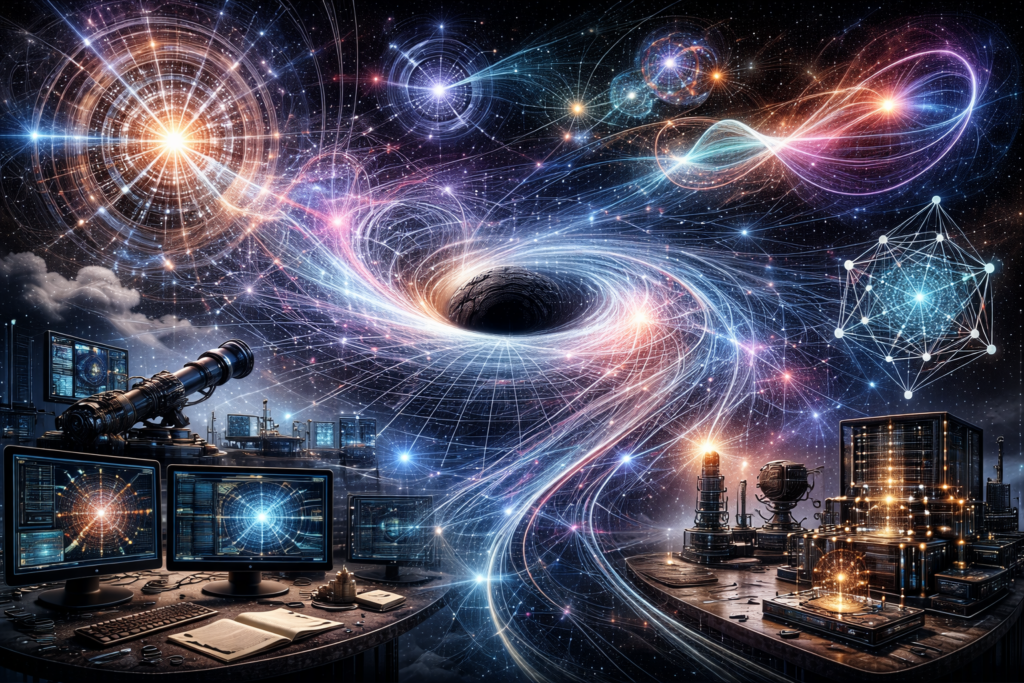
Editorial illustration of physics and the philosophy of reality featuring a warped spacetime structure, quantum-like interference patterns, geometric relational networks, observatory-style instruments, and computational analysis displays.

Physics and the Philosophy of Reality

Physics and the philosophy of reality explores what modern physical theory implies about the nature of the world, asking whether fields, particles, spacetime, wavefunctions, laws, and symmetries are best understood as real features of nature, structural descriptions, or theory-dependent models of an underlying reality. This article examines scientific realism, structural realism, laws of nature, causation, determinism, spacetime ontology, quantum interpretation, gauge structure, holism, and the limits of current physical explanation to show how physics does more than describe measurable phenomena: it also reshapes how reality itself can be conceived. It brings together mechanics, relativity, quantum theory, field theory, and philosophy of science to show that modern physics is not only a technical account of the universe but also a profound challenge to common-sense metaphysics and a continuing source of philosophical humility.

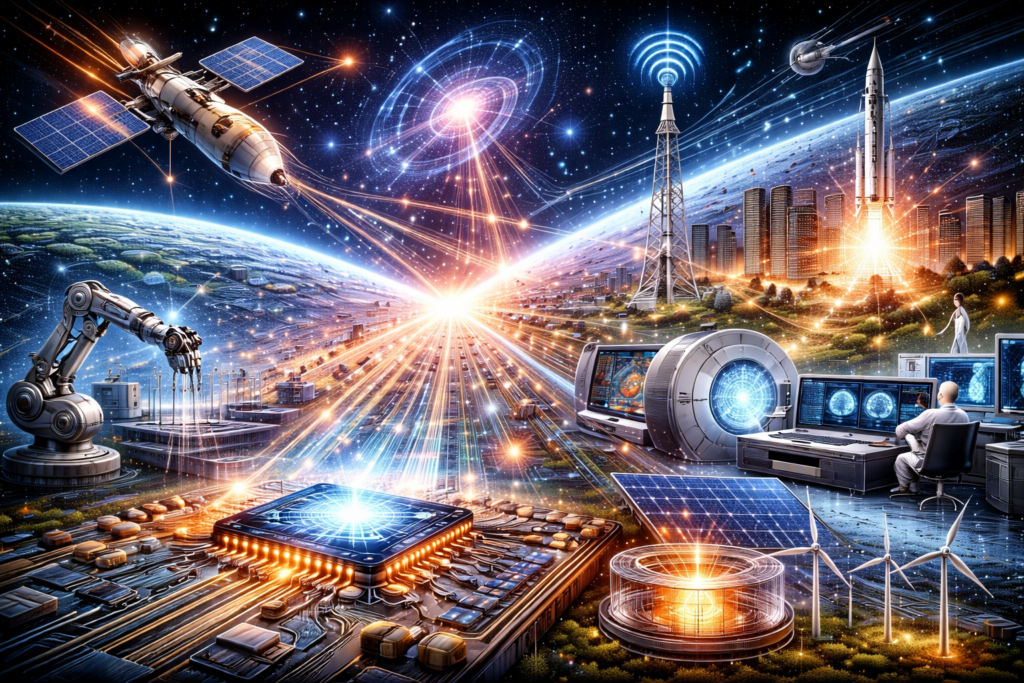
Editorial illustration of physics, technology, and the modern world featuring a semiconductor chip, robotic automation, medical imaging systems, renewable energy infrastructure, satellites, communication networks, and advanced computational displays.

Physics, Technology, and the Modern World

Physics, technology, and the modern world explores how physical law is translated into the systems that shape contemporary life, from semiconductors, photonics, and computation to medical imaging, navigation, energy infrastructure, advanced materials, and space-based observation. This article examines how measurement, standards, instrumentation, and materials science turn physical principles into reliable devices and large-scale technical systems, showing that the modern world is deeply structured by electromagnetism, quantum mechanics, thermodynamics, nuclear physics, and precision metrology. It also considers how physics continues to drive emerging technologies through semiconductors, quantum systems, photonic devices, advanced manufacturing, and large scientific infrastructures, while raising broader questions about power, governance, ethics, and the unequal distribution of technological benefit and risk.

Editorial illustration of physics beyond the Standard Model featuring collider-style detector geometry, dark-sector inspired structures, neutrino-like streams, cosmic components, and computational analysis displays.

Physics Beyond the Standard Model

Physics beyond the Standard Model explores why the most successful theory in particle physics is still incomplete and why new physics is required to explain some of the deepest unresolved features of the universe. This article examines dark matter, neutrino mass, matter–antimatter asymmetry, hidden sectors, axions, dark photons, unification, quantum gravity, and cosmological evidence to show how the search for new particles, new forces, and new symmetries extends beyond the known framework of quarks, leptons, gauge bosons, and the Higgs field. It also explains how modern experiments at colliders, neutrino facilities, underground detectors, and cosmological surveys are reshaping the frontier of fundamental physics by testing where the Standard Model succeeds, where it fails, and where the next layer of physical law may begin.

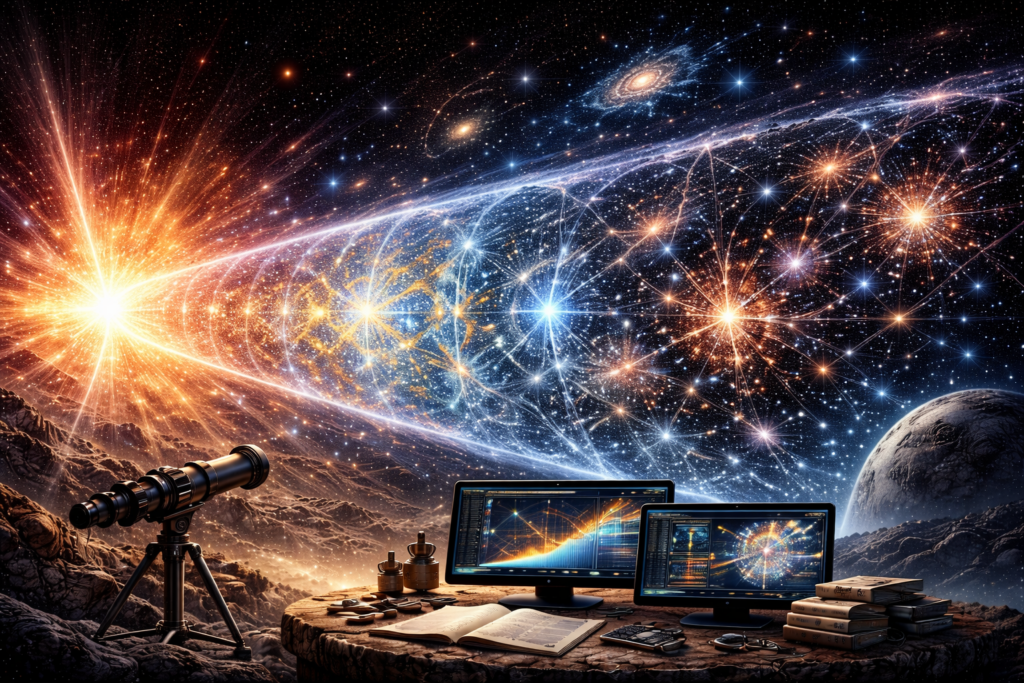
Editorial illustration of cosmology and the history of the universe featuring early-universe expansion, cosmic background-like structure, galaxy formation, large-scale filaments, telescopic observation, and cosmological data-analysis displays.

Cosmology and the History of the Universe

Cosmology and the history of the universe explores how the universe evolved from an extremely hot, dense, and nearly uniform early state into a vast structured cosmos of radiation, dark matter, galaxies, clusters, filaments, and expanding spacetime. This article examines the major eras of cosmic history, including early-universe cooling, recombination, the release of the cosmic microwave background, the growth of structure under gravity, the role of dark matter in building the cosmic web, and the late-time expansion history shaped by dark energy. It also explains how modern cosmology reconstructs this history through redshift surveys, background-radiation measurements, distance indicators, and large-scale observational mapping, showing how the universe became transparent, formed stars and galaxies, and continues to evolve across billions of years of cosmic time.

Scroll to Top