
Last Updated May 28, 2026
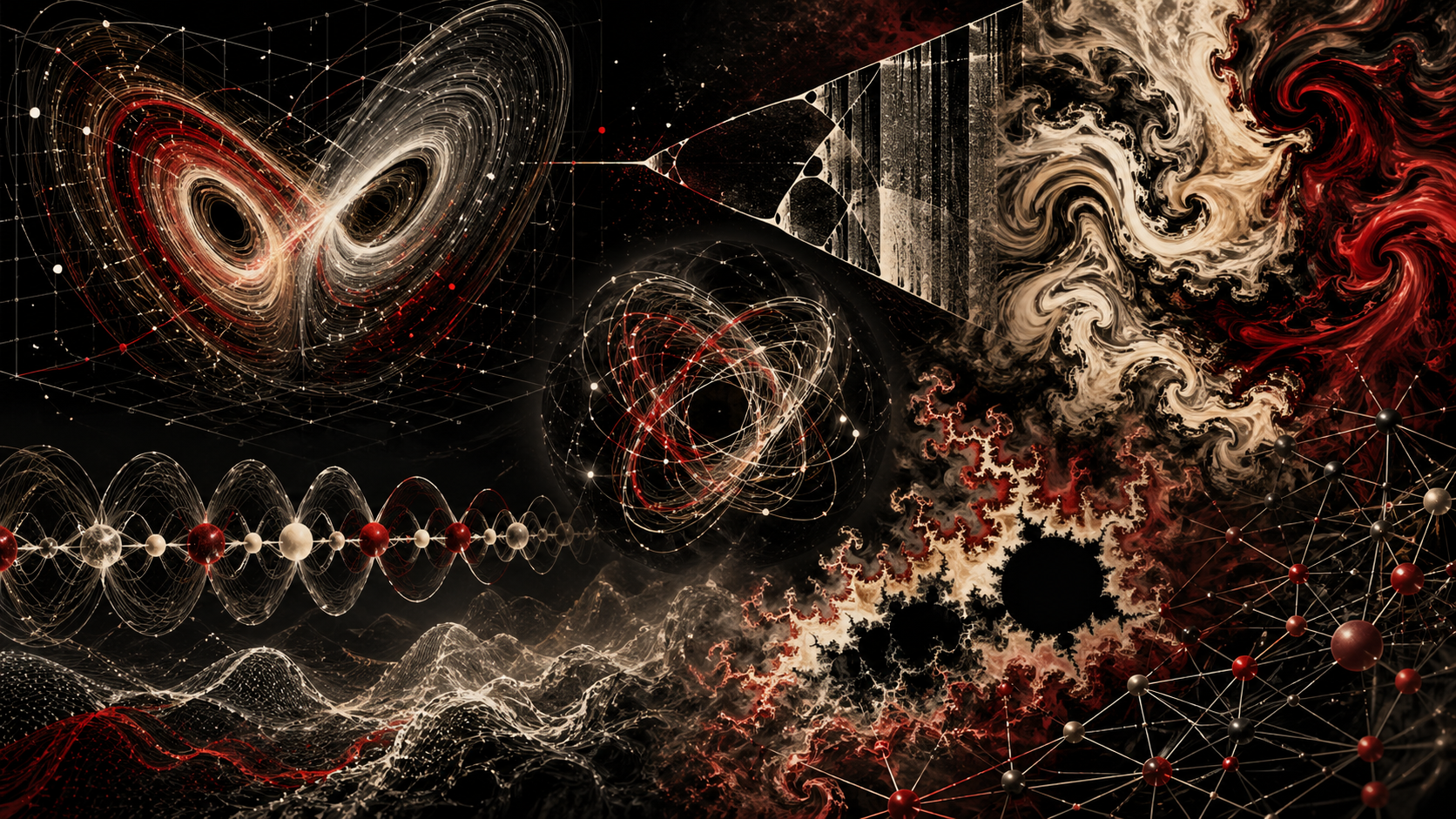
Nonlinear dynamics, chaos, and complex physical systems explain how deterministic laws can generate feedback, instability, bifurcation, pattern formation, sensitive dependence, and behavior that is difficult to predict even when the governing equations are known. Linear systems are powerful because they support superposition, proportional response, and analytic tractability. But much of the physical world is nonlinear. A pendulum at large amplitude, a turbulent fluid, a driven oscillator, a weather system, a laser, a plasma, a planetary resonance, a biological rhythm, a chemical reaction, a magnetic material, or a climate subsystem may respond in ways that cannot be understood by simply adding independent effects.
Nonlinear dynamics changes the question physics asks. Instead of asking only for closed-form solutions, one asks about fixed points, stability, phase portraits, limit cycles, bifurcations, attractors, invariant sets, sensitivity to initial conditions, Lyapunov exponents, fractal geometry, emergent order, and computational predictability. Chaos does not mean randomness. In its technical sense, chaos can arise in deterministic systems whose long-term behavior is highly sensitive to initial conditions. Small differences in starting state can grow until trajectories diverge, limiting practical prediction even when the equations are precise.
This article examines Nonlinear Dynamics, Chaos, and Complex Physical Systems within the Physics knowledge series. It explains nonlinear equations, phase space, fixed points, stability, bifurcations, limit cycles, chaos, sensitive dependence, the logistic map, the Lorenz system, strange attractors, Lyapunov exponents, fractals, intermittency, synchronization, pattern formation, turbulence, complex systems, and computational modeling. Selected R and Python workflows appear here, while the full GitHub repository contains expanded computational examples for logistic maps, bifurcation diagrams, Lyapunov exponents, Lorenz integration, strange attractors, phase portraits, stability classification, nonlinear oscillator diagnostics, SQL metadata, C/C++/Fortran/Rust examples, and reproducible nonlinear-dynamics workflows.
Main Library
Publications
Article Map
Physics
Related Topic
Mathematics
Related Topic
Data Systems & Analytics
Related Topic
Astronomy
Why Nonlinear Dynamics Matters
Nonlinear dynamics matters because many physical systems do not respond proportionally to input. A small force may produce a small displacement in a linear spring, but a nonlinear oscillator may shift frequency with amplitude, lock into resonance, jump between states, or become chaotic when driven. A fluid may remain smooth at low speed and become turbulent at higher speed. A climate subsystem may respond gradually until a threshold is crossed. A laser may suddenly begin coherent emission. A chemical reaction may form oscillations or spatial patterns. A population model may settle, cycle, or become chaotic depending on one parameter.
In nonlinear systems, feedback matters. A variable may affect its own rate of change. Coupled variables may amplify or suppress one another. Delays, thresholds, saturation, instability, and competing processes can produce behavior that is not obvious from the individual parts. This is why nonlinear dynamics provides a bridge from classical equations to complex physical behavior.
Nonlinear dynamics also reshapes the meaning of prediction. In a simple linear system, small errors often remain small. In a chaotic system, small differences in initial conditions can grow rapidly. The system may still be deterministic, but long-term prediction becomes practically limited because measurement precision is finite. This distinction is central to weather, turbulence, orbital resonances, plasma dynamics, nonlinear optics, and many complex systems.
For the Physics knowledge series, nonlinear dynamics is essential because it connects mechanics, waves, fluids, thermodynamics, statistical physics, computation, and complex systems. It shows that physical law can be exact while physical behavior remains difficult to forecast. It also shows why simulation, visualization, stability analysis, and qualitative reasoning are often as important as closed-form solution.
Linear vs. Nonlinear Physical Systems
A linear system obeys superposition. If \(x_1(t)\) and \(x_2(t)\) are solutions, then a linear combination is also a solution:
a x_1(t) + b x_2(t)
\]
Interpretation: Linear systems preserve solution structure under addition and scalar multiplication.
This property makes linear systems mathematically powerful. Normal modes, Fourier analysis, matrix methods, Green’s functions, and eigenvalue problems all rely heavily on linear structure.
A nonlinear system violates superposition. Its governing equations contain products, powers, nonlinear functions, thresholds, saturating terms, feedback loops, or state-dependent coefficients. A general nonlinear dynamical system can be written as:
\frac{d\mathbf{x}}{dt} = \mathbf{F}(\mathbf{x},t)
\]
Interpretation: A nonlinear dynamical system evolves according to a vector field that is not simply linear in the state variables.
where \(\mathbf{F}\) is not a linear function of \(\mathbf{x}\). Examples include:
\frac{dx}{dt} = rx(1-x)
\]
Interpretation: Logistic growth contains nonlinear self-limitation through the product \(x(1-x)\).
\ddot{\theta} + \frac{g}{\ell}\sin\theta = 0
\]
Interpretation: The full pendulum is nonlinear because the restoring term depends on \(\sin\theta\), not simply \(\theta\).
\frac{dx}{dt} = \sigma(y-x)
\]
Interpretation: This is one component of the Lorenz system, whose full nonlinear behavior comes from coupled products in the remaining equations.
Linearization is often useful. Near a fixed point, a nonlinear system may be approximated by its Jacobian matrix. But linearization is local. It may describe nearby stability while missing global behavior such as multiple attractors, separatrices, limit cycles, bifurcations, and chaos. Nonlinear dynamics therefore asks how local rules generate global structure.
Phase Space and State Evolution
Phase space is the space of possible states of a system. For a one-dimensional oscillator, a state may be described by position and velocity:
(x,v)
\]
Interpretation: A one-dimensional oscillator requires both position and velocity to specify its instantaneous state.
For a Hamiltonian system, a state is described by generalized coordinates and momenta:
(q,p)
\]
Interpretation: Hamiltonian phase space pairs generalized coordinates with conjugate momenta.
For a three-variable dynamical system such as the Lorenz system, the state is:
(x,y,z)
\]
Interpretation: A three-dimensional dynamical system evolves through a three-variable state space.
A trajectory in phase space shows how the system evolves over time. Instead of plotting only a single variable against time, phase-space analysis reveals geometry: fixed points, loops, spirals, separatrices, basins of attraction, and chaotic attractors.
For an autonomous system:
\frac{d\mathbf{x}}{dt} = \mathbf{F}(\mathbf{x})
\]
Interpretation: An autonomous system has a vector field that depends on state but not explicitly on time.
the vector field \(\mathbf{F}\) assigns a direction of motion to each point in phase space. This gives a geometric view of dynamics. A system’s future path is determined by its current location in phase space, but the structure of the flow determines whether trajectories settle, oscillate, diverge, or wander chaotically within a bounded region.
Phase-space reasoning is one of the strongest continuities between nonlinear dynamics and Hamiltonian mechanics. In Hamiltonian systems, phase-space geometry is constrained by symplectic structure and energy surfaces. In dissipative nonlinear systems, phase-space volumes may contract, allowing attractors to emerge.
Fixed Points and Stability
A fixed point is a state that does not change with time. For a continuous dynamical system:
\frac{d\mathbf{x}}{dt} = \mathbf{F}(\mathbf{x})
\]
Interpretation: A continuous dynamical system evolves according to its vector field.
a fixed point \(\mathbf{x}^{*}\) satisfies:
\mathbf{F}(\mathbf{x}^{*}) = \mathbf{0}
\]
Interpretation: At a fixed point, the vector field vanishes and the state does not change.
Fixed points are important because they represent equilibria. But equilibrium alone is not enough. One must ask whether the fixed point is stable. If a small perturbation decays, the fixed point is stable. If a small perturbation grows, it is unstable. If perturbations decay in some directions and grow in others, the fixed point may be a saddle.
Stability is often analyzed by linearizing the system near the fixed point. For a one-dimensional system:
\frac{dx}{dt}=f(x)
\]
Interpretation: One-dimensional stability can be studied by the slope of the function near equilibrium.
near \(x^*\), one writes:
\frac{d}{dt}(x-x^*) \approx f'(x^*)(x-x^*)
\]
Interpretation: Linearization estimates how small perturbations evolve near a fixed point.
If \(f'(x^*)<0\), perturbations decay. If \(f'(x^*)>0\), perturbations grow. In higher dimensions, stability is governed by eigenvalues of the Jacobian matrix:
J_{ij} = \frac{\partial F_i}{\partial x_j}
\]
Interpretation: The Jacobian matrix describes the local linear approximation to a nonlinear vector field.
Fixed-point analysis is one of the basic tools of nonlinear dynamics. It identifies equilibria, classifies local behavior, and prepares the way for bifurcation analysis.
Bifurcations and Qualitative Change
A bifurcation occurs when a small change in a parameter causes a qualitative change in system behavior. A stable equilibrium may disappear. A new equilibrium may emerge. A fixed point may become unstable. A limit cycle may appear. A periodic orbit may double in period. A system may transition toward chaos.
A simple normal form for a saddle-node bifurcation is:
\frac{dx}{dt}=r+x^2
\]
Interpretation: In a saddle-node bifurcation, fixed points can appear or disappear as the control parameter changes.
where \(r\) is a control parameter. Depending on \(r\), the system may have two fixed points, one degenerate fixed point, or no fixed points. This shows how parameter variation changes the structure of phase space.
A pitchfork bifurcation may be represented by:
\frac{dx}{dt}=rx-x^3
\]
Interpretation: A pitchfork bifurcation models symmetry-breaking behavior as a parameter crosses a threshold.
For \(r<0\), the origin is stable. For \(r>0\), the origin becomes unstable and two stable fixed points appear. This kind of symmetry-breaking behavior appears in physical contexts such as buckling, pattern formation, phase transitions, and idealized models of spontaneous symmetry breaking.
A Hopf bifurcation occurs when a fixed point loses stability and a periodic orbit emerges. Hopf bifurcations are important in oscillatory systems, chemical reactions, biological rhythms, fluid instabilities, and nonlinear circuits.
Bifurcation theory is important because it studies qualitative change, not merely numerical solution. It asks what kinds of behavior are possible as parameters vary.
Limit Cycles and Self-Sustained Oscillation
A limit cycle is an isolated closed trajectory in phase space. Nearby trajectories may spiral toward it or away from it. A stable limit cycle represents self-sustained oscillation: the system oscillates not because it was started with just the right initial condition, but because its dynamics attract nearby states into a recurring cycle.
Limit cycles occur in many physical and biological systems. Examples include nonlinear electrical circuits, lasers, chemical oscillations, heart rhythms, walking gaits, fluid vortex shedding, and driven dissipative oscillators. Unlike the ideal harmonic oscillator, whose closed orbits depend continuously on initial energy, a stable limit cycle has an amplitude and period selected by the system itself.
The van der Pol oscillator is a classic example:
\frac{d^2x}{dt^2}
–
\mu(1-x^2)\frac{dx}{dt}
+
x=0
\]
Interpretation: The van der Pol oscillator uses nonlinear damping to generate self-sustained oscillation.
For \(\mu>0\), the system has nonlinear damping: it adds energy at small amplitude and removes energy at large amplitude. The result is a stable self-sustained oscillation.
Limit cycles show that nonlinear systems can create organized temporal structure. They are neither static equilibria nor arbitrary fluctuations. They are stable patterns of motion generated by feedback and dissipation.
Chaos and Sensitive Dependence
Chaos is deterministic behavior that appears irregular, aperiodic, and highly sensitive to initial conditions. A chaotic system is not random in the sense of being governed by chance alone. Its future follows from its current state and equations of motion. But nearby initial states may separate rapidly, making long-term prediction practically impossible.
Sensitive dependence can be expressed approximately as:
|\delta(t)| \approx |\delta(0)|e^{\lambda t}
\]
Interpretation: In chaotic dynamics, nearby trajectories may separate exponentially on average.
where \(\delta(0)\) is a small initial separation, \(\delta(t)\) is the separation after time \(t\), and \(\lambda\) is a Lyapunov exponent. If the largest Lyapunov exponent is positive, nearby trajectories diverge exponentially on average.
Chaos requires nonlinearity, but not every nonlinear system is chaotic. Chaos also generally requires enough dynamical dimension or an iterated map structure. In continuous autonomous systems, chaos cannot occur in one-dimensional flows and is highly constrained in two-dimensional flows. Three-dimensional systems, periodically driven systems, delayed systems, and maps can display chaotic behavior.
The practical significance of chaos is profound. It limits prediction in weather, turbulence, celestial mechanics, nonlinear circuits, plasma behavior, and many coupled physical systems. It also reveals that deterministic law and practical unpredictability are not opposites.
The Logistic Map
The logistic map is one of the simplest mathematical systems that exhibits period doubling and chaos:
x_{n+1}=r x_n(1-x_n)
\]
Interpretation: The logistic map is a nonlinear recurrence whose long-run behavior changes dramatically with parameter \(r\).
where \(0 \leq x_n \leq 1\) and \(r\) is a control parameter. Despite its simple form, the logistic map produces a rich sequence of behaviors. For some values of \(r\), trajectories approach a fixed point. For larger values, they approach a two-cycle, then a four-cycle, then an eight-cycle, and eventually chaotic behavior appears through a period-doubling cascade.
The logistic map is important because it shows that complicated behavior does not require complicated equations. Nonlinearity and iteration can produce structure, bifurcation, and chaos from a compact rule.
Fixed points satisfy:
x^*=r x^*(1-x^*)
\]
Interpretation: A fixed point of the logistic map maps back to itself after one iteration.
The fixed points are:
x^*=0
\]
Interpretation: Zero is always a fixed point of the logistic map.
and:
x^*=1-\frac{1}{r}
\]
Interpretation: The nonzero fixed point depends on the control parameter \(r\).
Stability depends on the derivative of the map:
f'(x)=r(1-2x)
\]
Interpretation: The derivative determines whether small perturbations around a fixed point grow or decay.
A fixed point is stable when:
|f'(x^*)|<1
\]
Interpretation: A one-dimensional map fixed point is stable when the magnitude of the local slope is less than one.
This simple criterion shows how fixed-point stability changes as \(r\) changes, leading to bifurcation.
The Lorenz System
The Lorenz system is a classic continuous-time chaotic system originally developed as a simplified model related to atmospheric convection. It is written as:
\frac{dx}{dt}=\sigma(y-x)
\]
\[
\frac{dy}{dt}=x(\rho-z)-y
\]
\[
\frac{dz}{dt}=xy-\beta z
\]
Interpretation: The Lorenz system is a three-variable nonlinear system capable of deterministic chaos.
where \(\sigma\), \(\rho\), and \(\beta\) are parameters. For common parameter values such as:
\sigma=10,\qquad \rho=28,\qquad \beta=\frac{8}{3}
\]
Interpretation: These standard parameter values produce the famous chaotic Lorenz attractor.
the system exhibits chaotic behavior and produces the famous butterfly-shaped strange attractor.
The Lorenz system is important not because it is a complete model of the atmosphere, but because it shows how deterministic differential equations can produce aperiodic, sensitive, bounded behavior. Its trajectories do not simply settle to a fixed point or repeat in a simple cycle. They move around structured regions of phase space in a way that is orderly enough to have geometry but unpredictable enough to limit long-term forecasting.
The Lorenz system therefore became one of the canonical examples of deterministic chaos. It links nonlinear dynamics to weather prediction, fluid convection, phase-space geometry, strange attractors, and the limits of measurement-based prediction.
Strange Attractors and Fractal Geometry
An attractor is a set toward which trajectories evolve over time. A stable fixed point is an attractor. A stable limit cycle is an attractor. A strange attractor is an attractor with complex geometry, often fractal structure, and sensitive dependence on initial conditions.
Dissipative nonlinear systems can contract phase-space volumes while stretching and folding trajectories. This combination can create attractors that are bounded but geometrically intricate. A strange attractor is not a simple point or closed curve. It has structure across scales and may have non-integer fractal dimension.
Fractal dimension provides a way to describe geometric complexity that lies between ordinary integer dimensions. A curve has topological dimension one, a surface has dimension two, and a volume has dimension three. A strange attractor may occupy phase space in a way that is more complex than a curve but less than a filled volume.
Strange attractors are important because they reveal how order and unpredictability can coexist. The system is not wandering arbitrarily anywhere in phase space. It is constrained to an attractor. Yet motion on that attractor can be highly sensitive and aperiodic.
Lyapunov Exponents and Predictability
Lyapunov exponents quantify the average exponential rates at which nearby trajectories separate or converge. If the largest Lyapunov exponent is positive, the system exhibits sensitive dependence on initial conditions.
For a separation \(\delta(t)\), one may write approximately:
\lambda
\approx
\lim_{t\to\infty}
\frac{1}{t}
\ln
\left(
\frac{|\delta(t)|}{|\delta(0)|}
\right)
\]
Interpretation: A Lyapunov exponent measures the long-run average exponential rate of trajectory separation.
A positive \(\lambda\) indicates exponential separation. A negative \(\lambda\) indicates convergence. A zero exponent often corresponds to neutral motion along a trajectory or continuous symmetry.
Lyapunov exponents connect dynamics to predictability. Suppose measurement uncertainty gives an initial error \(\delta(0)\). If the system has positive Lyapunov exponent \(\lambda\), the error grows approximately as \(e^{\lambda t}\). Prediction becomes unreliable when the error reaches the scale of the phenomenon being predicted.
This does not mean that chaotic systems are meaningless or unscientific. Short-term prediction may be possible. Statistical properties may be stable. Attractor geometry may be studied. Ensemble forecasts may be useful. But the meaning of prediction changes. In chaotic systems, precise long-term trajectory prediction is replaced by probabilistic, statistical, structural, or ensemble-based understanding.
Intermittency, Routes to Chaos, and Nonlinear Transition
Chaos can emerge through multiple routes. Period doubling is one famous route, visible in the logistic map. A system may transition from a stable fixed point to a periodic orbit, then to cycles of doubled period, and eventually to chaos. Quasiperiodicity, intermittency, and crisis events provide other pathways.
Intermittency occurs when a system alternates between relatively regular behavior and irregular bursts. This is common in nonlinear systems near transition. A flow may remain mostly laminar with turbulent bursts. A signal may show quiet intervals interrupted by chaotic episodes. A driven oscillator may spend long times near regular motion before abrupt irregular excursions.
Nonlinear transition is important because physical systems often do not change smoothly from one regime to another. They may cross thresholds, lose stability, reorganize patterns, or suddenly amplify fluctuations. This matters in fluid turbulence, plasma instabilities, climate tipping behavior, structural buckling, chemical reactions, and nonlinear optics.
Routes to chaos reveal that disorder can have structure. Chaotic behavior is not simply a failure of theory. It can arise through mathematically describable transitions.
Synchronization, Pattern Formation, and Emergence
Nonlinear dynamics also explains how order can emerge from interaction. Coupled oscillators may synchronize. Reaction-diffusion systems may form spatial patterns. Fluids may form coherent vortices. Lasers may produce coherent light. Biological rhythms may lock to environmental cycles. Networks of interacting elements may produce collective behavior not obvious from any one element alone.
Synchronization occurs when interacting oscillators adjust their rhythms. The details depend on coupling strength, frequency mismatch, noise, network structure, and nonlinear response. Synchronization appears in pendulum clocks, Josephson junctions, cardiac cells, fireflies, power grids, lasers, and coupled mechanical systems.
Pattern formation occurs when uniform states become unstable and spatial structure emerges. Examples include convection rolls, chemical reaction patterns, wave fronts, ripples, dendritic growth, and phase separation. Pattern formation often depends on competing processes: amplification and damping, reaction and diffusion, forcing and dissipation, local interaction and global constraint.
Emergence is not magic. In physical systems, it refers to collective behavior generated by interactions among parts. Nonlinear dynamics provides mathematical tools for studying how such behavior appears, stabilizes, changes, and fails.
Complex Physical Systems
A complex physical system contains many interacting components whose collective behavior cannot be understood by isolating each part independently. Complexity may arise from nonlinearity, feedback, networks, heterogeneity, multiscale coupling, adaptation, stochastic forcing, memory, delays, spatial structure, or open exchange of energy and matter.
Physical examples include turbulent flows, climate systems, ecosystems, granular materials, plasmas, active matter, biological tissues, neural dynamics, fracture networks, traffic flow, power grids, and planetary systems. Not all complex systems are chaotic, and not all chaotic systems are complex in the same way. But nonlinear dynamics provides a shared language for studying instability, feedback, attractors, transitions, and emergent structure.
Complex physical systems often require multiple layers of description. A fluid can be described by Navier–Stokes equations, but turbulence may require statistical quantities, spectra, coherent structures, and simulation. A material can be described by continuum mechanics, but fracture may require microstructure, defects, energy release, and stochastic variability. A climate model may require fluid dynamics, radiation, thermodynamics, chemistry, biology, and human forcing.
Nonlinear dynamics therefore links physics to systems modeling. It helps identify when a model should focus on exact trajectories, qualitative regimes, stability boundaries, statistical behavior, or scenario ensembles.
Measurement, Units, and SI Interpretation
Nonlinear dynamics uses the same physical units as the systems being modeled, but many nonlinear models are nondimensionalized. Nondimensionalization rescales variables so that key behavior depends on dimensionless parameters rather than arbitrary unit choices.
For example, the logistic map:
x_{n+1}=r x_n(1-x_n)
\]
Interpretation: The logistic map is usually written in nondimensional variables to emphasize structural behavior.
uses dimensionless \(x_n\) and dimensionless control parameter \(r\). This makes it a structural model rather than a model tied to one particular physical unit system.
Continuous systems may involve dimensional variables. In a mechanical oscillator, time is measured in seconds, displacement in meters, velocity in meters per second, energy in joules, and damping in inverse seconds or kilograms per second depending on formulation. In the Lorenz system, variables are often treated in nondimensional form, while the parameters \(\sigma\), \(\rho\), and \(\beta\) are dimensionless.
Lyapunov exponents in continuous-time systems have units of inverse time:
[\lambda] = \mathrm{s^{-1}}
\]
Interpretation: A continuous-time Lyapunov exponent has units of inverse time because it measures growth rate per unit time.
because they describe exponential growth rate per unit time. For discrete maps, Lyapunov exponents are often measured per iteration.
Unit interpretation matters because nonlinear models often combine physical variables, scaled variables, and dimensionless parameters. A model may be mathematically correct but physically ambiguous if units and nondimensionalization choices are not documented.
Mathematical Lens
A mathematics-first treatment of nonlinear dynamics begins with state evolution:
\frac{d\mathbf{x}}{dt}=\mathbf{F}(\mathbf{x},\boldsymbol{\mu})
\]
Interpretation: Nonlinear dynamics often begins with a state vector evolving under a parameter-dependent vector field.
where \(\mathbf{x}\) is the state vector and \(\boldsymbol{\mu}\) is a set of parameters. Fixed points satisfy:
\mathbf{F}(\mathbf{x}^{*},\boldsymbol{\mu})=\mathbf{0}
\]
Interpretation: Fixed points are states where the vector field vanishes.
Local stability is analyzed through the Jacobian:
J_{ij}
=
\frac{\partial F_i}{\partial x_j}
\bigg|_{\mathbf{x}^{*}}
\]
Interpretation: The Jacobian evaluated at a fixed point determines local linear stability.
The eigenvalues of \(J\) determine local behavior. Negative real parts indicate local attraction. Positive real parts indicate instability. Complex eigenvalues indicate spiraling or oscillatory behavior.
For discrete maps:
x_{n+1}=f(x_n)
\]
Interpretation: Discrete nonlinear dynamics evolves by iteration rather than continuous-time flow.
a fixed point satisfies:
x^*=f(x^*)
\]
Interpretation: A map fixed point is unchanged by one iteration.
and stability in one dimension requires:
|f'(x^*)|<1
\]
Interpretation: A one-dimensional discrete fixed point is stable when perturbations shrink after iteration.
Chaotic sensitivity can be quantified through Lyapunov growth:
|\delta_n|
\approx
|\delta_0|e^{\lambda n}
\]
Interpretation: In maps, trajectory separation may grow exponentially per iteration.
or, for continuous time:
|\delta(t)|
\approx
|\delta(0)|e^{\lambda t}
\]
Interpretation: In continuous systems, trajectory separation may grow exponentially with time.
Attractors organize long-term behavior. Bifurcations describe qualitative changes in attractor structure or stability as parameters change. Computationally, nonlinear dynamics often requires numerical integration, iteration, visualization, parameter sweeps, and statistical diagnostics because closed-form solutions are rare.
Variables, Units, and Physical Interpretation
Nonlinear dynamics depends on variables that describe state, time, parameters, stability, sensitivity, and attractor structure. The table below summarizes several central quantities.
| Symbol or Term | Meaning | Typical Unit | Physical Interpretation |
|---|---|---|---|
| \(\mathbf{x}\) | State vector | context-dependent | Variables needed to specify system state |
| \(\mathbf{F}(\mathbf{x})\) | Dynamical vector field | state unit/time | Rule for state evolution in continuous time |
| \(x_n\) | Discrete map state | context-dependent | State after \(n\) iterations |
| \(r\) | Control parameter | often dimensionless | Parameter whose variation may change qualitative behavior |
| \(J\) | Jacobian matrix | varies by model | Linearized local dynamics near a state or fixed point |
| \(\lambda\) | Lyapunov exponent | s⁻¹ or per iteration | Average exponential rate of trajectory separation |
| \(A\) | Attractor | none | Set toward which trajectories evolve |
| \(\mu\) | Bifurcation parameter | context-dependent | Parameter controlling qualitative changes in dynamics |
| \(\Delta t\) | Numerical time step | s | Discrete time increment used in simulation |
| \(D_f\) | Fractal dimension | dimensionless | Measure of geometric complexity across scales |
The table illustrates a recurring feature of nonlinear dynamics: many quantities are structural rather than directly mechanical. Stability, attractors, bifurcations, Lyapunov exponents, and fractal dimensions describe behavior in state space, not simply forces or energies.
Worked Example: Logistic Map Stability
Consider the logistic map:
x_{n+1}=f(x_n)=r x_n(1-x_n)
\]
Interpretation: The logistic map evolves by repeatedly applying a nonlinear function.
Fixed points satisfy:
x^*=r x^*(1-x^*)
\]
Interpretation: A fixed point is unchanged by the logistic-map update rule.
One fixed point is:
x^*=0
\]
Interpretation: The zero state is always a fixed point.
For the nonzero fixed point, divide by \(x^*\) when \(x^*\neq 0\):
1=r(1-x^*)
\]
Interpretation: The nonzero fixed-point condition can be simplified by dividing by \(x^*\).
so:
x^*=1-\frac{1}{r}
\]
Interpretation: The nonzero fixed point exists meaningfully when the parameter range makes it fall within the modeled interval.
The derivative of the map is:
f'(x)=r(1-2x)
\]
Interpretation: Local slope determines whether nearby points move closer to or farther from a fixed point.
For the zero fixed point:
f'(0)=r
\]
Interpretation: Stability of the zero fixed point depends directly on the control parameter \(r\).
The fixed point is stable when:
|r|<1
\]
Interpretation: The zero fixed point is stable when perturbations shrink after each iteration.
For the nonzero fixed point:
f’\left(1-\frac{1}{r}\right)
=
r\left(1-2+ \frac{2}{r}\right)
=
2-r
\]
Interpretation: Substitution gives the slope at the nonzero fixed point.
Stability requires:
|2-r|<1
\]
Interpretation: The nonzero fixed point is stable when this slope has magnitude less than one.
which gives:
1<r<3
\]
Interpretation: The nonzero fixed point is stable between \(r=1\) and \(r=3\).
At \(r=3\), the nonzero fixed point loses stability and period-doubling behavior begins. This worked example shows how a simple derivative test can reveal the first qualitative transition in a nonlinear map. It also shows why nonlinear dynamics often focuses on parameter ranges rather than one isolated solution.
Computational Modeling
Computational modeling is central to nonlinear dynamics because many nonlinear systems cannot be solved exactly. Iterated maps can be swept across parameter values. Differential equations can be integrated numerically. Phase portraits can reveal attractors and basins. Nearby trajectories can be compared to estimate sensitivity. Bifurcation diagrams can summarize long-term behavior across control parameters. Lyapunov exponents can quantify predictability. Fractal diagnostics can describe attractor geometry. Metadata can preserve equations, parameters, integration methods, tolerances, initial conditions, and model assumptions.
The selected examples below focus on the logistic map and Lorenz system because they are canonical, readable, and computationally useful. The GitHub repository extends the same logic into richer computational examples: R logistic-map bifurcation workflows, Python Lorenz integration and trajectory-separation diagnostics, Lyapunov-estimation examples, phase-portrait generation, fixed-point stability tables, Julia nonlinear systems, C++ logistic map sweeps, Fortran Lorenz tables, SQL nonlinear-dynamics metadata, Rust command-line utilities, C examples, documentation, and reproducible sample data.
R Workflow: Logistic Map Bifurcation Summary
R is especially useful for parameter sweeps, bifurcation summaries, and tabular diagnostics. The following workflow iterates the logistic map across values of \(r\), discards transients, and summarizes the long-run states.
# Logistic Map Bifurcation Summary
#
# This workflow iterates:
#
#   x_{n+1} = r x_n (1 - x_n)
#
# across a range of r values. It discards transient iterations
# and summarizes the long-run states for each parameter value.
#
# This is a compact computational example for bifurcation analysis.

library(tibble)
library(dplyr)
library(purrr)

iterate_logistic_map <- function(r, x0 = 0.2, n_iter = 1200, burn_in = 800) {
  x <- numeric(n_iter)
  x[1] <- x0

  for (i in 2:n_iter) {
    x[i] <- r * x[i - 1] * (1 - x[i - 1])
  }

  tibble(
    iteration = seq_len(n_iter),
    r = r,
    x = x
  ) %>%
    filter(iteration > burn_in)
}

r_values <- seq(2.5, 4.0, by = 0.005)

bifurcation_data <- map_dfr(
  r_values,
  ~ iterate_logistic_map(r = .x)
)

bifurcation_summary <- bifurcation_data %>%
  group_by(r) %>%
  summarise(
    min_x = min(x),
    mean_x = mean(x),
    max_x = max(x),
    sd_x = sd(x),
    approximate_unique_states =
      n_distinct(round(x, 5)),
    .groups = "drop"
  ) %>%
  mutate(
    qualitative_region = case_when(
      r < 3.0 ~ "stable_fixed_point",
      r < 3.45 ~ "period_doubling_region",
      r < 3.57 ~ "higher_period_region",
      TRUE ~ "chaotic_or_mixed_region"
    )
  )

print(head(bifurcation_data, 12))
print(head(bifurcation_summary, 12))
print(tail(bifurcation_summary, 12))
This workflow shows how nonlinear behavior becomes visible through parameter sweeps. Instead of solving for one trajectory, the model asks how long-run behavior changes as \(r\) varies. That shift from single solution to structural pattern is one of the defining moves of nonlinear dynamics.
Python Workflow: Lorenz System and Lyapunov-Style Separation
Python is especially useful for numerical integration, phase-space data, and sensitivity diagnostics. The following workflow integrates two nearby Lorenz trajectories and measures their separation over time.
"""
Lorenz System and Lyapunov-Style Trajectory Separation

This workflow integrates two nearby initial conditions for the Lorenz system:

    dx/dt = sigma (y - x)
    dy/dt = x (rho - z) - y
    dz/dt = x y - beta z

It then measures how the distance between the trajectories changes over time.

This is not a full rigorous Lyapunov exponent estimator. It is a readable
diagnostic example for sensitive dependence on initial conditions.
"""

import numpy as np
import pandas as pd
from scipy.integrate import solve_ivp

SIGMA = 10.0
RHO = 28.0
BETA = 8.0 / 3.0

TIME_START = 0.0
TIME_END = 40.0
N_TIME_POINTS = 8000

def lorenz_system(time_s: float, state: np.ndarray) -> list[float]:
    """
    Return derivatives for the Lorenz system.
    """
    x, y, z = state

    dx_dt = SIGMA * (y - x)
    dy_dt = x * (RHO - z) - y
    dz_dt = x * y - BETA * z

    return [dx_dt, dy_dt, dz_dt]

def integrate_lorenz(initial_state: np.ndarray, time_eval: np.ndarray) -> np.ndarray:
    """
    Integrate the Lorenz system for one initial condition.
    """
    solution = solve_ivp(
        lorenz_system,
        (TIME_START, TIME_END),
        initial_state,
        t_eval=time_eval,
        rtol=1e-9,
        atol=1e-11,
    )

    if not solution.success:
        raise RuntimeError(solution.message)

    return solution.y.T

def main() -> None:
    """
    Integrate two nearby Lorenz trajectories and summarize separation.
    """
    time_eval = np.linspace(TIME_START, TIME_END, N_TIME_POINTS)

    initial_state_a = np.array([1.0, 1.0, 1.0])
    initial_state_b = np.array([1.0 + 1.0e-8, 1.0, 1.0])

    trajectory_a = integrate_lorenz(initial_state_a, time_eval)
    trajectory_b = integrate_lorenz(initial_state_b, time_eval)

    separation = np.linalg.norm(trajectory_b - trajectory_a, axis=1)
    initial_separation = separation[0]

    trajectory_table = pd.DataFrame(
        {
            "time_s": time_eval,
            "x_a": trajectory_a[:, 0],
            "y_a": trajectory_a[:, 1],
            "z_a": trajectory_a[:, 2],
            "x_b": trajectory_b[:, 0],
            "y_b": trajectory_b[:, 1],
            "z_b": trajectory_b[:, 2],
            "trajectory_separation": separation,
            "log_separation_ratio": np.log(
                np.maximum(separation, 1.0e-300) / initial_separation
            ),
        }
    )

    early_window = trajectory_table[
        (trajectory_table["time_s"] >= 0.0) &
        (trajectory_table["time_s"] <= 8.0)
    ]

    slope, intercept = np.polyfit(
        early_window["time_s"],
        early_window["log_separation_ratio"],
        deg=1,
    )

    summary = pd.DataFrame(
        [
            {
                "sigma": SIGMA,
                "rho": RHO,
                "beta": BETA,
                "initial_separation": initial_separation,
                "final_separation": separation[-1],
                "max_separation": separation.max(),
                "early_time_log_separation_slope": slope,
                "early_time_log_separation_intercept": intercept,
            }
        ]
    )

    print("Lorenz trajectory sample:")
    print(trajectory_table.head(12).round(8).to_string(index=False))

    print("\nSeparation diagnostic summary:")
    print(summary.round(10).to_string(index=False))

if __name__ == "__main__":
    main()
This workflow makes sensitive dependence visible. Two trajectories that begin almost indistinguishably may remain close for a while, then separate dramatically. The exact numerical estimate depends on integration settings, time window, and method, but the diagnostic illustrates why chaotic systems require ensemble, statistical, or structural approaches to long-term prediction.
GitHub Repository
The article body includes only selected computational examples so the conceptual and mathematical argument remains readable. The full repository contains the expanded computational infrastructure: R logistic-map and bifurcation workflows, Python Lorenz integration and trajectory-separation diagnostics, Lyapunov-estimation examples, phase-portrait generation, fixed-point stability tables, Julia nonlinear systems, C++ logistic map sweeps, Fortran Lorenz tables, SQL nonlinear-dynamics metadata, Rust command-line utilities, C examples, documentation, and reproducible sample data.
From Nonlinear Dynamics to Modern Physics
Nonlinear dynamics reveals that physical systems can be deterministic without being simply predictable, structured without being periodic, and governed by compact equations without being analytically solvable. This makes it one of the central bridges between classical physics and modern complexity science.
Within the Physics knowledge series, this article belongs after Lagrangian and Hamiltonian Mechanics and Mathematical Methods in Physics, and before deeper treatments of computational physics, turbulence, statistical physics, climate physics, plasma systems, and complex systems modeling. It shows why phase space, stability, attractors, feedback, and parameter sensitivity matter across physical domains.
The next conceptual steps are natural. Fluid Dynamics and the Physics of Flow shows how nonlinear continuum equations generate vortices, transition, and turbulence. Statistical Physics and the Emergence of Macroscopic Order connects microscopic uncertainty to macroscopic behavior. Systems Modeling extends dynamical thinking into feedback-rich social, ecological, technological, and sustainability systems.
Related Articles
- Physics
- What Is Physics?
- Mathematical Methods in Physics
- Measurement, Mathematics, and the Structure of Physical Inquiry
- Motion, Force, and the Foundations of Classical Mechanics
- Energy, Work, and Conservation in Physical Systems
- Waves, Oscillations, and Resonance
- Lagrangian and Hamiltonian Mechanics
- Fluid Dynamics and the Physics of Flow
- Continuum Physics and Material Behavior
- Statistical Physics and the Emergence of Macroscopic Order
- Symmetry, Law, and the Search for Physical Order
- Systems Modeling
- Calculus for Systems Modeling
- Data Systems & Analytics
Further Reading
- Alligood, K.T., Sauer, T.D. and Yorke, J.A. (1996) Chaos: An Introduction to Dynamical Systems. New York: Springer. Available at: https://link.springer.com/book/10.1007/b97589 (Accessed: 25 April 2026).
- Gleick, J. (2008) Chaos: Making a New Science. New York: Penguin Books. Available at: https://www.penguinrandomhouse.com/books/321477/chaos-by-james-gleick/ (Accessed: 25 April 2026).
- Hilborn, R.C. (2000) Chaos and Nonlinear Dynamics: An Introduction for Scientists and Engineers, 2nd edn. Oxford: Oxford University Press. Available at: https://global.oup.com/academic/product/chaos-and-nonlinear-dynamics-9780198507239 (Accessed: 25 April 2026).
- Lorenz, E.N. (1963) ‘Deterministic Nonperiodic Flow’, Journal of the Atmospheric Sciences, 20(2), pp. 130–141. Available at: https://doi.org/10.1175/1520-0469(1963)020%3C0130:DNF%3E2.0.CO;2 (Accessed: 25 April 2026).
- MIT OpenCourseWare (2014) Nonlinear Dynamics and Chaos — Lecture Notes. Available at: https://ocw.mit.edu/courses/18-385j-nonlinear-dynamics-and-chaos-fall-2014/pages/lecture-notes/ (Accessed: 25 April 2026).
- MIT OpenCourseWare (2014) Classical Mechanics III — Chapter 7: Chaos and Non-Linear Dynamics. Available at: https://ocw.mit.edu/courses/8-09-classical-mechanics-iii-fall-2014/resources/mit8_09f14_chapter_7/ (Accessed: 25 April 2026).
- MIT OpenCourseWare (2022) Nonlinear Dynamics: Chaos. Available at: https://ocw.mit.edu/courses/12-006j-nonlinear-dynamics-chaos-fall-2022/ (Accessed: 25 April 2026).
- MIT OpenCourseWare (2022) Nonlinear Dynamics: Chaos — Lecture Notes. Available at: https://ocw.mit.edu/courses/12-006j-nonlinear-dynamics-chaos-fall-2022/pages/lecture-notes/ (Accessed: 25 April 2026).
- Santa Fe Institute (n.d.) Complex Systems Summer School. Available at: https://santafe.edu/engage/learn/programs/sfi-complex-systems-summer-school/experience (Accessed: 25 April 2026).
- Strogatz, S.H. (2024) Nonlinear Dynamics and Chaos: With Applications to Physics, Biology, Chemistry, and Engineering, 3rd edn. Boca Raton: CRC Press/Routledge. Available at: https://www.routledge.com/Nonlinear-Dynamics-and-Chaos-With-Applications-to-Physics-Biology-Chemistry-and-Engineering/Strogatz/p/book/9780367026509 (Accessed: 25 April 2026).
References
- Gleick, J. (2008) Chaos: Making a New Science. New York: Penguin Books. Available at: https://www.penguinrandomhouse.com/books/321477/chaos-by-james-gleick/ (Accessed: 25 April 2026).
- Lorenz, E.N. (1963) ‘Deterministic Nonperiodic Flow’, Journal of the Atmospheric Sciences, 20(2), pp. 130–141. Available at: https://doi.org/10.1175/1520-0469(1963)020%3C0130:DNF%3E2.0.CO;2 (Accessed: 25 April 2026).
- MIT OpenCourseWare (2014) Nonlinear Dynamics and Chaos — Lecture Notes. Available at: https://ocw.mit.edu/courses/18-385j-nonlinear-dynamics-and-chaos-fall-2014/pages/lecture-notes/ (Accessed: 25 April 2026).
- MIT OpenCourseWare (2014) Classical Mechanics III — Chapter 7: Chaos and Non-Linear Dynamics. Available at: https://ocw.mit.edu/courses/8-09-classical-mechanics-iii-fall-2014/resources/mit8_09f14_chapter_7/ (Accessed: 25 April 2026).
- MIT OpenCourseWare (2022) Nonlinear Dynamics: Chaos. Available at: https://ocw.mit.edu/courses/12-006j-nonlinear-dynamics-chaos-fall-2022/ (Accessed: 25 April 2026).
- MIT OpenCourseWare (2022) Nonlinear Dynamics: Chaos — Lecture Notes. Available at: https://ocw.mit.edu/courses/12-006j-nonlinear-dynamics-chaos-fall-2022/pages/lecture-notes/ (Accessed: 25 April 2026).
- Strogatz, S.H. (2024) Nonlinear Dynamics and Chaos: With Applications to Physics, Biology, Chemistry, and Engineering, 3rd edn. Boca Raton: CRC Press/Routledge. Available at: https://www.routledge.com/Nonlinear-Dynamics-and-Chaos-With-Applications-to-Physics-Biology-Chemistry-and-Engineering/Strogatz/p/book/9780367026509 (Accessed: 25 April 2026).