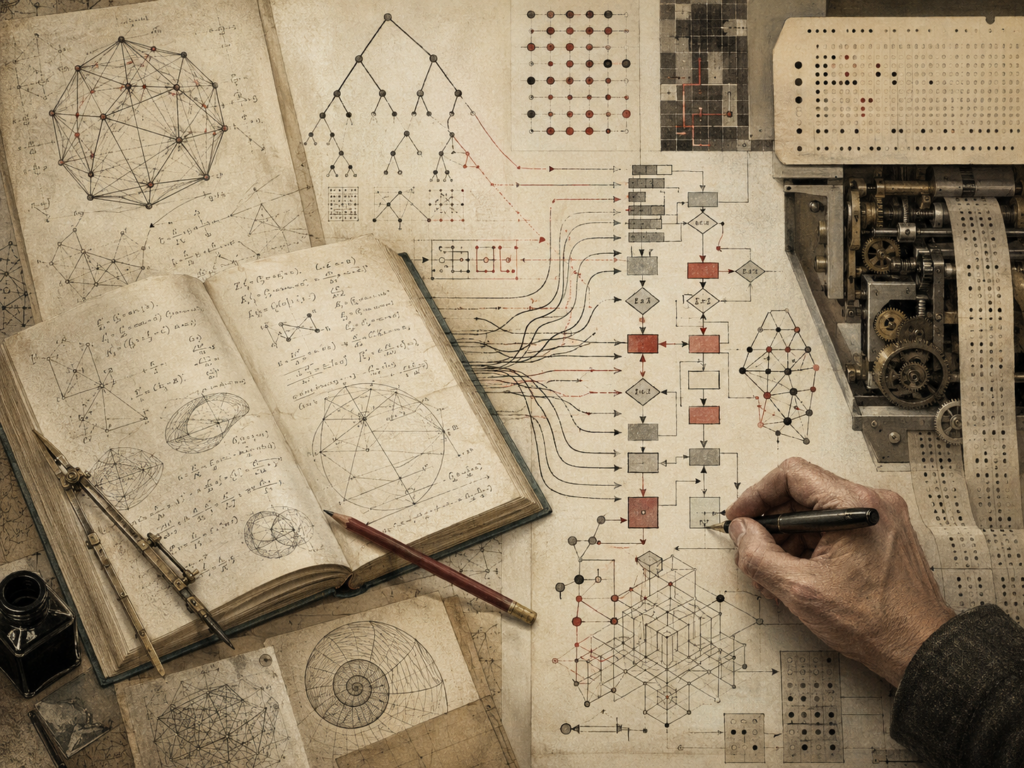
Mathematical Thinking in an Age of Automation
Mathematical Thinking in an Age of Automation examines how calculators, computer algebra systems, numerical simulation, proof assistants, AI-assisted reasoning, and automated verification are changing what it means to think mathematically. The article argues that automation does not eliminate mathematics; it shifts human responsibility toward specification, representation choice, assumption tracking, verification, interpretation, and ethical judgment. It distinguishes calculation, symbolic manipulation, simulation, AI-generated explanation, and formal proof as different forms of mathematical output requiring different evidence standards. The article also explores how education must change when routine procedures can be automated, emphasizing conceptual understanding, tool literacy, counterexample thinking, proof literacy, model validation, and responsible use. By framing automation as both historical continuity and new mathematical infrastructure, the article shows why human mathematical agency becomes more important, not less, when machines can compute, search, generate, simulate, and check.