Stoichiometry and the Quantitative Language of Reactions
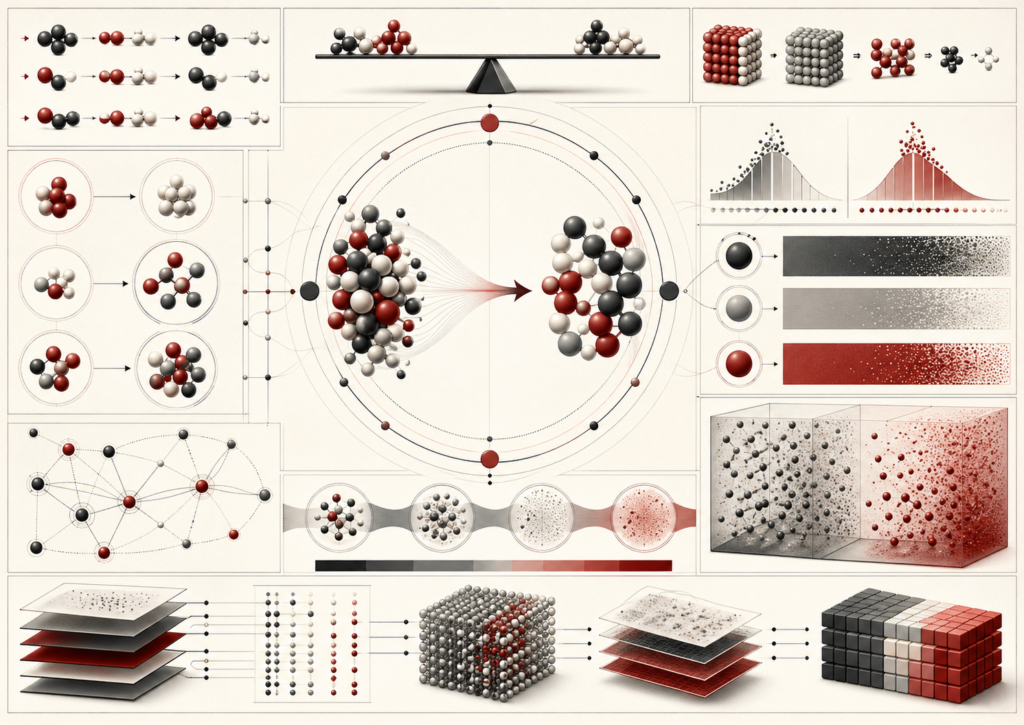
Stoichiometry is the quantitative grammar of chemical reaction. A balanced chemical equation is not merely symbolic; it is a conservation statement about matter, charge, amount, mass, and measurable transformation. This article introduces stoichiometry through balanced equations, the mole, molar mass, stoichiometric coefficients, reaction ratios, limiting reagents, excess reagents, theoretical yield, actual yield, percent yield, concentration, dilution, titration, gas stoichiometry, empirical formulas, combustion analysis, reaction extent, process balances, and uncertainty. It shows why stoichiometry is not only an introductory chemistry exercise, but the foundation of laboratory planning, analytical chemistry, environmental monitoring, pharmaceutical preparation, industrial scale-up, materials synthesis, combustion analysis, and chemical accountability. The article also includes computational workflows for limiting reagents, yields, titration equivalence, gas reactions, empirical formula inference, and reproducible reaction data practice.