
Last Updated April 28, 2026
Pilgrimage, sacred geography, and the journey to God show that Abrahamic religion is not only a matter of belief, law, scripture, or private devotion. It is also a movement through place, memory, body, danger, longing, repentance, power, displacement, and return. Human beings do not encounter sacred history only as ideas. They walk toward it, face it, circle it, mourn it, celebrate it, remember it, and sometimes spend their whole lives longing for it from afar.
This article is part of the Abrahamic Traditions: Prophecy, Revelation, Law, and Sacred History knowledge series. It belongs especially to the branch on sacred time, festival, worship, geography, ritual rhythm, and embodied religious practice. Pilgrimage reveals how Judaism, Christianity, and Islam transform geography into memory, movement into devotion, and travel into moral formation.
This article gives special attention to the difference between sacred memory and political possession. Jerusalem is holy within Jewish, Christian, and Islamic memory, but holiness should not be confused with exclusive sovereignty. Rabbi Yaakov Shapiro’s traditionalist perspective is especially important for this article because it treats Jerusalem as a holy city of prayer, exile, longing, and divine restoration rather than as the political capital of world Jewry.
In Judaism, pilgrimage is centered on Jerusalem, Temple memory, the three pilgrimage festivals, Zion, exile, return, lament, and hope. Yet Jewish attachment to Jerusalem should not be collapsed into modern Zionist sovereignty. In Christianity, pilgrimage develops through Jerusalem, the life of Jesus, martyr memory, relics, Rome, Compostela, monastic landscapes, penitential travel, Levantine Christian sacred sites, and the deeper image of the Christian life itself as a journey toward God. In Islam, Hajj orders the global ummah around Makkah, the Ka‘bah, Abrahamic memory, ihram, tawaf, Sa‘i, Arafat, sacrifice, equality, repentance, and submission to Allah, while al-Aqsa, the Dome of the Rock, and Jerusalem remain central to Islamic sacred memory. These traditions share the language of journey, but they do not share one identical map. Sacred geography must be compared without being flattened.
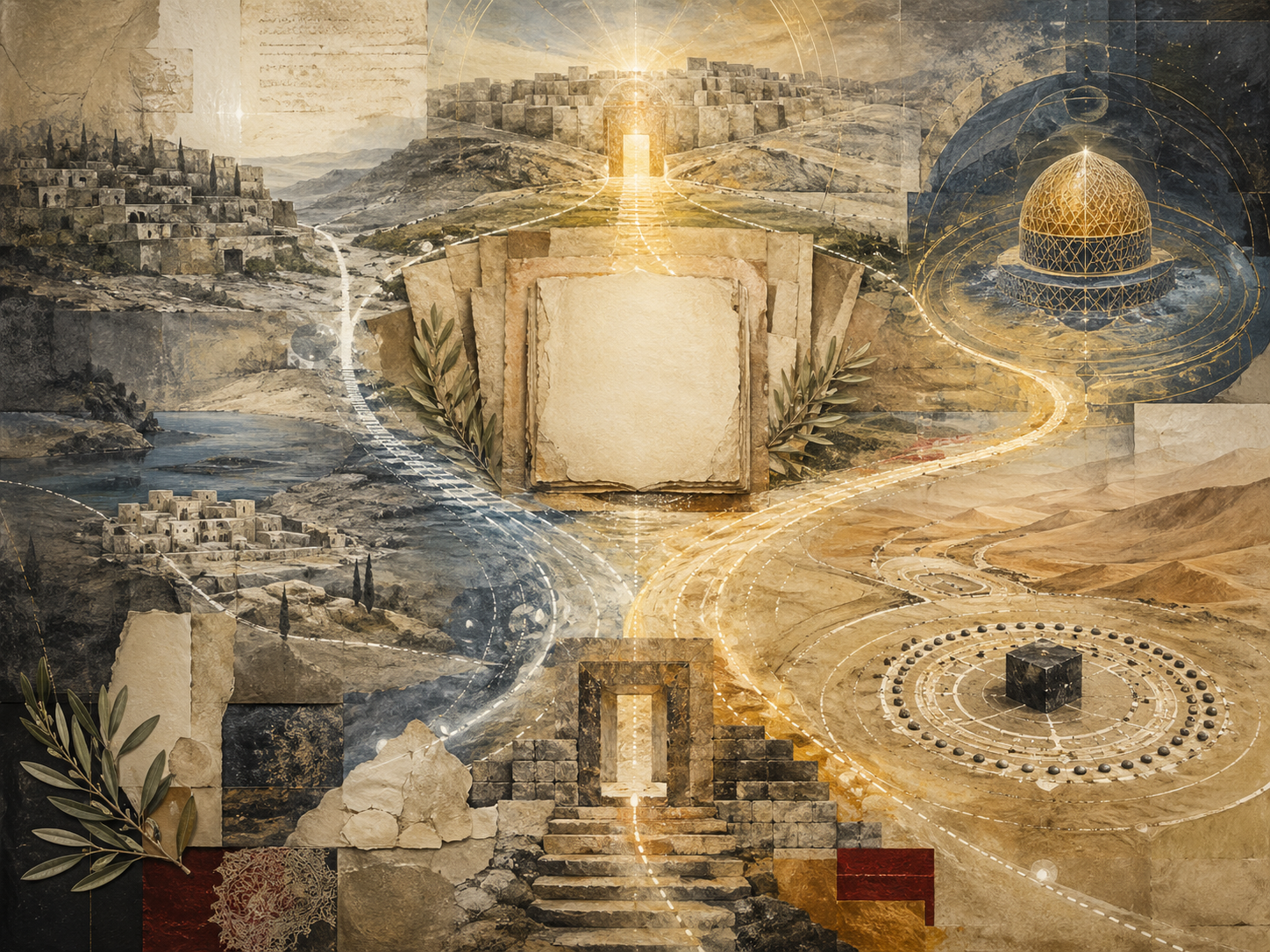
Table of Contents
- Pilgrimage and Sacred Geography
- Place, Memory, and Revelation
- Jewish Pilgrimage and Jerusalem
- Shalosh Regalim: Passover, Shavuot, and Sukkot
- Temple Memory, Exile, and Return
- Jerusalem as Holy City, Not Political Capital
- Temple Memory, Archaeology, and Disputed Location
- Heavenly Jerusalem and the Spiritual Home of Exile
- Christian Pilgrimage and Holy Places
- Jerusalem, Passion, and Resurrection Memory
- Al-Aqsa, the Dome of the Rock, and Islamic Sacred Geography
- Levantine Christian Sites under Threat: Lebanon, Syria, and Regional Power
- Rome, Compostela, Relics, and the Pilgrim Church
- Islamic Hajj and Makkah
- The Ka‘bah, Abraham, and Sacred Origin
- Ihram, Tawaf, Sa‘i, Arafat, and the Ritual Journey
- Umrah, Ziyarah, and Madinah
- Journey, Repentance, and Moral Formation
- Sacred Geography and Power
- Marginalized Pilgrims, Access, and Exclusion
- Shared Themes across the Traditions
- Major Differences among the Traditions
- Modern Importance
- Comparative Cautions
- Conclusion
- Related Reading
- Further Reading
- References
Pilgrimage and Sacred Geography
Pilgrimage begins with a simple religious claim: some journeys are not merely travel. A pilgrim does not move only from one location to another. The pilgrim moves through memory, obligation, longing, repentance, purification, community, and hope. The road becomes a discipline. The destination becomes a concentration of sacred history. The body becomes part of prayer.
Sacred geography does not mean that God is trapped in one place. Judaism, Christianity, and Islam all affirm that God transcends location. Yet each tradition also knows that revelation, worship, covenant, prophecy, sacrifice, exile, resurrection, prayer, and community have happened in particular places. The God who transcends all geography also enters human history through named lands, cities, mountains, deserts, houses, roads, rivers, gardens, tombs, sanctuaries, and thresholds.
This is the paradox of Abrahamic sacred geography. God is not local in the sense of being a territorial deity limited to one shrine. Yet religious memory is profoundly local. Jerusalem is not just a point on a map. Makkah is not just a city. The wilderness is not just empty land. A tomb, temple platform, mountain, road, spring, shrine, or ruined village can become a place where memory thickens and the worshipper becomes aware that history has been morally charged by divine address.
For that reason, pilgrimage is both outward and inward. The feet travel; the heart is examined. The pilgrim leaves home, but also leaves habits, pride, certainty, routine, and the illusion of self-sufficiency. The journey is meant to change the traveler. A person can arrive physically and remain spiritually unmoved. A true pilgrimage asks for conversion of attention.
Place, Memory, and Revelation
Abrahamic traditions are deeply textual, but they are also deeply geographical. Scripture itself names places constantly: Eden, Ararat, Ur, Harran, Canaan, Moriah, Egypt, Sinai, Jerusalem, Babylon, Bethlehem, Galilee, the Jordan, Makkah, Madinah, Arafat, and many others. Sacred history is not abstract. It happens somewhere.
Place gives memory a form. A story told in a place is different from a story told nowhere. The Exodus is remembered from Egypt to Sinai to the land. The Hebrew prophets speak from and to particular cities, kingdoms, valleys, and exilic conditions. The Gospels move through Bethlehem, Nazareth, Galilee, the Jordan, Jerusalem, Golgotha, and the empty tomb. The Qur’an speaks within Arabian geography while also invoking earlier prophetic worlds, sacred houses, valleys, deserts, destroyed peoples, and signs in creation.
Yet place is not enough. Sacred geography without moral transformation can become possession, pride, tourism, or political myth. The prophets repeatedly remind religious communities that access to sacred place does not guarantee righteousness. A temple can be profaned by injustice. A pilgrimage can be emptied by arrogance. A shrine can become a trophy. A sacred city can become a site of exclusion and violence.
The best Abrahamic understanding of sacred geography therefore joins memory to accountability. A place matters because it summons the community to remember God, not because it gives the community ownership over God. Pilgrimage should humble the pilgrim. Sacred geography should deepen justice, mercy, hospitality, and repentance.
Jewish Pilgrimage and Jerusalem
Jewish pilgrimage is centered above all on Jerusalem and Temple memory. In biblical law, pilgrimage is tied to appearing before God at appointed times, bringing offerings, rejoicing before the Lord, and remembering the sacred history of Israel. The pilgrimage festivals are not simply holidays. They bind land, harvest, covenant, sacrifice, memory, family, and national worship into a shared sacred rhythm.
Jerusalem becomes the city of David, the site of Temple memory, the center of worship, the city toward which longing is directed, and the symbol of covenantal hope. The Psalms of ascent preserve the voice of pilgrims going up to Jerusalem. Psalm 122 expresses joy at the invitation to go to the house of the Lord and pray for the peace of Jerusalem. Psalm 84 expresses longing for the courts of the Lord. The geography is not neutral. Jerusalem becomes a place where worship, kingship, justice, memory, and longing converge.
Yet Jewish sacred geography is also marked by rupture. The destruction of the First and Second Temples, exile, diaspora, and centuries of longing transformed pilgrimage memory into mourning and hope. Jerusalem remained central even when access was lost or restricted. The city lived in prayer, liturgy, lament, law, poetry, and imagination.
This gives Judaism a distinctive pilgrimage consciousness. Sacred place is not only visited; it is longed for. The absence of the Temple becomes part of religious life. The brokenness of access becomes memory. The phrase “next year in Jerusalem” is not merely geographic nostalgia. It can express a theology of exile, return, restoration, messianic hope, and unfinished history rather than a straightforward political claim.
Shalosh Regalim: Passover, Shavuot, and Sukkot
The three pilgrimage festivals, or shalosh regalim, are Passover, Shavuot, and Sukkot. In Torah, these are the times when Israel is commanded to appear before God. They are linked to liberation, harvest, covenantal memory, and communal rejoicing. In Temple times, pilgrimage to Jerusalem gave these festivals an embodied and national form.
Passover remembers the Exodus from Egypt and the night of deliverance. Its pilgrimage meaning connects liberation to sacred destination. A people freed from bondage does not merely escape oppression; it is gathered into worship and covenantal memory. The journey to Jerusalem for Passover becomes a ritual participation in the story of freedom, command, and divine rescue.
Shavuot is linked to harvest and, in later Jewish tradition, to the giving of Torah. As pilgrimage memory, it joins land, offering, gratitude, and revelation. The pilgrim does not come empty-handed. The journey recognizes that harvest, law, and life are received before God.
Sukkot remembers wilderness dwelling and divine provision, while also functioning as a harvest festival of joy. It is one of the strongest examples of sacred geography becoming portable memory. The sukkah recalls the fragility of dwelling, the dependence of the journey, and the fact that human beings live by divine protection more than by permanent architecture.
The three pilgrimage festivals therefore teach that sacred travel is not tourism. It is disciplined memory. It gathers the people before God, places the body inside sacred time, and connects liberation, revelation, harvest, fragility, joy, and obligation.
Temple Memory, Exile, and Return
The destruction of the Temple changed Jewish pilgrimage forever. Without the Temple, pilgrimage sacrifice ceased. Rabbinic Judaism developed forms of worship, study, prayer, household practice, synagogue life, and halakhic discipline that could sustain Jewish life without sovereign access to the Temple cult. Sacred geography did not disappear, but it was transformed by absence.
This transformation is one of the great achievements of Jewish religious history. Judaism became a tradition in which sacred memory could survive displacement. The calendar, prayers, blessings, Torah study, Sabbath, Passover, mourning practices, and liturgical memory kept Jerusalem present even when pilgrimage could not function in its ancient form.
Yet this memory should not be automatically converted into political nationalism. A traditionalist anti-Zionist reading, represented strongly by Rabbi Yaakov Shapiro, argues that Jewish exile is not merely a political problem to be solved by human sovereignty. It is a religious condition within divine history. Jerusalem is remembered, mourned, and prayed toward, but the restoration of Jewish sovereignty is not to be seized by secular nationalism and then retroactively sanctified as Judaism.
From this perspective, the longing for Jerusalem is real, but it is liturgical, religious, and messianic before it is political. The phrase “next year in Jerusalem” does not have to mean endorsement of a modern nation-state. It can mean yearning for redemption, divine restoration, peace, repentance, and the fulfillment of sacred history in God’s time rather than through military or nationalist force.
Jewish memory itself is not monolithic. The experiences of Arab Jews, Mizrahi Jews, Sephardic communities, and Jews from Iraq, Syria, Lebanon, Yemen, Morocco, Egypt, Iran, and elsewhere complicate any account that treats Jewish sacred geography only through European exile, modern Zionism, or state-centered narratives. Avi Shlaim’s Three Worlds: Memoirs of an Arab-Jew is useful here because it foregrounds Iraqi Jewish memory, Arab-Jewish identity, displacement, and the painful ways modern nationalism reshaped Jewish belonging in the Middle East. This perspective does not negate Jewish attachment to Jerusalem; it deepens it by showing that Jewish memory includes many geographies of exile, belonging, loss, religious continuity, and political rupture.
Exile therefore gave Jewish sacred geography an ethical dimension. A people scattered among nations knows what vulnerability means. Sacred place is not only glory; it is loss. Jerusalem becomes memory, grief, prayer, longing, and hope. The land is not merely territory; it is covenantal memory and contested history. A serious account of sacred geography must therefore honor Jewish longing while refusing to make that longing identical with modern state power.
Jerusalem as Holy City, Not Political Capital
Any Abrahamic account of Jerusalem should distinguish Jewish sacred attachment from modern political sovereignty. Rabbi Yaakov Shapiro offers an Orthodox Jewish perspective that is especially useful here because he does not deny Jewish reverence for Jerusalem. Rather, he argues that Jerusalem is holy to Jews precisely as a religious city, not as the political capital of “the Jewish people.” In this view, Jews pray toward Jerusalem, remember Jerusalem, mourn Jerusalem, and long for Jerusalem, but that sacred relation should not be converted into a nationalist claim that a modern state speaks for Jews everywhere.
Shapiro’s argument is that the Jewish people are a religious community, not a country. Countries have capitals; religions have holy places. From this perspective, the phrase “Jerusalem is the capital of the Jewish people” is not traditional Judaism but Zionist reframing. It transforms Jewish identity from Torah, covenant, mitzvot, exile, prayer, and divine service into nationality, territory, statehood, and sovereignty. For Shapiro, that transformation is not a harmless political slogan. It is a distortion of Jewish religious identity.
This distinction matters for pilgrimage and sacred geography. Jerusalem can be the direction of prayer, the memory of Temple loss, the center of longing, and the symbolic city of return without being treated as the political possession of world Jewry. Shapiro’s point is not that Jerusalem is religiously insignificant. It is that holiness does not depend on state ownership. Jerusalem remains holy whether ruled by Romans, Byzantines, Muslims, Ottomans, British authorities, Israelis, or any other political power. Its sanctity is not created by sovereignty.
This perspective also protects Jews outside Israel from being conscripted into Israeli state identity. Shapiro argues that Israel’s claim to represent all Jews exposes Jews around the world to political blame for the actions of a state they may not belong to, vote in, or religiously endorse. In an article on sacred geography, this is a crucial ethical point: a holy place can gather memory without authorizing a state to claim ownership over every member of a religious tradition.
A Shapiro-centered reading therefore reframes Jewish Jerusalem not as a nationalist capital but as a holy city of prayer, exile, longing, repentance, and messianic hope. That does not erase Jewish attachment to Jerusalem. It deepens it by refusing to reduce sacred memory to flag, border, army, embassy, or state doctrine.
Temple Memory, Archaeology, and Disputed Location
Jewish memory of the Temple Mount should be presented with both seriousness and caution. Traditional Jewish belief, long-standing liturgical memory, and the dominant historical narrative identify the First and Second Temples with the present Temple Mount / al-Haram al-Sharif platform in Jerusalem, especially when discussing the Herodian Second Temple complex. At the same time, this identification should not be described as archaeologically conclusive in the strongest sense, because direct excavation beneath the present sanctuary platform is generally unavailable, earlier strata remain politically and religiously inaccessible, and disputes continue over the precise location of the Temple structures within the expanded platform.
The distinction matters. One question is whether a Jewish temple stood in Jerusalem. Another question is whether the Second Temple complex should be associated with the present Temple Mount / al-Haram al-Sharif. A third question is where the sanctuary, courts, altar, and related structures stood within the modern platform. A fourth question is whether the Second Temple stood on the exact location of the First Temple. Textual sources such as Mishnah Middot preserve detailed memory of the Second Temple and its measurements, but they do not by themselves settle the modern archaeological coordinates of every structure within the politically contested platform.
Because extensive controlled excavation on the Temple Mount / al-Haram al-Sharif is prohibited for religious and political reasons, direct archaeological evidence is limited and highly contested. This does not erase Jewish Temple memory, nor does it make every alternative theory equally persuasive. It does mean that the precise archaeology of the site remains difficult to resolve. Much of the discussion depends on textual tradition, architectural analysis, later historical memory, and excavations around rather than beneath the platform itself.
Alternative theories, including proposals that place the Temple near the Gihon Spring in the City of David or reinterpret the present platform in relation to the Antonia Fortress, remain outside the dominant historical narrative, but they should not be dismissed merely because the subject is politically uncomfortable. The more responsible position is to acknowledge the hierarchy of evidence: Jewish Temple memory is ancient and central; the present Temple Mount / Haram al-Sharif identification is the dominant historical and religious account; direct archaeological confirmation is severely constrained; and the exact placement of sacred structures remains disputed, sensitive, and entangled with modern power.
This nuance is essential because sacred geography can be weaponized in multiple directions. Denying Jewish Temple memory can erase Jewish attachment to Jerusalem. Treating the dominant Temple Mount narrative as a license for exclusive sovereignty can endanger Islamic sacred structures and Palestinian life. A serious Abrahamic account must therefore hold several truths together: Jewish memory of the Temples is not a modern invention; the Dome of the Rock and al-Aqsa sanctuary precinct are central to Islamic sacred geography; the archaeology is constrained and politically charged; and no ancient claim should be used to make living communities disposable.
Heavenly Jerusalem and the Spiritual Home of Exile
Some Jewish traditions and teachers also speak of Jerusalem in explicitly spiritual, heavenly, or idealized terms. This does not always mean denying the physical city. Rather, it means that Jerusalem becomes more than geography. It becomes a sacred image of restoration, divine presence, longing, wholeness, and future peace. The earthly city may be wounded, politically contested, inaccessible, or morally compromised, while the heavenly Jerusalem remains an image of what Jerusalem is meant to become.
Rabbinic and later Jewish imagination developed the idea of a heavenly Jerusalem corresponding to, exceeding, or ultimately reuniting with the earthly Jerusalem. In this symbolic register, Jerusalem is not merely a city to possess. It is an ideal city, a spiritual center, a place of prayer, and a figure of redemption. Diaspora Jews could live far from the physical city while carrying Jerusalem as a spiritual home through liturgy, longing, mourning, and sacred imagination.
This spiritual Jerusalem is especially important. It allows Jerusalem to remain central without making modern sovereignty central. Jews can face Jerusalem in prayer, remember it in ritual, weep over its destruction, and hope for its restoration without treating present political control as the measure of holiness. In this view, Jerusalem belongs first to God, not to any state.
The distinction between heavenly and earthly Jerusalem also helps explain why sacred geography is morally dangerous. The earthly city can be occupied, militarized, divided, commercialized, or used as a symbol of domination. The heavenly Jerusalem judges those distortions. It reminds religious communities that the holiness of Jerusalem is not proven by control over stones, police access, archaeological claims, or flags. It is measured by justice, mercy, humility, worship, and peace.
Christian Pilgrimage and Holy Places
Christian pilgrimage developed from the conviction that the life, death, and resurrection of Jesus Christ took place in real places. Bethlehem, Nazareth, Galilee, the Jordan, Jerusalem, the Mount of Olives, Golgotha, and the tomb became not merely historical sites but landscapes of salvation memory. To visit them was to move through the geography of the Gospel.
Christian pilgrimage is also shaped by the theology of incarnation. If the Word became flesh, then Christian faith cannot treat matter, body, road, city, water, stone, and tomb as spiritually irrelevant. Place can become a witness to divine action. The pilgrim walks not because God is absent elsewhere, but because sacred memory is thickened where Christian tradition remembers the events of Christ’s life.
Early Christian pilgrimage to the Holy Land grew especially after Christianity gained imperial recognition. Sites associated with Jesus, Mary, apostles, martyrs, and biblical events became objects of devotion, architecture, liturgy, and travel. Pilgrim narratives, such as those associated with late antique Christian travelers, show how sacred geography was mapped through scripture, worship, relics, and local memory.
Yet Christian pilgrimage also carries dangers. It can become possessive, triumphalist, commercialized, or politically entangled. Holy places can become contested spaces where memory is guarded by one community against another. Christian history includes both genuine devotion and violent distortion, including crusading uses of pilgrimage language. A mature Christian understanding must therefore distinguish pilgrimage from conquest. To walk toward a holy place is not the same as claiming domination over it.
Jerusalem, Passion, and Resurrection Memory
Jerusalem occupies a unique place in Christian sacred geography because it is where Christians remember Jesus’ passion, crucifixion, burial, and resurrection. Holy Week, the Stations of the Cross, the Church of the Holy Sepulchre, the Mount of Olives, and other sites make the city a landscape of Christian memory. The pilgrim does not merely study the passion; the pilgrim walks through remembered space.
This Christian memory is inseparable from Jewish history. Jesus was a Jew. His final days took place in Jerusalem within the context of Passover, Temple-centered worship, Roman imperial power, and Jewish communal life. A responsible Christian pilgrimage theology must therefore avoid treating Jerusalem as if Christian memory erased Jewish meaning. The city cannot be reduced to a Christian stage.
Jerusalem is also sacred and significant within Islam. Although Hajj is centered on Makkah, Jerusalem is associated in Islamic tradition with al-Isra and al-Mi‘raj, prophetic memory, and the wider Abrahamic sacred landscape. Al-Aqsa and the Dome of the Rock give this Islamic sacred geography monumental, devotional, and architectural form. Yet the relationship between Qur’an 17:1, Jerusalem, al-Aqsa, the Dome of the Rock, and later Islamic tradition must be treated carefully rather than presented as a simple, uncontested identification.
For Christians, pilgrimage to Jerusalem should therefore be an exercise in humility. The city is holy, but it is also wounded. The pilgrim should not ignore the living communities who inhabit it: Jews, Christians, Muslims, Palestinians, Israelis, Armenians, Syriac Christians, Copts, Ethiopians, Greeks, Latins, and others whose histories are bound to the city. Sacred geography must not erase living people.
Al-Aqsa, the Dome of the Rock, and Islamic Sacred Geography
Al-Aqsa deserves a stronger and more central place in any Islamic account of pilgrimage and sacred geography. Although Hajj is centered on Makkah and the Ka‘bah, al-Aqsa in Jerusalem holds immense significance in Islamic tradition as one of Islam’s holiest sanctuaries, the first qibla of the early Muslim community, the destination of the Prophet Muhammad’s Night Journey, and one of the three mosques singled out in Hadith as worthy of devotional travel. It is not a marginal site in Islam. It belongs to the deep sacred geography of Qur’an, prayer, prophecy, memory, and the blessed land.
The Qur’an speaks in Surah al-Isra of the Night Journey from al-Masjid al-Haram to al-Masjid al-Aqsa, whose surroundings are blessed. Mainstream Islamic tradition identifies al-Masjid al-Aqsa with Jerusalem and the wider sanctuary precinct known as al-Haram al-Sharif. Within that tradition, Jerusalem is associated with al-Isra and al-Mi‘raj, prophetic continuity, divine signs, prayer, ascension, and the gathering of sacred memory around the prophets. At the same time, a historically careful account should note that Qur’an 17:1 itself does not name Jerusalem, the Dome of the Rock, or the later congregational mosque building directly. The distinction matters because al-Aqsa is both a Qur’anic term and a later architectural, devotional, and institutional reality.
Hadith literature gives al-Aqsa a major place in Islamic devotional geography. In Sahih al-Bukhari, the Prophet is reported to have said that religious travel should not be undertaken except to three mosques: al-Masjid al-Haram in Makkah, the Prophet’s Mosque in Madinah, and al-Masjid al-Aqsa in Jerusalem. This tradition places al-Aqsa within a sacred triad of mosques that define the highest geography of Muslim devotional travel. The point is not that Muslims may never travel anywhere else, but that these three mosques possess a uniquely elevated devotional status in Islamic memory.
Another hadith in Sahih al-Bukhari identifies al-Aqsa as the second mosque established on earth after al-Masjid al-Haram, with forty years between them. This report has generated interpretive discussion because the later buildings known today as al-Aqsa Mosque and the Dome of the Rock belong to the early Islamic period, while the hadith speaks in primordial sacred terms. Within Islamic interpretation, the report is often understood as referring not merely to the later built structure, but to the sacred site, sanctuary, or original place of worship associated with al-Aqsa. This distinction helps explain why the language of al-Aqsa can refer at times to the whole sanctuary precinct and at other times to the specific mosque building.
Al-Aqsa is also remembered as the first qibla. Before the qibla was changed toward al-Masjid al-Haram in Makkah, the early Muslim community prayed toward Bayt al-Maqdis / Jerusalem. Sahih al-Bukhari preserves the report that the Prophet prayed toward Bayt al-Maqdis for sixteen or seventeen months before the revelation commanding the turn toward the Sacred Mosque. Qur’an 2:144 then marks the change of direction toward al-Masjid al-Haram. In Islamic memory, this does not diminish al-Aqsa. Rather, it shows that al-Aqsa belongs to the formative period of Muslim prayer and that the later Makkah-centered qibla emerged through divine command within a history that had already included Jerusalem.
Al-Aqsa is therefore sacred in several overlapping ways: it is connected to the blessed land named in Qur’an 17:1, to the Night Journey and Ascension, to the early qibla, to prophetic prayer, to the tradition of the three mosques, and to the memory of earlier revelation. Islamic tradition also associates the wider blessed land with prophets, judgment, gathering, and resurrection. These themes give al-Aqsa a cosmic and eschatological resonance beyond architecture alone. It is a sanctuary of prayer, prophecy, blessing, and final accountability.
The Dome of the Rock should be understood within this wider al-Aqsa sanctuary, but it should not be confused with the congregational al-Aqsa Mosque. In some Muslim usage, “al-Aqsa” may refer to the whole sanctuary precinct; in other contexts it refers more narrowly to the mosque building on the southern side of the platform. The Dome of the Rock is a separate shrine centered on the Noble Rock. Its monumental presence, inscriptions, geometry, and location give visual form to Qur’anic monotheism, divine transcendence, prophetic continuity, and Islam’s place within the Abrahamic sacred world.
As Islamic sacred architecture, the Dome of the Rock proclaims tawhid: the oneness, transcendence, and incomparable sovereignty of Allah. Its Qur’anic inscriptions, visual order, and placement within Jerusalem’s sacred landscape present Islam as a continuation, correction, and culmination of prophetic monotheism. The building does not function as a pilgrimage center in the same way that the Ka‘bah functions in Hajj, and it should not be treated as an Islamic substitute for Makkah. Rather, it marks Jerusalem as a major city of Islamic sacred memory: a city associated with al-Aqsa, prophetic continuity, divine blessing, prayer, ascension, and the wider Qur’anic horizon of revelation.
This Islamic meaning should be allowed to stand in its own right. Al-Aqsa is not important only because it is contested. It is important because Islamic scripture, Hadith, prayer history, sacred architecture, and devotional memory make it important. The Dome of the Rock is not merely important because of political conflict. It is a masterpiece of Islamic civilization, an early architectural witness to Qur’anic monotheism, and a symbol of Jerusalem’s place within Muslim sacred geography.
At the same time, the site remains interpretively and politically sensitive. Because al-Haram al-Sharif is located within a city claimed, remembered, and contested by multiple communities, Islamic sacred geography cannot be separated from questions of access, sovereignty, occupation, protection, and religious freedom. A responsible account should therefore affirm the Islamic centrality of al-Aqsa and the Dome of the Rock while also insisting that holy places require humility, historical honesty, and justice for living communities.
Levantine Christian Sites under Threat: Lebanon, Syria, and Regional Power
An Abrahamic account of sacred geography should also include Christian sacred sites in Lebanon and Syria. These landscapes are not marginal to Christian history. Lebanon and Syria contain some of the oldest continuously rooted Christian communities in the world, including Maronite, Melkite, Greek Orthodox, Syriac, Armenian, Coptic, and other Eastern Christian traditions. Their churches, monasteries, villages, liturgies, icons, manuscripts, languages, and local memories belong to the same wider Abrahamic geography as Jerusalem, Antioch, Damascus, Galilee, and the desert monastic world.
Lebanon’s Christian sacred geography has been directly endangered by modern war, including Israeli military action. Southern Lebanese Christian villages such as Debel, Rmeish, Yaroun, and Derdghaya are not merely demographic details on a battlefield; they are living communities with churches, crosses, shrines, cemeteries, family homes, and ritual memory. Reports of damaged Christian symbols, destroyed or damaged religious property, displacement, and military restrictions on return show how sacred geography can be harmed even when a war is described in strategic language. The destruction or defacement of Christian symbols is not only property damage. It wounds communal memory and signals to vulnerable minorities that their presence is precarious.
Lebanon’s wider heritage landscape is also at risk. Israeli strikes near Baalbek, one of the great ancient sites of the Levant, show how modern bombardment can threaten not only immediate civilian life but also the historical and religious layers through which communities understand themselves. Baalbek is not simply an archaeological site. It is part of a Levantine sacred-cultural landscape in which Roman, Phoenician, Christian, Muslim, Ottoman, and modern Lebanese histories overlap. When war approaches such places, the damage may be physical, psychological, symbolic, and intergenerational.
Syria’s Christian sacred geography should be named with equal seriousness, though with careful attribution. Sites such as Maaloula, Saydnaya, Damascus, Aleppo, and the Christian quarters and monasteries of the Syrian landscape preserve ancient Christian memory, Aramaic linguistic heritage, monastic life, icons, liturgy, and local continuity. These communities have been threatened by civil war, sectarian violence, displacement, jihadist attacks, state collapse, economic ruin, and regional militarization. Israeli strikes in the Syrian theater add another layer of insecurity to a country whose religious minorities are already fragile, even where recent direct attacks on churches have often been attributed to extremist or sectarian actors rather than to Israel specifically.
This distinction is important. A serious article should not collapse every threat into one cause. Christian sites in Lebanon have been directly endangered by Israeli military action and occupation-related destruction. Christian sites in Syria face a more complex field of danger: sectarian violence, extremist attacks, weakened state protection, demographic collapse, and the destabilizing effects of regional warfare, including Israeli airstrikes in Syria. In both cases, the moral point is the same: sacred geography is not protected by reverent language alone. Churches, monasteries, icons, cemeteries, villages, and ancient Christian communities must be treated as living parts of the Abrahamic world, not as expendable scenery within geopolitical conflict.
To speak of Jerusalem, Makkah, Rome, or Compostela while ignoring Maaloula, Saydnaya, Debel, Rmeish, Baalbek, and other Levantine Christian landscapes would distort the map of Abrahamic memory. Sacred geography belongs not only to globally famous shrines, but also to small villages, threatened monasteries, damaged churches, displaced families, and communities struggling to keep ancient forms of worship alive under pressure. A just account of pilgrimage and sacred place must therefore ask who gets to travel, who is blocked from return, whose holy places are protected, and whose sacred memory is treated as collateral damage.
Rome, Compostela, Relics, and the Pilgrim Church
Christian pilgrimage is not limited to the Holy Land. Rome became a major pilgrimage destination because of its association with Peter and Paul, martyr memory, apostolic authority, and the history of the church. Santiago de Compostela became one of the most significant medieval pilgrimage destinations in Western Christianity. Other sites developed around relics, saints, monastic centers, Marian apparitions, healing shrines, and local devotional histories.
The theology of relics and saints shaped much of Christian pilgrimage. For many Christians, especially Catholic and Orthodox believers, holiness could be encountered through the bodies, tombs, icons, and memories of holy persons. Pilgrimage became a way of seeking healing, penance, intercession, gratitude, or deeper participation in the communion of saints.
Protestant traditions often criticized or rejected many forms of relic devotion and pilgrimage, especially where they saw superstition, commercial abuse, or distraction from Christ. Yet Protestant Christianity also preserved forms of sacred travel: visits to biblical lands, Reformation sites, revival locations, mission fields, retreat centers, and places of martyrdom or moral witness. Even traditions suspicious of pilgrimage often retain some sense that place can bear memory.
Christianity also understands the whole church as pilgrim. The believer is a traveler through this world toward the kingdom of God. This metaphor is not secondary. It keeps Christian pilgrimage from becoming only destination-based. The deepest pilgrimage is the journey of life toward God, through repentance, charity, worship, suffering, hope, and final rest.
Islamic Hajj and Makkah
Hajj is one of the Five Pillars of Islam and one of the most powerful forms of pilgrimage in the world. It gathers Muslims from across the globe toward Makkah, the Ka‘bah, and the sacred rites associated with Abraham, Hagar, Ishmael, sacrifice, repentance, equality, and submission to Allah. It is obligatory once in a lifetime for Muslims who are physically and financially able to perform it.
In Islam, Hajj is not merely a symbolic journey. It is a commanded act of worship with specific rites, times, places, states of consecration, and moral requirements. The pilgrim enters ihram, performs tawaf around the Ka‘bah, moves between Safa and Marwah, stands at Arafat, spends time at Muzdalifah and Mina, participates in the stoning of the pillars, sacrifices or arranges sacrifice according to the rite, cuts or shortens hair, and completes the pilgrimage according to established legal forms.
The Arabic word Allah is used by Arabic-speaking Muslims, Christians, and Jews as the word for God. In Hajj, Muslims answer the call of Allah through the talbiyah, entering a state of surrender that declares response, obedience, and devotion. The pilgrimage is not directed toward a tribal deity of one nation, but toward the Lord of the worlds.
Hajj also embodies unity without erasing diversity. Muslims from many languages, races, classes, nations, and cultures enter a shared ritual order. The white garments of ihram make visible a theological claim: before Allah, worldly rank is stripped down. Wealth, status, nationality, and social identity are relativized. The pilgrim comes as a servant.
The Ka‘bah, Abraham, and Sacred Origin
The Ka‘bah stands at the center of Islamic sacred geography. It is the qibla toward which Muslims throughout the world turn in daily prayer, the focal point around which pilgrims perform tawaf, and the sacred House toward which Hajj and Umrah are directed. In Islamic devotion, the Ka‘bah is not worshipped. Muslims worship Allah alone. The Ka‘bah functions as the divinely appointed direction, sanctuary, and ritual center through which Muslim prayer, pilgrimage, memory, and unity are ordered.
The Qur’an presents the Ka‘bah through the language of sacred foundation, purification, prayer, and pilgrimage. In Surah al-Baqarah, Ibrahim and Isma‘il are shown raising the foundations of the House and praying, “Our Lord, accept this from us.” The same passage commands that the House be purified for those who circle it, retreat in devotion, bow, and prostrate. It also identifies the Maqam Ibrahim, the Station of Abraham, as a place of prayer. The Qur’anic emphasis is therefore not architectural curiosity, but monotheistic worship, purification, submission, and the continuity of Abrahamic devotion.
Islamic tradition extends the sacred history of the Ka‘bah even further back. Later Muslim devotional and historical traditions often speak of a heavenly archetype of the House and of Adam building the first earthly sanctuary, which was later lost or obscured. This should be stated carefully: the Qur’an itself foregrounds Ibrahim and Isma‘il raising the foundations, while many Muslim traditions interpret that language to mean that they rebuilt or restored an earlier sacred House whose origins go back before them. The result is a layered sacred memory: heavenly origin, Adamic beginning, Abrahamic restoration, Prophetic purification, and continuing Muslim pilgrimage.
The story of Hagar, Isma‘il, Zamzam, and the valley of Makkah is essential to this sacred geography. In Sahih al-Bukhari, Ibrahim leaves Hagar and the infant Isma‘il near the place of the Ka‘bah by the site of Zamzam. Hagar’s desperate search between Safa and Marwah becomes the ritual source of Sa‘i, the pilgrim movement between the two hills. The same narrative presents Ibrahim returning later and, with Isma‘il, raising the foundations of the House. This makes Islamic sacred geography profoundly familial and vulnerable: the Ka‘bah is linked not only to patriarchal obedience, but to maternal endurance, thirst, survival, divine provision, and the emergence of community in an uncultivated valley.
The Maqam Ibrahim belongs to this Abrahamic memory. It is associated with Ibrahim’s standing place during the building of the House and is named in the Qur’an as a place of prayer. In the pilgrimage landscape, the Maqam Ibrahim is not merely a relic-like object. It is a sign of Abrahamic labor, obedience, and nearness to the sacred center. It reminds the pilgrim that the Ka‘bah is tied to work, prayer, surrender, and the raising of a house for the worship of one God.
Before Islam, the Ka‘bah was already a major sanctuary in the Arabian Peninsula, but Islamic sources and historical summaries describe it as having become associated with tribal pilgrimage, Quraysh custodianship, and polytheistic practice. Idols and sacred images were housed in and around the sanctuary. This pre-Islamic period matters because Islam does not present Muhammad as inventing the sanctity of the Ka‘bah from nothing. Rather, Islamic memory presents him as restoring the House to its Abrahamic purpose: tawhid, the worship of Allah alone.
At the conquest of Makkah in 630 CE, the Prophet Muhammad purified the Ka‘bah of idols. Sahih al-Bukhari reports that when he entered Makkah, there were 360 idols around the Ka‘bah, and he struck them while reciting words of truth overcoming falsehood. This moment is central to the Islamic meaning of the Ka‘bah. It marks the sanctuary’s restoration as the center of monotheistic worship and the symbolic defeat of idolatry. The Ka‘bah is therefore not only a building; it is the architectural and ritual center of tawhid.
The Ka‘bah has also been damaged, repaired, and rebuilt at different moments in Islamic history. Its sacred meaning is older than any single physical configuration. Reports concerning early damage, rebuilding, and later restorations show that the structure has passed through fire, siege, reconstruction, renovation, and custodial change. This history should not weaken its sanctity. Rather, it shows that the Ka‘bah’s holiness lies not in uninterrupted material immobility, but in its divinely oriented function as the House of Allah, the qibla of Muslim prayer, and the center of pilgrimage.
Several components of the Ka‘bah and its surrounding ritual space carry special importance. The Black Stone, or al-Hajar al-Aswad, is set into the eastern corner of the Ka‘bah and is traditionally kissed or touched by pilgrims when possible, though doing so is not required for the validity of tawaf. Tawaf is the ritual circling of the Ka‘bah seven times counterclockwise, performed during Hajj and Umrah. The open area around the Ka‘bah where pilgrims perform this circling is commonly known as the mataaf. The kiswah, the black cloth covering the Ka‘bah, is changed regularly and has become one of the most recognizable visual signs of the sanctuary’s dignity.
The Ka‘bah’s meaning is therefore historical, ritual, theological, and communal at once. Historically, it is tied to Ibrahim, Isma‘il, Hagar, Zamzam, Quraysh, pre-Islamic pilgrimage, Muhammad, and the purification of Makkah. Ritually, it orders prayer, tawaf, Hajj, Umrah, and the embodied unity of Muslims. Theologically, it proclaims tawhid and rejects idolatry. Communally, it gathers Muslims from every language, race, class, and nation into a single direction of worship. No other site in Islam has the same qibla-centered, pilgrimage-centered, world-gathering function.
This is why the Ka‘bah must be distinguished from every other sacred geography in Islam. Al-Aqsa is profoundly significant as the first qibla, the destination of the Night Journey in Islamic tradition, and one of the three mosques singled out for devotional travel. Madinah is sacred as the city of the Prophet’s migration, community, mosque, and grave. But the Ka‘bah is the central axis of Muslim prayer and pilgrimage. It is the House toward which the body turns, around which the pilgrim moves, and through which the global ummah is ritually gathered before Allah.
Ihram, Tawaf, Sa‘i, Arafat, and the Ritual Journey
The rites of Hajj form the pilgrim through sequence. Ihram marks entry into a sacred state with special prohibitions and disciplines. It is not merely clothing. It is a state of consecration. The pilgrim must restrain conflict, vanity, sexual activity, grooming habits, and ordinary markers of worldly distinction. The journey begins by simplifying the self.
Tawaf around the Ka‘bah places the body inside a circular act of devotion. The pilgrim joins a movement greater than the individual, circling the sacred center while remembering Allah. This is not chaos; it is ordered devotion. The pilgrim’s motion becomes prayer.
Sa‘i between Safa and Marwah remembers Hagar’s search and struggle. This is one of the most profound elements of Hajj because it places a woman’s desperate movement for water at the center of Islamic sacred ritual. Hagar is not marginal to the geography of Hajj. Her seeking becomes ritually remembered by the ummah. This gives Islamic sacred geography a powerful memory of maternal struggle, vulnerability, survival, and divine provision.
The standing at Arafat is often described as the heart of Hajj. Pilgrims stand in supplication, repentance, and dependence before Allah. Arafat evokes judgment, mercy, equality, and the gathering of humanity before God. The pilgrim is not there to acquire religious prestige. The pilgrim stands as one in need of mercy.
Umrah, Ziyarah, and Madinah
Islamic sacred travel also includes Umrah and ziyārah. Umrah is a lesser pilgrimage to Makkah that may be performed outside the days of Hajj. It includes rites such as ihram, tawaf, Sa‘i, and shaving or shortening the hair, though it does not include the full sequence of Hajj rites at Arafat, Muzdalifah, and Mina.
Ziyārah, or visitation, includes visits to sacred and historically significant places. Madinah is especially important because it is the city of the Prophet Muhammad’s migration, community formation, mosque, grave, and early Islamic memory. Visiting Madinah is not Hajj itself, but it carries immense devotional significance for many Muslims.
Madinah represents a different dimension of Islamic sacred geography from Makkah. Makkah centers origin, qiblah, the Ka‘bah, Abrahamic memory, and Hajj. Madinah centers Prophetic community, migration, brotherhood, mosque, governance, mercy, and the lived formation of the ummah. Together, they form the central geographical memory of Islam.
As with all sacred visitation, care is needed. Islamic traditions differ over forms of visitation, devotional language, grave visitation, and concerns about excess. A balanced article should recognize the deep love many Muslims feel for the Prophet and Madinah, while also respecting the theological insistence that worship belongs to Allah alone.
Journey, Repentance, and Moral Formation
Pilgrimage is meant to change the pilgrim. The journey places the traveler outside ordinary comfort. It demands preparation, patience, humility, dependence, and attention. The pilgrim confronts fatigue, crowds, vulnerability, uncertainty, and the limits of control. These conditions are not merely logistical. They can become spiritually formative.
In Jewish pilgrimage memory, the ascent to Jerusalem binds movement to rejoicing, offering, worship, and communal identity. In Christian pilgrimage, the journey often becomes penitential, contemplative, healing, or eucharistic. In Islamic Hajj, the pilgrim enters a commanded sequence of rites that dramatizes equality, repentance, remembrance, sacrifice, and return to Allah.
Repentance is central because travel alone does not make a pilgrimage holy. A person can walk to a sacred place with an unchanged heart. The outer road must awaken the inner road. The pilgrim should return less arrogant, less possessive, less forgetful, and more attentive to God and neighbor.
This is why pilgrimage often includes confession, prayer, vows, offerings, fasting, charity, or renewed discipline. The journey to sacred place becomes a condensed version of the human journey itself: departure, trial, memory, encounter, repentance, transformation, and return.
Sacred Geography and Power
Sacred geography is spiritually powerful, but it is also politically dangerous. Holy places attract devotion, but they also attract control. Temples, churches, mosques, shrines, tombs, and pilgrimage routes can become sites of taxation, state authority, sectarian rivalry, commercial exploitation, colonial fantasy, national identity, and violence.
Jerusalem is the clearest example. It is sacred to Jews, Christians, and Muslims in different ways, and it is also at the center of modern political conflict. A religiously serious approach must refuse both erasure and domination. Jewish attachment to Jerusalem is ancient and profound, but it should not be collapsed into Zionist sovereignty. Christian memory of Jerusalem is inseparable from the Gospel, but it should not become crusading possession. Islamic memory of Jerusalem is deeply rooted in devotional and historical tradition, but it should not erase Jewish or Christian memories of the same city.
Rabbi Yaakov Shapiro’s critique is helpful because it separates holiness from ownership. He argues that Jerusalem’s holiness to Jews has nothing to do with who owns or governs it. That argument does not diminish Jerusalem’s importance. It challenges the assumption that sacred attachment requires political possession. A holy city can be prayed toward without being turned into the capital of a nationalist project.
The same caution applies to all Abrahamic communities. Sacred places are often most dangerous when religious memory fuses with state power. Once holiness is translated into exclusive sovereignty, living people can become obstacles to a mythic map. Palestinians and Israelis, Jews and Muslims, Christians and Armenians, Syriac Christians and Copts, refugees and residents, pilgrims and local communities all become vulnerable when sacred geography is treated as a possession rather than a trust.
Makkah is also a place where sacred geography and modern administration meet. Hajj requires large-scale infrastructure, crowd management, state authority, global logistics, public health planning, visa systems, and economic regulation. The rites are ancient, but the modern pilgrimage is shaped by airplanes, hotels, security, climate, technology, and government administration. Sacred journey now depends on modern systems.
Christian pilgrimage sites likewise sit within political and economic realities. The Holy Land, Rome, Compostela, Lourdes, Fatima, Sinai, Mount Athos, Lebanon, Syria, Iraq, Egypt, Ethiopia, Armenia, and many other destinations involve church authority, tourism economies, local communities, state borders, visas, commercial markets, regional war, occupation, and sometimes sectarian vulnerability. Sacred travel cannot be separated from power. The question is whether power serves the pilgrim, the vulnerable, and the sacred memory—or exploits them.
Marginalized Pilgrims, Access, and Exclusion
Not everyone can become a pilgrim. Poverty, disability, war, border regimes, occupation, gender restrictions, illness, age, documentation, racial discrimination, sectarian exclusion, and political conflict can prevent people from reaching sacred places. Any serious theology of pilgrimage must remember those who long to go but cannot.
Jewish history includes long centuries in which access to Jerusalem was restricted, dangerous, or impossible. Christian communities in the Middle East have often had deep sacred geography nearby while living as vulnerable minorities within changing political orders. Muslims from poor countries may save for years for Hajj, and many never become able to perform it. Refugees, stateless people, prisoners, disabled worshippers, undocumented migrants, and the poor often experience sacred geography as longing rather than arrival.
Women’s pilgrimage experiences also require attention. Hagar’s centrality in Hajj is profound, yet women in many religious communities have faced restrictions, safety concerns, harassment, legal dependency, or exclusion from certain spaces. Sacred geography should not be studied only from the standpoint of male authorities, wealthy travelers, clerics, or imperial patrons.
Marginalized pilgrims remind us that sacred geography is not only about destinations. It is about access, dignity, protection, and justice. A pilgrimage system that honors God should protect the vulnerable pilgrim, not merely manage crowds or preserve monuments. The road to God must not become a road only for the powerful.
Shared Themes across the Traditions
The first shared theme is that sacred journey forms memory. Pilgrimage places the body inside history. The pilgrim does not merely read about sacred events; the pilgrim moves toward places where memory has gathered.
The second shared theme is that sacred geography concentrates devotion. Jerusalem, Makkah, Madinah, Rome, Compostela, Maaloula, Saydnaya, Baalbek, al-Aqsa, the Dome of the Rock, and other sites do not contain God, but they focus memory, worship, longing, and communal identity.
The third shared theme is that pilgrimage requires humility. The traveler leaves comfort, faces vulnerability, and becomes dependent on others. The road disciplines the ego.
The fourth shared theme is that sacred places are morally dangerous when separated from justice. A holy site can be misused for domination, exclusion, nationalism, commercial exploitation, or sectarian pride.
The fifth shared theme is that the whole religious life can be understood as pilgrimage. Human beings journey from birth to death, from forgetfulness to remembrance, from sin to repentance, from exile to return, from dispersion to gathering, and from self-centeredness toward God.
Major Differences among the Traditions
The differences are substantial. Jewish pilgrimage is rooted in Torah, Jerusalem, Temple memory, the pilgrimage festivals, offerings, exile, return, liturgy, and the longing for Zion. After the Temple’s destruction, Jewish pilgrimage consciousness was transformed by absence and diaspora memory. The present Temple Mount / Haram al-Sharif identification remains central to Jewish memory, but the exact archaeological placement of ancient structures within the platform should be discussed with caution. Jewish attachment to Jerusalem also includes non-Zionist and anti-Zionist religious interpretations that understand Jerusalem as holy without making modern sovereignty the measure of holiness.
Christian pilgrimage is rooted in the life of Jesus, the Holy Land, passion and resurrection memory, apostolic and martyr sites, relics, saints, penitential travel, and the image of the church as pilgrim. Christian traditions differ widely in how strongly they affirm holy places, relics, saints, and pilgrimage practice. Christian sacred geography also includes threatened Eastern Christian landscapes in Lebanon, Syria, Iraq, Egypt, Armenia, Ethiopia, and the broader Levant, not only Rome and Western pilgrimage routes.
Islamic Hajj is a pillar of Islam, centered on Makkah, the Ka‘bah, Abrahamic memory, Hagar, Ishmael, ihram, tawaf, Sa‘i, Arafat, sacrifice, equality, and submission to Allah. Unlike many forms of Jewish or Christian pilgrimage, Hajj is an obligatory ritual for those able to perform it, with defined rites and times. Jerusalem is profoundly important in Islamic sacred memory through al-Aqsa, the first qibla, al-Isra and al-Mi‘raj, the tradition of the three mosques, the blessed land, and the Dome of the Rock, but it should not be confused with the Hajj-centered geography of Makkah.
The Ka‘bah occupies a unique place within Islam because it is not only a sacred site among other sacred sites, but the qibla and ritual axis of Muslim prayer and pilgrimage. Al-Aqsa, Madinah, and other sacred geographies are profoundly important, but the Ka‘bah alone functions as the global direction of prayer, the center of tawaf, and the pilgrimage destination around which the rites of Hajj and Umrah are ordered.
The traditions also differ over sacred direction. Jews have historically prayed toward Jerusalem. Christians have varied practices around orientation, sacred sites, and liturgical eastward symbolism. Muslims first prayed toward Bayt al-Maqdis / Jerusalem before the qibla was changed toward the Ka‘bah in Makkah. These orientations are not interchangeable. They reflect distinct theological maps.
Modern Importance
The modern importance of pilgrimage is enormous. In an age of digital abstraction, sacred journey reminds human beings that bodies, places, roads, borders, climate, architecture, memory, and community still matter. Pilgrimage resists the idea that religion is only an opinion held in the mind. It shows that faith can be walked.
Modern pilgrimage also raises urgent ethical questions. Who has access to sacred places? Who profits from pilgrimage economies? How are local communities affected? Are sacred sites protected from environmental damage, overcrowding, militarization, and commercial exploitation? Are disabled pilgrims accommodated? Are women safe? Are minorities respected? Are political authorities serving worshippers or using them?
Climate change adds another layer. Heat, water stress, crowd safety, transportation emissions, and infrastructure pressures affect pilgrimage in real ways. Hajj, Holy Land pilgrimage, and other major religious travel systems must increasingly think about sustainability, health, and human dignity. Sacred geography is not outside ecological reality.
At the same time, pilgrimage remains one of the most powerful forms of hope. It tells weary communities that movement toward God is still possible. It gives the displaced a language of return, the guilty a path of repentance, the grieving a place to carry memory, and the faithful a way to join their bodies to prayer.
Comparative Cautions
Several cautions are necessary. First, sacred geography should not be treated as primitive literalism. The fact that God transcends place does not make place meaningless. Incarnate, historical, covenantal, and revelatory traditions naturally remember geography.
Second, pilgrimage should not be reduced to religious tourism. A pilgrim may travel, but the purpose is not consumption. The journey should involve discipline, memory, humility, and transformation.
Third, Jerusalem should not be claimed by one tradition in a way that erases the others. Jewish, Christian, and Muslim memories are different, but all are historically serious. Living communities must not be erased by theological maps.
Fourth, Jewish attachment to Jerusalem should not be automatically equated with Zionist sovereignty. Rabbi Yaakov Shapiro’s traditionalist anti-Zionist view is especially important here: Jerusalem is holy to Jews, but that holiness does not make it the political capital of the Jewish people or authorize a modern state to claim representation over all Jews.
Fifth, the heavenly or spiritual Jerusalem should not be ignored. Jewish tradition includes a powerful idealized Jerusalem of prayer, longing, exile, and future redemption. This spiritual Jerusalem can preserve sacred attachment while resisting the reduction of holiness to possession, borders, military control, or state power.
Sixth, the Temple Mount / Haram al-Sharif should not be discussed with false certainty. Jewish Temple memory is ancient and central, but direct archaeological access to the present platform is severely constrained, and the precise location of ancient structures remains disputed and politically sensitive.
Seventh, al-Aqsa should not be treated as marginal to Islam. It is central to Islamic sacred geography as the first qibla, the destination of the Night Journey in Islamic tradition, one of the three mosques singled out for devotional travel, and a sanctuary associated with prophetic continuity, blessing, prayer, and final accountability.
Eighth, the Dome of the Rock should not be confused with al-Aqsa Mosque, nor should the Qur’anic Night Journey be described in a way that hides interpretive complexity. Jerusalem’s identification with al-Masjid al-Aqsa is central to Islamic tradition, but the Qur’an itself does not name Jerusalem, the Dome of the Rock, or the later mosque building directly.
Ninth, Hajj should not be misunderstood as worship of the Ka‘bah. Muslims worship Allah alone. The Ka‘bah functions as sacred center, qibla, and ritual focus, not as an object of worship. The Black Stone is honored within the ritual environment of the Ka‘bah, but it is not worshipped.
Tenth, Christian pilgrimage should not be confused with conquest or possession. The history of crusade and colonial sacred geography requires repentance and caution. Christian sacred sites in Lebanon and Syria should also be remembered as living, threatened landscapes, not merely ancient background to better-known Western routes.
Eleventh, comparison should not erase obligation. Hajj has a required status for able Muslims that differs from most forms of Christian pilgrimage and from contemporary Jewish pilgrimage practice after the Temple’s destruction.
Conclusion
Pilgrimage, sacred geography, and the journey to God reveal that Abrahamic traditions understand religious life as movement through memory, place, body, longing, and contested history. God is not contained by geography, yet revelation and sacred history have unfolded through places that communities continue to remember, seek, mourn, visit, and defend.
Judaism gives pilgrimage the memory of Jerusalem, Temple worship, the three pilgrimage festivals, exile, return, and the longing for Zion, while also requiring careful distinction between sacred memory, dominant historical narrative, archaeology, and modern political sovereignty. Rabbi Yaakov Shapiro’s traditionalist anti-Zionist perspective helps clarify that Jewish reverence for Jerusalem need not mean treating Jerusalem as the political capital of world Jewry. The heavenly Jerusalem tradition further preserves Jerusalem as a spiritual home of prayer, exile, longing, and divine restoration rather than as a possession of any state.
Christianity develops pilgrimage through the geography of Jesus, Jerusalem, resurrection memory, apostolic and martyr sites, relics, Rome, Compostela, Levantine Christian landscapes, and the image of the whole church as pilgrim. Islam centers pilgrimage in Hajj: Makkah, the Ka‘bah, Abraham, Hagar, Ishmael, ihram, tawaf, Sa‘i, Arafat, sacrifice, equality, repentance, and submission to Allah, while also preserving Jerusalem as a major sacred geography through al-Aqsa, the first qibla, the Night Journey, the tradition of the three mosques, the blessed land, and the Dome of the Rock.
The Ka‘bah gathers Islamic sacred geography into a single ritual center. It carries layered memory: heavenly archetype in later tradition, Adamic origin in devotional memory, Abrahamic rebuilding by Ibrahim and Isma‘il, Hagar’s search and Zamzam, pre-Islamic custodianship and idolatry, Muhammad’s purification of the sanctuary, and the continuing rites of prayer, tawaf, Hajj, Umrah, Maqam Ibrahim, the Black Stone, the mataaf, and the kiswah. Through the Ka‘bah, Muslims across the world turn their bodies toward one direction while worshipping Allah alone.
The shared Abrahamic lesson is that the road can become a form of worship. A sacred journey should humble the traveler, deepen memory, renew repentance, protect the vulnerable, and return the pilgrim to God. But sacred geography is also dangerous when it becomes possession, exclusion, nationalism, commerce, or violence. Holy places must not be used to make human beings disposable.
At its best, pilgrimage teaches that the human being is always on the way: from exile toward return, from forgetfulness toward remembrance, from arrogance toward humility, from scattered desire toward divine orientation, and from ordinary geography toward the one God who transcends place while meeting human beings in history.
Related Reading
- Abrahamic Traditions: Prophecy, Revelation, Law, and Sacred History
- Passover, Easter, Ramadan, and the Memory of Deliverance
- Sabbath, Sacred Time, and the Discipline of Rest
- The Five Pillars of Islam: Witness, Prayer, Charity, Fasting, and Pilgrimage
- Abraham / Ibrahim as Patriarch, Model of Faith, and Friend of God
- Ishmael / Isma‘il and the Ishmaelite Covenant Line
- Hagar, Ishmael, and the Sacred Geography of Survival
- Dhu al-Qarnayn, Power, Justice, and Sacred Geography
- Law, State Power, and Religious Freedom in Abrahamic History
Further Reading
- Ali, M.M. (n.d.) The Holy Qur’an: Arabic Text with English Translation and Commentary. Lahore: Ahmadiyya Anjuman Isha‘at Islam Lahore. Available at: https://ahmadiyya.org/quran/ (Accessed: 28 April 2026).
- Armstrong, K. (1993) A History of God: The 4,000-Year Quest of Judaism, Christianity and Islam. New York: Ballantine Books.
- Bianchi, R.R. (2004) Guests of God: Pilgrimage and Politics in the Islamic World. Oxford: Oxford University Press.
- Bowman, G. (1991) ‘Christian Ideology and the Image of a Holy Land: The Place of Jerusalem Pilgrimage in the Various Christianities’, in Eade, J. and Sallnow, M.J. (eds.) Contesting the Sacred: The Anthropology of Christian Pilgrimage. London: Routledge.
- Coleman, S. and Elsner, J. (1995) Pilgrimage: Past and Present in the World Religions. Cambridge, MA: Harvard University Press.
- Davidson, L.K. and Gitlitz, D.M. (2002) Pilgrimage: From the Ganges to Graceland: An Encyclopedia. Santa Barbara: ABC-CLIO.
- Galor, K. and Bloedhorn, H. (2013) The Archaeology of Jerusalem: From the Origins to the Ottomans. New Haven: Yale University Press.
- Grabar, O. (2006) The Dome of the Rock. Cambridge, MA: Harvard University Press.
- Halevi, L. (2007) Muhammad’s Grave: Death Rites and the Making of Islamic Society. New York: Columbia University Press.
- Lings, M. (2006) Muhammad: His Life Based on the Earliest Sources. Rochester, VT: Inner Traditions.
- Magid, S. (2025) Jewish Anti-Zionism as Political Theology. Oakland: University of California Press.
- Necipoğlu, G. (2008) ‘The Dome of the Rock as Palimpsest: ‘Abd al-Malik’s Grand Narrative and Sultan Süleyman’s Glosses’, Muqarnas, 25, pp. 17–105.
- Rabbat, N. (1989) ‘The Meaning of the Umayyad Dome of the Rock’, Muqarnas, 6, pp. 12–21.
- Raj, R. and Griffin, K. (eds.) (2015) Religious Tourism and Pilgrimage Management: An International Perspective. 2nd edn. Wallingford: CABI.
- Satlow, M.L. (2015) ‘There Was a Temple on the Temple Mount’, Then and Now, 9 October. Available at: https://mlsatlow.com/2015/10/09/there-was-a-temple-on-the-temple-mount/ (Accessed: 28 April 2026).
- Shapiro, Y. (2020) The Empty Wagon: Zionism’s Journey from Identity Crisis to Identity Theft. Brooklyn: Judaica Press.
- Shlaim, A. (2023) Three Worlds: Memoirs of an Arab-Jew. London: Oneworld Publications.
- Smith, J.Z. (1987) To Take Place: Toward Theory in Ritual. Chicago: University of Chicago Press.
- Turner, V. and Turner, E. (1978) Image and Pilgrimage in Christian Culture: Anthropological Perspectives. New York: Columbia University Press.
- Wasserstrom, S.M. (1995) Between Muslim and Jew: The Problem of Symbiosis under Early Islam. Princeton: Princeton University Press.
- Wilken, R.L. (1992) The Land Called Holy: Palestine in Christian History and Thought. New Haven: Yale University Press.
References
- Ahmadiyya Anjuman Lahore Publications (n.d.) The Holy Quran, Chapter 2: Al-Baqarah — The Cow. Available at: https://alahmadiyya.org/holy-quran/english-translation-commentary-holy-quran-2010-maulana-muhammad-ali/chapter-2-al-baqarah-cow/ (Accessed: 28 April 2026).
- American Council for Judaism (2018) ‘Calling Jerusalem the Capital of the “Jewish People” Is an “Assault on My Religion,” Says Rabbi Yaakov Shapiro’. Available at: https://acjna.org/articles/calling-jerusalem-the-capital-of-the-jewish-people-is-an-assault-on-my-religion-says-rabbi-yaakov-shapiro/ (Accessed: 28 April 2026).
- Associated Press (2025) A Christian Town in Syria Keeps the Biblical Language of Aramaic Alive. But It Fears for Its Future. Available at: https://apnews.com/article/syria-aramaic-christians-religion-maaloula-biblical-language-d3d675da743f867d794664c29da23690 (Accessed: 28 April 2026).
- Associated Press (2026) Lebanon Resident Recognizes Family Crucifix Smashed by Israeli Soldier in Viral Image. Available at: https://apnews.com/article/lebanon-israel-hezbollah-ceasefire-christianity-e0eae9e5c2a3b735548b71928fa93f55 (Accessed: 28 April 2026).
- BibleGateway (n.d.) Luke 2:41–52, New Revised Standard Version Updated Edition. Available at: https://www.biblegateway.com/passage/?search=Luke%202%3A41-52&version=NRSVUE (Accessed: 28 April 2026).
- BibleGateway (n.d.) John 4:19–24, New Revised Standard Version Updated Edition. Available at: https://www.biblegateway.com/passage/?search=John%204%3A19-24&version=NRSVUE (Accessed: 28 April 2026).
- BibleGateway (n.d.) Luke 9:51, New Revised Standard Version Updated Edition. Available at: https://www.biblegateway.com/passage/?search=Luke%209%3A51&version=NRSVUE (Accessed: 28 April 2026).
- BibleGateway (n.d.) Acts 2:1–13, New Revised Standard Version Updated Edition. Available at: https://www.biblegateway.com/passage/?search=Acts%202%3A1-13&version=NRSVUE (Accessed: 28 April 2026).
- BibleGateway (n.d.) Hebrews 11:8–16, New Revised Standard Version Updated Edition. Available at: https://www.biblegateway.com/passage/?search=Hebrews%2011%3A8-16&version=NRSVUE (Accessed: 28 April 2026).
- Britannica (2026) Al-Aqsa Mosque. Available at: https://www.britannica.com/topic/Al-Aqsa-Mosque (Accessed: 28 April 2026).
- Britannica (2026) Dome of the Rock. Available at: https://www.britannica.com/topic/Dome-of-the-Rock (Accessed: 28 April 2026).
- Britannica (2026) Kaaba. Available at: https://www.britannica.com/topic/Kaaba-shrine-Mecca-Saudi-Arabia (Accessed: 28 April 2026).
- Britannica (2026) Temple Mount. Available at: https://www.britannica.com/place/Temple-Mount (Accessed: 28 April 2026).
- Committing High Reason (2022) ‘Zionism Has Nothing to Do with Judaism: An Interview with Rabbi Yaakov Shapiro’. Available at: https://www.committinghighreason.com/blog/rabbi-yaakov-shapiro-zionism-has-nothing-to-do-with-judaism-prepare-for-change/ (Accessed: 28 April 2026).
- Emek Shaveh (2017) The Temple Mount/Haram al-Sharif: Archaeology in a Political Context. Available at: https://emekshaveh.org/en/the-temple-mountharam-al-sharif-archaeology-in-a-political-context/ (Accessed: 28 April 2026).
- International Council for Middle East Studies (n.d.) The Empty Wagon. Available at: https://www.icmes.net/publications/the-empty-wagon-rabbi-yaakov-shapiro (Accessed: 28 April 2026).
- Judaica Press (n.d.) The Empty Wagon. Available at: https://judaicapress.com/products/the-empty-wagon (Accessed: 28 April 2026).
- My Jewish Learning (n.d.) ‘The Heavenly Jerusalem’. Available at: https://www.myjewishlearning.com/article/the-heavenly-jerusalem/ (Accessed: 28 April 2026).
- Quran.com (n.d.) Surah Al-Baqarah 2:125–129. Available at: https://quran.com/al-baqarah/125-129 (Accessed: 28 April 2026).
- Quran.com (n.d.) Surah Al-Baqarah 2:144. Available at: https://quran.com/al-baqarah/144 (Accessed: 28 April 2026).
- Quran.com (n.d.) Surah Al-Baqarah 2:158. Available at: https://quran.com/2/158 (Accessed: 28 April 2026).
- Quran.com (n.d.) Surah Al-Isra 17:1. Available at: https://quran.com/al-isra/1 (Accessed: 28 April 2026).
- Quran.com (n.d.) Surah Ali ‘Imran 3:96–97. Available at: https://quran.com/3/96-97 (Accessed: 28 April 2026).
- Quran.com (n.d.) Surah Al-Ma’idah 5:2. Available at: https://quran.com/5/2 (Accessed: 28 April 2026).
- Quran.com (n.d.) Surah Al-Hajj 22:26–37. Available at: https://quran.com/al-hajj/26-37 (Accessed: 28 April 2026).
- Quran.com (n.d.) Surah Al-Fath 48:27. Available at: https://quran.com/48/27 (Accessed: 28 April 2026).
- Reuters (2024) Israeli Strike Destroys Ottoman-Era Building near Baalbek Ruins. Available at: https://www.reuters.com/world/middle-east/israeli-strike-destroys-ottoman-era-building-near-baalbek-ruins-2024-11-07/ (Accessed: 28 April 2026).
- Reuters (2026) Israeli Soldier’s Desecration of Crucifix in South Lebanon Draws Condemnation. Available at: https://www.reuters.com/world/middle-east/israel-condemns-soldiers-desecration-crucifix-south-lebanon-2026-04-20/ (Accessed: 28 April 2026).
- Sahih al-Bukhari (n.d.) Sahih al-Bukhari 1189: Virtues of Prayer at Masjid Makkah and Madinah. Available at: https://sunnah.com/bukhari:1189 (Accessed: 28 April 2026).
- Sahih al-Bukhari (n.d.) Sahih al-Bukhari 3364: Hagar, Zamzam, and the Raising of the Foundations of the House. Available at: https://sunnah.com/bukhari:3364 (Accessed: 28 April 2026).
- Sahih al-Bukhari (n.d.) Sahih al-Bukhari 3366: The First Mosque Built on Earth. Available at: https://sunnah.com/bukhari:3366 (Accessed: 28 April 2026).
- Sahih al-Bukhari (n.d.) Sahih al-Bukhari 4287: The Cleansing of the Ka‘bah at the Conquest of Makkah. Available at: https://sunnah.com/bukhari:4287 (Accessed: 28 April 2026).
- Sahih al-Bukhari (n.d.) Sahih al-Bukhari 4486: The Change of Qibla. Available at: https://sunnah.com/bukhari:4486 (Accessed: 28 April 2026).
- Satlow, M.L. (2015) ‘There Was a Temple on the Temple Mount’, Then and Now, 9 October. Available at: https://mlsatlow.com/2015/10/09/there-was-a-temple-on-the-temple-mount/ (Accessed: 28 April 2026).
- Schechter Institutes (n.d.) ‘Heavenly or Earthly: Will the Real Jerusalem Please Stand Up’. Available at: https://schechter.edu/heavenly-or-earthly-will-the-real-jerusalem-please-stand-up/ (Accessed: 28 April 2026).
- Sefaria (n.d.) Exodus 23:14–17. Available at: https://www.sefaria.org/Exodus.23.14-17 (Accessed: 28 April 2026).
- Sefaria (n.d.) Deuteronomy 16. Available at: https://www.sefaria.org/Deuteronomy.16 (Accessed: 28 April 2026).
- Sefaria (n.d.) Deuteronomy 16:16. Available at: https://www.sefaria.org/Deuteronomy.16.16 (Accessed: 28 April 2026).
- Sefaria (n.d.) I Kings 8. Available at: https://www.sefaria.org/I_Kings.8 (Accessed: 28 April 2026).
- Sefaria (n.d.) Psalm 84. Available at: https://www.sefaria.org/Psalms.84 (Accessed: 28 April 2026).
- Sefaria (n.d.) Psalm 122. Available at: https://www.sefaria.org/Psalms.122 (Accessed: 28 April 2026).
- Sefaria (n.d.) Mishnah Hagigah. Available at: https://www.sefaria.org/Mishnah_Chagigah (Accessed: 28 April 2026).
- Sefaria (n.d.) Mishnah Middot. Available at: https://www.sefaria.org/Mishnah_Middot (Accessed: 28 April 2026).
- Shalom Hartman Institute (2008) ‘Heavenly Jerusalem, Earthly Jerusalem’. Available at: https://www.hartman.org.il/heavenly-jerusalem-earthly-jerusalem/ (Accessed: 28 April 2026).
- Shlaim, A. (2023) Three Worlds: Memoirs of an Arab-Jew. London: Oneworld Publications. Available at: https://www.simonandschuster.com/books/Three-Worlds/Avi-Shlaim/9780861548101 (Accessed: 28 April 2026).
- Smithsonian Magazine (2011) ‘What Is Beneath the Temple Mount?’. Available at: https://www.smithsonianmag.com/history/what-is-beneath-the-temple-mount-920764/ (Accessed: 28 April 2026).
- The Holy See (1998) The Pilgrimage in the Great Jubilee. Available at: https://www.vatican.va/roman_curia/pontifical_councils/migrants/documents/rc_pc_migrants_doc_19980425_pilgrimage_en.htm (Accessed: 28 April 2026).
- John Paul II (1999) Letter Concerning Pilgrimage to the Places Linked to the History of Salvation. Available at: https://www.vatican.va/content/john-paul-ii/en/letters/1999/documents/hf_jp-ii_let_30061999_pilgrimage.html (Accessed: 28 April 2026).
- United States Conference of Catholic Bishops (n.d.) Holy Land Pilgrimage Guidelines. Available at: https://www.usccb.org/resources/holy-land-pilgrimage-guidelines (Accessed: 28 April 2026).
- The Washington Post (2025) Deadly Church Bombing Reignites Christians’ Fears in Post-Assad Syria. Available at: https://www.washingtonpost.com/world/2025/06/23/syria-church-bombing-sectarian-violence/ (Accessed: 28 April 2026).