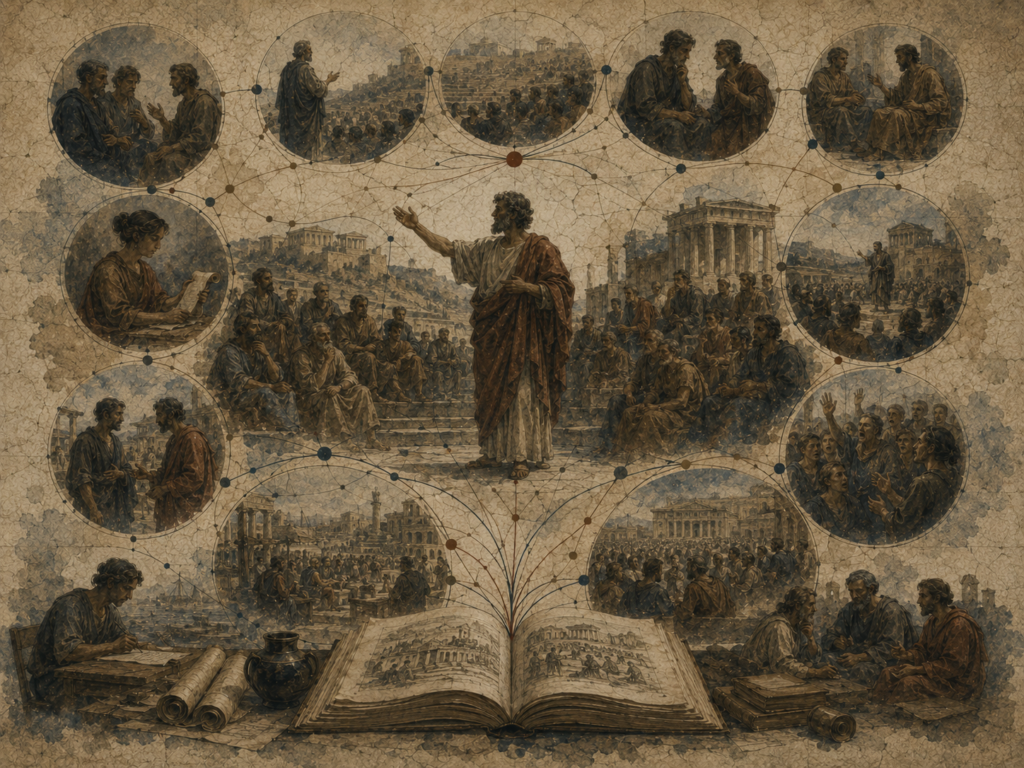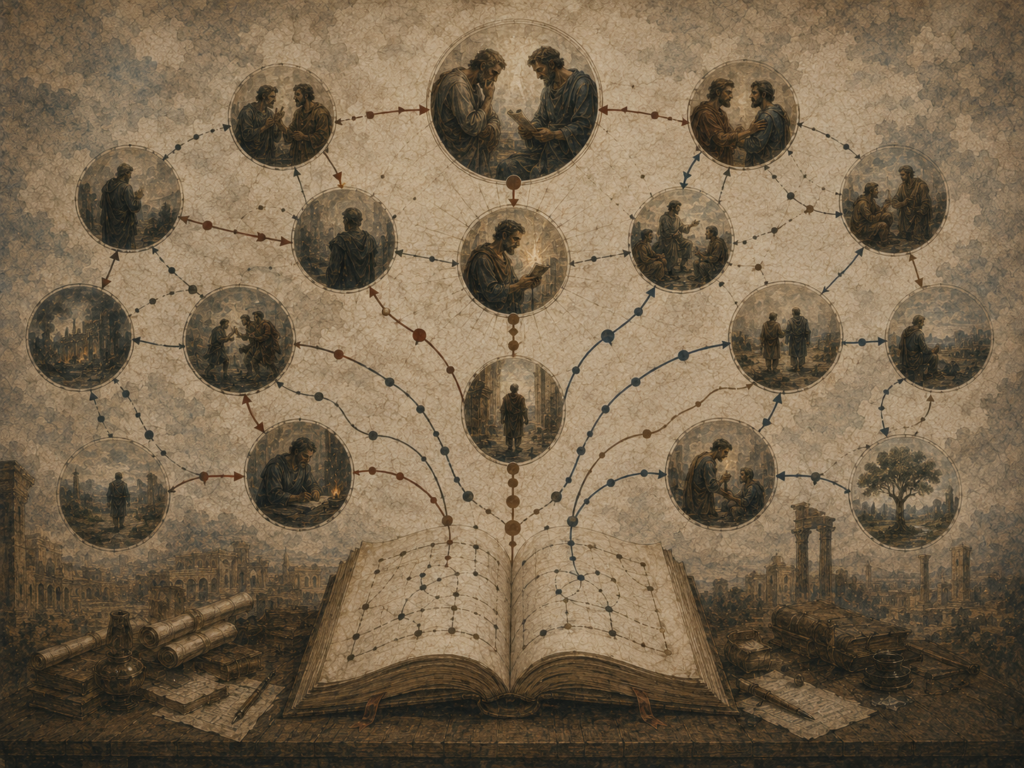
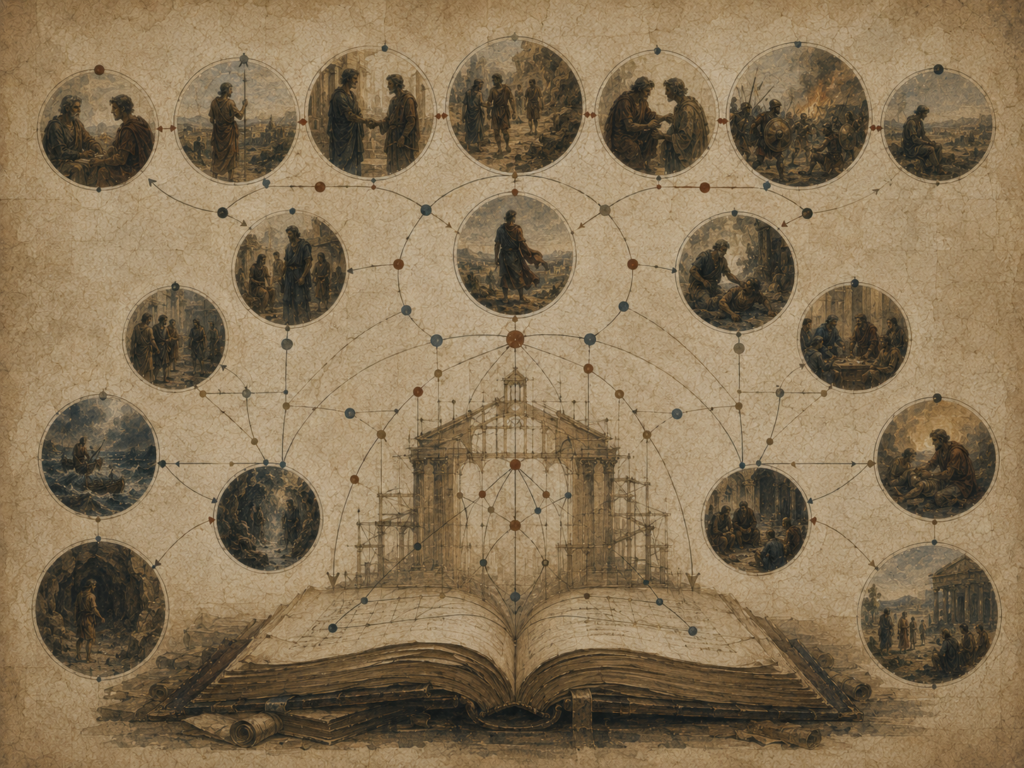
Editorial illustration of an open manuscript branching into connected scenes of conflict, recognition, revelation, reconciliation, and transformation.

Reversal, Recognition, and Transformation: How Stories Change Meaning

Reversal, Recognition, and Transformation examines how stories change direction, meaning, and consequence through decisive turns. This article explains reversal as a shift in narrative condition, recognition as movement from ignorance to knowledge, and transformation as the deeper change that follows when identity, relationship, value, responsibility, or future possibility is altered. It builds from Aristotle’s account of peripeteia and anagnorisis while extending the discussion to narrative theory, memory, public storytelling, institutional accountability, media design, games, and ethical interpretation. The article distinguishes structural reversal from mere twist, earned surprise from arbitrary shock, and recognition from repair. It also examines delayed recognition, false recognition, closure pressure, evidence omission, and the responsibility that follows knowing. As part of the Storytelling series, it connects plot theory with narrative ethics, public meaning, cultural memory, and practical methods for auditing transformation across media and knowledge contexts.
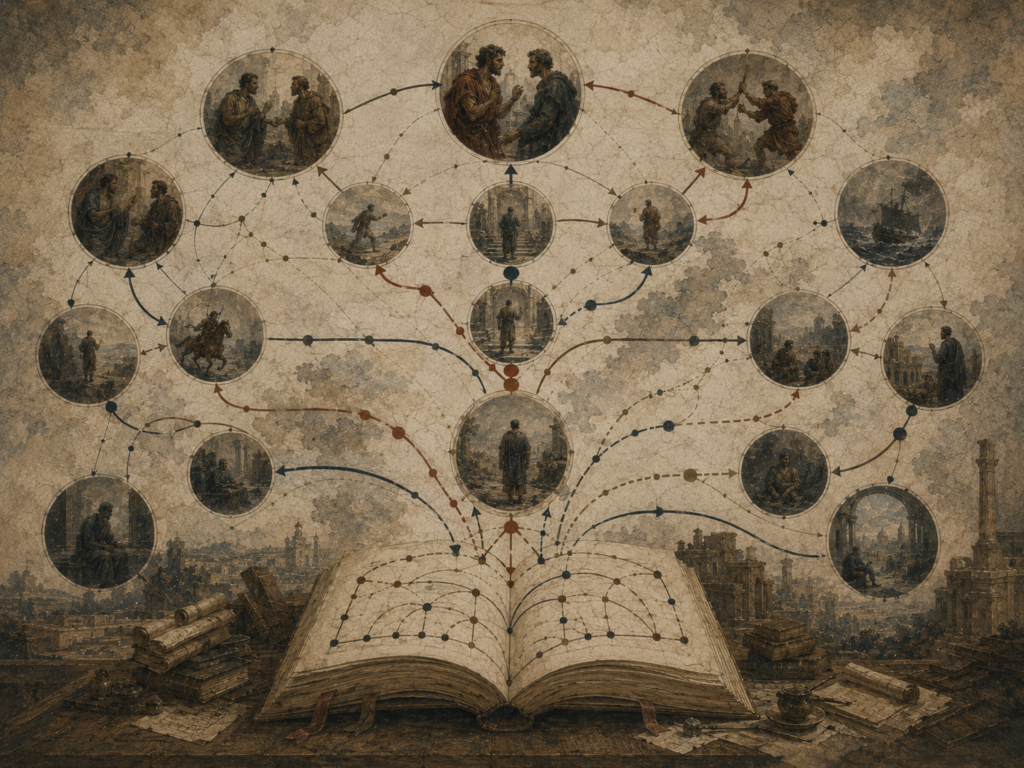
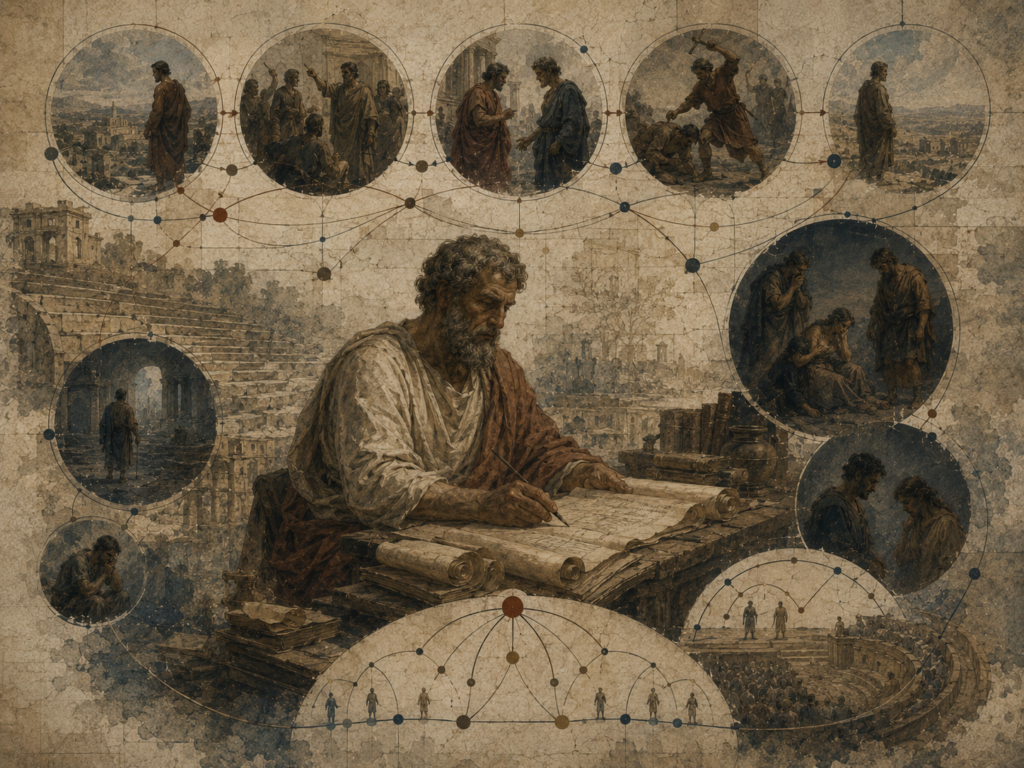
Editorial illustration of an open manuscript sending branching arrows, nodes, and circular scenes of conflict, pursuit, opposition, and turning points through a narrative structure.

Conflict, Tension, and Narrative Movement: How Stories Create Pressure and Change

Conflict, Tension, and the Logic of Narrative Movement examines how stories move through pressure, uncertainty, opposition, delay, escalation, and consequence. This article explains why conflict is not merely argument, violence, or dramatic noise, but a structural relation among desire, obstacle, value, agency, stakes, and change. It distinguishes conflict from tension, activity from movement, and meaningful pressure from empty spectacle. The article explores internal, interpersonal, moral, institutional, systemic, epistemic, and environmental conflict, showing how each form shapes narrative movement differently. It also examines tension over time, escalation, reversal, release, suspension, and the ethical risks of scapegoating, conflict inflation, trauma spectacle, false balance, and premature closure. As part of the Storytelling series, it connects plot structure with narrative ethics, public communication, systems thinking, and practical methods for auditing whether conflict creates meaningful movement across media and knowledge contexts responsibly and clearly.

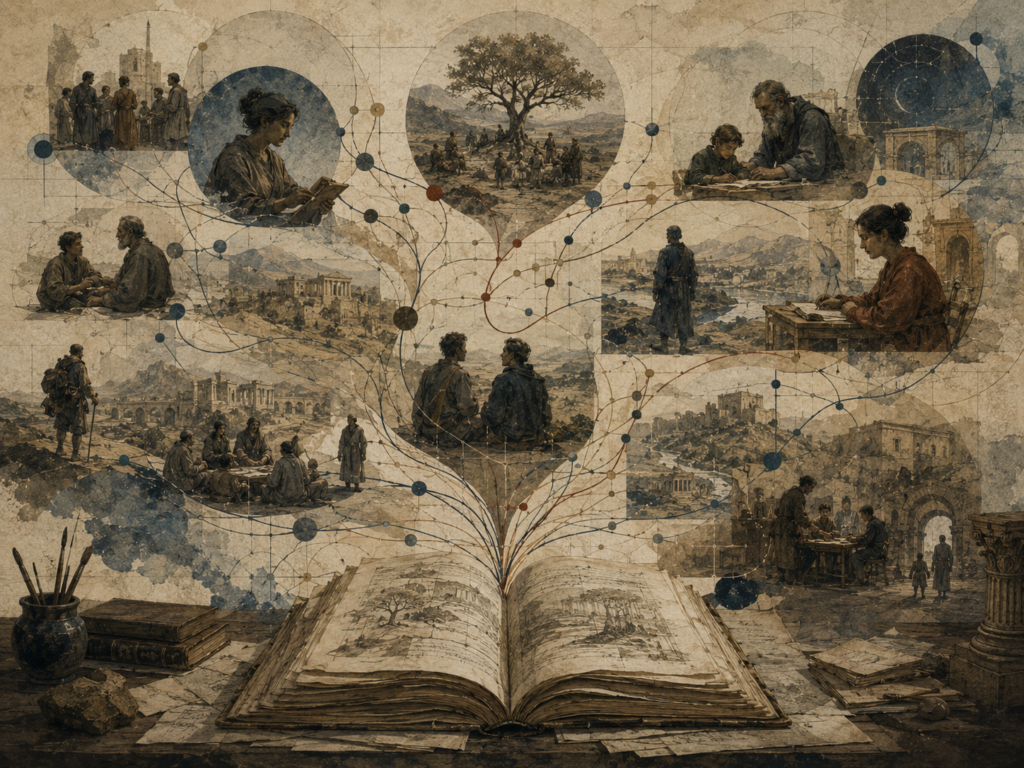
Editorial illustration of an open manuscript unfolding into connected circular scenes, arrows, nodes, and architectural structures representing plot and narrative action.

Plot, Action, and Narrative Coherence: How Stories Turn Events Into Meaning

Plot, Action, and Narrative Coherence examines how stories turn events into meaningful structure through action, causality, motivation, consequence, tension, transformation, and relation. This article explains why plot is not simply what happens, but how incidents are arranged so that audiences can understand movement, pressure, agency, conflict, ambiguity, and change. It distinguishes chronology from plot, coherence from simplicity, and responsible complexity from confusion. The article explores causal links, motivation, sequence, turning points, fragmented structures, narrative gaps, closure pressure, and the ethical risks of making stories seem too neat. It also shows how plot coherence matters across literature, film, public communication, games, education, institutional storytelling, and knowledge architecture. As part of the Storytelling series, it connects narrative form with interpretation, responsibility, systems thinking, and practical methods for auditing story structure across media and contexts without reducing complex stories to rigid formulas.

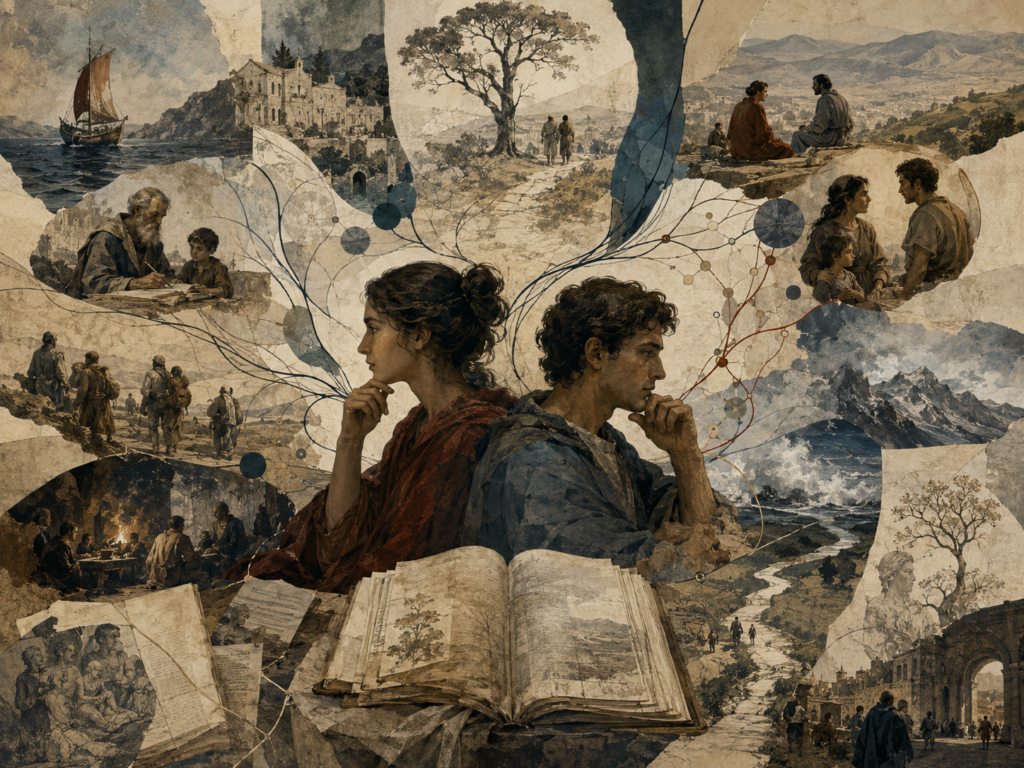
Editorial illustration of a classical orator addressing a public assembly, surrounded by civic debate scenes, listeners, manuscripts, and symbolic networks of persuasion.

Rhetoric, Persuasion, and the Public Life of Story

Rhetoric, Persuasion, and the Public Life of Story examines how stories move from private meaning into civic, institutional, legal, political, and digital public life. This article explains how storytelling persuades by shaping credibility, emotion, evidence, audience identification, public memory, moral judgment, legitimacy, and calls to action. It connects classical rhetorical appeals such as ethos, pathos, and logos with modern questions about narrative argument, civic reasoning, institutional storytelling, platform circulation, public testimony, and ethical persuasion. The article shows how stories can clarify complex issues, humanize public problems, build solidarity, and support democratic judgment. It also warns that persuasive stories can manipulate emotion, overstate evidence, scapegoat groups, flatten memory, manufacture urgency, or pressure audiences into loyalty. As part of the Storytelling series, it links narrative structure with rhetoric, ethics, public communication, governance, and responsible persuasion across media.

Editorial illustration of Aristotle studying scrolls, surrounded by connected scenes of classical drama, action, reversal, recognition, and narrative sequence.

Aristotle and the Earliest Theory of Plot: Action, Unity, and Narrative Structure

Aristotle and the Earliest Theory of Plot examines one of the foundational moments in narrative analysis: Aristotle’s account of plot in the Poetics. This article explains how Aristotle understood plot not as a loose sequence of events, but as the arrangement of incidents into a whole action with beginning, middle, end, unity, probability, necessity, reversal, recognition, and emotional consequence. It explores mimesis, muthos, unity of action, character, catharsis, tragic structure, and the difference between earned surprise and arbitrary episode. The article also cautions against reducing Aristotle to a modern formula or universal story template. As part of the Storytelling series, it shows why Aristotle still matters for understanding plot, action, causality, dramatic consequence, narrative coherence, and the responsible analysis of story structure across literature, theater, film, games, content systems, and other media in contemporary narrative design, editing, and criticism.

Editorial illustration of an open manuscript branching into connected scenes, pathways, human figures, and symbolic nodes across time.

Storytelling and the Architecture of Meaning Over Time

Storytelling and the Architecture of Meaning Over Time examines how narrative connects past, present, and future into durable structures of meaning. This article explains how stories organize origin, sequence, continuity, rupture, memory, repetition, revision, identity, and future possibility across personal life, cultural memory, institutions, media, and knowledge systems. It argues that meaning does not simply survive over time; it must be preserved, questioned, updated, and governed. The article explores how communities remember, how institutions repeat founding stories, how public memory becomes contested, how digital platforms reshape temporal context, and how article series can build long-term knowledge architecture. It also considers the risks of narrative drift, nostalgia, false continuity, premature closure, archive bias, and revision without accountability. As part of the Storytelling series, it links narrative time with cultural memory, governance, knowledge design, and responsible interpretation across generations and media.

Editorial illustration of two contemplative figures surrounded by connected scenes of memory, experience, landscapes, and human relationships.

Story as a Mode of Human Understanding: Narrative, Meaning, and Identity

Story as a mode of human understanding explains how narrative helps people connect events, motives, memory, causality, identity, moral judgment, and possible futures into meaningful patterns. This article examines story as more than entertainment, persuasion, or cultural memory. It treats narrative as an interpretive structure that helps humans move from scattered information to sequence, from action to consequence, from experience to identity, and from uncertainty to possible meaning. The article explores how stories organize time, clarify agency, support moral imagination, shape self-understanding, create possible worlds, and make knowledge systems easier to navigate. It also considers the risks of narrative overreach, including false coherence, unsupported causality, selection bias, hindsight bias, emotional manipulation, and premature closure. As part of the Storytelling series, it provides a foundation for later articles on narrative time, identity, memory, ethics, narrative systems, responsibility, and public meaning.

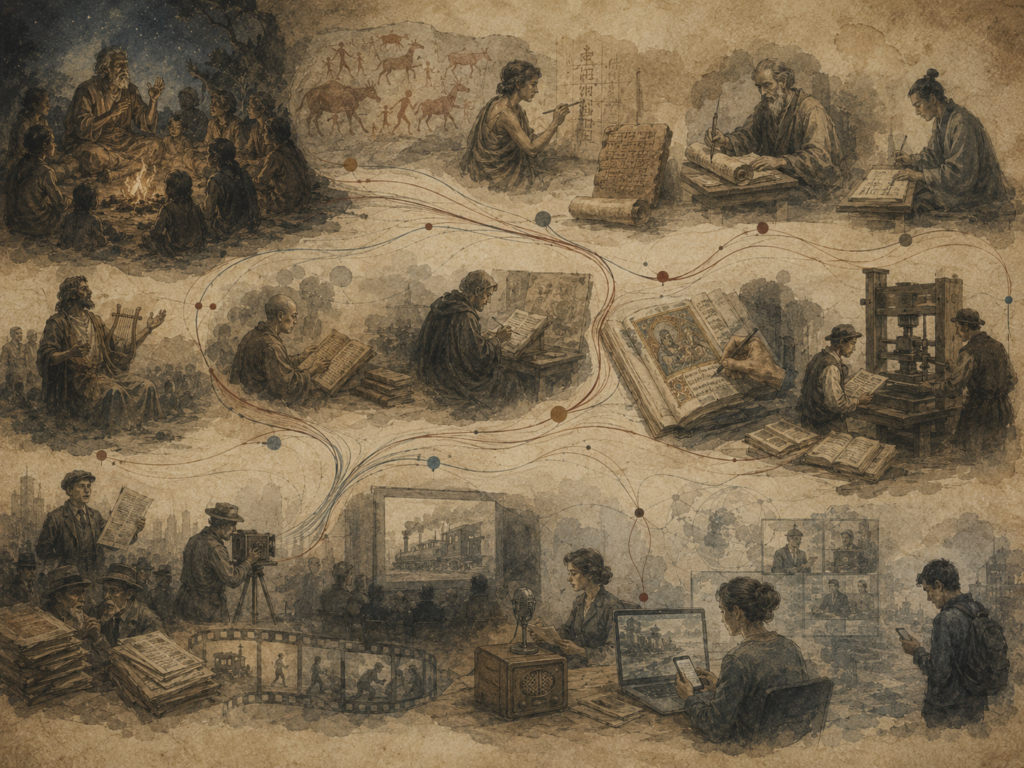
Editorial illustration showing the evolution of storytelling from oral tradition and cave symbols to manuscripts, printing, cinema, radio, and digital media.

The History of Storytelling: From Oral Tradition to Modern Media

The history of storytelling is the history of how human beings preserve, perform, circulate, and transform meaning across media. This article traces storytelling from oral tradition, myth, ritual, epic, and collective memory through writing, manuscript culture, print, theater, novels, photography, film, radio, television, digital platforms, games, and transmedia systems. It argues that storytelling history is not a straight line of progress from speech to screen, but a layered process in which older forms survive inside newer media. Each medium changes the relationship among memory, authority, audience participation, preservation, access, and power. The article explains how oral performance, textual record, printed circulation, visual narrative, broadcast seriality, networked platforms, and interactive systems shape what stories can do. It also considers archives, context loss, algorithmic visibility, cultural ownership, and ethical responsibility in studying storytelling history across cultures and technologies over long periods.

Editorial illustration of an open manuscript unfolding into connected narrative panels, symbolic threads, human figures, and knowledge pathways.

Storytelling as a Content Framework: Narrative Structure for Knowledge Systems

Storytelling becomes a content framework when narrative principles organize more than individual messages. This article examines storytelling as a structure for sequencing ideas, guiding audiences, connecting articles, shaping memory, clarifying stakes, and maintaining coherence across content systems. It explains how story can support content strategy, research communication, educational design, topic clusters, article maps, internal linking, editorial governance, and knowledge architecture without reducing complex subjects to formula or emotional manipulation. The article translates story elements such as setting, conflict, perspective, sequence, evidence, transformation, and closure into practical content design tools. It also considers the risks of storytelling frameworks when they become too linear, too heroic, unsupported by evidence, or detached from ethical responsibility. As part of the Storytelling series, it connects narrative theory with scalable content systems, audience pathways, and responsible editorial practice for long-term governance and public-facing knowledge work.

Scroll to Top