
Last Updated June 10, 2026
Plot is not simply what happens in a story. It is the arrangement of action into meaningful consequence. A story may contain many incidents, characters, scenes, images, memories, arguments, or emotions, but those materials become narratively coherent only when they are shaped into relationships that audiences can follow, question, reinterpret, and remember.
Plot, Action, and Narrative Coherence examines how stories become intelligible through action, sequence, causality, motivation, conflict, expectation, transformation, and closure. It builds from Aristotle’s account of plot as organized action, then moves into broader narrative theory, modern media, knowledge architecture, and ethical storytelling. The article treats coherence not as rigid neatness, but as the relation among parts that allows a story to make sense without becoming simplistic.
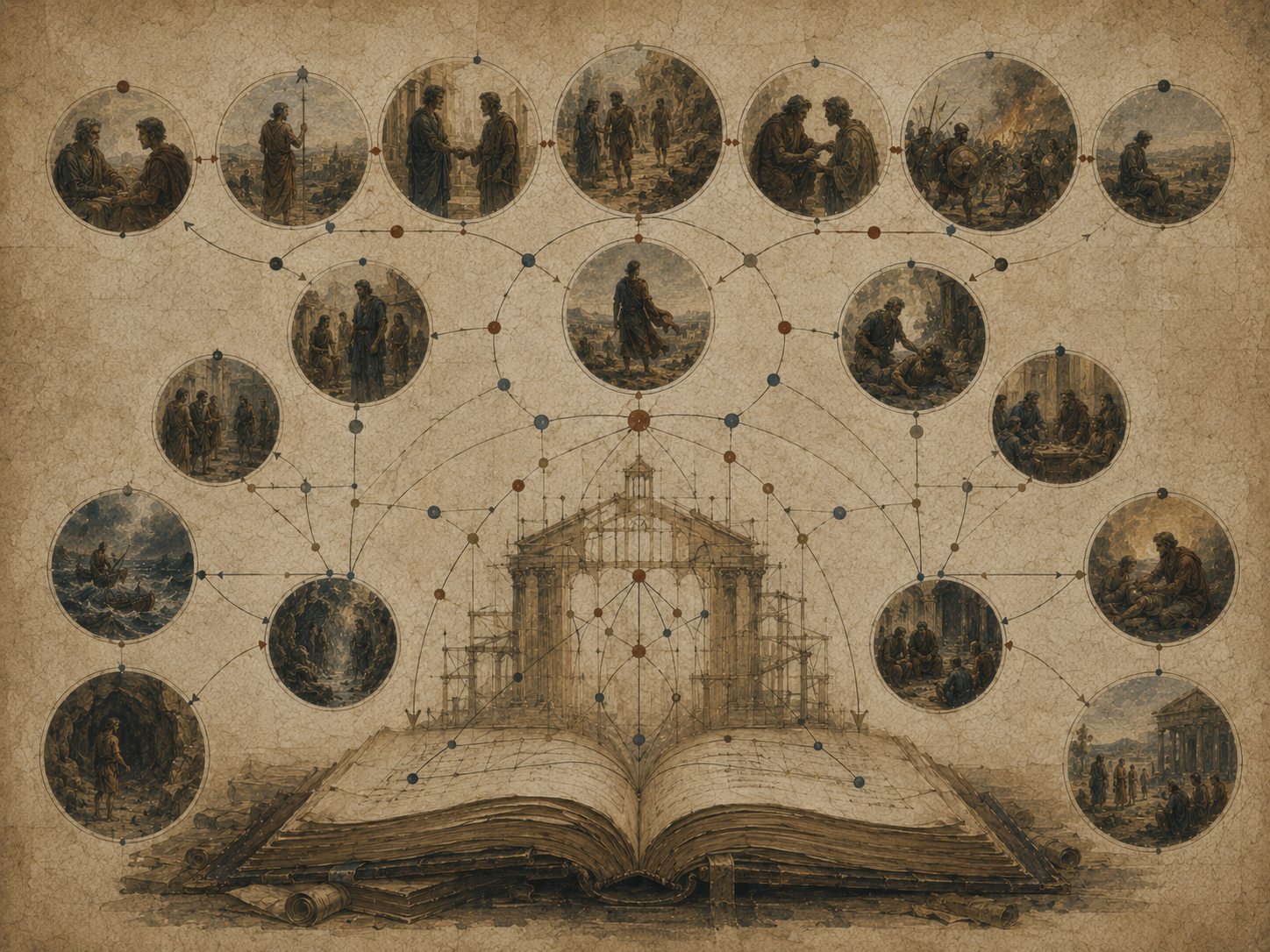
This article explains why plot is best understood as the organization of meaningful action rather than a simple sequence of events. It examines causality, motivation, agency, conflict, expectation, turning points, narrative gaps, coherence failure, nonlinear structure, ethical interpretation, and story design across literature, film, public communication, games, education, and knowledge systems. It also includes computational workflows for auditing plot coherence, causal linkage, action dependency, motivation clarity, closure pressure, and Catalyst Canvas-ready governance outputs.
Why Plot Matters
Plot matters because stories need more than material. A story can have striking characters, memorable images, emotional scenes, vivid dialogue, historical detail, or powerful themes and still feel shapeless. Plot gives those materials relation. It helps audiences understand what is changing, why it matters, what actions have consequences, and how one part of the story alters another.
This does not mean every story needs a rigid formula. Plot is not a mechanical template. It is a relational structure. It explains how events, actions, choices, discoveries, delays, conflicts, memories, and consequences belong together. In some stories, that structure is linear and clear. In others, it is layered, fragmented, cyclical, nonlinear, recursive, or deliberately unstable.
Plot matters because coherence matters. Human beings do not experience stories as isolated fragments. We search for relation, sequence, implication, cause, contrast, repetition, and change. Narrative coherence allows audiences to follow complexity without reducing everything to a single simple line.
| Plot concern | Core question | Why it matters |
|---|---|---|
| Action | What is being done, chosen, resisted, suffered, or changed? | Stories move through consequential action. |
| Sequence | How are events arranged? | Order shapes interpretation. |
| Causality | How does one event affect another? | Consequence creates intelligibility. |
| Motivation | Why do characters, groups, or institutions act? | Action needs pressure, desire, constraint, or purpose. |
| Transformation | What changes by the end? | Change gives narrative movement weight. |
| Coherence | How do parts belong together? | Relation turns material into story. |
Plot matters because it is one of the primary ways stories make action intelligible across time.
Plot Is Not the Same as Events
Events are things that happen. Plot is the arrangement of those happenings into meaningful relation. A timeline can list events. A plot explains why their arrangement matters. The difference is critical.
A weak story may be full of events: meetings, discoveries, arguments, journeys, losses, victories, accidents, memories, reversals, and revelations. But if those events do not affect one another, the story may feel episodic, arbitrary, or emotionally flat. A strong plot does not require constant activity. It requires meaningful relation among actions and consequences.
This distinction also helps explain why the same events can support different stories. A biography, courtroom argument, political speech, documentary, memoir, or article can arrange similar material in different ways. Each arrangement creates a different plot, and each plot invites a different interpretation.
| Events | Plot | Storytelling implication |
|---|---|---|
| Chronological items | Organized action | Order alone is not enough. |
| Things that happen | Things that matter in relation | Meaning emerges through connection. |
| Can be listed | Must be interpreted | Plot requires selection and arrangement. |
| May be detachable | Should affect the whole | Each major incident should change the story’s movement. |
| Can accumulate | Must develop | More incidents do not automatically create stronger narrative. |
| Often external | Often structural | Plot depends on relation, pressure, and consequence. |
Plot begins when events are arranged so that audiences can understand relation, pressure, direction, and consequence.
Action as the Narrative Engine
Action is the engine of plot. This does not mean every story must be physically dramatic or externally busy. Action includes choices, refusals, discoveries, concealments, promises, betrayals, testimony, adaptation, resistance, care, silence, waiting, interpretation, and institutional decision. A quiet story may be deeply action-driven if its choices carry consequence.
Action matters because it connects character, world, and consequence. A person acts under pressure. A community responds to crisis. An institution hides or reveals information. A witness speaks. A family chooses what to remember. A narrator withholds context. These actions generate narrative movement because they alter conditions.
In plot analysis, the first question is not “What happens?” but “What action is being organized?” A story about grief may organize acts of memory. A story about corruption may organize acts of concealment and exposure. A story about scientific discovery may organize inquiry, error, revision, and recognition. A story about public policy may organize tradeoffs, harms, decisions, and delayed consequences.
| Action type | Example | Plot function |
|---|---|---|
| Choice | A character decides whether to reveal the truth. | Creates consequence and moral pressure. |
| Refusal | A community refuses an official story. | Creates conflict and counter-memory. |
| Discovery | A hidden cause becomes visible. | Reorders prior events. |
| Concealment | An institution hides evidence. | Creates delay, tension, and accountability risk. |
| Adaptation | A person changes strategy under constraint. | Shows agency and transformation. |
| Testimony | A witness tells what happened. | Turns private experience into public action. |
A plot becomes coherent when action is not merely present, but structurally consequential.
Causality and Consequence
Causality is one of the main ways plot becomes intelligible. Events do not need to follow simple cause-and-effect chains, but audiences need some way to understand how one part of the story affects another. Consequence may be direct, indirect, delayed, hidden, systemic, emotional, symbolic, or retrospective.
A causal plot does not mean every event is predictable. In strong narratives, surprise often works because the event is unexpected but still meaningful. The audience did not foresee it, but once it happens, the story’s structure makes the event feel earned. Coherence depends on this balance between surprise and intelligibility.
Causality can be especially difficult in stories about systems. In a story about climate, health, finance, law, infrastructure, technology, or institutional failure, no single person may “cause” the central problem. Plot coherence then depends on mapping distributed causality: incentives, feedback loops, delays, policies, omissions, thresholds, and unintended consequences.
| Causal pattern | Story form | Coherence challenge |
|---|---|---|
| Direct causality | One action produces a visible result. | May become too simple if wider context is ignored. |
| Delayed consequence | An action matters later. | The story must preserve memory of earlier causes. |
| Hidden causality | The cause is not visible at first. | Recognition must be prepared. |
| Systemic causality | Many conditions produce an outcome. | The plot must avoid false individual blame. |
| Emotional causality | A wound, desire, fear, or attachment drives action. | Motivation must be legible without overexplaining. |
| Retrospective causality | Later knowledge changes the meaning of earlier events. | The story must support reinterpretation. |
Narrative coherence is strongest when consequences feel neither random nor artificially forced.
Motivation and Agency
Plot depends on action, but action depends on motivation and agency. Characters, institutions, communities, and narrators act for reasons: desire, fear, duty, ignorance, loyalty, power, survival, care, ambition, belief, confusion, habit, pressure, or constraint. Motivation makes action intelligible.
Agency does not mean unlimited freedom. In many stories, agency appears under constraint. A character may act within poverty, law, family obligation, trauma, bureaucracy, censorship, illness, occupation, debt, climate risk, or technological systems. Coherence requires showing not only what an actor does, but what conditions shape what can be done.
This matters especially for ethical storytelling. Weak plots often assign agency too easily. They make individuals responsible for systemic outcomes, or they erase agency by treating people only as victims of circumstance. Stronger plots show action within constraint: how people choose, resist, adapt, fail, cooperate, or survive inside worlds they did not fully create.
| Agency question | Coherence function | Ethical risk |
|---|---|---|
| What does the actor want? | Clarifies motive and direction. | May reduce complex people to one desire. |
| What limits the actor? | Explains constraint and pressure. | May erase responsibility if overused. |
| What does the actor know? | Shapes choice and recognition. | May create artificial ignorance. |
| What choice becomes costly? | Creates stakes and consequence. | May romanticize suffering. |
| What changes after the action? | Connects agency to plot movement. | May force transformation too neatly. |
| Who lacks agency in the story? | Reveals power and representation gaps. | May silence those most affected. |
Motivation and agency make plot human, institutional, and ethical rather than merely mechanical.
Sequence and Structure
Sequence is the order in which story material is presented. Structure is the deeper arrangement that gives that order meaning. A story may present events chronologically, but it may also begin near the end, move through memory, alternate timelines, loop through repeated scenes, branch through choices, or withhold a key event until late in the narrative.
Sequence shapes interpretation. If a story begins with consequence, the audience reads earlier events as explanation. If it begins with origin, the audience reads later events as development. If it begins with mystery, the audience reads scenes as clues. If it begins with memory, the audience reads events through loss, revision, or unresolved meaning.
Structure is not reducible to sequence. A nonlinear story can be highly coherent if its arrangement helps the audience understand emotional, thematic, causal, or moral relation. A chronological story can be incoherent if it merely lists events without pressure, development, or consequence.
| Sequence type | How it works | Coherence requirement |
|---|---|---|
| Chronological | Events appear in time order. | Chronology must still develop consequence. |
| In medias res | The story begins in the middle of action. | Later context must clarify stakes. |
| Flashback | Past events interrupt present action. | Memory must change present understanding. |
| Parallel timelines | Multiple time streams develop together. | Connections must matter structurally. |
| Recursive | The story returns to repeated scenes or motifs. | Repetition must produce new meaning. |
| Fragmented | Parts appear incomplete or disordered. | Fragmentation must serve interpretation. |
Narrative coherence does not require simple order. It requires meaningful relation among ordered or disordered parts.
What Narrative Coherence Means
Narrative coherence is the degree to which a story’s parts can be understood as belonging together. Coherence can come from causality, theme, voice, character development, setting, conflict, memory, repeated motif, moral question, emotional arc, public problem, or formal pattern. It is not one thing.
A coherent story does not answer every question. It may leave ambiguity, contradiction, silence, and uncertainty. Coherence means that these features have a place in the work’s design. An unresolved ending can be coherent if the story is about irresolution. A fragmented structure can be coherent if the story is about trauma, memory, exile, or contested truth. A branching game can be coherent if choice architecture preserves consequence.
Narrative coherence is therefore different from neatness. Neatness closes down complexity too quickly. Coherence allows complexity to remain legible.
| Coherence type | How it works | Example question |
|---|---|---|
| Causal coherence | Events affect one another. | Can the audience understand consequence? |
| Motivational coherence | Actions follow from desire, pressure, belief, or constraint. | Do choices make sense within the story world? |
| Thematic coherence | Parts return to a shared question or concern. | What problem keeps recurring? |
| Emotional coherence | Feeling develops through recognizable movement. | Does emotional change feel earned? |
| Formal coherence | Structure, repetition, voice, or pattern organizes the work. | Does the form guide interpretation? |
| Ethical coherence | Representation, responsibility, and consequence align. | Does the story honor the stakes it presents? |
Narrative coherence is the architecture that lets complexity become interpretable.
Coherence Without Simplicity
The strongest stories are often coherent without being simple. They allow contradictions, layered motives, uncertain evidence, competing memories, multiple points of view, delayed consequences, and unresolved questions. Coherence does not require eliminating complexity. It requires giving complexity form.
A story about institutional failure may need multiple causes. A story about grief may need temporal disorientation. A story about migration may need layered memory. A story about law may need conflicting accounts. A story about climate risk may need feedback loops and delayed effects. A story about identity may need contradiction rather than clean resolution.
This distinction matters because some storytelling advice treats coherence as simplification. That can damage serious work. Public stories, research communication, historical narratives, ethical case studies, and literary works often need complexity to remain visible. The goal is not to make every story easy. The goal is to make the difficulty meaningful.
| Complex feature | Weak handling | Coherent handling |
|---|---|---|
| Multiple causes | Blames one convenient actor. | Maps interacting causes and responsibilities. |
| Contradictory motives | Forces a simple explanation. | Shows competing pressures and choices. |
| Fragmented memory | Feels randomly disordered. | Uses fragmentation to represent memory truthfully. |
| Unresolved ending | Stops before consequence matters. | Marks unresolved consequence deliberately. |
| Ambiguous evidence | Uses ambiguity to avoid responsibility. | Documents uncertainty and interpretive limits. |
| Multiple perspectives | Creates confusion without purpose. | Shows how perspectives alter meaning. |
Coherence is not the enemy of complexity. It is what keeps complexity from becoming noise.
Conflict, Tension, and Movement
Plot usually moves through tension. Tension arises when desire meets obstacle, expectation meets uncertainty, value meets threat, memory meets denial, evidence meets concealment, or action meets consequence. Conflict is one form of tension, but not the only one.
A story can be driven by interpersonal conflict, institutional conflict, inner conflict, moral conflict, social conflict, ecological pressure, epistemic uncertainty, or structural contradiction. A quiet narrative about waiting can contain deep tension if the waiting changes what is known, desired, feared, or possible.
Movement occurs when tension changes state. A hidden fact becomes visible. A relationship breaks. A person acts. A system fails. A memory returns. A public claim is challenged. A promise becomes impossible. A community reorganizes around loss or hope. Plot coherence depends on whether these changes build on one another.
| Tension type | Plot movement | Coherence test |
|---|---|---|
| Interpersonal conflict | People oppose, misunderstand, betray, or care for one another. | Does conflict change action or relation? |
| Institutional conflict | Rules, power, and accountability shape choices. | Does the plot show institutional consequence? |
| Internal conflict | A character struggles with desire, duty, fear, or memory. | Does inner conflict affect external action? |
| Moral conflict | Values collide under pressure. | Are tradeoffs represented honestly? |
| Epistemic conflict | Characters or audiences struggle to know what is true. | Does uncertainty develop rather than stall? |
| Systemic tension | Structures create pressure across time. | Does the story show feedback, delay, or constraint? |
Tension gives plot energy. Coherence gives that energy shape.
Turning Points and Transformations
Turning points are moments when the story’s conditions change. They may involve decision, discovery, reversal, betrayal, failure, recognition, arrival, departure, loss, confession, evidence, crisis, or refusal. A turning point matters when the story cannot return unchanged to its prior state.
Not every dramatic moment is a turning point. A scene may be intense but structurally minor. A quiet realization may be structurally major. The question is whether the moment changes the direction, pressure, knowledge, relation, stakes, or possible outcome of the story.
Transformation can occur at different levels. A character changes. A relationship changes. A public claim changes. A community changes. A system crosses a threshold. An audience reinterprets what came before. A story may also refuse transformation, making stasis itself the point. In every case, coherence depends on how the transformation relates to prior action.
| Turning-point type | What changes | Review question |
|---|---|---|
| Decision | Action becomes irreversible. | Was the choice prepared by pressure? |
| Discovery | Knowledge changes. | Does new knowledge alter consequence? |
| Reversal | Expectation or fortune changes direction. | Is the reversal earned? |
| Recognition | Identity, relation, or meaning becomes visible. | Does recognition reorganize the story? |
| Threshold | A system, relationship, or situation crosses a limit. | Was the threshold visible or legible? |
| Refusal | Expected action does not occur. | Does refusal have consequence? |
Turning points make plot visible because they reveal what the story treats as consequential.
Gaps, Ambiguity, and Fragmentation
Narrative coherence does not require filling every gap. Gaps can be powerful. They invite inference, mark trauma, protect mystery, respect uncertainty, or reveal what cannot be fully known. Ambiguity can keep interpretation open. Fragmentation can represent memory, exile, violence, institutional secrecy, digital circulation, or the limits of evidence.
The problem is not the presence of gaps. The problem is unmanaged gaps. A gap becomes incoherent when the audience cannot tell whether something is missing by design, by error, by evasion, or by weak structure. Ambiguity becomes irresponsible when it hides accountability. Fragmentation becomes noise when it does not help the story’s meaning.
Strong narratives govern gaps. They use silence, omission, delay, and fragmentation deliberately. They give audiences enough structure to interpret uncertainty without pretending that uncertainty has disappeared.
| Open form | Strong use | Weak use |
|---|---|---|
| Gap | Invites meaningful inference. | Leaves necessary context missing. |
| Ambiguity | Preserves genuine uncertainty. | Avoids making a responsible claim. |
| Fragmentation | Represents memory, trauma, or contested evidence. | Creates disordered material without purpose. |
| Delay | Builds recognition and re-interpretation. | Withholds information artificially. |
| Silence | Marks absence, power, or the unsayable. | Erases necessary voices. |
| Contradiction | Shows competing realities or perspectives. | Confuses without interpretive value. |
Coherence can include uncertainty, but uncertainty must be shaped, not neglected.
When Plot Coherence Fails
Plot coherence fails when parts of a story do not meaningfully relate. This failure may appear as random incidents, forced choices, unearned reversals, disappearing motivations, unresolved consequences, inconsistent stakes, excessive exposition, false closure, or episodes that could be removed without changing the whole.
Coherence failure can also occur at higher levels. A public story may use one emotional case to imply a broad claim without evidence. An institutional story may claim reform while hiding unresolved harm. A historical narrative may impose neat causality on uncertain archives. A personal story may turn complex identity into a simplified lesson. In each case, the problem is not simply structural. It is interpretive and ethical.
Diagnosing coherence failure requires asking what the story promises. A fragmented story should not be judged by the same standard as a linear thriller. A testimony should not be judged like a fictional plot. A systems explanation should not be forced into a hero narrative. Coherence depends on genre, medium, purpose, and ethical stakes.
| Coherence failure | Symptom | Revision question |
|---|---|---|
| Random incident | Events happen without relation. | What action does this incident change? |
| Forced choice | A character acts only because the plot requires it. | What motive or pressure makes the choice intelligible? |
| Unearned reversal | A twist surprises but does not fit. | What preparation is missing? |
| Disappearing consequence | Major events stop mattering. | Where should the consequence return? |
| False closure | The ending resolves what remains unresolved. | What should remain open or accountable? |
| Theme without action | The story says what it means but does not enact it. | How does the theme become action? |
Coherence failure is often a sign that the story’s structure, purpose, and ethical responsibility have drifted apart.
The Ethics of Narrative Coherence
Coherence is not ethically neutral. A coherent story can clarify truth, but it can also make a false interpretation feel persuasive. Humans are drawn to pattern. That makes narrative powerful, but it also makes narrative risky. A story can impose causality where evidence is uncertain, assign blame too quickly, simplify systemic harm, erase contradiction, or make closure feel deserved before repair has occurred.
This is especially important in public communication, history, journalism, law, institutional storytelling, trauma narrative, and policy explanation. In these settings, coherence must be accountable to evidence, context, proportion, representation, and uncertainty. A good story is not only smooth. It is responsible.
Ethical coherence asks whether the story’s structure honors the complexity of what it represents. Does the narrative preserve uncertainty where uncertainty matters? Does it show agency without blaming the vulnerable? Does it map systems without erasing persons? Does it avoid turning pain into convenient plot? Does it resist closure when accountability remains incomplete?
| Ethical issue | Coherence risk | Responsible practice |
|---|---|---|
| False causality | The story makes one event seem to explain everything. | Distinguish cause, correlation, context, and speculation. |
| Scapegoating | A group or person becomes the convenient plot villain. | Map systems, incentives, and shared responsibility. |
| False closure | The story ends before repair or accountability. | Name unresolved consequences. |
| Trauma simplification | Pain becomes a tidy transformation arc. | Respect fragmentation, silence, and ongoing effects. |
| Institutional self-protection | The institution tells a reform story without proof. | Connect narrative to evidence and governance. |
| Representation erasure | The plot centers one viewpoint as universal. | Document omitted perspectives and counter-stories. |
Ethical storytelling does not abandon coherence. It makes coherence accountable.
Examples of Plot and Coherence Analysis
The examples below show how plot coherence can be evaluated across different story forms without forcing every story into the same model.
Linear adventure plot
Weak: The protagonist moves from challenge to challenge without lasting consequence.
Stronger: Each challenge changes knowledge, cost, relationship, or available action.
Why it works: Episodes become part of one developing action.
Fragmented memory narrative
Weak: Scenes appear in random order without interpretive purpose.
Stronger: Fragmentation reflects how memory, loss, and recognition work.
Why it works: Form becomes meaningful rather than decorative.
Institutional failure story
Weak: One person is blamed for a systemic breakdown.
Stronger: The plot maps decisions, incentives, delays, omissions, and accountability.
Why it works: Causality remains complex but legible.
Public testimony
Weak: One vivid case is made to prove a universal claim.
Stronger: The testimony is linked to evidence, pattern, and limits.
Why it works: Story supports reasoning without overclaiming.
Mystery structure
Weak: The final reveal introduces information the audience could not have inferred.
Stronger: The reveal surprises but reorganizes earlier clues.
Why it works: Recognition is earned by prior structure.
Educational explanation
Weak: The article lists concepts without sequence.
Stronger: Each concept answers a prior problem and prepares the next.
Why it works: Knowledge architecture becomes narrative movement.
Plot coherence is not one pattern. It is the disciplined relation among action, structure, purpose, and consequence.
Mathematics, Computation, and Modeling
Plot and coherence cannot be reduced to formulas, but modeling can help make structural assumptions visible. A computational workflow can audit whether actions are connected, whether consequences persist, whether motivations are clear, whether episodes are detachable, whether turning points are earned, and whether closure pressure is creating ethical risk.
A plot coherence score can combine action, causality, motivation, dependency, and consequence:
C_p = \frac{A_c + C_l + M_v + E_d + T_s + R_c}{6}
\]
Interpretation: Plot coherence \(C_p\) averages action clarity \(A_c\), causal linkage \(C_l\), motivation visibility \(M_v\), episode dependency \(E_d\), turning-point strength \(T_s\), and resolution consequence \(R_c\).
An action-dependency score can estimate whether scenes belong to the plot’s central movement:
D_a = \frac{S_c + K_c + P_c + R_i + F_m}{5}
\]
Interpretation: Action dependency \(D_a\) averages state change \(S_c\), knowledge change \(K_c\), pressure change \(P_c\), relationship impact \(R_i\), and future movement \(F_m\).
A coherence-risk score can estimate when narrative smoothness may become ethically unsafe:
R_n = F_cw_f + S_bw_s + C_pw_c + E_ow_e + (1 – U_c)w_u
\]
Interpretation: Narrative coherence risk \(R_n\) rises with false causality \(F_c\), simplification bias \(S_b\), closure pressure \(C_p\), evidence omission \(E_o\), and low uncertainty clarity \(U_c\).
A governance priority score can combine coherence strength with ethical risk and public consequence:
G_c = C_pw_p + R_nw_r + A_sw_a + P_cw_c
\]
Interpretation: Coherence governance priority \(G_c\) combines plot coherence \(C_p\), narrative coherence risk \(R_n\), audience sensitivity \(A_s\), and public consequence \(P_c\).
| Modeling task | Coherence question | Example output |
|---|---|---|
| Plot coherence audit | Do action, causality, motivation, and consequence align? | Plot coherence score. |
| Episode dependency audit | Can an incident be removed without altering the story? | Detachable episode report. |
| Turning-point audit | Does the turn change direction, knowledge, pressure, or stakes? | Turning-point strength table. |
| Motivation audit | Are actions intelligible under pressure and constraint? | Motivation visibility score. |
| Closure audit | Does the ending resolve too neatly? | Closure-pressure warning. |
| Ethical coherence audit | Does coherence hide uncertainty, power, or omitted evidence? | Governance queue. |
Computation can support story analysis by making structural assumptions explicit. It should never replace interpretive, editorial, historical, cultural, or ethical judgment.
Python Workflow: Plot Coherence Audit
The Python workflow below evaluates story items by action clarity, causal linkage, motivation visibility, episode dependency, turning-point strength, resolution consequence, state change, knowledge change, pressure change, relationship impact, future movement, false causality, simplification bias, closure pressure, evidence omission, uncertainty clarity, audience sensitivity, and public consequence. The companion repository version extends this into a Catalyst Canvas-ready module with schemas, package-style Python, tests, JSON exports, Canvas cards, markdown governance queues, and reusable plot-coherence templates.
# plot_coherence_audit.py
# Dependency-light workflow for auditing plot, action, and narrative coherence.

from __future__ import annotations

from dataclasses import dataclass
from pathlib import Path
import csv
import json
from statistics import mean

ARTICLE_ROOT = Path(__file__).resolve().parents[1]
OUTPUTS = ARTICLE_ROOT / "outputs"
TABLES = OUTPUTS / "tables"
JSON_DIR = OUTPUTS / "json"
MARKDOWN = OUTPUTS / "markdown"


@dataclass
class PlotCoherenceItem:
    item: str
    story_type: str
    action_clarity: float
    causal_linkage: float
    motivation_visibility: float
    episode_dependency: float
    turning_point_strength: float
    resolution_consequence: float
    state_change: float
    knowledge_change: float
    pressure_change: float
    relationship_impact: float
    future_movement: float
    false_causality: float
    simplification_bias: float
    closure_pressure: float
    evidence_omission: float
    uncertainty_clarity: float
    audience_sensitivity: float
    public_consequence: float
    owner: str
    status: str

    def plot_coherence(self) -> float:
        return mean([
            self.action_clarity,
            self.causal_linkage,
            self.motivation_visibility,
            self.episode_dependency,
            self.turning_point_strength,
            self.resolution_consequence,
        ])

    def action_dependency(self) -> float:
        return mean([
            self.state_change,
            self.knowledge_change,
            self.pressure_change,
            self.relationship_impact,
            self.future_movement,
        ])

    def coherence_risk(self) -> float:
        return min(
            1.0,
            self.false_causality * 0.25
            + self.simplification_bias * 0.20
            + self.closure_pressure * 0.20
            + self.evidence_omission * 0.20
            + (1 - self.uncertainty_clarity) * 0.15,
        )

    def governance_priority_score(self) -> float:
        return min(
            1.0,
            self.plot_coherence() * 0.20
            + self.coherence_risk() * 0.35
            + self.audience_sensitivity * 0.20
            + self.public_consequence * 0.25,
        )

    def review_priority(self) -> str:
        risk = self.coherence_risk()
        priority = self.governance_priority_score()
        coherence = self.plot_coherence()

        if self.status == "revise" or risk >= 0.55 or coherence < 0.55 or priority >= 0.62:
            return "high"
        if self.status == "review" or risk >= 0.40 or coherence < 0.68 or priority >= 0.48:
            return "medium"
        return "standard"


def write_csv(path: Path, rows: list[dict[str, object]]) -> None:
    path.parent.mkdir(parents=True, exist_ok=True)
    if not rows:
        raise ValueError(f"No rows to write: {path}")
    with path.open("w", encoding="utf-8", newline="") as handle:
        writer = csv.DictWriter(handle, fieldnames=list(rows[0].keys()))
        writer.writeheader()
        writer.writerows(rows)


def write_json(path: Path, payload: object) -> None:
    path.parent.mkdir(parents=True, exist_ok=True)
    path.write_text(json.dumps(payload, indent=2), encoding="utf-8")


def write_markdown_queue(path: Path, rows: list[dict[str, object]]) -> None:
    path.parent.mkdir(parents=True, exist_ok=True)
    lines = [
        "# Plot Coherence Governance Queue",
        "",
        "| Item | Type | Plot coherence | Action dependency | Coherence risk | Priority | Owner |",
        "|---|---|---:|---:|---:|---|---|",
    ]

    for row in rows:
        lines.append(
            f"| {row['item']} | {row['story_type']} | "
            f"{row['plot_coherence']} | {row['action_dependency']} | "
            f"{row['coherence_risk']} | {row['review_priority']} | {row['owner']} |"
        )

    path.write_text("\n".join(lines) + "\n", encoding="utf-8")


def main() -> None:
    items = [
        PlotCoherenceItem(
            "Causal mystery plot",
            "mystery",
            0.86, 0.84, 0.78, 0.82, 0.88, 0.80,
            0.82, 0.88, 0.78, 0.74, 0.80,
            0.24, 0.30, 0.42, 0.28, 0.76,
            0.68, 0.72,
            "editorial", "active"
        ),
        PlotCoherenceItem(
            "Fragmented memory narrative",
            "nonlinear narrative",
            0.72, 0.66, 0.70, 0.68, 0.74, 0.58,
            0.66, 0.82, 0.70, 0.76, 0.62,
            0.20, 0.26, 0.30, 0.24, 0.84,
            0.82, 0.68,
            "research", "active"
        ),
        PlotCoherenceItem(
            "Institutional reform story",
            "public narrative",
            0.66, 0.58, 0.62, 0.54, 0.60, 0.52,
            0.58, 0.60, 0.66, 0.62, 0.54,
            0.52, 0.66, 0.78, 0.58, 0.46,
            0.88, 0.86,
            "governance", "review"
        ),
        PlotCoherenceItem(
            "Episodic adventure sequence",
            "episodic narrative",
            0.62, 0.46, 0.58, 0.38, 0.52, 0.50,
            0.48, 0.44, 0.50, 0.42, 0.46,
            0.32, 0.30, 0.34, 0.28, 0.70,
            0.54, 0.48,
            "structure review", "review"
        ),
        PlotCoherenceItem(
            "Over-neat trauma arc",
            "life story",
            0.72, 0.68, 0.70, 0.66, 0.74, 0.82,
            0.70, 0.72, 0.68, 0.70, 0.66,
            0.48, 0.74, 0.86, 0.62, 0.34,
            0.92, 0.84,
            "ethics", "revise"
        ),
    ]

    rows = []

    for item in items:
        rows.append({
            "item": item.item,
            "story_type": item.story_type,
            "action_clarity": item.action_clarity,
            "causal_linkage": item.causal_linkage,
            "motivation_visibility": item.motivation_visibility,
            "episode_dependency": item.episode_dependency,
            "plot_coherence": round(item.plot_coherence(), 3),
            "action_dependency": round(item.action_dependency(), 3),
            "coherence_risk": round(item.coherence_risk(), 3),
            "governance_priority_score": round(item.governance_priority_score(), 3),
            "review_priority": item.review_priority(),
            "owner": item.owner,
            "status": item.status,
        })

    priority_order = {"high": 3, "medium": 2, "standard": 1}
    rows = sorted(
        rows,
        key=lambda row: (
            priority_order.get(str(row["review_priority"]), 0),
            float(row["coherence_risk"])
        ),
        reverse=True,
    )

    governance_queue = [
        row for row in rows
        if row["review_priority"] != "standard"
    ]

    write_csv(TABLES / "plot_coherence_audit.csv", rows)
    write_csv(TABLES / "plot_coherence_governance_queue.csv", governance_queue)

    write_json(JSON_DIR / "plot_coherence_canvas_cards.json", rows)
    write_json(JSON_DIR / "plot_coherence_governance_queue.json", governance_queue)

    write_markdown_queue(MARKDOWN / "plot_coherence_governance_queue.md", governance_queue)

    print("Plot coherence audit complete.")


if __name__ == "__main__":
    main()
This workflow helps identify whether plot structure supports meaningful action or whether it requires review for weak causality, detachable episodes, false closure, oversimplification, or ethical coherence risk.
R Workflow: Narrative Coherence Diagnostics
The R workflow below creates a synthetic plot-coherence dataset, calculates plot coherence, action dependency, coherence risk, governance priority, and review priority, then exports summary tables and base R plots. It is intentionally portable and uses only base R.
# plot_coherence_diagnostics.R
# Base R workflow for plot, action, and narrative coherence.

args <- commandArgs(trailingOnly = FALSE)
file_arg <- grep("^--file=", args, value = TRUE)

if (length(file_arg) > 0) {
  script_path <- normalizePath(sub("^--file=", "", file_arg[1]), mustWork = TRUE)
  article_root <- normalizePath(file.path(dirname(script_path), ".."), mustWork = TRUE)
} else {
  article_root <- getwd()
}

setwd(article_root)

tables_dir <- file.path(article_root, "outputs", "tables")
figures_dir <- file.path(article_root, "outputs", "figures")
dir.create(tables_dir, recursive = TRUE, showWarnings = FALSE)
dir.create(figures_dir, recursive = TRUE, showWarnings = FALSE)

items <- data.frame(
  item = c(
    "Causal mystery plot",
    "Fragmented memory narrative",
    "Institutional reform story",
    "Episodic adventure sequence",
    "Over-neat trauma arc"
  ),
  story_type = c(
    "mystery",
    "nonlinear narrative",
    "public narrative",
    "episodic narrative",
    "life story"
  ),
  action_clarity = c(0.86, 0.72, 0.66, 0.62, 0.72),
  causal_linkage = c(0.84, 0.66, 0.58, 0.46, 0.68),
  motivation_visibility = c(0.78, 0.70, 0.62, 0.58, 0.70),
  episode_dependency = c(0.82, 0.68, 0.54, 0.38, 0.66),
  turning_point_strength = c(0.88, 0.74, 0.60, 0.52, 0.74),
  resolution_consequence = c(0.80, 0.58, 0.52, 0.50, 0.82),
  state_change = c(0.82, 0.66, 0.58, 0.48, 0.70),
  knowledge_change = c(0.88, 0.82, 0.60, 0.44, 0.72),
  pressure_change = c(0.78, 0.70, 0.66, 0.50, 0.68),
  relationship_impact = c(0.74, 0.76, 0.62, 0.42, 0.70),
  future_movement = c(0.80, 0.62, 0.54, 0.46, 0.66),
  false_causality = c(0.24, 0.20, 0.52, 0.32, 0.48),
  simplification_bias = c(0.30, 0.26, 0.66, 0.30, 0.74),
  closure_pressure = c(0.42, 0.30, 0.78, 0.34, 0.86),
  evidence_omission = c(0.28, 0.24, 0.58, 0.28, 0.62),
  uncertainty_clarity = c(0.76, 0.84, 0.46, 0.70, 0.34),
  audience_sensitivity = c(0.68, 0.82, 0.88, 0.54, 0.92),
  public_consequence = c(0.72, 0.68, 0.86, 0.48, 0.84),
  owner = c("editorial", "research", "governance", "structure review", "ethics"),
  status = c("active", "active", "review", "review", "revise"),
  stringsAsFactors = FALSE
)

items$plot_coherence <- rowMeans(items[, c(
  "action_clarity",
  "causal_linkage",
  "motivation_visibility",
  "episode_dependency",
  "turning_point_strength",
  "resolution_consequence"
)])

items$action_dependency <- rowMeans(items[, c(
  "state_change",
  "knowledge_change",
  "pressure_change",
  "relationship_impact",
  "future_movement"
)])

items$coherence_risk <- pmin(
  1,
  items$false_causality * 0.25 +
    items$simplification_bias * 0.20 +
    items$closure_pressure * 0.20 +
    items$evidence_omission * 0.20 +
    (1 - items$uncertainty_clarity) * 0.15
)

items$governance_priority_score <- pmin(
  1,
  items$plot_coherence * 0.20 +
    items$coherence_risk * 0.35 +
    items$audience_sensitivity * 0.20 +
    items$public_consequence * 0.25
)

items$review_priority <- ifelse(
  items$status == "revise" | items$coherence_risk >= 0.55 | items$plot_coherence < 0.55 | items$governance_priority_score >= 0.62,
  "high",
  ifelse(
    items$status == "review" | items$coherence_risk >= 0.40 | items$plot_coherence < 0.68 | items$governance_priority_score >= 0.48,
    "medium",
    "standard"
  )
)

items <- items[order(items$coherence_risk, decreasing = TRUE), ]

write.csv(
  items,
  file.path(tables_dir, "plot_coherence_diagnostics.csv"),
  row.names = FALSE
)

governance_queue <- items[items$review_priority != "standard", ]

write.csv(
  governance_queue,
  file.path(tables_dir, "plot_coherence_governance_queue.csv"),
  row.names = FALSE
)

png(file.path(figures_dir, "plot_coherence_scores.png"), width = 1200, height = 700)
barplot(
  items$plot_coherence,
  names.arg = items$item,
  las = 2,
  ylab = "Plot coherence",
  main = "Plot Coherence Scores"
)
grid()
dev.off()

png(file.path(figures_dir, "coherence_risk_scores.png"), width = 1200, height = 700)
barplot(
  items$coherence_risk,
  names.arg = items$item,
  las = 2,
  ylab = "Coherence risk",
  main = "Narrative Coherence Risk"
)
grid()
dev.off()

print(items[, c(
  "item",
  "story_type",
  "plot_coherence",
  "action_dependency",
  "coherence_risk",
  "governance_priority_score",
  "review_priority"
)])
This workflow turns plot coherence into a reviewable editorial artifact. It helps identify where a story needs stronger action dependency, clearer causality, better motivation, more honest uncertainty, or less closure pressure.
GitHub Repository
The companion repository for this article supports plot, action, and narrative coherence as a Catalyst Canvas-ready analysis module. It includes plot-coherence audits, action-dependency scoring, causal-linkage diagnostics, motivation visibility, turning-point checks, closure-pressure warnings, coherence-risk governance, JSON schemas, package-style Python, R workflows, SQL structures, Canvas cards, markdown governance queues, synthetic datasets, documentation, and reusable plot-coherence templates.
Complete Code Repository
Companion repository for the article, including Catalyst Canvas-ready code for plot coherence, action dependency, causal linkage, motivation visibility, turning points, closure pressure, narrative coherence risk, ethical governance, JSON exports, Canvas cards, and reproducible research workflows.
articles/plot-action-and-narrative-coherence/
├── canvas/
│   ├── canvas_manifest.json
│   ├── input_schema.json
│   ├── output_schema.json
│   ├── canvas_cards.json
│   └── governance_queue.json
├── html/
├── css/
├── php/
├── java/
├── python/
│   ├── plot_coherence_canvas/
│   │   ├── __init__.py
│   │   ├── __main__.py
│   │   ├── cli.py
│   │   ├── models.py
│   │   ├── scoring.py
│   │   ├── validation.py
│   │   ├── governance.py
│   │   └── exporters.py
│   ├── tests/
│   │   └── test_plot_coherence_canvas.py
│   └── run_plot_coherence_canvas_audit.py
├── r/
│   ├── plot_coherence_diagnostics.R
│   └── run_all_plot_coherence_workflows.R
├── sql/
│   ├── canvas_schema.sql
│   └── canvas_queries.sql
├── docs/
│   ├── article_notes.md
│   ├── modeling_principles.md
│   ├── plot_vs_events.md
│   ├── action_dependency.md
│   ├── narrative_coherence.md
│   ├── coherence_risk.md
│   └── governance_notes.md
├── data/
│   ├── plot_coherence_items.csv
│   ├── plot_events.csv
│   ├── action_dependencies.csv
│   ├── causal_links.csv
│   ├── coherence_risks.csv
│   └── plot_governance_notes.csv
├── outputs/
│   ├── figures/
│   ├── json/
│   ├── markdown/
│   └── tables/
├── notebooks/
├── shared/
│   ├── schemas/
│   ├── narrative-templates/
│   ├── story-archetypes/
│   ├── character-models/
│   ├── plot-structures/
│   ├── rhetorical-frameworks/
│   ├── cultural-memory/
│   ├── plot-coherence/
│   └── governance/
├── tests/
└── README.md
Related Articles
- Aristotle and the Earliest Theory of Plot
- Rhetoric, Persuasion, and the Public Life of Story
- Conflict, Tension, and the Logic of Narrative Movement
- Reversal, Recognition, and Transformation
- Voice, Perspective, and Point of View
- Beginnings, Endings, and Narrative Closure
A Practical Method for Analyzing Plot Coherence
1. Identify the central action
Ask what is being done, chosen, resisted, discovered, suffered, or changed.
2. Separate events from plot
List major events, then ask how each event contributes to the story’s movement.
3. Map causal links
Identify direct, delayed, hidden, systemic, emotional, and retrospective causal relations.
4. Map motivations
Ask why characters, institutions, communities, or narrators act as they do.
5. Test episode dependency
Ask what would change if a scene, section, or incident were removed.
6. Locate turning points
Identify moments when knowledge, pressure, direction, relation, stakes, or possibility changes.
7. Review sequence
Ask whether the order of presentation supports interpretation.
8. Identify gaps and ambiguity
Decide whether missing information is intentional, meaningful, ethical, or accidental.
9. Audit closure
Ask whether the ending resolves, transforms, suspends, or falsely simplifies consequence.
10. Add governance notes
Document false causality, simplification bias, evidence omission, representation risk, and unresolved accountability.
This method treats plot coherence as a disciplined relationship among structure, interpretation, and responsibility.
Common Pitfalls
Several pitfalls appear when plot coherence is misunderstood.
- Confusing plot with chronology: Time order alone does not create narrative meaning.
- Adding incidents instead of developing action: More events can make a story weaker if they are detachable.
- Forcing causality: A story can become misleading when it makes uncertain relations feel certain.
- Overexplaining motivation: Coherence does not require reducing every action to one explicit reason.
- Eliminating productive ambiguity: Some stories need uncertainty, silence, or fragmentation.
- Using closure too aggressively: A neat ending can hide unresolved harm, complexity, or accountability.
- Confusing coherence with simplicity: Complex stories can be coherent without becoming easy.
- Ignoring genre and medium: Games, testimony, oral tradition, poetry, documentary, and fiction organize coherence differently.
- Flattening systems into villains: Public stories can distort causality by personalizing systemic problems.
- Letting theme replace action: A story must enact its meaning, not only state it.
The central pitfall is assuming that coherence means tidiness. Strong narrative coherence can preserve complexity, contradiction, and uncertainty.
Why Plot Coherence Still Matters
Plot coherence still matters because stories shape how people understand action across time. They help audiences connect choices, causes, constraints, conflict, responsibility, memory, and consequence. Without coherence, stories become lists, fragments, impressions, or claims without structure. With false coherence, they become persuasive distortions. With responsible coherence, they become ways of thinking clearly about complex experience.
The task is not to force every story into one model. Some stories are linear; others are fragmented, cyclical, recursive, episodic, collective, interactive, or deliberately unresolved. The question is whether the structure helps audiences understand what kind of meaning is being made.
Plot, action, and narrative coherence belong at the center of storytelling because they determine how stories move, how they hold together, and how they carry responsibility. A coherent story does not have to be simple. It has to make its complexity matter.
Further Reading
- Aristotle (1995) Poetics. In Poetics. Longinus: On the Sublime. Demetrius: On Style. Translated by S. Halliwell. Cambridge, MA: Harvard University Press. Available at: https://www.hup.harvard.edu/books/9780674995635
- Aristotle (n.d.) Poetics. Translated by S.H. Butcher. The Internet Classics Archive. Available at: https://classics.mit.edu/Aristotle/poetics.1.1.html
- Barthes, R. (1977) Image Music Text. Translated by S. Heath. London: Fontana Press.
- Bruner, J. (1986) Actual Minds, Possible Worlds. Cambridge, MA: Harvard University Press. Available at: https://www.hup.harvard.edu/books/9780674003668
- Chatman, S. (1978) Story and Discourse: Narrative Structure in Fiction and Film. Ithaca: Cornell University Press.
- Herman, D. (2009) Basic Elements of Narrative. Malden, MA: Wiley-Blackwell.
- Polkinghorne, D.E. (1988) Narrative Knowing and the Human Sciences. Albany: State University of New York Press.
- Ricoeur, P. (1984) Time and Narrative, Volume 1. Translated by K. McLaughlin and D. Pellauer. Chicago: University of Chicago Press. Available at: https://press.uchicago.edu/ucp/books/book/chicago/T/bo5962044.html
- Rimmon-Kenan, S. (2002) Narrative Fiction: Contemporary Poetics. 2nd edn. London: Routledge.
- Toolan, M. (2001) Narrative: A Critical Linguistic Introduction. 2nd edn. London: Routledge.
References
- Aristotle (1995) Poetics. In Poetics. Longinus: On the Sublime. Demetrius: On Style. Translated by S. Halliwell. Cambridge, MA: Harvard University Press. Available at: https://www.hup.harvard.edu/books/9780674995635
- Aristotle (n.d.) Poetics. Translated by S.H. Butcher. The Internet Classics Archive. Available at: https://classics.mit.edu/Aristotle/poetics.1.1.html
- Barthes, R. (1977) Image Music Text. Translated by S. Heath. London: Fontana Press.
- Bruner, J. (1986) Actual Minds, Possible Worlds. Cambridge, MA: Harvard University Press. Available at: https://www.hup.harvard.edu/books/9780674003668
- Chatman, S. (1978) Story and Discourse: Narrative Structure in Fiction and Film. Ithaca: Cornell University Press.
- Herman, D. (2009) Basic Elements of Narrative. Malden, MA: Wiley-Blackwell.
- Polkinghorne, D.E. (1988) Narrative Knowing and the Human Sciences. Albany: State University of New York Press.
- Ricoeur, P. (1984) Time and Narrative, Volume 1. Translated by K. McLaughlin and D. Pellauer. Chicago: University of Chicago Press. Available at: https://press.uchicago.edu/ucp/books/book/chicago/T/bo5962044.html
- Rimmon-Kenan, S. (2002) Narrative Fiction: Contemporary Poetics. 2nd edn. London: Routledge.
- Toolan, M. (2001) Narrative: A Critical Linguistic Introduction. 2nd edn. London: Routledge.