
Last Updated June 10, 2026
Conflict is often described as the engine of story, but that phrase can be misleading. Conflict is not merely argument, violence, opposition, or dramatic noise. In narrative, conflict becomes meaningful when it creates tension, pressure, movement, choice, consequence, uncertainty, and transformation. A story moves when something matters enough to resist completion, demand response, or alter what can happen next.
Conflict, Tension, and the Logic of Narrative Movement examines how stories move through pressure. It explains the difference between conflict and tension, shows how narrative movement depends on changing conditions, and explores interpersonal, internal, moral, institutional, social, systemic, epistemic, and environmental forms of conflict. The article treats conflict not as a requirement for aggression, but as a structural relation among desire, obstacle, value, uncertainty, agency, consequence, and change.
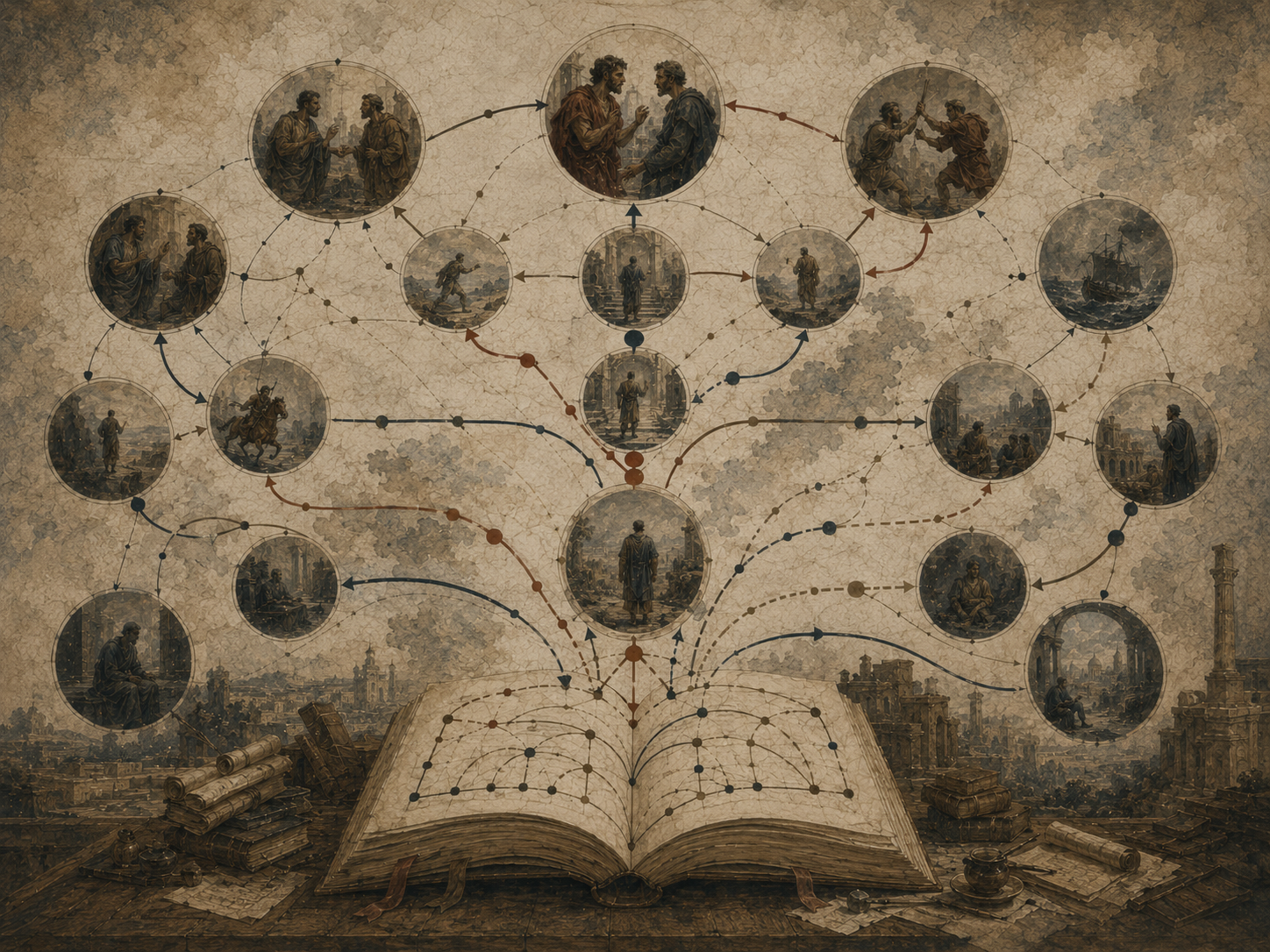
This article explains how narrative movement emerges from unresolved pressure rather than from activity alone. It examines conflict as relation, tension as sustained pressure, stakes as consequence, and movement as change in action, knowledge, value, or possibility. It also includes computational workflows for auditing conflict clarity, tension durability, stakes visibility, agency pressure, movement strength, escalation risk, and Catalyst Canvas-ready governance outputs for responsible story analysis.
Why Conflict Matters in Story
Conflict matters because stories need pressure. Without pressure, events may occur, but they may not move. A character travels, speaks, remembers, works, argues, or waits, but unless some value, desire, condition, relationship, question, or consequence is under pressure, the story may feel static.
Conflict is one way narrative makes pressure visible. It shows that something cannot remain as it is. A person wants something but faces an obstacle. A community remembers one version of the past while another group remembers differently. An institution claims legitimacy while evidence challenges it. A family avoids a truth that keeps returning. A public decision creates consequences that no one can fully control.
Conflict gives story movement because it creates difference: between desire and reality, promise and evidence, value and action, memory and denial, knowledge and uncertainty, freedom and constraint, survival and risk, or present and future. The conflict does not have to be loud. It has to matter.
| Conflict function | Story question | Movement created |
|---|---|---|
| Pressure | What cannot remain stable? | The story begins to move. |
| Obstacle | What resists action or desire? | The story develops difficulty. |
| Choice | What must be decided under pressure? | The story reveals agency. |
| Consequence | What changes because of action or inaction? | The story gains stakes. |
| Uncertainty | What is unknown or unresolved? | The story sustains attention. |
| Transformation | What is altered by the conflict? | The story reaches meaningful change. |
Conflict matters because it helps stories convert condition into movement, movement into consequence, and consequence into meaning.
Conflict Is Not the Same as Tension
Conflict and tension are related, but they are not identical. Conflict is a relation of opposition, incompatibility, constraint, contradiction, or unresolved pressure. Tension is the felt duration of that pressure. Conflict names the structural problem. Tension names how the story sustains that problem over time.
A story can have conflict without tension. A disagreement may appear, but if it is resolved too quickly, carries no consequence, or does not alter the story’s movement, the conflict may feel flat. A story can also have tension without obvious conflict. A character waits for medical results. A community senses a threat but cannot identify it. A narrator withholds a fact. A public report contains a missing number. Nothing may be visibly explosive, but pressure accumulates.
Tension depends on delay, uncertainty, stakes, expectation, and consequence. The audience must feel that something is unresolved and that the unresolved condition matters. Conflict may open the story. Tension keeps the story alive.
| Element | Definition | Weak form | Strong form |
|---|---|---|---|
| Conflict | A structural opposition or incompatibility. | A loud disagreement without consequence. | A pressure relation that changes action. |
| Tension | The sustained experience of unresolved pressure. | Artificial suspense or delay. | Meaningful uncertainty with stakes. |
| Obstacle | Something that resists action, desire, knowledge, or repair. | A temporary inconvenience. | A force that reshapes possible action. |
| Stakes | What can be lost, gained, harmed, revealed, or transformed. | Vague importance. | Clear consequence. |
| Delay | Time between pressure and resolution. | Padding. | Time in which meaning changes. |
| Release | Change in pressure through action, recognition, reversal, or closure. | Simple relief. | A transformation of conditions. |
Conflict is the structure of pressure. Tension is how that pressure lives across the story.
Narrative Movement Is Not Narrative Noise
Narrative movement is not the same as constant activity. A story can contain chases, arguments, disasters, reversals, cliffhangers, and spectacle but still feel empty if those moments do not change the story’s conditions. Noise creates stimulation. Movement creates transformation.
Movement occurs when the story’s state changes. A character knows something they did not know before. A relationship becomes damaged or repaired. A public claim loses credibility. A hidden cause becomes visible. A promise becomes impossible. A community crosses a threshold. A system moves from stress to failure. A narrator’s reliability changes. A moral question becomes harder.
This distinction matters for serious storytelling because conflict can easily become decoration. Writers, editors, communicators, and designers may add conflict to make a story “dramatic” without asking whether the conflict advances meaning. Real narrative movement is structural. It alters what the story can now become.
| Activity | Movement | Diagnostic question |
|---|---|---|
| A scene is loud. | A condition changes. | What is different after the scene? |
| A character argues. | A relationship shifts. | What pressure or consequence changed? |
| A threat appears. | Future options narrow or expand. | What can no longer happen? |
| A reveal occurs. | Prior events are reinterpreted. | What does the audience now understand differently? |
| A crisis escalates. | The system crosses a threshold. | What new state has been reached? |
| An ending arrives. | Pressure is transformed, resolved, suspended, or exposed. | What has the conflict become? |
Narrative movement is the meaningful alteration of story conditions. It is not simply motion on the surface.
Desire, Obstacle, and Pressure
Many plots move because someone wants something and something resists. Desire does not have to mean ambition, romance, conquest, or heroic quest. It can mean safety, truth, recognition, belonging, repair, silence, justice, dignity, understanding, survival, forgiveness, escape, or continuity.
Obstacle does not have to be a villain. It can be law, memory, illness, debt, silence, fear, bureaucracy, climate, distance, shame, inherited obligation, social expectation, technological design, institutional secrecy, or uncertainty. A sophisticated story often works because the obstacle is not simply external; it is woven through relationships, systems, history, and self-understanding.
Pressure emerges when desire and obstacle cannot easily coexist. The story begins to move because the character, group, or institution must respond. They can act, refuse, wait, avoid, compromise, adapt, conceal, confess, resist, or fail. Each response changes the pressure.
| Desire | Obstacle | Pressure created |
|---|---|---|
| Truth | Concealment | Investigation, testimony, exposure, denial. |
| Belonging | Exclusion | Identity conflict, adaptation, resistance. |
| Repair | Unacknowledged harm | Accountability, memory, apology, refusal. |
| Safety | Threat or instability | Risk assessment, flight, protection, compromise. |
| Freedom | Constraint | Strategy, rebellion, negotiation, sacrifice. |
| Meaning | Ambiguity or loss | Interpretation, memory, narrative reconstruction. |
Narrative movement begins when desire meets resistance and the story makes that resistance consequential.
Stakes and Consequence
Stakes are what make tension matter. If nothing can be lost, harmed, revealed, transformed, delayed, corrupted, repaired, or misunderstood, tension weakens. Stakes give conflict weight by making clear why pressure matters.
Stakes can be personal, relational, moral, social, institutional, spiritual, ecological, intellectual, or historical. A love story may have relational stakes. A legal story may have evidentiary and ethical stakes. A climate story may have long-horizon systemic stakes. A memoir may have identity stakes. A public narrative may have legitimacy stakes. A myth may have cosmic or sacred stakes.
Consequence turns stakes into movement. A story does not need catastrophe, but it needs change. Consequence can be visible or subtle: a silence hardens, a trust breaks, an institution loses credibility, a memory returns, a system reaches a threshold, a child understands the family differently, or a community can no longer believe its own official story.
| Stake type | What is at risk? | Possible consequence |
|---|---|---|
| Personal | Identity, desire, safety, dignity, future. | A person changes course or self-understanding. |
| Relational | Trust, loyalty, love, care, betrayal. | A relationship breaks, deepens, or becomes redefined. |
| Moral | Responsibility, justice, guilt, obligation. | A choice reveals values under pressure. |
| Institutional | Legitimacy, authority, accountability, trust. | An institution must disclose, reform, or defend. |
| Social | Belonging, status, recognition, rights. | A group is included, excluded, mobilized, or harmed. |
| Systemic | Stability, resilience, thresholds, feedback loops. | A system adapts, fails, or enters a new regime. |
Stakes make conflict more than opposition. They make it consequential.
Major Forms of Narrative Conflict
Conflict appears in many forms. Traditional teaching often names person versus person, person versus self, person versus society, person versus nature, and similar categories. These are useful starting points, but they can become too narrow if treated as a complete taxonomy.
Modern storytelling often requires more precise categories. A story may involve institutional conflict, epistemic conflict, technological conflict, intergenerational conflict, ecological conflict, memory conflict, narrative conflict, or conflict between competing systems of value. Many of the most important stories are not about a hero defeating an enemy. They are about how pressure circulates through people, institutions, environments, and histories.
A serious analysis of conflict asks: what is actually opposed? Is it one person against another, or a person against a rule? Is the conflict external, internal, moral, structural, historical, informational, or symbolic? Does the conflict belong to the plot, or has it been added merely for drama?
| Conflict form | Core opposition | Story movement |
|---|---|---|
| Internal | Desire, fear, memory, guilt, identity, or belief within a person. | Choice, recognition, self-deception, transformation. |
| Interpersonal | People with incompatible desires, values, or interpretations. | Argument, betrayal, alliance, negotiation, rupture. |
| Moral | Competing values or obligations. | Dilemma, sacrifice, compromise, accountability. |
| Institutional | People or communities against rules, authority, bureaucracy, secrecy, or legitimacy. | Exposure, reform, resistance, procedural struggle. |
| Systemic | Agents inside complex structures of cause and constraint. | Feedback, delay, threshold, unintended consequence. |
| Epistemic | Knowing versus not knowing, proof versus uncertainty, truth versus concealment. | Inquiry, evidence, doubt, recognition, reinterpretation. |
Conflict taxonomy matters because different conflicts move stories in different ways.
Internal Conflict
Internal conflict occurs when pressure operates within a character, narrator, speaker, witness, or collective identity. A person wants to tell the truth but fears the cost. A narrator wants coherence but remembers in fragments. A leader wants reform but depends on the institution being criticized. A community wants continuity but carries unresolved harm.
Internal conflict is not merely indecision. It becomes narrative when the inner pressure affects action, perception, memory, relation, or consequence. The audience must see how the conflict changes what the character can do or understand. A character who simply “feels conflicted” may remain static. A character whose internal division alters choices creates movement.
Internal conflict often creates some of the deepest tension because it cannot be solved by defeating an external opponent. The obstacle is embedded in desire, memory, fear, shame, loyalty, identity, or value. The story moves as the person or group negotiates what cannot easily be separated.
| Internal pressure | Possible action | Narrative movement |
|---|---|---|
| Fear versus duty | A person delays, confesses, hides, or acts. | The moral stakes become visible. |
| Memory versus denial | A past event returns in fragments. | The present is reinterpreted. |
| Desire versus loyalty | A character chooses between self and group. | Identity and relation shift. |
| Guilt versus self-protection | A person rationalizes or accepts responsibility. | Recognition becomes possible or blocked. |
| Hope versus despair | A person acts despite uncertainty. | Future orientation changes. |
| Belief versus evidence | A worldview is tested. | Knowledge and identity come under pressure. |
Internal conflict creates movement when private pressure becomes consequential action, altered understanding, or changed relation.
Interpersonal Conflict
Interpersonal conflict is one of the most familiar forms of narrative pressure. It occurs when people want different things, interpret events differently, hold competing values, or occupy roles that place them in opposition. It can appear as argument, rivalry, betrayal, love under pressure, family obligation, workplace tension, political disagreement, legal contest, or public debate.
Interpersonal conflict is powerful because it makes abstract values visible through relation. Trust becomes concrete when someone is betrayed. Loyalty becomes concrete when someone must choose. Justice becomes concrete when one person harms another. Memory becomes concrete when two people remember the same event differently.
The danger is melodrama without structure. If characters fight because the story needs noise, conflict becomes artificial. Strong interpersonal conflict emerges from pressure already embedded in the story: desire, history, misunderstanding, obligation, scarcity, moral difference, institutional role, or unequal power.
| Interpersonal pattern | Source of tension | Coherence test |
|---|---|---|
| Rivalry | Competing desire, status, recognition, or survival. | Does rivalry change action or stakes? |
| Betrayal | Violation of trust or obligation. | Does betrayal alter the relationship and future movement? |
| Misunderstanding | Different information, assumptions, or interpretations. | Is misunderstanding earned or artificial? |
| Care under pressure | Love, duty, or responsibility becomes costly. | Does care require action or sacrifice? |
| Power imbalance | Unequal authority, resources, status, or vulnerability. | Does the story show structural pressure? |
| Conflicting memory | People remember the past differently. | Does memory conflict reshape identity or legitimacy? |
Interpersonal conflict becomes narratively strong when it reveals values under pressure, not merely personalities in opposition.
Moral Conflict
Moral conflict occurs when values collide. It is not simply good versus evil. In many serious stories, moral conflict appears when responsibility conflicts with loyalty, truth conflicts with safety, justice conflicts with mercy, care conflicts with law, survival conflicts with dignity, or public good conflicts with private obligation.
Moral conflict creates tension because every available action carries cost. A character may do the right thing for one value and betray another. A public institution may act legally but unjustly. A witness may tell the truth and harm someone vulnerable. A community may preserve unity by silencing pain. These conflicts move stories because they make action morally consequential.
Moral conflict should not be simplified too quickly. If one side is obviously correct and the other is merely villainous, the story may still work, but the moral tension may be thin. Stronger moral conflict often preserves pressure by showing why the choice is difficult, what each option protects, what each option harms, and what cannot be repaired.
| Moral collision | Narrative pressure | Responsible treatment |
|---|---|---|
| Truth versus protection | Disclosure may harm or heal. | Show both stakes without hiding accountability. |
| Justice versus mercy | Repair and punishment pull in different directions. | Avoid easy moral closure. |
| Loyalty versus responsibility | Belonging conflicts with public duty. | Show the cost of both loyalty and refusal. |
| Freedom versus care | One person’s autonomy affects another’s vulnerability. | Map dependency and agency carefully. |
| Survival versus dignity | Constraint forces compromised action. | Avoid blaming the constrained actor. |
| Peace versus memory | Silence protects stability but preserves harm. | Distinguish reconciliation from suppression. |
Moral conflict moves stories because it makes choice costly and consequence ethically visible.
Institutional and Systemic Conflict
Institutional and systemic conflicts are central to modern storytelling. They appear when people, communities, or publics encounter rules, bureaucracies, markets, infrastructures, algorithms, laws, schools, courts, hospitals, corporations, governments, archives, or media systems that shape what can happen.
These conflicts are often difficult to narrate because there may be no single villain. A hospital delay, policy failure, environmental crisis, financial collapse, platform harm, supply-chain breakdown, or legal injustice may emerge from many decisions distributed across time. The story must create movement without falsely simplifying causality.
Institutional conflict often moves through exposure, delay, procedure, resistance, reform, denial, documentation, or accountability. Systemic conflict often moves through feedback, threshold, accumulation, unintended consequence, and delayed harm. These patterns require a different narrative logic than simple duel-like conflict.
| Conflict type | Pressure source | Narrative challenge |
|---|---|---|
| Institutional secrecy | Information is withheld or controlled. | Show how concealment alters agency. |
| Bureaucratic delay | Rules slow or block action. | Make delay consequential rather than dull. |
| Legal conflict | Evidence, procedure, rights, and responsibility collide. | Respect proof, uncertainty, and due process. |
| Platform conflict | Visibility, amplification, and context collapse shape meaning. | Show algorithmic and social incentives. |
| Infrastructure conflict | Systems fail under stress or neglect. | Make hidden dependencies visible. |
| Environmental conflict | Human action meets ecological limit. | Represent scale, delay, feedback, and uncertainty. |
Institutional and systemic conflict create narrative movement by showing how power, rules, incentives, and delayed consequences shape action.
Epistemic Conflict and the Struggle to Know
Epistemic conflict is conflict over knowledge. Who knows what? Who is believed? What counts as evidence? What remains hidden? What is rumor, testimony, proof, interpretation, memory, propaganda, or silence? Many stories move because the truth is incomplete, contested, buried, distorted, or too dangerous to acknowledge.
Mysteries, investigations, legal dramas, historical narratives, memoirs, political stories, institutional accountability stories, and trauma narratives often depend on epistemic conflict. The movement is not only external action; it is movement from uncertainty to partial knowledge, from ignorance to recognition, from official story to counter-story, or from false certainty to responsible doubt.
Epistemic conflict must be handled carefully. A story can create suspense by withholding knowledge, but it can also manipulate the audience unfairly. A public narrative can challenge official truth, but it can also promote conspiracy. A memoir can preserve uncertainty, but it can also overstate what memory can prove. Coherence requires showing how knowledge changes and what limits remain.
| Knowledge conflict | Story movement | Risk |
|---|---|---|
| Ignorance to discovery | A hidden fact becomes known. | The reveal may feel unearned. |
| Official story versus counter-story | Public meaning is contested. | Counter-story may also require evidence. |
| Memory versus record | Personal recollection meets archive or documentation. | Either memory or record may be oversimplified. |
| Evidence versus belief | A worldview is challenged. | The story may mock belief rather than examine it. |
| Testimony versus disbelief | A witness struggles to be heard. | The story may exploit testimony for effect. |
| Uncertainty versus closure | The story must decide what can be known. | Closure may exceed available evidence. |
Epistemic conflict creates movement by changing what can be known, believed, challenged, or responsibly left unresolved.
Tension Over Time
Tension is temporal. It depends on what has happened, what has not yet happened, what might happen, what has been delayed, what has been withheld, and what consequences are accumulating. A story sustains tension by managing time.
Some tension comes from anticipation. The audience knows something is coming but not when. Some comes from dramatic irony. The audience knows something a character does not. Some comes from mystery. Neither audience nor character knows enough. Some comes from delay. A decision, answer, meeting, or disclosure is postponed. Some comes from accumulation. Small pressures build until a threshold is reached.
Tension over time must be managed with care. Too much delay without development becomes padding. Too much escalation without consequence becomes inflation. Too much uncertainty without structure becomes confusion. Good tension changes while it lasts. The audience should feel that pressure is accumulating, shifting, deepening, narrowing, or transforming.
| Tension pattern | How it works | Failure mode |
|---|---|---|
| Anticipation | The audience expects an event, decision, or consequence. | Expectation is delayed without development. |
| Dramatic irony | The audience knows more than a character. | Characters remain ignorant artificially. |
| Mystery | Knowledge is incomplete. | The solution is unsupported by prior structure. |
| Accumulation | Small pressures build toward threshold. | Pressure resets instead of building. |
| Compression | Time, options, or resources narrow. | Urgency feels manufactured. |
| Suspension | Resolution is withheld for meaning. | The story avoids necessary consequence. |
Tension lasts when pressure develops. It fails when pressure merely repeats.
Escalation, Reversal, and Release
Narrative movement often depends on changes in pressure. Escalation increases pressure. Reversal changes direction. Release transforms or reduces pressure. These movements can be dramatic, subtle, emotional, intellectual, institutional, or symbolic.
Escalation does not simply mean making things bigger. It means making the conflict more consequential. The cost rises. The options narrow. The hidden truth becomes harder to avoid. The relationship becomes more fragile. The institution faces more evidence. The system moves closer to failure. Good escalation deepens pressure rather than merely increasing volume.
Reversal changes expectation. A success becomes danger. A trusted figure becomes suspect. A delay becomes evidence. A minor action becomes decisive. A supposed ending becomes a new beginning. Release occurs when pressure changes state: confession, exposure, reconciliation, rupture, refusal, verdict, collapse, recognition, or unresolved suspension.
| Movement type | What changes? | Strong use |
|---|---|---|
| Escalation | Pressure increases or consequences deepen. | Raises stakes through structural change. |
| Complication | New information or constraints alter the conflict. | Makes action harder in a meaningful way. |
| Reversal | Direction or expectation changes. | Surprises while remaining earned. |
| Recognition | Knowledge or relation becomes visible. | Changes interpretation and action. |
| Release | Pressure transforms, resolves, or shifts. | Creates consequence, not just relief. |
| Suspension | Pressure remains unresolved. | Marks ongoing consequence honestly. |
Narrative movement depends on how pressure changes, not merely on whether conflict exists.
The Ethics of Conflict
Conflict is powerful, but it is ethically risky. Stories can use conflict to clarify injustice, responsibility, danger, and moral choice. They can also use conflict to manufacture enemies, simplify systems, exploit suffering, intensify fear, or make violence feel inevitable.
A story should not add conflict simply to increase attention. Conflict creates frames of responsibility. It tells audiences who is opposed, who is harmed, who acts, who resists, who deserves sympathy, and what outcome matters. These frames shape public judgment. In civic, institutional, legal, journalistic, historical, and educational storytelling, careless conflict can distort reality.
Ethical conflict analysis asks whether the conflict is truthful, proportional, contextual, and accountable. Does the story scapegoat a person or group? Does it confuse structural harm with individual villainy? Does it romanticize suffering? Does it turn trauma into spectacle? Does it preserve agency? Does it allow complexity where complexity matters?
| Ethical risk | How it appears | Responsible alternative |
|---|---|---|
| Scapegoating | A complex problem is embodied in one convenient villain. | Map systems, incentives, and distributed responsibility. |
| Conflict inflation | Minor disagreement is dramatized as existential struggle. | Keep stakes proportional. |
| Trauma spectacle | Suffering is used mainly to intensify the story. | Center dignity, consent, context, and aftermath. |
| False balance | Unequal harms are treated as symmetrical conflict. | Represent power and consequence accurately. |
| Villain simplification | Motive is flattened into pure evil. | Distinguish moral judgment from crude reduction. |
| Resolution fantasy | Conflict ends neatly before repair is complete. | Name unresolved consequence and accountability. |
The ethical task is not to remove conflict from story. It is to make conflict accountable to truth, proportion, dignity, and consequence.
Examples of Conflict and Narrative Movement
The examples below show how conflict can be analyzed as pressure, not merely opposition.
Family memory conflict
Weak: Two family members argue about the past.
Stronger: Their disagreement reveals different loyalties, silences, wounds, and responsibilities.
Why it works: Conflict changes memory, identity, and relation.
Institutional accountability story
Weak: A single leader is blamed for a complex failure.
Stronger: The story maps secrecy, incentives, policy, delay, documentation, and decision points.
Why it works: Systemic conflict becomes legible without false simplification.
Quiet internal conflict
Weak: A character feels uncertain but does not act differently.
Stronger: Their uncertainty changes what they say, hide, refuse, or risk.
Why it works: Inner pressure becomes narrative movement.
Public testimony
Weak: The testimony is used only to create emotion.
Stronger: The testimony introduces a conflict between lived experience, official denial, and public evidence.
Why it works: Personal story becomes public pressure.
Environmental conflict
Weak: Nature is treated as an enemy to defeat.
Stronger: The plot shows human systems encountering ecological limits, feedback, and delayed consequence.
Why it works: Conflict becomes systemic rather than cartoonish.
Knowledge conflict
Weak: A final reveal appears from nowhere.
Stronger: Earlier uncertainty, clues, omissions, and contradictions prepare recognition.
Why it works: Discovery changes meaning rather than merely surprising the audience.
Conflict becomes meaningful when it alters pressure, knowledge, relationship, agency, or future possibility.
Mathematics, Computation, and Modeling
Conflict and tension cannot be reduced to formulas, but modeling can help make narrative pressure visible. A computational workflow can audit whether conflict is clear, whether tension develops, whether stakes are visible, whether movement changes story conditions, and whether conflict is ethically risky.
A conflict clarity score can estimate whether the pressure relation is legible:
C_f = \frac{D_c + O_c + P_s + A_g + S_v + R_l}{6}
\]
Interpretation: Conflict clarity \(C_f\) averages desire clarity \(D_c\), obstacle clarity \(O_c\), pressure strength \(P_s\), agency visibility \(A_g\), stakes visibility \(S_v\), and relation legibility \(R_l\).
A tension durability score can estimate whether pressure develops over time:
T_d = \frac{U_p + D_l + S_h + E_p + C_m}{5}
\]
Interpretation: Tension durability \(T_d\) averages unresolved pressure \(U_p\), meaningful delay \(D_l\), stakes heightening \(S_h\), expectation pressure \(E_p\), and complication movement \(C_m\).
A narrative movement score can estimate whether conflict changes story conditions:
M_n = \frac{S_c + K_c + R_i + P_c + F_m + V_t}{6}
\]
Interpretation: Narrative movement \(M_n\) averages state change \(S_c\), knowledge change \(K_c\), relationship impact \(R_i\), pressure change \(P_c\), future movement \(F_m\), and value transformation \(V_t\).
A conflict-risk score can estimate when conflict may be ethically unsafe:
R_f = S_gw_s + I_fw_i + T_sw_t + F_bw_f + C_pw_c
\]
Interpretation: Conflict risk \(R_f\) rises with scapegoating \(S_g\), conflict inflation \(I_f\), trauma spectacle \(T_s\), false balance \(F_b\), and closure pressure \(C_p\).
| Modeling task | Narrative question | Example output |
|---|---|---|
| Conflict clarity audit | Is the pressure relation legible? | Conflict clarity score. |
| Tension durability audit | Does pressure develop rather than repeat? | Tension durability table. |
| Movement audit | Does conflict change story conditions? | Narrative movement score. |
| Stakes audit | What can be lost, gained, harmed, or transformed? | Stakes visibility report. |
| Escalation audit | Does pressure deepen meaningfully? | Escalation and complication map. |
| Ethical conflict audit | Does conflict distort responsibility or exploit harm? | Conflict governance queue. |
Computation can support narrative analysis by making conflict pressure explicit. It should not replace human judgment about meaning, ethics, context, or representation.
Python Workflow: Conflict and Tension Audit
The Python workflow below evaluates story items by desire clarity, obstacle clarity, pressure strength, agency visibility, stakes visibility, relation legibility, unresolved pressure, meaningful delay, stakes heightening, expectation pressure, complication movement, state change, knowledge change, relationship impact, future movement, value transformation, scapegoating, conflict inflation, trauma spectacle, false balance, and closure pressure. The companion repository version extends this into a Catalyst Canvas-ready module with schemas, package-style Python, tests, JSON exports, Canvas cards, markdown governance queues, and reusable conflict-analysis templates.
# conflict_tension_audit.py
# Dependency-light workflow for auditing conflict, tension, and narrative movement.

from __future__ import annotations

from dataclasses import dataclass
from pathlib import Path
import csv
import json
from statistics import mean

ARTICLE_ROOT = Path(__file__).resolve().parents[1]
OUTPUTS = ARTICLE_ROOT / "outputs"
TABLES = OUTPUTS / "tables"
JSON_DIR = OUTPUTS / "json"
MARKDOWN = OUTPUTS / "markdown"


@dataclass
class ConflictTensionItem:
    item: str
    story_type: str
    desire_clarity: float
    obstacle_clarity: float
    pressure_strength: float
    agency_visibility: float
    stakes_visibility: float
    relation_legibility: float
    unresolved_pressure: float
    meaningful_delay: float
    stakes_heightening: float
    expectation_pressure: float
    complication_movement: float
    state_change: float
    knowledge_change: float
    relationship_impact: float
    pressure_change: float
    future_movement: float
    value_transformation: float
    scapegoating: float
    conflict_inflation: float
    trauma_spectacle: float
    false_balance: float
    closure_pressure: float
    audience_sensitivity: float
    public_consequence: float
    owner: str
    status: str

    def conflict_clarity(self) -> float:
        return mean([
            self.desire_clarity,
            self.obstacle_clarity,
            self.pressure_strength,
            self.agency_visibility,
            self.stakes_visibility,
            self.relation_legibility,
        ])

    def tension_durability(self) -> float:
        return mean([
            self.unresolved_pressure,
            self.meaningful_delay,
            self.stakes_heightening,
            self.expectation_pressure,
            self.complication_movement,
        ])

    def narrative_movement(self) -> float:
        return mean([
            self.state_change,
            self.knowledge_change,
            self.relationship_impact,
            self.pressure_change,
            self.future_movement,
            self.value_transformation,
        ])

    def conflict_risk(self) -> float:
        return min(
            1.0,
            self.scapegoating * 0.25
            + self.conflict_inflation * 0.20
            + self.trauma_spectacle * 0.20
            + self.false_balance * 0.20
            + self.closure_pressure * 0.15,
        )

    def governance_priority_score(self) -> float:
        return min(
            1.0,
            self.conflict_risk() * 0.35
            + self.audience_sensitivity * 0.20
            + self.public_consequence * 0.25
            + (1 - self.conflict_clarity()) * 0.20,
        )

    def review_priority(self) -> str:
        risk = self.conflict_risk()
        priority = self.governance_priority_score()
        clarity = self.conflict_clarity()
        movement = self.narrative_movement()

        if self.status == "revise" or risk >= 0.55 or priority >= 0.62 or clarity < 0.55 or movement < 0.50:
            return "high"
        if self.status == "review" or risk >= 0.40 or priority >= 0.48 or clarity < 0.68:
            return "medium"
        return "standard"


def write_csv(path: Path, rows: list[dict[str, object]]) -> None:
    path.parent.mkdir(parents=True, exist_ok=True)
    if not rows:
        raise ValueError(f"No rows to write: {path}")
    with path.open("w", encoding="utf-8", newline="") as handle:
        writer = csv.DictWriter(handle, fieldnames=list(rows[0].keys()))
        writer.writeheader()
        writer.writerows(rows)


def write_json(path: Path, payload: object) -> None:
    path.parent.mkdir(parents=True, exist_ok=True)
    path.write_text(json.dumps(payload, indent=2), encoding="utf-8")


def write_markdown_queue(path: Path, rows: list[dict[str, object]]) -> None:
    path.parent.mkdir(parents=True, exist_ok=True)
    lines = [
        "# Conflict and Tension Governance Queue",
        "",
        "| Item | Type | Conflict clarity | Tension durability | Movement | Risk | Priority | Owner |",
        "|---|---|---:|---:|---:|---:|---|---|",
    ]

    for row in rows:
        lines.append(
            f"| {row['item']} | {row['story_type']} | "
            f"{row['conflict_clarity']} | {row['tension_durability']} | "
            f"{row['narrative_movement']} | {row['conflict_risk']} | "
            f"{row['review_priority']} | {row['owner']} |"
        )

    path.write_text("\n".join(lines) + "\n", encoding="utf-8")


def main() -> None:
    items = [
        ConflictTensionItem(
            "Family memory conflict",
            "memory narrative",
            0.78, 0.74, 0.76, 0.72, 0.80, 0.78,
            0.76, 0.70, 0.72, 0.68, 0.74,
            0.66, 0.82, 0.78, 0.72, 0.70, 0.76,
            0.22, 0.28, 0.34, 0.30, 0.42,
            0.78, 0.64,
            "editorial", "active"
        ),
        ConflictTensionItem(
            "Institutional accountability story",
            "public narrative",
            0.72, 0.80, 0.84, 0.62, 0.88, 0.76,
            0.82, 0.78, 0.84, 0.74, 0.80,
            0.70, 0.76, 0.68, 0.84, 0.72, 0.78,
            0.48, 0.58, 0.42, 0.56, 0.70,
            0.90, 0.88,
            "governance", "review"
        ),
        ConflictTensionItem(
            "Digital outrage conflict",
            "platform narrative",
            0.66, 0.72, 0.90, 0.50, 0.86, 0.54,
            0.88, 0.40, 0.76, 0.92, 0.54,
            0.58, 0.48, 0.52, 0.66, 0.60, 0.44,
            0.84, 0.88, 0.72, 0.74, 0.78,
            0.92, 0.90,
            "platform review", "revise"
        ),
        ConflictTensionItem(
            "Quiet internal dilemma",
            "literary narrative",
            0.74, 0.66, 0.68, 0.82, 0.70, 0.72,
            0.72, 0.76, 0.66, 0.62, 0.68,
            0.60, 0.74, 0.62, 0.70, 0.64, 0.72,
            0.18, 0.22, 0.20, 0.18, 0.34,
            0.62, 0.48,
            "research", "active"
        ),
        ConflictTensionItem(
            "Over-simplified villain plot",
            "conflict-heavy fiction",
            0.70, 0.78, 0.82, 0.64, 0.76, 0.58,
            0.74, 0.52, 0.70, 0.76, 0.60,
            0.58, 0.48, 0.50, 0.64, 0.56, 0.42,
            0.82, 0.76, 0.48, 0.68, 0.60,
            0.70, 0.66,
            "structure review", "review"
        ),
    ]

    rows = []

    for item in items:
        rows.append({
            "item": item.item,
            "story_type": item.story_type,
            "conflict_clarity": round(item.conflict_clarity(), 3),
            "tension_durability": round(item.tension_durability(), 3),
            "narrative_movement": round(item.narrative_movement(), 3),
            "conflict_risk": round(item.conflict_risk(), 3),
            "governance_priority_score": round(item.governance_priority_score(), 3),
            "review_priority": item.review_priority(),
            "owner": item.owner,
            "status": item.status,
        })

    priority_order = {"high": 3, "medium": 2, "standard": 1}
    rows = sorted(
        rows,
        key=lambda row: (
            priority_order.get(str(row["review_priority"]), 0),
            float(row["conflict_risk"])
        ),
        reverse=True,
    )

    governance_queue = [
        row for row in rows
        if row["review_priority"] != "standard"
    ]

    write_csv(TABLES / "conflict_tension_audit.csv", rows)
    write_csv(TABLES / "conflict_tension_governance_queue.csv", governance_queue)

    write_json(JSON_DIR / "conflict_tension_canvas_cards.json", rows)
    write_json(JSON_DIR / "conflict_tension_governance_queue.json", governance_queue)

    write_markdown_queue(MARKDOWN / "conflict_tension_governance_queue.md", governance_queue)

    print("Conflict and tension audit complete.")


if __name__ == "__main__":
    main()
This workflow helps identify whether conflict creates meaningful movement or whether it requires review for weak pressure, repeated tension, scapegoating, trauma spectacle, conflict inflation, false balance, or premature closure.
R Workflow: Narrative Movement Diagnostics
The R workflow below creates a synthetic conflict-and-tension dataset, calculates conflict clarity, tension durability, narrative movement, conflict risk, governance priority, and review priority, then exports summary tables and base R plots. It is intentionally portable and uses only base R.
# conflict_tension_diagnostics.R
# Base R workflow for conflict, tension, and narrative movement.

args <- commandArgs(trailingOnly = FALSE)
file_arg <- grep("^--file=", args, value = TRUE)

if (length(file_arg) > 0) {
  script_path <- normalizePath(sub("^--file=", "", file_arg[1]), mustWork = TRUE)
  article_root <- normalizePath(file.path(dirname(script_path), ".."), mustWork = TRUE)
} else {
  article_root <- getwd()
}

setwd(article_root)

tables_dir <- file.path(article_root, "outputs", "tables")
figures_dir <- file.path(article_root, "outputs", "figures")
dir.create(tables_dir, recursive = TRUE, showWarnings = FALSE)
dir.create(figures_dir, recursive = TRUE, showWarnings = FALSE)

items <- data.frame(
  item = c(
    "Family memory conflict",
    "Institutional accountability story",
    "Digital outrage conflict",
    "Quiet internal dilemma",
    "Over-simplified villain plot"
  ),
  story_type = c(
    "memory narrative",
    "public narrative",
    "platform narrative",
    "literary narrative",
    "conflict-heavy fiction"
  ),
  desire_clarity = c(0.78, 0.72, 0.66, 0.74, 0.70),
  obstacle_clarity = c(0.74, 0.80, 0.72, 0.66, 0.78),
  pressure_strength = c(0.76, 0.84, 0.90, 0.68, 0.82),
  agency_visibility = c(0.72, 0.62, 0.50, 0.82, 0.64),
  stakes_visibility = c(0.80, 0.88, 0.86, 0.70, 0.76),
  relation_legibility = c(0.78, 0.76, 0.54, 0.72, 0.58),
  unresolved_pressure = c(0.76, 0.82, 0.88, 0.72, 0.74),
  meaningful_delay = c(0.70, 0.78, 0.40, 0.76, 0.52),
  stakes_heightening = c(0.72, 0.84, 0.76, 0.66, 0.70),
  expectation_pressure = c(0.68, 0.74, 0.92, 0.62, 0.76),
  complication_movement = c(0.74, 0.80, 0.54, 0.68, 0.60),
  state_change = c(0.66, 0.70, 0.58, 0.60, 0.58),
  knowledge_change = c(0.82, 0.76, 0.48, 0.74, 0.48),
  relationship_impact = c(0.78, 0.68, 0.52, 0.62, 0.50),
  pressure_change = c(0.72, 0.84, 0.66, 0.70, 0.64),
  future_movement = c(0.70, 0.72, 0.60, 0.64, 0.56),
  value_transformation = c(0.76, 0.78, 0.44, 0.72, 0.42),
  scapegoating = c(0.22, 0.48, 0.84, 0.18, 0.82),
  conflict_inflation = c(0.28, 0.58, 0.88, 0.22, 0.76),
  trauma_spectacle = c(0.34, 0.42, 0.72, 0.20, 0.48),
  false_balance = c(0.30, 0.56, 0.74, 0.18, 0.68),
  closure_pressure = c(0.42, 0.70, 0.78, 0.34, 0.60),
  audience_sensitivity = c(0.78, 0.90, 0.92, 0.62, 0.70),
  public_consequence = c(0.64, 0.88, 0.90, 0.48, 0.66),
  owner = c("editorial", "governance", "platform review", "research", "structure review"),
  status = c("active", "review", "revise", "active", "review"),
  stringsAsFactors = FALSE
)

items$conflict_clarity <- rowMeans(items[, c(
  "desire_clarity",
  "obstacle_clarity",
  "pressure_strength",
  "agency_visibility",
  "stakes_visibility",
  "relation_legibility"
)])

items$tension_durability <- rowMeans(items[, c(
  "unresolved_pressure",
  "meaningful_delay",
  "stakes_heightening",
  "expectation_pressure",
  "complication_movement"
)])

items$narrative_movement <- rowMeans(items[, c(
  "state_change",
  "knowledge_change",
  "relationship_impact",
  "pressure_change",
  "future_movement",
  "value_transformation"
)])

items$conflict_risk <- pmin(
  1,
  items$scapegoating * 0.25 +
    items$conflict_inflation * 0.20 +
    items$trauma_spectacle * 0.20 +
    items$false_balance * 0.20 +
    items$closure_pressure * 0.15
)

items$governance_priority_score <- pmin(
  1,
  items$conflict_risk * 0.35 +
    items$audience_sensitivity * 0.20 +
    items$public_consequence * 0.25 +
    (1 - items$conflict_clarity) * 0.20
)

items$review_priority <- ifelse(
  items$status == "revise" | items$conflict_risk >= 0.55 | items$governance_priority_score >= 0.62 | items$conflict_clarity < 0.55 | items$narrative_movement < 0.50,
  "high",
  ifelse(
    items$status == "review" | items$conflict_risk >= 0.40 | items$governance_priority_score >= 0.48 | items$conflict_clarity < 0.68,
    "medium",
    "standard"
  )
)

items <- items[order(items$conflict_risk, decreasing = TRUE), ]

write.csv(
  items,
  file.path(tables_dir, "conflict_tension_diagnostics.csv"),
  row.names = FALSE
)

governance_queue <- items[items$review_priority != "standard", ]

write.csv(
  governance_queue,
  file.path(tables_dir, "conflict_tension_governance_queue.csv"),
  row.names = FALSE
)

png(file.path(figures_dir, "conflict_clarity_scores.png"), width = 1200, height = 700)
barplot(
  items$conflict_clarity,
  names.arg = items$item,
  las = 2,
  ylab = "Conflict clarity",
  main = "Conflict Clarity Scores"
)
grid()
dev.off()

png(file.path(figures_dir, "conflict_risk_scores.png"), width = 1200, height = 700)
barplot(
  items$conflict_risk,
  names.arg = items$item,
  las = 2,
  ylab = "Conflict risk",
  main = "Conflict Risk Scores"
)
grid()
dev.off()

print(items[, c(
  "item",
  "story_type",
  "conflict_clarity",
  "tension_durability",
  "narrative_movement",
  "conflict_risk",
  "governance_priority_score",
  "review_priority"
)])
This workflow turns conflict and tension into a reviewable editorial artifact. It helps identify whether a story has meaningful pressure, durable tension, structural movement, and ethical conflict governance.
GitHub Repository
The companion repository for this article supports conflict, tension, and narrative movement as a Catalyst Canvas-ready analysis module. It includes conflict-clarity audits, tension-durability diagnostics, movement scoring, stakes visibility, escalation maps, ethical conflict-risk scoring, JSON schemas, package-style Python, R workflows, SQL structures, Canvas cards, markdown governance queues, synthetic datasets, documentation, and reusable conflict-analysis templates.
Complete Code Repository
Companion repository for the article, including Catalyst Canvas-ready code for conflict clarity, tension durability, stakes visibility, narrative movement, escalation, conflict risk, ethical governance, JSON exports, Canvas cards, and reproducible research workflows.
articles/conflict-tension-and-the-logic-of-narrative-movement/
├── canvas/
│   ├── canvas_manifest.json
│   ├── input_schema.json
│   ├── output_schema.json
│   ├── canvas_cards.json
│   └── governance_queue.json
├── html/
├── css/
├── php/
├── java/
├── python/
│   ├── conflict_tension_canvas/
│   │   ├── __init__.py
│   │   ├── __main__.py
│   │   ├── cli.py
│   │   ├── models.py
│   │   ├── scoring.py
│   │   ├── validation.py
│   │   ├── governance.py
│   │   └── exporters.py
│   ├── tests/
│   │   └── test_conflict_tension_canvas.py
│   └── run_conflict_tension_canvas_audit.py
├── r/
│   ├── conflict_tension_diagnostics.R
│   └── run_all_conflict_tension_workflows.R
├── sql/
│   ├── canvas_schema.sql
│   └── canvas_queries.sql
├── docs/
│   ├── article_notes.md
│   ├── modeling_principles.md
│   ├── conflict_vs_tension.md
│   ├── narrative_movement.md
│   ├── stakes_and_consequence.md
│   ├── conflict_risk.md
│   └── governance_notes.md
├── data/
│   ├── conflict_tension_items.csv
│   ├── conflict_patterns.csv
│   ├── tension_progressions.csv
│   ├── movement_events.csv
│   ├── conflict_risks.csv
│   └── conflict_governance_notes.csv
├── outputs/
│   ├── figures/
│   ├── json/
│   ├── markdown/
│   └── tables/
├── notebooks/
├── shared/
│   ├── schemas/
│   ├── narrative-templates/
│   ├── story-archetypes/
│   ├── character-models/
│   ├── plot-structures/
│   ├── rhetorical-frameworks/
│   ├── cultural-memory/
│   ├── conflict-tension/
│   └── governance/
├── tests/
└── README.md
Related Articles
- Plot, Action, and Narrative Coherence
- Reversal, Recognition, and Transformation
- Voice, Perspective, and Point of View
- Beginnings, Endings, and Narrative Closure
- Rhetoric, Persuasion, and the Public Life of Story
- Narrative Risk and the Misuse of Story
A Practical Method for Analyzing Narrative Movement
1. Identify the conflict relation
Ask what is opposed, constrained, incompatible, hidden, delayed, or unresolved.
2. Separate conflict from noise
Ask whether the conflict changes anything or only adds activity.
3. Identify desire and obstacle
Name what is wanted, needed, protected, feared, resisted, or blocked.
4. Clarify stakes
Ask what can be lost, gained, harmed, transformed, exposed, or misunderstood.
5. Track pressure over time
Ask whether tension develops, repeats, escalates, compresses, or dissolves.
6. Map movement events
Identify where state, knowledge, relationship, pressure, future possibility, or value changes.
7. Examine escalation
Ask whether pressure deepens meaningfully or merely becomes louder.
8. Test release
Ask whether the conflict resolves, transforms, reverses, suspends, or exposes unresolved consequence.
9. Audit ethical risk
Look for scapegoating, false balance, conflict inflation, trauma spectacle, villain simplification, and premature closure.
10. Add governance notes
Document review owner, representation concerns, evidence limits, public consequence, and revision recommendations.
This method treats conflict as structured pressure rather than a generic requirement for drama.
Common Pitfalls
Several pitfalls appear when conflict and tension are misunderstood.
- Confusing conflict with loudness: Arguments, violence, and spectacle do not automatically create narrative movement.
- Adding conflict without consequence: A conflict that changes nothing is usually ornamental.
- Repeating pressure instead of developing tension: Tension should accumulate, shift, deepen, or transform.
- Making stakes vague: Audiences need to understand what can be lost, harmed, exposed, or changed.
- Flattening systems into villains: Complex institutional or systemic conflicts require more than one antagonist.
- Overusing crisis: Constant emergency can exhaust meaning and reduce credibility.
- Confusing ambiguity with tension: Unclear information creates tension only when it is structured and consequential.
- Using trauma as spectacle: Suffering should not be added merely to intensify drama.
- Creating false balance: Not every conflict is symmetrical in power, harm, or responsibility.
- Resolving pressure too neatly: Some conflicts require honest suspension, aftermath, or accountability rather than tidy closure.
The central pitfall is treating conflict as a surface feature instead of a logic of pressure, movement, and consequence.
Why Narrative Movement Matters
Narrative movement matters because stories are not merely containers for events. They are structures of pressure and change. Conflict, tension, and movement help audiences understand why action matters, why choices become difficult, why knowledge changes, why consequences accumulate, and why a story cannot remain still.
Conflict gives the story pressure. Tension sustains that pressure over time. Narrative movement transforms the pressure into action, recognition, consequence, or unresolved responsibility. When these elements work together, a story becomes more than a sequence of scenes. It becomes an intelligible movement through difficulty.
The strongest stories do not use conflict as decoration. They use it as a way to reveal values under pressure, systems under strain, people under constraint, and futures under question. Conflict is not the whole of storytelling, but it is one of the central ways stories move.
Further Reading
- Aristotle (1995) Poetics. In Poetics. Longinus: On the Sublime. Demetrius: On Style. Translated by S. Halliwell. Cambridge, MA: Harvard University Press. Available at: https://www.hup.harvard.edu/books/9780674995635
- Aristotle (n.d.) Poetics. Translated by S.H. Butcher. The Internet Classics Archive. Available at: https://classics.mit.edu/Aristotle/poetics.1.1.html
- Brooks, P. (1992) Reading for the Plot: Design and Intention in Narrative. Cambridge, MA: Harvard University Press. Available at: https://books.google.com/books/about/Reading_for_the_Plot.html?id=pofL1Hyfvc8C
- Chatman, S. (1978) Story and Discourse: Narrative Structure in Fiction and Film. Ithaca: Cornell University Press. Available at: https://books.google.com/books/about/Story_and_Discourse.html?id=ewrOp9uPjYUC
- Herman, D. (2009) Basic Elements of Narrative. Malden, MA: Wiley-Blackwell.
- Kermode, F. (1967) The Sense of an Ending: Studies in the Theory of Fiction. Oxford: Oxford University Press.
- Polkinghorne, D.E. (1988) Narrative Knowing and the Human Sciences. Albany: State University of New York Press.
- Ricoeur, P. (1984) Time and Narrative, Volume 1. Translated by K. McLaughlin and D. Pellauer. Chicago: University of Chicago Press. Available at: https://press.uchicago.edu/ucp/books/book/chicago/T/bo5962044.html
- Ryan, M.-L. (1991) Possible Worlds, Artificial Intelligence, and Narrative Theory. Bloomington: Indiana University Press.
- Turner, M. (1996) The Literary Mind. Oxford: Oxford University Press.
References
- Aristotle (1995) Poetics. In Poetics. Longinus: On the Sublime. Demetrius: On Style. Translated by S. Halliwell. Cambridge, MA: Harvard University Press. Available at: https://www.hup.harvard.edu/books/9780674995635
- Aristotle (n.d.) Poetics. Translated by S.H. Butcher. The Internet Classics Archive. Available at: https://classics.mit.edu/Aristotle/poetics.1.1.html
- Brooks, P. (1992) Reading for the Plot: Design and Intention in Narrative. Cambridge, MA: Harvard University Press. Available at: https://books.google.com/books/about/Reading_for_the_Plot.html?id=pofL1Hyfvc8C
- Chatman, S. (1978) Story and Discourse: Narrative Structure in Fiction and Film. Ithaca: Cornell University Press. Available at: https://books.google.com/books/about/Story_and_Discourse.html?id=ewrOp9uPjYUC
- Herman, D. (2009) Basic Elements of Narrative. Malden, MA: Wiley-Blackwell.
- Kermode, F. (1967) The Sense of an Ending: Studies in the Theory of Fiction. Oxford: Oxford University Press.
- Polkinghorne, D.E. (1988) Narrative Knowing and the Human Sciences. Albany: State University of New York Press.
- Ricoeur, P. (1984) Time and Narrative, Volume 1. Translated by K. McLaughlin and D. Pellauer. Chicago: University of Chicago Press. Available at: https://press.uchicago.edu/ucp/books/book/chicago/T/bo5962044.html
- Ryan, M.-L. (1991) Possible Worlds, Artificial Intelligence, and Narrative Theory. Bloomington: Indiana University Press.
- Turner, M. (1996) The Literary Mind. Oxford: Oxford University Press.