
Last Updated June 10, 2026
Aristotle’s Poetics is one of the earliest surviving works to treat plot as an analyzable structure rather than merely a sequence of events. It does not offer a modern screenwriting formula, a universal template, or a simple recipe for dramatic success. It asks a deeper question: what makes an action intelligible, complete, emotionally consequential, and artistically unified?
Aristotle and the Earliest Theory of Plot examines how Aristotle’s account of tragedy shaped later thinking about story structure, action, causality, unity, reversal, recognition, character, spectacle, and emotional effect. The article treats Aristotle not as a rigid rule-maker but as an early analyst of narrative design: someone who understood plot as an organized action whose parts must relate to one another through probability, necessity, consequence, and meaningful change.
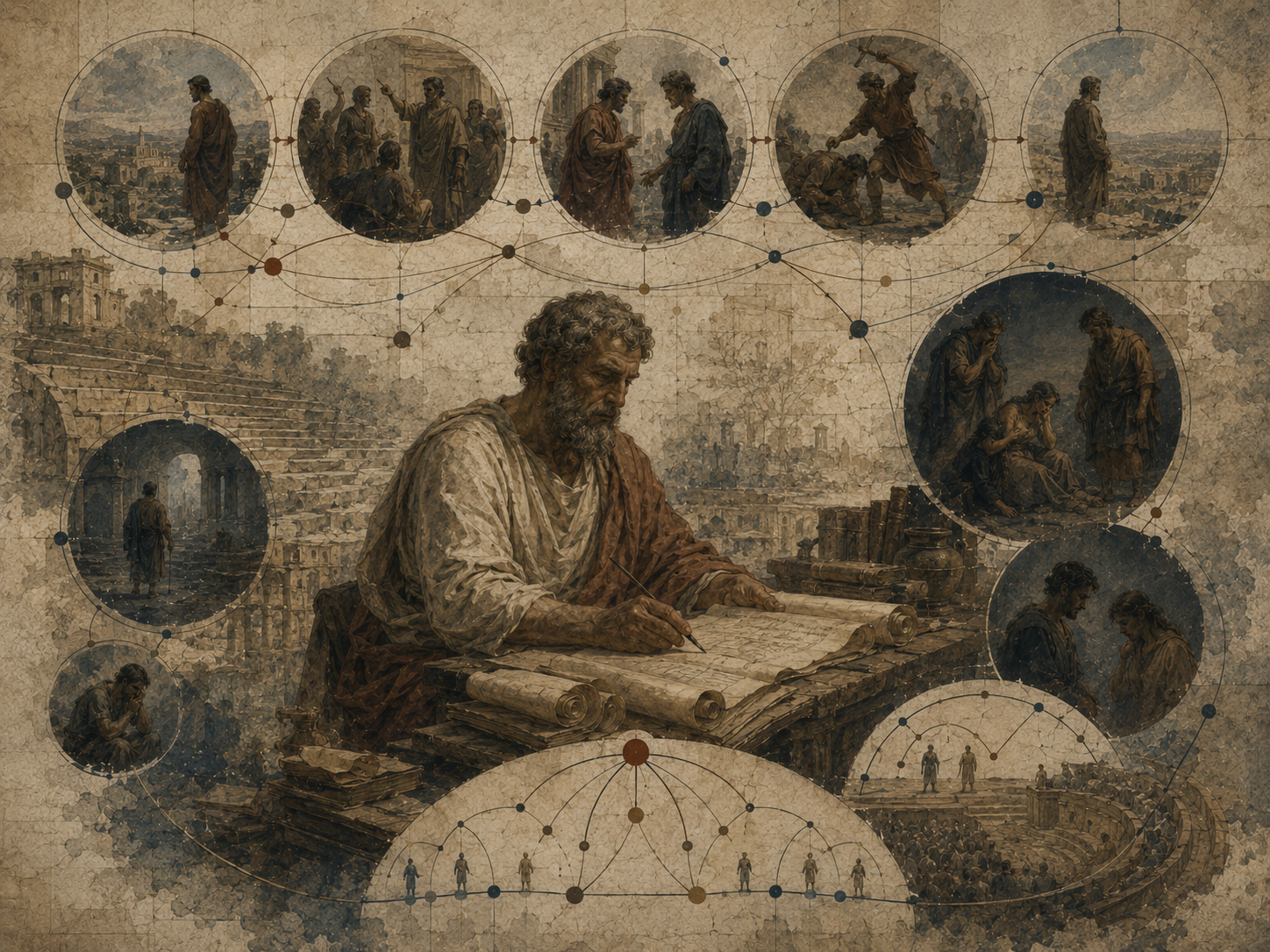
This article places Aristotle’s theory of plot inside the larger Storytelling series as a foundational moment in narrative analysis. It explains muthos, imitation of action, unity, beginning-middle-end structure, probability, necessity, reversal, recognition, catharsis, character, spectacle, and the risks of turning Aristotle into a simplistic formula. It also includes computational workflows for auditing plot coherence, causal linkage, action unity, reversal strength, recognition clarity, and Catalyst Canvas-ready governance outputs for responsible plot analysis.
Why Aristotle Matters for Storytelling
Aristotle matters for storytelling because he gave one of the earliest systematic accounts of how plot works. Earlier cultures had myths, epics, ritual performances, songs, dramas, and oral traditions, but Aristotle’s Poetics is one of the earliest surviving theoretical attempts to ask why some dramatic actions feel whole, compelling, intelligible, and emotionally powerful.
His primary concern is not “story” in the broad modern sense. He is focused especially on tragedy, epic, imitation, action, poetic making, and dramatic effect. Yet his ideas about plot became foundational for later theories of narrative structure because they identify several enduring story problems: how events relate, how actions form a whole, how change becomes meaningful, how surprise can remain intelligible, and how emotional response depends on structure.
Aristotle’s account is especially important because he treats plot as more than a list of incidents. Plot is arrangement. It is the organized structure of action. Events matter because they are placed in relation to one another. A story is not strong merely because many things happen. It is strong when the events belong to a whole and when each major part contributes to the movement of the action.
| Aristotelian concern | Storytelling question | Modern relevance |
|---|---|---|
| Action | What is being done, chosen, suffered, or changed? | Stories need more than description; they need consequential movement. |
| Arrangement | How are incidents organized? | Structure shapes meaning, pacing, and audience understanding. |
| Wholeness | Does the plot have a coherent beginning, middle, and end? | Audiences need orientation, development, and consequence. |
| Unity | Do the parts belong to one action? | Subplots and episodes need structural purpose. |
| Probability and necessity | Do events follow in a plausible or necessary way? | Surprise must still feel earned. |
| Reversal and recognition | How does knowledge or fortune change? | Turning points depend on changed conditions and changed understanding. |
Aristotle matters because he understood plot as a structure of intelligible consequence. That idea remains central to storytelling, drama, fiction, film, games, journalism, policy explanation, and content design.
The Poetics as an Analysis of Making
The word poetics comes from a tradition concerned with making, composition, and artistic production. Aristotle is not merely praising good poetry or drama. He is analyzing how certain kinds of artistic works are made and why they produce certain effects. The Poetics is therefore a technical, philosophical, and critical work at once.
Aristotle examines kinds of imitation, differences among poetic forms, the structure of tragedy, the role of plot, the function of character, the relation between action and emotional response, and the comparison between tragedy and epic. The work is compact, partial, and historically situated. It does not give a complete theory of all storytelling. It gives a concentrated account of tragic structure that later readers expanded far beyond its original scope.
This matters because modern readers often treat Aristotle as if he wrote a general rulebook for all narrative. He did not. He wrote within a Greek dramatic context. He was responding to existing art forms, philosophical debates, and theatrical practices. His insights are powerful, but they must be adapted carefully.
| Feature of the Poetics | What it does | Interpretive caution |
|---|---|---|
| Analytical | Breaks tragedy into parts and functions. | Analysis should not be mistaken for a rigid formula. |
| Technical | Studies construction, arrangement, and effect. | Technique is tied to a historical dramatic form. |
| Philosophical | Connects imitation, action, knowledge, and emotion. | Terms such as mimesis and catharsis require care. |
| Comparative | Distinguishes tragedy, epic, comedy, and other forms. | Only parts of the original larger project survive. |
| Evaluative | Judges stronger and weaker kinds of plot construction. | Evaluation reflects ancient Greek dramatic assumptions. |
| Generative | Offers principles useful for later narrative design. | Modern use requires translation across media and cultures. |
The Poetics is best read as an early theory of how dramatic meaning is made through structured action.
Mimesis and the Imitation of Action
Aristotle places poetry and drama under the broader concept of mimesis, often translated as imitation, representation, or enactment. In his account, tragedy imitates action. This does not mean that tragedy simply copies reality. It means that tragedy represents human action in a shaped form so that the audience can grasp patterns of consequence, choice, reversal, suffering, and recognition.
The phrase “imitation of action” is crucial. Aristotle does not define tragedy primarily as imitation of personality, scenery, emotion, spectacle, or isolated incident. It is an imitation of action that is complete and has magnitude. The plot organizes that action. Character matters because people act, choose, suffer, recognize, and change, but the structure of action gives tragedy its form.
This makes Aristotle especially important for storytelling theory. He directs attention away from mere events and toward organized action. A plot is not a chronology. It is a structured representation of something done, undergone, discovered, reversed, or completed.
| Concept | Aristotelian function | Storytelling implication |
|---|---|---|
| Mimesis | Representation or imitation through artistic form. | Story shapes experience rather than merely recording it. |
| Action | The central object of tragic representation. | Plot depends on consequential doing and undergoing. |
| Magnitude | The action must have sufficient scale and completeness. | A story needs enough development to be grasped as a whole. |
| Completion | The action should reach meaningful closure. | Closure is structural, not merely the stopping of narration. |
| Representation | The work presents human action in shaped form. | Selection and arrangement create meaning. |
| Effect | The structure produces emotional and intellectual response. | Audience response is tied to plot design. |
Aristotle’s focus on action remains useful because many weak stories fail not from lack of events, but from lack of organized, meaningful action.
Plot as Muthos
The Greek term often translated as plot is muthos. In Aristotle’s usage, it does not simply mean myth in the modern sense of sacred or traditional story. It refers to the arrangement of incidents. Plot is the organized structure through which action becomes intelligible.
This is one of Aristotle’s central contributions. He treats plot as the soul or organizing principle of tragedy. Plot is not decorative. It is not secondary to character, language, or spectacle. It is the structural pattern that determines how the dramatic action unfolds and how the audience experiences consequence.
A plot, in this sense, is not “what happens” in the loosest sense. It is how what happens is arranged into a unified action. Two works may contain similar events but produce different meanings because their plots organize those events differently. Arrangement creates interpretation.
| Plot feature | Aristotelian meaning | Modern translation |
|---|---|---|
| Arrangement | The ordering of incidents into an intelligible whole. | Structure, sequence, and causal design. |
| Action-centeredness | Plot organizes what is done and suffered. | Story movement depends on consequence. |
| Wholeness | The plot has limits, shape, and completion. | The story has meaningful boundaries. |
| Unity | The parts belong to one action. | Episodes and subplots serve the central movement. |
| Causal relation | Events follow plausibly or necessarily. | “Because of this” matters more than “and then.” |
| Emotional design | The arrangement supports pity, fear, recognition, and catharsis. | Audience response depends on structure. |
To think with Aristotle is to ask not merely what a story contains, but how its incidents are arranged into action.
The Whole Action: Beginning, Middle, and End
Aristotle’s famous account of beginning, middle, and end is often reduced to a simple three-part formula. That misses the point. For Aristotle, beginning, middle, and end are not arbitrary containers. They describe the logic of a complete action.
A beginning is not simply the first scene. It is the point after which something naturally follows. A middle follows from something before it and leads to something after it. An end follows from what came before and does not require another event after it to complete the action. This is a structural account of narrative necessity.
The key idea is wholeness. A plot should not begin or end wherever the author happens to stop. Its limits should feel meaningful. A beginning should initiate the action. A middle should develop it. An end should complete it. This does not mean every story must have tidy closure, but it does mean that the boundaries of the story should be structurally intelligible.
| Part | Structural role | Weak use | Strong use |
|---|---|---|---|
| Beginning | Initiates the action from which later events follow. | Starts with unrelated background. | Opens where the central action becomes active. |
| Middle | Develops consequence, pressure, complication, and movement. | Adds episodes without necessity. | Builds from prior action toward later consequence. |
| End | Completes the action in a meaningful way. | Stops because the text runs out. | Resolves, transforms, or closes the action’s logic. |
| Whole | Holds beginning, middle, and end together. | Feels like a string of incidents. | Feels like one intelligible movement. |
| Magnitude | Provides enough scale for recognition and consequence. | Too small for meaningful development. | Large enough to show change clearly. |
| Completion | Gives the action structural sufficiency. | Leaves core movement arbitrary. | Lets the audience grasp the action as complete. |
Aristotle’s beginning-middle-end structure is not a formula for length. It is a theory of meaningful narrative boundaries.
Unity of Action
Unity of action is one of Aristotle’s most important ideas. A plot should not be unified merely because it concerns one person, one place, or one sequence of time. It is unified because its parts belong to one action. Remove or rearrange a major part, and the whole should be damaged.
This is a crucial distinction. A biography can include many events from one life but still lack unity as a plot. A drama can include multiple characters and locations but still be unified if the incidents all contribute to one action. Unity is not sameness. It is structural relation.
Unity of action also helps explain why Aristotle is suspicious of episodic plots. An episodic plot strings incidents together without strong probability or necessity. Things happen, but they do not necessarily belong to one developing action. The result may be busy but weak.
| Unity type | Definition | Aristotelian judgment |
|---|---|---|
| Unity of hero | The story follows one main person. | Insufficient by itself. |
| Unity of place | The story occurs in one location. | Not Aristotle’s central standard. |
| Unity of time | The story occurs within a limited duration. | Related to later interpretation, but not the main point. |
| Unity of action | The incidents form one complete action. | Central to strong plot design. |
| Episodic sequence | Events follow one another without necessary relation. | Structurally weak. |
| Organic whole | Parts contribute to the life of the whole. | Ideal form of plot coherence. |
Unity of action remains useful for modern storytelling because it asks whether every part of a story contributes to the central movement, not merely whether it is interesting by itself.
Probability and Necessity
Aristotle’s theory of plot depends on probability and necessity. Events should not merely happen one after another. They should follow in a way that feels plausible, consequential, or necessary within the logic of the action. This does not eliminate surprise. It disciplines surprise.
A good plot can contain unexpected events, but those events should make sense once they occur. Aristotle values recognition and reversal, but not arbitrary shock. A surprising event is stronger when the audience can look back and see that it emerged from the structure of the action. The event was unexpected, but not random.
This idea remains central to narrative design. In weak stories, turning points feel imposed from outside. In strong stories, turning points feel both surprising and earned. They change the situation while revealing that the change belonged to the story’s underlying logic.
| Plot relation | Weak form | Strong form |
|---|---|---|
| Sequence | This happened, then this happened. | This happened, therefore this became possible or necessary. |
| Surprise | A shock arrives without groundwork. | A reversal surprises but later feels prepared. |
| Causality | Events are adjacent but not connected. | Events follow through action, choice, error, recognition, or consequence. |
| Character action | A character behaves only to serve the plot. | A character’s action belongs to the story’s logic. |
| Resolution | The ending solves the plot externally. | The ending emerges from the action’s prior structure. |
| Episode | An incident is interesting but detachable. | An incident changes the whole action. |
Probability and necessity make plot more than chronology. They create the difference between a list of incidents and an intelligible action.
Reversal, Recognition, and Suffering
Aristotle gives special attention to reversal, recognition, and suffering. These are not merely dramatic devices. They are structural moments in which action, knowledge, fortune, and emotional effect converge.
Reversal, or peripeteia, occurs when the action turns in the opposite direction from what was expected. Recognition, or anagnorisis, occurs when ignorance becomes knowledge. Suffering, or pathos, involves destructive or painful action. In strong tragedy, reversal and recognition may be closely joined, producing powerful emotional and intellectual effect.
These concepts remain important because stories often turn on changed knowledge. A character discovers the truth. An audience reinterprets earlier events. A decision reveals consequences. A hidden relation becomes visible. A victory becomes disaster. A presumed enemy becomes kin. Recognition changes the meaning of what came before.
| Concept | Basic meaning | Plot function | Modern analogue |
|---|---|---|---|
| Peripeteia | Reversal of the action. | Changes direction, fortune, expectation, or consequence. | Turning point, reversal, twist, reversal of fortune. |
| Anagnorisis | Recognition or movement from ignorance to knowledge. | Changes understanding, identity, or relation. | Discovery, revelation, realization, recognition scene. |
| Pathos | Suffering or destructive action. | Gives tragic consequence embodied force. | Loss, harm, violence, sacrifice, irreversible cost. |
| Joined reversal and recognition | Action and knowledge change together. | Creates especially powerful plot movement. | A revelation that transforms the outcome. |
| Prepared surprise | The event surprises but fits the structure. | Maintains probability while creating shock. | An earned twist. |
| Retrospective meaning | Earlier events are reinterpreted after discovery. | Deepens unity and consequence. | A late revelation that reorganizes the story. |
Reversal and recognition show that plot is not only movement through events. It is movement through knowledge, expectation, and consequence.
Character and Plot
Aristotle’s claim that plot is more important than character is often misunderstood. He does not mean that character is unimportant. He means that tragedy is fundamentally an imitation of action, and character is revealed through action. In his model, character matters because it contributes to what is chosen, done, suffered, recognized, and changed.
Modern storytelling often treats character as the center of narrative. Aristotle’s account challenges that by asking whether character has been integrated into the structure of action. A character who has traits but does not act meaningfully is not enough. A plot that forces characters into arbitrary behavior is also weak. Character and plot need each other.
Aristotle’s hierarchy can still be useful if read carefully. It warns against stories that substitute personality, dialogue, or spectacle for action. It also warns against plot mechanisms that ignore human agency. Character should not decorate plot; character should participate in action.
| Element | Aristotelian role | Storytelling implication |
|---|---|---|
| Plot | Arrangement of incidents and action. | Gives the story its structural movement. |
| Character | Reveals choice, disposition, and moral quality. | Matters through action and decision. |
| Thought | Concerns reasoning, argument, theme, or judgment. | Shapes what the story makes intelligible. |
| Diction | Language and expression. | Gives action verbal form and style. |
| Melody | Musical or lyrical element. | Contributes emotional and formal force. |
| Spectacle | Visual staging. | Powerful but less central than action’s structure. |
Aristotle’s priority of plot is best understood as a priority of structured action. Character becomes dramatically powerful when it acts within that structure.
Catharsis and Emotional Effect
Aristotle’s account of tragedy includes pity, fear, and catharsis. Catharsis is one of the most debated terms in the Poetics. It has been translated and interpreted in different ways: purification, purgation, clarification, emotional release, intellectual ordering, or some combination of emotional and cognitive effect.
For storytelling analysis, the most important point is that Aristotle links emotional effect to structure. Pity and fear do not arise merely because painful events occur. They arise because the action is arranged in a way that makes suffering intelligible, undeserved or consequential in a particular way, and emotionally significant. Catharsis is tied to the experience of a shaped tragic action.
This matters for modern narrative ethics. Emotional force should not be treated as decoration or manipulation. It emerges from how the story presents action, consequence, recognition, and suffering. A story that seeks strong emotion without structural or ethical responsibility can become sensational. A story that avoids emotional consequence may fail to convey the seriousness of action.
| Emotional element | Plot relation | Responsible use |
|---|---|---|
| Pity | Responds to suffering and vulnerability. | Should not exploit suffering for easy effect. |
| Fear | Responds to possible human vulnerability, error, or reversal. | Should not become empty shock or intimidation. |
| Catharsis | Names the effect of tragic emotional structure. | Should be treated as debated, not simplified. |
| Recognition | Changes understanding and emotional response. | Should be earned by the plot’s structure. |
| Suffering | Gives consequence painful force. | Should not be aestheticized without meaning. |
| Emotional design | Connects structure and audience response. | Requires ethical responsibility. |
Aristotle’s theory reminds us that emotion in story is not separate from form. It is shaped by structure.
Aristotle Is Not a Formula
Aristotle is often treated as if he created a universal three-act structure. That is too simple. His beginning-middle-end account is not a modern act template. His unity of action is not a demand that every story follow the same pattern. His theory of tragedy is not a universal law for all narrative forms.
The danger of formula is that it turns analytic insight into mechanical prescription. Aristotle helps us ask whether a story has unity, consequence, recognition, reversal, and meaningful completion. He does not require every story to imitate ancient Greek tragedy. Many powerful story forms are episodic, circular, fragmented, open-ended, anti-heroic, collective, ritual, lyrical, nonlinear, or non-Western in structure.
A responsible use of Aristotle therefore treats him as a foundational theorist, not the final authority. His vocabulary is useful, but it should be tested against different media, cultures, genres, and ethical demands.
| Misuse | Why it is a problem | Better use |
|---|---|---|
| Turning beginning-middle-end into a rigid template | Reduces structural logic to a surface formula. | Ask how the action begins, develops, and completes. |
| Assuming all stories need one hero | Confuses unity of action with unity of protagonist. | Ask what action unifies the story. |
| Equating plot with events | Misses arrangement and causal relation. | Analyze how incidents are structured. |
| Using catharsis as a vague emotional payoff | Simplifies a debated concept. | Discuss emotional effect with interpretive caution. |
| Treating Aristotle as universal | Ignores culture, genre, medium, and history. | Use Aristotle comparatively and critically. |
| Ignoring alternatives | Marginalizes nonlinear, episodic, ritual, and collective forms. | Place Aristotle among multiple story theories. |
Aristotle is most useful when he sharpens analysis rather than narrowing imagination.
The Legacy of Aristotle’s Plot Theory
Aristotle’s theory of plot shaped centuries of dramatic theory, literary criticism, rhetoric, aesthetics, dramaturgy, screenplay structure, narrative education, and story analysis. Even when later thinkers reject or revise Aristotle, they often do so in relation to his core questions: what is a plot, how does action become whole, how do parts relate, how does recognition work, and why does structure affect emotion?
His influence is visible in discussions of dramatic unity, tragic reversal, recognition scenes, plot coherence, causal sequencing, action-centered storytelling, and the difference between episodic and unified structure. Modern writers may not use Aristotelian vocabulary, but they often still care about earned turns, coherent action, meaningful endings, and emotional consequence.
At the same time, Aristotle’s legacy includes misreadings. Later traditions sometimes hardened his flexible analysis into rules. The so-called “unities” of time, place, and action were often treated more rigidly in later neoclassical criticism than in Aristotle’s own text. Modern story advice sometimes compresses Aristotle into simplistic structural templates.
| Legacy area | Aristotelian influence | Modern adaptation |
|---|---|---|
| Dramatic theory | Plot as organized action. | Stage structure, conflict, reversal, recognition. |
| Literary criticism | Analysis of form, unity, and effect. | Close reading of narrative design. |
| Screenwriting | Consequential structure and turning points. | Act structure, reversals, causality, payoff. |
| Content strategy | Beginning, development, and completion of argument. | Article sequencing, knowledge pathways, reader transformation. |
| Game narrative | Action, consequence, recognition, and reversal. | Branching structure, meaningful choice, consequence design. |
| AI story modeling | Global coherence and plot planning. | Structure-aware generation and narrative evaluation. |
Aristotle’s legacy persists because his theory addresses a recurring storytelling problem: how to make action meaningful through structure.
Limits and Critiques
Aristotle’s plot theory is foundational, but it is not sufficient for all storytelling. It is based primarily on ancient Greek tragedy and epic. It does not fully account for oral tradition, ritual storytelling, lyric narrative, fragmented modernism, postcolonial storytelling, Indigenous narrative forms, digital platforms, open-world games, documentary forms, collective memory, or nonlinear life-writing.
The emphasis on unity can also become restrictive when applied too broadly. Some stories intentionally resist unity because they represent trauma, memory, exile, systemic complexity, fragmented identity, or unresolved history. Some traditions value repetition, circularity, digression, relational pattern, or ritual recurrence more than causal closure.
Aristotle is therefore best used as one powerful framework among many. His theory clarifies how structured action works, but it should not be used to judge every story form by tragic criteria.
| Limit | Why it matters | Critical response |
|---|---|---|
| Genre focus | The theory centers tragedy and epic. | Apply carefully to other forms. |
| Cultural specificity | Greek dramatic assumptions are not universal. | Compare with other narrative traditions. |
| Unity bias | Can undervalue episodic, fragmented, or circular forms. | Ask whether disunity is meaningful. |
| Action-centeredness | May understate lyrical, contemplative, or relational storytelling. | Use other frameworks where action is not primary. |
| Closure pressure | Can encourage neat endings. | Distinguish completion from false closure. |
| Emotional ambiguity | Catharsis remains contested. | Treat the concept with interpretive humility. |
The value of Aristotle’s theory increases when its limits are visible.
Examples of Aristotelian Plot Analysis
The examples below show how Aristotle’s ideas can be used as analytical tools without reducing every story to a formula.
Weak episodic plot
Pattern: A character moves from one incident to another without clear relation.
Aristotelian question: Do the incidents belong to one action?
Revision move: Identify the central action and remove or restructure detachable episodes.
Earned reversal
Pattern: The story turns sharply, but earlier conditions make the turn plausible.
Aristotelian question: Does reversal follow by probability or necessity?
Revision move: Strengthen causal preparation without making the reversal predictable.
Recognition scene
Pattern: A character or audience moves from ignorance to knowledge.
Aristotelian question: Does the recognition transform the action?
Revision move: Connect discovery to consequence, not merely information.
Character without action
Pattern: The character is richly described but does not meaningfully act.
Aristotelian question: How does character become visible through choice?
Revision move: Put character under pressure through consequential action.
Beginning in the wrong place
Pattern: The story opens with background that does not initiate the central action.
Aristotelian question: Where does the action naturally begin?
Revision move: Start where consequence begins to move.
False closure
Pattern: The story ends before its action has completed.
Aristotelian question: Does the ending follow from and complete the action?
Revision move: Resolve the structural action or intentionally mark incompletion.
Aristotle’s theory is especially useful when it helps diagnose why a story feels busy, arbitrary, unearned, or incomplete.
Mathematics, Computation, and Modeling
Aristotle’s theory of plot cannot be reduced to equations, but computational modeling can help audit whether a story’s incidents form a coherent action. A model can evaluate unity, causal linkage, beginning-middle-end clarity, reversal strength, recognition clarity, character-action integration, emotional consequence, and episode dependency.
A plot unity score can estimate whether the incidents belong to one action:
U_p = \frac{A_c + C_l + E_d + T_r + R_s + G_c}{6}
\]
Interpretation: Plot unity \(U_p\) averages action clarity \(A_c\), causal linkage \(C_l\), episode dependency \(E_d\), turning-point relevance \(T_r\), resolution support \(R_s\), and goal coherence \(G_c\).
A reversal-recognition strength score can estimate whether a turning point changes both action and understanding:
R_r = \frac{D_c + K_c + P_s + C_p + E_i}{5}
\]
Interpretation: Reversal-recognition strength \(R_r\) averages direction change \(D_c\), knowledge change \(K_c\), preparation strength \(P_s\), consequence pressure \(C_p\), and emotional/intellectual impact \(E_i\).
A plot over-formula risk score can estimate whether Aristotelian analysis is being turned into a rigid template:
F_r = H_sw_h + C_sw_c + U_bw_u + G_bw_g + (1 – M_f)w_m
\]
Interpretation: Formula risk \(F_r\) rises with hero-template saturation \(H_s\), closure pressure \(C_s\), unity bias \(U_b\), genre bias \(G_b\), and low medium flexibility \(M_f\).
A responsible plot governance score can combine unity with evidence, genre fit, medium fit, and cultural caution:
G_p = U_pw_u + E_sw_e + G_fw_g + M_fw_m + C_aw_c
\]
Interpretation: Plot governance \(G_p\) combines plot unity \(U_p\), evidence support \(E_s\), genre fit \(G_f\), medium fit \(M_f\), and cultural awareness \(C_a\).
| Modeling task | Aristotelian question | Example output |
|---|---|---|
| Unity audit | Do the incidents belong to one action? | Unity score and detachable episode report. |
| Causal linkage audit | Do events follow by probability or necessity? | Causal chain table. |
| Boundary audit | Does the story begin and end in structurally meaningful places? | Beginning-middle-end diagnostic. |
| Reversal audit | Does the action turn in a meaningful way? | Reversal strength score. |
| Recognition audit | Does knowledge change the action? | Recognition clarity report. |
| Formula-risk audit | Is Aristotle being used too rigidly? | Over-formula governance queue. |
Computational analysis is useful when it helps make plot assumptions visible. It should support human literary judgment, not replace it.
Python Workflow: Aristotelian Plot Audit
The Python workflow below evaluates plot items by action clarity, causal linkage, episode dependency, reversal strength, recognition clarity, resolution support, character-action integration, and formula risk. The companion repository version extends this into a Catalyst Canvas-ready module with schemas, package-style Python, tests, JSON exports, Canvas cards, markdown governance queues, and reusable Aristotelian plot templates.
# aristotelian_plot_audit.py
# Dependency-light workflow for auditing plot through Aristotelian concepts.

from __future__ import annotations

from dataclasses import dataclass
from pathlib import Path
import csv
import json
from statistics import mean

ARTICLE_ROOT = Path(__file__).resolve().parents[1]
OUTPUTS = ARTICLE_ROOT / "outputs"
TABLES = OUTPUTS / "tables"
JSON_DIR = OUTPUTS / "json"
MARKDOWN = OUTPUTS / "markdown"


@dataclass
class PlotItem:
    item: str
    story_type: str
    action_clarity: float
    causal_linkage: float
    episode_dependency: float
    turning_point_relevance: float
    resolution_support: float
    goal_coherence: float
    direction_change: float
    knowledge_change: float
    preparation_strength: float
    consequence_pressure: float
    emotional_intellectual_impact: float
    character_action_integration: float
    genre_fit: float
    medium_fit: float
    cultural_awareness: float
    hero_template_saturation: float
    closure_pressure: float
    unity_bias: float
    genre_bias: float
    owner: str
    status: str

    def plot_unity(self) -> float:
        return mean([
            self.action_clarity,
            self.causal_linkage,
            self.episode_dependency,
            self.turning_point_relevance,
            self.resolution_support,
            self.goal_coherence,
        ])

    def reversal_recognition_strength(self) -> float:
        return mean([
            self.direction_change,
            self.knowledge_change,
            self.preparation_strength,
            self.consequence_pressure,
            self.emotional_intellectual_impact,
        ])

    def formula_risk(self) -> float:
        return min(
            1.0,
            self.hero_template_saturation * 0.20
            + self.closure_pressure * 0.25
            + self.unity_bias * 0.20
            + self.genre_bias * 0.20
            + (1 - self.medium_fit) * 0.15,
        )

    def governance_score(self) -> float:
        return mean([
            self.plot_unity(),
            self.character_action_integration,
            self.genre_fit,
            self.medium_fit,
            self.cultural_awareness,
        ])

    def review_priority(self) -> str:
        risk = self.formula_risk()
        unity = self.plot_unity()
        if self.status == "revise" or risk >= 0.55 or unity < 0.55:
            return "high"
        if self.status == "review" or risk >= 0.40 or unity < 0.68:
            return "medium"
        return "standard"


def write_csv(path: Path, rows: list[dict[str, object]]) -> None:
    path.parent.mkdir(parents=True, exist_ok=True)
    if not rows:
        raise ValueError(f"No rows to write: {path}")
    with path.open("w", encoding="utf-8", newline="") as handle:
        writer = csv.DictWriter(handle, fieldnames=list(rows[0].keys()))
        writer.writeheader()
        writer.writerows(rows)


def write_json(path: Path, payload: object) -> None:
    path.parent.mkdir(parents=True, exist_ok=True)
    path.write_text(json.dumps(payload, indent=2), encoding="utf-8")


def write_markdown_queue(path: Path, rows: list[dict[str, object]]) -> None:
    path.parent.mkdir(parents=True, exist_ok=True)
    lines = [
        "# Aristotelian Plot Governance Queue",
        "",
        "| Item | Type | Plot unity | Reversal/recognition | Formula risk | Priority | Owner |",
        "|---|---|---:|---:|---:|---|---|",
    ]

    for row in rows:
        lines.append(
            f"| {row['item']} | {row['story_type']} | "
            f"{row['plot_unity']} | {row['reversal_recognition_strength']} | "
            f"{row['formula_risk']} | {row['review_priority']} | {row['owner']} |"
        )

    path.write_text("\n".join(lines) + "\n", encoding="utf-8")


def main() -> None:
    items = [
        PlotItem(
            "Unified tragic action",
            "tragedy",
            0.88, 0.86, 0.84, 0.82, 0.80, 0.84,
            0.82, 0.78, 0.80, 0.84, 0.82,
            0.86, 0.88, 0.84, 0.78,
            0.28, 0.42, 0.38, 0.30,
            "dramaturgy", "active"
        ),
        PlotItem(
            "Episodic adventure sequence",
            "episodic narrative",
            0.62, 0.48, 0.40, 0.54, 0.52, 0.58,
            0.50, 0.42, 0.44, 0.52, 0.56,
            0.60, 0.62, 0.72, 0.70,
            0.34, 0.36, 0.24, 0.28,
            "editorial", "review"
        ),
        PlotItem(
            "Formulaic hero template",
            "commercial story framework",
            0.76, 0.72, 0.70, 0.74, 0.78, 0.76,
            0.72, 0.68, 0.66, 0.70, 0.72,
            0.74, 0.68, 0.54, 0.42,
            0.88, 0.84, 0.82, 0.76,
            "governance", "revise"
        ),
        PlotItem(
            "Fragmented memory narrative",
            "nonlinear narrative",
            0.70, 0.66, 0.62, 0.72, 0.58, 0.60,
            0.74, 0.82, 0.70, 0.68, 0.76,
            0.72, 0.78, 0.86, 0.84,
            0.20, 0.30, 0.26, 0.22,
            "research", "active"
        ),
    ]

    rows = []

    for item in items:
        rows.append({
            "item": item.item,
            "story_type": item.story_type,
            "action_clarity": item.action_clarity,
            "causal_linkage": item.causal_linkage,
            "episode_dependency": item.episode_dependency,
            "plot_unity": round(item.plot_unity(), 3),
            "reversal_recognition_strength": round(item.reversal_recognition_strength(), 3),
            "character_action_integration": item.character_action_integration,
            "formula_risk": round(item.formula_risk(), 3),
            "governance_score": round(item.governance_score(), 3),
            "review_priority": item.review_priority(),
            "owner": item.owner,
            "status": item.status,
        })

    rows = sorted(rows, key=lambda row: (row["review_priority"], row["formula_risk"]), reverse=True)

    governance_queue = [
        row for row in rows
        if row["review_priority"] != "standard"
    ]

    write_csv(TABLES / "aristotelian_plot_audit.csv", rows)
    write_csv(TABLES / "aristotelian_plot_governance_queue.csv", governance_queue)

    write_json(JSON_DIR / "aristotelian_plot_canvas_cards.json", rows)
    write_json(JSON_DIR / "aristotelian_plot_governance_queue.json", governance_queue)

    write_markdown_queue(MARKDOWN / "aristotelian_plot_governance_queue.md", governance_queue)

    print("Aristotelian plot audit complete.")


if __name__ == "__main__":
    main()
This workflow helps identify whether plot analysis is clarifying action structure or forcing a story into an overly narrow template.
R Workflow: Plot Structure Diagnostics
The R workflow below creates a synthetic Aristotelian plot dataset, calculates plot unity, reversal-recognition strength, formula risk, governance score, and review priority, then exports summary tables and base R plots. It is intentionally portable and uses only base R.
# aristotelian_plot_diagnostics.R
# Base R workflow for Aristotle and the earliest theory of plot.

args <- commandArgs(trailingOnly = FALSE)
file_arg <- grep("^--file=", args, value = TRUE)

if (length(file_arg) > 0) {
  script_path <- normalizePath(sub("^--file=", "", file_arg[1]), mustWork = TRUE)
  article_root <- normalizePath(file.path(dirname(script_path), ".."), mustWork = TRUE)
} else {
  article_root <- getwd()
}

setwd(article_root)

tables_dir <- file.path(article_root, "outputs", "tables")
figures_dir <- file.path(article_root, "outputs", "figures")
dir.create(tables_dir, recursive = TRUE, showWarnings = FALSE)
dir.create(figures_dir, recursive = TRUE, showWarnings = FALSE)

items <- data.frame(
  item = c(
    "Unified tragic action",
    "Episodic adventure sequence",
    "Formulaic hero template",
    "Fragmented memory narrative"
  ),
  story_type = c(
    "tragedy",
    "episodic narrative",
    "commercial story framework",
    "nonlinear narrative"
  ),
  action_clarity = c(0.88, 0.62, 0.76, 0.70),
  causal_linkage = c(0.86, 0.48, 0.72, 0.66),
  episode_dependency = c(0.84, 0.40, 0.70, 0.62),
  turning_point_relevance = c(0.82, 0.54, 0.74, 0.72),
  resolution_support = c(0.80, 0.52, 0.78, 0.58),
  goal_coherence = c(0.84, 0.58, 0.76, 0.60),
  direction_change = c(0.82, 0.50, 0.72, 0.74),
  knowledge_change = c(0.78, 0.42, 0.68, 0.82),
  preparation_strength = c(0.80, 0.44, 0.66, 0.70),
  consequence_pressure = c(0.84, 0.52, 0.70, 0.68),
  emotional_intellectual_impact = c(0.82, 0.56, 0.72, 0.76),
  character_action_integration = c(0.86, 0.60, 0.74, 0.72),
  genre_fit = c(0.88, 0.62, 0.68, 0.78),
  medium_fit = c(0.84, 0.72, 0.54, 0.86),
  cultural_awareness = c(0.78, 0.70, 0.42, 0.84),
  hero_template_saturation = c(0.28, 0.34, 0.88, 0.20),
  closure_pressure = c(0.42, 0.36, 0.84, 0.30),
  unity_bias = c(0.38, 0.24, 0.82, 0.26),
  genre_bias = c(0.30, 0.28, 0.76, 0.22),
  owner = c("dramaturgy", "editorial", "governance", "research"),
  status = c("active", "review", "revise", "active"),
  stringsAsFactors = FALSE
)

items$plot_unity <- rowMeans(items[, c(
  "action_clarity",
  "causal_linkage",
  "episode_dependency",
  "turning_point_relevance",
  "resolution_support",
  "goal_coherence"
)])

items$reversal_recognition_strength <- rowMeans(items[, c(
  "direction_change",
  "knowledge_change",
  "preparation_strength",
  "consequence_pressure",
  "emotional_intellectual_impact"
)])

items$formula_risk <- pmin(
  1,
  items$hero_template_saturation * 0.20 +
    items$closure_pressure * 0.25 +
    items$unity_bias * 0.20 +
    items$genre_bias * 0.20 +
    (1 - items$medium_fit) * 0.15
)

items$governance_score <- rowMeans(cbind(
  items$plot_unity,
  items$character_action_integration,
  items$genre_fit,
  items$medium_fit,
  items$cultural_awareness
))

items$review_priority <- ifelse(
  items$status == "revise" | items$formula_risk >= 0.55 | items$plot_unity < 0.55,
  "high",
  ifelse(
    items$status == "review" | items$formula_risk >= 0.40 | items$plot_unity < 0.68,
    "medium",
    "standard"
  )
)

items <- items[order(items$formula_risk, decreasing = TRUE), ]

write.csv(
  items,
  file.path(tables_dir, "aristotelian_plot_diagnostics.csv"),
  row.names = FALSE
)

governance_queue <- items[items$review_priority != "standard", ]

write.csv(
  governance_queue,
  file.path(tables_dir, "aristotelian_plot_governance_queue.csv"),
  row.names = FALSE
)

png(file.path(figures_dir, "plot_unity_scores.png"), width = 1200, height = 700)
barplot(
  items$plot_unity,
  names.arg = items$item,
  las = 2,
  ylab = "Plot unity",
  main = "Aristotelian Plot Unity"
)
grid()
dev.off()

png(file.path(figures_dir, "formula_risk_scores.png"), width = 1200, height = 700)
barplot(
  items$formula_risk,
  names.arg = items$item,
  las = 2,
  ylab = "Formula risk",
  main = "Plot Formula Risk"
)
grid()
dev.off()

print(items[, c(
  "item",
  "story_type",
  "plot_unity",
  "reversal_recognition_strength",
  "formula_risk",
  "governance_score",
  "review_priority"
)])
This workflow turns Aristotelian plot analysis into a reviewable editorial artifact. It helps identify whether a story has meaningful unity, earned reversal, recognition, and responsible flexibility across genre and medium.
GitHub Repository
The companion repository for this article supports Aristotle’s theory of plot as a Catalyst Canvas-ready plot-analysis module. It includes plot-unity audits, causal-linkage diagnostics, beginning-middle-end checks, reversal and recognition scoring, character-action integration, formula-risk scoring, JSON schemas, package-style Python, R workflows, SQL structures, Canvas cards, markdown governance queues, synthetic datasets, documentation, and reusable Aristotelian plot templates.
Complete Code Repository
Companion repository for the article, including Catalyst Canvas-ready code for Aristotelian plot analysis, unity of action, causal linkage, reversal, recognition, character-action integration, formula-risk governance, JSON exports, Canvas cards, and reproducible research workflows.
articles/aristotle-and-the-earliest-theory-of-plot/
├── canvas/
│   ├── canvas_manifest.json
│   ├── input_schema.json
│   ├── output_schema.json
│   ├── canvas_cards.json
│   └── governance_queue.json
├── html/
├── css/
├── php/
├── java/
├── python/
│   ├── aristotelian_plot_canvas/
│   │   ├── __init__.py
│   │   ├── __main__.py
│   │   ├── cli.py
│   │   ├── models.py
│   │   ├── scoring.py
│   │   ├── validation.py
│   │   ├── governance.py
│   │   └── exporters.py
│   ├── tests/
│   │   └── test_aristotelian_plot_canvas.py
│   └── run_aristotelian_plot_canvas_audit.py
├── r/
│   ├── aristotelian_plot_diagnostics.R
│   └── run_all_aristotelian_plot_workflows.R
├── sql/
│   ├── canvas_schema.sql
│   └── canvas_queries.sql
├── docs/
│   ├── article_notes.md
│   ├── modeling_principles.md
│   ├── plot_unity.md
│   ├── reversal_recognition.md
│   ├── formula_risk.md
│   └── governance_notes.md
├── data/
│   ├── aristotelian_plot_items.csv
│   ├── plot_parts.csv
│   ├── unity_action_checks.csv
│   ├── reversal_recognition_map.csv
│   ├── formula_risks.csv
│   └── plot_governance_notes.csv
├── outputs/
│   ├── figures/
│   ├── json/
│   ├── markdown/
│   └── tables/
├── notebooks/
├── shared/
│   ├── schemas/
│   ├── narrative-templates/
│   ├── story-archetypes/
│   ├── character-models/
│   ├── plot-structures/
│   ├── rhetorical-frameworks/
│   ├── cultural-memory/
│   ├── aristotelian-poetics/
│   └── governance/
├── tests/
└── README.md
Related Articles
- Story as a Mode of Human Understanding
- Storytelling and the Architecture of Meaning Over Time
- Rhetoric, Persuasion, and the Public Life of Story
- Plot, Action, and Narrative Coherence
- Conflict, Tension, and the Logic of Narrative Movement
- Reversal, Recognition, and Transformation
A Practical Method for Reading Plot with Aristotle
1. Identify the central action
Ask what is being done, chosen, suffered, discovered, reversed, or completed.
2. Separate events from plot
List the incidents, then ask how they are arranged into a meaningful action.
3. Test the beginning
Ask whether the story begins where the central action becomes active.
4. Test the middle
Ask whether the middle develops pressure, consequence, complication, and movement.
5. Test the ending
Ask whether the ending completes the action or merely stops the narration.
6. Audit unity of action
Ask whether each major part contributes to the central action. If a part can be removed without altering the whole, it may be episodic.
7. Examine probability and necessity
Ask whether key events feel plausible or necessary within the story’s logic.
8. Map reversal and recognition
Identify where fortune, direction, knowledge, identity, or expectation changes.
9. Connect character to action
Ask how character is revealed through choice, pressure, and consequence.
10. Check for formula risk
Ask whether Aristotelian concepts are clarifying the story or forcing it into a narrow template.
This method treats Aristotle as a tool for close analysis, not as a universal rulebook.
Common Pitfalls
Several pitfalls appear when Aristotle’s theory of plot is used too casually.
- Reducing Aristotle to three acts: Beginning, middle, and end describe structural logic, not a fixed screenplay template.
- Confusing unity with simplicity: A unified plot can still be complex, layered, and multi-character.
- Confusing unity of action with unity of hero: A story is not unified merely because one protagonist appears throughout.
- Equating plot with chronology: Plot is the arrangement of incidents, not just the order in which events occur.
- Using causality too mechanically: Probability and necessity do not mean every event must feel predictable.
- Overvaluing closure: Completion is not the same as a tidy or comforting ending.
- Ignoring genre and medium: Ancient tragic criteria do not automatically fit novels, games, documentaries, oral traditions, or fragmented narratives.
- Flattening catharsis: Catharsis is debated and should not be reduced to emotional payoff.
- Subordinating character too crudely: Aristotle’s priority of plot does not make character irrelevant.
- Treating Aristotle as universal: His theory is foundational but historically situated.
The central pitfall is turning Aristotle’s analysis of action into a rigid formula for all storytelling.
Why Aristotle’s Theory of Plot Still Matters
Aristotle’s theory of plot still matters because it asks questions that every storyteller, critic, editor, teacher, and designer eventually faces. Does the story have an action? Do the parts belong together? Does the beginning initiate something meaningful? Does the middle develop consequence? Does the ending complete the action? Do reversals and recognitions feel earned? Does emotion emerge from structure rather than manipulation?
These questions remain valuable even when the answer is not Aristotelian. A fragmented memory narrative may resist unity for a reason. A ritual story may repeat rather than progress. A digital game may branch instead of closing. A postcolonial narrative may challenge the very assumptions of Western plot theory. But Aristotle still helps clarify what kind of structure a story accepts, resists, or transforms.
The value of Aristotle is not that he tells every story what to be. It is that he gives us an early vocabulary for seeing plot as organized action. That remains one of the foundations of narrative analysis.
Further Reading
- Aristotle (1995) Poetics. In Poetics. Longinus: On the Sublime. Demetrius: On Style. Translated by S. Halliwell. Cambridge, MA: Harvard University Press. Available at: https://www.hup.harvard.edu/books/9780674995635
- Aristotle (2013) Poetics. Translated by A. Kenny. Oxford: Oxford University Press. Available at: https://global.oup.com/academic/product/poetics-9780199608362
- Aristotle (n.d.) Poetics. Translated by S.H. Butcher. The Internet Classics Archive. Available at: https://classics.mit.edu/Aristotle/poetics.1.1.html
- Else, G.F. (1957) Aristotle’s Poetics: The Argument. Cambridge, MA: Harvard University Press.
- Halliwell, S. (1986) Aristotle’s Poetics. Chapel Hill: University of North Carolina Press.
- Halliwell, S. (2002) The Aesthetics of Mimesis: Ancient Texts and Modern Problems. Princeton: Princeton University Press.
- Heath, M. (1996) Aristotle: Poetics. London: Penguin Classics.
- Nussbaum, M.C. (2001) The Fragility of Goodness: Luck and Ethics in Greek Tragedy and Philosophy. Revised edn. Cambridge: Cambridge University Press.
- Ricoeur, P. (1984) Time and Narrative, Volume 1. Translated by K. McLaughlin and D. Pellauer. Chicago: University of Chicago Press. Available at: https://press.uchicago.edu/ucp/books/book/chicago/T/bo5962044.html
- Woodruff, P. (2008) The Necessity of Theater: The Art of Watching and Being Watched. Oxford: Oxford University Press.
References
- Aristotle (1995) Poetics. In Poetics. Longinus: On the Sublime. Demetrius: On Style. Translated by S. Halliwell. Cambridge, MA: Harvard University Press. Available at: https://www.hup.harvard.edu/books/9780674995635
- Aristotle (2013) Poetics. Translated by A. Kenny. Oxford: Oxford University Press. Available at: https://global.oup.com/academic/product/poetics-9780199608362
- Aristotle (n.d.) Poetics. Translated by S.H. Butcher. The Internet Classics Archive. Available at: https://classics.mit.edu/Aristotle/poetics.1.1.html
- Else, G.F. (1957) Aristotle’s Poetics: The Argument. Cambridge, MA: Harvard University Press.
- Halliwell, S. (1986) Aristotle’s Poetics. Chapel Hill: University of North Carolina Press.
- Halliwell, S. (2002) The Aesthetics of Mimesis: Ancient Texts and Modern Problems. Princeton: Princeton University Press.
- Heath, M. (1996) Aristotle: Poetics. London: Penguin Classics.
- Nussbaum, M.C. (2001) The Fragility of Goodness: Luck and Ethics in Greek Tragedy and Philosophy. Revised edn. Cambridge: Cambridge University Press.
- Ricoeur, P. (1984) Time and Narrative, Volume 1. Translated by K. McLaughlin and D. Pellauer. Chicago: University of Chicago Press. Available at: https://press.uchicago.edu/ucp/books/book/chicago/T/bo5962044.html
- Woodruff, P. (2008) The Necessity of Theater: The Art of Watching and Being Watched. Oxford: Oxford University Press.