
Last Updated June 9, 2026
The history of storytelling is not a simple movement from primitive speech to advanced media. It is a long transformation in how human beings remember, perform, preserve, circulate, contest, and reshape meaning across time. Storytelling begins in embodied oral culture, but it does not disappear when writing, print, film, broadcast media, digital platforms, games, or networked systems appear. Each medium changes what stories can do, who can carry them, how they travel, and how audiences participate.
The History of Storytelling from Oral Tradition to Modern Media examines storytelling as a changing cultural technology. It traces major shifts from oral performance, myth, ritual, epic, and collective memory to manuscript culture, print, theater, novels, photography, cinema, radio, television, games, digital platforms, transmedia storytelling, and interactive media. The article emphasizes continuity as well as change: new media rarely replace older forms completely. They reorganize the relationship among memory, authority, audience, performance, preservation, participation, and power.
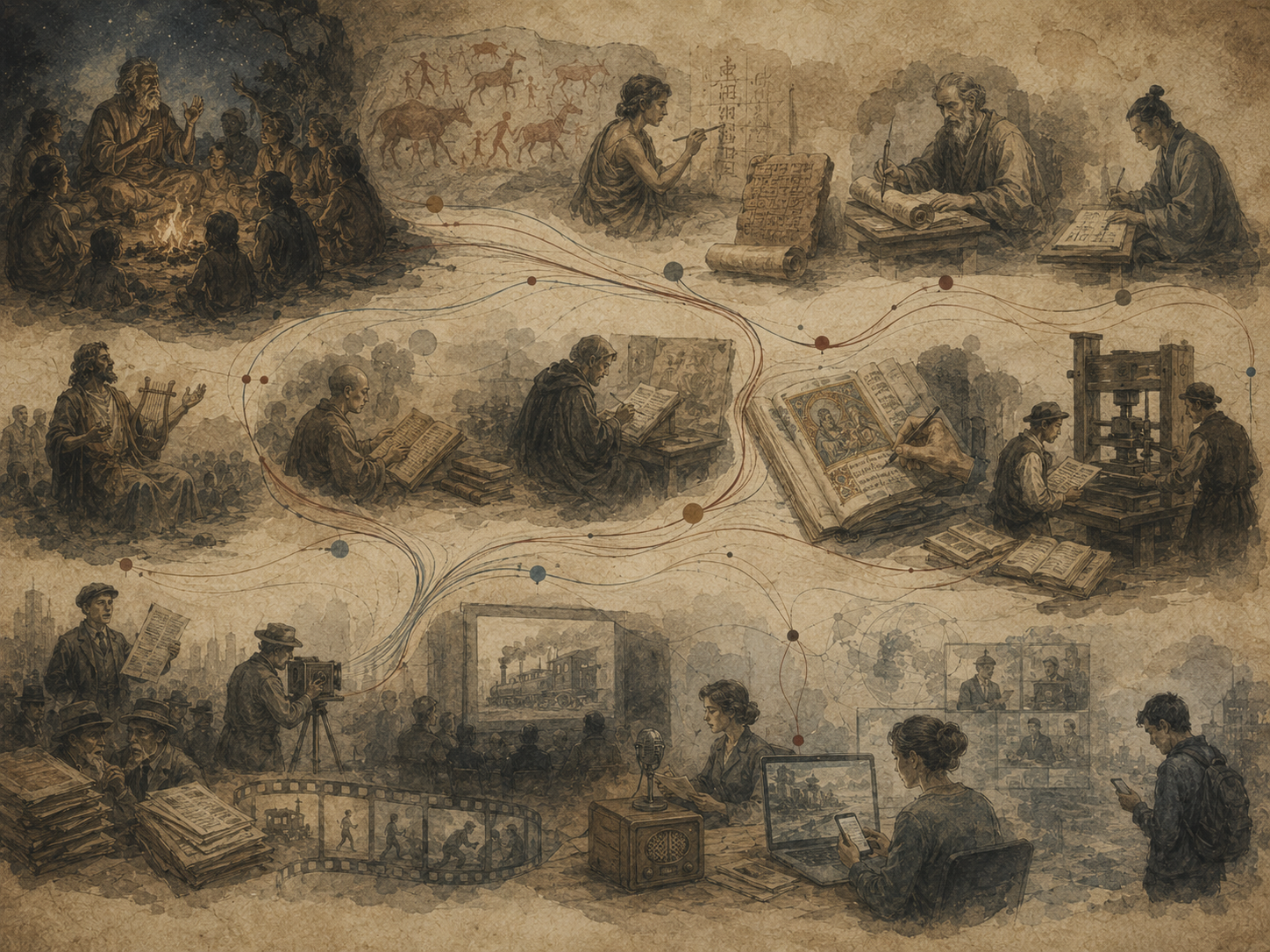
This article treats storytelling history as a series of media transitions rather than a straight line of progress. Oral storytelling, writing, print, theater, film, radio, television, games, and digital platforms each create different relationships among teller, audience, memory, authority, repetition, preservation, and participation. The article also includes computational workflows for modeling story-media transitions, transmission strength, preservation risk, audience participation, and Catalyst Canvas-ready governance queues for historical storytelling systems.
Why the History of Storytelling Matters
The history of storytelling matters because every story is shaped by the medium through which it is carried. A story told beside a fire, performed in ritual, sung as epic poetry, copied into a manuscript, printed in a book, staged in a theater, projected on a screen, broadcast by radio, serialized on television, played through a game, or distributed through a platform is not the same cultural event. The core human need for narrative may remain, but the conditions of storytelling change.
Storytelling history helps explain how human culture moves between memory and record, performance and text, local community and mass audience, authority and participation, preservation and variation. It also helps explain why old forms never fully disappear. Oral storytelling continues in families, classrooms, religious practice, public speech, podcasts, video performance, and social media. Written narrative continues inside digital systems. Film grammar shapes games and streaming media. Platform storytelling revives forms of serialized, participatory, and performative culture.
A historical view prevents two common mistakes. The first is nostalgia: treating older storytelling forms as pure, authentic, or culturally superior. The second is technological triumphalism: treating each new medium as a complete replacement for the last. Storytelling history is more complicated. New media reorganize older practices. They preserve some features, weaken others, and create new possibilities.
| Historical question | Why it matters | Example |
|---|---|---|
| How is the story remembered? | Different media preserve memory differently. | Oral repetition preserves through performance; print preserves through fixed copies. |
| Who controls the story? | Media shape authority, authorship, and access. | Manuscript culture privileges scribes and institutions; platforms privilege algorithmic distribution. |
| How does the audience participate? | Storytelling changes with response, interpretation, and interaction. | Oral audiences may respond directly; game audiences may act inside the story system. |
| How does the story travel? | Circulation affects cultural reach and transformation. | Print, broadcast, and digital networks expand scale in different ways. |
| What changes when the medium changes? | Media alter pacing, memory, sequence, voice, and authority. | Film editing creates visual continuity that differs from oral narration. |
| What remains continuous? | Story forms persist across changing technologies. | Mythic patterns, character roles, conflicts, and journeys recur across media. |
A history of storytelling is therefore also a history of cultural memory, communication technology, power, audience, and human imagination.
Oral Tradition and Embodied Storytelling
Before stories were stored in written form, they were carried by bodies, voices, gestures, rhythm, repetition, memory, performance, ritual, and communal participation. Oral storytelling is not simply storytelling before writing. It is a distinct cultural system with its own techniques, aesthetics, authority, and modes of preservation.
In oral tradition, stories live through performance. The teller is not merely reciting information. Voice, pace, gesture, audience response, setting, occasion, and social relationship shape meaning. A story may vary across tellings while remaining recognizably part of a tradition. Variation can be a feature of the system rather than an error.
Oral traditions include myths, legends, folktales, epic poems, genealogies, proverbs, riddles, songs, chants, prayers, ritual speech, origin stories, teaching stories, and historical memory. These forms may carry ecological knowledge, social norms, spiritual meaning, political memory, warnings, humor, law, kinship, and identity. UNESCO describes oral traditions and expressions as forms that pass on knowledge, cultural and social values, and collective memory.
| Feature of oral storytelling | Historical significance | Analytical caution |
|---|---|---|
| Embodied performance | Meaning depends on voice, gesture, presence, and occasion. | A written transcript cannot capture the full event. |
| Repetition | Supports memory, rhythm, recognition, and transmission. | Repetition may carry cultural meaning, not redundancy. |
| Variation | Allows adaptation across tellers, audiences, and situations. | Do not assume one fixed version is the only authentic version. |
| Communal memory | Stories may be preserved by shared performance rather than individual authorship. | Authorship may be collective, inherited, or tradition-based. |
| Formula and pattern | Recurring phrases, scenes, and motifs support composition and recall. | Formulaic structure can be artful, not mechanical. |
| Occasion | Stories may belong to ritual, teaching, mourning, celebration, law, or ceremony. | Context determines meaning and permission. |
Oral storytelling reminds modern readers that stories are not only texts. They are events, performances, relationships, and cultural acts.
Myth, Ritual, Epic, and Collective Memory
Many of the oldest storytelling systems are linked to myth, ritual, epic, and collective memory. Myths explain origins, divine order, social obligations, cosmic conflict, human vulnerability, and cultural meaning. Ritual stories are performed in relation to ceremony, seasonal cycles, initiation, mourning, healing, worship, or communal renewal. Epic traditions preserve heroic, ancestral, political, or cosmological memory across long narrative forms.
Epic storytelling is especially important because it shows how oral cultures can preserve complex narrative material without fixed writing. The work of Milman Parry and Albert Lord on oral-formulaic composition helped show how singers of tales could compose long epic performances through repeated formulas, themes, and flexible narrative structures. This changed modern understanding of Homeric and other oral epics by showing that oral composition could be sophisticated, adaptive, and systematic.
Myth and epic should not be treated as childish explanation or failed history. They are cultural forms that organize meaning. They may explain why a people understands a place as sacred, why a rule matters, why suffering has meaning, why social obligations endure, or why power must be limited. They often carry memory, authority, and identity together.
| Story form | Historical function | Examples of cultural work |
|---|---|---|
| Myth | Explains origin, order, transformation, and sacred meaning. | Creation, flood, exile, sacrifice, descent, renewal. |
| Ritual story | Links narrative to repeated communal practice. | Initiation, mourning, harvest, worship, healing. |
| Epic | Preserves extended collective memory through heroic or ancestral narrative. | War, journey, founding, return, fate, honor. |
| Legend | Connects place, memory, and extraordinary events. | Local heroes, sacred places, warnings, origin memories. |
| Folktale | Circulates social knowledge through patterned narrative. | Trickster tales, tests, reversals, moral lessons. |
| Genealogy | Preserves descent, kinship, authority, and belonging. | Lineage, inheritance, obligation, political legitimacy. |
These older forms still influence modern storytelling. Superhero films, national origin stories, institutional founding narratives, fantasy franchises, campaign speeches, and brand myths often draw on mythic, epic, or ritual structures even when they appear in modern media forms.
Writing, Manuscript Culture, and the Preservation of Story
Writing changed storytelling by making stories more durable, portable, inspectable, and preservable. Oral stories could be remembered and performed across generations, but writing created new possibilities for textual stability, commentary, comparison, storage, legal authority, literary complexity, and institutional control.
The move from oral performance to written record did not simply improve storytelling. It changed the balance between memory and inscription. A written story can survive beyond the immediate performance, but it may lose gesture, voice, occasion, and communal responsiveness. A written text can preserve detail, but it can also freeze one version of a living tradition. Writing expands memory while changing what counts as authoritative memory.
Manuscript culture also shaped who could access and transmit stories. Scribes, religious institutions, courts, monasteries, libraries, schools, and elite patrons often controlled textual preservation. Stories that were written down could gain durability, but stories outside these systems could remain vulnerable to loss, suppression, or distortion.
| Shift introduced by writing | Storytelling effect | Tradeoff |
|---|---|---|
| Durable inscription | Stories can persist beyond the teller and occasion. | Performance context may be weakened. |
| Textual comparison | Versions can be compared, copied, edited, and interpreted. | Variation may be judged as error rather than tradition. |
| Institutional preservation | Religious, legal, literary, and scholarly institutions can archive stories. | Institutions decide what is worth preserving. |
| Authorship | Stories can be attached to named authors, scribes, or schools. | Collective or traditional authorship may be obscured. |
| Commentary | Texts can generate interpretation across time. | Interpretive communities may become specialized or exclusionary. |
| Canon formation | Certain stories become authoritative and teachable. | Canons may marginalize alternative traditions. |
Writing changed storytelling by creating a new relationship between memory and permanence. It made stories easier to preserve, but it also changed who could control preservation.
Print Culture and the Expansion of Story Circulation
Print culture transformed storytelling by expanding scale, repetition, standardization, and circulation. A manuscript might be copied slowly and unevenly. Print made it possible to reproduce stories, religious texts, news, pamphlets, plays, novels, educational material, and political arguments with new consistency and reach.
The printing press did not simply spread stories faster. It altered relationships among authors, publishers, readers, markets, institutions, and publics. Printed texts supported wider literacy, new reading publics, serial publication, political pamphleteering, religious reform, scientific communication, commercial publishing, and literary culture. Stories could circulate beyond local performance and manuscript communities into broader publics.
Print also changed the economics of storytelling. Publishers, printers, booksellers, editors, periodicals, and reading markets shaped what stories reached audiences. Storytelling became increasingly tied to mass literacy, commercial distribution, intellectual property, public debate, and cultural prestige.
| Print feature | Storytelling effect | Historical significance |
|---|---|---|
| Reproducibility | Stories can be copied at scale. | Texts become more stable and widely available. |
| Standardization | Versions can circulate with greater consistency. | Canons, editions, and school texts become more durable. |
| Market circulation | Stories become part of publishing economies. | Readers, publishers, and genres influence one another. |
| Public debate | Pamphlets, newspapers, and books support argument and persuasion. | Storytelling becomes central to public opinion and political culture. |
| Seriality | Stories can unfold over installments. | Audience anticipation, suspense, and habit become publishing forces. |
| Archival durability | Printed works can be stored, cataloged, and retrieved. | Libraries and bibliographies shape cultural memory. |
Print culture expanded storytelling from local and manuscript-centered transmission into mass circulation. It also created new forms of authority, access, exclusion, and commercial pressure.
Theater, Performance, and Public Story
Theater carries storytelling into public performance. It combines spoken language, gesture, body, space, costume, music, staging, audience presence, and collective attention. Theater preserves elements of oral storytelling while also developing scripted, repeatable dramatic forms.
Theater is historically important because it makes story social and public. A play is not simply a text. It is an event in which audience members experience narrative together. Comedy, tragedy, ritual drama, religious drama, court performance, popular theater, and modern stage traditions all use performance to make conflict visible.
Theater also highlights the political life of story. Public performance can reinforce authority, question power, dramatize social conflict, represent moral crisis, or create shared civic reflection. It can humanize abstract questions by embodying them in characters and scenes. It can also stereotype, propagandize, or perform exclusion.
| Theatrical feature | Storytelling effect | Historical role |
|---|---|---|
| Embodiment | Characters and conflicts appear through bodies and voices. | Story becomes visible, social, and emotionally immediate. |
| Audience presence | Reception occurs collectively. | Theater becomes a public interpretive event. |
| Staging | Space, props, costume, and movement shape meaning. | Storytelling becomes visual and spatial. |
| Dialogue | Conflict appears through speech and interaction. | Competing perspectives can be dramatized. |
| Reperformance | A script can be staged differently across time. | Stories remain open to reinterpretation. |
| Public conflict | Social and political tensions can be made visible. | Theater can support critique, satire, mourning, and civic reflection. |
Theater shows that storytelling history is not simply the history of media objects. It is also the history of shared attention and public interpretation.
The Novel and the Rise of Interior Storytelling
The novel transformed storytelling by expanding interiority, social detail, psychological development, domestic life, realism, individual consciousness, and long-form narrative immersion. While earlier forms also explored character and moral conflict, the novel became especially powerful for representing inner life, social mobility, memory, desire, contradiction, and change over time.
Print culture supported the novel’s growth by creating reading publics and commercial circulation. Serial publication created anticipation and reader attachment. Libraries, periodicals, schools, and literary criticism helped shape the novel as a major cultural form.
The novel also changed the relationship between storyteller and audience. Readers could encounter extended fictional worlds privately and repeatedly. Interior narration, free indirect discourse, letters, diaries, multiple perspectives, and unreliable narration all expanded how stories could represent consciousness.
| Novelistic feature | Storytelling effect | Cultural significance |
|---|---|---|
| Interior consciousness | Readers enter thought, memory, motive, and perception. | Story becomes a tool for psychological and moral imagination. |
| Social realism | Stories represent ordinary life, institutions, class, gender, labor, and family. | Everyday experience becomes narratable. |
| Long-form development | Characters and conflicts unfold over extended time. | Identity and social change can be explored deeply. |
| Serial publication | Stories unfold through installments. | Audience anticipation and public discussion shape reception. |
| Multiple perspectives | Narrative can show competing interpretations. | Story becomes a tool for complexity and ambiguity. |
| Unreliable narration | The storyteller’s account becomes questionable. | Readers become active interpreters of truth and perspective. |
The novel helped make storytelling a major form for examining modern selfhood, society, memory, morality, and interior life.
Photography, Film, and Visual Narrative
Photography and film changed storytelling by giving images a new narrative force. Photography could capture moments, faces, places, violence, labor, ceremony, and public events with an evidentiary aura, even when framing and context still shaped meaning. Film combined image, motion, editing, performance, music, and time into a powerful narrative medium.
Cinema transformed storytelling through montage, close-up, shot composition, pacing, point of view, continuity editing, sound design, genre, star systems, and collective spectatorship. It made possible forms of storytelling based on visual sequence rather than primarily spoken or written narration. Film could move across time and space through cuts, dissolve memory into image, externalize emotion through sound and camera movement, and build worlds at scale.
Visual storytelling also introduced new ethical issues. Images can humanize, document, and preserve, but they can also manipulate, stereotype, aestheticize suffering, or create false immediacy. A visual story can feel true because it is seen, even when the frame hides selection, editing, staging, or context.
| Visual narrative feature | Storytelling effect | Ethical caution |
|---|---|---|
| Photography | Captures a moment and gives it documentary force. | The frame selects and excludes context. |
| Close-up | Intensifies emotion, recognition, and attention. | Emotion can overpower analysis. |
| Montage | Creates meaning through image sequence. | Editing can imply causality or inevitability. |
| Sound | Shapes mood, memory, suspense, and interpretation. | Music and sound can manipulate response. |
| Genre | Gives audiences expectations for plot and meaning. | Genre can reproduce stereotype or formula. |
| Spectacle | Creates scale, awe, and mass attention. | Spectacle can flatten history or suffering. |
Film did not replace older storytelling forms. It absorbed and transformed them: theater, oral narration, visual art, music, literature, journalism, myth, and popular performance all entered cinematic storytelling.
Radio, Television, and Broadcast Storytelling
Radio and television changed storytelling by creating mass broadcast audiences. Radio revived the power of voice at scale. It used sound, silence, music, seriality, news, drama, interviews, comedy, sport, and public address to create shared listening cultures. Television added image and domestic regularity, making serial storytelling part of everyday household life.
Broadcast storytelling created new relationships among schedule, habit, intimacy, authority, and mass culture. Families could listen to or watch the same story at the same time. News events became narrated into public memory. Serialized programs created long-term attachment to characters and worlds. Advertising and entertainment became deeply intertwined.
Television also transformed public life. Political speeches, televised debates, documentary programs, news coverage, live events, and serialized drama all shaped public imagination. Television made storytelling central to mass politics, consumer culture, celebrity, and national memory.
| Broadcast feature | Storytelling effect | Historical significance |
|---|---|---|
| Schedule | Stories arrive at shared times. | Audience habit and collective attention develop. |
| Voice | Radio creates intimacy, imagination, and authority through sound. | Public storytelling can enter domestic space. |
| Seriality | Characters and plots develop over repeated episodes. | Long-term audience attachment becomes central. |
| Live broadcast | Events are narrated as they unfold. | Public memory becomes mediated in real time. |
| Advertising | Stories become linked to commercial attention. | Entertainment, persuasion, and markets converge. |
| Domestic screen | Television makes visual story part of everyday home life. | Mass culture becomes intimate and habitual. |
Broadcast media expanded storytelling into shared national and global rhythms. They also raised new questions about persuasion, propaganda, spectacle, representation, and audience measurement.
Digital Platforms and Networked Storytelling
Digital platforms changed storytelling by making distribution networked, participatory, searchable, remixable, datafied, and algorithmically mediated. Stories can now move through websites, blogs, social media, video platforms, podcasts, newsletters, forums, archives, messaging apps, and recommendation systems.
Digital storytelling often combines old and new forms. A podcast may revive oral intimacy. A thread may resemble serial publication. A meme may compress story into image, caption, repetition, and shared context. A video essay may combine scholarship, narration, editing, and visual evidence. A platform archive may preserve stories at scale while also making them vulnerable to decontextualization.
The major historical shift is not simply that stories became digital. It is that story circulation became tied to platforms that rank, recommend, monetize, moderate, and measure attention. Algorithms influence which stories are visible. Metrics influence which stories are repeated. Networked audiences can respond, reinterpret, remix, challenge, or amplify stories rapidly.
| Digital feature | Storytelling effect | Governance risk |
|---|---|---|
| Searchability | Stories can be discovered through keywords and metadata. | Search visibility may privilege optimized content over careful content. |
| Networked distribution | Stories circulate through shares, links, feeds, and communities. | Context can collapse across audiences. |
| Algorithmic ranking | Platforms shape what stories are seen. | Outrage, novelty, or intensity may be rewarded. |
| Remix | Audiences can modify, parody, reuse, or reframe stories. | Attribution, consent, and context may be lost. |
| Metrics | Attention becomes quantified. | Performance pressure may reshape storytelling ethics. |
| Archive at scale | Stories can be stored, linked, and retrieved globally. | Preservation does not guarantee interpretation or care. |
Digital storytelling continues older narrative functions—memory, teaching, identity, persuasion, belonging—but reorganizes them through platforms, data, networks, and audience participation.
Games, Interactivity, and Branching Narrative
Games and interactive media changed storytelling by making audience action part of narrative experience. A reader or viewer interprets a story; a player also acts within a rule-bound system. This does not mean the player has unlimited freedom. It means storytelling can be shaped through choice, constraint, feedback, consequence, exploration, world state, and procedural design.
Interactive storytelling raises questions that older media also contained but did not foreground in the same way. Who has agency? What choices are meaningful? What consequences are simulated? What cannot be chosen? How does the system guide or limit interpretation? What kind of world does the game model? How do mechanics tell a story even when dialogue does not?
Games can tell stories through plot, character, environment, mechanics, level design, inventory, failure, repetition, player memory, and emergent behavior. A game’s story is not only what is written in dialogue or cutscenes. It is also what the system asks the player to do.
| Interactive feature | Narrative effect | Analytical question |
|---|---|---|
| Choice | Audience action becomes part of narrative movement. | Are choices meaningful or only decorative? |
| Branching | Different paths or endings become possible. | What values shape the branches? |
| Rules | The system defines what can happen. | What does the system make possible or impossible? |
| Feedback | Actions produce visible consequences. | What consequences are rewarded, punished, or ignored? |
| Worldbuilding | Story is embedded in environment and systems. | How does the world tell its history? |
| Emergence | Players create unexpected story moments through interaction. | How does the system support unscripted meaning? |
Interactive media show that storytelling history is not only about better preservation or wider distribution. It is also about changing the audience’s role inside narrative systems.
Transmedia Storytelling and Convergence Culture
Modern storytelling often unfolds across multiple media. A story world may include novels, films, television series, games, comics, podcasts, websites, social media accounts, archives, fan communities, and interactive experiences. This is not merely adaptation, where the same story is retold in another medium. Transmedia storytelling distributes different parts of a story world across media, allowing audiences to enter from multiple points.
Convergence culture describes a media environment where old and new media intersect, audiences participate, and cultural circulation moves across official and unofficial channels. In this environment, stories are not only produced by institutions and consumed by audiences. They are discussed, expanded, contested, remixed, and organized by communities.
Transmedia storytelling can deepen worldbuilding and audience engagement, but it can also fragment access. A story world may become difficult to understand without following multiple channels. Commercial ownership may exploit fan labor. Canon disputes may intensify. Storytelling becomes a matter of navigation, rights, participation, platform governance, and community interpretation.
| Transmedia feature | Storytelling effect | Risk |
|---|---|---|
| Multiple entry points | Audiences can begin through different media. | New audiences may feel lost. |
| Distributed worldbuilding | Different media add different pieces of the story world. | Continuity can become difficult to maintain. |
| Fan participation | Audiences interpret, remix, archive, and expand stories. | Community labor may be exploited or ignored. |
| Platform circulation | Stories move through official and unofficial channels. | Platform rules shape visibility and access. |
| Canon management | Story continuity becomes a governance problem. | Contradictions may produce confusion or conflict. |
| Commercial expansion | Story worlds become franchises and ecosystems. | Expansion may dilute meaning or prioritize monetization. |
Transmedia storytelling reveals a central pattern in storytelling history: every expansion of medium creates new possibilities and new governance problems.
Continuity and Change Across Story Media
The history of storytelling is best understood through continuity and change together. Storytelling retains recurring functions across media: memory, teaching, identity, entertainment, persuasion, moral imagination, belonging, and public meaning. But each medium changes how those functions operate.
Oral storytelling depends on living performance and community memory. Writing stabilizes stories as texts. Print expands circulation. Theater creates embodied public performance. The novel explores interior consciousness. Film develops visual and auditory narrative grammar. Broadcast media create mass shared experience. Digital platforms make stories networked, searchable, participatory, and algorithmically distributed. Games make action and system feedback central to narrative experience.
This layered history means that modern storytelling is rarely one medium at a time. A contemporary story may begin as a podcast, become a book, circulate as social clips, generate fan commentary, appear in documentary form, and inspire interactive media. Older and newer forms continue to interact.
| Medium | Primary story affordance | Continuity with older forms |
|---|---|---|
| Oral tradition | Performance, memory, variation, communal presence. | Continues in speech, podcasting, teaching, ritual, and live media. |
| Writing | Durability, inspection, commentary, textual authority. | Continues in digital text, archives, scripts, metadata, and documentation. |
| Mass reproduction, standardization, seriality, reading publics. | Continues in newsletters, blogs, serialized digital publication, and ebooks. | |
| Theater | Embodied scene, public audience, staged conflict. | Continues in film performance, livestreams, public speaking, and video. |
| Film | Visual sequence, editing, sound, cinematic time. | Continues in streaming, video essays, short-form video, and games. |
| Broadcast | Shared schedule, mass attention, serial programming. | Continues in livestreams, podcasts, streaming releases, and event media. |
| Digital platforms | Networked circulation, search, remix, metrics, participation. | Recombines oral, written, visual, serial, and communal traditions. |
| Games | Choice, rules, feedback, branching, procedural narrative. | Transforms older quest, trial, worldbuilding, and role-based story forms. |
Storytelling history is therefore cumulative and recombinant. Media change the form, but they rarely erase the older human practices that storytelling carries forward.
Power, Archives, and Access
Every history of storytelling is also a history of power. Some stories survive because institutions preserve them. Some disappear because they were never written, never printed, never translated, never archived, or never treated as culturally valuable. Some are preserved but stripped of context. Others are repeated so often that they become official memory.
Oral traditions may be misrepresented by collectors. Manuscripts may preserve elite or religious voices while excluding popular or marginalized traditions. Print may expand access while also creating commercial and colonial publishing systems. Film and broadcast may reach mass audiences while centralizing production power. Platforms may allow more people to publish while subjecting visibility to algorithms, moderation policies, monetization systems, and data extraction.
Archives are never neutral. They preserve, classify, describe, and make available. They also omit, mislabel, restrict, or decontextualize. A responsible history of storytelling must ask not only what stories were told, but which stories were allowed to travel and which were silenced.
| Power issue | Historical question | Responsible practice |
|---|---|---|
| Preservation | Which stories survived, and why? | Study archive formation, not only archived content. |
| Authorship | Who is credited as teller, author, collector, editor, or translator? | Distinguish tradition, performance, collection, and publication roles. |
| Access | Who can read, hear, perform, publish, or retrieve the story? | Examine literacy, technology, language, class, and platform barriers. |
| Translation | What changes when stories cross language and culture? | Document translation choices and interpretive limits. |
| Extraction | Were stories taken from communities without consent or context? | Respect cultural ownership, permission, and community authority. |
| Visibility | What makes a story appear important or discoverable? | Audit canons, catalogs, algorithms, and institutional priorities. |
A history of storytelling should not be only a history of great texts or dominant media industries. It should also be a history of preservation, loss, access, translation, power, and repair.
Examples of Storytelling Across Media History
The examples below show how storytelling changes when it moves through different historical media systems.
Oral epic
Medium: Voice, memory, performance, formula, audience presence.
Story effect: The story is composed and recomposed through performance.
Historical insight: Oral complexity does not require fixed text.
Manuscript story
Medium: Hand-copied text, scribal labor, institutional preservation.
Story effect: A version can survive, circulate, and invite commentary.
Historical insight: Preservation depends on institutions and access.
Printed novel
Medium: Print circulation, private reading, serial publication.
Story effect: Long-form interiority and social worlds can develop over time.
Historical insight: Markets and reading publics shape narrative form.
Theater
Medium: Embodied performance, staged conflict, live audience.
Story effect: Conflict becomes public, social, and immediate.
Historical insight: Story is an event, not only a text.
Film
Medium: Moving image, editing, sound, visual framing.
Story effect: Meaning is created through image sequence and cinematic time.
Historical insight: Seeing is also mediated by selection and composition.
Digital platform story
Medium: Network, feed, metrics, remix, algorithmic visibility.
Story effect: Stories circulate through participation and ranking systems.
Historical insight: Distribution becomes part of storytelling power.
A medium changes the story not only by changing its format, but by changing memory, authority, circulation, audience, and interpretation.
Mathematics, Computation, and Modeling
Storytelling history cannot be reduced to equations, but computational modeling can help compare how different media affect story preservation, circulation, participation, and governance risk. These models are interpretive tools. They help make assumptions visible; they do not determine cultural meaning.
A story-media transition score can estimate how much a storytelling system changes when moving from one medium to another:
T_m = \frac{|P_2 – P_1| + |A_2 – A_1| + |C_2 – C_1| + |R_2 – R_1| + |G_2 – G_1|}{5}
\]
Interpretation: Media transition score \(T_m\) compares preservation \(P\), audience participation \(A\), circulation scale \(C\), repeatability \(R\), and governance complexity \(G\) before and after a medium shift.
A transmission strength score can combine memory support, repeatability, circulation, and archive durability:
S_t = \frac{M + R + C + D}{4}
\]
Interpretation: Transmission strength \(S_t\) averages memory support \(M\), repeatability \(R\), circulation scale \(C\), and durability \(D\).
A participation score can compare audience presence, response, remix, choice, and community interpretation:
A_p = \frac{L + F + X + Q + I}{5}
\]
Interpretation: Audience participation \(A_p\) averages live presence \(L\), feedback \(F\), remix capacity \(X\), choice \(Q\), and interpretive community activity \(I\).
A preservation risk score can combine fragility, institutional dependence, context loss, access barriers, and platform instability:
R_p = F_gw_f + I_dw_i + C_lw_c + A_bw_a + P_sw_p
\]
Interpretation: Preservation risk \(R_p\) rises with material fragility \(F_g\), institutional dependence \(I_d\), context loss \(C_l\), access barriers \(A_b\), and platform instability \(P_s\).
| Modeling task | Historical question | Example output |
|---|---|---|
| Media transition audit | What changes when a story moves from one medium to another? | Transition score, feature comparison table. |
| Transmission strength audit | How strongly can the medium carry the story across time? | Transmission ranking by medium. |
| Participation audit | How active is the audience in shaping the story? | Participation score by medium. |
| Preservation risk audit | Where is the story vulnerable to loss or decontextualization? | Preservation risk queue. |
| Power audit | Who controls access, circulation, and interpretation? | Authority and governance matrix. |
| Continuity audit | Which older story forms persist inside newer media? | Continuity map across media layers. |
Modeling storytelling history helps compare media systems without claiming that numbers capture the full cultural life of stories.
Python Workflow: Story-Media Transition Audit
The Python workflow below models storytelling media by preservation, participation, circulation, repeatability, governance complexity, archive durability, and preservation risk. The companion repository version extends this into a Catalyst Canvas-ready module with schemas, package-style Python, tests, JSON exports, Canvas cards, markdown governance queues, and reusable historical-storytelling templates.
# story_media_transition_audit.py
# Dependency-light workflow for historical storytelling media analysis.

from __future__ import annotations

from dataclasses import dataclass
from pathlib import Path
import csv
import json
from statistics import mean

ARTICLE_ROOT = Path(__file__).resolve().parents[1]
OUTPUTS = ARTICLE_ROOT / "outputs"
TABLES = OUTPUTS / "tables"
JSON_DIR = OUTPUTS / "json"
MARKDOWN = OUTPUTS / "markdown"


@dataclass(frozen=True)
class StoryMedium:
    medium: str
    period_label: str
    preservation: float
    participation: float
    circulation: float
    repeatability: float
    governance_complexity: float
    archive_durability: float
    context_retention: float
    access_openness: float
    platform_stability: float
    owner: str
    status: str

    def transmission_strength(self) -> float:
        return mean([
            self.preservation,
            self.repeatability,
            self.circulation,
            self.archive_durability,
        ])

    def participation_score(self) -> float:
        return self.participation

    def preservation_risk(self) -> float:
        return min(
            1.0,
            (1 - self.archive_durability) * 0.25
            + self.governance_complexity * 0.20
            + (1 - self.context_retention) * 0.25
            + (1 - self.access_openness) * 0.15
            + (1 - self.platform_stability) * 0.15,
        )

    def review_priority(self) -> str:
        risk = self.preservation_risk()
        if self.status == "review" or risk >= 0.50:
            return "high"
        if risk >= 0.35:
            return "medium"
        return "standard"


def transition_score(first: StoryMedium, second: StoryMedium) -> float:
    return mean([
        abs(second.preservation - first.preservation),
        abs(second.participation - first.participation),
        abs(second.circulation - first.circulation),
        abs(second.repeatability - first.repeatability),
        abs(second.governance_complexity - first.governance_complexity),
    ])


def write_csv(path: Path, rows: list[dict[str, object]]) -> None:
    path.parent.mkdir(parents=True, exist_ok=True)
    if not rows:
        raise ValueError(f"No rows to write: {path}")
    with path.open("w", encoding="utf-8", newline="") as handle:
        writer = csv.DictWriter(handle, fieldnames=list(rows[0].keys()))
        writer.writeheader()
        writer.writerows(rows)


def write_json(path: Path, payload: object) -> None:
    path.parent.mkdir(parents=True, exist_ok=True)
    path.write_text(json.dumps(payload, indent=2), encoding="utf-8")


def write_markdown_queue(path: Path, rows: list[dict[str, object]]) -> None:
    path.parent.mkdir(parents=True, exist_ok=True)
    lines = [
        "# Historical Storytelling Preservation Queue",
        "",
        "| Medium | Transmission | Participation | Preservation risk | Priority | Owner |",
        "|---|---:|---:|---:|---|---|",
    ]

    for row in rows:
        lines.append(
            f"| {row['medium']} | {row['transmission_strength']} | "
            f"{row['participation_score']} | {row['preservation_risk']} | "
            f"{row['review_priority']} | {row['owner']} |"
        )

    path.write_text("\n".join(lines) + "\n", encoding="utf-8")


def main() -> None:
    media = [
        StoryMedium("Oral tradition", "pre-writing and continuing", 0.62, 0.88, 0.42, 0.70, 0.48, 0.42, 0.90, 0.70, 0.82, "archive", "active"),
        StoryMedium("Manuscript", "ancient and medieval", 0.78, 0.34, 0.38, 0.58, 0.72, 0.74, 0.62, 0.32, 0.76, "archive", "review"),
        StoryMedium("Print", "early modern onward", 0.88, 0.42, 0.82, 0.86, 0.64, 0.86, 0.68, 0.58, 0.82, "library", "active"),
        StoryMedium("Theater", "ancient to modern", 0.54, 0.84, 0.50, 0.62, 0.54, 0.48, 0.82, 0.66, 0.72, "performance", "active"),
        StoryMedium("Film", "modern visual media", 0.80, 0.50, 0.86, 0.82, 0.70, 0.76, 0.64, 0.62, 0.74, "media", "active"),
        StoryMedium("Broadcast", "radio and television", 0.72, 0.48, 0.90, 0.76, 0.78, 0.70, 0.58, 0.56, 0.70, "media", "active"),
        StoryMedium("Digital platform", "networked media", 0.68, 0.86, 0.96, 0.74, 0.92, 0.54, 0.44, 0.78, 0.38, "platform", "review"),
        StoryMedium("Interactive game", "digital interactive", 0.70, 0.92, 0.76, 0.70, 0.86, 0.62, 0.60, 0.66, 0.58, "interactive", "active"),
    ]

    rows = []
    for item in media:
        rows.append({
            "medium": item.medium,
            "period_label": item.period_label,
            "preservation": item.preservation,
            "participation_score": round(item.participation_score(), 3),
            "circulation": item.circulation,
            "repeatability": item.repeatability,
            "governance_complexity": item.governance_complexity,
            "archive_durability": item.archive_durability,
            "context_retention": item.context_retention,
            "access_openness": item.access_openness,
            "platform_stability": item.platform_stability,
            "transmission_strength": round(item.transmission_strength(), 3),
            "preservation_risk": round(item.preservation_risk(), 3),
            "review_priority": item.review_priority(),
            "owner": item.owner,
            "status": item.status,
        })

    transition_rows = []
    for first, second in zip(media, media[1:]):
        transition_rows.append({
            "from_medium": first.medium,
            "to_medium": second.medium,
            "transition_score": round(transition_score(first, second), 3),
        })

    rows = sorted(rows, key=lambda row: row["preservation_risk"], reverse=True)
    governance_queue = [row for row in rows if row["review_priority"] != "standard"]

    write_csv(TABLES / "story_media_audit.csv", rows)
    write_csv(TABLES / "story_media_transition_scores.csv", transition_rows)
    write_csv(TABLES / "story_media_preservation_queue.csv", governance_queue)

    write_json(JSON_DIR / "story_media_canvas_cards.json", rows)
    write_json(JSON_DIR / "story_media_transition_scores.json", transition_rows)
    write_json(JSON_DIR / "story_media_preservation_queue.json", governance_queue)

    write_markdown_queue(MARKDOWN / "story_media_preservation_queue.md", governance_queue)

    print("Story-media transition audit complete.")


if __name__ == "__main__":
    main()
This workflow helps compare storytelling media historically while keeping preservation risk, participation, circulation, and governance visible.
R Workflow: Historical Storytelling Diagnostics
The R workflow below creates a synthetic dataset of storytelling media, calculates transmission strength, preservation risk, and participation score, then exports summary tables and base R plots. It is intentionally portable and uses only base R.
# historical_storytelling_diagnostics.R
# Base R workflow for storytelling media history diagnostics.

args <- commandArgs(trailingOnly = FALSE)
file_arg <- grep("^--file=", args, value = TRUE)

if (length(file_arg) > 0) {
  script_path <- normalizePath(sub("^--file=", "", file_arg[1]), mustWork = TRUE)
  article_root <- normalizePath(file.path(dirname(script_path), ".."), mustWork = TRUE)
} else {
  article_root <- getwd()
}

setwd(article_root)

tables_dir <- file.path(article_root, "outputs", "tables")
figures_dir <- file.path(article_root, "outputs", "figures")
dir.create(tables_dir, recursive = TRUE, showWarnings = FALSE)
dir.create(figures_dir, recursive = TRUE, showWarnings = FALSE)

media <- data.frame(
  medium = c(
    "Oral tradition",
    "Manuscript",
    "Print",
    "Theater",
    "Film",
    "Broadcast",
    "Digital platform",
    "Interactive game"
  ),
  preservation = c(0.62, 0.78, 0.88, 0.54, 0.80, 0.72, 0.68, 0.70),
  participation = c(0.88, 0.34, 0.42, 0.84, 0.50, 0.48, 0.86, 0.92),
  circulation = c(0.42, 0.38, 0.82, 0.50, 0.86, 0.90, 0.96, 0.76),
  repeatability = c(0.70, 0.58, 0.86, 0.62, 0.82, 0.76, 0.74, 0.70),
  governance_complexity = c(0.48, 0.72, 0.64, 0.54, 0.70, 0.78, 0.92, 0.86),
  archive_durability = c(0.42, 0.74, 0.86, 0.48, 0.76, 0.70, 0.54, 0.62),
  context_retention = c(0.90, 0.62, 0.68, 0.82, 0.64, 0.58, 0.44, 0.60),
  access_openness = c(0.70, 0.32, 0.58, 0.66, 0.62, 0.56, 0.78, 0.66),
  platform_stability = c(0.82, 0.76, 0.82, 0.72, 0.74, 0.70, 0.38, 0.58),
  stringsAsFactors = FALSE
)

media$transmission_strength <- rowMeans(media[, c(
  "preservation",
  "repeatability",
  "circulation",
  "archive_durability"
)])

media$preservation_risk <- pmin(
  1,
  (1 - media$archive_durability) * 0.25 +
    media$governance_complexity * 0.20 +
    (1 - media$context_retention) * 0.25 +
    (1 - media$access_openness) * 0.15 +
    (1 - media$platform_stability) * 0.15
)

media$review_priority <- ifelse(
  media$preservation_risk >= 0.50,
  "high",
  ifelse(media$preservation_risk >= 0.35, "medium", "standard")
)

media <- media[order(media$preservation_risk, decreasing = TRUE), ]

write.csv(
  media,
  file.path(tables_dir, "historical_storytelling_media_diagnostics.csv"),
  row.names = FALSE
)

governance_queue <- media[media$review_priority != "standard", ]

write.csv(
  governance_queue,
  file.path(tables_dir, "historical_storytelling_preservation_queue.csv"),
  row.names = FALSE
)

png(file.path(figures_dir, "story_media_transmission_strength.png"), width = 1200, height = 700)
barplot(
  media$transmission_strength,
  names.arg = media$medium,
  las = 2,
  ylab = "Transmission strength",
  main = "Story Media Transmission Strength"
)
grid()
dev.off()

png(file.path(figures_dir, "story_media_preservation_risk.png"), width = 1200, height = 700)
barplot(
  media$preservation_risk,
  names.arg = media$medium,
  las = 2,
  ylab = "Preservation risk",
  main = "Story Media Preservation Risk"
)
grid()
dev.off()

print(media[, c(
  "medium",
  "transmission_strength",
  "participation",
  "preservation_risk",
  "review_priority"
)])
This workflow turns storytelling history into a reviewable media-comparison artifact. It helps identify how different media preserve, circulate, transform, and endanger stories.
GitHub Repository
The companion repository for this article supports historical storytelling analysis as a Catalyst Canvas-ready narrative-media module. It includes media transition audits, oral tradition modeling, manuscript and print transmission scoring, broadcast and digital platform comparisons, preservation-risk diagnostics, audience participation scoring, JSON schemas, package-style Python, R workflows, SQL structures, Canvas cards, markdown governance queues, synthetic datasets, documentation, and reusable historical-storytelling templates.
Complete Code Repository
Companion repository for the article, including Catalyst Canvas-ready code for storytelling media history, oral tradition, manuscript and print transmission, visual and broadcast media, digital platforms, interactive narrative, preservation risk, JSON exports, Canvas cards, and reproducible research workflows.
articles/the-history-of-storytelling-from-oral-tradition-to-modern-media/
├── canvas/
│   ├── canvas_manifest.json
│   ├── input_schema.json
│   ├── output_schema.json
│   ├── canvas_cards.json
│   └── governance_queue.json
├── html/
├── css/
├── php/
├── java/
├── python/
│   ├── story_media_history_canvas/
│   │   ├── __init__.py
│   │   ├── __main__.py
│   │   ├── cli.py
│   │   ├── models.py
│   │   ├── scoring.py
│   │   ├── validation.py
│   │   ├── governance.py
│   │   └── exporters.py
│   ├── tests/
│   │   └── test_story_media_history_canvas.py
│   └── run_story_media_history_canvas_audit.py
├── r/
│   ├── historical_storytelling_diagnostics.R
│   └── run_all_historical_storytelling_workflows.R
├── sql/
│   ├── canvas_schema.sql
│   └── canvas_queries.sql
├── docs/
│   ├── article_notes.md
│   ├── modeling_principles.md
│   ├── oral_tradition.md
│   ├── media_transition_notes.md
│   └── governance_notes.md
├── data/
│   ├── story_media_history.csv
│   ├── oral_tradition_features.csv
│   ├── manuscript_print_transitions.csv
│   ├── visual_broadcast_media.csv
│   ├── digital_interactive_media.csv
│   └── preservation_risks.csv
├── outputs/
│   ├── figures/
│   ├── json/
│   ├── markdown/
│   └── tables/
├── notebooks/
├── shared/
│   ├── schemas/
│   ├── narrative-templates/
│   ├── story-archetypes/
│   ├── character-models/
│   ├── plot-structures/
│   ├── rhetorical-frameworks/
│   ├── cultural-memory/
│   ├── media-history/
│   └── governance/
├── tests/
└── README.md
Related Articles
- What Is Storytelling?
- Why Storytelling Matters in Human Culture
- Storytelling as a Content Framework
- Oral Tradition, Performance, and Collective Memory
- Storytelling as Intangible Cultural Heritage
- Storytelling Across Oral, Literary, and Visual Media
A Practical Method for Studying Storytelling History
1. Identify the storytelling medium
Name whether the story is oral, written, manuscript, printed, performed, visual, broadcast, digital, interactive, or transmedia.
2. Describe the performance or publication setting
Ask where, when, by whom, and for whom the story is told, performed, copied, printed, distributed, or played.
3. Map the transmission system
Identify how the story moves across time: memory, repetition, copying, print, archive, broadcast, platform, or community circulation.
4. Examine authorship and authority
Distinguish teller, performer, author, scribe, editor, translator, publisher, platform, institution, and audience.
5. Analyze medium affordances
Ask what the medium makes easier: repetition, performance, preservation, scale, image, sound, interaction, remix, or archive.
6. Identify what changes across media
Compare voice, sequence, variation, audience participation, evidence, pacing, authority, and context.
7. Identify what persists
Look for recurring motifs, plots, roles, conflicts, themes, rituals, or memory functions.
8. Audit power and access
Ask who can tell, preserve, publish, translate, retrieve, monetize, or reinterpret the story.
9. Assess preservation risk
Look for fragility, context loss, institutional dependence, translation issues, platform instability, and restricted access.
10. Document interpretive limits
Name what cannot be known, what context may be missing, and what cultural permission or expertise is required.
This method treats storytelling history as a study of changing narrative systems rather than a simple timeline of media inventions.
Common Pitfalls
Several mistakes appear when the history of storytelling is treated too simply.
- Assuming progress: Newer media are not automatically better storytelling media; they create different affordances and risks.
- Romanticizing oral tradition: Oral storytelling is powerful, but it should not be treated as pure, timeless, or outside history.
- Reducing oral tradition to text: A transcript cannot capture performance, occasion, gesture, voice, or audience response.
- Ignoring institutions: Manuscripts, print, film, broadcast, and platforms all depend on systems of preservation and control.
- Confusing preservation with understanding: A story can be archived and still be decontextualized or misinterpreted.
- Treating media as replacements: Writing did not erase speech; print did not erase performance; digital media did not erase older forms.
- Forgetting power: Storytelling history includes silencing, extraction, censorship, canon formation, and unequal access.
- Overemphasizing technology: Media matter, but so do communities, rituals, economics, politics, and cultural authority.
- Flattening global variation: Storytelling media histories differ across languages, regions, traditions, and institutions.
- Ignoring audience participation: Audiences have always interpreted stories; digital systems make some forms of participation more visible.
The central pitfall is treating storytelling history as a list of media formats rather than a history of memory, power, performance, circulation, and interpretation.
Why Storytelling History Is Not a Straight Line
The history of storytelling is not a straight line from speech to writing to print to screen to platform. It is a layered history of media systems that overlap, compete, borrow, preserve, and transform one another. Oral storytelling survives inside digital audio. Manuscript habits survive inside annotation and commentary. Print seriality survives inside newsletters, blogs, and streaming releases. Theater survives inside film performance and livestreamed events. Film grammar shapes games, social video, and platform culture.
Storytelling persists because human beings continue to need memory, meaning, identity, teaching, persuasion, imagination, and shared interpretation. Media change the conditions of storytelling, but they do not eliminate the deeper cultural work that stories perform.
A responsible history of storytelling must therefore ask two questions at once: what changed when the medium changed, and what human need continued across the change? The answer is never only technological. It is cultural, ethical, political, institutional, and deeply human.
Further Reading
- Eisenstein, E.L. (1980) The Printing Press as an Agent of Change: Communications and Cultural Transformations in Early-Modern Europe. Cambridge: Cambridge University Press. Available at: https://www.cambridge.org/core/books/printing-press-as-an-agent-of-change/7DC19878AB937940DE13075FE839BDBA
- Jenkins, H. (2006) Convergence Culture: Where Old and New Media Collide. New York: NYU Press. Available at: https://nyupress.org/9780814742952/convergence-culture/
- Lord, A.B. (1960) The Singer of Tales. Cambridge, MA: Harvard University Press. Available at: https://www.hup.harvard.edu/books/9780674975736
- Manovich, L. (2001) The Language of New Media. Cambridge, MA: MIT Press. Available at: https://mitpress.mit.edu/9780262632553/the-language-of-new-media/
- McLuhan, M. (1962) The Gutenberg Galaxy: The Making of Typographic Man. Toronto: University of Toronto Press. Available at: https://utppublishing.com/doi/book/10.3138/9781442612693
- Murray, J.H. (1997) Hamlet on the Holodeck: The Future of Narrative in Cyberspace. Cambridge, MA: MIT Press. Available at: https://mitpress.mit.edu/9780262631877/hamlet-on-the-holodeck/
- Ong, W.J. (2012) Orality and Literacy: The Technologizing of the Word. 30th anniversary edn. London: Routledge. Available at: https://www.routledge.com/Orality-and-Literacy-30th-Anniversary-Edition/Ong/p/book/9780415538381
- UNESCO (n.d.) Oral traditions and expressions including language as a vehicle of the intangible cultural heritage. Paris: UNESCO. Available at: https://ich.unesco.org/en/oral-traditions-and-expressions-00053
- Vansina, J. (1985) Oral Tradition as History. Madison, WI: University of Wisconsin Press.
- Zumthor, P. (1990) Oral Poetry: An Introduction. Minneapolis: University of Minnesota Press.
References
- Eisenstein, E.L. (1980) The Printing Press as an Agent of Change: Communications and Cultural Transformations in Early-Modern Europe. Cambridge: Cambridge University Press. Available at: https://www.cambridge.org/core/books/printing-press-as-an-agent-of-change/7DC19878AB937940DE13075FE839BDBA
- Jenkins, H. (2006) Convergence Culture: Where Old and New Media Collide. New York: NYU Press. Available at: https://nyupress.org/9780814742952/convergence-culture/
- Lord, A.B. (1960) The Singer of Tales. Cambridge, MA: Harvard University Press. Available at: https://www.hup.harvard.edu/books/9780674975736
- Manovich, L. (2001) The Language of New Media. Cambridge, MA: MIT Press. Available at: https://mitpress.mit.edu/9780262632553/the-language-of-new-media/
- McLuhan, M. (1962) The Gutenberg Galaxy: The Making of Typographic Man. Toronto: University of Toronto Press. Available at: https://utppublishing.com/doi/book/10.3138/9781442612693
- Murray, J.H. (1997) Hamlet on the Holodeck: The Future of Narrative in Cyberspace. Cambridge, MA: MIT Press. Available at: https://mitpress.mit.edu/9780262631877/hamlet-on-the-holodeck/
- Ong, W.J. (2012) Orality and Literacy: The Technologizing of the Word. 30th anniversary edn. London: Routledge. Available at: https://www.routledge.com/Orality-and-Literacy-30th-Anniversary-Edition/Ong/p/book/9780415538381
- Ricoeur, P. (1984) Time and Narrative, Volume 1. Translated by K. McLaughlin and D. Pellauer. Chicago: University of Chicago Press. Available at: https://press.uchicago.edu/ucp/books/book/chicago/T/bo5962044.html
- UNESCO (n.d.) Oral traditions and expressions including language as a vehicle of the intangible cultural heritage. Paris: UNESCO. Available at: https://ich.unesco.org/en/oral-traditions-and-expressions-00053
- Vansina, J. (1985) Oral Tradition as History. Madison, WI: University of Wisconsin Press.