Historical research workspace showing the evolution from early maps, instruments, and physical models to engineering schematics, analog systems, network diagrams, and layered computational models.

The History of Systems Modeling: From Cybernetics to Simulation

Systems modeling emerged during the twentieth century as researchers across multiple disciplines sought more rigorous ways to understand systems whose behavior arises from interaction, feedback, delay, and interdependence rather than from isolated variables alone. This article traces that historical development from cybernetics and general systems theory through system dynamics, computer simulation, and the rise of modern complexity research. It explains how figures such as Norbert Wiener, Ludwig von Bertalanffy, and Jay W. Forrester helped shift scientific reasoning toward feedback, regulation, accumulation, and dynamic structure, and how later advances in computation expanded modeling into agent-based simulation, network analysis, and global systems research. The history matters because it clarifies why systems modeling developed in the first place: to analyze phenomena that static, reductionist, and equilibrium-based approaches could not adequately explain.


A dense interconnected landscape of cities, waterways, infrastructure, people, industry, and ecology transitions into a layered research-table model with maps, networks, feedback loops, and modular structures.

Why Complex Systems Require Models: Systems Modeling Explained

Complex systems frequently behave in ways that cannot be understood through simple linear cause-and-effect reasoning. Their behavior emerges from interactions among many components linked through feedback loops, time delays, nonlinear relationships, and structural interdependence, making outcomes difficult to infer from intuition alone. This article explains why formal modeling is essential for analyzing such systems, showing how models make interaction, accumulation, delay, and threshold effects explicit and therefore open to systematic study. It examines the limits of intuitive reasoning, the importance of feedback and dynamic structure, the role of scenario exploration, and the value of models as tools for learning rather than perfect prediction. In systems characterized by recursive interaction and delayed consequence, modeling matters because it provides a disciplined way to understand structure, compare trajectories, and reason more effectively about long-term change under uncertainty.

Interconnected landscape of people, infrastructure, waterways, institutions, and ecology gradually transitions into a layered research-table model with network diagrams, maps, feedback loops, and modular blocks.

Systems Thinking vs Systems Modeling: Understanding the Difference

Systems thinking and systems modeling are closely related approaches for understanding complex systems, but they operate at different levels of analysis. Systems thinking provides the conceptual lens: it emphasizes interdependence, feedback, emergence, nonlinearity, and whole-system structure. Systems modeling extends that perspective by translating systemic insight into formal representations such as equations, simulations, and computational models that can be tested, compared, and explored across scenarios. This article explains the distinction between conceptual framing and analytical implementation, showing how systems thinking helps identify structure while systems modeling makes that structure explicit and measurable. Across sustainability, economics, infrastructure, and governance, the two approaches work best together. Systems thinking without modeling can remain too abstract, while modeling without systems thinking can become technically precise but conceptually shallow.

Layered systems model on a research table with maps, network diagrams, feedback loops, translucent planes, and small physical structures representing complex ecological, social, and infrastructure systems.

What Is Systems Modeling? Understanding Models of Complex Systems

Systems modeling is the formal study of how complex systems can be represented, analyzed, and simulated using mathematical, computational, or structured conceptual models. Rather than focusing on isolated variables, it examines how interactions among components generate dynamic patterns through feedback loops, nonlinear responses, delays, and structural interdependence. This article introduces the field as a whole, explains why formal models are necessary for understanding systems whose behavior cannot be grasped through intuition alone, and outlines the major modeling traditions that now shape research and policy analysis. It also emphasizes that systems modeling is not primarily about eliminating uncertainty, but about making assumptions explicit, exploring alternative futures, and improving judgment under complexity. Across climate, infrastructure, economics, public health, and sustainability, systems modeling matters because it turns dynamic interdependence into something that can be studied, compared, and used for more responsible decision-making.

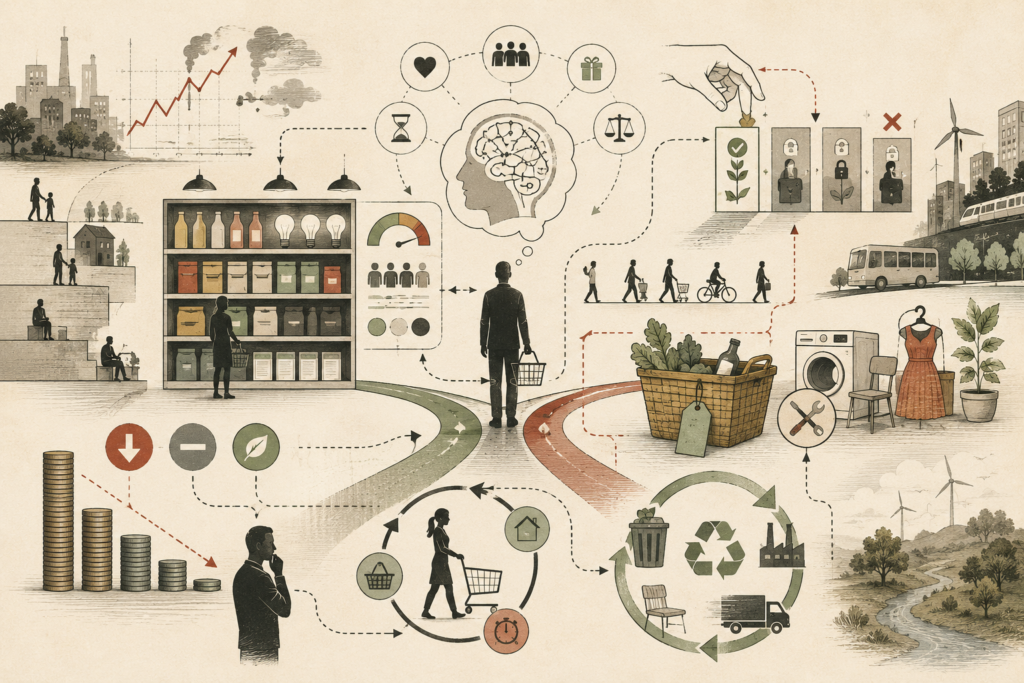
Editorial systems illustration showing sustainable consumption as a behavioral decision environment shaped by incentives, defaults, habits, social norms, pricing, infrastructure, reuse, and environmental feedback loops.

Behavioral Economics and Sustainable Consumption

Behavioral economics offers a stronger account of sustainable consumption than models that assume households respond cleanly to prices and information. Environmentally consequential decisions are made under conditions of limited attention, habit, present bias, uncertainty, status competition, and institutional constraint. This article examines the attitude-behavior gap, the role of norms and conditional cooperation, the power of defaults and choice architecture, and the limits of purely informational approaches. It also develops a formal analytical framework for sustainable choice and includes substantial R and Python sections for simulation and welfare analysis. The broader argument is that sustainable consumption is not simply a matter of individual virtue, but of governance, incentive design, and the architecture of feasible everyday action.

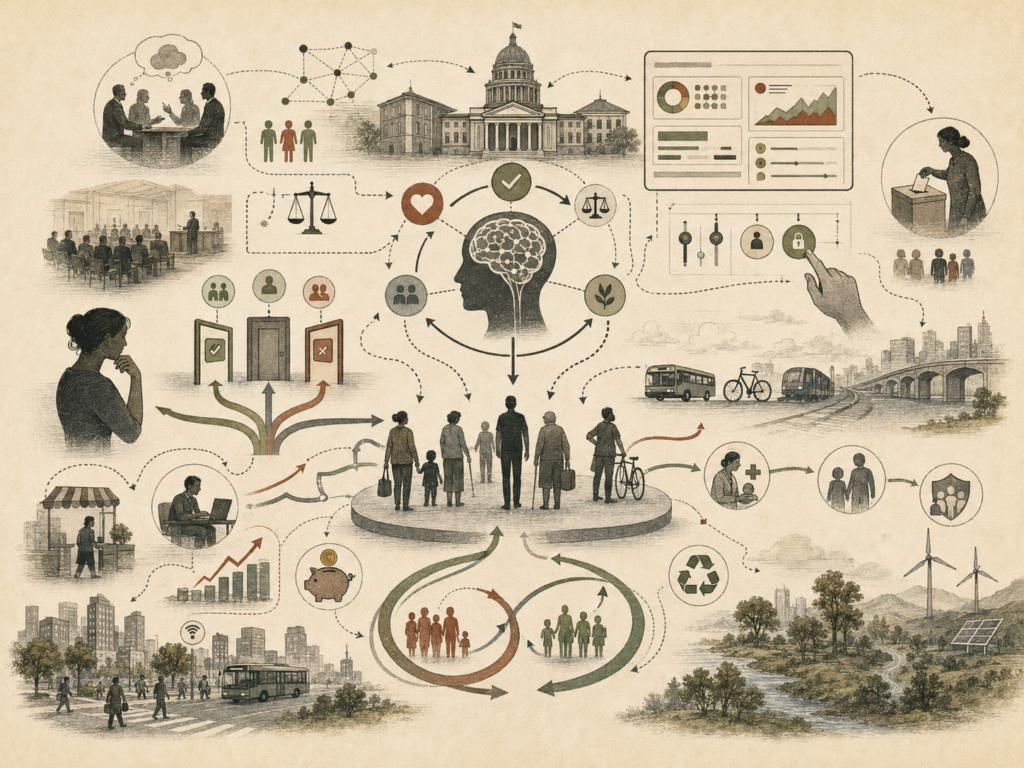
Editorial systems illustration showing behavioral economics applied to governance and public policy through decision pathways, civic institutions, social norms, public services, infrastructure, and feedback loops.

The Future of Behavioral Economics in Governance and Policy

Behavioral economics is becoming increasingly important to governance because institutions do not operate on idealized rational agents, but on people navigating friction, limited attention, social influence, and uneven trust. This article argues that the field’s future lies not only in nudges or bias correction, but in the design of psychologically realistic and ethically defensible institutions. It examines behavioral public policy, digital governance, sustainability transitions, administrative burden, and institutional legitimacy, while also developing a formal analytical framework for behaviorally informed governance. Substantial R and Python sections model compliance, trust, salience, and welfare across alternative governance regimes, showing how behavioral economics increasingly functions as a theory of institutional design rather than merely individual error.

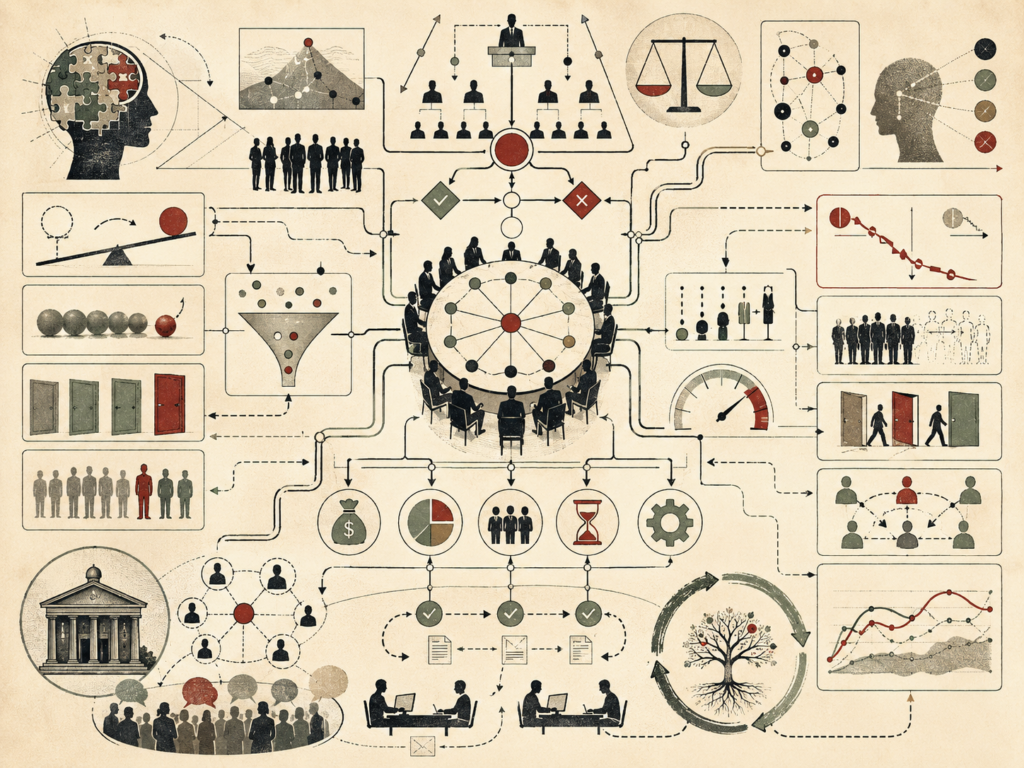
Editorial systems illustration showing organizational decision-making shaped by cognitive bias, incentives, hierarchy, group dynamics, feedback loops, risk perception, and institutional design.

Behavioral Economics in Organizational Decision-Making

Behavioral economics in organizational decision-making shows that firms, governments, and complex institutions do not behave like unified optimizing agents. They decide through bounded rationality, incentive structures, group dynamics, internal narratives, and governance systems that shape what becomes visible, rewarded, or ignored. This article examines how overconfidence, escalation of commitment, conformity pressure, metric distortion, and institutional culture influence strategic choice under uncertainty. It also develops a formal analytical framework for organizational decision-making and includes substantial R and Python sections for modeling incentives, review structures, and governance regimes. The broader argument is that organizational behavior is best understood not as isolated managerial error, but as the product of institutional design under real cognitive and political constraints.

Editorial systems illustration showing behavioral design in technology systems through interfaces, nudges, incentives, attention flows, privacy controls, feedback loops, user choice, and governance safeguards.

Behavioral Design in Technology Systems

Behavioral design in technology systems examines how digital environments structure judgment, attention, retention, consent, and action through defaults, salience, friction, prompts, and feedback. This article argues that interface design should be understood not as a neutral technical layer but as a form of behavioral governance with economic and ethical consequences. It explores persuasive design, attention architecture, dark patterns, platform power, and sustainability-oriented applications, while also developing a formal analytical framework for digital choice environments. Substantial R and Python sections model retention, friction asymmetry, and interface welfare across contrasting design regimes. The broader argument is that behavioral effectiveness alone is not enough; digital systems must also be judged by whether they support user autonomy, reversibility, and legitimate institutional aims.

Editorial systems illustration showing how algorithms, digital interfaces, notifications, rankings, defaults, recommendations, incentives, privacy controls, and platform governance shape user decision-making.

Behavioral Economics and Digital Platforms: How Algorithms and Interfaces Shape Decision-Making

Behavioral economics and digital platforms examines how online systems shape attention, preference formation, information exposure, and economic choice through recommendation, ranking, feedback, and interface design. This article argues that digital platforms should be understood not as neutral intermediaries but as behavioral infrastructures that organize action at scale. It explores recommendation loops, the attention economy, social feedback, manipulative design, digital governance, and sustainability-related platform effects, while also developing a formal analytical framework for visibility, salience, and reinforcement in online environments. Substantial R and Python sections model recommendation concentration, social amplification, and comparative platform regimes. The central claim is that platform power is behavioral as well as economic, and must therefore be judged in terms of welfare, legitimacy, and institutional accountability.

Scroll to Top