
Last Updated May 25, 2026
Behavioral design in technology systems examines how digital environments are intentionally structured to shape judgment, attention, action, consent, habit, and institutional trust. In contemporary platform economies, interface design is no longer a merely aesthetic or technical matter. It is a mode of behavioral governance. Defaults, prompts, ranking systems, friction points, recommendation engines, visual hierarchy, notification timing, personalization, and feedback loops all influence what users notice, what they ignore, what they choose, what they postpone, what they share, what they buy, and how long they remain engaged. Behavioral economics matters here because digital systems increasingly operate as large-scale choice architectures in which design decisions become economically consequential, socially consequential, and politically significant.
Modern technology systems do not simply present neutral options to autonomous users. They create structured environments in which some actions are easier, faster, more visible, more rewarding, or more difficult to reverse than others. Social platforms organize attention through engagement ranking. Marketplaces steer discovery through placement and recommendation. Financial applications sequence decisions through reminders, defaults, simplified interfaces, and risk framings. Subscription services can make entry frictionless and exit burdensome. Privacy controls can be designed for comprehension or exhaustion. In each case, design operates behaviorally: it shapes action not by explicit coercion, but by configuring the context in which choice occurs.
Main Library
Publications
Article Map
Behavioral Economics
Related Topic
Decision Science
Related Topic
Data Systems & Analytics
Related Topic
Institutions & Governance
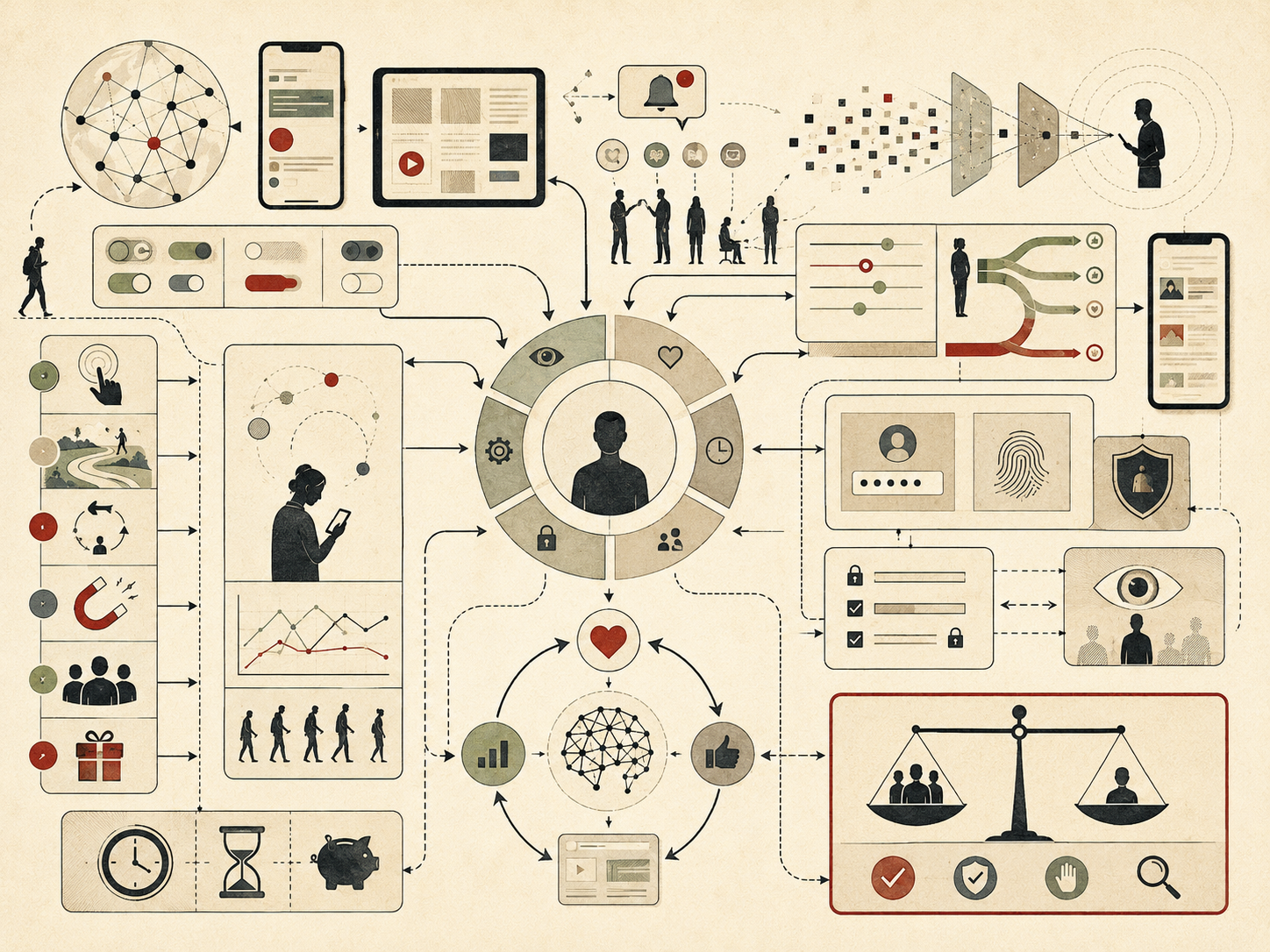
For that reason, behavioral design in technology systems should be understood as a serious interdisciplinary field connecting behavioral economics, psychology, human-computer interaction, design ethics, data science, consumer protection, platform governance, digital regulation, institutional accountability, and public welfare. It includes both welfare-enhancing design and exploitative design. It concerns not only whether systems are effective, but for whom they are effective, toward what ends, under what conditions of transparency, and with what safeguards against manipulation, discrimination, extraction, and dependency.
The central question is no longer whether technology influences behavior. It does. The deeper question is how digital environments should be designed when the people using them have limited attention, incomplete information, social vulnerability, present bias, privacy fatigue, habit formation, and unequal power relative to the institutions that build the systems. Behavioral economics provides the conceptual language for analyzing these systems. Governance, ethics, and institutional design determine whether that knowledge is used to support human agency or exploit predictable human limits.
Technology Systems as Choice Architecture
One of the most important insights of behavioral economics is that decisions are influenced not only by preferences and incentives, but by the structure of the environments in which those decisions occur. Digital systems bring that insight into unusually sharp focus because they can be designed, tested, revised, personalized, and optimized at speed and scale. Menus, ranking systems, prompts, defaults, dashboards, modal windows, visual contrast, progress indicators, recommendation queues, and cancellation paths all influence how users interpret options and what they are most likely to do next.
This means that technology systems function as operational forms of choice architecture. Designers do not merely decide what features exist. They decide which options are prominent, which require extra effort, which are preselected, which generate feedback, which are deferred, which are framed as recommended, and which remain obscure. The environment becomes part of the decision itself.
The digital context intensifies this logic because online systems can be instrumented continuously. Firms can run experiments across large populations, estimate how interface variants alter click-through, retention, consent, purchase behavior, cancellation, time spent, or sharing, and then iterate on designs accordingly. In this sense, digital markets often behave as continuously updated behavioral laboratories, where interface structure and economic incentive become tightly intertwined.
This does not mean every design decision is manipulative. A clear interface can reduce confusion. A default can protect users from harmful error. A reminder can help people complete an action they already intended to take. A progress indicator can make a complex process manageable. Behavioral design becomes ethically significant precisely because the same tools can support or undermine agency depending on purpose, transparency, reversibility, and institutional accountability.
Technology systems therefore create a governance problem. When a government form is confusing, eligible people may fail to receive services. When a privacy dashboard is obscure, users may share more data than they understand. When a platform ranks content by engagement, attention may shift toward arousal rather than accuracy. When a subscription makes cancellation difficult, retention may reflect obstruction rather than satisfaction. Behavioral design is not merely interface detail. It is the architecture through which users encounter rights, markets, platforms, institutions, and public information.
Persuasive Design and Digital Nudges
Behavioral design is not inherently harmful. In many settings, it can support learning, savings, health behavior, accessibility, public-service uptake, energy conservation, financial planning, safety, and environmental stewardship. B.J. Fogg’s work on persuasive technology helped formalize the idea that computing systems can be designed to change attitudes and behavior, making this a central theme in human-computer interaction and behavioral design research.
Examples of constructive behavioral design include financial applications that simplify saving, educational platforms that reinforce study routines, health systems that improve adherence through timely reminders, accessibility features that reduce cognitive and physical effort, and energy dashboards that make conservation patterns legible. These interventions often resemble the logic of nudge theory: they preserve formal choice while adjusting context so that better outcomes become easier to achieve.
The strongest persuasive designs are aligned with user welfare. They help people do what they reflectively want to do but might fail to do because of friction, forgetfulness, limited attention, present bias, or complexity. A medication reminder, a retirement contribution default, a spending alert, or a simplified benefits application can be behaviorally powerful without being exploitative. The ethical legitimacy of the design depends on whether it supports agency rather than replacing it.
But even in beneficial settings, normative questions remain. Does the design help users pursue their own considered goals, or does it substitute designer judgment for user agency? Are behavioral prompts transparent and proportionate? Is the interface reducing complexity, or redirecting action in ways that users may not fully understand? Can users reverse the choice easily? Are the design’s objectives aligned with user welfare, institutional convenience, advertiser value, or platform retention?
These questions become increasingly important as systems become adaptive and personalized. A static reminder is one thing; a continuously optimized behavioral system that learns when a user is most vulnerable to a prompt is another. The more precisely a system can infer state, intention, weakness, emotion, fatigue, or habit, the more serious its ethical responsibilities become.
Persuasive design therefore needs a distinction between assistance and exploitation. Assistance reduces friction between a person’s considered goals and their actual behavior. Exploitation increases friction around exit, comprehension, refusal, or self-control in order to serve the system’s goals at the user’s expense.
Attention Architecture and the Behavioral Economics of Engagement
Behavioral design in digital technology increasingly centers on the organization of attention. Herbert Simon’s famous observation that an abundance of information creates a poverty of attention has become even more salient in the platform era, where firms compete to capture, redirect, monetize, and retain attention through ranking, alerts, autoplay, variable feedback, social comparison, and personalized recommendation.
From a behavioral perspective, engagement systems often exploit predictable tendencies: present bias toward immediate reward, salience sensitivity, social validation motives, habit formation, intermittent reinforcement, loss aversion, curiosity gaps, and reduced deliberation under repeated prompts. Notifications do not merely inform; they pull action into the present. Feeds do not merely display; they rank and sequence relevance. Progress cues, counts, streaks, and social signals transform interaction into a loop of expectation, response, and return.
This is why technology firms increasingly operate within what can properly be called an attention economy. Economic value is often tied to time spent, engagement intensity, conversion probability, advertising exposure, subscription renewal, and the extraction of behaviorally useful data. Under those conditions, interface design becomes a revenue-relevant mechanism for steering cognition itself. Behavioral economics is crucial here because it helps explain why seemingly minor design features can scale into large aggregate effects across populations.
Attention architecture also changes the meaning of user preference. If a user clicks, scrolls, watches, shares, or returns, the system may record that behavior as preference. But observed behavior inside a behaviorally optimized environment is not always the same as reflective endorsement. A person may continue scrolling while later judging the experience as wasteful. A user may click a sensational headline because it is salient, not because it is valuable. A consumer may accept a default because refusal is confusing, not because consent is meaningful.
This creates an interpretive problem for data-driven design. Behavioral data are not pure expressions of preference; they are traces of interaction within a designed environment. If the environment is optimized for engagement, the resulting data may increasingly teach the system how to deepen engagement rather than how to improve user welfare. This feedback loop is one of the defining behavioral risks of digital systems.
A more responsible attention architecture would ask different questions. Instead of asking only what increases time spent, it would ask what supports comprehension, agency, trust, user-defined goals, healthy pacing, and meaningful completion. Instead of treating every return as success, it would distinguish between satisfied return, compulsive return, confused return, and trapped return. That distinction is central to the behavioral ethics of digital design.
Dark Patterns, Manipulation, and Consumer Harm
Not all behavioral design is aligned with user welfare. Some systems intentionally exploit predictable vulnerabilities to induce purchases, prolong subscriptions, expand data sharing, weaken meaningful consent, discourage cancellation, or create urgency where none is warranted. These practices are commonly described as dark patterns: interface designs that trick, pressure, obstruct, or confuse users into actions they might not otherwise take under clearer conditions.
The U.S. Federal Trade Commission’s report Bringing Dark Patterns to Light describes dark patterns as increasingly sophisticated practices that can mislead consumers, make cancellation difficult, bury key terms, disguise advertising, or manipulate data-sharing decisions. Behavioral economics is particularly important in this area because dark patterns often work through mechanisms already familiar in the literature: inertia, default bias, limited attention, urgency framing, loss aversion, scarcity cues, social proof, complexity avoidance, and fatigue.
Subscription traps exploit friction asymmetry between sign-up and cancellation. Privacy interfaces exploit informational overload and consent fatigue. Purchase interfaces exploit scarcity cues, countdown timers, hidden fees, and time pressure. Platform onboarding flows can encourage data sharing before users understand the consequences. The user appears to choose, but the architecture has been designed to tilt that choice predictably.
Dark patterns are especially harmful because they preserve the appearance of agency while undermining its substance. The user clicked. The user agreed. The user remained subscribed. The user accepted the default. But a behavioral analysis asks whether that observed action reflects informed, reversible, low-pressure choice or whether it reflects friction, confusion, fatigue, or manipulation.
These issues make behavioral design a matter of consumer protection and platform governance rather than mere usability. Once interface decisions shape market conduct and informational self-determination at scale, they become institutional questions about responsibility, accountability, and the lawful boundaries of behavioral influence.
Dark patterns also have distributional consequences. Users with lower digital literacy, limited time, disability, language barriers, financial stress, or less institutional familiarity may be more vulnerable to confusing interfaces and obstructive flows. A manipulative interface may not harm all users equally. Behavioral design ethics therefore must consider who bears the burden of complexity and who has the resources to resist it.
Friction Asymmetry, Reversibility, and User Autonomy
Friction is one of the most important variables in behavioral technology design. Friction is not always bad. It can protect users from impulsive decisions, harmful purchases, unsafe sharing, irreversible deletion, or accidental disclosure. A confirmation step can be user-protective. A cooling-off period can support deliberation. A warning can prevent harm. But friction becomes ethically suspect when it is asymmetrically distributed to favor the institution over the user.
Friction asymmetry occurs when it is easy to enter a relationship but difficult to leave it, easy to share data but difficult to withdraw consent, easy to subscribe but difficult to cancel, easy to accept defaults but difficult to modify them, or easy to make an impulsive purchase but difficult to reverse it. In such cases, design is not simply simplifying user experience. It is shaping economic outcomes through behavioral burden.
Reversibility is therefore central to user autonomy. A choice is more meaningful when users can understand it, refuse it, modify it, and reverse it without unreasonable cost. A system that hides exit, fragments settings, uses confusing labels, requires unnecessary calls, or creates emotional pressure during cancellation is not merely inconvenient. It is using behavioral friction as a retention strategy.
Behavioral economics clarifies why this matters. Limited attention, status quo bias, procrastination, loss aversion, and effort avoidance mean that small frictions can have large effects. A few extra clicks, an unclear button, a warning framed as loss, or a difficult-to-find setting can alter behavior at population scale. Designers and regulators should therefore treat friction placement as an ethical and governance choice.
A responsible digital system should distinguish protective friction from extractive friction. Protective friction slows users down when the user faces risk. Extractive friction slows users down when the institution faces revenue loss, data loss, or reduced engagement. That difference is not always obvious from the interface alone, but it is central to behavioral evaluation.
Behavioral Design, Platforms, and Institutional Power
Behavioral design also raises broader questions about institutional power. Technology companies do not simply sell products. Many of them govern the conditions under which communication, discovery, search, consumption, work, payment, ranking, recommendation, and consent occur. Their design choices influence what users see, how choices are framed, what behavior is rewarded, which actions are made costly or obscure, and how social reality becomes visible.
This is one reason behavioral design belongs in close conversation with Behavioral Economics and Digital Platforms. Platforms act as architects of environments rather than passive intermediaries. They shape the behavioral terrain on which users, advertisers, sellers, creators, workers, institutions, and citizens interact. This gives them forms of power that are partly economic, partly informational, and partly behavioral.
Platform power is behavioral because platforms can define salience. Search results, feeds, recommendations, default filters, content moderation labels, product rankings, and notification systems determine what appears available, popular, urgent, credible, or socially endorsed. Users may experience the platform as a neutral environment, but the environment has been actively ordered.
Platform power is also asymmetric. Platforms often know far more about user behavior than users know about platform design. They can test interface variants, infer vulnerability, segment audiences, and optimize for outcomes invisible to the user. The user experiences a single interface. The platform observes a population-scale behavioral experiment.
Shoshana Zuboff’s work on surveillance capitalism helped crystallize the argument that digital firms increasingly seek to predict and modify behavior through data extraction and behavioral surplus. Whatever one’s view of the broader thesis, the book remains influential in framing how behavior modification, platform incentives, and asymmetries of knowledge intersect in digital systems.
A governance-oriented behavioral economics must therefore ask not only how users choose, but how institutions structure the field of choice. It must examine platform incentives, data extraction, interface testing, algorithmic ranking, advertising systems, and the political economy of attention. Behavioral design is not only a matter of individual psychology. It is a matter of institutional power operating through interface form.
Algorithmic Choice Architecture and Recommendation Systems
Recommendation systems are among the most powerful behavioral design mechanisms in contemporary technology. They determine which products, posts, videos, songs, articles, jobs, ads, routes, services, or people are placed in front of users. They do not merely predict preference; they help produce the behavioral environment in which preferences are expressed.
Algorithmic choice architecture differs from static interface design because it is adaptive. The system can learn from behavior, update rankings, personalize exposure, and optimize for a target metric. If the target metric is engagement, the system may learn to amplify content that generates arousal, anger, curiosity, fear, status comparison, or compulsive return. If the target metric is user welfare, the system would need a much richer understanding of what welfare means and how it can be measured without reducing human flourishing to behavioral intensity.
This creates a major behavioral-economics problem: optimization metrics are not neutral. A platform that optimizes watch time is not simply helping users watch what they prefer. It is shaping future exposure in ways that can influence preference, habit, attention, and social perception. A marketplace that optimizes conversion may rank options that sell quickly rather than options that best serve long-term user value. A news feed that optimizes interaction may privilege conflict over understanding.
Recommendation systems can also create feedback loops. Exposure influences behavior; behavior trains the system; the system changes exposure; changed exposure further influences behavior. Over time, this can narrow user experience, intensify preferences, reinforce biases, or create path dependency. Behavioral economics helps clarify why revealed preference inside such systems should be interpreted cautiously.
For governance, algorithmic choice architecture raises questions of transparency, auditability, contestability, and objective function. What is the system optimizing? Who benefits from that optimization? How are harms measured? Can users meaningfully influence recommendations? Are vulnerable users protected? Are content creators or sellers subject to opaque ranking decisions? Does the system reward quality, accuracy, welfare, engagement, or revenue?
A responsible design framework would treat recommender systems as behavioral institutions. They allocate attention, opportunity, visibility, and social meaning. Their effects cannot be evaluated only through technical accuracy. They must also be evaluated through behavioral, ethical, distributional, and institutional consequences.
Privacy, Consent, and Cognitive Burden
Privacy interfaces are among the clearest examples of behavioral design in technology systems. Consent banners, settings pages, permission prompts, cookie notices, data-sharing controls, and privacy dashboards often appear to give users choice. But meaningful choice depends on comprehension, timing, salience, reversibility, and reasonable cognitive demand.
Many privacy systems impose heavy cognitive burden. Users are asked to make decisions about data practices they cannot fully observe, legal terms they cannot realistically read, downstream uses they cannot predict, and risks that may unfold over time. The result is often consent fatigue. Users click through because they are trying to complete another task, not because they have evaluated the data relationship.
Behavioral economics helps explain why formal disclosure may fail. Information can be available but not salient. Options can be present but not understandable. Settings can be technically adjustable but practically inaccessible. Consent can be recorded but not meaningfully informed. A system can satisfy a narrow procedural requirement while failing the behavioral conditions of autonomy.
Privacy design also uses defaults. Opt-in and opt-out structures produce different outcomes because inertia matters. Preselected data-sharing options can increase consent rates without increasing genuine understanding. Layered menus can preserve nominal control while burying meaningful settings. Warning language can frame refusal as loss of functionality or personalization even when the consequence is minor.
A behaviorally responsible privacy architecture would reduce cognitive burden, make defaults protective, use plain language, separate necessary from optional data uses, make refusal easy, preserve reversibility, and avoid using urgency or confusion to obtain consent. It would treat privacy not as a legal checkbox, but as an ongoing relationship of trust, accountability, and user control.
Behavioral Design and Sustainability Applications
Behavioral design can also be used constructively in domains linked to sustainability. Digital systems increasingly influence transportation choice, household energy use, product comparison, waste behavior, food consumption, repair decisions, sharing platforms, environmental reporting, and exposure to ecological information. Interfaces can make lower-impact choices easier to identify, defaults can favor reduced resource use, and comparative feedback can help households or firms situate their behavior in relation to peers or targets.
These applications overlap closely with Behavioral Economics and Sustainable Consumption and Behavioral Insights in Environmental Policy. A transit app can make lower-emission routes more salient. A utility dashboard can show energy peaks and conservation opportunities. A marketplace can highlight repairability, durability, and lifecycle impact. A procurement system can default to lower-impact options. A waste-management interface can reduce confusion about sorting. In each case, behavioral design can lower the cognitive and practical cost of sustainable action.
Yet the same caution applies here as elsewhere: beneficial design should not be treated as a substitute for infrastructure, regulation, or accurate pricing of externalities. Behavioral design is strongest when it supports substantively better systems rather than attempting to compensate for structurally poor ones. A digital prompt cannot solve inadequate transit. A green default cannot compensate for unaffordable clean technology. An energy dashboard cannot replace building efficiency standards.
Digital sustainability design is therefore an especially revealing case. It shows both the promise and the limit of behavioral intervention. Interfaces can assist coordination, salience, and uptake. They cannot by themselves resolve deeper questions of political economy, material inequality, infrastructure, supply-chain responsibility, or institutional accountability.
Sustainability-oriented behavioral design should also avoid moralizing individual choice while ignoring structural constraint. A well-designed system makes lower-impact options easier and more intelligible without shifting all responsibility onto users. The ethical goal is not to nudge people into compensating for broken systems. It is to align infrastructure, incentives, information, defaults, and governance so that lower-impact behavior becomes more feasible and durable.
An Analytical Framework for Behavioral Design in Technology
A useful starting point is to represent a user’s choice among digital options as depending not only on intrinsic preference, but on interface structure. Let the perceived utility of choosing option \(j\) in a digital environment be:
U_j = v_j + \alpha S_j + \beta D_j – \gamma F_j + \delta R_j – \lambda C_j
\]
Interpretation: A user’s perceived utility depends on baseline value, salience, default status, friction, reward intensity, and cognitive burden.
Here, \(v_j\) is baseline value to the user, \(S_j\) is salience or visual prominence, \(D_j\) is whether the option is set as a default, \(F_j\) is friction or effort cost, \(R_j\) is reward intensity or positive feedback, and \(C_j\) is cognitive burden or complexity. Parameters \(\alpha, \beta, \gamma, \delta, \lambda > 0\) reflect user sensitivity to these design features.
This formulation makes clear that interface structure can alter behavior even when underlying preferences remain unchanged. A cancellation path that increases \(F_j\), a privacy-invasive default that raises \(D_j\), a prominent call-to-action that increases \(S_j\), or a reward loop that increases \(R_j\) can materially shift observed behavior without changing what the user would endorse under clearer or more neutral conditions.
Intertemporal dynamics also matter. Many engagement systems can be modeled using present-biased utility. Suppose immediate reward from checking an application is \(r_0\), while long-run cost in attention loss, distraction, regret, or opportunity cost is \(L_t\). Then a present-biased user evaluates repeated engagement according to:
U_t = r_0 – \beta \sum_{k=1}^{T} \delta^k L_k
\]
Interpretation: Immediate rewards are experienced now, while long-run costs may be behaviorally discounted.
Here, \(0 < \beta \leq 1\). When \(\beta < 1\), long-run harms are underweighted relative to immediate reward. This helps explain why systems built around alerts, streaks, or variable feedback can produce persistent over-engagement even among users who later regard the behavior as misaligned with their own priorities.
Dark-pattern dynamics can also be expressed through friction asymmetry. Let \(F_{in}\) be friction to enter a contract, subscribe, accept a default, or share data, and \(F_{out}\) be the friction required to reverse that decision. A manipulative interface often produces:
F_{out} \gg F_{in}
\]
Interpretation: When exit friction is far greater than entry friction, retention may reflect lock-in rather than genuine user welfare.
Under inertia and limited attention, this asymmetry increases retention or data extraction without necessarily increasing genuine user welfare. Welfare-enhancing design, by contrast, tends to reduce unnecessary friction while preserving clarity, comprehension, and reversibility.
Finally, recommendation systems can be understood as salience-allocation devices. Let exposure to content or products depend on an algorithmic ranking score \(q_i\), such that the probability of user selection is:
P(i) = \frac{e^{q_i}}{\sum_{m=1}^{n} e^{q_m}}
\]
Interpretation: Ranking systems allocate exposure by changing the probability that a user sees or selects an item.
When ranking criteria optimize engagement rather than user welfare, the system can systematically privilege items that are more arousing, divisive, impulsively attractive, or commercially valuable, even if they are not better in any substantively meaningful sense. A behavioral analysis therefore asks not only whether users clicked, but why the system made that click likely.
One additional welfare-oriented model can distinguish behavioral effectiveness from legitimacy. Let platform value from a design be \(P_D\), user welfare be \(W_U\), and autonomy cost be \(A_C\). A design that maximizes institutional outcome alone may optimize:
\max_D P_D
\]
Interpretation: A narrow platform objective can optimize engagement, conversion, or retention without accounting for user welfare.
A more responsible behavioral design objective would instead consider:
\max_D \left(W_U + P_D – A_C\right)
\]
Interpretation: Legitimate design should account for user welfare and autonomy costs, not only institutional performance.
This does not solve every measurement problem, but it clarifies the central ethical distinction: a behaviorally effective interface is not automatically a good interface. It must be evaluated by what it helps users understand, choose, reverse, and sustain.
R Workflow: Simulating Default Effects, Friction, and Retention Dynamics
The following R workflow simulates user decisions inside a digital system where defaults, friction, salience, reward structure, and cognitive burden influence conversion, retention, and opt-out behavior. It is designed as a practical starting point for analysts examining interface effects. The data are synthetic and intended for methods demonstration, not for operational user scoring or behavioral targeting.
# Behavioral Design in Technology Systems
# R workflow: default effects, friction, and retention dynamics
# Synthetic data only. This is a research-scaffolding example.

set.seed(202)

n_users <- 7000

users <- data.frame(
  user_id = seq_len(n_users),

  # Intrinsic value from the product or service.
  baseline_value = rnorm(n_users, mean = 0.45, sd = 0.18),

  # Heterogeneous sensitivity to interface features.
  salience_sensitivity = pmin(pmax(rnorm(n_users, 0.55, 0.18), 0), 1),
  default_sensitivity = pmin(pmax(rnorm(n_users, 0.50, 0.20), 0), 1),
  friction_sensitivity = pmin(pmax(rnorm(n_users, 0.60, 0.16), 0), 1),
  reward_sensitivity = pmin(pmax(rnorm(n_users, 0.58, 0.17), 0), 1),
  cognitive_overload = pmin(pmax(rnorm(n_users, 0.42, 0.15), 0), 1),

  # User-protective preference: how strongly the user values control.
  autonomy_preference = pmin(pmax(rnorm(n_users, 0.55, 0.18), 0), 1)
)

interface_grid <- expand.grid(
  salience = c(0.25, 0.55, 0.85),
  default_on = c(0, 1),
  entry_friction = c(0.05, 0.15),
  exit_friction = c(0.10, 0.35, 0.60),
  reward_intensity = c(0.20, 0.50, 0.80)
)

simulate_retention <- function(
  df,
  salience,
  default_on,
  entry_friction,
  exit_friction,
  reward_intensity
) {
  # Stage 1: joining or initial conversion.
  join_score <- with(
    df,
    baseline_value +
      salience_sensitivity * salience +
      default_sensitivity * default_on -
      friction_sensitivity * entry_friction +
      reward_sensitivity * reward_intensity -
      cognitive_overload * 0.4
  )

  joined_prob <- plogis(join_score)
  joined <- rbinom(nrow(df), 1, joined_prob)

  # Stage 2: retention after joining.
  stay_score <- with(
    df,
    baseline_value * 0.5 +
      reward_sensitivity * reward_intensity +
      default_sensitivity * default_on +
      friction_sensitivity * exit_friction -
      cognitive_overload * 0.35
  )

  retained_prob <- plogis(stay_score)
  retained <- ifelse(joined == 1, rbinom(nrow(df), 1, retained_prob), 0)

  friction_asymmetry <- exit_friction - entry_friction

  # Stylized welfare proxy:
  # value and rewards can help, but asymmetry and overload impose costs.
  welfare <- with(
    df,
    joined * (baseline_value + 0.4 * reward_intensity) -
      0.8 * friction_asymmetry -
      0.5 * cognitive_overload -
      0.4 * autonomy_preference * max(friction_asymmetry, 0)
  )

  data.frame(
    joined_prob = joined_prob,
    retained_prob = retained_prob,
    joined = joined,
    retained = retained,
    welfare = welfare
  )
}

results_list <- vector("list", nrow(interface_grid))

for (i in seq_len(nrow(interface_grid))) {
  g <- interface_grid[i, ]

  sim <- simulate_retention(
    users,
    salience = g$salience,
    default_on = g$default_on,
    entry_friction = g$entry_friction,
    exit_friction = g$exit_friction,
    reward_intensity = g$reward_intensity
  )

  results_list[[i]] <- data.frame(
    salience = g$salience,
    default_on = g$default_on,
    entry_friction = g$entry_friction,
    exit_friction = g$exit_friction,
    reward_intensity = g$reward_intensity,
    join_rate = mean(sim$joined),
    retention_rate = mean(sim$retained),
    mean_welfare = mean(sim$welfare)
  )
}

results <- do.call(rbind, results_list)

results$friction_asymmetry <- results$exit_friction - results$entry_friction
results$possible_dark_pattern <- ifelse(
  results$friction_asymmetry > 0.25 & results$default_on == 1,
  1,
  0
)

results_by_retention <- results[order(-results$retention_rate), ]
print(head(results_by_retention, 15))

dark_pattern_summary <- aggregate(
  cbind(join_rate, retention_rate, mean_welfare) ~ possible_dark_pattern,
  data = results,
  FUN = mean
)

print(dark_pattern_summary)

welfare_ranked <- results[order(-results$mean_welfare), ]
print(head(welfare_ranked, 15))

dir.create("outputs/tables", recursive = TRUE, showWarnings = FALSE)
write.csv(results, "outputs/tables/interface_design_simulation_results.csv", row.names = FALSE)
write.csv(dark_pattern_summary, "outputs/tables/dark_pattern_summary.csv", row.names = FALSE)

# Analysts can extend this model by adding:
# - churn regret
# - user satisfaction
# - complaint rates
# - privacy sensitivity
# - platform trust
# - regulatory risk exposure
# - heterogeneous effects by age, disability, language, or digital literacy
This type of simulation makes one central point visible: high retention is not, by itself, evidence of good design. Retention can be produced by clarity and value, but it can also be produced by default lock-in and exit friction. Behavioral analytics must therefore distinguish between user benefit, user habit, user confusion, and user captivity. A system that keeps users is not automatically a system that serves users.
Python Workflow: Comparing Welfare-Enhancing and Manipulative Interface Regimes
The Python workflow below compares three stylized interface regimes: user-supportive design, engagement-maximizing design, and friction-heavy lock-in design. It estimates not only conversion and retention, but also a simple welfare score that penalizes asymmetry, overload, and autonomy costs. The workflow is synthetic and educational, but it provides a reusable scaffold for thinking more clearly about the difference between behavioral effectiveness and behavioral legitimacy.
# Behavioral Design in Technology Systems
# Python workflow: welfare-enhancing and manipulative interface regimes
# Synthetic data only. This is a research-scaffolding example.

from __future__ import annotations

import numpy as np
import pandas as pd

rng = np.random.default_rng(202)

n = 9000

users = pd.DataFrame({
    "user_id": np.arange(1, n + 1),
    "baseline_value": rng.normal(0.45, 0.18, n),
    "salience_sensitivity": np.clip(rng.normal(0.55, 0.18, n), 0, 1),
    "default_sensitivity": np.clip(rng.normal(0.50, 0.20, n), 0, 1),
    "friction_sensitivity": np.clip(rng.normal(0.60, 0.16, n), 0, 1),
    "reward_sensitivity": np.clip(rng.normal(0.58, 0.17, n), 0, 1),
    "cognitive_overload": np.clip(rng.normal(0.42, 0.15, n), 0, 1),
    "privacy_sensitivity": np.clip(rng.normal(0.55, 0.20, n), 0, 1),
    "autonomy_preference": np.clip(rng.normal(0.58, 0.18, n), 0, 1)
})

def evaluate_interface(
    df: pd.DataFrame,
    salience: float,
    default_on: int,
    entry_friction: float,
    exit_friction: float,
    reward_intensity: float,
    data_extraction_intensity: float
) -> dict[str, float]:
    """
    Evaluate a synthetic interface regime.

    The model has two behavioral stages:
    1. Initial joining or conversion
    2. Retention after joining

    It also computes a stylized welfare score that penalizes
    friction asymmetry, cognitive burden, and autonomy/privacy costs.
    """
    join_score = (
        df["baseline_value"].values
        + df["salience_sensitivity"].values * salience
        + df["default_sensitivity"].values * default_on
        - df["friction_sensitivity"].values * entry_friction
        + df["reward_sensitivity"].values * reward_intensity
        - df["cognitive_overload"].values * 0.4
    )

    join_prob = 1 / (1 + np.exp(-join_score))
    joined = rng.binomial(1, join_prob)

    stay_score = (
        df["baseline_value"].values * 0.5
        + df["reward_sensitivity"].values * reward_intensity
        + df["default_sensitivity"].values * default_on
        + df["friction_sensitivity"].values * exit_friction
        - df["cognitive_overload"].values * 0.35
    )

    retain_prob = 1 / (1 + np.exp(-stay_score))
    retained = np.where(joined == 1, rng.binomial(1, retain_prob), 0)

    friction_asymmetry = exit_friction - entry_friction

    autonomy_cost = (
        0.7 * np.maximum(friction_asymmetry, 0)
        * df["autonomy_preference"].values
    )

    privacy_cost = (
        data_extraction_intensity
        * df["privacy_sensitivity"].values
        * joined
    )

    welfare = (
        joined * (df["baseline_value"].values + 0.4 * reward_intensity)
        - 0.8 * np.maximum(friction_asymmetry, 0)
        - 0.5 * df["cognitive_overload"].values
        - autonomy_cost
        - privacy_cost
    )

    platform_value = (
        1.2 * joined
        + 1.6 * retained
        + 1.0 * data_extraction_intensity * joined
    )

    return {
        "join_rate": float(joined.mean()),
        "retention_rate": float(retained.mean()),
        "mean_user_welfare": float(welfare.mean()),
        "mean_platform_value": float(platform_value.mean()),
        "friction_asymmetry": float(friction_asymmetry),
        "welfare_platform_gap": float(platform_value.mean() - welfare.mean())
    }

regimes = {
    "user_supportive_design": {
        "salience": 0.55,
        "default_on": 0,
        "entry_friction": 0.08,
        "exit_friction": 0.08,
        "reward_intensity": 0.35,
        "data_extraction_intensity": 0.10
    },
    "engagement_maximizing_design": {
        "salience": 0.85,
        "default_on": 1,
        "entry_friction": 0.03,
        "exit_friction": 0.22,
        "reward_intensity": 0.80,
        "data_extraction_intensity": 0.45
    },
    "friction_heavy_lock_in": {
        "salience": 0.75,
        "default_on": 1,
        "entry_friction": 0.02,
        "exit_friction": 0.60,
        "reward_intensity": 0.55,
        "data_extraction_intensity": 0.60
    }
}

rows = []

for name, params in regimes.items():
    out = evaluate_interface(users, **params)
    out["regime"] = name
    rows.append(out)

results = pd.DataFrame(rows)[[
    "regime",
    "join_rate",
    "retention_rate",
    "mean_user_welfare",
    "mean_platform_value",
    "friction_asymmetry",
    "welfare_platform_gap"
]]

print(results.sort_values("mean_user_welfare", ascending=False))

users["overload_group"] = pd.qcut(
    users["cognitive_overload"],
    4,
    labels=["low", "medium", "high", "very_high"]
)

dist_rows = []

for name, params in regimes.items():
    for group in users["overload_group"].unique():
        subset = users.loc[users["overload_group"] == group].copy()
        out = evaluate_interface(subset, **params)
        out["regime"] = name
        out["overload_group"] = str(group)
        dist_rows.append(out)

distribution = pd.DataFrame(dist_rows)

print(distribution.sort_values(["regime", "overload_group"]))

from pathlib import Path

output_dir = Path("outputs/tables")
output_dir.mkdir(parents=True, exist_ok=True)

results.to_csv(output_dir / "interface_regime_comparison.csv", index=False)
distribution.to_csv(output_dir / "interface_regime_overload_distribution.csv", index=False)

# This structure can be adapted to:
# - privacy consent flows
# - subscriptions
# - recommendation systems
# - educational platforms
# - sustainability-oriented digital interfaces
# - government service portals
# - financial technology applications
For researchers, product teams, public-interest technologists, and regulators, the value of this comparison is that it distinguishes behavioral effectiveness from behavioral legitimacy. An interface can be successful in producing action while still degrading user welfare or autonomy. It can raise retention while increasing lock-in. It can increase consent while weakening comprehension. It can generate platform value while imposing hidden cognitive, privacy, and autonomy costs on users.
GitHub Repository
The companion repository provides reproducible scaffolding for the computational side of this article, including synthetic interface-behavior data, default-effect simulations, friction-asymmetry models, dark-pattern diagnostics, welfare comparisons, documentation, SQL schemas, and multi-language scientific-computing examples for behavioral design analysis.
This article is supported by an article-level folder in the Behavioral Economics computational repository, with reproducible examples, synthetic datasets, documentation, default-effect simulations, friction-asymmetry models, behavioral-retention workflows, dark-pattern diagnostics, platform-welfare comparisons, SQL metadata structures, and scientific-computing examples across Python, R, Julia, C++, Fortran, C, Rust, Go, and notebooks where appropriate.
The Future of Behavioral Design
As AI systems, adaptive interfaces, recommendation engines, automated decision supports, and personalized digital environments become more pervasive, behavioral design will become even more central to economic and civic life. Systems will increasingly tailor prompts, ranking, pacing, offers, reminders, and recommendations to inferred user states. This may improve educational outcomes, health adherence, savings behavior, accessibility, environmental coordination, and public-service delivery. It may also intensify asymmetries of knowledge and increase the precision with which systems steer behavior.
The future of the field therefore depends on whether behavioral design is developed within credible ethical and regulatory frameworks. Questions of transparency, reversibility, welfare measurement, contestability, consumer protection, and public accountability will become increasingly important. So too will questions about the institutional goals embedded in design. Systems optimized for long-term user benefit look very different from systems optimized for extraction, retention, conversion, or compliance at any cost.
AI-enabled personalization raises the stakes further. A system that can infer when a user is tired, lonely, impulsive, financially stressed, socially anxious, or likely to disengage has extraordinary behavioral power. Used responsibly, that power could support well-being, accessibility, learning, and safety. Used irresponsibly, it could enable manipulation at a level of precision that older forms of advertising and interface design could not achieve.
The future of behavioral design will also require stronger institutional methods. Product teams may need behavioral-impact assessments, dark-pattern audits, consent-flow testing, independent interface review, user-welfare metrics, accessibility evaluation, and governance processes that separate user benefit from platform benefit. Regulators may need new ways to evaluate interfaces as behavioral systems rather than static disclosures.
Behavioral design will remain important not because people are unusually malleable, but because digital environments have become unusually capable of structuring what counts as normal action. That makes the field central not only to product design, but to democratic governance in technologically mediated societies.
Interpretive Limits and Ethical Cautions
Behavioral economics provides powerful tools for analyzing technology systems, but those tools must be used carefully. Not every design effect is manipulation. Not every nudge is unethical. Not every retained user is trapped. Not every exited user has been harmed. The behavioral interpretation depends on context, purpose, transparency, user welfare, reversibility, and the distribution of benefits and burdens.
There is also a danger of over-attributing user behavior to interface design alone. Users bring their own goals, histories, preferences, constraints, identities, and social contexts. A behavioral design analysis should not erase agency. Rather, it should ask whether the environment supports or distorts agency under real human conditions.
At the same time, designers and platforms should not hide behind formal choice. A user’s click does not automatically prove meaningful consent. A user’s retention does not automatically prove satisfaction. A user’s engagement does not automatically prove benefit. Behavioral economics shows why observed behavior must be interpreted in relation to the architecture that produced it.
Ethical behavioral design should therefore be guided by several principles: clarity, reversibility, proportionality, user welfare, accessibility, privacy protection, distributional fairness, accountability, and respect for autonomy. These principles do not eliminate hard trade-offs, but they prevent behavioral design from becoming merely the science of making users do what institutions want.
Finally, behavioral design should be evaluated in relation to power. A small design choice made by a large platform can affect millions of people. A consent flow can shape data rights. A recommendation system can shape public attention. A cancellation path can transfer wealth. A ranking system can create or destroy visibility. When design operates at institutional scale, behavioral ethics becomes a public concern.
Conclusion
Behavioral design in technology systems reveals that digital interfaces are not passive surfaces layered on top of neutral markets. They are active environments that shape attention, preference expression, retention, consent, trust, and action. Through defaults, ranking, prompts, friction, rewards, and feedback, technology systems increasingly govern behavior at scale.
The significance of the field lies in its dual character. It can support user welfare by simplifying complexity and helping people act on their own goals. But it can also exploit bounded rationality, asymmetries of information, cognitive fatigue, and social vulnerability to produce manipulation disguised as convenience. For that reason, behavioral design belongs at the center of conversations about platform governance, consumer autonomy, privacy, digital regulation, and the ethics of technological systems.
The key question is no longer whether technology influences behavior. It is how, for whose benefit, and under what legitimate constraints. A responsible behavioral design tradition must distinguish assistance from exploitation, engagement from welfare, consent from fatigue, retention from lock-in, and personalization from manipulation. Digital systems will continue shaping behavior. The task is to ensure that they do so in ways that preserve human agency, protect vulnerable users, and make institutional power accountable.
Behavioral economics gives technology designers, researchers, and regulators a language for understanding these dynamics. Good governance must turn that language into standards, audits, design norms, and institutional responsibilities. The future of digital life will depend not only on what technology can do, but on what behavioral power society is willing to permit, constrain, and hold accountable.
Related Articles
- Behavioral Economics
- Choice Architecture and Decision Environments
- Nudge Theory and Behavioral Public Policy
- Behavioral Economics and Digital Platforms
- Present Bias and the Psychology of Immediate Reward
- Behavioral Economics and Sustainable Consumption
- Behavioral Insights in Environmental Policy
- The Future of Behavioral Economics in Governance and Policy
- Data Systems & Analytics
- Institutions & Governance
Further Reading
- Bösch, C., Erb, B., Kargl, F., Kopp, H. and Pfattheicher, S. (2016) ‘Tales from the dark side: Privacy dark strategies and privacy dark patterns’, Proceedings on Privacy Enhancing Technologies, 2016(4), pp. 237–254. Available at: https://petsymposium.org/popets/2016/popets-2016-0038.php.
- Federal Trade Commission (2022) Bringing Dark Patterns to Light. Washington, DC: Federal Trade Commission. Available at: https://www.ftc.gov/reports/bringing-dark-patterns-light.
- Fogg, B.J. (2003) Persuasive Technology: Using Computers to Change What We Think and Do. San Francisco, CA: Morgan Kaufmann. Available at: https://shop.elsevier.com/books/persuasive-technology/fogg/978-1-55860-643-2.
- Gray, C.M., Kou, Y., Battles, B., Hoggatt, J. and Toombs, A.L. (2018) ‘The dark patterns side of UX design’, Proceedings of the 2018 CHI Conference on Human Factors in Computing Systems. Available at: https://dl.acm.org/doi/10.1145/3173574.3174108.
- Harry Brignull / Deceptive Patterns (n.d.) Deceptive Patterns. Available at: https://www.deceptive.design/.
- Kahneman, D. (2011) Thinking, Fast and Slow. New York: Farrar, Straus and Giroux. Available at: https://us.macmillan.com/books/9780374533557/thinkingfastandslow.
- Mathur, A. et al. (2019) ‘Dark patterns at scale: Findings from a crawl of 11K shopping websites’, Proceedings of the ACM on Human-Computer Interaction, 3(CSCW). Available at: https://dl.acm.org/doi/10.1145/3359183.
- Thaler, R.H. and Sunstein, C.R. (2008) Nudge: Improving Decisions About Health, Wealth, and Happiness. New Haven, CT: Yale University Press. Available at: https://yalebooks.yale.edu/book/9780300122237/nudge/.
- Zuboff, S. (2019) The Age of Surveillance Capitalism: The Fight for a Human Future at the New Frontier of Power. New York: PublicAffairs. Available at: https://www.publicaffairsbooks.com/titles/shoshana-zuboff/the-age-of-surveillance-capitalism/9781610395694/.
References
- Bösch, C., Erb, B., Kargl, F., Kopp, H. and Pfattheicher, S. (2016) ‘Tales from the dark side: Privacy dark strategies and privacy dark patterns’, Proceedings on Privacy Enhancing Technologies, 2016(4), pp. 237–254. Available at: https://petsymposium.org/popets/2016/popets-2016-0038.php.
- Federal Trade Commission (2022) Bringing Dark Patterns to Light. Washington, DC: Federal Trade Commission. Available at: https://www.ftc.gov/reports/bringing-dark-patterns-light.
- Fogg, B.J. (2003) Persuasive Technology: Using Computers to Change What We Think and Do. San Francisco, CA: Morgan Kaufmann. Available at: https://shop.elsevier.com/books/persuasive-technology/fogg/978-1-55860-643-2.
- Gray, C.M., Kou, Y., Battles, B., Hoggatt, J. and Toombs, A.L. (2018) ‘The dark patterns side of UX design’, Proceedings of the 2018 CHI Conference on Human Factors in Computing Systems. Available at: https://dl.acm.org/doi/10.1145/3173574.3174108.
- Kahneman, D. (2011) Thinking, Fast and Slow. New York: Farrar, Straus and Giroux. Available at: https://us.macmillan.com/books/9780374533557/thinkingfastandslow.
- Mathur, A. et al. (2019) ‘Dark patterns at scale: Findings from a crawl of 11K shopping websites’, Proceedings of the ACM on Human-Computer Interaction, 3(CSCW). Available at: https://dl.acm.org/doi/10.1145/3359183.
- Simon, H.A. (1971) ‘Designing organizations for an information-rich world’, in Greenberger, M. (ed.) Computers, Communications, and the Public Interest. Baltimore, MD: Johns Hopkins Press, pp. 37–72.
- Thaler, R.H. and Sunstein, C.R. (2008) Nudge: Improving Decisions About Health, Wealth, and Happiness. New Haven, CT: Yale University Press. Available at: https://yalebooks.yale.edu/book/9780300122237/nudge/.
- Zuboff, S. (2019) The Age of Surveillance Capitalism: The Fight for a Human Future at the New Frontier of Power. New York: PublicAffairs. Available at: https://www.publicaffairsbooks.com/titles/shoshana-zuboff/the-age-of-surveillance-capitalism/9781610395694/.