
Last Updated May 25, 2026
Behavioral economics provides a more realistic framework for understanding sustainable consumption than models that treat households as frictionless optimizers responding cleanly to prices and information. Environmentally consequential decisions are often made under conditions of distraction, habit, social comparison, limited liquidity, uncertainty, status pressure, institutional constraint, and uneven access to alternatives. As a result, the transition toward lower-impact consumption cannot be understood solely through preferences and prices. It must also be understood through decision environments, attention, defaults, habits, infrastructure, social norms, policy design, and the unequal distribution of behavioral burden.
Sustainable consumption is often described as a matter of individual responsibility, but this framing is incomplete. Consumption takes place inside systems shaped by infrastructure, product design, pricing, marketing, information asymmetries, cultural aspiration, administrative burden, and public policy. Behavioral economics matters here not because it offers a catalogue of quirks or biases, but because it explains why environmentally harmful patterns persist even when many people endorse ecological goals, why information alone so often fails, and why institutional design matters for aligning private action with collective welfare.
Main Library
Publications
Article Map
Behavioral Economics
Related Topic
Decision Science
Related Topic
Sustainable Development
Related Topic
Environmental Monitoring
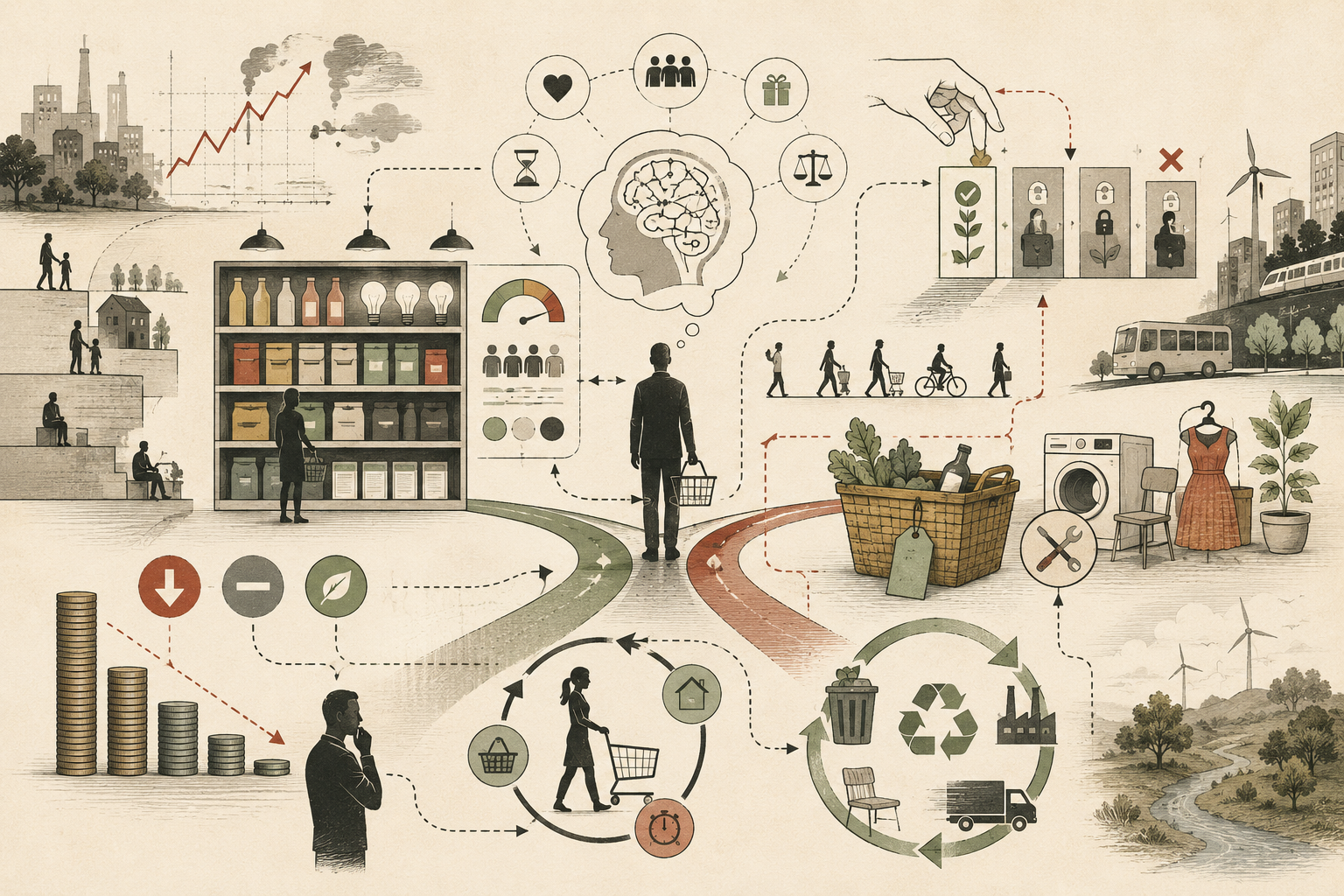
Behavioral economics reframes sustainable consumption as a problem of decision systems. The central question is not simply whether people care about environmental harm. Many do. The harder question is why concern often fails to become durable action, why lower-impact choices remain difficult even when people endorse them, and why the behavioral architecture of markets so often preserves high-consumption defaults. Sustainable consumption therefore requires more than awareness campaigns. It requires institutions, infrastructures, and choice environments that make lower-impact behavior feasible, visible, affordable, socially supported, and materially durable.
Beyond Rational Choice and the Problem of Sustainable Consumption
Sustainable consumption refers to patterns of household and individual behavior that reduce ecological harm across domains such as energy use, food systems, transportation, material consumption, waste, repair, reuse, and product choice. In standard economic treatments, unsustainable consumption is often modeled as a consequence of distorted prices, missing information, or unpriced externalities. Those mechanisms are important. Carbon-intensive goods are frequently too cheap relative to their social cost, environmental harms are often hidden, and individuals may lack credible information about lifecycle impact.
But this is only part of the story. Even where consumers express concern, have access to some information, and face modest incentives to change, environmentally harmful behavior often persists. The persistence of such behavior suggests that sustainable consumption is not simply a problem of preference revelation or informational deficit. It is also a problem of cognition, timing, social context, material feasibility, institutional arrangement, and the behavioral design of markets.
Behavioral economics improves the analysis by relaxing the assumption that decision-makers are fully attentive, dynamically consistent, and insulated from framing, status, habit, or social meaning. This does not imply that people are simply irrational. Rather, it means behavior is produced under constraint: finite attention, habitual routines, ambiguity, loss aversion, self-control problems, unequal resources, and environments designed by firms, platforms, landlords, employers, utilities, retailers, and public institutions. Consumption becomes easier to understand once it is placed inside the real architecture of modern choice.
For sustainability, this shift is especially important because ecological harms are often delayed, dispersed, invisible, and collectively produced. The individual consumer rarely experiences the full consequence of a purchase at the moment of decision. The carbon embedded in a product, the biodiversity impact of land use, the water footprint of a commodity, or the waste stream created by packaging is not naturally salient at the checkout counter. Behavioral economics therefore helps explain why prices, labels, and moral appeals may be insufficient when the structure of the decision environment continues to favor convenience, abundance, disposability, and short-term private benefit.
The Attitude-Behavior Gap
One of the central empirical puzzles in environmental behavior is the attitude-behavior gap. Large numbers of people report concern about climate change, pollution, biodiversity loss, waste, or resource depletion, yet many do not consistently adopt lower-impact consumption patterns. They may endorse recycling but overconsume disposable goods, support climate policy while maintaining energy-intensive routines, or express a willingness to buy sustainable products while repeatedly choosing cheaper, more convenient, or more familiar alternatives.
This gap should not be dismissed as hypocrisy. In many cases, it reflects the mismatch between reflective commitments and the real conditions of everyday decision-making. Environmentally preferable options may require search effort, higher upfront cost, delayed payoff, uncertainty about quality, inconvenience, social deviation, or departure from established routines. People do not decide in a vacuum. They decide while tired, rushed, budget-constrained, socially embedded, and often confronted with product environments designed to maximize short-run conversion rather than long-run welfare.
From a behavioral perspective, the attitude-behavior gap emerges because attitudes operate at one level of cognition while action is filtered through another. Moral concern may be genuine, but it must compete with salience, habit, present bias, friction costs, status signaling, default continuation, and limited attention. Sustainable consumption is therefore not achieved merely by raising awareness. Awareness must be translated into behavior through institutions that reduce friction and make ecological choice more cognitively, socially, and materially feasible.
The attitude-behavior gap also reveals why individualistic sustainability narratives can become unfair or misleading. If lower-impact choices are costly, unavailable, hidden, unreliable, or socially penalized, then failure to adopt them is not simply a personal moral defect. It reflects the design of the system. Behavioral economics is most useful when it shows how decision environments can be redesigned so that ecological concern does not have to fight against every default feature of daily life.
Behavioral Frictions in Environmentally Relevant Choice
Behavioral frictions are small obstacles that alter action even when preferences appear stable. In sustainability contexts, these frictions include effort, confusion, delay, uncertainty, inconvenience, administrative burden, habit disruption, search costs, status concerns, and lack of timely feedback. None of these factors necessarily changes what people value in principle. But each can change what people do in practice.
Environmental behavior is particularly sensitive to friction because many sustainable choices require repeated action. Reusable goods must be remembered. Energy settings must be adjusted. Transit routes must be learned. Repair services must be found. Labels must be interpreted. Food routines must shift. Waste sorting must be done correctly. A single high-friction step may not appear significant in isolation, but repeated across daily life and across millions of households, friction becomes a system-level force.
Behavioral economics therefore treats friction as a central design variable. If a policy makes lower-impact action easy, timely, trusted, and socially normal, adoption becomes more likely. If it merely provides information while preserving high-friction sustainable options and low-friction unsustainable defaults, behavior may change very little.
Present Bias and Delayed Environmental Benefit
Many sustainable choices require accepting immediate cost in exchange for delayed and often diffuse benefit. Energy-efficiency investments, dietary change, public transit use, repair rather than replacement, adoption of reusable goods, electrification, insulation upgrades, and reduced material consumption may involve inconvenience today for financial, environmental, or health gains that are deferred. Present-biased agents systematically overvalue the immediate cost relative to future benefit. This helps explain underinvestment in energy efficiency, delay in adopting lower-emission technologies, and the preference for convenience-heavy consumption systems.
Present bias is especially important because ecological benefits are often collective rather than individually captured. A household may bear the immediate inconvenience of changing behavior while the environmental benefit is dispersed across society and time. In this setting, behavioral and collective-action problems reinforce each other. The private cost is immediate and concrete; the public benefit is delayed and abstract.
A behaviorally informed sustainability policy therefore has to compress time. It can do this by reducing upfront costs, providing immediate feedback, making future savings visible, creating recurring reminders, simplifying enrollment, or pairing long-term environmental gains with short-term private benefits such as comfort, reliability, health, convenience, or lower bills.
Limited Attention and Informational Overload
Consumers cannot attend to every attribute of every decision. Price, brand familiarity, convenience, placement, visual salience, delivery time, and packaging cues often dominate attention, while embodied carbon, ecological footprint, repairability, durability, labor conditions, and supply-chain ethics remain peripheral. Information campaigns often fail not because the information is false, but because attention is scarce.
If sustainability information is cognitively costly, poorly timed, buried in fine print, or structurally subordinate to more salient cues, it will not reliably shape behavior. This is why information design matters. A label that requires extensive interpretation may add burden rather than reduce it. A crowded marketplace of certifications can confuse rather than clarify. A sustainability claim that lacks credibility may generate skepticism rather than action.
Limited attention also creates ethical risks. Firms and platforms can exploit attention scarcity by highlighting environmentally favorable details while hiding larger harms. Behavioral economics therefore supports not only better labeling, but stronger governance of claims, standards, verification, and consumer protection.
Status Quo Bias, Inertia, and Switching Costs
Many consumption choices involve default continuation. Households remain with incumbent electricity plans, food routines, mobility patterns, appliance usage habits, subscription bundles, waste practices, and purchasing channels not because these are optimal, but because changing them requires effort, uncertainty tolerance, administrative action, and sometimes social adjustment. Inertia is especially consequential when unsustainable options are built into the default structure of markets.
Status quo bias is not simply laziness. It often reflects rational caution under uncertainty, fear of regret, cognitive overload, and the perceived risk of making the wrong change. A consumer may remain with a carbon-intensive default because the alternative is unfamiliar, difficult to compare, or uncertain in quality. A household may delay an energy upgrade because the process is complicated, contractors are hard to evaluate, and savings are difficult to verify.
Under such conditions, even modest switching costs can preserve high-impact behavior at scale. The implication is direct: sustainable options need to become easier to choose, easier to trust, and easier to maintain. If the greener option remains opt-in while the higher-impact option remains automatic, policy is relying on effort exactly where behavioral evidence suggests effort will be scarce.
Framing, Reference Points, and Perceived Sacrifice
Sustainable consumption is often framed in terms of sacrifice, restraint, or moral burden. This matters. Choices are not evaluated in absolute terms but relative to reference points and interpretive frames. A consumer may reject a sustainable option if it is framed as giving something up, but accept the same option if it is framed as improving durability, lowering long-run cost, enhancing health, reducing waste, increasing resilience, or aligning with a valued social identity.
Framing does not change only rhetoric. It changes perceived utility. If a lower-impact option is coded as loss, inconvenience, or deprivation, loss aversion can make adoption difficult even when the objective cost is small. If the same option is coded as quality, prudence, independence, stewardship, repairability, health, or community resilience, it may become psychologically easier to adopt.
This is not an argument for manipulation. It is an argument for truthful framing that recognizes how people actually evaluate choices. The ethical test is whether framing clarifies real benefits and trade-offs or obscures them. Sustainable-consumption communication should make consequences understandable without exploiting fear, shame, confusion, or moral superiority.
Habit and Repeated Choice
A large share of environmentally important behavior is habitual rather than deliberative. Commuting mode, thermostat settings, food purchases, laundry routines, packaging choices, appliance use, and waste disposal are often repeated patterns, not fresh maximization problems. This means sustainable transitions require more than persuasion. They require disrupting routines, creating stable new defaults, and supporting repeated lower-friction action until alternative behaviors become normalized.
Habit also explains why moments of transition are behaviorally important. Moving homes, changing jobs, having children, replacing appliances, switching utilities, beginning a new commute, or adopting a new technology can create openings for new routines. Policy and institutional design can use these moments to make sustainable defaults easier to adopt before older habits reassert themselves.
In this sense, sustainable consumption is less like a single decision and more like a behavioral pathway. The question is not only whether someone chooses the sustainable option once, but whether the surrounding environment helps that choice become repeatable.
Social Norms, Status, and Conditional Cooperation
Sustainable consumption has a strong social dimension. Individuals observe others, infer norms from visible behavior, and evaluate their own conduct partly through comparison. Behavioral economics therefore intersects with social psychology and institutional analysis in explaining why ecological conduct spreads in some environments and stalls in others.
Descriptive norms matter because people often ask, implicitly, what others like them are doing. If conservation appears unusual, inconvenient, or socially marginal, adoption slows. If recycling, energy restraint, low-waste practices, repair, reuse, or sustainable transport appear normal and expected, adherence rises. Work on social-comparison energy reports is especially important here because it shows how norm-based messages can measurably reduce household energy consumption.
Status also complicates sustainable consumption. Some forms of consumption serve identity display, distinction, or aspiration. Environmentally harmful goods may be tied to convenience, abundance, speed, prestige, autonomy, or success. In such settings, sustainability policies confront not only economic incentives but symbolic economies. A purely informational campaign may fail if the high-impact behavior remains socially rewarded and the low-impact behavior is coded as inferior, inconvenient, or marginal.
Behavioral economics also highlights conditional cooperation. Many people are willing to contribute to collective goods when they believe others are doing so too. But willingness collapses if they perceive free-riding, elite exemption, institutional hypocrisy, or unfair burden-sharing. For sustainability policy, this means credibility and fairness are not secondary issues. They are central determinants of behavioral compliance.
Norms therefore should not be treated as superficial messaging devices. They are part of the social infrastructure of consumption. A sustainability transition requires visible participation, fair burden-sharing, credible institutions, and public evidence that lower-impact behavior is not a private sacrifice imposed on some while others remain exempt.
Choice Architecture, Defaults, and Information Design
Because behavior is sensitive to context, the structure of decision environments matters greatly. Through choice architecture, institutions can alter the path of least resistance without eliminating freedom of choice. This is especially relevant in sustainability, where the gap between stated preference and action is often amplified by complexity and friction.
Default effects are among the most consequential tools in this domain. When renewable-energy enrollment, paperless billing, lower-waste packaging options, efficient appliance settings, or reduced-impact service tiers are made default rather than optional add-ons, participation can rise sharply. Green defaults can be powerful precisely because they harness inertia, suggestion, and loss aversion in favor of environmentally preferable outcomes.
Eco-labels can also matter, but only when they reduce rather than increase cognitive burden. Overly technical labels, competing certification systems, vague claims, or dense informational displays can produce confusion rather than clarity. Effective information design requires compression, timing, interpretability, comparability, and trust. The central behavioral question is not whether more information exists, but whether the right information becomes salient at the moment of choice.
Still, choice architecture should not be romanticized. It is best understood as one layer of policy design, not a substitute for correcting structural incentives. Nudges can improve outcomes at the margin, but they cannot by themselves overcome poverty, lock-in, inadequate public infrastructure, landlord-tenant split incentives, mispriced environmental harms, or the absence of feasible alternatives. Behavioral design is strongest when it complements broader institutional reform.
Ethically, sustainable choice architecture must remain transparent, accountable, contestable, and reversible. A default can support welfare, but it can also hide a policy choice. A friction can protect consumers, but it can also trap them. A label can inform, but it can also greenwash. The behavioral design of sustainability therefore belongs within democratic governance, not merely marketing optimization.
An Analytical Framework for Sustainable Consumption
A simple way to formalize sustainable consumption is to treat the choice between a conventional option \(c\) and a sustainable option \(s\) as depending on more than monetary price alone. Let the perceived utility of option \(j \in \{c,s\}\) be:
U_j = q_j – p_j – \phi_j + \alpha E_j + \beta N_j + \gamma I_j – \lambda L_j
\]
Interpretation: The perceived utility of a consumption option depends on quality, price, friction, environmental benefit, social norms, identity fit, and perceived loss relative to a reference point.
Here, \(q_j\) is perceived product quality or convenience, \(p_j\) is price, \(\phi_j\) is friction or effort cost, \(E_j\) is the perceived environmental benefit, \(N_j\) captures normative or social approval, \(I_j\) captures identity congruence, and \(L_j\) captures perceived loss relative to the reference option. The coefficients \(\alpha, \beta, \gamma,\lambda > 0\) vary across persons and contexts.
This formulation immediately shows why sustainable choices may be underselected even when people care about the environment. If \(\phi_s\) is high, if the quality differential is uncertain, if the environmental gain \(E_s\) is abstract or weakly salient, or if the sustainable option is coded as a loss of convenience, then \(U_s\) may remain below \(U_c\) despite pro-environmental attitudes.
Intertemporal structure deepens the problem. Suppose the sustainable option has an immediate private cost \(C_0\) and a stream of future private and social benefits \(B_t\). Under exponential discounting, adoption occurs when:
-C_0 + \sum_{t=1}^{T} \delta^t B_t > 0
\]
Interpretation: Under exponential discounting, adoption is favored when discounted future benefits outweigh the immediate cost.
But under quasi-hyperbolic discounting, present bias changes the evaluation:
-C_0 + \beta \sum_{t=1}^{T} \delta^t B_t > 0
\qquad \text{with } 0 < \beta \leq 1
\]
Interpretation: When \(\beta < 1\), future benefits are down-weighted relative to present costs, making adoption less likely even when long-run benefits are substantial.
When \(\beta < 1\), future benefits are down-weighted relative to the present. This helps explain why households may delay insulation upgrades, continue high-waste convenience practices, or underinvest in efficient technologies even when the net present value is positive under standard assumptions.
Prospect-theoretic reasoning adds another layer. If the sustainable option is coded relative to the current pattern of consumption, the immediate inconvenience or price premium may be experienced as a loss. A stylized value function is:
v(x) =
\begin{cases}
x^{\eta}, & x \geq 0 \\
-\kappa (-x)^{\eta}, & x < 0
\end{cases}
\]
Interpretation: With \(\kappa > 1\), perceived losses weigh more heavily than equivalent gains, which can make switching away from familiar consumption patterns difficult.
Norms can also be incorporated more formally. Let perceived participation by others be \(m \in [0,1]\), and let the agent’s cooperative utility include \(\theta m\). Then adoption may depend on a threshold condition:
U_s – U_c = \Delta q – \Delta p – \Delta \phi + \alpha \Delta E + \beta m + \gamma \Delta I – \lambda \Delta L > 0
\]
Interpretation: Sustainable adoption becomes more likely when social participation, identity fit, environmental salience, and reduced friction outweigh price, effort, and perceived loss.
As \(m\) rises, sustainable behavior becomes easier to sustain. This provides a behavioral foundation for norm cascades, peer-comparison interventions, visible public commitments, and community-level transition strategies.
Behavioral Public Policy and the Limits of Nudge
Behavioral public policy broadens the policy toolkit available for sustainability, but it also raises normative questions. When should institutions steer choice? Which interventions enhance welfare, and which merely manipulate? When does paternalism become overreach? These questions matter because sustainability policy operates in spaces where individual conduct and collective harm are tightly linked.
A defensible behavioral approach usually satisfies several conditions. First, there should be evidence of a genuine friction, bias, coordination problem, or informational asymmetry rather than mere disagreement with official goals. Second, the intervention should improve the ability of people to act on their own considered preferences, or reduce socially harmful error under conditions of complexity. Third, the intervention should remain transparent and contestable. Fourth, it should be evaluated against distributive consequences rather than assumed universally beneficial.
In practice, the strongest behavioral sustainability policies often combine price correction, infrastructure, and behavioral design. A carbon price may alter incentives; default renewable enrollment may reduce inertia; clear comparative billing may improve salience; public transit investment may make lower-emission choice materially feasible; standards may remove harmful options from the market; subsidies may reduce upfront burdens; and public communication may strengthen trust. No single instrument is sufficient across all contexts. Policy design is strongest when it recognizes the layered nature of behavior.
The limits of nudge are therefore not a reason to abandon behavioral economics. They are a reason to place it inside a broader policy architecture. Behavioral tools can help reduce friction, clarify information, support long-term welfare, and make better choices easier. But they should not be used to avoid structural reform, shift responsibility away from producers and institutions, or treat sustainability as a private lifestyle problem detached from political economy.
Distribution, Governance, and Structural Constraint
It is important not to moralize sustainable consumption in ways that ignore inequality. Households differ in time, money, infrastructure access, housing tenure, transportation dependence, food environment, exposure to environmental risk, and ability to absorb upfront costs. A behaviorally informed sustainability agenda cannot assume that all consumers face the same feasible set. The green choice may be easy for affluent households and prohibitive for others.
This is one reason the field should remain connected to welfare economics, environmental justice, and governance rather than drifting into lifestyle moralism. Sustainable consumption is not only about better individual choices; it is about how institutions shape the menu of feasible actions. If public policy wants lower-impact behavior, it must design the environment accordingly: reliable transit, efficient housing, repairable products, credible labeling systems, clean energy access, fair pricing, and equitable burden-sharing.
Behavioral economics becomes especially useful here because it helps bridge micro-level decision-making and macro-level institutional outcomes. It clarifies how small frictions scale across populations, how norms propagate, how default structures become hidden governance, and how policy legitimacy affects compliance. In that sense, sustainable consumption is not a narrow consumer issue. It is a question of political economy under ecological constraint.
Distribution also changes the ethical interpretation of behavioral intervention. A reminder sent to an affluent household about energy conservation is not equivalent to a friction-filled application process imposed on a low-income household seeking energy assistance. The same behavioral mechanism can serve welfare in one context and deepen exclusion in another. Serious behavioral sustainability policy must therefore ask who bears the cognitive load, who receives the benefit, who faces the penalty, and who has meaningful alternatives.
Technology Platforms and Digital Sustainable Consumption
Digital platforms increasingly mediate consumption. Search rankings, recommender systems, delivery interfaces, subscription flows, comparison tools, payment defaults, loyalty programs, and personalized advertising shape what consumers see, how they evaluate options, and how easily they can act. These systems are not neutral channels. They are behavioral environments.
In principle, digital systems can support sustainable consumption. They can make lifecycle information more visible, compare product durability, flag repair options, recommend lower-impact substitutes, reduce food waste, optimize shared mobility, support energy feedback, and help households understand long-term savings. They can also coordinate collective behavior by making social norms and participation visible.
But platform-mediated consumption can also intensify behavioral vulnerability. One-click purchasing, urgency cues, personalized discounts, infinite scroll, frictionless returns, status-based recommendation loops, and subscription traps can increase material throughput while making consumption feel effortless. Dark patterns can exploit inertia, loss aversion, confusion, and limited attention. Behavioral economics is therefore essential for understanding not only how to promote sustainable consumption, but how digital choice environments may actively undermine it.
A mature behavioral economics of sustainable consumption must therefore include platform governance. The question is not only whether consumers can choose better, but whether digital systems are designed to respect autonomy, reduce manipulation, make ecological consequences legible, and avoid locking users into high-consumption patterns.
Measurement, Evaluation, and Behavioral Evidence
Behavioral sustainability interventions should be evaluated rather than assumed effective. An intervention may sound intuitive but fail in practice. A label may increase trust in one market and confusion in another. A default may increase adoption but reduce informed consent. A social-norm message may motivate some households while producing boomerang effects among others. A subsidy may raise uptake overall while disproportionately benefiting higher-income households.
Evaluation should therefore include adoption, persistence, welfare, distribution, spillovers, unintended consequences, and legitimacy. Did the behavior persist after the intervention ended? Did the intervention reduce total impact or merely shift consumption elsewhere? Did it increase autonomy or exploit inattention? Did it help marginalized households or impose additional burden? Did it complement structural reform or substitute for it?
Computational workflows can support this evaluation by making assumptions explicit. Synthetic data, decision-regime simulations, policy-uptake models, welfare comparisons, and scenario analyses cannot replace empirical evidence, but they can clarify mechanisms, reveal sensitivity to assumptions, and help researchers design better experiments. The goal is not behavioral control. The goal is accountable reasoning about decision environments.
R Workflow: Simulating Adoption Under Defaults, Present Bias, and Social Norms
The following R example models the probability that households adopt a sustainable option under varying combinations of price premium, friction, environmental concern, social norms, and default design. It is structured for scenario analysis and uses synthetic data only. The workflow is designed as a reproducible scaffold for thinking about how behavioral mechanisms interact rather than as a claim about any specific population.
# Behavioral Economics and Sustainable Consumption
# R workflow: adoption under defaults, present bias, and social norms
# Synthetic data only. Educational and research-scaffolding example.

set.seed(42)

n <- 5000

households <- data.frame(
  income = rlnorm(n, meanlog = log(65000), sdlog = 0.45),
  env_concern = pmin(pmax(rnorm(n, 0.60, 0.18), 0), 1),
  present_bias = pmin(pmax(rbeta(n, 2, 5), 0.05), 0.99),
  norm_sensitivity = pmin(pmax(rnorm(n, 0.50, 0.20), 0), 1),
  friction_sensitivity = pmin(pmax(rnorm(n, 0.55, 0.18), 0), 1),
  quality_uncertainty = pmin(pmax(rnorm(n, 0.30, 0.15), 0), 1)
)

policy_grid <- expand.grid(
  default_green = c(0, 1),
  norm_signal = c(0.20, 0.50, 0.80),
  price_premium = c(0.00, 0.05, 0.10),
  friction = c(0.05, 0.15, 0.30)
)

simulate_adoption <- function(df, default_green, norm_signal, price_premium, friction) {
  affordability_pressure <- 1 / log(df$income)

  utility_diff <-
    1.25 * df$env_concern +
    0.90 * df$norm_sensitivity * norm_signal +
    0.85 * default_green -
    1.80 * price_premium * affordability_pressure * 100 -
    1.40 * friction * df$friction_sensitivity -
    0.95 * df$quality_uncertainty -
    0.80 * df$present_bias * (price_premium + friction)

  adoption_prob <- plogis(utility_diff)
  adoption_draw <- rbinom(length(adoption_prob), 1, adoption_prob)

  data.frame(
    adoption_prob = adoption_prob,
    adopted = adoption_draw
  )
}

results_list <- vector("list", nrow(policy_grid))

for (i in seq_len(nrow(policy_grid))) {
  g <- policy_grid[i, ]

  sim <- simulate_adoption(
    households,
    default_green = g$default_green,
    norm_signal = g$norm_signal,
    price_premium = g$price_premium,
    friction = g$friction
  )

  results_list[[i]] <- data.frame(
    default_green = g$default_green,
    norm_signal = g$norm_signal,
    price_premium = g$price_premium,
    friction = g$friction,
    mean_adoption_probability = mean(sim$adoption_prob),
    realized_adoption_rate = mean(sim$adopted)
  )
}

results <- do.call(rbind, results_list)
results <- results[order(-results$realized_adoption_rate), ]

print(head(results, 12))

if (requireNamespace("dplyr", quietly = TRUE)) {
  library(dplyr)

  default_effects <- results %>%
    group_by(norm_signal, price_premium, friction) %>%
    summarize(
      adoption_without_default = realized_adoption_rate[default_green == 0],
      adoption_with_default = realized_adoption_rate[default_green == 1],
      default_lift = adoption_with_default - adoption_without_default,
      .groups = "drop"
    ) %>%
    arrange(desc(default_lift))

  print(default_effects)
}
This simulation illustrates a general policy lesson: behavioral interventions often matter most when they reduce friction and exploit norm-sensitive dynamics, but their effects weaken when price premiums remain too high or when feasible alternatives are materially constrained. In real research, these parameters would require empirical grounding, sensitivity analysis, and careful interpretation across income, geography, infrastructure, and cultural context.
Python Workflow: Behavioral Welfare Comparison Across Policy Designs
The Python example below evaluates three policy regimes for a sustainable product or service choice: information only, default enrollment, and a combined design with subsidy plus default. The model incorporates heterogeneity in concern, loss aversion, present bias, and norm responsiveness, then compares adoption and welfare. It is synthetic and educational, but it demonstrates how computational workflows can make behavioral assumptions explicit.
# Behavioral Economics and Sustainable Consumption
# Python workflow: behavioral welfare comparison across policy designs
# Synthetic data only. Educational and research-scaffolding example.

import numpy as np
import pandas as pd

rng = np.random.default_rng(42)
n = 10000

agents = pd.DataFrame({
    "income": rng.lognormal(mean=np.log(60000), sigma=0.50, size=n),
    "env_concern": np.clip(rng.normal(0.60, 0.18, size=n), 0, 1),
    "present_bias": np.clip(rng.beta(2, 5, size=n), 0.05, 0.99),
    "loss_aversion": np.clip(rng.normal(2.0, 0.40, size=n), 1.0, 4.0),
    "norm_sensitivity": np.clip(rng.normal(0.50, 0.20, size=n), 0, 1),
    "friction_sensitivity": np.clip(rng.normal(0.55, 0.18, size=n), 0, 1),
    "quality_uncertainty": np.clip(rng.normal(0.30, 0.15, size=n), 0, 1)
})

def evaluate_policy(df, subsidy=0.0, default_green=0, norm_signal=0.5, friction=0.15):
    """
    Evaluate a synthetic sustainable-consumption policy regime.

    Parameters:
        df: agent-level synthetic population
        subsidy: price-premium reduction
        default_green: whether the sustainable option is the default
        norm_signal: perceived social participation
        friction: effort and process cost

    Returns:
        adoption and welfare summary dictionary
    """
    conventional_private_utility = 1.0

    base_price_premium = 0.10
    effective_premium = max(base_price_premium - subsidy, 0.0)

    affordability_pressure = 1 / np.log(df["income"].values)

    immediate_cost = (
        effective_premium * affordability_pressure * 100
        + friction * df["friction_sensitivity"].values
    )

    future_private_benefit = 0.50 * df["env_concern"].values
    norm_benefit = 0.70 * df["norm_sensitivity"].values * norm_signal
    default_bonus = 0.60 * default_green
    quality_penalty = 0.60 * df["quality_uncertainty"].values

    discounted_future_value = (
        1 - df["present_bias"].values * 0.5
    ) * future_private_benefit

    perceived_loss = df["loss_aversion"].values * immediate_cost

    sustainable_utility = (
        conventional_private_utility
        + discounted_future_value
        + norm_benefit
        + default_bonus
        - perceived_loss
        - quality_penalty
    )

    conventional_utility = np.full(len(df), conventional_private_utility)
    choose_sustainable = sustainable_utility > conventional_utility

    social_benefit_per_adopter = 0.9
    fiscal_cost = subsidy * choose_sustainable.astype(float)

    private_welfare = np.where(
        choose_sustainable,
        sustainable_utility,
        conventional_utility
    )

    total_welfare = (
        private_welfare
        + social_benefit_per_adopter * choose_sustainable.astype(float)
        - fiscal_cost
    )

    return {
        "adoption_rate": choose_sustainable.mean(),
        "mean_private_welfare": private_welfare.mean(),
        "mean_total_welfare": total_welfare.mean(),
        "mean_fiscal_cost": fiscal_cost.mean()
    }

scenarios = {
    "information_only": {
        "subsidy": 0.00,
        "default_green": 0,
        "norm_signal": 0.50,
        "friction": 0.15
    },
    "default_enrollment": {
        "subsidy": 0.00,
        "default_green": 1,
        "norm_signal": 0.65,
        "friction": 0.08
    },
    "subsidy_plus_default": {
        "subsidy": 0.05,
        "default_green": 1,
        "norm_signal": 0.65,
        "friction": 0.08
    }
}

results = []

for name, params in scenarios.items():
    outcome = evaluate_policy(agents, **params)
    outcome["scenario"] = name
    results.append(outcome)

results_df = pd.DataFrame(results)[[
    "scenario",
    "adoption_rate",
    "mean_private_welfare",
    "mean_total_welfare",
    "mean_fiscal_cost"
]]

print(results_df.sort_values("mean_total_welfare", ascending=False))

agents["income_group"] = pd.qcut(
    agents["income"],
    q=5,
    labels=["Q1", "Q2", "Q3", "Q4", "Q5"]
)

distributional_rows = []

for name, params in scenarios.items():
    for group in agents["income_group"].unique():
        sub = agents.loc[agents["income_group"] == group].copy()
        outcome = evaluate_policy(sub, **params)
        outcome["scenario"] = name
        outcome["income_group"] = group
        distributional_rows.append(outcome)

distributional_df = pd.DataFrame(distributional_rows)
print(distributional_df.sort_values(["scenario", "income_group"]))
This model helps distinguish intervention types. Information alone often produces limited change when frictions and perceived losses remain intact. Defaults can shift behavior more substantially. Combined interventions may produce the highest welfare, but they also raise fiscal and distributive questions that require explicit evaluation rather than assumption. The important lesson is not that one policy always dominates. It is that behavioral mechanisms, material constraints, and distributive effects must be modeled together.
GitHub Repository
The companion repository provides reproducible scaffolding for the computational side of this article, including synthetic data, behavioral adoption simulations, welfare-comparison workflows, documentation, SQL schemas, and multi-language scientific-computing examples for sustainable-consumption analysis.
Interpretive Limits and Ethical Cautions
Behavioral economics is powerful because it reveals how real people choose under constraint. Yet the same power can become dangerous when behavioral insight is used carelessly. A nudge is not automatically ethical. A default is not neutral. A friction is not always accidental. A sustainability message is not legitimate merely because it changes behavior. A behavioral intervention must be evaluated not only by its effect size, but by its transparency, fairness, reversibility, and relationship to structural reform.
This caution is especially important in sustainable consumption because ecological responsibility is often unevenly distributed. Wealthier households may consume more and have greater ability to change, while lower-income households may face higher constraints and fewer feasible alternatives. A behavioral intervention that increases pressure on constrained households while leaving larger structural drivers intact may be efficient in a narrow sense and unjust in a broader one.
Behavioral economics should therefore not be used to blame individuals for system-level failures. It should not treat poverty as a cognitive error, ecological harm as merely a consumer mistake, or platform manipulation as clever design. Its better purpose is constructive: to build decision environments that are clearer, fairer, more accountable, more behaviorally realistic, and more supportive of human agency under ecological constraint.
Conclusion
Sustainable consumption cannot be adequately understood through the fiction of fully informed, frictionless, time-consistent choice. Nor can it be reduced to moral exhortation. Behavioral economics shows that environmentally significant consumption emerges from the interaction of incentives, habit, attention, loss aversion, social norms, default structures, infrastructure, institutional trust, and unequal constraint. This makes the field especially valuable for sustainability analysis, because ecological outcomes depend not only on what people prefer in principle, but on what environments make easy, salient, legitimate, and affordable in practice.
The strongest applications of behavioral economics do not trivialize the challenge by treating it as a matter of clever nudges alone. They locate behavior within systems of governance, infrastructure, markets, platforms, and inequality. Under those conditions, sustainable consumption becomes a serious question of political economy: how societies redesign markets and decision environments so that lower-impact action is not heroic or exceptional, but ordinary, intelligible, fair, and durable.
In that sense, behavioral economics does not weaken the ethical case for sustainability by showing that people are boundedly rational. It strengthens the institutional case for designing systems that respect human limits. A sustainable society cannot depend on every person overcoming friction, confusion, habit, scarcity, and social pressure in isolation. It must make responsible action structurally easier to choose and easier to sustain.
Related Articles
- Behavioral Economics
- Choice Architecture and Decision Environments
- Nudge Theory and Behavioral Public Policy
- Present Bias and the Psychology of Immediate Reward
- Fairness, Reciprocity, and Social Preferences
- Behavioral Insights in Environmental Policy
- Sustainable Development
- Decision Science
Further Reading
- Allcott, H. and Kessler, J.B. (2019) The Welfare Effects of Nudges: A Case Study of Energy Use Social Comparisons. Cambridge, MA: National Bureau of Economic Research. Available at: https://www.nber.org/papers/w24865.
- Congdon, W.J., Kling, J.R. and Mullainathan, S. (2011) Policy and Choice: Public Finance through the Lens of Behavioral Economics. Washington, DC: Brookings Institution Press. Available at: https://www.brookings.edu/books/policy-and-choice/.
- Kahneman, D. (2011) Thinking, Fast and Slow. New York: Farrar, Straus and Giroux. Available at: https://us.macmillan.com/books/9780374533557/thinkingfastandslow.
- Shafir, E. (ed.) (2013) The Behavioral Foundations of Public Policy. Princeton, NJ: Princeton University Press. Available at: https://press.princeton.edu/books/hardcover/9780691137568/the-behavioral-foundations-of-public-policy.
- Sunstein, C.R. (2021) Behavioral Science and Public Policy. Cambridge: Cambridge University Press. Available at: https://www.cambridge.org/core/books/behavioral-science-and-public-policy/AD17A0FCDB0FD44D9F018F765BCEFEBE.
- Thaler, R.H. (2015) Misbehaving: The Making of Behavioral Economics. New York: W.W. Norton. Available at: https://wwnorton.com/books/9780393354775.
- United Nations Environment Programme (n.d.) UNEP. Available at: https://www.unep.org/.
- Intergovernmental Panel on Climate Change (n.d.) IPCC. Available at: https://www.ipcc.ch/.
References
- Akerlof, G.A. and Kranton, R.E. (2000) ‘Economics and identity’, Quarterly Journal of Economics, 115(3), pp. 715–753. Available at: https://academic.oup.com/qje/article-abstract/115/3/715/1828151.
- Allcott, H. (2011) ‘Social norms and energy conservation’, Journal of Public Economics, 95(9–10), pp. 1082–1095. Available at: https://www.sciencedirect.com/science/article/pii/S0047272711000478.
- Allcott, H. and Rogers, T. (2014) ‘The short-run and long-run effects of behavioral interventions: Experimental evidence from energy conservation’, American Economic Review, 104(10), pp. 3003–3037. Available at: https://www.aeaweb.org/articles?id=10.1257/aer.104.10.3003.
- Benartzi, S. et al. (2017) ‘Should governments invest more in nudging?’, Psychological Science, 28(8), pp. 1041–1055. Available at: https://journals.sagepub.com/doi/10.1177/0956797617702501.
- Camerer, C., Issacharoff, S., Loewenstein, G., O’Donoghue, T. and Rabin, M. (2003) ‘Regulation for conservatives: Behavioral economics and the case for asymmetric paternalism’, University of Pennsylvania Law Review, 151(3), pp. 1211–1254. Available at: https://scholarship.law.upenn.edu/penn_law_review/vol151/iss3/11/.
- Fehr, E. and Schmidt, K.M. (1999) ‘A theory of fairness, competition, and cooperation’, Quarterly Journal of Economics, 114(3), pp. 817–868. Available at: https://academic.oup.com/qje/article-abstract/114/3/817/1848113.
- Frederick, S., Loewenstein, G. and O’Donoghue, T. (2002) ‘Time discounting and time preference: A critical review’, Journal of Economic Literature, 40(2), pp. 351–401. Available at: https://www.aeaweb.org/articles?id=10.1257/002205102320161311.
- Hausman, D.M. and Welch, B. (2010) ‘Debate: To nudge or not to nudge’, Journal of Political Philosophy, 18(1), pp. 123–136. Available at: https://onlinelibrary.wiley.com/doi/10.1111/j.1467-9760.2009.00351.x.
- Kahneman, D. and Tversky, A. (1979) ‘Prospect theory: An analysis of decision under risk’, Econometrica, 47(2), pp. 263–291. Available at: https://www.jstor.org/stable/1914185.
- Laibson, D. (1997) ‘Golden eggs and hyperbolic discounting’, Quarterly Journal of Economics, 112(2), pp. 443–478. Available at: https://academic.oup.com/qje/article/112/2/443/1870925.
- Mullainathan, S., Schwartzstein, J. and Congdon, W.J. (2012) ‘A reduced-form approach to behavioral public finance’, Annual Review of Economics, 4, pp. 511–540. Available at: https://www.annualreviews.org/doi/10.1146/annurev-economics-080511-110920.
- O’Donoghue, T. and Rabin, M. (1999) ‘Doing it now or later’, American Economic Review, 89(1), pp. 103–124. Available at: https://www.aeaweb.org/articles?id=10.1257/aer.89.1.103.
- Samuelson, W. and Zeckhauser, R. (1988) ‘Status quo bias in decision making’, Journal of Risk and Uncertainty, 1(1), pp. 7–59. Available at: https://link.springer.com/article/10.1007/BF00055564.
- Simon, H.A. (1955) ‘A behavioral model of rational choice’, Quarterly Journal of Economics, 69(1), pp. 99–118. Available at: https://www.jstor.org/stable/1884852.
- Sunstein, C.R. and Reisch, L.A. (2014) ‘Automatically green: Behavioral economics and environmental protection’, Harvard Environmental Law Review, 38(1), pp. 127–158. Available at: https://journals.law.harvard.edu/elr/2014/04/08/automatically-green-behavioral-economics-and-environmental-protection/.
- Thaler, R.H. and Sunstein, C.R. (2008) Nudge: Improving Decisions About Health, Wealth, and Happiness. New Haven, CT: Yale University Press. Available at: https://yalebooks.yale.edu/book/9780300122237/nudge/.
- Tversky, A. and Kahneman, D. (1991) ‘Loss aversion in riskless choice: A reference-dependent model’, Quarterly Journal of Economics, 106(4), pp. 1039–1061. Available at: https://academic.oup.com/qje/article-abstract/106/4/1039/1907253.