Fundamental Attribution Error: Why We Overestimate Character and Underestimate Situations
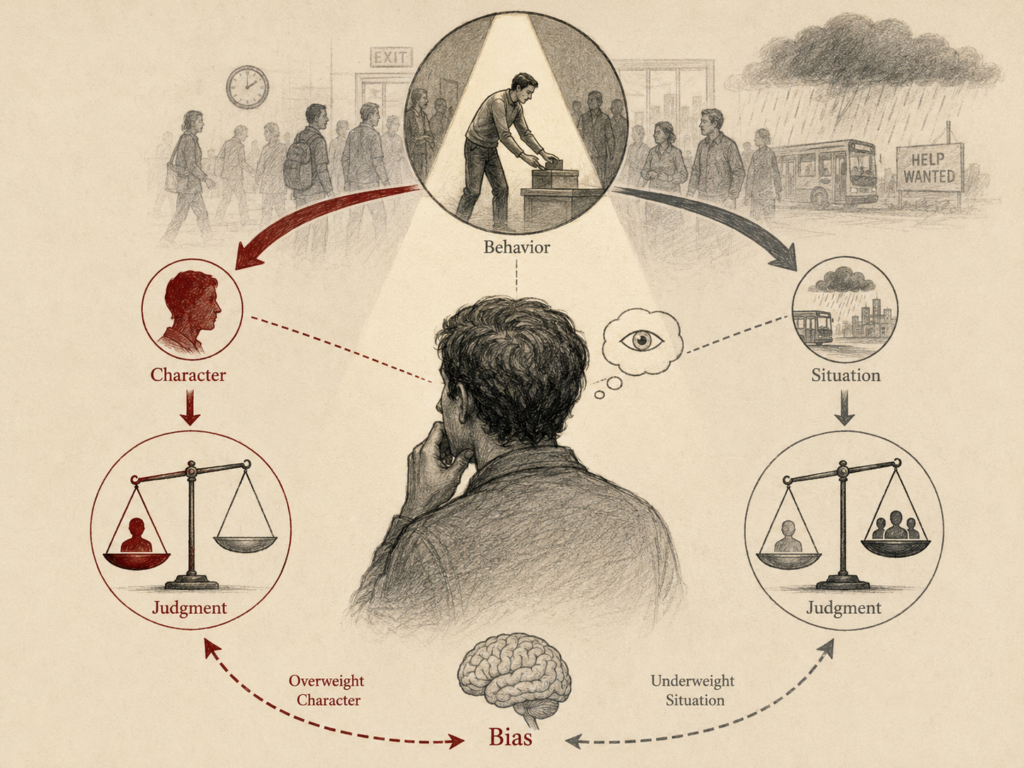
The fundamental attribution error refers to a systematic bias in social perception whereby observers explain others’ behavior primarily in terms of internal traits while underestimating the force of situational conditions. It remains one of the most important findings in social psychology because it shows how easily people treat action as a transparent expression of character, even when behavior is strongly shaped by institutional rules, contextual pressure, environmental constraint, or social expectation. Human observers rarely have direct access to the full structure surrounding another person’s conduct, so they often default to explanations based on personality, intention, or moral disposition. This makes social judgment faster and more coherent, but it also creates a powerful tendency to misread structurally constrained behavior as evidence of who a person “really is.” For that reason, the fundamental attribution error has consequences far beyond laboratory research. It shapes how people assign blame, judge fairness, evaluate leadership, interpret political behavior, and respond to conflict, making it essential for understanding why social explanations so often diverge from the deeper realities that produce human action.