
Last Updated May 20, 2026
Social dilemmas arise when individually rational decisions produce collectively inferior outcomes. In these situations, each actor has an incentive to pursue short-term private advantage, yet when many actors follow that same logic, the result is underprovided public goods, depleted shared resources, weakened trust, institutional failure, environmental damage, or collective risk. Social dilemmas therefore reveal one of the central problems of social life: people can make choices that appear reasonable from their own position while helping produce systems that are worse for everyone.
The concept is foundational for social psychology because cooperation is not only a moral preference. It is also a problem of expectations, trust, norms, fairness, reciprocity, identity, enforcement, institutional legitimacy, and governance design. People are more likely to cooperate when they believe others will cooperate, when rules are fair, when defection is visible, when sanctions are credible, when institutions are legitimate, and when the benefits of cooperation are understandable. They are less likely to cooperate when they expect others to free ride, when rules seem illegitimate, when monitoring is weak, or when exploitation goes unpunished.
Social dilemmas appear in climate mitigation, tax compliance, public-health behavior, scientific knowledge production, biodiversity conservation, common-pool resource management, platform governance, workplace collaboration, corruption control, organizational safety, and democratic institutions. In each case, the question is not simply whether people value the collective good. The question is whether the social system makes cooperation credible, worthwhile, fair, and durable.
Main Library
Publications
Article Map
Social Psychology
Related Topic
Behavioral Economics
Related Topic
Economic Systems
Related Topic
Institutions & Governance
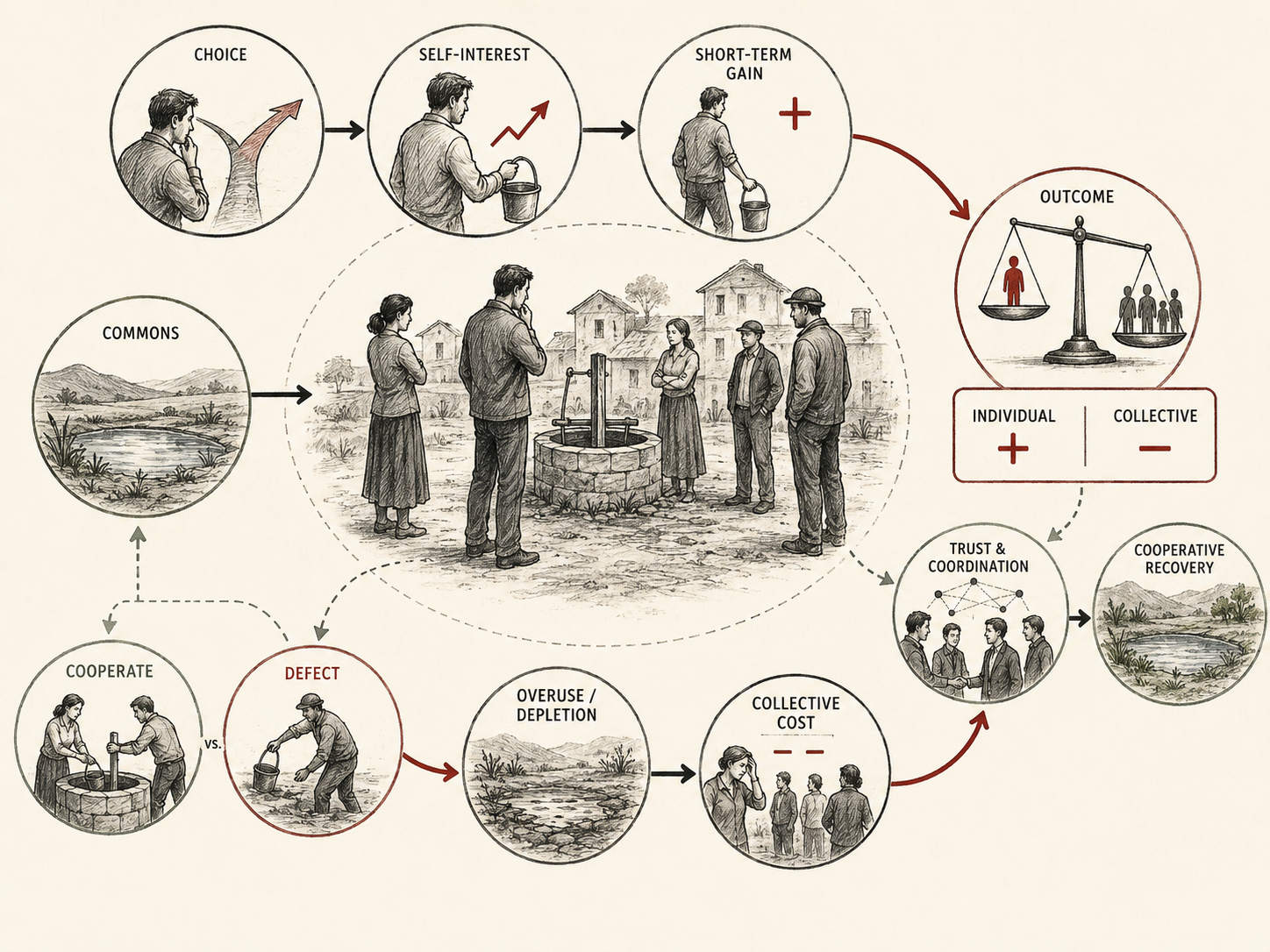
Social dilemmas connect directly to the prisoner’s dilemma, collective action, prosocial behavior, altruism, social norms, intergroup conflict, trust, cooperation, and behavioral economics. Together these topics show why cooperation is fragile, why defection can spread quickly, and why institutions matter for sustaining shared welfare.
What are social dilemmas?
A social dilemma exists when individual incentives conflict with collective welfare. Each actor can gain by choosing a self-interested strategy, but if many actors choose that strategy, the group becomes worse off. The dilemma is not simply that people disagree about what is good. The dilemma is that the structure of incentives makes noncooperation tempting even when cooperation would produce a better shared outcome.
Social dilemmas expose a central paradox of collective life: rational individuals can produce irrational systems. A person may free ride because their own contribution seems small. A firm may pollute because competitors do the same. A country may delay emissions reductions because it fears economic disadvantage. A worker may withhold cooperation because others are not contributing fairly. Each decision can be understandable locally while destructive collectively.
This makes social dilemmas different from simple moral failures. They are structural problems. They arise when the benefits of defection are concentrated and immediate, while the costs are distributed, delayed, or collectively absorbed. They are especially difficult when people cannot easily observe one another’s behavior, when trust is low, when institutions are weak, or when rules are perceived as unfair.
The social-psychological question is therefore not merely “Why don’t people cooperate?” It is “Under what social conditions does cooperation become psychologically credible, normatively expected, institutionally protected, and strategically rational?”
Origins and intellectual background
Social dilemma research developed across game theory, social psychology, economics, political science, sociology, and environmental governance. Early game-theoretic models such as the prisoner’s dilemma showed how individually rational strategies could produce collectively poor outcomes. Later public-goods and commons research extended the analysis to larger groups, shared resources, free riding, and institutional governance.
Robyn Dawes’s influential review helped define social dilemmas for psychology by emphasizing the tension between individual and collective rationality. Peter Kollock later synthesized sociological and social-psychological work by describing social dilemmas as the anatomy of cooperation. Van Lange and colleagues further developed the psychological literature around trust, social value orientation, communication, reputation, uncertainty, and institutional context.
Political economy added another crucial strand. Mancur Olson’s work on collective action showed why groups with shared interests may still fail to organize, especially when public goods create incentives to free ride. Garrett Hardin’s famous “tragedy of the commons” essay drew attention to the danger of unregulated common access, though later commons scholarship criticized simplistic readings that equated commons with inevitable failure. Elinor Ostrom’s research demonstrated that communities can and do govern common-pool resources successfully under appropriate institutional conditions.
This history matters because social dilemmas should not be reduced to one model or one solution. They are not always solved by privatization, central authority, moral appeals, punishment, or voluntary goodwill alone. Different dilemmas require different combinations of trust, rules, monitoring, legitimacy, local knowledge, sanctions, communication, and collective learning.
The structure of social dilemmas
Social dilemmas share several structural features. First, actors are interdependent: each person’s outcome depends partly on what others do. Second, each actor has a private incentive to defect, free ride, overuse, undercontribute, or delay cooperation. Third, the group is better off when actors cooperate, contribute, restrain extraction, or comply with shared rules. Fourth, cooperators risk exploitation if others defect.
The basic tension can be summarized in four elements:
- Private temptation: each actor can improve their immediate position by defecting or contributing less.
- Collective vulnerability: widespread defection reduces group welfare or damages a shared resource.
- Strategic uncertainty: actors do not know whether others will cooperate.
- Institutional dependence: cooperation often requires norms, rules, monitoring, trust, or enforcement.
These structural features make cooperation fragile. If people believe others will cooperate, they may be willing to cooperate. If they believe others will defect, they may defect defensively. Once defection becomes expected, it can become self-reinforcing: people defect because they expect defection, and their behavior confirms others’ mistrust.
This is why social dilemmas are often not solved by information alone. Actors may already know the collective problem exists. The harder problem is whether they believe cooperation is safe, fair, reciprocated, and enforceable.
Major types of social dilemmas
Social dilemmas come in several forms. They share a conflict between private incentives and collective welfare, but they differ in the structure of the good, the type of risk, and the form of noncooperation.
Public-goods dilemmas
Public-goods dilemmas occur when a good is available to members of a group whether or not each person helped provide it. This creates an incentive to free ride. Public infrastructure, clean air, open scientific knowledge, public health, national defense, institutional trust, and shared civic stability all have public-goods features.
The central problem is undercontribution. Each person may prefer that the public good exist, but also prefer that others bear the cost. If too many actors reason this way, the public good is underprovided.
Commons dilemmas
Commons dilemmas involve shared resources that can be depleted by overuse. Fisheries, forests, groundwater, grazing land, biodiversity, atmospheric carbon capacity, and many ecological systems have commons features. Each user may benefit from additional extraction, but excessive extraction damages the resource for everyone.
The central problem is overuse. The individual benefit of extraction is immediate, while the cost of depletion is distributed across the group and often delayed into the future.
Prisoner’s dilemma problems
The prisoner’s dilemma is a two-actor model in which mutual cooperation is collectively superior, but each actor has an incentive to defect regardless of the other’s choice. It provides a compact model of mistrust, defensive defection, and cooperation failure under strategic uncertainty.
The central problem is vulnerability. Cooperation exposes an actor to exploitation if the other defects.
Threshold public-goods dilemmas
In threshold dilemmas, the public good is produced only if contributions reach a certain level. Climate tipping-point prevention, collective strike funds, disaster preparedness, and shared infrastructure projects may have threshold features.
The central problem is coordination under uncertainty. People may hesitate to contribute if they doubt the group will reach the threshold.
Intergenerational dilemmas
Intergenerational dilemmas occur when current actors benefit from choices that impose costs on future people. Climate change, biodiversity loss, public debt, nuclear waste, soil depletion, and infrastructure neglect all have intergenerational dimensions.
The central problem is temporal asymmetry. Future people cannot reciprocate, bargain, vote, punish, or directly defend their interests.
Nested and polycentric dilemmas
Many real dilemmas are nested across levels. A local community, firm, city, nation, and international system may all be involved in the same problem. Cooperation at one level may be undermined by incentives at another.
The central problem is multi-level governance. Effective cooperation may require institutions at several scales rather than a single centralized solution.
Formalizing social dilemmas
Social dilemmas can be represented as situations in which the private payoff to defection exceeds the private payoff to cooperation, while universal cooperation produces greater collective welfare than universal defection:
u_i(D \mid others\ cooperate)>u_i(C \mid others\ cooperate)
\]
Interpretation: For an individual actor, defection is privately attractive when others cooperate.
\sum_{i=1}^{n}u_i(C,\ldots,C)>\sum_{i=1}^{n}u_i(D,\ldots,D)
\]
Interpretation: At the collective level, universal cooperation produces greater welfare than universal defection.
A public-goods dilemma can be written as:
u_i=y_i-c_i+\alpha\sum_{j=1}^{n}c_j
\]
Interpretation: The actor keeps their endowment \(y_i\), pays contribution cost \(c_i\), and receives benefit from total group contributions multiplied by \(\alpha\).
For a public-goods dilemma, the marginal per-capita return is typically less than the private cost of contributing but greater than zero for the group:
0<\alpha<1 \quad \text{and} \quad n\alpha>1
\]
Interpretation: Each individual contribution is privately costly, but total group contribution is collectively beneficial.
A commons dilemma can be expressed as a resource stock problem:
R_{t+1}=R_t+g(R_t)-\sum_{i=1}^{n}x_{i,t}
\]
Interpretation: The future resource stock depends on current stock, regeneration, and total extraction by users.
Unsustainable extraction occurs when total use exceeds regenerative capacity:
\sum_{i=1}^{n}x_{i,t}>g(R_t)
\]
Interpretation: A shared resource declines when extraction exceeds replenishment.
The probability of cooperation can also be modeled as a function of social-psychological and institutional variables:
P(C_i=1)=\operatorname{logit}^{-1}(\beta_0+\beta_1T_i+\beta_2N_i+\beta_3L_i+\beta_4E_i+\beta_5R_i-\beta_6K_i)
\]
Interpretation: Cooperation rises with trust \(T_i\), norm salience \(N_i\), institutional legitimacy \(L_i\), enforcement credibility \(E_i\), and reciprocity expectation \(R_i\), and falls with temptation or perceived cost \(K_i\).
These formalizations clarify why social dilemmas are not merely moral stories. They are incentive structures embedded in social systems. But the variables that shift behavior are psychological and institutional: trust, legitimacy, norms, monitoring, identity, reciprocity, and fairness.
Social-psychological mechanisms behind cooperation
Social dilemma behavior is shaped by several psychological mechanisms. People do not simply calculate monetary payoffs in isolation. They interpret the situation, infer what others will do, evaluate fairness, respond to norms, and decide whether cooperation is likely to be reciprocated.
Trust
Trust allows actors to cooperate despite vulnerability. When people believe others will contribute, restrain extraction, obey rules, or reciprocate cooperation, they are more willing to accept short-term costs for collective benefit. Without trust, actors often defect defensively.
Expectations
Expectations about others are central. Many people are conditional cooperators: they cooperate when they expect others to cooperate and reduce cooperation when they expect free riding. This makes beliefs self-reinforcing. Cooperative expectations support cooperation; expectations of defection produce defensive defection.
Fairness
People are more willing to cooperate when the distribution of costs and benefits feels fair. Perceived unfairness can lead to withdrawal, protest, retaliation, or refusal to contribute. This is especially important in asymmetric dilemmas where actors differ in resources, vulnerability, responsibility, or historical benefit.
Social value orientation
Individuals differ in how much they value their own outcomes relative to others’ outcomes. Some people are more prosocial, some more individualistic, and some more competitive. These orientations influence behavior, but they do not determine it completely; context and institutions still matter.
Identity
Shared identity can expand the circle of concern. People often cooperate more with those they see as members of a common group, community, or fate. But identity can also narrow cooperation: strong in-group cooperation may coexist with exploitation of out-groups.
Legitimacy
Rules work better when they are viewed as legitimate. Sanctions may raise cooperation when they are fair, transparent, and connected to shared goals. The same sanctions may provoke resistance when they are perceived as arbitrary, biased, extractive, or imposed without voice.
These mechanisms show why social dilemmas cannot be solved by payoff engineering alone. People cooperate inside meaning systems. They ask whether others are trustworthy, whether rules are fair, whether institutions deserve compliance, and whether their contribution matters.
Trust, expectation, and conditional cooperation
Trust is one of the strongest predictors of cooperation in social dilemmas because cooperation requires vulnerability. Contributors risk being exploited by free riders. Commons users risk restraining themselves while others overextract. States risk reducing emissions while rivals continue polluting. Workers risk collaborating while others capture credit.
Conditional cooperation is central. Many people are not unconditional altruists or pure free riders. They cooperate when they expect others to cooperate and reduce cooperation when they observe defection. This creates feedback. Cooperation can build trust, but defection can spread quickly because each defection changes what others expect.
This dynamic explains why early signals matter. If the first rounds of a public-goods game show high contribution, participants may infer a cooperative norm. If early rounds show free riding, cooperation may collapse. Likewise, in organizations, early evidence that misconduct goes unpunished can weaken future cooperation and compliance.
Trust is also institutional. People may trust specific individuals, but they may also trust rules, procedures, monitoring systems, courts, platforms, professional norms, or governance bodies. When institutional trust collapses, even people who value cooperation may defect because they no longer believe the system will protect cooperators from exploitation.
Durable cooperation therefore requires both interpersonal and institutional trust. People need to believe not only that others may cooperate, but that the system will respond when they do not.
Free riding and strategic noncooperation
Free riding occurs when actors benefit from a collective good without contributing fairly to its provision. It is a central mechanism in public-goods dilemmas. A person may prefer that the public good exist but also prefer that others pay for it. If only a few actors free ride, the public good may survive. If many free ride, it fails.
Free riding is not always driven by selfishness alone. It can also result from distrust, perceived inefficacy, unfairness, protest, alienation, or belief that others are already defecting. A person may withhold contribution because they think the system is corrupt, because their contribution seems too small to matter, because they believe powerful actors are exempt, or because they see cooperation as self-exploitation.
This distinction matters. If free riding is treated only as moral failure, institutions may respond with punishment alone. But if free riding is partly driven by mistrust or illegitimacy, punishment may not solve the problem and may even deepen resistance.
Research-grade analysis should therefore ask why noncooperation occurs. Is the actor exploiting the group? Defending against expected exploitation? Responding to unfair rules? Doubting efficacy? Protesting illegitimacy? Lacking information? Different causes require different institutional responses.
Social norms, reputation, and reciprocity
Social norms stabilize cooperation by making expectations visible. When people know that contribution, restraint, and compliance are expected, cooperation becomes easier to sustain. Norms also define what counts as fair behavior and what counts as defection.
Reputation extends cooperation across time. If people expect their behavior to be remembered, they are less likely to defect for short-term advantage. Reputation makes present action part of future trust. This is especially important in repeated interactions, professional communities, markets, scientific networks, and local governance systems.
Reciprocity connects cooperation to response. Actors are more willing to cooperate when cooperation is rewarded and defection is met with withdrawal, sanction, or reduced trust. Reciprocity does not require pure altruism. It allows cooperation to emerge under self-interest because cooperative behavior becomes strategically valuable over time.
However, norms can also be harmful. A group may normalize free riding, corruption, overuse, exclusion, or exploitation. Reputation can protect insiders while excluding outsiders. Reciprocity can become retaliation. A social dilemma framework must therefore ask not only whether norms are strong, but what kind of behavior they stabilize and who benefits from them.
Punishment, enforcement, and legitimacy
Punishment can increase cooperation by making defection costly. Public-goods experiments show that people may punish free riders even when punishment is personally costly, and the possibility of punishment can raise cooperation. This finding is important because it shows that people are often willing to enforce cooperative norms, not merely benefit from them.
Yet punishment is not a complete solution. Sanctions can backfire when they are perceived as illegitimate, biased, excessive, externally imposed, or disconnected from shared goals. Punishment can crowd out intrinsic motivation, intensify conflict, or become a tool of domination when power is unequal.
Effective enforcement usually requires several conditions:
- rules must be clear;
- violations must be observable;
- sanctions must be proportionate;
- procedures must be fair;
- participants must have voice;
- powerful actors must also be accountable;
- conflicts must have legitimate resolution mechanisms;
- the institution must be seen as serving the collective good.
This is where social psychology and institutional governance meet. Enforcement is not only a material incentive. It is also a signal about fairness, authority, group membership, and legitimacy. People comply more durably when they see the system as worth cooperating with.
Commons dilemmas and common-pool resources
Commons dilemmas involve shared resources that can be depleted by overuse. The classic concern is that each user gains from additional extraction while the costs of depletion are shared across all users. If the resource is open access and unregulated, the logic can lead to collapse.
However, it is important to distinguish open-access resources from governed commons. A commons is not automatically a tragedy. Many communities have developed rules, monitoring systems, sanctions, conflict-resolution practices, and local governance arrangements that sustain shared resources over long periods.
This distinction is crucial for avoiding simplistic policy conclusions. Hardin’s “tragedy of the commons” is often interpreted as implying that shared resources must be privatized or centrally controlled. Ostrom’s work showed that this is not universally true. Common-pool resources can be governed successfully when institutions fit local conditions, participants have voice, rules are enforceable, and governance systems adapt over time.
Commons dilemmas therefore reveal both risk and possibility. Shared resources can be overused when governance is weak, but communities can also build institutions that sustain cooperation without relying only on markets or centralized states.
Ostrom, design principles, and polycentric governance
Elinor Ostrom’s work transformed the study of social dilemmas by showing that collective action is not doomed by self-interest. Through empirical research on irrigation systems, fisheries, forests, and other common-pool resources, Ostrom identified institutional conditions associated with durable commons governance.
Her design principles include clearly defined boundaries, rules adapted to local conditions, collective-choice arrangements, monitoring, graduated sanctions, conflict-resolution mechanisms, recognition of the right to organize, and nested enterprises for larger systems. Later research has generally supported the relevance of these design principles while also refining how they should be interpreted across contexts.
Ostrom’s broader idea of polycentric governance is especially important for complex social dilemmas. Many collective problems cannot be solved by one central authority or one local community alone. They require overlapping centers of decision-making at multiple scales: households, communities, firms, cities, regions, states, international institutions, and transnational networks.
Polycentric governance is not a guarantee of success. It can produce fragmentation, inequality, duplication, or accountability gaps. But it offers a way to think beyond the false choice between centralized command and unregulated markets. For many social dilemmas, the challenge is to build institutions that are local enough to be legitimate and adaptive, but coordinated enough to address large-scale collective risk.
For a social psychology audience, Ostrom’s work matters because it shows that cooperation depends on institutional meaning as well as incentives. People cooperate when rules are legitimate, locally intelligible, monitored, enforceable, and connected to shared responsibility.
Environmental governance and planetary-scale dilemmas
Environmental problems are among the most important social dilemmas of the present era. Climate change, biodiversity loss, deforestation, ocean depletion, groundwater exhaustion, air pollution, soil degradation, and plastic contamination all involve conflicts between short-term benefit and long-term collective stability.
Environmental dilemmas are difficult because they are large-scale, delayed, unequal, and multi-level. Actors do not contribute equally to harm. They do not suffer equally from consequences. Those most responsible may be least vulnerable, while those least responsible may face the greatest risk. Future generations have no direct bargaining power. Nonhuman life has no political representation in ordinary decision systems.
This means environmental social dilemmas are not only incentive problems. They are justice problems. A climate agreement that ignores historical emissions, development needs, unequal capacity, and vulnerability will struggle for legitimacy. A biodiversity policy that ignores Indigenous stewardship, local livelihoods, and land rights may reproduce injustice even if it claims conservation goals.
Durable environmental cooperation requires monitoring, transparency, credible commitments, finance, technology transfer, participatory governance, accountability, and legitimacy. It also requires attention to marginalized communities and unequal power. Social dilemmas are not solved by asking everyone to sacrifice equally when the history and distribution of benefits and harms are unequal.
Organizations, platforms, and institutional cooperation
Social dilemmas occur inside organizations whenever individual or departmental incentives conflict with collective outcomes. Teams may hoard information, departments may protect budgets, managers may pursue local metrics, employees may withhold effort, and executives may prioritize short-term performance while imposing long-term costs on workers, customers, communities, or the environment.
Digital platforms create additional dilemmas. A platform may benefit from maximizing engagement even when the collective effect is misinformation, polarization, addiction, privacy erosion, or social harm. Users may benefit from free access while contributing data to systems that weaken autonomy. Advertisers, platforms, creators, and users may all be trapped in incentive structures that reward attention extraction.
Organizational social dilemmas often persist because responsibility is distributed and incentives are misaligned. Local actors may not experience the system-level harm of their choices. Teams may optimize their own metrics while degrading institutional trust. Leaders may reward outcomes without measuring hidden costs.
Better organizational design requires aligning local incentives with shared welfare. This can include cross-functional metrics, accountability for externalities, transparent reporting, protected dissent, shared ownership, ethical review, long-term performance measures, and governance systems that make social costs visible rather than invisible.
Experimental research on social dilemmas
Experimental research has shown that people are not simply selfish payoff maximizers. Many participants contribute to public goods, punish free riders, respond to fairness, cooperate conditionally, and change behavior based on communication, reputation, and enforcement.
Public-goods experiments often show that contributions decline over repeated rounds when free riding is visible and unpunished. However, communication, punishment, reputation, and legitimate institutions can increase cooperation. Commons experiments show that extraction can be reduced when users communicate, monitor one another, and develop enforceable rules.
Several experimental findings are especially important:
- many people begin with some willingness to cooperate;
- cooperation declines when free riding appears common;
- trust and expectations strongly shape contribution;
- communication often increases cooperation by stabilizing expectations;
- punishment can increase cooperation but depends on legitimacy and fairness;
- institutions work best when rules are understandable, enforceable, and perceived as fair;
- asymmetry and inequality can weaken cooperation by damaging perceived fairness;
- resource feedback matters in commons dilemmas because actors need to see depletion risk.
The central experimental lesson is that social dilemmas are sensitive systems. Small changes in information, expectations, legitimacy, monitoring, or early behavior can shift groups toward cooperation or collapse.
Social dilemmas in the architecture of social influence
Within the broader architecture of social influence, social dilemmas reveal why collective welfare cannot be sustained by isolated individual goodwill alone. Social norms define what is expected. Prosocial behavior identifies actions that support others. Altruism examines other-regarding motivation. Collective action explains how groups organize around shared interests. The prisoner’s dilemma provides one formal model of strategic cooperation failure.
Social dilemmas integrate these concepts by showing the conditions under which cooperation becomes difficult. They show why good intentions may not be enough when defection is rewarded. They show why trust collapses when institutions fail. They show why norms matter when formal enforcement is weak. They show why fairness and legitimacy are central to durable cooperation.
Seen this way, social dilemmas are not peripheral to social psychology. They are one of the discipline’s key bridges between individual behavior and social systems. They explain how cognition, motivation, norms, identity, and institutions interact to determine whether groups can solve shared problems.
Interpretive cautions and limits
Social dilemma theory is powerful, but it should not be applied carelessly. Not every collective problem is a social dilemma. Some problems are coordination failures, bargaining conflicts, coercive systems, domination structures, information failures, distributional struggles, or consequences of historical injustice.
Several cautions are essential:
- Do not reduce all social problems to individual self-interest.
- Do not ignore power, coercion, inequality, colonial history, or structural injustice.
- Do not treat “the group” as homogeneous when costs and benefits are unequally distributed.
- Do not assume cooperation is always desirable; groups can cooperate to harm outsiders.
- Do not treat punishment as automatically legitimate or effective.
- Do not confuse open-access failure with governed commons.
- Do not assume privatization or central control is always superior to community governance.
- Do not ignore the voices and knowledge of communities directly affected by resource governance.
The strongest use of social dilemma theory combines formal structure with historical, institutional, and ethical analysis. It asks who benefits, who pays, who decides, who monitors, who is excluded, and whether rules are legitimate. Without those questions, the language of cooperation can conceal unequal power.
Measurement, data, and research design
Social dilemma research uses public-goods games, commons games, prisoner’s dilemma games, threshold public-goods experiments, intergenerational allocation tasks, field experiments, survey experiments, agent-based models, institutional case studies, and mixed-methods commons research.
Key variables include:
- participant and group identifiers;
- dilemma type;
- round number;
- endowment;
- contribution;
- extraction;
- marginal per-capita return;
- trust score;
- norm salience;
- enforcement signal;
- fairness score;
- institutional legitimacy;
- monitoring strength;
- sanction probability;
- sanction severity;
- reciprocity expectation;
- resource stock;
- individual payoff;
- group welfare;
- response time.
Strong designs should verify that the payoff structure actually creates a social dilemma. In public-goods games, the marginal return to the individual should be lower than the private cost, while the total return to the group should be positive. In commons games, the model should specify resource stock, extraction, regeneration, and sustainability thresholds.
Researchers should measure expectations, not only behavior. Contribution levels are difficult to interpret without knowing whether participants trusted others, expected reciprocity, perceived rules as fair, understood the payoff structure, or believed enforcement was credible.
Institutional studies should measure legitimacy as well as enforcement. Monitoring and sanctions may change incentives, but legitimacy affects whether rules are internalized, resisted, evaded, or accepted as part of shared governance.
R code for social dilemma research
The following R workflow models public-goods contribution, commons extraction, group welfare, individual payoff, institutional legitimacy, enforcement, trust, norms, and response time. It is designed for repeated social dilemma experiments and institutional-governance research.
# Install packages if needed:
# pak::pak(c("tidyverse", "lme4", "lmerTest", "emmeans", "broom.mixed", "performance"))

library(tidyverse)
library(lme4)
library(lmerTest)
library(emmeans)
library(broom.mixed)
library(performance)

# Expected columns:
# participant, group_id, site_id, condition, dilemma_type, round,
# endowment, contribution, extraction, mpcr, trust_score,
# norm_salience, enforcement_signal, fairness_score,
# institutional_legitimacy, monitoring_strength, sanction_probability,
# sanction_severity, reciprocity_expectation, resource_stock,
# group_welfare, individual_payoff, response_time_ms

dat <- read_csv("social_dilemmas_trials.csv") %>%
  mutate(
    participant = factor(participant),
    group_id = factor(group_id),
    site_id = factor(site_id),
    condition = factor(condition),
    dilemma_type = factor(dilemma_type),
    free_riding_index = if_else(
      endowment > 0,
      (endowment - contribution) / endowment,
      NA_real_
    ),
    institutional_effectiveness = monitoring_strength *
      sanction_probability *
      sanction_severity *
      (institutional_legitimacy / 10),
    cooperation_score = if_else(
      dilemma_type == "commons",
      -extraction,
      contribution
    ),
    log_response_time = log(response_time_ms)
  )

# -----------------------------
# 1. Descriptive summary
# -----------------------------

summary_table <- dat %>%
  group_by(condition, dilemma_type, round) %>%
  summarise(
    n = n(),
    groups = n_distinct(group_id),
    mean_contribution = mean(contribution, na.rm = TRUE),
    mean_extraction = mean(extraction, na.rm = TRUE),
    mean_free_riding = mean(free_riding_index, na.rm = TRUE),
    mean_trust = mean(trust_score, na.rm = TRUE),
    mean_norm_salience = mean(norm_salience, na.rm = TRUE),
    mean_enforcement = mean(enforcement_signal, na.rm = TRUE),
    mean_legitimacy = mean(institutional_legitimacy, na.rm = TRUE),
    mean_group_welfare = mean(group_welfare, na.rm = TRUE),
    mean_resource_stock = mean(resource_stock, na.rm = TRUE),
    .groups = "drop"
  )

print(summary_table)

# -----------------------------
# 2. Public-goods contribution model
# -----------------------------

public_goods <- dat %>%
  filter(dilemma_type != "commons")

contribution_model <- lmer(
  contribution ~
    round +
    trust_score +
    norm_salience +
    enforcement_signal +
    fairness_score +
    institutional_legitimacy +
    monitoring_strength +
    sanction_probability +
    sanction_severity +
    reciprocity_expectation +
    condition +
    (1 | group_id) +
    (1 | participant) +
    (1 | site_id),
  data = public_goods,
  REML = FALSE
)

summary(contribution_model)
emmeans(contribution_model, ~ condition)

# -----------------------------
# 3. Commons extraction model
# -----------------------------

commons <- dat %>%
  filter(dilemma_type == "commons")

extraction_model <- lmer(
  extraction ~
    round +
    trust_score +
    norm_salience +
    enforcement_signal +
    fairness_score +
    institutional_legitimacy +
    monitoring_strength +
    sanction_probability +
    sanction_severity +
    reciprocity_expectation +
    resource_stock +
    condition +
    (1 | group_id) +
    (1 | participant) +
    (1 | site_id),
  data = commons,
  REML = FALSE
)

summary(extraction_model)

# -----------------------------
# 4. Payoff and welfare models
# -----------------------------

payoff_model <- lmer(
  individual_payoff ~
    contribution +
    extraction +
    trust_score +
    norm_salience +
    institutional_legitimacy +
    institutional_effectiveness +
    condition +
    dilemma_type +
    (1 | group_id) +
    (1 | participant) +
    (1 | site_id),
  data = dat,
  REML = FALSE
)

welfare_model <- lmer(
  group_welfare ~
    contribution +
    extraction +
    trust_score +
    norm_salience +
    institutional_legitimacy +
    institutional_effectiveness +
    condition +
    dilemma_type +
    (1 | group_id) +
    (1 | participant) +
    (1 | site_id),
  data = dat,
  REML = FALSE
)

summary(payoff_model)
summary(welfare_model)

# -----------------------------
# 5. Response-time model
# -----------------------------

rt_model <- lmer(
  log_response_time ~
    round +
    trust_score +
    norm_salience +
    enforcement_signal +
    fairness_score +
    institutional_legitimacy +
    condition +
    dilemma_type +
    (1 | group_id) +
    (1 | participant) +
    (1 | site_id),
  data = dat %>% filter(response_time_ms >= 150),
  REML = FALSE
)

summary(rt_model)

# -----------------------------
# 6. Export outputs
# -----------------------------

write_csv(summary_table, "social_dilemmas_summary.csv")

write_csv(
  tidy(contribution_model, effects = "fixed", conf.int = TRUE),
  "social_dilemmas_contribution_coefficients.csv"
)

write_csv(
  tidy(extraction_model, effects = "fixed", conf.int = TRUE),
  "social_dilemmas_extraction_coefficients.csv"
)

write_csv(
  tidy(payoff_model, effects = "fixed", conf.int = TRUE),
  "social_dilemmas_payoff_coefficients.csv"
)

write_csv(
  tidy(welfare_model, effects = "fixed", conf.int = TRUE),
  "social_dilemmas_welfare_coefficients.csv"
)

# -----------------------------
# 7. Visualization
# -----------------------------

ggplot(
  summary_table %>% filter(dilemma_type != "commons"),
  aes(x = round, y = mean_contribution, color = condition)
) +
  geom_line() +
  geom_point() +
  labs(
    title = "Public-goods contribution across social dilemma rounds",
    x = "Round",
    y = "Mean contribution"
  ) +
  theme_minimal()
This workflow supports public-goods and commons-dilemma analysis. It estimates how cooperation responds to trust, norms, enforcement, fairness, legitimacy, sanctions, reciprocity, and resource feedback.
Python code for social dilemma research
The Python workflow below parallels the R analysis and adds a commons-depletion simulation. It is useful for modeling how monitoring, legitimacy, sanctions, and norm salience can preserve or deplete shared resources over repeated periods.
import numpy as np
import pandas as pd
import statsmodels.formula.api as smf
import matplotlib.pyplot as plt

# Expected columns:
# participant, group_id, site_id, condition, dilemma_type, round,
# endowment, contribution, extraction, mpcr, trust_score,
# norm_salience, enforcement_signal, fairness_score,
# institutional_legitimacy, monitoring_strength, sanction_probability,
# sanction_severity, reciprocity_expectation, resource_stock,
# group_welfare, individual_payoff, response_time_ms

df = pd.read_csv("social_dilemmas_trials.csv")

categorical_cols = [
    "participant",
    "group_id",
    "site_id",
    "condition",
    "dilemma_type"
]

for col in categorical_cols:
    df[col] = df[col].astype("category")

df["free_riding_index"] = np.where(
    df["endowment"] > 0,
    (df["endowment"] - df["contribution"]) / df["endowment"],
    np.nan
)

df["institutional_effectiveness"] = (
    df["monitoring_strength"]
    * df["sanction_probability"]
    * df["sanction_severity"]
    * (df["institutional_legitimacy"] / 10)
)

df["cooperation_score"] = np.where(
    df["dilemma_type"].astype(str) == "commons",
    -df["extraction"],
    df["contribution"]
)

df["log_response_time"] = np.log(df["response_time_ms"])

# -----------------------------
# 1. Descriptive summary
# -----------------------------

summary_table = (
    df.groupby(["condition", "dilemma_type", "round"], observed=True)
    .agg(
        n=("participant", "size"),
        groups=("group_id", "nunique"),
        mean_contribution=("contribution", "mean"),
        mean_extraction=("extraction", "mean"),
        mean_free_riding=("free_riding_index", "mean"),
        mean_trust=("trust_score", "mean"),
        mean_norm_salience=("norm_salience", "mean"),
        mean_enforcement=("enforcement_signal", "mean"),
        mean_legitimacy=("institutional_legitimacy", "mean"),
        mean_group_welfare=("group_welfare", "mean"),
        mean_resource_stock=("resource_stock", "mean"),
    )
    .reset_index()
)

print(summary_table)

# -----------------------------
# 2. Public-goods contribution model
# -----------------------------

public_goods = df[df["dilemma_type"].astype(str) != "commons"].copy()

contribution_model = smf.ols(
    "contribution ~ round + trust_score + norm_salience "
    "+ enforcement_signal + fairness_score "
    "+ institutional_legitimacy + monitoring_strength "
    "+ sanction_probability + sanction_severity "
    "+ reciprocity_expectation + condition",
    data=public_goods,
)

contribution_result = contribution_model.fit(
    cov_type="cluster",
    cov_kwds={"groups": public_goods["participant"]},
)

print(contribution_result.summary())

# -----------------------------
# 3. Commons extraction model
# -----------------------------

commons = df[df["dilemma_type"].astype(str) == "commons"].copy()

extraction_model = smf.ols(
    "extraction ~ round + trust_score + norm_salience "
    "+ enforcement_signal + fairness_score "
    "+ institutional_legitimacy + monitoring_strength "
    "+ sanction_probability + sanction_severity "
    "+ reciprocity_expectation + resource_stock + condition",
    data=commons,
)

extraction_result = extraction_model.fit(
    cov_type="cluster",
    cov_kwds={"groups": commons["participant"]},
)

print(extraction_result.summary())

# -----------------------------
# 4. Payoff and welfare models
# -----------------------------

payoff_model = smf.ols(
    "individual_payoff ~ contribution + extraction "
    "+ trust_score + norm_salience "
    "+ institutional_legitimacy "
    "+ institutional_effectiveness "
    "+ condition + dilemma_type",
    data=df,
)

payoff_result = payoff_model.fit(
    cov_type="cluster",
    cov_kwds={"groups": df["participant"]},
)

print(payoff_result.summary())

welfare_model = smf.ols(
    "group_welfare ~ contribution + extraction "
    "+ trust_score + norm_salience "
    "+ institutional_legitimacy "
    "+ institutional_effectiveness "
    "+ condition + dilemma_type",
    data=df,
)

welfare_result = welfare_model.fit(
    cov_type="cluster",
    cov_kwds={"groups": df["participant"]},
)

print(welfare_result.summary())

# -----------------------------
# 5. Commons-depletion simulation
# -----------------------------

def simulate_commons(
    n_groups=250,
    periods=50,
    seed=42
):
    rng = np.random.default_rng(seed)

    resource = rng.uniform(70, 120, n_groups)
    monitoring = rng.uniform(1, 9, n_groups)
    legitimacy = rng.uniform(1, 9, n_groups)
    sanction = rng.uniform(0, 8, n_groups)
    norm = rng.uniform(1, 9, n_groups)

    rows = []

    for period in range(1, periods + 1):
        extraction = np.clip(
            8.5
            - 0.25 * monitoring
            - 0.25 * legitimacy
            - 0.25 * sanction
            - 0.25 * norm
            + rng.normal(0, 1.0, n_groups),
            0,
            15
        )

        total_extraction = 6 * extraction

        regeneration = np.maximum(
            0,
            0.12 * resource * (1 - resource / 150)
        )

        resource = np.clip(
            resource + regeneration - total_extraction,
            0,
            150
        )

        for i in range(n_groups):
            rows.append({
                "group_id": f"G{i+1:04d}",
                "period": period,
                "resource_stock": resource[i],
                "mean_extraction": extraction[i],
                "monitoring": monitoring[i],
                "legitimacy": legitimacy[i],
                "sanction": sanction[i],
                "norm_salience": norm[i],
            })

    simulation = pd.DataFrame(rows)

    period_summary = (
        simulation.groupby("period")
        .agg(
            mean_resource_stock=("resource_stock", "mean"),
            mean_extraction=("mean_extraction", "mean"),
            depleted_rate=("resource_stock", lambda x: np.mean(x <= 1)),
        )
        .reset_index()
    )

    return simulation, period_summary

simulation, period_summary = simulate_commons()

print(period_summary.head())

# -----------------------------
# 6. Visualization
# -----------------------------

plot_data = summary_table[
    summary_table["dilemma_type"].astype(str) != "commons"
]

fig, ax = plt.subplots(figsize=(8, 5))

for condition, group in plot_data.groupby("condition", observed=True):
    ax.plot(
        group["round"],
        group["mean_contribution"],
        marker="o",
        label=condition
    )

ax.set_xlabel("Round")
ax.set_ylabel("Mean contribution")
ax.set_title("Public-goods contribution across social dilemma rounds")
ax.legend()
plt.tight_layout()
plt.show()

# -----------------------------
# 7. Export summaries
# -----------------------------

summary_table.to_csv("social_dilemmas_summary.csv", index=False)
simulation.to_csv("commons_simulation.csv", index=False)
period_summary.to_csv("commons_simulation_summary.csv", index=False)
This Python workflow supports experimental and simulation-based analysis. It estimates contribution, extraction, payoff, and welfare outcomes, then simulates how shared resources decline or persist under different levels of monitoring, legitimacy, sanctions, and norm strength.
Research data architecture
Social dilemma research often depends on relational data: participants, groups, sites, conditions, dilemma types, rounds, endowments, contributions, extraction, marginal per-capita returns, trust scores, norm salience, enforcement signals, fairness judgments, institutional legitimacy, monitoring strength, sanction probability, sanction severity, reciprocity expectations, resource stock, group welfare, individual payoff, and response time. Rather than embedding executable database code directly in the WordPress article body, the companion GitHub repository includes the full SQL schema and example queries for researchers who want to reproduce or extend the data model.
The research data model is designed to support questions such as:
- Do contributions decline across repeated public-goods rounds?
- Does trust predict contribution?
- Does norm salience increase cooperation?
- Does institutional legitimacy moderate enforcement effects?
- Do sanctions increase cooperation only when perceived as legitimate?
- Does monitoring reduce over-extraction in commons dilemmas?
- Does asymmetry reduce fairness and cooperation?
- Does polycentric governance produce more stable resource outcomes?
- How do resource stock and feedback affect extraction behavior?
The GitHub repository contains the full database schema, example analytical queries, validation logic, and reproducible data workflow. Keeping executable SQL in GitHub avoids WordPress hosting restrictions while preserving the research-grade infrastructure for readers who want to inspect or reuse the model.
View the SQL research data architecture in GitHub.
GitHub repository
The companion repository provides reusable code and research scaffolding for studying social dilemmas, including workflows for public-goods games, commons dilemmas, free riding, trust, norm salience, enforcement, fairness, institutional legitimacy, monitoring, sanctions, reciprocity, resource stock, group welfare, and individual payoff.
Complete Code Repository
Access the full companion repository for this article, including reproducible analysis materials and multi-language code workflows for social dilemma research.
Why social dilemmas matter
Social dilemmas matter because they explain how collective failure can emerge from ordinary, locally rational behavior. They show why cooperation is difficult when people fear exploitation, when contribution feels ineffective, when rules lack legitimacy, when free riders go unpunished, or when shared resources are treated as open-access opportunities for private gain.
They also show why institutions matter. Durable cooperation requires more than moral appeal. It requires trust, fair rules, visible behavior, credible monitoring, legitimate enforcement, conflict resolution, reputation, communication, and adaptive governance. In many cases, cooperation must be designed before it can be expected.
The strongest lesson is not that people are selfish by nature or that cooperation is impossible. It is that cooperation depends on social conditions. People often cooperate when they trust others, when rules are fair, when institutions are legitimate, and when defection is constrained. They withdraw cooperation when those conditions fail.
Read alongside the prisoner’s dilemma, collective action, social norms, behavioral economics, Economic Systems, and Institutions & Governance, social dilemmas become a central framework for understanding how societies can either degrade shared futures or build institutions capable of sustaining them.
Related articles
- Social Psychology
- The Prisoner’s Dilemma
- Collective Action and Social Change
- Prosocial Behavior in Social Psychology
- Altruism in Social Psychology
- Social Norms in Social Psychology
- Trust in Social Psychology
- Cooperation in Social Psychology
- Intergroup Conflict in Social Psychology
- Behavioral Economics
- Economic Systems
- Institutions & Governance
Further reading
- Andreoni, J. (1988) ‘Why free ride? Strategies and learning in public goods experiments’, Journal of Public Economics, 37(3), pp. 291–304. Available at: https://doi.org/10.1016/0047-2727(88)90043-6.
- Axelrod, R. (1984) The Evolution of Cooperation. New York: Basic Books. PDF copy available at: https://ee.stanford.edu/~hellman/Breakthrough/book/pdfs/axelrod.pdf.
- Cox, M., Arnold, G. and Villamayor Tomás, S. (2010) ‘A review of design principles for community-based natural resource management’, Ecology and Society, 15(4), article 38. Available at: https://doi.org/10.5751/ES-03704-150438.
- Dawes, R.M. (1980) ‘Social dilemmas’, Annual Review of Psychology, 31, pp. 169–193. Available at: https://doi.org/10.1146/annurev.ps.31.020180.001125.
- Dawes, R.M., McTavish, J. and Shaklee, H. (1977) ‘Behavior, communication, and assumptions about other people’s behavior in a commons dilemma situation’, Journal of Personality and Social Psychology, 35(1), pp. 1–11. Available at: https://doi.org/10.1037/0022-3514.35.1.1.
- Fehr, E. and Gächter, S. (2000) ‘Cooperation and punishment in public goods experiments’, American Economic Review, 90(4), pp. 980–994. Available at: https://doi.org/10.1257/aer.90.4.980.
- Hardin, G. (1968) ‘The tragedy of the commons’, Science, 162(3859), pp. 1243–1248. Available at: https://doi.org/10.1126/science.162.3859.1243.
- Kollock, P. (1998) ‘Social dilemmas: The anatomy of cooperation’, Annual Review of Sociology, 24, pp. 183–214. Available at: https://doi.org/10.1146/annurev.soc.24.1.183.
- Olson, M. (1965) The Logic of Collective Action: Public Goods and the Theory of Groups. Cambridge, MA: Harvard University Press. Book details available at: https://books.google.com/books/about/The_Logic_of_Collective_Action.html?id=jzTeOLtf7_wC.
- Ostrom, E. (1990) Governing the Commons: The Evolution of Institutions for Collective Action. Cambridge: Cambridge University Press. PDF copy available at: https://www.actu-environnement.com/media/pdf/ostrom_1990.pdf.
- Ostrom, E. (2010) ‘Beyond markets and states: Polycentric governance of complex economic systems’, American Economic Review, 100(3), pp. 641–672. Available at: https://doi.org/10.1257/aer.100.3.641.
- Ostrom, E. (2009) ‘Prize Lecture: Beyond markets and states: Polycentric governance of complex economic systems’. Nobel Prize. Available at: https://www.nobelprize.org/prizes/economic-sciences/2009/ostrom/lecture/.
- Ostrom, E., Gardner, R. and Walker, J. (1994) Rules, Games, and Common-Pool Resources. Ann Arbor: University of Michigan Press. Book details available at: https://press.umich.edu/Books/R/Rules-Games-and-Common-Pool-Resources.
- Van Lange, P.A.M., Joireman, J., Parks, C.D. and Van Dijk, E. (2013) ‘The psychology of social dilemmas: A review’, Organizational Behavior and Human Decision Processes, 120(2), pp. 125–141. Available at: https://doi.org/10.1016/j.obhdp.2012.11.003.
References
- Andreoni, J. (1988) ‘Why free ride? Strategies and learning in public goods experiments’, Journal of Public Economics, 37(3), pp. 291–304. Available at: https://doi.org/10.1016/0047-2727(88)90043-6.
- Axelrod, R. (1984) The Evolution of Cooperation. New York: Basic Books. PDF copy available at: https://ee.stanford.edu/~hellman/Breakthrough/book/pdfs/axelrod.pdf.
- Cox, M., Arnold, G. and Villamayor Tomás, S. (2010) ‘A review of design principles for community-based natural resource management’, Ecology and Society, 15(4), article 38. Available at: https://doi.org/10.5751/ES-03704-150438.
- Dawes, R.M. (1980) ‘Social dilemmas’, Annual Review of Psychology, 31, pp. 169–193. Available at: https://doi.org/10.1146/annurev.ps.31.020180.001125.
- Dawes, R.M., McTavish, J. and Shaklee, H. (1977) ‘Behavior, communication, and assumptions about other people’s behavior in a commons dilemma situation’, Journal of Personality and Social Psychology, 35(1), pp. 1–11. Available at: https://doi.org/10.1037/0022-3514.35.1.1.
- Fehr, E. and Gächter, S. (2000) ‘Cooperation and punishment in public goods experiments’, American Economic Review, 90(4), pp. 980–994. Available at: https://doi.org/10.1257/aer.90.4.980.
- Hardin, G. (1968) ‘The tragedy of the commons’, Science, 162(3859), pp. 1243–1248. Available at: https://doi.org/10.1126/science.162.3859.1243.
- Kollock, P. (1998) ‘Social dilemmas: The anatomy of cooperation’, Annual Review of Sociology, 24, pp. 183–214. Available at: https://doi.org/10.1146/annurev.soc.24.1.183.
- Olson, M. (1965) The Logic of Collective Action: Public Goods and the Theory of Groups. Cambridge, MA: Harvard University Press. Book details available at: https://books.google.com/books/about/The_Logic_of_Collective_Action.html?id=jzTeOLtf7_wC.
- Ostrom, E. (1990) Governing the Commons: The Evolution of Institutions for Collective Action. Cambridge: Cambridge University Press. PDF copy available at: https://www.actu-environnement.com/media/pdf/ostrom_1990.pdf.
- Ostrom, E. (2010) ‘Beyond markets and states: Polycentric governance of complex economic systems’, American Economic Review, 100(3), pp. 641–672. Available at: https://doi.org/10.1257/aer.100.3.641.
- Ostrom, E. (2009) ‘Prize Lecture: Beyond markets and states: Polycentric governance of complex economic systems’. Nobel Prize. Available at: https://www.nobelprize.org/prizes/economic-sciences/2009/ostrom/lecture/.
- Ostrom, E., Gardner, R. and Walker, J. (1994) Rules, Games, and Common-Pool Resources. Ann Arbor: University of Michigan Press. Book details available at: https://press.umich.edu/Books/R/Rules-Games-and-Common-Pool-Resources.
- Van Lange, P.A.M., Joireman, J., Parks, C.D. and Van Dijk, E. (2013) ‘The psychology of social dilemmas: A review’, Organizational Behavior and Human Decision Processes, 120(2), pp. 125–141. Available at: https://doi.org/10.1016/j.obhdp.2012.11.003.