
Last Updated May 20, 2026
Social loafing refers to the tendency for individuals to exert less effort when working collectively than when working alone. In social psychology, the concept explains why group productivity often falls below the combined potential of individual members, especially when responsibility is diffuse, personal contributions are difficult to identify, and the connection between individual effort and group outcome feels weak.
The study of social loafing addresses a central paradox of collective behavior. Groups are formed because cooperation promises greater efficiency, broader expertise, shared labor, and collective capacity. Yet decades of research show that collective settings can also weaken motivation, reduce accountability, diffuse responsibility, and produce systematic underperformance. The group does not merely add individuals together. It changes the motivational field in which individuals decide how much effort to invest.
Social loafing is therefore not best understood as simple laziness. It is a predictable response to specific social and institutional conditions: low identifiability, low accountability, weak task value, large group size, unclear standards, perceived dispensability, free-rider expectations, and the fear of being exploited by lower-contributing members. When those conditions are reversed, loafing declines and collective effort can become disciplined, visible, and meaningful.
Main Library
Publications
Article Map
Social Psychology
Related Topic
Cognitive Psychology
Related Topic
Behavioral Economics
Related Topic
Institutions & Governance
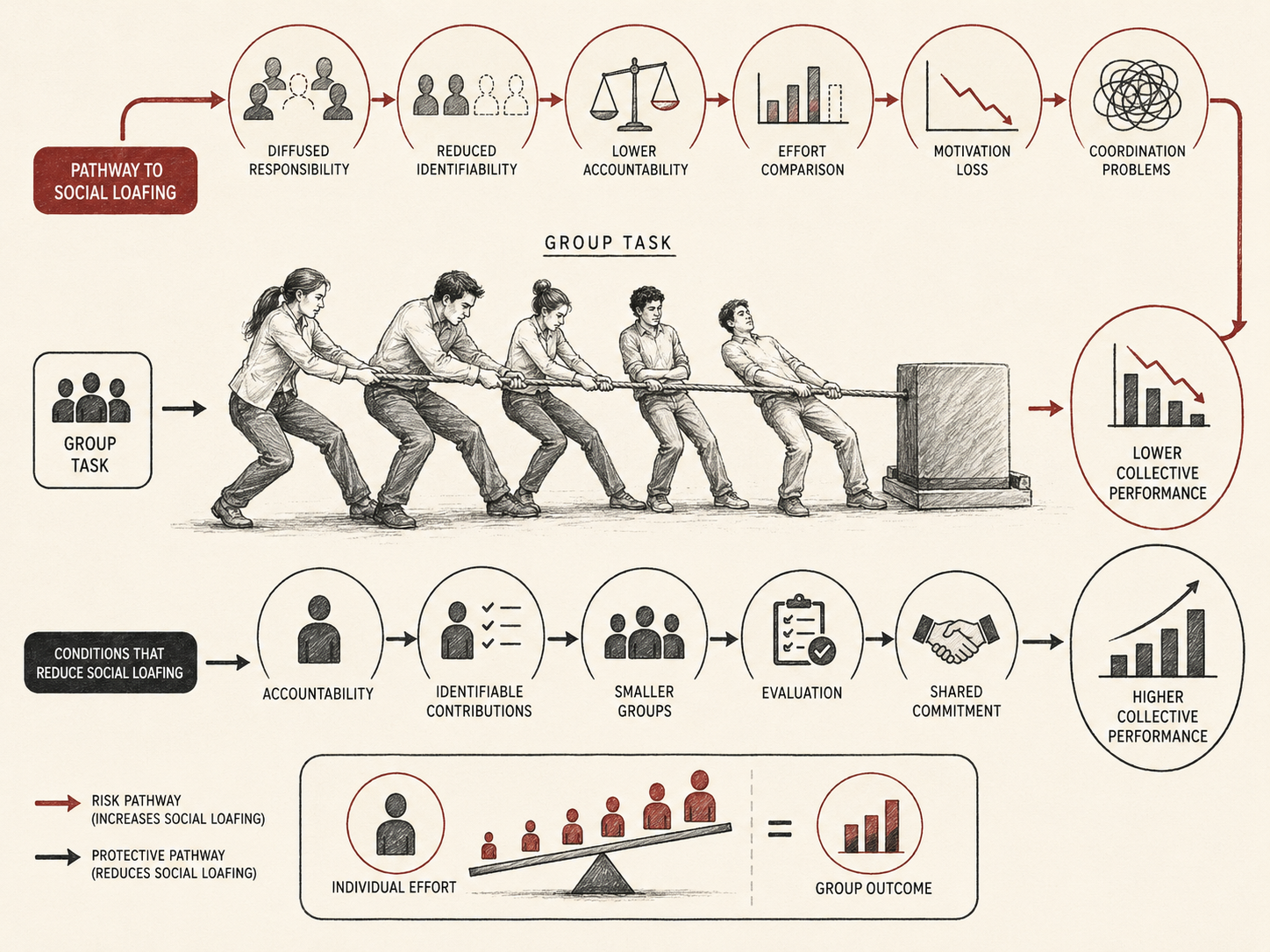
Social loafing connects directly to social facilitation, deindividuation, diffusion of responsibility, social norms, the bystander effect, collective action, social dilemmas, and the tragedy of the commons. Together these concepts explain how shared responsibility can either support cooperation or weaken personal investment.
What is social loafing?
Social loafing occurs when individuals reduce their effort during collective tasks relative to the effort they would exert if working alone or if their contribution were individually identifiable. The concept is distinct from simple inefficiency or poor coordination. It refers specifically to motivational loss: the decline in individual effort caused by shared responsibility, weak identifiability, low accountability, and reduced perceived instrumentality.
In a collective task, individuals may believe that their personal effort is difficult to detect, that the group outcome will not depend strongly on their contribution, or that others will compensate for lower effort. Under those conditions, motivation can decline even when the person is capable of higher performance and even when the person supports the group’s goal in principle.
Social loafing is important because it challenges idealized views of teamwork. Groups can produce more than individuals when they coordinate well, distribute roles clearly, and create strong accountability. But groups can also underperform when effort is pooled, responsibility is diffuse, standards are vague, and individual contributions disappear into the collective result.
The concept therefore reveals a core problem of collective life: shared responsibility can create shared strength, but it can also create motivational ambiguity. Whether groups mobilize effort or suppress it depends on how visibility, accountability, meaning, identity, fairness, and institutional design are structured.
Historical foundations of social loafing research
The modern study of social loafing builds on earlier research into group size and productivity. Researchers observed that total group output often increases as more people are added, but the average contribution per person tends to decline. This pattern challenged the assumption that group performance is simply additive.
If groups merely aggregated effort, output should scale proportionally with the number of participants. A group of four should produce four times the output of one person, all else equal. In practice, collective performance often falls short of that simple additive expectation. The shortfall may reflect coordination difficulties, motivational loss, or both.
Early research therefore led to an important distinction:
- coordination losses — inefficiencies caused by difficulty synchronizing, combining, or timing multiple contributions;
- motivation losses — reductions in individual effort caused by lower accountability, weaker identifiability, or reduced perceived instrumentality.
Social loafing refers primarily to the second problem. A group may lose performance because members cannot coordinate effectively, but social loafing specifically concerns reduced personal effort within the group setting.
This distinction matters because the solutions differ. Coordination losses may require better roles, process design, communication, timing, and technical integration. Motivation losses require clearer accountability, visible contributions, task value, meaningful feedback, and fair norms of participation.
The Ringelmann effect
One of the earliest demonstrations of reduced individual effort in groups came from French agricultural engineer Maximilien Ringelmann. Ringelmann studied collective physical performance, including rope-pulling tasks, and observed that although total group force increased as additional people joined, average force per person declined.
This pattern became known as the Ringelmann effect. It showed that collective performance does not necessarily scale linearly with group size. A larger group may produce more total output than a smaller group, but each member’s average contribution may fall as the group grows.
The Ringelmann effect does not prove that all decline is motivational. In rope pulling, part of the loss may come from coordination: people may not pull at precisely the same time, angle, or rhythm. Later research revisited Ringelmann’s work to distinguish coordination losses from motivational losses. That distinction became foundational for modern social loafing research.
The importance of Ringelmann’s work lies in the problem it revealed. Group output is not only a matter of adding bodies. Collective performance depends on how individual effort is coordinated, measured, valued, and made consequential.
Latané, Williams, and Harkins
The term social loafing was introduced by Bibb Latané, Kipling Williams, and Stephen Harkins in their 1979 article “Many Hands Make Light the Work.” Their experiments asked participants to clap or shout either individually or in groups. Participants wore blindfolds and headphones so that individual performance felt difficult to isolate. When participants believed their effort was pooled with others, their individual output declined.
The design was powerful because it reduced coordination problems. Participants were not failing to synchronize a complex group task. Instead, they were reducing effort when they believed their contribution was submerged in a collective output. This allowed the researchers to identify social loafing as a motivational effect.
The study remains foundational because it clarified that the mere perception of pooled responsibility can reduce effort. A person does not need to dislike the group or reject the goal. If their effort feels unidentifiable and noninstrumental, motivation can weaken.
Later studies deepened the finding by showing that identifiability, evaluation potential, task importance, self-evaluation, group cohesion, and cultural context all moderate social loafing. The basic effect is robust, but it is not inevitable. It depends on the motivational architecture of the group task.
Psychological mechanisms of social loafing
Several psychological mechanisms contribute to social loafing. They often operate together, but each identifies a different reason why collective settings can reduce effort.
Diffusion of responsibility
When responsibility is spread across multiple people, each individual may feel less personally accountable for the outcome. The logic resembles the bystander effect: if many people share responsibility, each person’s felt obligation may decline.
Reduced identifiability
Motivation declines when individual contributions cannot be observed, evaluated, or attributed. If the group receives one shared score, members may believe that effort differences will not be noticed. Identifiability is one of the strongest practical levers for reducing loafing.
Low perceived instrumentality
Individuals are more likely to invest effort when they believe their effort matters. When a group is large or a task is highly pooled, members may conclude that their contribution has little effect on the final outcome. Effort then feels less instrumental.
Free-rider expectations
Some members may reduce effort because they expect to benefit from the work of others. If rewards are shared regardless of contribution, free riding becomes tempting. This is especially likely when monitoring is weak.
The sucker effect
Other members may reduce effort for the opposite reason: they fear being exploited by free riders. Rather than carry the group while others undercontribute, they lower their own effort defensively. This is called the sucker effect.
Low task value
When the task feels unimportant, meaningless, or disconnected from valued outcomes, motivation declines. High task value can reduce loafing by giving members a reason to invest effort even when accountability is imperfect.
Perceived dispensability
If a person believes their contribution is redundant, replaceable, or unnecessary, effort may fall. Conversely, when a person believes their contribution is unique or indispensable, effort often increases.
These mechanisms show why social loafing is not simply a flaw in individual character. It is a predictable response to group structures that make effort less visible, less consequential, or less fair.
The Collective Effort Model
The Collective Effort Model, developed by Steven Karau and Kipling Williams, is one of the most influential frameworks for explaining social loafing. It integrates expectancy-value logic with group motivation. The model argues that individuals exert effort in collective tasks when they believe their effort is instrumental to achieving outcomes they value.
Motivation depends on several linked perceptions:
- Does my effort improve my personal performance?
- Does my performance improve the group’s performance?
- Does the group’s performance lead to outcomes I care about?
- Will my contribution be visible, recognized, or evaluated?
- Is the task meaningful enough to justify effort?
- Will others contribute fairly?
When these links are strong, collective effort can remain high. When they weaken, loafing becomes more likely. This is why social loafing is reduced by identifiability, task importance, group cohesion, task uniqueness, individual evaluation, clear standards, and meaningful group identity.
The Collective Effort Model also explains why collective work can sometimes increase effort. If members care deeply about the group, believe their contribution matters, and expect others to underperform, some may engage in social compensation: they work harder to protect the group outcome. This is the opposite of loafing, but it emerges from the same motivational architecture.
The model’s central lesson is institutional: motivation is not only inside the individual. It is structured by the perceived relationship among effort, contribution, group performance, fairness, and outcome value.
Formalizing social loafing
Social loafing can be represented as a difference between individual effort in solo conditions and individual effort in group conditions. Let \(e_i^{solo}\) represent the effort of person \(i\) when working alone, and \(e_i^{group}\) represent effort when working collectively:
L_i=e_i^{solo}-e_i^{group}
\]
Interpretation: Loafing intensity \(L_i\) is positive when a person exerts less effort in a group than alone.
At the group level, average social loafing can be summarized as:
\bar{L}=\frac{1}{n}\sum_{i=1}^{n}(e_i^{solo}-e_i^{group})
\]
Interpretation: Average loafing measures the mean decline in individual effort across group members.
A basic group production function can be written as:
Q_g=\sum_{i=1}^{n}e_i-C_g
\]
Interpretation: Group output \(Q_g\) depends on the sum of member effort minus coordination costs \(C_g\).
This equation shows why reduced group output can have two sources. The group may lose output because members exert less effort, or because coordination costs increase. Observed productivity loss can therefore be decomposed as:
Q_{potential}-Q_{actual}=M_g+C_g
\]
Interpretation: Total productivity loss reflects motivation loss \(M_g\) plus coordination loss \(C_g\).
The Collective Effort Model can be expressed as a simplified effort function:
e_i=\beta_0+\beta_1A_i+\beta_2I_i+\beta_3V_i+\beta_4U_i-\beta_5D_i-\beta_6F_i-\beta_7S_i
\]
Interpretation: Effort rises with accountability \(A\), instrumentality \(I\), task value \(V\), and task uniqueness \(U\), but falls with perceived dispensability \(D\), free-rider expectations \(F\), and sucker-effect concern \(S\).
Finally, group size often affects effort indirectly by reducing perceived individual impact:
I_i=\frac{\partial Q_g}{\partial e_i}
\]
Interpretation: Perceived instrumentality depends on whether a person believes their additional effort meaningfully changes group output.
These equations clarify the core idea: social loafing is not simply a behavioral label. It is a measurable motivational loss that can be modeled through identifiability, accountability, instrumentality, task value, perceived dispensability, and group size.
Coordination loss versus motivation loss
One of the most important methodological issues in social loafing research is the distinction between coordination loss and motivation loss. Both can reduce group performance, but they have different causes.
Coordination loss occurs when members try hard but fail to combine their efforts efficiently. Examples include mistimed actions, duplicated work, unclear roles, communication delays, incompatible methods, and process friction. In a rope-pulling task, coordination loss occurs when people do not pull in the same direction or at the same moment.
Motivation loss occurs when members reduce effort because the group setting weakens personal responsibility, identifiability, instrumentality, or task value. This is social loafing in the strict sense.
The distinction matters because many real-world teams suffer from both. A project may fail because members are poorly coordinated and because some members reduce effort. A committee may underperform because roles are unclear and because accountability is low. A distributed team may suffer from communication delay and invisible contribution patterns.
Research designs should therefore try to separate these sources. Pseudo-group designs, individually measurable subtasks, version history, contribution logs, solo baselines, and process measures can help distinguish coordination difficulty from motivational withdrawal.
Practically, managers and institutions should avoid blaming low group output entirely on motivation. Sometimes the group needs better structure, not harder-working members. At the same time, better process design will not solve loafing if individual contributions remain invisible and inconsequential.
When social loafing increases or declines
Social loafing is not inevitable. It is strongly moderated by task design, group structure, accountability, culture, identity, and perceived fairness.
Loafing tends to increase when:
- group size is large;
- individual contributions are difficult to identify;
- output is pooled into one shared score;
- task importance is low;
- members feel weak attachment to the group;
- performance standards are unclear;
- individual effort seems dispensable;
- free riding appears possible;
- members fear being exploited by low contributors;
- leadership fails to clarify roles and expectations;
- reward systems ignore contribution differences.
Loafing tends to decline when:
- individual contributions are visible;
- members receive specific feedback;
- the task has high personal, social, or moral meaning;
- group identity is strong;
- members perceive their contribution as unique or indispensable;
- accountability is fair and consistent;
- clear norms of reciprocity exist;
- the group has strong cohesion without hiding contribution differences;
- members believe their effort affects the outcome;
- evaluation standards are legitimate;
- digital systems create transparent contribution records.
These moderators show that social loafing reflects design rather than destiny. Groups can reduce loafing when they make contribution visible, meaningful, and consequential without turning collaboration into punitive surveillance.
Free-rider effects, sucker effects, and social compensation
Social loafing overlaps with several related motivational processes. These processes help explain why people reduce effort in groups even when they care about fairness and group outcomes.
The free-rider effect occurs when someone reduces effort because they expect to benefit from others’ work. The free rider relies on the group’s output while contributing less than they could.
The sucker effect occurs when someone reduces effort because they fear being exploited by free riders. Rather than be the person who works hard while others coast, they lower effort defensively. The sucker effect is especially likely when members perceive unfair contribution patterns but lack a way to correct them.
Social compensation occurs when someone increases effort because they expect others to perform poorly or undercontribute. This is more likely when the task is important, the group matters to the person, and the person believes their effort can protect the outcome.
These processes reveal that social loafing is bound up with fairness. People do not simply calculate whether they can get away with doing less. They also interpret whether the group is reciprocal, whether effort is being exploited, whether contribution is recognized, and whether the outcome is worth protecting.
In organizations, this means loafing can spread through perceived unfairness. One member’s free riding may lead others to reduce effort defensively. Conversely, transparent contribution systems and fair accountability can protect motivation by reducing both free riding and sucker-effect withdrawal.
Culture, identity, and collective obligation
Social loafing varies across cultural and identity contexts. In some settings, group membership and collective obligation may reduce loafing. When group identity is strong, the task is meaningful, and members feel responsible to one another, collective work can increase rather than suppress effort.
This is why social loafing should not be interpreted as a universal law of group behavior. The effect is robust, but it is moderated by cultural norms, relational obligations, group cohesion, interdependence, reputation, and moral meaning.
In more individualistic contexts, people may evaluate group tasks through personal contribution, reward fairness, and individual recognition. In more collectivist or high-commitment group contexts, members may experience group success as personally meaningful and feel stronger obligation to contribute. But this should not be reduced to a simple East-West contrast. Within any society, teams, families, movements, organizations, and communities differ in identity strength and norm structure.
The most useful question is not whether a culture “loafs” or “does not loaf.” The better question is: under what conditions do people experience group work as anonymous and dispensable versus meaningful and accountable?
Identity matters because it changes the meaning of effort. If the group is psychologically distant, effort may feel like a cost. If the group is morally important, effort may feel like duty, loyalty, or shared purpose.
Social loafing in organizations and institutions
Social loafing has major implications for organizations, public administration, committees, professional teams, research groups, nonprofit boards, classrooms, policy working groups, and large institutions. Many collective failures are not caused by lack of talent. They arise because accountability is unclear, contribution is invisible, and responsibility is diffused.
Examples include:
- committee work where no one owns a deliverable;
- group reports where one or two members quietly carry the project;
- large meetings where responsibility is discussed but not assigned;
- bureaucratic processes where tasks pass through many hands without clear ownership;
- collaborative policy development with unclear decision rights;
- public-good initiatives where everyone supports the goal but few contribute effort;
- organizational dashboards that measure team outcomes but hide individual contribution patterns.
Institutions can reduce loafing by designing contribution systems carefully. Useful practices include clear role assignment, visible deliverables, individual and collective evaluation, transparent workflows, fair peer review, smaller working groups, meaningful tasks, contribution logs, and feedback loops.
But the solution is not simply surveillance. Excessive monitoring can produce distrust, defensive behavior, or performative productivity. The goal is accountable collaboration: a system where members understand what they owe the group, how their contribution matters, and how fairness will be protected.
Social loafing therefore belongs within institutional analysis. It explains why shared goals are not enough. Cooperation requires structures that connect effort to responsibility, recognition, and outcome.
Social loafing in digital and distributed teams
Remote work and digital collaboration have made social loafing newly relevant. Distributed teams often depend on shared documents, asynchronous communication, project-management tools, repositories, dashboards, messaging platforms, and collaborative task boards. These systems can either hide contribution or make it more visible.
Digital environments can increase loafing when:
- roles are unclear;
- tasks are spread across many channels;
- group output is visible but individual contribution is not;
- meetings replace ownership;
- deadlines are collective but responsibilities are vague;
- silent members can remain invisible;
- workload imbalance is hard to detect;
- activity metrics reward performative presence rather than real contribution.
At the same time, digital systems can reduce loafing when they provide transparent records of work. Version control, issue tracking, pull requests, document histories, task boards, shared decision logs, research notebooks, and contribution dashboards can make effort more visible. These tools can increase accountability without requiring constant managerial observation.
The key distinction is between traceability and surveillance. Traceability clarifies who contributed what, when, and how. Surveillance monitors people in ways that may reduce trust or distort behavior. Effective distributed-team design should preserve autonomy while making contribution visible enough to support fairness.
Digital social loafing is therefore not caused by remote work itself. It is caused by poor visibility, weak ownership, unclear norms, and poorly designed collaboration infrastructure.
Education, group projects, and peer accountability
Educational group projects are one of the most familiar settings for social loafing. Students often experience uneven contribution, vague task division, last-minute work, and frustration when grades are shared across members who contributed unequally.
Group learning can be valuable. It can teach collaboration, communication, role distribution, peer explanation, conflict resolution, and collective problem-solving. But poorly designed group projects can reward free riding and punish high-contributing students.
Social loafing can be reduced in educational settings through:
- individual accountability within group work;
- clearly assigned roles;
- milestone-based deliverables;
- peer evaluation;
- reflection logs;
- contribution statements;
- smaller groups;
- meaningful task design;
- rubrics that distinguish process, contribution, and final output;
- instructor checkpoints before final submission.
The goal is not to make students suspicious of one another. The goal is to design group work so that effort is visible, contribution is meaningful, and fairness is protected. When students believe their contribution matters and will be recognized, loafing declines.
Educational design also needs to distinguish loafing from unequal preparation, anxiety, exclusion, disability, language barriers, or role ambiguity. Not all uneven participation is motivational withdrawal. Research-grade interpretation requires attention to context.
Public goods, civic life, and collective action
Social loafing is closely related to public-goods problems and collective-action dilemmas. In public life, many desirable outcomes depend on distributed contribution: voting, volunteering, climate action, community maintenance, public health, mutual aid, tax compliance, institutional trust, neighborhood safety, and shared knowledge systems.
People may support a collective goal while contributing less than they could because they believe their individual contribution is too small to matter. This is the civic version of low perceived instrumentality. If one vote, one donation, one hour, one act of restraint, or one contribution seems negligible, motivation may decline.
Public institutions can reduce this kind of motivational loss by making contribution visible, meaningful, and connected to outcomes. Community feedback, public recognition, participatory governance, transparent metrics, local identity, and credible institutional responsiveness can increase perceived instrumentality.
However, civic loafing should not be reduced to individual apathy. People may withdraw because institutions are unresponsive, burdens are unfair, past participation was ignored, or powerful actors are exempt from sacrifice. In such cases, the problem is not simply low motivation. It is low legitimacy.
This is where social loafing connects to governance. Collective effort depends on trust that contribution matters and that others are also contributing fairly.
Social loafing in the architecture of social influence
Within the broader architecture of social influence, social loafing explains how group environments reshape motivation even without explicit pressure. Social facilitation shows how the presence of others can increase arousal and improve or impair performance depending on task difficulty. Social loafing shows how pooled responsibility can reduce effort when individual contribution becomes less visible.
Deindividuation explains how anonymity and group immersion can reduce personal self-awareness or shift regulation toward group norms. Diffusion of responsibility explains why accountability weakens when many people are involved. Social dilemmas explain how individually rational choices can produce collectively worse outcomes.
Social loafing connects these processes through motivation. It shows how a person’s effort depends not only on ability or attitude, but on whether the social structure makes the contribution visible, necessary, fair, and consequential.
Seen this way, social loafing is not merely a small-group curiosity. It is a general principle of collective systems: when responsibility is pooled without accountability, effort can disappear into the group.
Critiques and limits of the concept
Although social loafing is well documented, the concept must be used carefully. Not every decline in group performance is loafing. Some declines reflect coordination difficulties, unclear instructions, poor leadership, inadequate resources, role ambiguity, burnout, exclusion, fear, skill mismatch, or structural constraints.
Several cautions are important:
- Do not confuse coordination loss with motivational loss.
- Do not label underperformance as loafing without a solo baseline or contribution measure.
- Do not treat group members as equally able, equally resourced, or equally included.
- Do not ignore role clarity, task design, leadership, and institutional incentives.
- Do not assume all cultures, teams, or communities respond to group tasks the same way.
- Do not use surveillance as the default solution.
- Do not mistake visible activity for meaningful contribution.
- Do not ignore the possibility of social compensation.
- Do not moralize loafing without examining fairness and accountability.
The concept is most useful when used diagnostically. What kind of task is being performed? Are individual contributions visible? Does the person believe their effort matters? Are rewards and burdens fair? Is the group cohesive? Are roles clear? Is the task meaningful? Are contribution records trustworthy?
Social loafing should therefore be treated as a theory of motivational design, not merely a label for low effort.
Measurement, data, and research design
Research on social loafing uses laboratory experiments, field studies, organizational surveys, team-performance data, peer evaluation, digital trace logs, task-output measures, public-goods games, group projects, and multilevel modeling.
Key variables include:
- participant, session, team, task, site, and organization identifiers;
- work condition;
- group size;
- solo baseline effort;
- group effort;
- effort loss;
- output score;
- coordination loss;
- motivation loss;
- identifiability;
- accountability;
- task value;
- task uniqueness;
- task visibility;
- perceived dispensability;
- perceived instrumentality;
- free-rider expectation;
- sucker-effect concern;
- social compensation tendency;
- group cohesion;
- group identity salience;
- evaluation potential;
- digital traceability;
- remote or hybrid status;
- response time.
Strong research designs should include a solo baseline whenever possible. Without a solo comparison, it is difficult to determine whether effort has declined in the group condition. Researchers should also include measures of coordination loss so that motivational withdrawal is not confused with process difficulty.
In digital or organizational settings, contribution records can be highly useful but must be interpreted carefully. Commit counts, comment counts, meeting participation, or task movements are imperfect proxies for effort. They should be triangulated with output quality, peer ratings, role expectations, and task difficulty.
Multilevel models are often appropriate because observations are nested: trials within participants, participants within teams, teams within sites or organizations. Research should therefore model both individual-level motivation and group-level structure.
R code for social loafing research
The following R workflow models group effort, effort loss, motivation loss, output, and response time as functions of group size, identifiability, accountability, task value, task uniqueness, perceived instrumentality, free-rider expectations, sucker-effect concern, group cohesion, group identity, evaluation potential, digital traceability, task type, and remote status.
# Install packages if needed:
# pak::pak(c("tidyverse", "lme4", "lmerTest", "emmeans", "broom.mixed", "performance"))

library(tidyverse)
library(lme4)
library(lmerTest)
library(emmeans)
library(broom.mixed)
library(performance)

# Expected columns:
# participant, session_id, team_id, task_id, site_id, condition,
# task_type, trial, group_size, solo_effort, group_effort,
# effort_loss, output_score, coordination_loss, motivation_loss,
# identifiability, accountability, task_value, task_uniqueness,
# task_visibility, perceived_dispensability,
# perceived_instrumentality, free_rider_expectation,
# sucker_effect_concern, social_compensation_tendency,
# group_cohesion, group_identity_salience, evaluation_potential,
# digital_traceability, remote_status, response_time_ms

dat <- read_csv("social_loafing_trials.csv") %>%
  mutate(
    participant = factor(participant),
    session_id = factor(session_id),
    team_id = factor(team_id),
    task_id = factor(task_id),
    site_id = factor(site_id),
    condition = factor(condition),
    task_type = factor(task_type),
    remote_status = factor(remote_status),
    log_group_size = log1p(group_size),
    accountability_index = (
      identifiability +
      accountability +
      task_visibility +
      evaluation_potential +
      digital_traceability
    ) / 5,
    collective_effort_index = (
      perceived_instrumentality +
      task_value +
      task_uniqueness +
      group_identity_salience +
      group_cohesion -
      perceived_dispensability
    ) / 5,
    motivation_loss_share =
      motivation_loss / pmax(coordination_loss + motivation_loss, 0.000001),
    log_response_time = log(response_time_ms)
  )

summary_table <- dat %>%
  group_by(condition, task_type) %>%
  summarise(
    n = n(),
    participants = n_distinct(participant),
    mean_group_size = mean(group_size, na.rm = TRUE),
    mean_solo_effort = mean(solo_effort, na.rm = TRUE),
    mean_group_effort = mean(group_effort, na.rm = TRUE),
    mean_effort_loss = mean(effort_loss, na.rm = TRUE),
    mean_output = mean(output_score, na.rm = TRUE),
    mean_coordination_loss = mean(coordination_loss, na.rm = TRUE),
    mean_motivation_loss = mean(motivation_loss, na.rm = TRUE),
    mean_identifiability = mean(identifiability, na.rm = TRUE),
    mean_accountability = mean(accountability, na.rm = TRUE),
    mean_task_value = mean(task_value, na.rm = TRUE),
    mean_instrumentality = mean(perceived_instrumentality, na.rm = TRUE),
    mean_collective_effort = mean(collective_effort_index, na.rm = TRUE),
    .groups = "drop"
  )

print(summary_table)

effort_loss_model <- lmer(
  effort_loss ~
    log_group_size +
    identifiability +
    accountability +
    task_value +
    task_uniqueness +
    perceived_dispensability +
    perceived_instrumentality +
    free_rider_expectation +
    sucker_effect_concern +
    group_cohesion +
    group_identity_salience +
    digital_traceability +
    condition +
    task_type +
    remote_status +
    (1 | participant) +
    (1 | team_id) +
    (1 | site_id),
  data = dat,
  REML = FALSE
)

summary(effort_loss_model)
emmeans(effort_loss_model, ~ condition)

motivation_loss_model <- lmer(
  motivation_loss ~
    log_group_size +
    accountability_index +
    collective_effort_index +
    perceived_dispensability +
    free_rider_expectation +
    sucker_effect_concern +
    social_compensation_tendency +
    condition +
    task_type +
    remote_status +
    (1 | participant) +
    (1 | team_id) +
    (1 | site_id),
  data = dat,
  REML = FALSE
)

summary(motivation_loss_model)

output_model <- lmer(
  output_score ~
    group_effort +
    coordination_loss +
    motivation_loss +
    accountability_index +
    collective_effort_index +
    condition +
    task_type +
    remote_status +
    (1 | participant) +
    (1 | team_id) +
    (1 | site_id),
  data = dat,
  REML = FALSE
)

summary(output_model)

rt_model <- lmer(
  log_response_time ~
    log_group_size +
    coordination_loss +
    motivation_loss +
    accountability_index +
    collective_effort_index +
    condition +
    task_type +
    remote_status +
    (1 | participant) +
    (1 | team_id) +
    (1 | site_id),
  data = dat %>% filter(response_time_ms >= 150),
  REML = FALSE
)

summary(rt_model)

group_size_summary <- dat %>%
  mutate(
    group_size_band = cut(
      group_size,
      breaks = c(0, 1, 3, 6, 10, 10000),
      labels = c("solo", "dyad_triads", "small_group", "medium_group", "large_group")
    )
  ) %>%
  group_by(condition, group_size_band) %>%
  summarise(
    n = n(),
    mean_effort_loss = mean(effort_loss, na.rm = TRUE),
    mean_motivation_loss = mean(motivation_loss, na.rm = TRUE),
    mean_output = mean(output_score, na.rm = TRUE),
    mean_accountability = mean(accountability_index, na.rm = TRUE),
    mean_collective_effort = mean(collective_effort_index, na.rm = TRUE),
    .groups = "drop"
  )

write_csv(summary_table, "social_loafing_summary.csv")
write_csv(group_size_summary, "social_loafing_group_size_summary.csv")

write_csv(
  tidy(effort_loss_model, effects = "fixed", conf.int = TRUE),
  "social_loafing_effort_loss_coefficients.csv"
)

ggplot(
  group_size_summary,
  aes(x = group_size_band, y = mean_effort_loss, color = condition, group = condition)
) +
  geom_line() +
  geom_point() +
  labs(
    title = "Social loafing by group size and accountability condition",
    x = "Group size band",
    y = "Mean effort loss"
  ) +
  theme_minimal()
This workflow supports experimental and organizational social loafing research by separating effort loss, motivation loss, coordination loss, accountability, instrumentality, and digital traceability.
Python code for social loafing research
The Python workflow below parallels the R analysis and adds simulation logic for collective effort, group size, identifiability, accountability, task value, task uniqueness, and digital traceability.
import numpy as np
import pandas as pd
import statsmodels.formula.api as smf
import matplotlib.pyplot as plt

# Expected columns:
# participant, session_id, team_id, task_id, site_id, condition,
# task_type, trial, group_size, solo_effort, group_effort,
# effort_loss, output_score, coordination_loss, motivation_loss,
# identifiability, accountability, task_value, task_uniqueness,
# task_visibility, perceived_dispensability,
# perceived_instrumentality, free_rider_expectation,
# sucker_effect_concern, social_compensation_tendency,
# group_cohesion, group_identity_salience, evaluation_potential,
# digital_traceability, remote_status, response_time_ms

df = pd.read_csv("social_loafing_trials.csv")

for col in [
    "participant", "session_id", "team_id", "task_id",
    "site_id", "condition", "task_type", "remote_status"
]:
    df[col] = df[col].astype("category")

df["log_group_size"] = np.log1p(df["group_size"])

df["accountability_index"] = (
    df["identifiability"]
    + df["accountability"]
    + df["task_visibility"]
    + df["evaluation_potential"]
    + df["digital_traceability"]
) / 5

df["collective_effort_index"] = (
    df["perceived_instrumentality"]
    + df["task_value"]
    + df["task_uniqueness"]
    + df["group_identity_salience"]
    + df["group_cohesion"]
    - df["perceived_dispensability"]
) / 5

df["motivation_loss_share"] = (
    df["motivation_loss"] /
    np.maximum(df["coordination_loss"] + df["motivation_loss"], 1e-6)
)

df["log_response_time"] = np.log(df["response_time_ms"])

summary_table = (
    df.groupby(["condition", "task_type"], observed=True)
    .agg(
        n=("participant", "size"),
        participants=("participant", "nunique"),
        mean_group_size=("group_size", "mean"),
        mean_solo_effort=("solo_effort", "mean"),
        mean_group_effort=("group_effort", "mean"),
        mean_effort_loss=("effort_loss", "mean"),
        mean_output=("output_score", "mean"),
        mean_coordination_loss=("coordination_loss", "mean"),
        mean_motivation_loss=("motivation_loss", "mean"),
        mean_identifiability=("identifiability", "mean"),
        mean_accountability=("accountability", "mean"),
        mean_task_value=("task_value", "mean"),
        mean_instrumentality=("perceived_instrumentality", "mean"),
        mean_collective_effort=("collective_effort_index", "mean"),
    )
    .reset_index()
)

print(summary_table)

effort_loss_model = smf.ols(
    "effort_loss ~ log_group_size + identifiability + accountability "
    "+ task_value + task_uniqueness + perceived_dispensability "
    "+ perceived_instrumentality + free_rider_expectation "
    "+ sucker_effect_concern + group_cohesion "
    "+ group_identity_salience + digital_traceability "
    "+ condition + task_type + remote_status",
    data=df,
)

effort_loss_result = effort_loss_model.fit(
    cov_type="cluster",
    cov_kwds={"groups": df["participant"]},
)

print(effort_loss_result.summary())

motivation_loss_model = smf.ols(
    "motivation_loss ~ log_group_size + accountability_index "
    "+ collective_effort_index + perceived_dispensability "
    "+ free_rider_expectation + sucker_effect_concern "
    "+ social_compensation_tendency + condition + task_type + remote_status",
    data=df,
)

motivation_loss_result = motivation_loss_model.fit(
    cov_type="cluster",
    cov_kwds={"groups": df["participant"]},
)

print(motivation_loss_result.summary())

output_model = smf.ols(
    "output_score ~ group_effort + coordination_loss + motivation_loss "
    "+ accountability_index + collective_effort_index "
    "+ condition + task_type + remote_status",
    data=df,
)

output_result = output_model.fit(
    cov_type="cluster",
    cov_kwds={"groups": df["team_id"]},
)

print(output_result.summary())

def simulate_collective_effort(n_cases=8000, seed=42):
    rng = np.random.default_rng(seed)
    rows = []

    conditions = [
        "pooled_group",
        "identifiable_group",
        "high_accountability",
        "traceable_digital_team"
    ]

    for condition in conditions:
        for _ in range(n_cases):
            group_size = {
                "pooled_group": 8,
                "identifiable_group": 6,
                "high_accountability": 6,
                "traceable_digital_team": 8
            }[condition] + rng.integers(-2, 3)

            group_size = max(1, int(group_size))

            identifiability = {
                "pooled_group": 2.0,
                "identifiable_group": 8.0,
                "high_accountability": 7.0,
                "traceable_digital_team": 8.0
            }[condition] + rng.normal(0, 0.8)

            accountability = {
                "pooled_group": 2.0,
                "identifiable_group": 7.0,
                "high_accountability": 9.0,
                "traceable_digital_team": 8.0
            }[condition] + rng.normal(0, 0.8)

            task_value = {
                "pooled_group": 5.0,
                "identifiable_group": 6.0,
                "high_accountability": 6.0,
                "traceable_digital_team": 7.0
            }[condition] + rng.normal(0, 0.8)

            task_uniqueness = {
                "pooled_group": 2.0,
                "identifiable_group": 5.0,
                "high_accountability": 5.0,
                "traceable_digital_team": 6.0
            }[condition] + rng.normal(0, 0.8)

            digital_traceability = {
                "pooled_group": 0.0,
                "identifiable_group": 2.0,
                "high_accountability": 4.0,
                "traceable_digital_team": 9.0
            }[condition] + rng.normal(0, 0.8)

            instrumentality = np.clip(
                2
                + 0.3 * identifiability
                + 0.25 * accountability
                + 0.25 * task_uniqueness
                - 0.25 * np.log1p(group_size),
                0,
                10
            )

            motivation_loss = np.clip(
                3
                + 1.5 * np.log1p(group_size)
                - 0.8 * identifiability
                - 0.8 * accountability
                - 0.6 * task_value
                - 0.5 * instrumentality
                - 0.4 * digital_traceability
                + rng.normal(0, 2),
                0,
                40
            )

            solo_effort = np.clip(rng.normal(80, 7), 0, 100)
            group_effort = np.clip(
                solo_effort - motivation_loss + rng.normal(0, 3),
                0,
                100
            )

            rows.append({
                "condition": condition,
                "group_size": group_size,
                "identifiability": identifiability,
                "accountability": accountability,
                "task_value": task_value,
                "task_uniqueness": task_uniqueness,
                "digital_traceability": digital_traceability,
                "perceived_instrumentality": instrumentality,
                "motivation_loss": motivation_loss,
                "solo_effort": solo_effort,
                "group_effort": group_effort,
                "effort_loss": solo_effort - group_effort,
            })

    simulation = pd.DataFrame(rows)

    simulation_summary = (
        simulation.groupby("condition")
        .agg(
            n=("condition", "size"),
            mean_group_size=("group_size", "mean"),
            mean_instrumentality=("perceived_instrumentality", "mean"),
            mean_motivation_loss=("motivation_loss", "mean"),
            mean_effort_loss=("effort_loss", "mean"),
            mean_group_effort=("group_effort", "mean"),
        )
        .reset_index()
    )

    return simulation, simulation_summary

simulation, simulation_summary = simulate_collective_effort()

print(simulation_summary)

group_size_summary = (
    df.assign(
        group_size_band=pd.cut(
            df["group_size"],
            bins=[0, 1, 3, 6, 10, 10000],
            labels=["solo", "dyad_triads", "small_group", "medium_group", "large_group"]
        )
    )
    .groupby(["condition", "group_size_band"], observed=True)
    .agg(mean_effort_loss=("effort_loss", "mean"))
    .reset_index()
)

fig, ax = plt.subplots(figsize=(8, 5))

for condition, group in group_size_summary.groupby("condition", observed=True):
    ax.plot(
        group["group_size_band"].astype(str),
        group["mean_effort_loss"],
        marker="o",
        label=condition
    )

ax.set_xlabel("Group size band")
ax.set_ylabel("Mean effort loss")
ax.set_title("Social loafing by group size and condition")
ax.legend()
plt.tight_layout()
plt.show()

summary_table.to_csv("social_loafing_summary.csv", index=False)
simulation.to_csv("collective_effort_simulation.csv", index=False)
simulation_summary.to_csv("collective_effort_simulation_summary.csv", index=False)
This Python workflow supports experimental, organizational, and distributed-team social loafing research by modeling how group size, identifiability, accountability, instrumentality, and digital traceability shape effort loss.
Research data architecture
Social loafing research often depends on relational data: participants, sessions, teams, tasks, sites, conditions, task type, group size, solo effort, group effort, effort loss, output, coordination loss, motivation loss, identifiability, accountability, task value, task uniqueness, task visibility, perceived dispensability, perceived instrumentality, free-rider expectation, sucker-effect concern, social compensation, group cohesion, group identity, evaluation potential, digital traceability, remote status, and response time.
Rather than embedding executable database code directly in the WordPress article body, the companion GitHub repository includes the full SQL schema and example queries for researchers who want to reproduce or extend the data model.
The research data model is designed to support questions such as:
- Does effort loss increase with group size?
- Does identifiability reduce social loafing?
- Does accountability reduce motivation loss?
- Does task value moderate loafing?
- Does perceived instrumentality predict group effort?
- Do free-rider expectations and sucker-effect concerns predict reduced effort?
- Does digital traceability reduce loafing in distributed teams?
- Does social compensation occur when group identity and task value are high?
- Can coordination loss be separated from motivation loss?
The GitHub repository contains the full database schema, example analytical queries, validation logic, and reproducible data workflow. Keeping executable SQL in GitHub avoids WordPress hosting restrictions while preserving the research-grade infrastructure for readers who want to inspect or reuse the model.
View the SQL research data architecture in GitHub.
GitHub repository
The companion repository provides reusable code and research scaffolding for studying social loafing, including workflows for group size, identifiability, accountability, task value, task uniqueness, perceived instrumentality, free-rider expectations, sucker-effect concerns, social compensation, coordination loss, motivation loss, distributed-team traceability, and group output.
Complete Code Repository
Access the full companion repository for this article, including reproducible analysis materials and multi-language code workflows for social loafing research.
Why social loafing matters
Social loafing matters because it reveals a central weakness in collective systems: people can support a shared goal and still reduce effort when their contribution becomes invisible, dispensable, or weakly connected to outcomes. Groups do not automatically multiply effort. They reshape motivation.
The concept also matters because it points toward practical solutions. Loafing declines when contributions are identifiable, tasks are meaningful, roles are clear, standards are fair, group identity is strong, and members believe their effort matters. The best groups are not simply groups with talented people. They are groups whose design makes contribution visible, valuable, and accountable.
In organizations, classrooms, institutions, civic life, and digital teams, social loafing helps explain why collective performance so often falls below collective capacity. It also shows how better design can restore effort without reducing collaboration to surveillance.
Read alongside social facilitation, deindividuation, diffusion of responsibility, social dilemmas, and Institutions & Governance, social loafing becomes more than a small-group effect. It becomes a framework for understanding how collective systems either mobilize or lose human effort.
Related articles
- Social Psychology
- Social Facilitation in Social Psychology
- Deindividuation in Social Psychology
- Diffusion of Responsibility
- The Bystander Effect
- Social Norms in Social Psychology
- Groupthink in Social Psychology
- Group Polarization in Social Psychology
- Collective Action and Social Change
- Social Dilemmas
- The Tragedy of the Commons
- Behavioral Economics
- Institutions & Governance
Further reading
- American Psychological Association (n.d.) Social loafing. APA Dictionary of Psychology. Available at: https://dictionary.apa.org/social-loafing.
- Harkins, S.G. (1987) ‘Social loafing and social facilitation’, Journal of Experimental Social Psychology, 23(1), pp. 1–18. Available at: https://doi.org/10.1016/0022-1031(87)90022-9.
- Harkins, S.G. and Szymanski, K. (1989) ‘Social loafing and group evaluation’, Journal of Personality and Social Psychology, 56(6), pp. 934–941. Available at: https://doi.org/10.1037/0022-3514.56.6.934.
- Ingham, A.G., Levinger, G., Graves, J. and Peckham, V. (1974) ‘The Ringelmann effect: Studies of group size and group performance’, Journal of Experimental Social Psychology, 10(4), pp. 371–384. Available at: https://doi.org/10.1016/0022-1031(74)90033-X.
- Jackson, J.M. and Williams, K.D. (1985) ‘Social loafing on difficult tasks: Working collectively can improve performance’, Journal of Personality and Social Psychology, 49(4), pp. 937–942. Available at: https://doi.org/10.1037/0022-3514.49.4.937.
- Karau, S.J. and Hart, J.W. (1998) ‘Group cohesiveness and social loafing: Effects of a social interaction manipulation on individual motivation within groups’, Group Dynamics: Theory, Research, and Practice, 2(3), pp. 185–191. Available at: https://doi.org/10.1037/1089-2699.2.3.185.
- Karau, S.J. and Williams, K.D. (1993) ‘Social loafing: A meta-analytic review and theoretical integration’, Journal of Personality and Social Psychology, 65(4), pp. 681–706. Available at: https://doi.org/10.1037/0022-3514.65.4.681.
- Kerr, N.L. (1983) ‘Motivation losses in small groups: A social dilemma analysis’, Journal of Personality and Social Psychology, 45(4), pp. 819–828. Available at: https://doi.org/10.1037/0022-3514.45.4.819.
- Kerr, N.L. and Bruun, S.E. (1981) ‘Ringelmann revisited: Alternative explanations for the social loafing effect’, Personality and Social Psychology Bulletin, 7(2), pp. 224–231. Available at: https://doi.org/10.1177/014616728172007.
- Kerr, N.L. and Bruun, S.E. (1983) ‘Dispensability of member effort and group motivation losses: Free-rider effects’, Journal of Personality and Social Psychology, 44(1), pp. 78–94.
- Kravitz, D.A. and Martin, B. (1986) ‘Ringelmann rediscovered: The original article’, Journal of Personality and Social Psychology, 50(5), pp. 936–941. Available at: https://doi.org/10.1037/0022-3514.50.5.936.
- Latané, B., Williams, K. and Harkins, S. (1979) ‘Many hands make light the work: The causes and consequences of social loafing’, Journal of Personality and Social Psychology, 37(6), pp. 822–832. Available at: https://doi.org/10.1037/0022-3514.37.6.822.
- Shepperd, J.A. (1993) ‘Productivity loss in performance groups: A motivation analysis’, Psychological Bulletin, 113(1), pp. 67–81.
- Shepperd, J.A. (1999) ‘Social loafing and expectancy-value theory’, Personality and Social Psychology Bulletin, 25(9), pp. 1147–1158. Available at: https://doi.org/10.1177/01461672992512008.
- Szymanski, K. and Harkins, S.G. (1987) ‘Social loafing and self-evaluation with a social standard’, Journal of Personality and Social Psychology, 53(5), pp. 891–897. Available at: https://doi.org/10.1037/0022-3514.53.5.891.
- Williams, K.D., Harkins, S.G. and Latané, B. (1981) ‘Identifiability as a deterrent to social loafing: Two cheering experiments’, Journal of Personality and Social Psychology, 40(2), pp. 303–311. Available at: https://doi.org/10.1037/0022-3514.40.2.303.
References
- American Psychological Association (n.d.) Social loafing. APA Dictionary of Psychology. Available at: https://dictionary.apa.org/social-loafing.
- Harkins, S.G. (1987) ‘Social loafing and social facilitation’, Journal of Experimental Social Psychology, 23(1), pp. 1–18. Available at: https://doi.org/10.1016/0022-1031(87)90022-9.
- Harkins, S.G. and Szymanski, K. (1989) ‘Social loafing and group evaluation’, Journal of Personality and Social Psychology, 56(6), pp. 934–941. Available at: https://doi.org/10.1037/0022-3514.56.6.934.
- Ingham, A.G., Levinger, G., Graves, J. and Peckham, V. (1974) ‘The Ringelmann effect: Studies of group size and group performance’, Journal of Experimental Social Psychology, 10(4), pp. 371–384. Available at: https://doi.org/10.1016/0022-1031(74)90033-X.
- Jackson, J.M. and Williams, K.D. (1985) ‘Social loafing on difficult tasks: Working collectively can improve performance’, Journal of Personality and Social Psychology, 49(4), pp. 937–942. Available at: https://doi.org/10.1037/0022-3514.49.4.937.
- Karau, S.J. and Hart, J.W. (1998) ‘Group cohesiveness and social loafing: Effects of a social interaction manipulation on individual motivation within groups’, Group Dynamics: Theory, Research, and Practice, 2(3), pp. 185–191. Available at: https://doi.org/10.1037/1089-2699.2.3.185.
- Karau, S.J. and Williams, K.D. (1993) ‘Social loafing: A meta-analytic review and theoretical integration’, Journal of Personality and Social Psychology, 65(4), pp. 681–706. Available at: https://doi.org/10.1037/0022-3514.65.4.681.
- Kerr, N.L. (1983) ‘Motivation losses in small groups: A social dilemma analysis’, Journal of Personality and Social Psychology, 45(4), pp. 819–828. Available at: https://doi.org/10.1037/0022-3514.45.4.819.
- Kerr, N.L. and Bruun, S.E. (1981) ‘Ringelmann revisited: Alternative explanations for the social loafing effect’, Personality and Social Psychology Bulletin, 7(2), pp. 224–231. Available at: https://doi.org/10.1177/014616728172007.
- Kerr, N.L. and Bruun, S.E. (1983) ‘Dispensability of member effort and group motivation losses: Free-rider effects’, Journal of Personality and Social Psychology, 44(1), pp. 78–94.
- Kravitz, D.A. and Martin, B. (1986) ‘Ringelmann rediscovered: The original article’, Journal of Personality and Social Psychology, 50(5), pp. 936–941. Available at: https://doi.org/10.1037/0022-3514.50.5.936.
- Latané, B., Williams, K. and Harkins, S. (1979) ‘Many hands make light the work: The causes and consequences of social loafing’, Journal of Personality and Social Psychology, 37(6), pp. 822–832. Available at: https://doi.org/10.1037/0022-3514.37.6.822.
- Shepperd, J.A. (1993) ‘Productivity loss in performance groups: A motivation analysis’, Psychological Bulletin, 113(1), pp. 67–81.
- Shepperd, J.A. (1999) ‘Social loafing and expectancy-value theory’, Personality and Social Psychology Bulletin, 25(9), pp. 1147–1158. Available at: https://doi.org/10.1177/01461672992512008.
- Szymanski, K. and Harkins, S.G. (1987) ‘Social loafing and self-evaluation with a social standard’, Journal of Personality and Social Psychology, 53(5), pp. 891–897. Available at: https://doi.org/10.1037/0022-3514.53.5.891.
- Williams, K.D., Harkins, S.G. and Latané, B. (1981) ‘Identifiability as a deterrent to social loafing: Two cheering experiments’, Journal of Personality and Social Psychology, 40(2), pp. 303–311. Available at: https://doi.org/10.1037/0022-3514.40.2.303.