
Last Updated June 17, 2026
Culture, Ritual, and Symbolic Life examines how human beings construct shared worlds through language, myth, ritual, narrative, classification, material practice, public performance, and symbolic interpretation. In cultural anthropology, culture is not treated as a decorative layer added to social life, but as a foundational system through which communities perceive reality, define belonging, organize memory, regulate moral life, contest authority, and make social order intelligible. Culture is therefore not simply what people inherit or express. It is one of the principal ways human beings create symbolic worlds that can be lived, transmitted, defended, revised, or resisted.
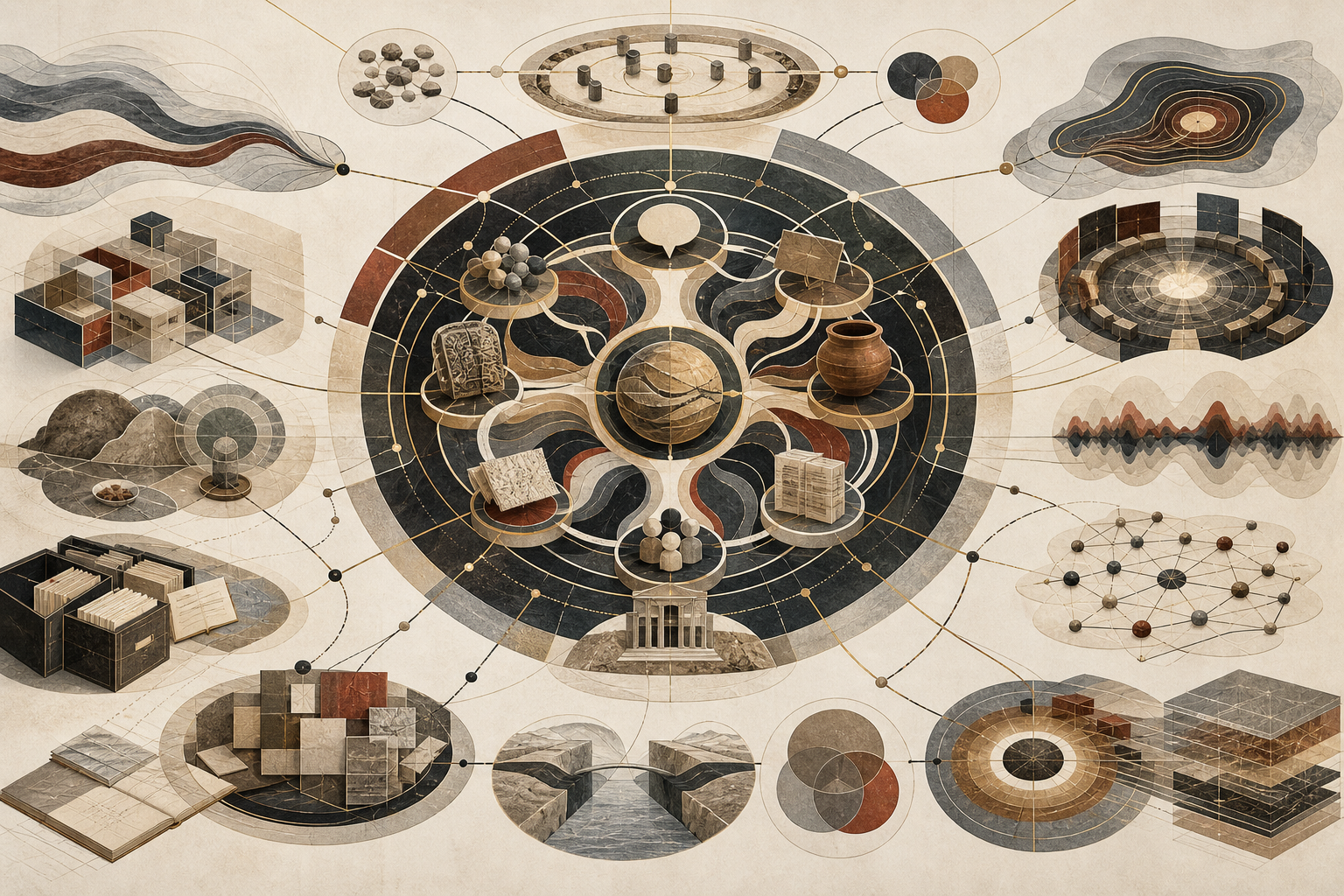
This article map brings together the major domains through which cultural anthropology studies ritual and symbolic life. It examines symbols, signs, myths, ceremonies, sacred categories, purity and danger, classification, identity, belonging, material culture, performance, language, collective memory, symbolic power, and the social production of reality. It treats ritual and symbolism not as escapes from material life, but as ways material conditions, institutions, bodies, places, technologies, histories, and power relations become socially meaningful. Across religion, politics, kinship, institutions, media, development, law, nationalism, technology, environmental life, and everyday practice, culture provides an indispensable language for understanding how human communities interpret the world and how those interpretations acquire social force.
Article Map
Cultural Anthropology
Related Map
Kinship & Social Organization
Culture, Ritual, and Symbolic Life also approaches symbolic anthropology as a field that benefits from careful research infrastructure: annotated bibliographies, concept maps, fieldnote templates, interpretive codebooks, comparative case files, qualitative coding protocols, archival records, media examples, oral-history metadata, interview guides, ethical review notes, and reproducible research documentation. Cultural anthropology cannot be reduced to datasets or computational pattern recognition. Its central commitments remain interpretation, context, reflexivity, fieldwork, language, historical depth, ethical responsibility, and attention to lived experience. Yet research repositories can strengthen this work by making concepts, sources, interpretive decisions, coding frameworks, and methodological assumptions more transparent.
For that reason, this article map integrates cultural anthropology with open research workflows where appropriate. Python may support text organization, motif indexing, metadata cleaning, corpus preparation, and transparent research utilities. R may support qualitative-code summaries, co-occurrence tables, bibliographic analysis, visualizations, and reproducible reports. SQL may support structured research catalogs for sources, excerpts, symbols, rituals, narratives, fieldnote metadata, and interpretive codes. Markdown and notebooks may support research logs, literature reviews, concept maps, reflexive memos, methods documentation, and article-level research packages. These tools do not replace anthropological interpretation. They help make interpretive work more organized, auditable, and reusable while preserving the central importance of context, ritual, symbolism, and ethical judgment.
Culture, Ritual, and Symbolic Life therefore appears here not only as a classic anthropological concern, but also as a research architecture for studying how human worlds become socially intelligible. The aim of the series is to preserve the interpretive richness of cultural anthropology while building a more transparent scholarly workflow around concepts, sources, cases, and evidence. In that sense, this article map treats culture not simply as a topic, but as the symbolic infrastructure through which social life becomes intelligible, persuasive, contested, and historically durable.
GitHub Repository
This article map is supported by companion research scaffolding for organizing symbolic anthropology notes, qualitative coding structures, source metadata, ritual examples, interpretive codebooks, synthetic teaching datasets, and reproducible workflows.
Complete Code Repository
The Culture, Ritual, and Symbolic Life companion repository includes article-level folders, annotated bibliographies, research notes, fieldnote templates, interpretive codebooks, qualitative coding examples, source metadata, synthetic teaching datasets, documentation, and reproducible research scaffolding across Markdown, Python, R, SQL, notebooks, and structured research logs where appropriate.
Culture, Ritual, and Symbolic Life as a Foundational Anthropological Field
Culture, ritual, and symbolic life occupy a central place in cultural anthropology because human beings do not live by institutions, incentives, technologies, and material systems alone. They also live through signs, stories, rituals, classifications, images, moral categories, symbolic boundaries, public performances, and inherited frameworks that tell them who they are, what matters, what is dangerous, what is sacred, what is shameful, what is legitimate, and how order should be maintained. To study culture in this sense is to study the symbolic architecture through which social life becomes intelligible, persuasive, and durable.
Anthropology has long treated culture as something more than custom, heritage, taste, or lifestyle. In its stronger sense, culture refers to historically transmitted and socially enacted patterns of significance embodied in symbols, practices, narratives, beliefs, classifications, institutions, objects, bodies, spaces, and forms of performance. These symbolic systems do not simply mirror social life. They help constitute it by shaping how communities perceive reality, classify experience, remember the past, imagine the future, and distinguish order from disorder.
This perspective matters because social action is never purely instrumental. People act within moral and symbolic worlds that distinguish sacred from profane, purity from danger, kin from stranger, legitimacy from threat, belonging from exclusion, memory from oblivion, and obligation from betrayal. Rituals mark transitions, encode obligation, dramatize hierarchy, produce solidarity, and reaffirm shared values. Narratives transmit memory, justify authority, carry trauma, and provide interpretive frameworks through which suffering, aspiration, sacrifice, and change become meaningful. Symbols condense wider systems of value into forms that can unify communities, naturalize hierarchy, provoke resistance, or reorganize collective imagination.
A serious anthropology of ritual and symbolic life therefore asks not only what people believe, but how shared symbols are encoded, enacted, transmitted, contested, and reproduced through social life. It asks how symbols become authoritative, how rituals create social force, how stories organize time, how classifications sustain order, how objects carry memory, how performances make identity visible, and how symbolic systems can both stabilize and challenge power.
Culture as Symbolic Worldmaking
Culture may be understood as a process of symbolic worldmaking. Human communities do not merely inhabit environments; they interpret them. They name landscapes, remember origins, classify bodies, mark kinship, organize sacred time, assign moral value, regulate impurity, narrate suffering, preserve ancestors, stage authority, and make public distinctions between belonging and danger. Through these acts, social worlds become more than material arrangements. They become socially meaningful worlds.
Worldmaking does not mean that symbols float free from material life. Symbolic systems are always entangled with bodies, labor, gender, ecology, economy, violence, memory, territory, technology, law, and institutions. A ritual may depend on food, clothing, architecture, land, sound, rhythm, and bodily discipline. A national symbol may depend on schools, monuments, ceremonies, borders, documents, media, and historical memory. A category of purity may regulate bodies, kitchens, temples, households, caste, gender, class, or public space. A technological object may carry meanings of progress, surveillance, status, danger, modernity, exclusion, or repair.
For that reason, symbolic anthropology does not oppose ritual and symbolism to material life. It examines how material life becomes symbolically charged, and how symbols become embedded in material arrangements. A road, shrine, flag, market, household, garment, meal, grave, photograph, phone, archive, or document can all become symbolic infrastructure. They carry more than practical function. They help organize memory, identity, obligation, hierarchy, and possibility.
Culture as worldmaking also helps explain why social change is rarely only technical. Institutions, policies, technologies, and development projects are never received in an interpretive vacuum. They enter existing symbolic worlds shaped by memory, trust, authority, moral expectation, local categories, trauma, aspiration, religious meaning, and historical experience. To understand culture is therefore to understand why the same formal system may carry different meanings in different contexts, and why durable change depends not only on design, but on legitimacy, interpretation, participation, and symbolic resonance.
Symbolic Anthropology as Interpretive Research Practice
Symbolic anthropology is an interpretive research practice. It does not treat symbols as simple codes with one fixed meaning, nor does it reduce ritual, myth, or performance to hidden economic or political causes alone. Instead, it asks how meanings are made publicly visible, how they become socially recognizable, and how they are interpreted within particular historical, linguistic, institutional, and moral worlds.
This requires close attention to context. A gesture, object, phrase, story, color, garment, meal, procession, song, or ritual act may mean different things depending on who performs it, where it appears, who witnesses it, what histories surround it, and what conflicts shape its interpretation. Symbols are not merely signs. They are socially situated forms that gather emotion, authority, memory, ambiguity, and power.
Interpretive research also requires reflexivity. Anthropologists do not stand outside culture as neutral machines of observation. They bring language, categories, training, assumptions, institutions, and positionality into the act of interpretation. For that reason, careful symbolic analysis must document sources, contexts, translations, interpretive decisions, uncertainties, and limits. It must distinguish between emic categories used by participants and etic analytical categories used by researchers. It must resist the temptation to flatten living traditions into examples, data points, or aesthetic fragments.
A research repository for this article map can therefore support, but never replace, interpretive anthropology. It can help organize sources, excerpts, fieldnote templates, codebooks, symbolic motifs, ritual sequences, narrative structures, and ethical notes. It can make research decisions more visible. But the core scholarly task remains interpretive: to understand how people create, inhabit, contest, and transform symbolic worlds.
What This Article Map Studies
This article map studies culture as a system of ritual and symbolic practice. It examines how language, ritual, myth, narrative, classification, performance, material culture, memory, and public symbols help organize social life. It asks how communities distinguish sacred from ordinary, pure from polluted, kin from stranger, human from nonhuman, center from margin, authority from illegitimacy, order from disorder, and continuity from rupture.
At the level of everyday life, the map examines how symbolic meaning is carried through food, clothing, greetings, kinship terms, bodily practice, domestic space, gendered performance, tools, objects, work routines, hospitality, mourning, celebration, and moral expectation. At the level of institutions, it examines ceremonies, archives, bureaucratic categories, legal rituals, national symbols, monuments, schools, professional codes, media narratives, and the symbolic life of public authority. At the level of collective memory, it examines origin stories, myths, historical narratives, commemorations, sacred geographies, trauma, inheritance, and contested pasts.
The article map also studies symbolic conflict. Meanings are not always shared peacefully. Symbols can unify, but they can also exclude. Classifications can make social life intelligible, but they can also stigmatize and discipline. Rituals can produce solidarity, but they can also reproduce hierarchy. Public narratives can sustain belonging, but they can also erase marginalized histories. A serious anthropology of symbolism must therefore study ritual, meaning, and power together.
Finally, this map studies interpretation itself. It asks how anthropologists read cultural forms without reducing them, exoticizing them, appropriating them, or treating them as static survivals from the past. Culture is not frozen tradition. It is lived, changing, contested, mediated, and historically situated. The study of culture, ritual, and symbolic life is therefore also a study of translation, representation, ethics, and scholarly responsibility.
Major Intellectual Lineages
The anthropology of ritual and symbolic life draws on several major intellectual traditions. One important lineage comes from the study of collective representations, ritual, and classification associated with Émile Durkheim and Marcel Mauss. In this tradition, symbolic systems are tied to the moral organization of society itself. Categories, rites, and shared representations help communities establish order, generate solidarity, and create distinctions that appear natural even though they are socially produced. The symbolic is therefore not an ornament of society but one of the mechanisms through which society becomes morally binding.
A second lineage emerges through structural and symbolic approaches to myth, opposition, classification, and cultural logic. Here, symbols are treated not as isolated signs but as elements within larger patterned systems through which societies organize cultural order. Anthropological work on purity, taboo, pollution, boundary, and symbolic distinction reflects this concern with the cultural logic of order. Such work shows that classification is never merely descriptive. It expresses anxieties about ambiguity, disorder, transgression, and the fragility of social form.
A third lineage is interpretive anthropology, associated especially with Clifford Geertz, which approaches culture as a web of publicly expressed significance embodied in symbols and social action. This tradition emphasizes interpretation rather than reduction. Ritual, religion, performance, and everyday practices are treated as meaningful forms that must be read in context rather than dissolved into material causes alone. Culture becomes intelligible through thick description: the disciplined interpretation of acts, symbols, and performances within the wider worlds that give them force.
A fourth lineage comes from ritual process, performance theory, and the study of liminality. This tradition emphasizes that symbolic action is not static. Rituals do not simply preserve order; they also mediate transition, ambiguity, inversion, and transformation. Public performances can reproduce hierarchy, generate communitas, stage authority, or expose instability within the social order itself. Symbolic life is therefore not only reproductive but dynamic. It is a site where continuity and change are both enacted.
A fifth lineage comes from work on power, discourse, representation, practice, and symbolic domination. This line of inquiry asks how meanings become attached to institutions, states, bodies, categories, media systems, and public authority. It examines the ways symbolic forms can naturalize inequality, organize common sense, produce legitimacy, and shape what appears thinkable or unspeakable. It also examines how marginalized communities reinterpret, refuse, resignify, or transform dominant symbols.
Taken together, these lineages show that symbolic anthropology is not peripheral to the discipline. It is one of anthropology’s central pathways for understanding how societies create legitimacy, reproduce memory, organize difference, transmit moral order, and bind significance to practice. Culture is not merely what people have. It is one of the principal media through which collective life becomes meaningful, durable, and contestable.
Core Themes in Symbolic Analysis
One major theme in this field is the study of symbols themselves: words, images, objects, gestures, sounds, colors, spaces, bodies, and practices that condense wider systems of meaning and value. Symbols matter because they connect visible forms to invisible worlds of obligation, memory, hierarchy, fear, belonging, and feeling. Anthropologists therefore ask how symbols acquire authority, how they circulate, how they become attached to emotion and identity, and how they persist or change across time.
A second major theme is ritual. Ritual is not simply repetitive ceremony, but patterned action through which communities enact transitions, dramatize hierarchy, reproduce shared values, and respond to moments of uncertainty, danger, conflict, or change. Whether religious, civic, institutional, domestic, political, or professional, ritual provides one of the clearest windows into the ways social meanings become embodied and collectively affirmed.
A third theme is myth and narrative. Societies tell stories about origins, order, suffering, obligation, destiny, loss, justice, and belonging. These stories do not merely entertain or preserve tradition. They provide moral maps, encode collective memory, and shape the way communities understand continuity, crisis, sacrifice, authority, and legitimacy. Narrative is therefore central to symbolic anthropology because it binds interpretation to history and identity to public significance.
A fourth theme is classification and boundary-making. Human communities organize the world through distinctions between pure and impure, sacred and profane, kin and stranger, normal and deviant, center and margin, civilized and uncivilized, human and nonhuman, lawful and unlawful. These classifications are neither trivial nor neutral. They structure perception, regulate conduct, and sustain systems of legitimacy and exclusion. Anthropological work on taboo, pollution, social categorization, and symbolic boundary-making shows that order often depends on controlling ambiguity and managing the instability of categories themselves.
A fifth theme is performance and public meaning. Culture is not only stored in texts, beliefs, or abstract systems of thought. It is enacted. Ceremonies, commemorations, festivals, protests, institutional rituals, religious services, domestic practices, and everyday performances of identity all make symbolic life visible in public space. Performance matters because it shows how meaning is embodied, framed, repeated, contested, and transformed before audiences, institutions, and communities.
A sixth theme is material culture. Objects are not only tools or commodities. They can carry memory, status, identity, sacredness, obligation, loss, inheritance, and power. Clothing, houses, icons, documents, technologies, monuments, food, gifts, weapons, heirlooms, and digital objects all participate in symbolic life. Material culture reveals how meaning becomes durable through things.
Finally, symbolic analysis raises persistent questions of power. Symbols can legitimate authority, naturalize hierarchy, preserve memory, produce belonging, and sustain moral worlds. They can also exclude, stigmatize, discipline, appropriate, and conceal relations of domination beneath the appearance of order or tradition. For this reason, the study of culture, ritual, and symbolic life is also a study of symbolic power and of the social production of reality itself.
Culture, Ritual, and Symbolic Life Article Map
The map below organizes the Culture, Ritual, and Symbolic Life series into conceptual domains, moving from foundations of culture into symbols, ritual, myth, classification, language, material culture, performance, identity, power, media, institutions, change, and research practice.
This article map is organized to move from foundations and first principles into symbolic systems, ritual life, narrative worlds, classification, sacred order, language, identity, material culture, performance, symbolic power, media, institutions, cultural change, and interpretive research methods. Research infrastructure is integrated where it strengthens scholarly practice, especially through annotated bibliographies, concept maps, fieldnote templates, qualitative codebooks, source metadata, research logs, Python utilities, R summaries, SQL catalogs, and reproducible notebooks. The goal is a map that remains fully anthropological while also making its research practices more transparent, organized, and reusable.
Foundations of Culture, Ritual, and Symbolic Life
- What Is Culture in Anthropological Thought? (planned) — A foundational article tracing the culture concept in anthropology, from early definitions to interpretive, practice-based, critical, and contemporary approaches. This article explains why culture is not merely custom or identity, but a historically transmitted and socially enacted field of symbolic practice.
- Culture as Worldmaking (planned) — An article on how human beings construct shared worlds through symbols, categories, rituals, institutions, places, and narratives. It explains culture as an active process through which reality becomes socially intelligible.
- Ritual, Interpretation, and Social Life (planned) — A conceptual article on ritual and symbolic interpretation as public, embodied, historically situated, and socially negotiated features of human life. It explains why anthropology studies symbolic life through context rather than abstraction alone.
- Symbolic Anthropology and the Study of Shared Worlds (planned) — A disciplinary article introducing symbolic anthropology as a central approach to ritual, myth, religion, classification, performance, and public meaning.
- Thick Description and the Interpretation of Culture (planned) — A focused article on Clifford Geertz, interpretive anthropology, thick description, contextual reading, and the anthropological interpretation of meaningful action.
- Emic and Etic Perspectives in Cultural Interpretation (planned) — A methodological article on participant categories, researcher categories, translation, analytical distance, and the ethical difficulty of interpreting symbolic worlds across cultures.
Symbols, Signs, and Cultural Communication
- Symbols, Signs, and the Social Construction of Meaning (planned) — A core article on symbols as public forms that condense meaning, value, memory, emotion, and authority. It explains how signs become socially powerful through shared interpretation.
- Semiotics and Anthropology (planned) — An article connecting anthropological interpretation with semiotics, sign systems, indexicality, icons, symbols, language, gesture, and the social circulation of meaning.
- Symbolic Condensation and the Power of Public Forms (planned) — A focused article on how flags, colors, gestures, sacred objects, monuments, images, and institutional symbols compress complex histories and values into visible form.
- Metaphor, Analogy, and Cultural Thought (planned) — An article on how metaphor and analogy organize social understanding, moral reasoning, cosmology, kinship, politics, illness, technology, and environmental relations.
- Color, Sound, Gesture, and Sensory Symbolism (planned) — A sensory anthropology article on how meaning is carried through color, sound, rhythm, gesture, smell, touch, taste, and embodied perception.
- Symbolic Ambiguity and Multiple Meanings (planned) — An article on why symbols often carry more than one meaning, how ambiguity can produce flexibility or conflict, and why symbolic systems are rarely fully closed.
Ritual, Ceremony, and Social Order
- Ritual and the Reproduction of Social Order (planned) — A major article on ritual as patterned action that makes values, hierarchy, belonging, transition, obligation, and authority publicly visible.
- Victor Turner and Ritual Process (planned) — A focused article on liminality, communitas, structure, anti-structure, rites of passage, and the transformative dimensions of ritual life.
- Rites of Passage, Liminality, and Transformation (planned) — An article on birth, initiation, marriage, death, migration, professional induction, and other transitional rituals that move persons across social statuses.
- Ceremony, Authority, and Public Legitimacy (planned) — An article on how institutions use ceremonies, inaugurations, trials, graduations, memorials, and public rituals to produce legitimacy and continuity.
- Ritual Failure, Crisis, and Social Disruption (planned) — A critical article on what happens when rituals fail, lose legitimacy, become contested, or expose contradictions within the social order.
- Everyday Ritual and the Patterning of Daily Life (planned) — An article on ordinary routines, meals, greetings, work practices, domestic habits, digital rituals, and the symbolic organization of everyday time.
Myth, Narrative, and Collective Memory
- Myth, Narrative, and Collective Memory (planned) — A major article on myths and narratives as symbolic structures that organize origins, belonging, suffering, authority, sacrifice, moral order, and historical continuity.
- Origin Stories and the Moral Architecture of Worlds (planned) — An article on origin narratives, cosmologies, ancestors, creation stories, founding events, and the ways societies narrate where order comes from.
- Collective Memory, Commemoration, and Public History (planned) — A study of monuments, memorials, anniversaries, archives, national memory, suppressed histories, and the politics of remembering.
- Trauma, Silence, and the Symbolic Life of the Past (planned) — An article on how communities remember, silence, ritualize, contest, or transmit painful histories across generations.
- Myth and Modernity (planned) — An article on why myth does not disappear in modern societies, but reappears in nationalism, technology, markets, institutions, media, and political imagination.
- Narrative, Identity, and Moral Order (planned) — A focused article on how stories create continuity between individual identity, collective belonging, moral obligation, and public meaning.
Language, Interpretation, and Cultural Worldmaking
- Language, Interpretation, and Cultural Worldmaking (planned) — An article on language as a medium of classification, memory, social relation, authority, belonging, and cultural reality.
- Naming, Classification, and Social Reality (planned) — A focused article on how names, labels, categories, titles, and classifications create social worlds and regulate who or what can be recognized.
- Translation, Meaning, and Anthropological Responsibility (planned) — A methodological article on translation, untranslatable concepts, interpretive loss, linguistic power, and the ethical responsibilities of representing others’ worlds.
- Speech Acts, Authority, and Social Performance (planned) — An article on how words can do things: bless, curse, command, marry, judge, apologize, promise, exclude, recognize, or authorize.
- Orality, Storytelling, and Living Memory (planned) — A study of oral traditions, storytelling, memory transmission, performance, authority, and the preservation of knowledge outside written archives.
- Digital Language, Memes, and Symbolic Circulation (planned) — A contemporary article on digital symbols, memes, hashtags, platforms, identity, publics, and the rapid circulation of cultural meaning online.
Sacred Order, Purity, and Classification
- Sacred and Profane in Symbolic Systems (planned) — A foundational article on sacredness, ordinary life, taboo, ritual separation, moral order, religious categories, and the social power of the sacred.
- Durkheim, Collective Representations, and the Sacred (planned) — A focused article on Durkheim’s theory of religion, collective representations, ritual solidarity, and the social basis of sacred meaning.
- Mary Douglas on Purity, Danger, and Classification (planned) — A major article on purity, pollution, taboo, anomaly, boundary, and the cultural logic of dirt as matter out of place.
- Purity, Pollution, and Symbolic Distinction (planned) — An article on how societies regulate boundaries through ideas of contamination, cleanliness, taboo, bodily order, food, caste, gender, and sacred space.
- Classification, Boundaries, and Cultural Order (planned) — A core article on classification as a symbolic practice that organizes social perception, moral life, hierarchy, and exclusion.
- Taboo, Transgression, and the Management of Ambiguity (planned) — An article on taboo as a system for regulating danger, ambiguity, boundary-crossing, and social anxiety.
Identity, Belonging, and Symbolic Community
- Identity, Belonging, and Symbolic Community (planned) — A major article on how symbols, rituals, narratives, names, kinship, territory, memory, and performance create collective belonging.
- Insiders, Outsiders, and the Symbolic Boundary of Community (planned) — An article on how communities define membership, exclusion, strangerhood, hospitality, stigma, and social distance.
- Ethnicity, Nation, and Symbolic Belonging (planned) — A careful article on ethnic and national symbols, collective memory, origin stories, language, territory, flags, ceremonies, and contested belonging.
- Gender, Embodiment, and Symbolic Order (planned) — An article on how gender is symbolically organized through bodies, clothing, space, ritual, labor, language, kinship, and moral expectation.
- Race, Classification, and Cultural Power (planned) — A critical article on racial categories as historically produced symbolic and institutional classifications with material consequences.
- Belonging, Diaspora, and Memory Across Distance (planned) — An article on migration, diaspora, homeland, memory, ritual, food, language, religion, and the symbolic maintenance of community across distance.
Material Culture, Objects, and Symbolic Worlds
- Material Culture and the Meaning of Objects (planned) — A foundational article on objects as carriers of memory, value, identity, obligation, status, sacredness, and social relation.
- Gifts, Exchange, and Symbolic Obligation (planned) — An article on gifts as symbolic acts that create relation, debt, reciprocity, hierarchy, generosity, and moral expectation.
- Food, Commensality, and Cultural Meaning (planned) — A study of food as symbolic practice, including hospitality, taboo, identity, kinship, ritual, class, memory, and belonging.
- Clothing, Bodies, and Public Identity (planned) — An article on dress, adornment, modesty, status, gender, ritual, profession, resistance, and the symbolic presentation of the body.
- Homes, Sacred Spaces, and the Symbolic Organization of Place (planned) — A spatial anthropology article on domestic space, shrines, temples, graves, monuments, thresholds, and the symbolic ordering of place.
- Technology as Material Culture (planned) — A contemporary article on tools, phones, platforms, machines, infrastructures, and digital objects as symbolic forms that carry meanings of power, progress, danger, identity, or dependence.
Performance, Media, and Public Meaning
- Performance, Ceremony, and Public Meaning (planned) — A major article on performance as a way symbolic meaning becomes visible, embodied, staged, repeated, and contested in public life.
- Festivals, Processions, and Collective Emotion (planned) — An article on public gatherings, celebration, mourning, religious procession, civic ritual, and the organization of collective feeling.
- Theater, Role, and Social Performance (planned) — A study of role, staging, audience, script, improvisation, and the theatrical dimensions of everyday and institutional life.
- Media, Representation, and Cultural Symbols (planned) — A contemporary article on mass media, images, icons, stereotypes, representation, visibility, erasure, and the circulation of symbolic power.
- Memes, Platforms, and Digital Symbolic Worlds (planned) — An article on online symbolic forms, virality, humor, identity, political meaning, platform publics, and digital cultural production.
- Visual Culture, Images, and the Politics of Seeing (planned) — A critical article on images, photographs, spectacle, surveillance, representation, visual authority, and the cultural politics of visibility.
Symbolic Power, Institutions, and Legitimacy
- Symbolic Power and the Politics of Meaning (planned) — A major article on how symbols naturalize authority, produce legitimacy, organize common sense, and shape what appears normal, sacred, dangerous, or possible.
- Symbolism, Legitimacy, and the Moral Life of Institutions (planned) — An article on how courts, schools, governments, universities, corporations, religious institutions, and public agencies depend on ceremonies, documents, titles, rituals, and narratives of legitimacy.
- Law, Ritual, and the Symbolic Performance of Justice (planned) — A focused article on courts, oaths, robes, documents, procedure, evidence, punishment, rights, and the symbolic life of legal authority.
- Bureaucracy, Classification, and the Power to Name (planned) — An article on documents, forms, categories, identification systems, records, eligibility, and the symbolic power of administrative classification.
- Monuments, Memorials, and the Politics of Public Memory (planned) — A critical article on monuments, memorial landscapes, removal debates, historical authority, trauma, and the symbolic struggle over public space.
- Resistance, Reinterpretation, and Symbolic Refusal (planned) — An article on how communities contest dominant meanings through refusal, parody, counter-ritual, renaming, reclamation, and alternative memory.
Cultural Change and Symbolic Transformation
- Cultural Change and the Transformation of Symbolic Worlds (planned) — A major article on how symbolic systems change through migration, media, religion, law, technology, development, conflict, generational change, and political struggle.
- Syncretism, Hybridity, and Cultural Translation (planned) — An article on blended symbolic forms, religious mixing, cultural translation, diaspora, colonial histories, and the creative reworking of inherited traditions.
- Modernity, Development, and Symbolic Disruption (planned) — A critical article on how development projects, states, markets, schools, technologies, and infrastructures transform local meanings and moral worlds.
- Colonialism, Missionization, and the Reordering of Symbolic Worlds (planned) — An article on colonial symbolic violence, religious transformation, language change, classification, archives, and the disruption of Indigenous and local worlds.
- Globalization and the Circulation of Symbols (planned) — An article on global media, consumer culture, religious networks, migration, branding, activism, and the movement of symbols across borders.
- Crisis, Ritual Renewal, and Symbolic Repair (planned) — A capstone-style article on how communities respond to rupture through ritual, mourning, memorialization, narrative repair, and symbolic reconstruction.
Research Methods, Ethics, and Interpretive Infrastructure
- Fieldnotes, Thick Description, and Symbolic Evidence (planned) — A methodological article on documenting symbolic life through fieldnotes, description, context, scene-setting, dialogue, gesture, material detail, and interpretive memos.
- Interviewing About Ritual, Memory, and Symbolic Life (planned) — A research-practice article on designing ethical interviews about belief, memory, belonging, ritual experience, sacred categories, and personal or collective meaning.
- Codebooks for Symbolic and Interpretive Anthropology (planned) — An article on qualitative coding, symbolic motifs, ritual sequences, narrative structures, emic categories, analytical categories, and the limits of coding meaning.
- Archives, Media, and the Interpretation of Cultural Sources (planned) — A methodological article on archival materials, photographs, media, institutional documents, oral histories, and the ethics of interpreting cultural records.
- Research Ethics, Representation, and Cultural Authority (planned) — A critical article on consent, representation, sacred knowledge, community authority, anonymity, appropriation, extraction, and the responsibilities of anthropological writing.
- Digital Research Repositories for Cultural Anthropology (planned) — A practical article on organizing sources, notes, codebooks, metadata, synthetic teaching datasets, research logs, and reproducible interpretive workflows without reducing culture to data.
Python Workflow: Symbolic Corpus, Motif Indexing, and Research Metadata
A useful Python workflow for this article map is a symbolic corpus and motif-indexing workflow. The workflow can begin with a small synthetic teaching corpus containing short excerpts from ritual descriptions, public narratives, institutional ceremonies, material-culture notes, or media examples. Python can be used to clean the text, attach source metadata, identify recurring symbolic motifs, create a transparent index of symbols and associated contexts, and export structured research tables for review. In a more advanced version, the workflow can incorporate manual coding, multilingual metadata, archival references, fieldnote categories, ritual sequences, narrative motifs, and links between sources, excerpts, and interpretive memos.
This workflow belongs naturally with articles on symbols, myth, narrative, ritual, classification, material culture, media, and symbolic power. It demonstrates how research infrastructure can support interpretation without replacing it. The purpose is not to automate cultural meaning or pretend that symbols have fixed meanings outside context. The purpose is to make a researcher’s source organization, motif tracking, and interpretive decisions more visible. A motif index can help a scholar ask better questions: Where does a symbol appear? In what ritual setting? Who uses it? What emotions or obligations surround it? How does its significance change across contexts? What conflicts or silences does it reveal?
R Workflow: Qualitative Coding, Co-occurrence, and Interpretive Theme Summaries
A useful R workflow for this article map is a qualitative coding and interpretive theme-summary workflow. The workflow can begin with a synthetic coding table containing excerpt identifiers, source types, emic categories, analytical codes, symbolic motifs, ritual stages, narrative themes, and researcher memos. R can be used to summarize code frequencies, visualize co-occurrence among themes, compare symbolic motifs across source types, and generate reproducible tables for article drafting. In a more advanced version, the workflow can incorporate intercoder comparison, uncertainty flags, source-weighting notes, reflexive memo categories, and links between interpretive claims and supporting excerpts.
This workflow belongs naturally with articles on thick description, qualitative coding, performance, ritual process, symbolic power, and research ethics. It demonstrates that computational summaries can support interpretive anthropology only when they remain subordinate to context. A table showing that “purity,” “boundary,” and “danger” co-occur in a corpus does not explain the culture by itself. It simply identifies a pattern that requires close reading, historical interpretation, participant context, and ethical care. Used carefully, R can help organize interpretive evidence while keeping the scholarly responsibility of interpretation visible.
Fieldwork, Ethics, and Interpretive Responsibility
The study of culture, ritual, and symbolic life requires ethical seriousness because symbols are not inert objects. They may be sacred, restricted, painful, politically contested, locally protected, or meaningful in ways that outsiders do not immediately understand. Rituals may involve forms of knowledge that are not meant for public circulation. Narratives may carry trauma, belonging, or historical injury. Objects may be bound to ancestors, land, kinship, or sacred obligation. Categories may have consequences for people’s lives. To interpret symbolic life without care risks extraction, distortion, appropriation, or harm.
Fieldwork therefore requires attention to consent, context, translation, anonymity, community authority, and the limits of what should be published. Not all knowledge that can be documented should be displayed. Not all symbols should be abstracted from the worlds that give them significance. Not all cultural forms should be converted into examples for outside audiences. Anthropology’s interpretive power must be balanced by humility, reciprocity, accountability, and attention to unequal power between researchers and the communities they study.
Research infrastructure can support this ethical work by documenting permissions, source types, anonymization decisions, restricted materials, interpretive uncertainty, and community review where appropriate. A repository for this article map should therefore include not only scripts and notes, but governance documents: ethical checklists, representation notes, cultural-sensitivity memos, source-use policies, and clear warnings against treating living traditions as raw data.
Culture, Symbolism, and Power
Symbols are powerful because they can make social arrangements appear natural, sacred, ancient, rational, inevitable, or morally necessary. They can transform institutions into moral orders, borders into homelands, documents into authority, uniforms into legitimacy, rituals into continuity, monuments into memory, and categories into common sense. Symbolic systems therefore help produce the conditions under which power is recognized, obeyed, resisted, or reimagined.
This does not mean that symbols are merely tools of domination. They are also tools of survival, memory, repair, solidarity, and resistance. Marginalized communities often preserve histories through stories, songs, rituals, names, foodways, religious practices, oral traditions, and counter-memories when official archives erase them. Symbols can be reclaimed. Rituals can be repurposed. Public spaces can be reinterpreted. Narratives can be rewritten. The anthropology of symbolism therefore studies both legitimacy and contestation.
A serious symbolic anthropology must therefore ask who has the power to define meaning. Who names categories? Who controls archives? Who decides which rituals count as tradition and which are dismissed as superstition? Who benefits when classifications appear natural? Who is excluded by the symbolic boundaries of nation, religion, caste, race, gender, class, citizenship, or civilization? How do communities contest meanings imposed from above? How do symbols become sites of struggle over memory, legitimacy, and future possibility?
Ritual, Symbolism, and Modern Institutions
Modern institutions are full of ritual and symbolic life. Courts use robes, oaths, architecture, procedure, and ritualized speech to stage justice. Universities use degrees, gowns, seals, rankings, ceremonies, and disciplinary language to organize knowledge and authority. States use flags, documents, borders, censuses, monuments, maps, holidays, and public rituals to produce belonging and legitimacy. Corporations use brands, mission statements, office rituals, credentials, metrics, and narratives of innovation to produce identity and trust. Technologies use interfaces, icons, metaphors, and promises of progress to shape how people imagine the future.
Without attention to symbolic life, institutions can appear formally coherent while remaining culturally unintelligible. Laws, policies, infrastructures, markets, platforms, and development projects are never encountered in an interpretive vacuum. They are received through inherited categories, moral expectations, collective memories, religious meanings, local histories, and symbolic vocabularies that shape how they are understood and lived. The anthropology of ritual and symbolism therefore reveals why apparently similar institutions function differently across contexts and why durable social order depends not only on administration or force, but on symbolic legitimacy.
This is especially important for contemporary work on sustainability, technology, governance, and development. A climate policy, public-health intervention, infrastructure project, conservation program, or AI system may fail if it ignores the symbolic worlds into which it enters. Communities assign meanings to land, water, authority, risk, evidence, progress, tradition, and obligation. To understand those meanings is not an ornamental task. It is central to whether institutions can become legitimate, accountable, and publicly intelligible.
Culture, Ritual, and Symbolic Life in a Wider Intellectual Context
Culture, ritual, and symbolic life occupy a distinctive place in human knowledge because they explain how human beings make worlds rather than merely occupy them. They show that social life depends not only on material resources, institutions, technologies, and laws, but on the interpretive systems through which those things become meaningful. Human beings live in environments, but they also live in stories, classifications, rituals, memories, obligations, and symbolic orders.
This wider intellectual significance makes symbolic anthropology indispensable for understanding modern life. Nationalism, religion, development, technology, markets, law, media, public health, environmental conflict, institutional trust, and political legitimacy all depend on ritual and symbolic systems. They cannot be understood only through economics, policy, or technical design. They must also be understood through cultural interpretation.
A serious Culture, Ritual, and Symbolic Life article map therefore belongs within a larger architecture of cultural anthropology, history, religious studies, sociology, political anthropology, media studies, psychology, governance, ethics, and sustainability. It gives readers a way to understand culture not as decoration, but as one of the deep infrastructures of social life.
Related Articles
- Cultural Anthropology
- Kinship, Reciprocity, and Social Organization
- Power, Norms, and Institutions
- Development, Modernity, and Global Change
- Environment, Place, and Ecological Knowledge
- Technology, Infrastructure, and Everyday Systems
- Symbolism, Style, and Cultural Meaning
- Storytelling
Further Reading
- Asad, T. (1993). Genealogies of Religion: Discipline and Reasons of Power in Christianity and Islam. Baltimore: Johns Hopkins University Press.
- Bell, C. (1992). Ritual Theory, Ritual Practice. New York: Oxford University Press.
- Brown, N., McIlwraith, T., and González, L. A. T. de (eds.) (2020). Perspectives: An Open Introduction to Cultural Anthropology, 2nd ed. American Anthropological Association. https://perspectives.americananthro.org/
- Douglas, M. (1966). Purity and Danger: An Analysis of Concepts of Pollution and Taboo. London: Routledge.
- Durkheim, É. (1912). The Elementary Forms of Religious Life. Paris: Alcan.
- Durkheim, É., and Mauss, M. ([1903] 1963). Primitive Classification. London: Cohen & West.
- Geertz, C. (1973). The Interpretation of Cultures. New York: Basic Books.
- Lévi-Strauss, C. (1963). Structural Anthropology. New York: Basic Books.
- Ortner, S. B. (1973). “On Key Symbols.” American Anthropologist, 75(5), pp. 1338–1346.
- Tambiah, S. J. (1985). Culture, Thought, and Social Action: An Anthropological Perspective. Cambridge, MA: Harvard University Press.
- Turner, V. (1967). The Forest of Symbols: Aspects of Ndembu Ritual. Ithaca: Cornell University Press.
- Turner, V. (1969). The Ritual Process: Structure and Anti-Structure. Chicago: Aldine.
- Van Gennep, A. ([1909] 1960). The Rites of Passage. Chicago: University of Chicago Press.
References
- Asad, T. (1993). Genealogies of Religion: Discipline and Reasons of Power in Christianity and Islam. Baltimore: Johns Hopkins University Press.
- Bell, C. (1992). Ritual Theory, Ritual Practice. New York: Oxford University Press.
- Brown, N., McIlwraith, T., and González, L. A. T. de (eds.) (2020). Perspectives: An Open Introduction to Cultural Anthropology, 2nd ed. American Anthropological Association. https://perspectives.americananthro.org/
- Douglas, M. (1966). Purity and Danger: An Analysis of Concepts of Pollution and Taboo. London: Routledge.
- Durkheim, É. (1912). The Elementary Forms of Religious Life. Paris: Alcan.
- Durkheim, É., and Mauss, M. ([1903] 1963). Primitive Classification. London: Cohen & West.
- Geertz, C. (1973). The Interpretation of Cultures. New York: Basic Books.
- Griffith, L. M., and Marion, J. S. (2020). Performance. In Perspectives: An Open Introduction to Cultural Anthropology. https://perspectives.americananthro.org/Chapters/Performance.pdf
- Lévi-Strauss, C. (1963). Structural Anthropology. New York: Basic Books.
- McIlwraith, T. (2020). The Culture Concept. In Perspectives: An Open Introduction to Cultural Anthropology. https://perspectives.americananthro.org/Chapters/Culture_Concept.pdf
- Miller, B. D. (2020). Religion. In Perspectives: An Open Introduction to Cultural Anthropology. https://perspectives.americananthro.org/archive/2017_Religion.pdf
- Ortner, S. B. (1973). “On Key Symbols.” American Anthropologist, 75(5), pp. 1338–1346.
- Tambiah, S. J. (1985). Culture, Thought, and Social Action: An Anthropological Perspective. Cambridge, MA: Harvard University Press.
- Turner, V. (1967). The Forest of Symbols: Aspects of Ndembu Ritual. Ithaca: Cornell University Press.
- Turner, V. (1969). The Ritual Process: Structure and Anti-Structure. Chicago: Aldine.
- Van Gennep, A. ([1909] 1960). The Rites of Passage. Chicago: University of Chicago Press.