
Last Updated May 20, 2026
Social facilitation refers to the systematic effect that the presence of others has on individual performance. In its classic form, the phenomenon describes a double pattern: people often perform better on simple, familiar, or well-practiced tasks when others are present, but perform worse on complex, unfamiliar, or cognitively demanding tasks under the same social conditions.
This pattern is important because it shows that performance is not determined by ability alone. Human action unfolds within social environments. Observation, coaction, audience awareness, evaluation pressure, social comparison, distraction, and reputational concern can change arousal, attention, motivation, error rates, response speed, and the expression of skill. Social facilitation therefore sits at the intersection of social psychology, cognitive psychology, performance science, organizational behavior, sport psychology, human-computer interaction, and educational assessment.
The core insight is not simply that “people try harder when watched.” Social presence amplifies dominant responses. When the dominant response is correct because the task is practiced, automatic, or simple, performance may improve. When the dominant response is incorrect because the task is difficult, novel, or high-load, performance may deteriorate. The same social environment can energize skill or magnify error depending on the task, the performer, and the meaning of being observed.
Main Library
Publications
Article Map
Social Psychology
Related Topic
Cognitive Psychology
Related Topic
Behavioral Economics
Related Topic
Institutions & Governance
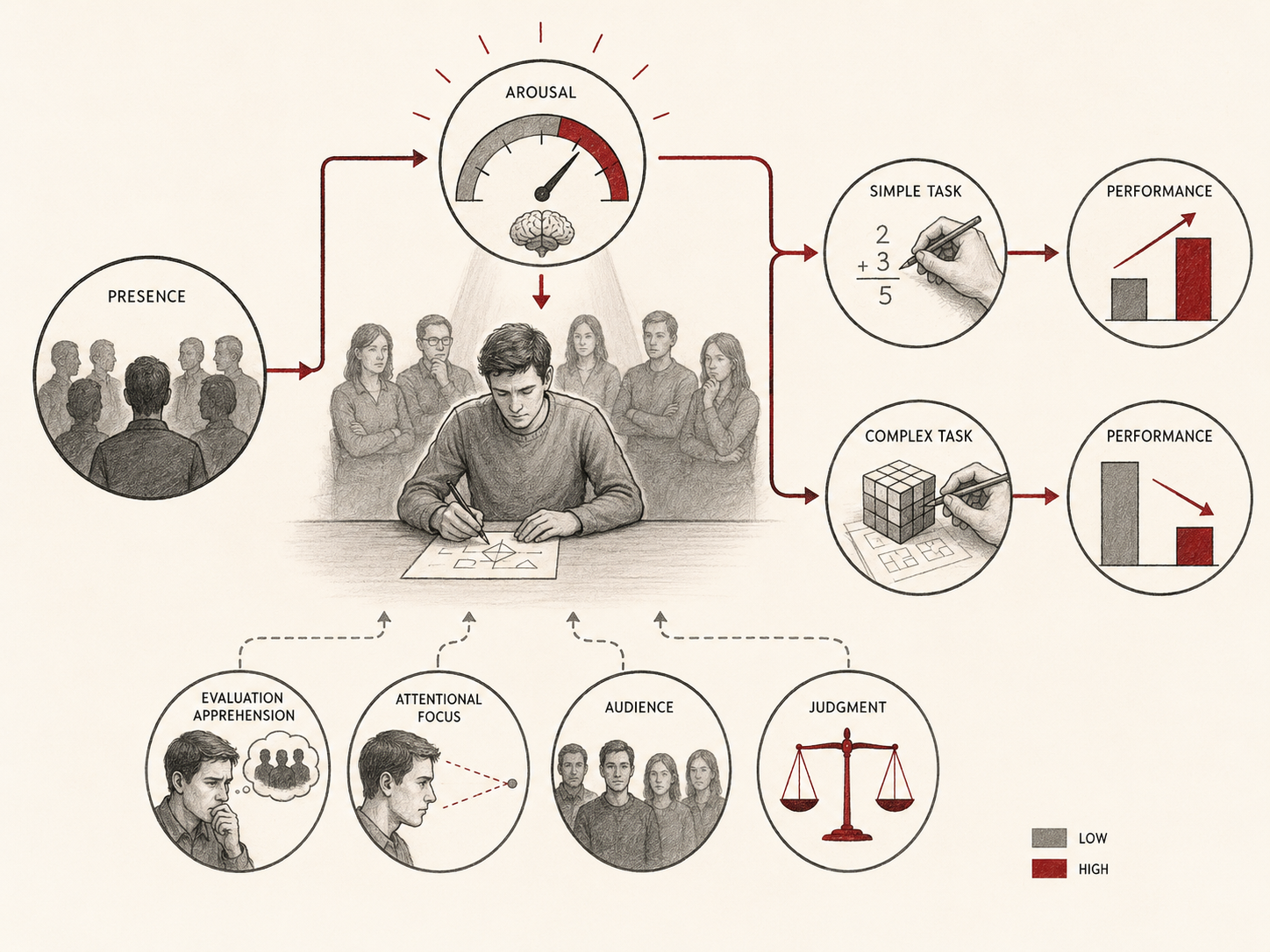
Social facilitation connects directly to social loafing, conformity and social influence, social norms, group polarization, obedience to authority, cognitive load, and attention. Together these concepts show how social presence shapes cognition, motivation, effort, self-monitoring, and performance.
What is social facilitation?
Social facilitation describes the effect of others’ presence on individual performance. The presence of an audience, coactors, observers, evaluators, competitors, or digital monitoring systems can change how a person performs a task. Sometimes performance improves. Sometimes it deteriorates. The direction of the effect depends largely on task difficulty, task mastery, evaluation pressure, attentional demand, and the performer’s dominant response.
The classic formulation is simple: social presence tends to improve performance on simple or well-learned tasks and impair performance on complex or unfamiliar tasks. This is why the phenomenon is sometimes discussed as both social facilitation and social inhibition. The same social condition can facilitate or interfere depending on whether arousal strengthens a correct or incorrect response.
For a simple task, such as a practiced motor action, typing a familiar pattern, performing a rehearsed routine, or executing an automatic skill, the dominant response is often correct. In that case, arousal can sharpen effort, speed, and confidence. For a difficult task, such as solving a novel problem, learning unfamiliar material, making a high-stakes judgment, or performing under cognitive overload, the dominant response may be incomplete or wrong. In that case, arousal can increase error, distraction, and self-consciousness.
Social facilitation therefore shows that social environments do not merely influence opinions. They enter performance itself. The body, attention, and cognition respond to being watched, compared, judged, or accompanied.
Origins of social facilitation research
Social facilitation is among the oldest experimentally studied topics in social psychology. It emerged from late nineteenth-century work on competition, coaction, and performance. The topic became influential because it provided an early empirical demonstration that the social environment can affect measurable behavior.
Early observations suggested that people sometimes perform more strongly when others are present. Cyclists appeared to ride faster when competing with others than when riding alone. Children sometimes worked faster when another child was present. These observations challenged a strictly individual model of performance. Ability, effort, and motivation were not sealed inside the person; they could be activated by the social setting.
Yet the literature soon became complicated. Some studies showed improvement under social presence, while others showed impairment. This inconsistency became the central puzzle. Why would the presence of others sometimes energize performance and sometimes disrupt it?
Zajonc’s mid-twentieth-century drive-theory account gave the field a durable solution: the presence of others increases arousal, and arousal strengthens dominant responses. Whether this improves performance depends on whether the dominant response is correct. Later evaluation-apprehension and distraction-conflict theories refined this account by asking what kind of social presence matters: mere presence, coaction, audience evaluation, comparison pressure, or attentional conflict.
The history of social facilitation therefore shows the development of social psychology itself: from observing group influence, to measuring performance, to formalizing mechanisms of arousal, attention, evaluation, and task structure.
Triplett’s early experiments
Norman Triplett’s 1898 paper, “The Dynamogenic Factors in Pacemaking and Competition,” is widely treated as one of the earliest experimental studies in social psychology. Triplett examined the effects of competition and coaction after observing that cyclists often performed differently when riding with others than when riding alone.
Triplett then conducted an experiment involving children winding fishing reels either alone or in the presence of another child. The study has become famous as an early demonstration that the presence of others can energize performance. Triplett interpreted the effect as a form of “dynamogenic” stimulation, meaning that the presence of another person could activate or release additional energy for performance.
Modern reanalyses have complicated the standard textbook story. Triplett’s original data were more mixed than later summaries sometimes suggest. This caution is important because social facilitation should not be built on a simplified origin myth. Triplett’s work remains historically important, but the strength of social facilitation research comes from the broader research tradition that followed: experimental replications, competing mechanisms, meta-analysis, applied studies, and later work on digital monitoring and social evaluation.
The broader lesson of Triplett’s work remains powerful: the social environment can alter measurable performance. Even when the early evidence was imperfect, the question it opened became foundational.
Zajonc’s drive theory
Robert Zajonc’s 1965 account provided one of the most influential explanations of social facilitation. His drive theory argued that the presence of others increases generalized arousal or drive. Increased drive strengthens dominant responses — the responses most likely to occur in a given situation.
The crucial insight is that arousal does not automatically improve performance. It amplifies what is already dominant. On simple or well-practiced tasks, the dominant response is usually correct. Arousal therefore improves performance. On complex or unfamiliar tasks, the dominant response may be incorrect. Arousal therefore increases errors or interferes with performance.
This account resolved a long-standing inconsistency in the literature. Studies showing performance improvement and studies showing performance impairment were not necessarily contradictory. They could be different expressions of the same mechanism under different task conditions.
Zajonc’s theory also broadened the significance of social facilitation. It suggested that audience effects were not limited to human self-consciousness or explicit evaluation. Social presence could operate through basic arousal mechanisms, with similar patterns appearing in nonhuman animals as well as humans. Whether the process is best explained by mere presence, learned evaluation, or attentional conflict remains debated, but Zajonc’s dominant-response framework remains central.
The drive account is especially useful because it explains why expertise matters. Skilled performers may benefit from an audience because their dominant responses are well trained. Novices may suffer under the same audience because their dominant responses are unstable or wrong.
Dominant responses and task mastery
The concept of the dominant response is the key to understanding social facilitation. A dominant response is the behavior, answer, movement, or mental operation most likely to be produced in a situation. It may be correct or incorrect depending on the task and the performer’s level of mastery.
In a well-learned task, the dominant response has been practiced repeatedly. It is efficient, accessible, and likely to be correct. A musician playing a rehearsed passage, an athlete executing a familiar movement, a typist entering common text, or an experienced worker completing a routine procedure may all benefit from heightened arousal because their dominant response is reliable.
In a complex or unfamiliar task, the dominant response may be a guess, a habit from a different context, a premature solution, a simple but wrong heuristic, or a movement pattern that has not yet been stabilized. Under observation, arousal can make that response more likely, increasing error rather than improving performance.
This is why task difficulty should not be treated as an objective property alone. A task that is easy for an expert may be difficult for a novice. A high-pressure audience may sharpen expert performance but impair early learning. Social facilitation is therefore best understood as an interaction among social presence, arousal, task mastery, cognitive load, and dominant-response correctness.
For research design, this means that studies should measure practice, baseline skill, and task mastery rather than assuming that a task is universally simple or complex. Without measuring mastery, audience effects can be misinterpreted.
Evaluation apprehension theory
Evaluation apprehension theory argues that social facilitation effects often arise not from the mere presence of others, but from concern about being judged. This account is associated especially with Nickolas Cottrell and later research examining whether observers must be capable of evaluating performance in order to affect arousal.
According to this view, people learn that others can reward, punish, approve, disapprove, rank, compare, or embarrass them. When an audience is present, the performer may become concerned about how they will be evaluated. That concern increases arousal and self-monitoring. The effect may be stronger when observers are experts, supervisors, peers, rivals, or people whose judgment has reputational consequences.
Evaluation apprehension helps explain why some audiences matter more than others. A blindfolded or inattentive audience may produce weaker effects than a judging audience. A supervisor may produce more arousal than a stranger. A high-status evaluator may produce more pressure than a casual co-present person. Digital monitoring may produce evaluative pressure even when no physical audience is present.
This theory also connects social facilitation to broader themes in social psychology: impression management, reputation, social anxiety, status, authority, and accountability. Being watched is not only sensory. It is social. The performer interprets the audience as a potential judge.
In applied settings, evaluation apprehension can be productive or harmful. Moderate evaluative pressure may motivate preparation and focus. Excessive scrutiny may impair complex reasoning, creativity, learning, and psychological safety.
Distraction-conflict theory
Distraction-conflict theory explains social facilitation through attentional conflict. The presence of others can divide attention between the task and the social environment. The performer may attend to the work, the audience, the possibility of evaluation, social comparison, self-presentation, or signs of approval and disapproval. This divided attention creates conflict.
Robert Baron’s account treats distraction as a source of increased drive. On simple tasks, this increased drive can improve performance because the correct response is dominant and does not require much working memory. On complex tasks, distraction consumes attentional capacity and impairs performance because the task requires controlled processing.
The theory is especially useful for cognitive and organizational settings. Many modern tasks require sustained attention: coding, writing, planning, design, analysis, diagnosis, policy review, editing, mathematical reasoning, and complex decision-making. In these tasks, observation can interfere by increasing self-monitoring and reducing available cognitive capacity.
Distraction-conflict theory also helps explain why coaction can matter. A coactor performing a similar task may trigger comparison. The performer may wonder how fast the other person is working, whether they are falling behind, or how their own performance will be judged. Even without explicit evaluation, social comparison can become distracting.
The applied lesson is straightforward: observation is not always accountability. Sometimes it is cognitive interference. High-visibility environments may improve routine output while degrading deep work, learning, and complex judgment.
Mere presence, coaction, and audience effects
Social facilitation research distinguishes several forms of social presence. These forms overlap, but they are analytically different.
Mere presence refers to the presence of others without obvious evaluation or interaction. The question is whether simple co-presence is enough to increase arousal and alter performance.
Coaction refers to situations in which other people are performing the same or similar task at the same time. Coaction can introduce comparison, pacing, competition, imitation, or shared rhythm.
Audience effects refer to situations in which others observe the performer. Audiences may be silent, supportive, hostile, expert, inattentive, evaluative, or anonymous.
Evaluation pressure occurs when the performer believes their behavior will be judged, scored, recorded, ranked, or used for decisions.
Digital monitoring extends audience effects into technological systems. Dashboards, cameras, screen tracking, productivity analytics, live metrics, shared documents, and remote work platforms can create the experience of being watched without a visible observer.
These distinctions matter because different mechanisms may operate in each case. Mere presence may increase arousal. Coaction may create comparison. Audiences may create self-presentation pressure. Evaluation may create apprehension. Digital monitoring may combine accountability, surveillance, feedback, and loss of control.
A research-grade account should avoid treating all forms of “others present” as identical. The social meaning of presence determines the psychological mechanism.
Formalizing social facilitation
Social facilitation can be modeled as an interaction among social presence, arousal, task difficulty, task mastery, and dominant-response correctness. Let performance be \(P_i\), baseline skill be \(S_i\), task mastery be \(M_i\), task difficulty be \(D_t\), and social presence be \(O_t\):
P_i=f(S_i,M_i,D_t,O_t)
\]
Interpretation: Performance depends on the performer’s skill, mastery, task difficulty, and social context.
In a drive-theory formulation, social presence and evaluation pressure increase arousal:
A_{i,t}=A_{0,i}+\alpha O_t+\gamma E_t
\]
Interpretation: Arousal \(A\) rises above baseline when others are present \(O\) and when evaluation pressure \(E\) is high.
Arousal strengthens the dominant response:
R’_{d,i,t}=R_{d,i,t}+\beta A_{i,t}
\]
Interpretation: The dominant response becomes more likely as arousal increases.
If the dominant response is correct, performance improves; if it is incorrect, performance declines. This can be written as:
P_{i,t}=S_i+\beta_1A_{i,t}C_{i,t}-\beta_2A_{i,t}(1-C_{i,t})-\beta_3D_t
\]
Interpretation: Arousal improves performance when the dominant response is correct \(C=1\), but impairs performance when the dominant response is incorrect \(C=0\).
Evaluation apprehension can be represented as perceived scrutiny:
E_t=\lambda_1J_t+\lambda_2H_t+\lambda_3V_t+\lambda_4R_t
\]
Interpretation: Evaluation pressure increases with perceived judgment \(J\), observer status or expertise \(H\), visibility \(V\), and reputational stakes \(R\).
Distraction-conflict theory can be represented as a reduction in effective attentional capacity:
C^*_{i,t}=C_i-\delta_1O_t-\delta_2E_t-\delta_3Q_t
\]
Interpretation: Effective cognitive capacity declines as social presence, evaluation pressure, and comparison pressure \(Q\) increase.
A response-time model can incorporate arousal and attentional conflict:
\log(RT_{i,t})=\theta_0+\theta_1D_t-\theta_2M_i+\theta_3K_{i,t}+\theta_4E_t
\]
Interpretation: Response time increases with task difficulty \(D\), attentional conflict \(K\), and evaluation pressure \(E\), but decreases with task mastery \(M\).
These formalizations clarify why social facilitation is not a single main effect. It is an interaction. Social presence changes arousal and attention, but performance depends on whether the task can benefit from that arousal.
Task difficulty, skill, and performance outcomes
The central empirical prediction of social facilitation is that task difficulty and skill level moderate the effect of social presence. The presence of others is most likely to improve performance when the task is simple, familiar, practiced, automatic, or low in cognitive demand. It is most likely to impair performance when the task is complex, novel, high-stakes, unfamiliar, or attentionally demanding.
This explains why audiences can energize athletes, musicians, public speakers, and skilled performers when routines are well practiced. It also explains why observation can impair novices, students learning new material, workers performing complex analysis, or individuals facing unfamiliar problem-solving tasks.
Performance outcomes may include:
- speed;
- accuracy;
- error rate;
- reaction time;
- completion time;
- fluency;
- quality ratings;
- physiological arousal;
- persistence;
- self-reported anxiety;
- post-task confidence.
Researchers should not rely only on a single score. Social presence may improve speed while increasing errors, increase effort while reducing creativity, or raise accuracy on routine items while impairing performance on transfer items. A strong design separates quantity, quality, speed, and cognitive load.
Task difficulty should also be measured empirically. A task labeled “simple” by the researcher may not be simple for all participants. Baseline skill and prior practice should be included in the model so that the analysis captures the interaction between social presence and mastery.
Arousal, attention, and response time
Social facilitation research often treats arousal as a central mechanism. Arousal may be physiological, emotional, cognitive, or motivational. It can be measured through self-report, heart rate, skin conductance, pupil dilation, response time, subjective tension, or behavioral indicators of effort.
However, arousal alone is not enough to explain all social facilitation effects. The quality of attention matters. A performer under observation may become more focused on the task, or more focused on the audience. They may experience motivating energy, or disruptive self-consciousness. They may benefit from accountability, or suffer from attentional fragmentation.
Response time is especially useful because it can reveal underlying processing changes. On routine tasks, social presence may reduce response time because arousal accelerates dominant responses. On complex tasks, social presence may increase response time because attention is divided or because the performer checks, hesitates, and self-monitors.
Physiological measures should therefore be interpreted alongside task difficulty and performance. High arousal is not inherently good or bad. Its effect depends on whether the task requires automatic execution or controlled processing.
For modern research, multimodal designs are useful: behavioral performance, response time, self-reported scrutiny, perceived evaluation, physiological arousal, and error patterns can be analyzed together to distinguish drive, evaluation, and distraction accounts.
Sport, performance, and practiced skill
Sport provides one of the clearest applied contexts for social facilitation. Athletes often perform in front of audiences, competitors, coaches, judges, cameras, and teammates. These audiences can energize practiced skill, but they can also create pressure, choking, hesitation, or excessive self-monitoring.
The social facilitation framework helps explain why experienced athletes may thrive under crowd conditions while novices may struggle. For highly practiced movements, arousal can strengthen execution. For unfamiliar movements or high-pressure corrections, arousal can interfere with fine motor control and decision-making.
Audience valence matters. A supportive audience may increase confidence and effort. A hostile or critical audience may increase evaluation pressure and threat. Observer expertise also matters. Being watched by a coach, judge, recruiter, or elite peer may produce different effects than being watched by casual spectators.
Sport settings also illustrate why performance is multidimensional. An audience may improve speed but impair precision. It may increase aggression but reduce strategic judgment. It may raise effort while increasing risk-taking. Social facilitation should therefore be analyzed in relation to the specific performance outcome that matters.
The broader lesson extends beyond sport: social presence can optimize performance when the task is practiced and the performer has sufficient control, but impair performance when the environment overwhelms attention or destabilizes execution.
Education, testing, and public performance
Educational environments are full of social facilitation dynamics. Students perform before teachers, peers, test proctors, cameras, online platforms, and grading systems. These conditions can motivate preparation and effort, but they can also increase anxiety, stereotype threat, self-consciousness, and cognitive load.
Public performance can benefit students when the task is rehearsed: presenting a practiced speech, reciting known material, demonstrating a mastered procedure, or participating in structured practice. But public evaluation can impair learning when students are still forming understanding, experimenting with mistakes, or working through complex problems.
This distinction matters for pedagogy. Classrooms need both performance spaces and learning spaces. Performance spaces can build confidence and accountability after practice. Learning spaces should protect experimentation, error, revision, and uncertainty. If students are constantly evaluated publicly, complex learning may suffer.
Social facilitation also matters for testing. High-stakes testing environments increase evaluation pressure. For well-learned material, this may sharpen performance. For unfamiliar or high-load problems, it may increase error and response time. Test design should therefore consider not only content difficulty but also social and evaluative conditions.
The educational lesson is not to remove all observation. It is to match observation to learning stage. Early learning often needs psychological safety; mastery demonstration can benefit from structured visibility.
Institutional and organizational implications
Organizations often use observation to increase accountability: performance reviews, dashboards, open offices, meetings, audits, productivity tracking, presentations, team standups, peer comparison, and managerial oversight. Social facilitation explains why these practices can have mixed effects.
Observation can improve routine performance. Workers may complete familiar tasks faster when output is visible. Teams may sustain effort when deadlines, peers, or supervisors are present. Public commitments can reduce procrastination. Accountability can focus attention.
But observation can impair complex work. Strategic planning, writing, research, diagnosis, technical troubleshooting, design, coding, policy analysis, and ethical judgment often require deep attention. Excessive visibility can increase self-monitoring and reduce cognitive capacity. It may push workers toward performative productivity rather than careful thought.
The organizational implication is that visibility should be designed selectively. Routine, well-defined tasks may benefit from transparent metrics. Complex, creative, or high-uncertainty tasks may require protected time, privacy, and reduced evaluative pressure. Institutions that treat all work as equally monitorable risk confusing visibility with effectiveness.
Social facilitation also clarifies why open offices and constant collaboration can be double-edged. Co-presence can increase energy and coordination, but it can also create distraction, comparison pressure, and reduced autonomy.
A mature organization should distinguish between accountability that supports performance and surveillance that degrades judgment.
Social facilitation in digital environments
Digital environments create new forms of social presence. A person may feel observed through cameras, screen sharing, shared documents, live dashboards, version histories, performance analytics, online classrooms, multiplayer environments, remote work tools, livestreams, and social media metrics. The audience may be invisible, asynchronous, algorithmic, or unknown.
Digital monitoring can reproduce many mechanisms of social facilitation. It can increase perceived scrutiny, evaluation apprehension, arousal, comparison pressure, and self-monitoring. It can also provide feedback, accountability, and social support. The effect depends on how monitoring is designed and interpreted.
Several digital conditions are especially important:
- whether the person knows they are being monitored;
- whether monitoring is used for learning, support, ranking, discipline, or surveillance;
- whether the performer has control over visibility;
- whether feedback is immediate or delayed;
- whether metrics capture meaningful performance or shallow activity;
- whether monitoring is perceived as fair and legitimate;
- whether observers are peers, supervisors, instructors, clients, or the public.
Digital social facilitation is especially relevant for remote work and online learning. A camera-on meeting, a shared coding session, or a live collaborative document can energize engagement, but it can also increase anxiety and reduce deep cognitive work. The same tool can facilitate routine coordination and impair complex thought.
The key design question is not whether digital visibility increases effort. It often does. The deeper question is whether the effort is directed toward meaningful performance, defensive self-presentation, or performative compliance.
Ethics of observation, monitoring, and evaluation
Social facilitation research has ethical implications because observation changes behavior. Institutions that observe, rank, record, or monitor people are not merely measuring performance. They are altering the psychological conditions under which performance occurs.
This matters in workplaces, schools, clinics, platforms, prisons, factories, call centers, warehouses, and remote-work environments. Monitoring can improve safety, accountability, and quality. It can also produce stress, anxiety, self-censorship, reduced autonomy, and distorted behavior.
Ethical observation should meet several standards:
- people should know when they are being monitored;
- monitoring should be proportionate to legitimate goals;
- metrics should measure meaningful performance rather than shallow activity;
- people should have channels to contest errors or unfair evaluation;
- monitoring should not be used to punish normal learning errors;
- complex work should not be judged only by visible activity;
- surveillance should not replace trust, training, or good management;
- privacy and dignity should be protected.
Social facilitation shows why these standards matter. Observation can change arousal, attention, and behavior. When institutions ignore that fact, they may misread performance data as if it were neutral evidence of ability. In reality, performance under observation is performance under a specific social condition.
Social facilitation in the architecture of social influence
Within the broader architecture of social influence, social facilitation is foundational because it shows that social presence can affect behavior before explicit persuasion, conformity, obedience, or group decision-making occurs. The mere fact of being with others, watched by others, compared to others, or evaluated by others can change performance.
Conformity describes how people align judgments or behavior with group expectations. Social norms describe shared expectations that regulate behavior. Social loafing explains reduced individual effort in group tasks when accountability is diffuse. Group polarization shows how discussion can intensify attitudes. Social facilitation operates at a more basic performance level: the social environment changes arousal, attention, and dominant responses.
This makes social facilitation a bridge between social psychology and cognitive psychology. It connects audience presence to attention, arousal, response selection, task difficulty, working memory, and error. It also connects individual performance to institutions that structure visibility and evaluation.
Seen this way, social facilitation is not only a laboratory phenomenon. It is one of the basic mechanisms through which social environments enter performance systems.
Interpretive cautions and limits
Social facilitation is a powerful framework, but it should not be overgeneralized. The presence of others does not automatically improve performance, and it does not automatically impair performance. Effects depend on task structure, mastery, perceived evaluation, audience meaning, social anxiety, attentional demand, and institutional context.
Several cautions are important:
- Do not treat all audiences as psychologically equivalent.
- Do not assume that visibility improves quality.
- Do not confuse effort with effective performance.
- Do not ignore task difficulty and prior mastery.
- Do not reduce all audience effects to evaluation apprehension.
- Do not assume digital monitoring is neutral measurement.
- Do not apply findings from simple laboratory tasks directly to complex organizational work without caution.
- Do not treat impaired performance under observation as evidence of low ability.
- Do not ignore social anxiety, stereotype threat, status, power, or prior experience with evaluation.
Social facilitation is best understood as a conditional phenomenon. It identifies how social presence changes arousal and attention, but the consequences depend on the performer, task, audience, and institution.
The strongest use of the concept is diagnostic: what kind of performance is being observed, what kind of social presence is involved, what kind of evaluation is expected, and whether the task benefits from arousal or requires protected cognitive control.
Measurement, data, and research design
Social facilitation research uses laboratory experiments, coaction tasks, audience-observation designs, field studies, sport-performance settings, workplace monitoring studies, online learning experiments, digital collaboration studies, response-time analysis, physiological measurement, and mixed-effects modeling.
Key variables include:
- participant and session identifiers;
- audience condition;
- coaction condition;
- evaluation pressure;
- observer expertise;
- audience size;
- audience valence;
- task domain;
- task difficulty;
- task mastery;
- dominant-response correctness;
- baseline skill;
- arousal index;
- distraction index;
- attentional conflict;
- perceived scrutiny;
- performance score;
- accuracy;
- error rate;
- response time;
- digital monitoring;
- social anxiety.
Strong research designs should include both objective and subjective measures of social presence. A participant may be objectively observed but not feel evaluated, or may feel highly scrutinized even when no visible audience is present. Digital environments make this distinction especially important.
Studies should also include baseline skill and task mastery. The same task may be easy for one participant and hard for another. Without measuring mastery, audience effects can be wrongly interpreted as general facilitation or inhibition.
Finally, researchers should model interactions. The key hypothesis is not simply that audiences affect performance. It is that social presence interacts with task difficulty, mastery, perceived evaluation, arousal, and attentional conflict.
R code for social facilitation research
The following R workflow models performance, accuracy, error, arousal, and response time as functions of social presence, task difficulty, task mastery, evaluation pressure, perceived scrutiny, arousal, distraction, dominant-response correctness, and digital monitoring.
# Install packages if needed:
# pak::pak(c("tidyverse", "lme4", "lmerTest", "emmeans", "broom.mixed", "performance"))

library(tidyverse)
library(lme4)
library(lmerTest)
library(emmeans)
library(broom.mixed)
library(performance)

# Expected columns:
# participant, session_id, site_id, condition, task_domain, trial,
# audience_present, coaction_present, evaluation_pressure,
# observer_expertise, audience_size, audience_valence,
# task_difficulty, task_mastery, dominant_response_correct,
# baseline_skill, arousal_index, distraction_index,
# attentional_conflict, perceived_scrutiny, performance_score,
# accuracy, error_rate, response_time_ms, digital_monitoring,
# social_anxiety

dat <- read_csv("social_facilitation_trials.csv") %>%
  mutate(
    participant = factor(participant),
    session_id = factor(session_id),
    site_id = factor(site_id),
    condition = factor(condition),
    task_domain = factor(task_domain),
    audience_present = as.integer(audience_present),
    coaction_present = as.integer(coaction_present),
    digital_monitoring = as.integer(digital_monitoring),
    dominant_response_correct = as.integer(dominant_response_correct),
    social_presence_intensity = audience_present +
      0.65 * coaction_present +
      0.50 * digital_monitoring,
    mastery_advantage = task_mastery - task_difficulty,
    simple_or_mastered = as.integer(mastery_advantage >= 1.0),
    complex_or_unmastered = as.integer(mastery_advantage < 0.0),
    evaluation_apprehension_index = (
      evaluation_pressure +
      perceived_scrutiny +
      observer_expertise +
      social_anxiety
    ) / 4,
    distraction_conflict_index = (
      distraction_index +
      attentional_conflict +
      perceived_scrutiny
    ) / 3,
    log_response_time = log(response_time_ms)
  )

# -----------------------------
# 1. Descriptive summary
# -----------------------------

summary_table <- dat %>%
  group_by(condition, task_domain) %>%
  summarise(
    n = n(),
    participants = n_distinct(participant),
    mean_performance = mean(performance_score, na.rm = TRUE),
    mean_accuracy = mean(accuracy, na.rm = TRUE),
    mean_error_rate = mean(error_rate, na.rm = TRUE),
    mean_response_time = mean(response_time_ms, na.rm = TRUE),
    mean_arousal = mean(arousal_index, na.rm = TRUE),
    mean_distraction = mean(distraction_index, na.rm = TRUE),
    mean_evaluation = mean(evaluation_pressure, na.rm = TRUE),
    mean_task_difficulty = mean(task_difficulty, na.rm = TRUE),
    mean_task_mastery = mean(task_mastery, na.rm = TRUE),
    mean_social_presence = mean(social_presence_intensity, na.rm = TRUE),
    .groups = "drop"
  )

print(summary_table)

# -----------------------------
# 2. Performance model
# -----------------------------

performance_model <- lmer(
  performance_score ~
    social_presence_intensity * task_difficulty +
    social_presence_intensity * task_mastery +
    evaluation_pressure +
    perceived_scrutiny +
    arousal_index +
    distraction_conflict_index +
    dominant_response_correct +
    baseline_skill +
    audience_valence +
    condition +
    task_domain +
    (1 + social_presence_intensity | participant) +
    (1 | site_id),
  data = dat,
  REML = FALSE
)

summary(performance_model)
emmeans(performance_model, ~ social_presence_intensity | task_difficulty)

# -----------------------------
# 3. Accuracy and error models
# -----------------------------

accuracy_model <- lmer(
  accuracy ~
    social_presence_intensity * task_difficulty +
    social_presence_intensity * task_mastery +
    evaluation_pressure +
    arousal_index +
    attentional_conflict +
    dominant_response_correct +
    baseline_skill +
    condition +
    task_domain +
    (1 | participant) +
    (1 | site_id),
  data = dat,
  REML = FALSE
)

error_model <- lmer(
  error_rate ~
    social_presence_intensity * task_difficulty +
    evaluation_pressure +
    arousal_index +
    distraction_conflict_index +
    dominant_response_correct +
    task_mastery +
    social_anxiety +
    condition +
    task_domain +
    (1 | participant) +
    (1 | site_id),
  data = dat,
  REML = FALSE
)

summary(accuracy_model)
summary(error_model)

# -----------------------------
# 4. Arousal model
# -----------------------------

arousal_model <- lmer(
  arousal_index ~
    audience_present +
    coaction_present +
    digital_monitoring +
    evaluation_pressure +
    perceived_scrutiny +
    observer_expertise +
    audience_size +
    audience_valence +
    social_anxiety +
    condition +
    (1 | participant) +
    (1 | site_id),
  data = dat,
  REML = FALSE
)

summary(arousal_model)

# -----------------------------
# 5. Response-time model
# -----------------------------

rt_model <- lmer(
  log_response_time ~
    social_presence_intensity * task_difficulty +
    task_mastery +
    evaluation_pressure +
    perceived_scrutiny +
    attentional_conflict +
    arousal_index +
    condition +
    task_domain +
    (1 | participant) +
    (1 | site_id),
  data = dat %>% filter(response_time_ms >= 150),
  REML = FALSE
)

summary(rt_model)

# -----------------------------
# 6. Difficulty-band summary
# -----------------------------

difficulty_summary <- dat %>%
  mutate(
    difficulty_band = cut(
      task_difficulty,
      breaks = c(-0.1, 3.33, 6.66, 10.1),
      labels = c("low", "medium", "high")
    )
  ) %>%
  group_by(condition, difficulty_band) %>%
  summarise(
    n = n(),
    mean_performance = mean(performance_score, na.rm = TRUE),
    mean_accuracy = mean(accuracy, na.rm = TRUE),
    mean_response_time = mean(response_time_ms, na.rm = TRUE),
    mean_arousal = mean(arousal_index, na.rm = TRUE),
    mean_scrutiny = mean(perceived_scrutiny, na.rm = TRUE),
    .groups = "drop"
  )

print(difficulty_summary)

# -----------------------------
# 7. Export outputs
# -----------------------------

write_csv(summary_table, "social_facilitation_summary.csv")
write_csv(difficulty_summary, "social_facilitation_difficulty_summary.csv")

write_csv(
  tidy(performance_model, effects = "fixed", conf.int = TRUE),
  "social_facilitation_performance_coefficients.csv"
)

write_csv(
  tidy(accuracy_model, effects = "fixed", conf.int = TRUE),
  "social_facilitation_accuracy_coefficients.csv"
)

write_csv(
  tidy(arousal_model, effects = "fixed", conf.int = TRUE),
  "social_facilitation_arousal_coefficients.csv"
)

# -----------------------------
# 8. Visualization
# -----------------------------

ggplot(
  difficulty_summary,
  aes(x = difficulty_band, y = mean_performance, color = condition, group = condition)
) +
  geom_line() +
  geom_point() +
  labs(
    title = "Social facilitation by task difficulty",
    x = "Task difficulty band",
    y = "Mean performance score"
  ) +
  theme_minimal()
This workflow tests the central social-facilitation prediction: social presence should improve performance when mastery is high and task difficulty is low, but impair performance when mastery is low and task difficulty is high.
Python code for social facilitation research
The Python workflow below parallels the R analysis and adds a drive-theory simulation. It is useful for modeling how social presence, evaluation pressure, arousal, dominant-response correctness, task mastery, and task difficulty jointly affect performance.
import numpy as np
import pandas as pd
import statsmodels.formula.api as smf
import statsmodels.api as sm
import matplotlib.pyplot as plt

# Expected columns:
# participant, session_id, site_id, condition, task_domain, trial,
# audience_present, coaction_present, evaluation_pressure,
# observer_expertise, audience_size, audience_valence,
# task_difficulty, task_mastery, dominant_response_correct,
# baseline_skill, arousal_index, distraction_index,
# attentional_conflict, perceived_scrutiny, performance_score,
# accuracy, error_rate, response_time_ms, digital_monitoring,
# social_anxiety

df = pd.read_csv("social_facilitation_trials.csv")

for col in [
    "participant",
    "session_id",
    "site_id",
    "condition",
    "task_domain"
]:
    df[col] = df[col].astype("category")

df["social_presence_intensity"] = (
    df["audience_present"]
    + 0.65 * df["coaction_present"]
    + 0.50 * df["digital_monitoring"]
)

df["mastery_advantage"] = (
    df["task_mastery"]
    - df["task_difficulty"]
)

df["simple_or_mastered"] = (
    df["mastery_advantage"] >= 1.0
).astype(int)

df["complex_or_unmastered"] = (
    df["mastery_advantage"] < 0.0
).astype(int)

df["evaluation_apprehension_index"] = (
    df["evaluation_pressure"]
    + df["perceived_scrutiny"]
    + df["observer_expertise"]
    + df["social_anxiety"]
) / 4

df["distraction_conflict_index"] = (
    df["distraction_index"]
    + df["attentional_conflict"]
    + df["perceived_scrutiny"]
) / 3

df["log_response_time"] = np.log(df["response_time_ms"])

# -----------------------------
# 1. Descriptive summary
# -----------------------------

summary_table = (
    df.groupby(["condition", "task_domain"], observed=True)
    .agg(
        n=("participant", "size"),
        participants=("participant", "nunique"),
        mean_performance=("performance_score", "mean"),
        mean_accuracy=("accuracy", "mean"),
        mean_error_rate=("error_rate", "mean"),
        mean_response_time=("response_time_ms", "mean"),
        mean_arousal=("arousal_index", "mean"),
        mean_distraction=("distraction_index", "mean"),
        mean_evaluation=("evaluation_pressure", "mean"),
        mean_task_difficulty=("task_difficulty", "mean"),
        mean_task_mastery=("task_mastery", "mean"),
        mean_social_presence=("social_presence_intensity", "mean"),
    )
    .reset_index()
)

print(summary_table)

# -----------------------------
# 2. Performance model
# -----------------------------

performance_model = smf.ols(
    "performance_score ~ social_presence_intensity * task_difficulty "
    "+ social_presence_intensity * task_mastery "
    "+ evaluation_pressure + perceived_scrutiny "
    "+ arousal_index + distraction_conflict_index "
    "+ dominant_response_correct + baseline_skill "
    "+ audience_valence + condition + task_domain",
    data=df,
)

performance_result = performance_model.fit(
    cov_type="cluster",
    cov_kwds={"groups": df["participant"]},
)

print(performance_result.summary())

# -----------------------------
# 3. Accuracy and error models
# -----------------------------

accuracy_model = smf.ols(
    "accuracy ~ social_presence_intensity * task_difficulty "
    "+ social_presence_intensity * task_mastery "
    "+ evaluation_pressure + arousal_index "
    "+ attentional_conflict + dominant_response_correct "
    "+ baseline_skill + condition + task_domain",
    data=df,
)

accuracy_result = accuracy_model.fit(
    cov_type="cluster",
    cov_kwds={"groups": df["participant"]},
)

print(accuracy_result.summary())

error_model = smf.ols(
    "error_rate ~ social_presence_intensity * task_difficulty "
    "+ evaluation_pressure + arousal_index "
    "+ distraction_conflict_index + dominant_response_correct "
    "+ task_mastery + social_anxiety "
    "+ condition + task_domain",
    data=df,
)

error_result = error_model.fit(
    cov_type="cluster",
    cov_kwds={"groups": df["participant"]},
)

print(error_result.summary())

# -----------------------------
# 4. Arousal and response-time models
# -----------------------------

arousal_model = smf.ols(
    "arousal_index ~ audience_present + coaction_present "
    "+ digital_monitoring + evaluation_pressure "
    "+ perceived_scrutiny + observer_expertise "
    "+ audience_size + audience_valence "
    "+ social_anxiety + condition",
    data=df,
)

arousal_result = arousal_model.fit(
    cov_type="cluster",
    cov_kwds={"groups": df["participant"]},
)

print(arousal_result.summary())

rt_df = df[df["response_time_ms"] >= 150].copy()

response_time_model = smf.ols(
    "log_response_time ~ social_presence_intensity * task_difficulty "
    "+ task_mastery + evaluation_pressure "
    "+ perceived_scrutiny + attentional_conflict "
    "+ arousal_index + condition + task_domain",
    data=rt_df,
)

response_time_result = response_time_model.fit(
    cov_type="cluster",
    cov_kwds={"groups": rt_df["participant"]},
)

print(response_time_result.summary())

# -----------------------------
# 5. Drive-theory simulation
# -----------------------------

def simulate_drive_theory(n_cases=5000, seed=42):
    rng = np.random.default_rng(seed)
    rows = []

    for condition in [
        "alone",
        "mere_presence",
        "evaluation",
        "digital_monitoring"
    ]:
        for _ in range(n_cases):
            baseline_skill = rng.uniform(0, 10)
            task_difficulty = rng.uniform(0, 10)

            task_mastery = np.clip(
                baseline_skill
                + rng.normal(0, 1.2)
                - 0.25 * task_difficulty,
                0,
                10
            )

            dominant_correct = int(task_mastery >= task_difficulty)

            social_presence = {
                "alone": 0.0,
                "mere_presence": 1.0,
                "evaluation": 1.4,
                "digital_monitoring": 1.1
            }[condition]

            evaluation_pressure = {
                "alone": 0.3,
                "mere_presence": 2.0,
                "evaluation": 8.0,
                "digital_monitoring": 7.0
            }[condition]

            arousal = np.clip(
                2.0
                + 0.8 * social_presence
                + 0.55 * evaluation_pressure
                + rng.normal(0, 0.9),
                0,
                10
            )

            performance = np.clip(
                55
                + 3.0 * baseline_skill
                + 2.0 * task_mastery
                - 2.0 * task_difficulty
                + 2.0 * arousal * dominant_correct
                - 2.2 * arousal * (1 - dominant_correct)
                + rng.normal(0, 5),
                0,
                100
            )

            rows.append({
                "condition": condition,
                "baseline_skill": baseline_skill,
                "task_difficulty": task_difficulty,
                "task_mastery": task_mastery,
                "dominant_response_correct": dominant_correct,
                "social_presence": social_presence,
                "evaluation_pressure": evaluation_pressure,
                "arousal": arousal,
                "performance": performance,
            })

    simulation = pd.DataFrame(rows)

    simulation["difficulty_band"] = pd.cut(
        simulation["task_difficulty"],
        bins=[-0.1, 3.33, 6.66, 10.1],
        labels=["low", "medium", "high"]
    )

    simulation_summary = (
        simulation.groupby(["condition", "difficulty_band"], observed=True)
        .agg(
            n=("performance", "size"),
            mean_performance=("performance", "mean"),
            mean_arousal=("arousal", "mean"),
            dominant_correct_rate=("dominant_response_correct", "mean"),
        )
        .reset_index()
    )

    return simulation, simulation_summary

simulation, simulation_summary = simulate_drive_theory()

print(simulation_summary)

# -----------------------------
# 6. Visualization
# -----------------------------

difficulty_summary = (
    df.assign(
        difficulty_band=pd.cut(
            df["task_difficulty"],
            bins=[-0.1, 3.33, 6.66, 10.1],
            labels=["low", "medium", "high"]
        )
    )
    .groupby(["condition", "difficulty_band"], observed=True)
    .agg(mean_performance=("performance_score", "mean"))
    .reset_index()
)

fig, ax = plt.subplots(figsize=(8, 5))

for condition, group in difficulty_summary.groupby("condition", observed=True):
    ax.plot(
        group["difficulty_band"].astype(str),
        group["mean_performance"],
        marker="o",
        label=condition
    )

ax.set_xlabel("Task difficulty band")
ax.set_ylabel("Mean performance score")
ax.set_title("Social facilitation by task difficulty")
ax.legend()
plt.tight_layout()
plt.show()

# -----------------------------
# 7. Export summaries
# -----------------------------

summary_table.to_csv("social_facilitation_summary.csv", index=False)
difficulty_summary.to_csv("social_facilitation_difficulty_summary.csv", index=False)
simulation.to_csv("drive_theory_simulation.csv", index=False)
simulation_summary.to_csv("drive_theory_simulation_summary.csv", index=False)
This Python workflow supports experimental and simulation-based social facilitation research. It estimates the effects of audience presence, evaluation pressure, digital monitoring, task difficulty, task mastery, arousal, and distraction on performance, accuracy, error, and response time.
Research data architecture
Social facilitation research often depends on relational data: participants, sessions, sites, task domains, audience conditions, coaction conditions, evaluation pressure, observer expertise, audience size, audience valence, task difficulty, task mastery, dominant-response correctness, baseline skill, arousal, distraction, attentional conflict, perceived scrutiny, performance, accuracy, error rate, response time, digital monitoring, and social anxiety. Rather than embedding executable database code directly in the WordPress article body, the companion GitHub repository includes the full SQL schema and example queries for researchers who want to reproduce or extend the data model.
The research data model is designed to support questions such as:
- Does audience presence improve performance on mastered tasks?
- Does audience presence impair performance on difficult tasks?
- Does evaluation pressure predict arousal beyond mere presence?
- Does perceived scrutiny mediate audience effects?
- Does task mastery moderate social facilitation?
- Does digital monitoring produce evaluation-apprehension effects?
- Does audience valence affect performance differently for simple and complex tasks?
- Does attentional conflict explain slower response times?
- Do socially anxious participants show stronger audience effects?
The GitHub repository contains the full database schema, example analytical queries, validation logic, and reproducible data workflow. Keeping executable SQL in GitHub avoids WordPress hosting restrictions while preserving the research-grade infrastructure for readers who want to inspect or reuse the model.
View the SQL research data architecture in GitHub.
GitHub repository
The companion repository provides reusable code and research scaffolding for studying social facilitation, including workflows for audience effects, coaction, evaluation apprehension, distraction-conflict, task difficulty, task mastery, arousal, performance, accuracy, error, response time, digital monitoring, and applied performance environments.
Complete Code Repository
Access the full companion repository for this article, including reproducible analysis materials and multi-language code workflows for social facilitation research.
Why social facilitation matters
Social facilitation matters because it shows that human performance is socially situated. People do not perform in isolation from observers, peers, evaluators, audiences, dashboards, cameras, or reputational systems. The presence of others changes arousal, attention, and dominant responses, sometimes sharpening performance and sometimes impairing it.
The concept also matters because it warns against simplistic assumptions about visibility. More observation does not always mean better work. Audiences can energize practiced skill, but they can disrupt learning, reasoning, creativity, and complex judgment. Evaluation can motivate, but it can also produce anxiety and self-monitoring. Digital monitoring can increase accountability, but it can also distort behavior and reduce trust.
The strongest lesson is conditional: social presence improves performance when the task is mastered and the dominant response is correct; it impairs performance when the task is complex, unfamiliar, or attentionally demanding. Institutions that understand this distinction can design better classrooms, workplaces, digital systems, performance environments, and accountability structures.
Read alongside social loafing, conformity, social norms, cognitive load, attention, and Institutions & Governance, social facilitation becomes more than a performance effect. It becomes a framework for understanding how social visibility enters cognition, motivation, and institutional life.
Related articles
- Social Psychology
- Social Loafing in Social Psychology
- Conformity and Social Influence
- Social Norms in Social Psychology
- Group Polarization in Social Psychology
- Groupthink in Social Psychology
- Obedience to Authority in Social Psychology
- Cognitive Load and Information Processing
- Attention in Cognitive Psychology
- Cognitive Psychology
- Institutions & Governance
Further reading
- Aiello, J.R. and Douthitt, E.A. (2001) ‘Social facilitation from Triplett to electronic performance monitoring’, Group Dynamics: Theory, Research, and Practice, 5(3), pp. 163–180. Publication listing available at: https://sites.rutgers.edu/john-aiello/publications/social/.
- American Psychological Association (2018) ‘Social interference’, APA Dictionary of Psychology. Available at: https://dictionary.apa.org/social-interference.
- Baron, R.S. (1986) ‘Distraction-conflict theory: Progress and problems’, Advances in Experimental Social Psychology, 19, pp. 1–40. Available at: https://www.sciencedirect.com/science/chapter/bookseries/pii/S0065260108602117.
- Bond, C.F. and Titus, L.J. (1983) ‘Social facilitation: A meta-analysis of 241 studies’, Psychological Bulletin, 94(2), pp. 265–292. PubMed record available at: https://pubmed.ncbi.nlm.nih.gov/6356198/.
- Cottrell, N.B. (1972) ‘Social facilitation’, in McClintock, C.G. (ed.) Experimental Social Psychology. New York: Holt, Rinehart & Winston.
- Geen, R.G. (1983) ‘Evaluation apprehension and the social facilitation/inhibition of dominant and subordinate responses’, Motivation and Emotion, 7, pp. 37–52. Available at: https://link.springer.com/article/10.1007/BF00992903.
- Guerin, B. (1993) Social Facilitation. Cambridge: Cambridge University Press. Book details available at: https://www.cambridge.org/core/books/social-facilitation/A29F85349E40F09EB3FC2047386F1AE9.
- Michaels, J.W., Blommel, J.M., Brocato, R.M., Linkous, R.A. and Rowe, J.S. (1982) ‘Social facilitation and inhibition in a natural setting’, Replications in Social Psychology, 2, pp. 21–24.
- Strube, M.J. (2005) ‘What did Triplett really find? A contemporary analysis of the first experiment in social psychology’, American Journal of Psychology, 118(2), pp. 271–286. Publication record available at: https://profiles.wustl.edu/en/publications/what-did-triplett-really-find-a-contemporary-analysis-of-the-firs/.
- Triplett, N. (1898) ‘The dynamogenic factors in pacemaking and competition’, American Journal of Psychology, 9, pp. 507–533. Full text available at: https://psychclassics.yorku.ca/Triplett/index.htm.
- Zajonc, R.B. (1965) ‘Social facilitation’, Science, 149(3681), pp. 269–274. PubMed record available at: https://pubmed.ncbi.nlm.nih.gov/14300526/.
- Zajonc, R.B., Heingartner, A. and Herman, E.M. (1969) ‘Social enhancement and impairment of performance in the cockroach’, Journal of Personality and Social Psychology, 13(2), pp. 83–92. Available at: https://doi.org/10.1037/h0028063.
References
- Aiello, J.R. and Douthitt, E.A. (2001) ‘Social facilitation from Triplett to electronic performance monitoring’, Group Dynamics: Theory, Research, and Practice, 5(3), pp. 163–180. Publication listing available at: https://sites.rutgers.edu/john-aiello/publications/social/.
- American Psychological Association (2018) ‘Social interference’, APA Dictionary of Psychology. Available at: https://dictionary.apa.org/social-interference.
- Baron, R.S. (1986) ‘Distraction-conflict theory: Progress and problems’, Advances in Experimental Social Psychology, 19, pp. 1–40. Available at: https://www.sciencedirect.com/science/chapter/bookseries/pii/S0065260108602117.
- Bond, C.F. and Titus, L.J. (1983) ‘Social facilitation: A meta-analysis of 241 studies’, Psychological Bulletin, 94(2), pp. 265–292. PubMed record available at: https://pubmed.ncbi.nlm.nih.gov/6356198/.
- Cottrell, N.B. (1972) ‘Social facilitation’, in McClintock, C.G. (ed.) Experimental Social Psychology. New York: Holt, Rinehart & Winston.
- Geen, R.G. (1983) ‘Evaluation apprehension and the social facilitation/inhibition of dominant and subordinate responses’, Motivation and Emotion, 7, pp. 37–52. Available at: https://link.springer.com/article/10.1007/BF00992903.
- Guerin, B. (1993) Social Facilitation. Cambridge: Cambridge University Press. Book details available at: https://www.cambridge.org/core/books/social-facilitation/A29F85349E40F09EB3FC2047386F1AE9.
- Michaels, J.W., Blommel, J.M., Brocato, R.M., Linkous, R.A. and Rowe, J.S. (1982) ‘Social facilitation and inhibition in a natural setting’, Replications in Social Psychology, 2, pp. 21–24.
- Strube, M.J. (2005) ‘What did Triplett really find? A contemporary analysis of the first experiment in social psychology’, American Journal of Psychology, 118(2), pp. 271–286. Publication record available at: https://profiles.wustl.edu/en/publications/what-did-triplett-really-find-a-contemporary-analysis-of-the-firs/.
- Triplett, N. (1898) ‘The dynamogenic factors in pacemaking and competition’, American Journal of Psychology, 9, pp. 507–533. Full text available at: https://psychclassics.yorku.ca/Triplett/index.htm.
- Zajonc, R.B. (1965) ‘Social facilitation’, Science, 149(3681), pp. 269–274. PubMed record available at: https://pubmed.ncbi.nlm.nih.gov/14300526/.
- Zajonc, R.B., Heingartner, A. and Herman, E.M. (1969) ‘Social enhancement and impairment of performance in the cockroach’, Journal of Personality and Social Psychology, 13(2), pp. 83–92. Available at: https://doi.org/10.1037/h0028063.