
Last Updated May 20, 2026
The tragedy of the commons is one of the most consequential concepts in modern social thought because it explains how individually rational extraction can destroy collectively necessary systems. When a resource is shared, rivalrous, and weakly governed, each user may gain from taking more while distributing the long-term cost of depletion across the wider group. The result is not merely inefficiency. It is ecological degradation, institutional instability, declining trust, and, under severe conditions, systemic collapse.
The concept belongs not only to environmental studies or economics, but also to social psychology. Commons failure depends on expectations, trust, reciprocity, fairness, legitimacy, identity, diffusion of responsibility, moral disengagement, and perceived efficacy. People do not approach shared resources as isolated calculators. They interpret them through social meaning: whether others can be trusted, whether rules are fair, whether restraint will be reciprocated, whether powerful actors are exempt, and whether the institution deserves compliance.
The strongest contemporary reading of the tragedy of the commons does not treat commons collapse as inevitable. Garrett Hardin’s 1968 formulation made the danger visible, but Elinor Ostrom and the broader commons-governance literature showed that communities can govern common-pool resources successfully when institutions define boundaries, fit local conditions, monitor use, apply graduated sanctions, resolve conflict, recognize collective rule-making, and coordinate across scales. The tragedy is therefore not a universal law of human nature. It is a conditional outcome produced when shared dependence is paired with weak, illegitimate, or absent governance.
Main Library
Publications
Article Map
Social Psychology
Related Topic
Behavioral Economics
Related Topic
Economic Systems
Related Topic
Institutions & Governance
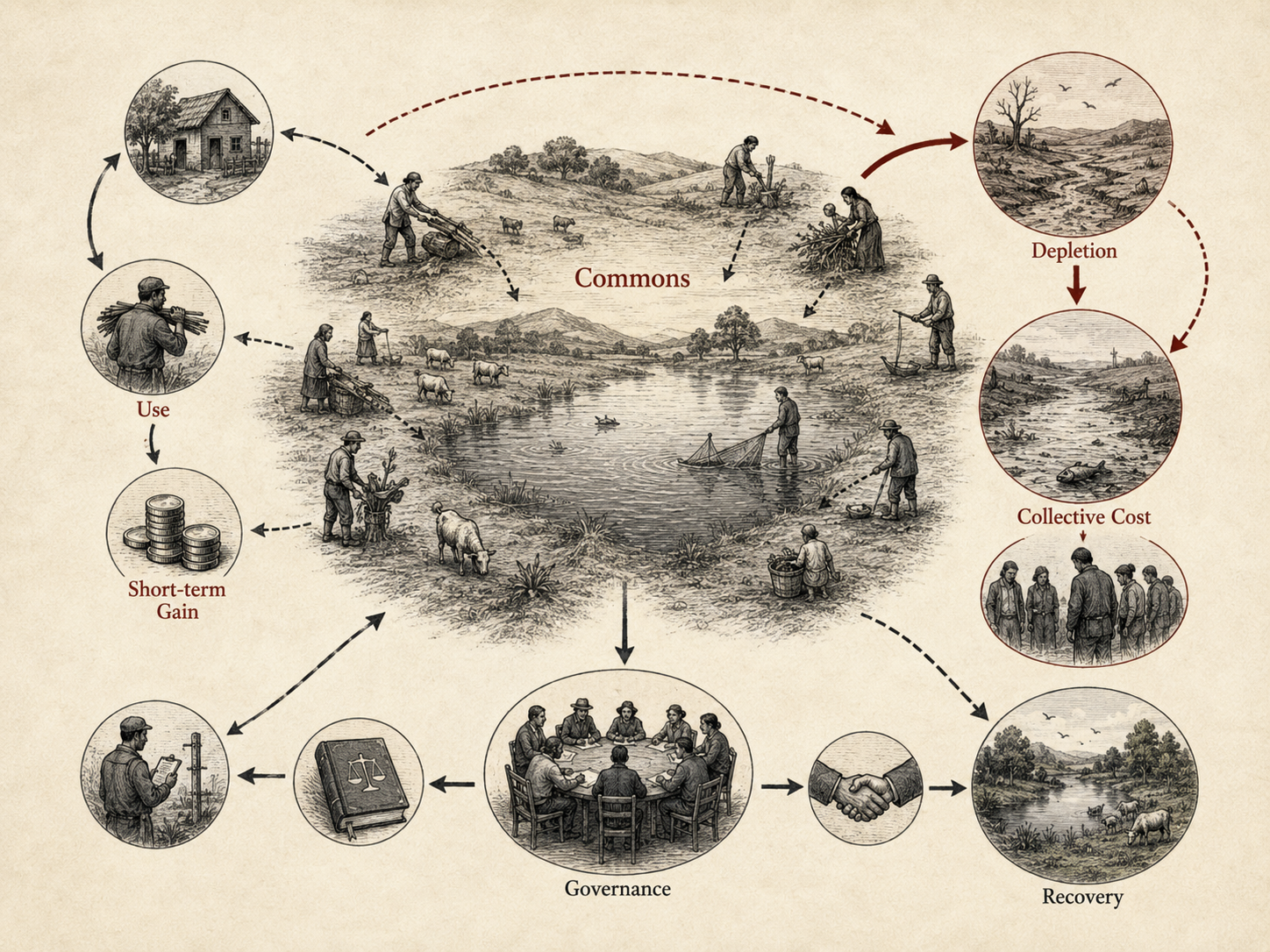
The tragedy of the commons connects directly to social dilemmas, the prisoner’s dilemma, collective action, prosocial behavior, social norms, diffusion of responsibility, moral disengagement, and Institutions & Governance. Together these concepts explain why shared systems collapse under weak governance and why cooperation depends on trust, reciprocity, legitimacy, accountability, and institutional design.
What is the tragedy of the commons?
The tragedy of the commons refers to a situation in which a shared resource is overused because the benefits of additional use accrue mainly to individual users while the costs of degradation are spread across the wider group. Each user may reason that one additional act of extraction is privately beneficial and only marginally harmful. But when many users follow that logic, the shared resource deteriorates.
The tragedy is structural. It does not require every actor to be greedy, malicious, or ignorant. It can occur when ordinary actors respond rationally to a system that rewards short-term appropriation more clearly than long-term restraint. The problem is especially severe when use is difficult to monitor, boundaries are unclear, users do not trust one another, sanctions are absent, and governance lacks legitimacy.
Commons problems occur in fisheries, forests, groundwater basins, grazing lands, irrigation systems, biodiversity systems, oceans, soils, atmospheric carbon capacity, and other shared ecological systems. They also occur in social and institutional systems: public trust, informational integrity, attention, organizational maintenance, scientific credibility, and civic infrastructure can all be degraded when private incentives reward extraction, neglect, or manipulation.
The key insight is that shared dependence does not automatically produce shared restraint. A commons becomes vulnerable when the system allows each actor to privatize benefits while socializing costs.
Why the tragedy of the commons belongs in social psychology
The tragedy of the commons is often introduced through environmental economics, but its dynamics are deeply social psychological. Commons governance depends on how people perceive other users, rules, risks, responsibilities, and institutions. Extraction behavior is shaped not only by material incentives but by trust, identity, fairness, legitimacy, norm salience, reciprocity expectations, and moral interpretation.
People ask social-psychological questions in commons settings even when they do not state them explicitly:
- Are others restraining themselves?
- Will my restraint matter?
- Are the rules fair?
- Are powerful users exempt?
- Is monitoring credible?
- Will defection be sanctioned?
- Do I belong to the community that depends on this resource?
- Do I trust the institution asking me to cooperate?
- Am I being asked to sacrifice while others benefit?
These perceptions determine whether restraint feels meaningful or foolish. When users trust one another and view rules as legitimate, cooperation becomes psychologically credible. When they expect others to defect or perceive rules as imposed, biased, or hypocritical, cooperation becomes fragile.
This is why knowledge alone rarely solves commons dilemmas. People may know that a resource is being depleted and still continue extracting if they believe others will not restrain themselves. The central problem is not always awareness. It is the social credibility of cooperation.
The core logic of commons failure
The tragedy of the commons is a type of social dilemma. A social dilemma exists when the strategy that appears advantageous for each actor, considered individually, produces an inferior outcome when adopted collectively. The commons version focuses on shared resources that can be depleted through overuse.
The core logic has four elements:
- A resource is shared by multiple users.
- Additional use creates private or localized gains.
- The costs of overuse are distributed across the larger group and often delayed over time.
- Weak governance allows repeated extraction to exceed regenerative capacity.
This logic is powerful because it scales. One extra animal on a pasture, one extra unit of groundwater, one extra boat in a fishery, one extra ton of emissions, one extra exploitative optimization in a digital platform — none may seem decisive in isolation. But aggregate behavior changes the system.
Commons failure often accelerates through expectation. Once users believe others are extracting aggressively, restraint may be reinterpreted as self-harm. Conditional cooperators become defensive defectors. As trust falls, extraction rises. As extraction rises, resource decline confirms the expectation that the system is failing. The tragedy becomes self-reinforcing.
The central design problem is therefore not only how to reduce use, but how to create institutions that make restraint credible, reciprocal, and enforceable before collapse becomes visible.
Hardin’s contribution and its limits
Garrett Hardin’s 1968 essay made the tragedy of the commons a canonical concept. His pasture example showed how individual herders could each benefit from adding animals while sharing the ecological cost of overgrazing. The image was simple, memorable, and analytically powerful. It showed how collectively destructive outcomes can emerge from individually rational decisions.
Hardin’s contribution remains important because many modern crises do involve cumulative overuse under weak governance. Climate change, overfishing, groundwater depletion, biodiversity loss, deforestation, soil degradation, and ocean pollution all involve situations where actors gain from activities that impose distributed ecological costs.
But Hardin was not the final word. The essay has often been interpreted as implying that shared resources inevitably fail unless privatized or controlled by centralized authority. That conclusion is too blunt. It conflates commons with open access and underestimates the institutional capacity of communities to govern shared resources.
Ostrom’s work fundamentally changed the debate. She showed empirically that communities have often developed durable institutions for managing common-pool resources. These institutions do not rely only on moral goodwill. They rely on rules, monitoring, sanctions, legitimacy, participation, conflict resolution, and adaptation.
The strongest contemporary reading is therefore conditional: commons collapse when institutions fail to align use, restraint, trust, monitoring, and legitimacy. Commons can endure when governance is credible and socially embedded.
Commons, open access, and common property
One of the most important distinctions in the commons literature is the difference between a commons and open access. These terms are often confused, but they describe different institutional conditions.
Open access refers to a situation in which no effective rules limit entry, use, extraction, or enforcement. Anyone can use the resource, and exclusion is weak or absent. Open-access conditions are highly vulnerable to overuse.
Common property refers to a shared resource governed by a defined community of users under rules, norms, rights, monitoring systems, and sanctions. Common property is not the same as no property. It is a property-rights regime with shared governance.
Commons is the broader category of shared resource systems that may be governed in different ways. A commons can be degraded under open access, but it can also be sustained through collective governance.
This distinction matters for both theory and policy. If all commons are mistaken for open access, then commons failure appears inevitable. But if we distinguish unmanaged open access from governed common property, we can ask a better question: what kinds of institutions allow shared resources to endure?
The policy implication is also different. The solution is not automatically privatization or centralization. In some cases, private property or state control may help. In others, community governance, hybrid institutions, or polycentric systems may be more legitimate, adaptive, and effective.
Psychological mechanisms that drive commons collapse
Commons collapse is not driven by incentives alone. Several psychological mechanisms make overuse more likely and cooperation more fragile.
Present bias and temporal discounting
Immediate gains are often more vivid than delayed harms. A user receives the benefit of extraction now, while depletion may unfold slowly. Future losses may feel uncertain, abstract, or someone else’s problem. This weakens restraint even when people understand the long-term danger.
Conditional cooperation
Many people cooperate only when they believe others are also cooperating. If users perceive widespread defection, they may increase extraction defensively. In this sense, cooperation depends on expectations. Trust can sustain restraint, but perceived cheating can quickly unravel it.
Diffusion of responsibility
Large-scale commons make personal responsibility feel small. Each actor may think their contribution to depletion is negligible. The reasoning feels plausible individually, but disastrous collectively. This is especially important in climate change, pollution, and digital commons problems.
Fairness and legitimacy
People are more willing to cooperate when burdens and benefits are distributed fairly. If powerful actors are exempt, if rules are imposed without participation, or if costs fall disproportionately on already vulnerable communities, legitimacy collapses and compliance weakens.
Moral disengagement
Actors may rationalize extraction by minimizing harm, displacing responsibility, blaming others, or framing depletion as necessary for growth, competitiveness, survival, or modernization. Moral disengagement allows participation in destructive systems without full moral confrontation.
Social proof and imitation
When users observe others extracting heavily, overuse can become normalized. What begins as strategic caution can become a visible norm. People may infer that restraint is naïve or that the resource is already lost.
Perceived inefficacy
Users may overextract because they believe individual restraint will not matter. This is common in large-scale environmental problems. When efficacy is low, moral concern may not translate into action.
These mechanisms show why commons governance must shape social expectations as well as material incentives. Durable restraint depends on trust, legitimacy, monitoring, and the belief that cooperation matters.
Formalizing the tragedy of the commons
The tragedy of the commons can be represented as a shared-resource extraction problem. Let \(x_i\) be the extraction of actor \(i\). Total extraction is:
X=\sum_{i=1}^{n}x_i
\]
Interpretation: Total resource pressure is the sum of extraction by all users.
If the resource has a regenerative or sustainable threshold \(R^*\), degradation begins when:
X>R^*
\]
Interpretation: Resource decline begins when total use exceeds the system’s sustainable capacity.
A simple dynamic stock model can be written as:
R_{t+1}=R_t+g(R_t)-\sum_{i=1}^{n}x_{i,t}
\]
Interpretation: Future resource stock depends on current stock, regeneration, and total extraction.
A logistic regeneration function can be written as:
g(R_t)=rR_t\left(1-\frac{R_t}{K}\right)
\]
Interpretation: Regeneration depends on intrinsic growth \(r\), current stock \(R_t\), and carrying capacity \(K\).
Individual utility can be represented as:
u_i=b(x_i)-\frac{1}{n}c(X)
\]
Interpretation: The actor receives private benefit from extraction but experiences only a fraction of the collective degradation cost.
In marginal terms, overuse becomes individually attractive when:
\frac{\partial b(x_i)}{\partial x_i}>\frac{1}{n}\frac{\partial c(X)}{\partial X}
\]
Interpretation: The private marginal benefit of extraction exceeds the actor’s perceived share of marginal collective cost.
At the system level, sustainable governance requires collective extraction to remain within ecological limits:
\sum_{i=1}^{n}x_{i,t}\leq g(R_t)
\]
Interpretation: Extraction remains sustainable only when total use does not exceed regeneration.
Behaviorally, cooperative restraint can be modeled as a function of trust, legitimacy, monitoring, norms, reciprocity, and knowledge:
P(C_i=1)=\operatorname{logit}^{-1}(\beta_0+\beta_1T_i+\beta_2L_i+\beta_3M_i+\beta_4N_i+\beta_5Q_i+\beta_6K_i-\beta_7A_i)
\]
Interpretation: Restraint becomes more likely when trust \(T_i\), legitimacy \(L_i\), monitoring \(M_i\), stewardship norms \(N_i\), reciprocity expectations \(Q_i\), and local knowledge \(K_i\) are strong, and less likely when asymmetry \(A_i\) undermines fairness.
These models clarify the core insight: commons collapse is not simply a matter of too many users. It is a mismatch between private incentives, collective costs, ecological thresholds, and institutional capacity.
Climate change and planetary commons
Climate change is one of the most consequential contemporary examples of commons dynamics. The atmosphere functions as a shared sink for greenhouse gas emissions. States, firms, and consumers receive near-term benefits from carbon-intensive activity, while the costs are distributed globally and across future generations.
The climate case also reveals why the commons framework must be used carefully. Responsibility is not evenly distributed. Historical emissions, industrial capacity, wealth, vulnerability, adaptive capacity, and political power are deeply unequal. A framework that treats all actors as symmetrical users of a shared resource can obscure the role of concentrated power and historical benefit.
Climate change is therefore both a commons problem and a justice problem. Cooperation requires more than shared awareness. It requires credible commitments, finance, technology transfer, transparent measurement, enforcement, adaptation support, and legitimate burden-sharing. Without fairness, climate cooperation becomes politically fragile.
The social psychology of climate action is inseparable from trust. Communities and countries ask whether others will act, whether pledges are credible, whether sacrifices are distributed fairly, whether powerful actors are exempt, and whether institutions can enforce commitments. When trust fails, climate cooperation weakens.
The tragedy of the commons remains useful here, but only when deepened by historical responsibility, political economy, and climate justice. The atmosphere is shared, but the causes and consequences of atmospheric degradation are not shared equally.
Why some commons endure
If commons collapse were inevitable, durable common-pool resource institutions would not exist. Yet empirical research shows many examples of communities sustaining shared resources over long periods. Fisheries, forests, irrigation systems, grazing lands, and water systems have sometimes been governed successfully through locally developed institutions.
Enduring commons typically do not depend on trust alone. They combine trust with rules. They do not depend on punishment alone. They combine enforcement with legitimacy. They do not depend on local community alone. They often connect local rules to larger institutional systems.
Several conditions make endurance more likely:
- users know who has rights to use the resource;
- resource boundaries are defined;
- rules fit ecological and social conditions;
- users participate in making and revising rules;
- monitoring is credible;
- sanctions are graduated and proportionate;
- conflicts can be resolved without excessive cost;
- the right to self-organize is recognized;
- larger systems use nested governance arrangements.
These features matter because they change the psychology of cooperation. Users can see whether others are complying. They can trust that rules apply. They can revise institutions when conditions change. They can identify violators without treating every user as an enemy. They can experience governance as legitimate rather than externally imposed.
Enduring commons therefore demonstrate that the tragedy is not the natural destiny of shared resources. It is a risk produced by particular institutional failures.
Ostrom’s design principles and polycentric governance
Ostrom’s design principles remain one of the most important contributions to commons governance. They shifted the debate away from simple claims that commons must be privatized or centrally controlled and toward a more empirical question: under what institutional conditions do resource users successfully govern shared systems?
The design principles emphasize boundaries, locally appropriate rules, collective-choice arrangements, monitoring, graduated sanctions, conflict-resolution mechanisms, recognition of self-organization, and nested enterprises. These principles do not function as a mechanical checklist. They identify recurring institutional features that make cooperation more stable.
Polycentric governance extends this insight to larger systems. Many commons problems operate across scales. A watershed may involve households, farmers, municipalities, regional authorities, national agencies, and international rules. Climate change involves households, firms, cities, states, international agreements, finance systems, scientific institutions, and civil society. A single centralized authority may be too distant; purely local governance may be too small.
Polycentric systems use multiple centers of decision-making. They can allow experimentation, learning, redundancy, local adaptation, and cross-scale coordination. They can also produce fragmentation and accountability gaps if poorly designed. Their value lies not in decentralization for its own sake, but in matching governance scale to problem structure.
For social psychology, the key point is that governance is not only formal design. It shapes trust, legitimacy, expectations, responsibility, and perceived efficacy. People cooperate more readily when institutions feel accountable, understandable, participatory, and enforceable.
Organizational and informational commons
The tragedy of the commons is often associated with ecological systems, but the logic applies to institutional and informational systems as well. Many shared goods are not physical resources. Trust, attention, knowledge, reputation, organizational maintenance, scientific integrity, and civic discourse can also be treated as commons.
In organizations, members may benefit individually from information hoarding, free riding, credit capture, underinvestment in maintenance, blame shifting, or short-term metric optimization. Each act may seem locally rational. Over time, these behaviors degrade the shared conditions that make organizational performance possible.
In digital environments, platforms and users may extract attention, amplify outrage, spread low-quality information, or optimize for engagement in ways that degrade the epistemic commons. Individual actors may gain visibility, revenue, influence, or entertainment, while the shared environment becomes less trustworthy.
Scientific and scholarly systems also contain commons dynamics. Peer review, open knowledge, citation integrity, data quality, and research reproducibility depend on shared norms. When actors exploit the system through low-quality publication, citation manipulation, plagiarism, or opaque data practices, the collective credibility of knowledge production suffers.
The broader lesson is that a commons is defined by shared dependence on a vulnerable system. The resource may be pasture, water, climate stability, institutional trust, or public knowledge. The tragedy emerges when extraction is rewarded and stewardship is underprovided.
Critiques, misuses, and the politics of the concept
The tragedy of the commons is analytically powerful, but it has often been misused. One misuse is to treat all shared resources as doomed. This erases histories of community governance and ignores the difference between open access and common property. Another misuse is to use the concept as a rhetorical defense of enclosure, privatization, or top-down control without examining whether those solutions are legitimate or effective.
A second danger is moral simplification. Commons failure is often described as a consequence of greed, but many cases involve poverty, coercion, unequal access, policy failure, market pressure, colonial extraction, regulatory capture, and survival constraints. A subsistence user and a multinational extractor may both use a commons, but they do not occupy the same moral or political position.
A third danger is false symmetry. Large-scale environmental crises are often described as shared problems, but responsibility and vulnerability are unequal. Climate change, deforestation, water depletion, and biodiversity loss cannot be understood without historical power, industrial systems, land rights, Indigenous stewardship, and unequal exposure to harm.
Finally, the concept can obscure governance alternatives if it is framed too narrowly. The real choice is not simply private property versus state control. The commons literature shows a wider institutional landscape: common property, co-management, hybrid governance, polycentric systems, community monitoring, public regulation, Indigenous governance, and nested institutions.
A rigorous use of the tragedy of the commons should therefore ask: whose commons, whose extraction, whose rules, whose burden, whose voice, whose loss, and whose power?
The tragedy of the commons in the architecture of social influence
Within the broader architecture of social influence, the tragedy of the commons clarifies how shared systems collapse when private incentives, weak trust, and poor governance interact. Social dilemmas identify the broader class of problems in which private and collective interests diverge. The prisoner’s dilemma models strategic defection under uncertainty. Collective action explains how groups organize around shared outcomes. Social norms stabilize or undermine cooperative expectations. Moral disengagement explains how actors rationalize participation in harmful systems.
The tragedy of the commons adds the resource dimension: the shared good can be depleted. It shows how repeated small acts of appropriation can accumulate into systemic decline. It also shows why cooperation requires more than goodwill. It requires institutions that make restraint visible, credible, legitimate, and enforceable.
Seen in this framework, the tragedy of the commons is not merely an environmental metaphor. It is a general model of how social systems degrade when stewardship is less rewarded than extraction.
Interpretive cautions and limits
The tragedy of the commons should be used carefully. Not every environmental or social failure is a commons problem. Some are better understood as coercion, monopoly power, colonial extraction, regulatory capture, corruption, distributive injustice, coordination failure, or state violence. The commons framework is useful when shared resource dependence and cumulative overuse are central, but it should not erase power.
Several cautions are essential:
- Do not confuse commons with unmanaged open access.
- Do not treat community governance as naïve or impossible.
- Do not assume privatization or centralization is automatically superior.
- Do not ignore unequal responsibility, vulnerability, and power.
- Do not treat all users as symmetrical actors.
- Do not reduce overuse to individual greed alone.
- Do not ignore local ecological knowledge or Indigenous stewardship.
- Do not use “shared responsibility” to obscure concentrated extraction.
- Do not treat punishment as legitimate without procedural fairness.
- Do not assume that more rules always mean better governance.
The strongest use of the concept combines formal modeling, social psychology, institutional analysis, historical context, and ethical attention to unequal power. The tragedy of the commons is not a license for fatalism. It is a warning about what happens when shared dependence is governed badly.
Measurement, data, and research design
Research on the tragedy of the commons uses laboratory commons games, field experiments, common-pool resource case studies, surveys, institutional analysis, ethnography, agent-based models, ecological stock-flow models, behavioral experiments, and mixed-methods governance research.
Key variables include:
- participant, group, community, and site identifiers;
- governance condition;
- property-rights regime;
- round or period;
- resource stock;
- carrying capacity;
- regeneration rate;
- individual extraction;
- sustainable extraction threshold;
- trust score;
- institutional legitimacy;
- monitoring credibility;
- sanction probability and severity;
- boundary clarity;
- rule participation;
- conflict-resolution access;
- local ecological knowledge;
- perceived fairness;
- reciprocity expectation;
- stewardship norm salience;
- asymmetry index;
- depletion risk;
- group welfare;
- individual payoff;
- response time.
Strong research designs should specify the resource model. If a study claims to analyze commons depletion, it should define resource stock, regeneration, extraction, and sustainability thresholds. It should also distinguish whether the resource is open access, common property, private property, state property, hybrid, or polycentric.
Institutional studies should measure legitimacy separately from enforcement. A sanction may reduce extraction when viewed as fair and collectively authorized, but provoke resistance when viewed as imposed, biased, or illegitimate. Rule participation and conflict-resolution access should be measured because they shape whether users experience governance as their own or as external coercion.
Finally, research should include asymmetry. Commons dilemmas are rarely composed of equal actors. Differences in wealth, power, historical responsibility, dependence, and vulnerability strongly influence whether cooperation is possible and whether rules are viewed as fair.
R code for commons research
The following R workflow models extraction, resource stock, depletion risk, payoff, legitimacy, monitoring, sanctions, rule participation, stewardship norms, and response time in repeated commons-governance research.
# Install packages if needed:
# pak::pak(c("tidyverse", "lme4", "lmerTest", "emmeans", "broom.mixed", "performance"))

library(tidyverse)
library(lme4)
library(lmerTest)
library(emmeans)
library(broom.mixed)
library(performance)

# Expected columns:
# participant, group_id, site_id, condition, property_regime, round,
# resource_stock, carrying_capacity, regeneration_rate, regeneration,
# extraction, sustainable_threshold, trust_score, legitimacy_score,
# monitoring_credibility, sanction_probability, sanction_severity,
# boundary_clarity, rule_participation, conflict_resolution_access,
# local_ecological_knowledge, perceived_fairness,
# reciprocity_expectation, stewardship_norm_salience,
# asymmetry_index, depletion_risk, group_welfare,
# individual_payoff, response_time_ms

dat <- read_csv("tragedy_commons_trials.csv") %>%
  mutate(
    participant = factor(participant),
    group_id = factor(group_id),
    site_id = factor(site_id),
    condition = factor(condition),
    property_regime = factor(property_regime),
    expected_sanction = monitoring_credibility *
      sanction_probability *
      sanction_severity / 10,
    institutional_effectiveness = boundary_clarity *
      monitoring_credibility *
      pmax(sanction_probability, 0.01) *
      pmax(sanction_severity, 0.01) *
      (legitimacy_score / 10) *
      (rule_participation / 10),
    restraint_index = (
      trust_score +
      legitimacy_score +
      reciprocity_expectation +
      stewardship_norm_salience +
      local_ecological_knowledge -
      asymmetry_index
    ) / 5,
    group_size_estimate = n(),
    .by = c(group_id, round)
  ) %>%
  mutate(
    over_extraction = as.integer(
      extraction > sustainable_threshold / group_size_estimate
    ),
    log_response_time = log(response_time_ms)
  )

# -----------------------------
# 1. Descriptive summary
# -----------------------------

summary_table <- dat %>%
  group_by(condition, property_regime, round) %>%
  summarise(
    n = n(),
    groups = n_distinct(group_id),
    mean_extraction = mean(extraction, na.rm = TRUE),
    total_extraction = sum(extraction, na.rm = TRUE),
    mean_stock = mean(resource_stock, na.rm = TRUE),
    mean_regeneration = mean(regeneration, na.rm = TRUE),
    mean_depletion_risk = mean(depletion_risk, na.rm = TRUE),
    over_extraction_rate = mean(over_extraction, na.rm = TRUE),
    mean_trust = mean(trust_score, na.rm = TRUE),
    mean_legitimacy = mean(legitimacy_score, na.rm = TRUE),
    mean_monitoring = mean(monitoring_credibility, na.rm = TRUE),
    mean_institutional_effectiveness =
      mean(institutional_effectiveness, na.rm = TRUE),
    mean_group_welfare = mean(group_welfare, na.rm = TRUE),
    .groups = "drop"
  )

print(summary_table)

# -----------------------------
# 2. Extraction model
# -----------------------------

extraction_model <- lmer(
  extraction ~
    round +
    trust_score +
    legitimacy_score +
    monitoring_credibility +
    expected_sanction +
    boundary_clarity +
    rule_participation +
    conflict_resolution_access +
    local_ecological_knowledge +
    perceived_fairness +
    reciprocity_expectation +
    stewardship_norm_salience +
    asymmetry_index +
    resource_stock +
    condition +
    property_regime +
    (1 | group_id) +
    (1 | participant) +
    (1 | site_id),
  data = dat,
  REML = FALSE
)

summary(extraction_model)
emmeans(extraction_model, ~ condition)

# -----------------------------
# 3. Resource-stock model
# -----------------------------

stock_model <- lmer(
  resource_stock ~
    round +
    extraction +
    regeneration +
    institutional_effectiveness +
    trust_score +
    legitimacy_score +
    monitoring_credibility +
    condition +
    property_regime +
    (1 | group_id) +
    (1 | site_id),
  data = dat,
  REML = FALSE
)

summary(stock_model)

# -----------------------------
# 4. Over-extraction model
# -----------------------------

depletion_model <- glmer(
  over_extraction ~
    trust_score +
    legitimacy_score +
    monitoring_credibility +
    expected_sanction +
    boundary_clarity +
    rule_participation +
    stewardship_norm_salience +
    asymmetry_index +
    condition +
    property_regime +
    (1 | group_id) +
    (1 | participant) +
    (1 | site_id),
  data = dat,
  family = binomial(),
  control = glmerControl(optimizer = "bobyqa")
)

summary(depletion_model)

# -----------------------------
# 5. Payoff and response-time models
# -----------------------------

payoff_model <- lmer(
  individual_payoff ~
    extraction +
    depletion_risk +
    expected_sanction +
    legitimacy_score +
    perceived_fairness +
    condition +
    property_regime +
    (1 | group_id) +
    (1 | participant) +
    (1 | site_id),
  data = dat,
  REML = FALSE
)

rt_model <- lmer(
  log_response_time ~
    round +
    extraction +
    trust_score +
    legitimacy_score +
    monitoring_credibility +
    depletion_risk +
    condition +
    property_regime +
    (1 | group_id) +
    (1 | participant) +
    (1 | site_id),
  data = dat %>% filter(response_time_ms >= 150),
  REML = FALSE
)

summary(payoff_model)
summary(rt_model)

# -----------------------------
# 6. Export outputs
# -----------------------------

write_csv(summary_table, "tragedy_commons_summary.csv")

write_csv(
  tidy(extraction_model, effects = "fixed", conf.int = TRUE),
  "tragedy_commons_extraction_coefficients.csv"
)

write_csv(
  tidy(stock_model, effects = "fixed", conf.int = TRUE),
  "tragedy_commons_stock_coefficients.csv"
)

write_csv(
  tidy(depletion_model, effects = "fixed", conf.int = TRUE),
  "tragedy_commons_depletion_coefficients.csv"
)

# -----------------------------
# 7. Visualization
# -----------------------------

ggplot(summary_table, aes(x = round, y = mean_stock, color = condition)) +
  geom_line() +
  geom_point() +
  labs(
    title = "Resource stock across repeated commons rounds",
    x = "Round",
    y = "Mean resource stock"
  ) +
  theme_minimal()
This workflow supports commons-governance research by estimating how extraction and resource decline respond to trust, legitimacy, monitoring, sanctions, boundary clarity, rule participation, stewardship norms, local ecological knowledge, and asymmetry.
Python code for commons research
The Python workflow below parallels the R analysis and adds a governance simulation comparing open-access and governed commons conditions. It is useful for modeling how legitimacy, monitoring, stewardship norms, and property-rights regimes shape extraction, resource stock, and depletion risk over repeated periods.
import numpy as np
import pandas as pd
import statsmodels.formula.api as smf
import matplotlib.pyplot as plt

# Expected columns:
# participant, group_id, site_id, condition, property_regime, round,
# resource_stock, carrying_capacity, regeneration_rate, regeneration,
# extraction, sustainable_threshold, trust_score, legitimacy_score,
# monitoring_credibility, sanction_probability, sanction_severity,
# boundary_clarity, rule_participation, conflict_resolution_access,
# local_ecological_knowledge, perceived_fairness,
# reciprocity_expectation, stewardship_norm_salience,
# asymmetry_index, depletion_risk, group_welfare,
# individual_payoff, response_time_ms

df = pd.read_csv("tragedy_commons_trials.csv")

for col in [
    "participant",
    "group_id",
    "site_id",
    "condition",
    "property_regime"
]:
    df[col] = df[col].astype("category")

df["expected_sanction"] = (
    df["monitoring_credibility"]
    * df["sanction_probability"]
    * df["sanction_severity"]
    / 10
)

df["institutional_effectiveness"] = (
    df["boundary_clarity"]
    * df["monitoring_credibility"]
    * np.maximum(df["sanction_probability"], 0.01)
    * np.maximum(df["sanction_severity"], 0.01)
    * (df["legitimacy_score"] / 10)
    * (df["rule_participation"] / 10)
)

df["restraint_index"] = (
    df["trust_score"]
    + df["legitimacy_score"]
    + df["reciprocity_expectation"]
    + df["stewardship_norm_salience"]
    + df["local_ecological_knowledge"]
    - df["asymmetry_index"]
) / 5

group_size = df.groupby(["group_id", "round"])["participant"].transform("count")

df["over_extraction"] = (
    df["extraction"] > df["sustainable_threshold"] / group_size
).astype(int)

df["log_response_time"] = np.log(df["response_time_ms"])

# -----------------------------
# 1. Descriptive summary
# -----------------------------

summary_table = (
    df.groupby(["condition", "property_regime", "round"], observed=True)
    .agg(
        n=("participant", "size"),
        groups=("group_id", "nunique"),
        mean_extraction=("extraction", "mean"),
        total_extraction=("extraction", "sum"),
        mean_stock=("resource_stock", "mean"),
        mean_regeneration=("regeneration", "mean"),
        mean_depletion_risk=("depletion_risk", "mean"),
        over_extraction_rate=("over_extraction", "mean"),
        mean_trust=("trust_score", "mean"),
        mean_legitimacy=("legitimacy_score", "mean"),
        mean_monitoring=("monitoring_credibility", "mean"),
        mean_institutional_effectiveness=(
            "institutional_effectiveness",
            "mean"
        ),
        mean_group_welfare=("group_welfare", "mean"),
    )
    .reset_index()
)

print(summary_table)

# -----------------------------
# 2. Extraction model
# -----------------------------

extraction_model = smf.ols(
    "extraction ~ round + trust_score + legitimacy_score "
    "+ monitoring_credibility + expected_sanction "
    "+ boundary_clarity + rule_participation "
    "+ conflict_resolution_access + local_ecological_knowledge "
    "+ perceived_fairness + reciprocity_expectation "
    "+ stewardship_norm_salience + asymmetry_index "
    "+ resource_stock + condition + property_regime",
    data=df,
)

extraction_result = extraction_model.fit(
    cov_type="cluster",
    cov_kwds={"groups": df["participant"]},
)

print(extraction_result.summary())

# -----------------------------
# 3. Resource-stock model
# -----------------------------

stock_model = smf.ols(
    "resource_stock ~ round + extraction + regeneration "
    "+ institutional_effectiveness + trust_score "
    "+ legitimacy_score + monitoring_credibility "
    "+ condition + property_regime",
    data=df,
)

stock_result = stock_model.fit(
    cov_type="cluster",
    cov_kwds={"groups": df["group_id"]},
)

print(stock_result.summary())

# -----------------------------
# 4. Depletion-risk model
# -----------------------------

depletion_model = smf.ols(
    "depletion_risk ~ extraction + institutional_effectiveness "
    "+ trust_score + legitimacy_score "
    "+ stewardship_norm_salience + asymmetry_index "
    "+ condition + property_regime",
    data=df,
)

depletion_result = depletion_model.fit(
    cov_type="cluster",
    cov_kwds={"groups": df["group_id"]},
)

print(depletion_result.summary())

# -----------------------------
# 5. Governance simulation
# -----------------------------

def simulate_governance(n_groups=300, periods=60, seed=42):
    rng = np.random.default_rng(seed)

    regimes = np.array([
        "open_access",
        "common_property",
        "state_property",
        "polycentric"
    ])

    regime_index = rng.choice(
        len(regimes),
        size=n_groups,
        p=[0.30, 0.35, 0.15, 0.20]
    )

    resource = rng.uniform(80, 130, n_groups)
    capacity = rng.uniform(130, 180, n_groups)
    regeneration_rate = rng.uniform(0.08, 0.16, n_groups)

    legitimacy = np.where(
        regimes[regime_index] == "open_access",
        rng.uniform(1, 4, n_groups),
        rng.uniform(4, 9, n_groups)
    )

    monitoring = np.where(
        regimes[regime_index] == "open_access",
        rng.uniform(0, 3, n_groups),
        rng.uniform(3, 9, n_groups)
    )

    stewardship = np.where(
        regimes[regime_index] == "open_access",
        rng.uniform(1, 4, n_groups),
        rng.uniform(4, 9, n_groups)
    )

    rows = []

    for period in range(1, periods + 1):
        extraction = np.clip(
            9.0
            - 0.28 * legitimacy
            - 0.25 * monitoring
            - 0.30 * stewardship
            + rng.normal(0, 1.0, n_groups),
            0,
            14
        )

        total_extraction = 6 * extraction

        regeneration = np.maximum(
            0,
            regeneration_rate * resource * (1 - resource / capacity)
        )

        resource = np.clip(
            resource + regeneration - total_extraction,
            0,
            capacity
        )

        depletion_risk = np.clip(1 - resource / capacity, 0, 1)

        for i in range(n_groups):
            rows.append({
                "group_id": f"G{i+1:04d}",
                "period": period,
                "property_regime": regimes[regime_index[i]],
                "resource_stock": resource[i],
                "mean_extraction": extraction[i],
                "regeneration": regeneration[i],
                "legitimacy": legitimacy[i],
                "monitoring": monitoring[i],
                "stewardship": stewardship[i],
                "depletion_risk": depletion_risk[i],
            })

    simulation = pd.DataFrame(rows)

    period_summary = (
        simulation.groupby(["property_regime", "period"])
        .agg(
            mean_resource_stock=("resource_stock", "mean"),
            mean_extraction=("mean_extraction", "mean"),
            mean_depletion_risk=("depletion_risk", "mean"),
            depleted_rate=("resource_stock", lambda x: np.mean(x <= 1)),
        )
        .reset_index()
    )

    return simulation, period_summary

simulation, period_summary = simulate_governance()

print(period_summary.head())

# -----------------------------
# 6. Visualization
# -----------------------------

fig, ax = plt.subplots(figsize=(8, 5))

for condition, group in summary_table.groupby("condition", observed=True):
    ax.plot(
        group["round"],
        group["mean_stock"],
        marker="o",
        label=condition
    )

ax.set_xlabel("Round")
ax.set_ylabel("Mean resource stock")
ax.set_title("Resource stock across repeated commons rounds")
ax.legend()
plt.tight_layout()
plt.show()

# -----------------------------
# 7. Export summaries
# -----------------------------

summary_table.to_csv("tragedy_commons_summary.csv", index=False)
simulation.to_csv("governance_simulation.csv", index=False)
period_summary.to_csv("governance_simulation_summary.csv", index=False)
This Python workflow supports experimental and simulation-based commons research. It estimates extraction and stock dynamics, then simulates how governance regimes shape resource depletion over time.
Research data architecture
Commons research often depends on relational data: participants, groups, sites, property regimes, governance conditions, resource stock, carrying capacity, regeneration, extraction, sustainable thresholds, trust, legitimacy, monitoring, sanctions, boundary clarity, rule participation, conflict-resolution access, local ecological knowledge, perceived fairness, reciprocity, stewardship norms, asymmetry, depletion risk, group welfare, individual payoff, and response time. Rather than embedding executable database code directly in the WordPress article body, the companion GitHub repository includes the full SQL schema and example queries for researchers who want to reproduce or extend the data model.
The research data model is designed to support questions such as:
- Does extraction differ between open-access and governed commons conditions?
- Does legitimacy reduce extraction?
- Does monitoring reduce overuse only when rules are viewed as legitimate?
- Does boundary clarity reduce depletion risk?
- Does user participation in rule-making increase restraint?
- Does perceived fairness predict cooperation?
- Does asymmetry weaken stewardship norms?
- Do graduated sanctions reduce over-extraction more effectively than externally imposed sanctions?
- Do polycentric governance conditions preserve resource stock better over repeated periods?
The GitHub repository contains the full database schema, example analytical queries, validation logic, and reproducible data workflow. Keeping executable SQL in GitHub avoids WordPress hosting restrictions while preserving the research-grade infrastructure for readers who want to inspect or reuse the model.
View the SQL research data architecture in GitHub.
GitHub repository
The companion repository provides reusable code and research scaffolding for studying the tragedy of the commons, including workflows for open-access failure, governed commons, extraction behavior, resource stock, regeneration, depletion risk, trust, legitimacy, monitoring, sanctions, boundary clarity, rule participation, conflict resolution, local ecological knowledge, stewardship norms, asymmetry, and polycentric governance.
Complete Code Repository
Access the full companion repository for this article, including reproducible analysis materials and multi-language code workflows for tragedy-of-the-commons research.
What the tragedy of the commons ultimately teaches
The tragedy of the commons teaches that sustainability is not secured by awareness alone. People may understand that a shared resource is threatened and still continue extracting if restraint feels unilateral, unfair, ineffective, or unreciprocated. The problem is not simply ignorance. It is the institutional credibility of cooperation.
The concept also teaches that shared resources do not fail automatically. Commons collapse is a risk, not a destiny. Shared systems endure when users have legitimate rules, credible monitoring, clear boundaries, fair burdens, conflict-resolution mechanisms, graduated sanctions, local knowledge, and institutions that adapt to changing conditions.
The deepest lesson is institutional and ethical. Collective life depends on systems that align private conduct with shared survival. Where that alignment fails, degradation follows. Where it succeeds, cooperation becomes possible even under scarcity, rivalry, and interdependence.
Read alongside social dilemmas, the prisoner’s dilemma, collective action, Behavioral Economics, Economic Systems, and Institutions & Governance, the tragedy of the commons becomes more than a warning about overuse. It becomes a theory of why governance, legitimacy, stewardship, and trust are indispensable to any serious account of sustainable human futures.
Related articles
- Social Psychology
- Social Dilemmas
- The Prisoner’s Dilemma
- Collective Action and Social Change
- Prosocial Behavior in Social Psychology
- Altruism in Social Psychology
- Social Norms in Social Psychology
- Diffusion of Responsibility
- Moral Disengagement
- Behavioral Economics
- Economic Systems
- Institutions & Governance
- Stewardship & Ethics
Further reading
- Berkes, F., Feeny, D., McCay, B.J. and Acheson, J.M. (1989) ‘The benefits of the commons’, Nature, 340, pp. 91–93. Available at: https://doi.org/10.1038/340091a0.
- Cox, M., Arnold, G. and Villamayor Tomás, S. (2010) ‘A review of design principles for community-based natural resource management’, Ecology and Society, 15(4), article 38. Available at: https://doi.org/10.5751/ES-03704-150438.
- Dawes, R.M., McTavish, J. and Shaklee, H. (1977) ‘Behavior, communication, and assumptions about other people’s behavior in a commons dilemma situation’, Journal of Personality and Social Psychology, 35(1), pp. 1–11. Available at: https://doi.org/10.1037/0022-3514.35.1.1.
- Dietz, T., Ostrom, E. and Stern, P.C. (2003) ‘The struggle to govern the commons’, Science, 302(5652), pp. 1907–1912. Available at: https://doi.org/10.1126/science.1091015.
- Feeny, D., Berkes, F., McCay, B.J. and Acheson, J.M. (1990) ‘The tragedy of the commons: Twenty-two years later’, Human Ecology, 18(1), pp. 1–19. Available at: https://doi.org/10.1007/BF00889070.
- Hardin, G. (1968) ‘The tragedy of the commons’, Science, 162(3859), pp. 1243–1248. Available at: https://doi.org/10.1126/science.162.3859.1243.
- National Research Council (2002) The Drama of the Commons. Washington, DC: National Academies Press. Available at: https://nap.nationalacademies.org/catalog/10287/the-drama-of-the-commons.
- Ostrom, E. (1990) Governing the Commons: The Evolution of Institutions for Collective Action. Cambridge: Cambridge University Press. Available at: https://doi.org/10.1017/CBO9780511807763.
- Ostrom, E. (2009) ‘Prize Lecture: Beyond markets and states: Polycentric governance of complex economic systems’. Nobel Prize. Available at: https://www.nobelprize.org/prizes/economic-sciences/2009/ostrom/lecture/.
- Ostrom, E. (2010) ‘Beyond markets and states: Polycentric governance of complex economic systems’, American Economic Review, 100(3), pp. 641–672. Available at: https://doi.org/10.1257/aer.100.3.641.
- Ostrom, E., Gardner, R. and Walker, J. (1994) Rules, Games, and Common-Pool Resources. Ann Arbor: University of Michigan Press. Available at: https://press.umich.edu/Books/R/Rules-Games-and-Common-Pool-Resources.
- Schlager, E. and Ostrom, E. (1992) ‘Property-rights regimes and natural resources: A conceptual analysis’, Land Economics, 68(3), pp. 249–262. Available at: https://doi.org/10.2307/3146375.
- Van Lange, P.A.M., Joireman, J., Parks, C.D. and Van Dijk, E. (2013) ‘The psychology of social dilemmas: A review’, Organizational Behavior and Human Decision Processes, 120(2), pp. 125–141. Available at: https://doi.org/10.1016/j.obhdp.2012.11.003.
References
- Berkes, F., Feeny, D., McCay, B.J. and Acheson, J.M. (1989) ‘The benefits of the commons’, Nature, 340, pp. 91–93. Available at: https://doi.org/10.1038/340091a0.
- Cox, M., Arnold, G. and Villamayor Tomás, S. (2010) ‘A review of design principles for community-based natural resource management’, Ecology and Society, 15(4), article 38. Available at: https://doi.org/10.5751/ES-03704-150438.
- Dawes, R.M., McTavish, J. and Shaklee, H. (1977) ‘Behavior, communication, and assumptions about other people’s behavior in a commons dilemma situation’, Journal of Personality and Social Psychology, 35(1), pp. 1–11. Available at: https://doi.org/10.1037/0022-3514.35.1.1.
- Dietz, T., Ostrom, E. and Stern, P.C. (2003) ‘The struggle to govern the commons’, Science, 302(5652), pp. 1907–1912. Available at: https://doi.org/10.1126/science.1091015.
- Feeny, D., Berkes, F., McCay, B.J. and Acheson, J.M. (1990) ‘The tragedy of the commons: Twenty-two years later’, Human Ecology, 18(1), pp. 1–19. Available at: https://doi.org/10.1007/BF00889070.
- Hardin, G. (1968) ‘The tragedy of the commons’, Science, 162(3859), pp. 1243–1248. Available at: https://doi.org/10.1126/science.162.3859.1243.
- National Research Council (2002) The Drama of the Commons. Washington, DC: National Academies Press. Available at: https://nap.nationalacademies.org/catalog/10287/the-drama-of-the-commons.
- Ostrom, E. (1990) Governing the Commons: The Evolution of Institutions for Collective Action. Cambridge: Cambridge University Press. Available at: https://doi.org/10.1017/CBO9780511807763.
- Ostrom, E. (2009) ‘Prize Lecture: Beyond markets and states: Polycentric governance of complex economic systems’. Nobel Prize. Available at: https://www.nobelprize.org/prizes/economic-sciences/2009/ostrom/lecture/.
- Ostrom, E. (2010) ‘Beyond markets and states: Polycentric governance of complex economic systems’, American Economic Review, 100(3), pp. 641–672. Available at: https://doi.org/10.1257/aer.100.3.641.
- Ostrom, E., Gardner, R. and Walker, J. (1994) Rules, Games, and Common-Pool Resources. Ann Arbor: University of Michigan Press. Available at: https://press.umich.edu/Books/R/Rules-Games-and-Common-Pool-Resources.
- Schlager, E. and Ostrom, E. (1992) ‘Property-rights regimes and natural resources: A conceptual analysis’, Land Economics, 68(3), pp. 249–262. Available at: https://doi.org/10.2307/3146375.
- Van Lange, P.A.M., Joireman, J., Parks, C.D. and Van Dijk, E. (2013) ‘The psychology of social dilemmas: A review’, Organizational Behavior and Human Decision Processes, 120(2), pp. 125–141. Available at: https://doi.org/10.1016/j.obhdp.2012.11.003.