
Last Updated June 1, 2026
Overshoot occurs when a system moves beyond a sustainable limit before feedback arrives strongly enough to slow, redirect, or correct it. Collapse can follow when the system damages the stocks, relationships, resources, trust, capacity, or ecological foundations that supported its earlier growth. Correction is the difficult work of restoring stability, rebuilding capacity, reducing harm, and redesigning the feedback structures that allowed overshoot to occur.
Overshoot is one of the most important patterns in systems thinking because it explains why success can become failure. Growth may look healthy while it is consuming the conditions that make it possible. Productivity may rise while workers burn out. Development may expand while infrastructure, water systems, housing affordability, or ecological resilience erode. A public institution may appear efficient while trust, legitimacy, and frontline capacity decline. An economy may grow while debt, emissions, extraction, or inequality accumulate. Overshoot is not simply too much growth. It is growth, demand, pressure, extraction, or commitment that outruns the system’s ability to regenerate, absorb, govern, or repair.
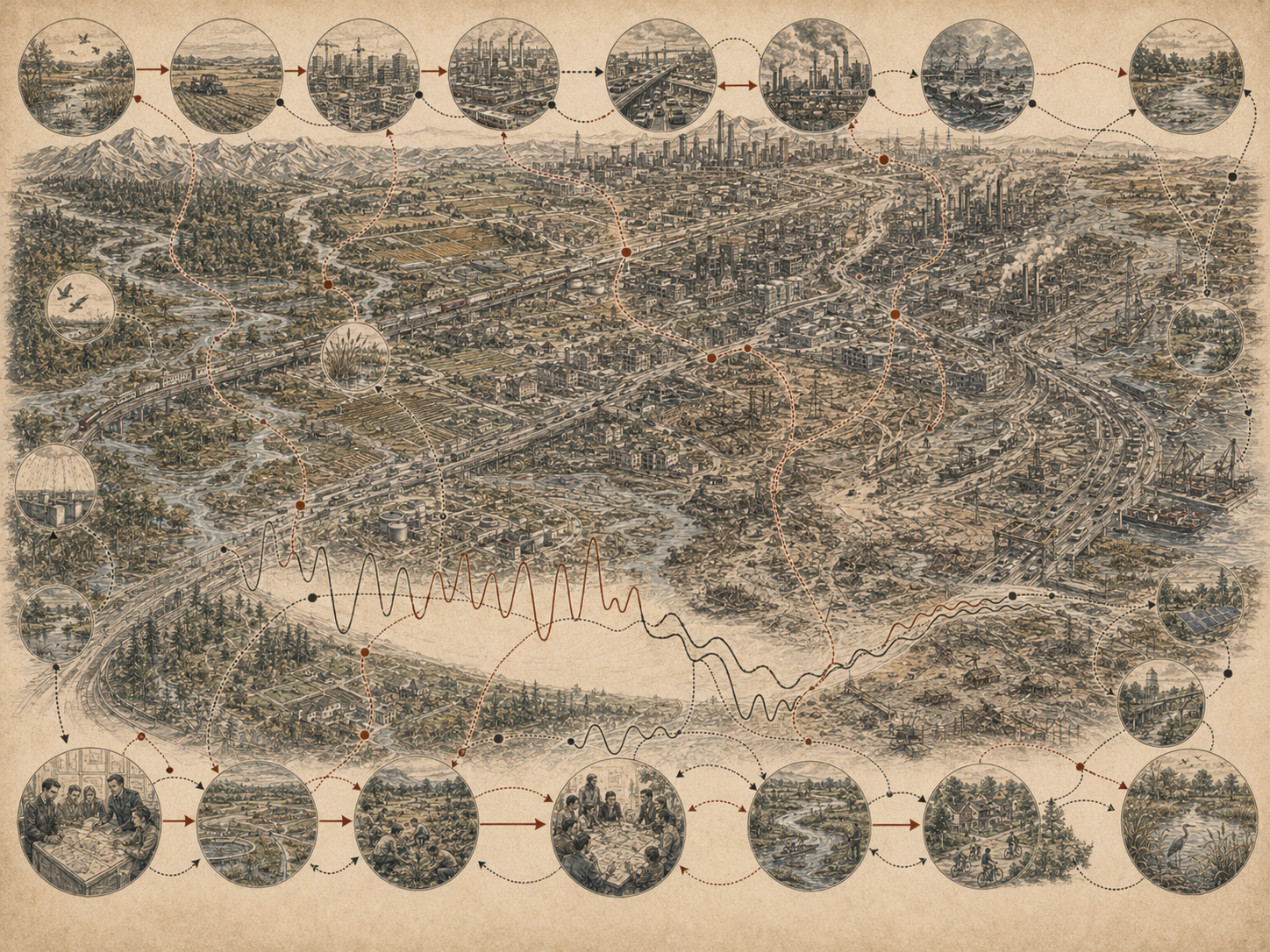
This article examines overshoot, collapse, and correction as core patterns in systems thinking. It explains how reinforcing growth can outrun balancing feedback, why delayed signals make limits hard to see, how stocks and buffers are depleted before collapse becomes visible, and why correction is often harder than prevention. It also examines the ethical stakes of overshoot: who benefits during expansion, who pays during collapse, and how costs are often shifted to workers, marginalized communities, ecosystems, public institutions, and future generations.
Why Overshoot Matters in Systems Thinking
Overshoot matters because many systems fail not from obvious external shocks alone, but from internal success exceeding system capacity. A pattern that once produced growth, efficiency, scale, or expansion can eventually undermine the conditions that made the growth possible. The system does not merely encounter a limit; it moves beyond the limit before recognizing it.
This is especially common when feedback is delayed. If the system receives accurate signals quickly, it may slow down, adapt, invest, or correct before damage accumulates. If signals are late, weak, ignored, politically inconvenient, or hidden outside the official boundary, the system may continue growing, extracting, consuming, or committing beyond sustainable limits. By the time the balancing signal becomes visible, the system may have already depleted capacity, trust, legitimacy, infrastructure, ecological resilience, financial reserves, or human energy.
Overshoot is not only an ecological concept. It appears wherever demand, pressure, extraction, workload, debt, risk, attention, growth, or complexity outruns the system’s ability to absorb or regenerate. Organizations overshoot when commitments exceed human and operational capacity. Infrastructure systems overshoot when use and deterioration exceed maintenance. Public institutions overshoot when administrative burdens exceed trust and accessibility. Technology platforms overshoot when engagement incentives exceed governance capacity. Economies overshoot when growth depends on extraction, debt, ecological depletion, or social exclusion.
| Overshoot domain | What grows or intensifies | What limit is exceeded | Possible collapse signal |
|---|---|---|---|
| Ecology | Extraction, pollution, land conversion, resource use. | Regenerative capacity, biodiversity, water, soil, climate stability. | Species loss, soil degradation, fisheries decline, ecosystem regime shift. |
| Organizations | Workload, commitments, speed, complexity. | Human capacity, coordination, trust, recovery time. | Burnout, turnover, errors, conflict, institutional memory loss. |
| Infrastructure | Use, age, deferred maintenance, exposure. | Asset condition, funding, inspection capacity, resilience. | Failures, outages, emergency repair cycles, service disruption. |
| Public policy | Administrative requirements, service demand, policy complexity. | Implementation capacity, public trust, access, legitimacy. | Backlogs, exclusion, distrust, nonparticipation, political backlash. |
| Technology systems | Automation, scale, engagement, data dependence. | Oversight, accountability, interpretability, trust, governance. | Bias, cascading errors, user harm, institutional dependence, loss of control. |
| Economies | Debt, extraction, speculation, inequality, consumption. | Household resilience, ecological limits, productive capacity, legitimacy. | Debt crises, bubbles, social instability, ecological externalities. |
Overshoot analysis helps systems thinkers avoid a dangerous mistake: treating growth as proof of health. A system can grow by consuming reserves. It can perform by exhausting people. It can appear efficient by deferring maintenance. It can appear profitable by externalizing costs. It can appear stable by suppressing feedback. Behavior over time must therefore be examined alongside the stocks and limits that sustain the system.
What Overshoot Is
Overshoot occurs when a system exceeds a limit, capacity, threshold, or sustainable operating range. The limit may be physical, ecological, social, institutional, cognitive, financial, technical, or political. Overshoot usually occurs because reinforcing growth or pressure continues after balancing feedback should have slowed the system down.
A simple example is a population growing beyond the carrying capacity of its environment. For a time, resources may appear sufficient. Growth continues. But if consumption exceeds regeneration, the resource base begins to decline. Because the decline may be delayed or hidden, growth may continue even after the sustainable limit has been crossed. Eventually the depleted resource base can no longer support the population, and collapse may follow.
In social and institutional systems, the same pattern can occur with less obvious resources. Trust can be depleted. Staff capacity can be depleted. public patience can be depleted. legitimacy can be depleted. institutional memory can be depleted. attention can be depleted. ecological buffers can be depleted. These stocks are often invisible until the system fails.
x_t > K_t
\]
Interpretation: Overshoot occurs when system demand, activity, load, population, extraction, or pressure \(x_t\) exceeds the current capacity or limit \(K_t\).
Overshoot should be distinguished from ordinary fluctuation. A system can temporarily operate above a preferred level without collapse if it has buffers, reserves, adaptive capacity, and recovery time. Overshoot becomes dangerous when the excess depletes the very capacity needed for future functioning. A team can handle a temporary surge if recovery follows. It cannot sustain permanent overload without degrading quality, trust, health, and retention. A watershed can absorb disturbance if regeneration remains possible. It cannot indefinitely absorb land conversion, pollution, altered flow, and climate stress without changing state.
Overshoot has several common features:
- a reinforcing process drives growth, demand, pressure, or extraction;
- a limit exists but is delayed, hidden, discounted, or politically inconvenient;
- the system receives weak or late signals about approaching the limit;
- decision-makers interpret short-term success as evidence that the system can continue;
- buffers and reserves are consumed before collapse becomes visible;
- correction becomes harder after the supporting stock has been depleted.
Systems thinking treats overshoot as a structural pattern. It is not merely a failure of individual restraint. It is often produced by incentives, feedback delays, short time horizons, externalized costs, inadequate measurement, and goals that reward expansion without tracking depletion.
Limits, Carrying Capacity, and Regenerative Capacity
Overshoot requires a limit. Some limits are fixed or relatively stable. Others change over time. Some can be expanded through investment, innovation, coordination, or restoration. Others cannot be expanded without damaging another part of the system. The analyst must therefore ask what kind of limit is operating.
Carrying capacity is often used in ecological contexts to describe the population or activity level that an environment can support without long-term degradation. In broader systems thinking, the concept can be generalized carefully. An organization has a capacity for workload. A public agency has capacity for service delivery. A city has capacity in its housing, transportation, water, drainage, and public-health systems. A community has social and institutional capacity. A platform has governance capacity. A person has cognitive, emotional, and physical capacity.
Regenerative capacity is especially important. A system may absorb use, stress, or disturbance if it can regenerate. A forest can regrow if disturbance remains within regenerative bounds. Workers can recover if overload is temporary and rest is real. Public trust can recover if institutions acknowledge harm and change behavior. Infrastructure can remain reliable if maintenance keeps pace with deterioration. Overshoot occurs when use or stress exceeds regeneration.
U_t \leq R_t
\]
Interpretation: A system remains within regenerative bounds when use, extraction, or stress \(U_t\) does not exceed the system’s regenerative or repair capacity \(R_t\).
Limits are often politically contested. One actor may say a system can handle more growth. Another may point to strain, hidden costs, or unequal burden. The disagreement may reflect different boundaries. A development project may appear sustainable if measured only by private return, but not if drainage, displacement, heat exposure, infrastructure maintenance, water use, and ecological loss are included. A workload increase may appear manageable if measured only by output, but not if fatigue, turnover, quality, recovery time, and long-term capacity are included.
| Limit type | What constrains the system | Example |
|---|---|---|
| Physical limit | Material capacity, space, energy, equipment, infrastructure. | Water supply, road capacity, grid capacity, hospital beds. |
| Ecological limit | Regeneration, biodiversity, nutrient cycling, climate stability. | Fishery regeneration, soil health, watershed absorption. |
| Human limit | Attention, recovery, skill, health, emotional capacity. | Burnout, decision fatigue, workforce turnover. |
| Institutional limit | Authority, legitimacy, implementation capacity, coordination. | Policy backlog, public distrust, fragmented governance. |
| Financial limit | Revenue, debt capacity, liquidity, affordability. | Debt spiral, underfunded maintenance, household cost burden. |
| Cognitive limit | Complexity, information load, interpretability, decision capacity. | Dashboard overload, automation dependency, unclear accountability. |
A limit is not always a wall. It may be a warning zone. Systems can sometimes operate near limits if feedback is accurate, buffers are strong, and correction is timely. But systems become fragile when they ignore the difference between temporary capacity and sustainable capacity.
Reinforcing Growth and Delayed Balancing Feedback
Overshoot often arises from the interaction of two feedback structures: a reinforcing loop that drives growth and a balancing loop that should eventually constrain it. The danger emerges when the balancing feedback is delayed, weak, ignored, or politically suppressed.
Reinforcing loops create momentum. More users attract more users. More revenue enables more expansion. More development raises land values and attracts more development. More demand creates pressure to expand capacity. More work completed creates a reputation for responsiveness, which attracts more work. Reinforcing dynamics are not inherently bad. They can produce learning, trust, recovery, and regeneration. But if they outrun the balancing loops that protect capacity, overshoot becomes likely.
Balancing feedback communicates limits. It may appear as rising costs, declining quality, resource depletion, public complaints, ecological stress, worker fatigue, service delay, infrastructure failure, or legitimacy loss. If this feedback arrives early and is acted upon, the system can adapt. If it arrives late, the system may cross the limit before correction begins.
x_{t+1} = x_t + r x_t\left(1 – \frac{x_{t-d}}{K}\right)
\]
Interpretation: A delayed-limit model shows growth responding to a past perception of capacity. If the system perceives the limit \(K\) too late, growth can continue beyond sustainable bounds.
Delayed balancing feedback is common because many limits are not visible until stress accumulates. Workers may continue producing before burnout appears. Infrastructure may function before failure. Ecosystems may absorb disturbance before regime shift. Public trust may appear adequate until a crisis reveals accumulated resentment. Debt may appear manageable before interest burden accelerates. Climate systems may absorb emissions before feedbacks intensify.
The danger is that short-term success can strengthen the reinforcing loop. If growth produces rewards before limits appear, the system learns to keep growing. If overwork produces output before burnout appears, the system learns to rely on overwork. If deferred maintenance saves money before failure appears, the system learns to defer maintenance. If development produces revenue before ecological and infrastructure costs appear, the system learns to expand.
Systems thinking asks:
- What reinforcing loop is driving growth, demand, pressure, or extraction?
- What balancing feedback should signal limits?
- Is that feedback delayed, weak, ignored, or hidden?
- What rewards arrive before the costs?
- What costs arrive after the decision-makers have benefited?
- What would make the limit visible earlier?
- What correction is possible before the supporting stock is depleted?
Overshoot is rarely mysterious after the feedback structure is visible. The system kept going because the rewards were immediate and the limits were delayed.
Collapse as Systemic Loss of Capacity
Collapse is not always sudden disappearance. In systems thinking, collapse can mean a sharp decline in capacity, function, resilience, legitimacy, coordination, regeneration, or trust. A system can continue to exist formally while losing the ability to perform its essential role. An organization may still have a name and structure while its workforce is depleted. An institution may still have legal authority while public trust has collapsed. An ecosystem may still appear as land or water while its regenerative functions are severely weakened.
Collapse often follows overshoot when supporting stocks are depleted. These stocks may include soil fertility, groundwater, biodiversity, workforce capacity, financial reserves, institutional memory, public legitimacy, maintenance condition, data quality, social trust, or ecological buffers. The system may appear functional while the stock is declining. Collapse becomes visible only when the stock falls below a critical threshold.
C_t < C_{\text{critical}} \]
Interpretation: Collapse risk rises when system capacity \(C_t\) falls below a critical threshold needed to maintain function, absorb disturbance, or recover.
Collapse can be nonlinear. A system may decline slowly for a long time, then deteriorate rapidly. This is common when buffers are depleted. A bridge may hold until it cannot. A workforce may cope until it breaks. A financial system may appear liquid until confidence evaporates. A community may tolerate institutional neglect until legitimacy fails. An ecosystem may absorb pressure until a regime shift occurs.
Collapse can also be partial. One level of the system may collapse while another remains. A national economy may grow while household resilience declines. A city may prosper while certain neighborhoods face infrastructure collapse. A company may increase revenue while internal capacity deteriorates. A platform may grow users while public trust and information quality decline. Systems thinking asks collapse for whom, at what level, and across what boundary.
Several collapse signals matter:
- loss of recovery capacity after disturbance;
- increasing frequency or severity of failure;
- rising cost of maintaining the same level of performance;
- declining trust or legitimacy despite formal compliance;
- increasing dependence on emergency fixes;
- loss of skilled people, memory, biodiversity, or buffers;
- rapid shift after long apparent stability;
- failure of feedback systems to produce correction.
Collapse is often misinterpreted as the result of the final trigger. A storm caused the flood. A resignation caused the staffing crisis. A scandal caused the trust crisis. A market shock caused the bankruptcy. But systems analysis asks what capacity had already been depleted before the trigger arrived. The trigger reveals collapse risk; it rarely explains the full structure.
Buffers, Reserves, and Hidden Depletion
Buffers and reserves allow systems to absorb stress. They include ecological diversity, financial reserves, staffing slack, spare parts, maintenance budgets, redundancy, social trust, institutional memory, soil organic matter, water storage, public legitimacy, time for recovery, and local knowledge. These buffers are often treated as inefficiency because they are not always used. In reality, they are part of the system’s resilience.
Overshoot often begins by consuming buffers. A system can appear efficient because it has removed slack. A hospital can operate at high occupancy until a surge arrives. A supply chain can reduce inventory until disruption occurs. An organization can run lean until people burn out. A city can defer maintenance until infrastructure fails. An ecosystem can absorb pressure until biodiversity loss reduces resilience.
Hidden depletion is dangerous because buffers often decline quietly. A workforce may lose experienced people gradually. Public trust may erode through repeated minor failures. Soil health may decline over years. Maintenance backlog may grow unseen. Institutional memory may disappear through turnover. Because the depletion is gradual, leaders may treat the system as stable.
B_{t+1} = B_t – D_t + R_t
\]
Interpretation: A buffer \(B\) changes through depletion \(D_t\) and restoration \(R_t\). Overshoot risk rises when depletion persistently exceeds restoration.
Buffers are often unevenly distributed. Wealthy households may have savings, flexible work, insurance, transportation, and access to services. Low-income households may have little margin. Well-funded institutions may absorb disruption. Underfunded institutions may collapse under the same pressure. Ecosystems with high biodiversity may recover from disturbance. degraded ecosystems may not. Systems thinking therefore asks not only whether the system has buffers, but who has them and who lacks them.
The removal of buffers can be framed as efficiency. But efficiency without resilience can become fragility. If all spare capacity is eliminated, the system may perform well under expected conditions and fail under stress. This is especially dangerous when stress is increasing, uncertainty is high, or feedback is delayed.
Overshoot analysis asks:
- What buffers are protecting the system?
- Are they measured?
- Are they being depleted?
- Are they being restored?
- Who depends on them?
- Who lacks them?
- What happens when the buffer is gone?
- Is the system mistaking buffer consumption for sustainable performance?
Buffers are not waste. They are stored resilience. A system that consumes them without rebuilding them is borrowing stability from the future.
Correction, Recovery, and Repair
Correction after overshoot is difficult because the system may have damaged the very capacity needed for recovery. A depleted workforce cannot easily implement reform. A degraded ecosystem cannot immediately regenerate. A distrusted institution cannot quickly persuade the public. A debt-burdened household cannot easily invest in resilience. A maintenance-starved infrastructure system cannot rapidly eliminate backlog. Correction is therefore not simply a return to the prior state.
Correction requires three kinds of work. First, the system must reduce pressure below sustainable levels. Second, it must rebuild depleted stocks and buffers. Third, it must redesign the feedback structures that caused overshoot. Without the third step, recovery may be temporary. The system may return to the same pattern.
\text{Correction} = \text{Pressure Reduction} + \text{Stock Repair} + \text{Feedback Redesign}
\]
Interpretation: Correction after overshoot requires more than symptom relief. It must reduce excess pressure, rebuild depleted capacity, and change the feedback structures that allowed overshoot.
Correction can be mistaken for emergency response. Emergency response is necessary, but it may not change the system. After a flood, emergency relief matters. But correction also requires land-use reform, drainage maintenance, watershed restoration, housing support, climate adaptation, and risk governance. After organizational burnout, time off may help. But correction also requires workload redesign, staffing, priority control, trust repair, and incentive change. After infrastructure failure, repair matters. But correction also requires preventive maintenance funding, inspection, asset management, and political accountability.
Correction also takes time. This is one of the reasons prevention is so important. Trust is harder to rebuild than to preserve. Species are harder to restore than to protect. Experienced workers are harder to replace than to retain. Infrastructure is harder to rebuild after collapse than to maintain. Correction is often possible, but it is rarely costless.
| Correction task | Systems purpose | Example |
|---|---|---|
| Reduce pressure | Bring system demand or extraction below sustainable limits. | Reduce workload, slow development, limit extraction, reduce emissions. |
| Restore stocks | Rebuild depleted capacity or reserves. | Rebuild trust, replenish groundwater, repair backlog, restore staffing. |
| Strengthen buffers | Increase resilience before future stress. | Add redundancy, reserves, maintenance capacity, ecological diversity. |
| Redesign feedback | Make limits visible earlier and actionable. | Leading indicators, public reporting, early-warning triggers, adaptive governance. |
| Change goals | Stop rewarding the behavior that caused overshoot. | Shift from growth-at-all-costs to resilience, stewardship, and sufficiency. |
Correction is most effective when it recognizes that collapse is not only a low point. It is a signal about system design. The goal should not be to restore the conditions that produced overshoot. It should be to create a system that can recognize limits earlier, distribute burdens fairly, maintain buffers, and act before collapse becomes necessary evidence.
Prevention Before Collapse
Prevention is the highest-leverage response to overshoot. Once collapse begins, correction is more expensive, slower, and less certain. Prevention requires the system to act before visible crisis, which is politically and institutionally difficult. It means valuing early warning, leading indicators, precaution, maintenance, stewardship, resilience, and long-term responsibility.
Preventing overshoot requires making limits visible. This may involve measuring stocks that are usually hidden: trust, fatigue, maintenance backlog, ecological condition, institutional capacity, debt stress, groundwater levels, soil health, service access, or public legitimacy. It may also involve listening to people who notice early harm before formal metrics do: frontline workers, residents, Indigenous communities, maintenance staff, patients, students, caregivers, farmers, and local ecological observers.
Prevention also requires changing incentives. If the system rewards short-term output while ignoring depletion, overshoot will recur. If leaders are rewarded for growth but not for maintenance, maintenance will be deferred. If budgets reward cost cutting but not avoided failure, reserves will be consumed. If platforms reward engagement but not public harm, harmful feedback loops may intensify. If policy systems reward visible action but not prevention, late correction becomes normal.
\text{Prevention} < \text{Repair after Collapse} \]
Interpretation: In many systems, prevention requires fewer resources and produces less harm than repairing damage after collapse. The inequality is conceptual rather than universal, but it captures a central systems principle.
Preventive systems often include:
- leading indicators for stress, depletion, and risk;
- thresholds that trigger early action;
- buffers and reserves protected from short-term extraction;
- maintenance and repair systems funded before crisis;
- adaptive governance that can revise policy as feedback arrives;
- long-term accounting that includes delayed costs;
- stakeholder feedback from those affected first;
- institutional incentives that reward resilience, not only growth.
Prevention can be hard to defend because avoided collapse is invisible. A disaster that does not happen creates fewer headlines than a disaster response. A worker who does not burn out may not appear in the metric. A bridge that does not fail may not be celebrated. An ecosystem that remains resilient may be taken for granted. This is why systems thinking must make non-events visible as outcomes of care, maintenance, and governance.
Prevention is not inaction. It is action before collapse forces recognition.
Ethics, Power, and Distribution of Collapse
Overshoot is ethically important because the benefits of exceeding limits and the costs of collapse are often distributed unequally. Those who profit from expansion may not be those who suffer depletion. Those who make decisions may leave before consequences appear. Those who lack power may experience early warning signs but lack authority to force correction. Future generations and ecological systems cannot vote in present decisions, yet they often bear delayed costs.
Overshoot often depends on externalization. A system exceeds its apparent limit by pushing costs beyond its boundary. A company externalizes pollution. A public budget externalizes maintenance costs to the future. An organization externalizes workload onto workers and families. A platform externalizes misinformation costs onto public discourse. A city externalizes development pressure onto flood risk, displacement, and infrastructure strain. The system appears successful because the accounting boundary is too narrow.
Collapse is also uneven. A regional economy may recover while displaced households do not. A company may restructure while workers carry the cost. A city may rebuild downtown while marginalized neighborhoods remain exposed. An ecosystem may be damaged beyond recovery while economic reports count short-term output. Systems thinking asks collapse for whom, where, and on what timeline.
Ethical overshoot analysis asks:
- Who benefits during the overshoot phase?
- Who bears the costs during collapse?
- Whose warnings were ignored?
- What costs were externalized beyond the official boundary?
- Who lacked the power to slow the system before limits were crossed?
- What forms of repair are owed?
- What future harms were discounted?
- What would justice require beyond technical correction?
Overshoot is often described as a technical failure of management, forecasting, or control. But it is also a moral failure when known risks are deferred, when vulnerable people absorb preventable harm, when ecological systems are treated as expendable, and when short-term beneficiaries avoid accountability for long-term damage.
Correction must therefore include repair. Repair may involve compensation, restoration, redistribution, institutional reform, public accountability, ecological regeneration, participatory governance, and changes to the goals that produced overshoot. A system that merely returns to growth after collapse may be preparing the next collapse.
Examples Across Systems
Overshoot, collapse, and correction appear across ecological, institutional, organizational, technological, and economic systems. The examples below show how the same systems pattern can appear in different domains.
Ecological systems
A fishery may grow as harvest increases. For a time, catch levels appear strong. If harvest exceeds regeneration and the feedback from declining fish populations is delayed or ignored, the fishery can overshoot. Collapse appears when the population can no longer reproduce fast enough to support the harvest. Correction requires reducing pressure, restoring habitat, rebuilding stock, protecting breeding populations, and changing governance incentives.
Climate systems
Emissions create delayed feedback. Economic systems benefit from fossil-fuel energy now while climate consequences accumulate over time. The atmosphere functions as a stock, and the climate system responds with delay. Overshoot occurs when emissions exceed the capacity of natural and human systems to absorb and adapt without severe harm. Correction requires emissions reduction, adaptation, restoration, justice-centered transition, and long-term accountability.
Infrastructure
Infrastructure systems overshoot when use, deterioration, and exposure exceed maintenance and renewal. Deferred maintenance creates immediate budget relief but delayed risk. Collapse appears as bridge closures, water-main breaks, transit failures, grid outages, or emergency repair cycles. Correction requires asset-condition monitoring, dedicated maintenance funding, preventive repair, climate adaptation, and public accountability for long-term stewardship.
Organizations
An organization may overshoot by accepting more commitments than its people and processes can sustain. Output remains high for a time because workers absorb the pressure. Eventually fatigue, errors, conflict, absenteeism, and turnover rise. Collapse may appear as mass resignation, quality failure, loss of institutional memory, or reputational damage. Correction requires reducing demand, rebuilding staffing, clarifying priorities, repairing trust, and changing incentives that rewarded overload.
Public institutions
A public agency may overshoot by adding complexity, verification requirements, reporting burdens, and procedural safeguards without increasing implementation capacity or accessibility. The system may appear more controlled, but users experience delay, exclusion, and distrust. Collapse appears as backlog, nonparticipation, appeals, public anger, and legitimacy loss. Correction requires simplifying access, improving service capacity, measuring administrative burden, and including affected people in redesign.
Artificial intelligence systems
An AI system may overshoot when automation scale exceeds oversight capacity. Early deployment may appear efficient. Over time, errors, bias, data drift, automation dependency, appeal failures, and accountability gaps may accumulate. Collapse may appear as public trust failure, institutional harm, legal exposure, or decision systems that no one can adequately explain or correct. Correction requires monitoring, contestability, auditability, human oversight, governance, and limits on deployment where accountability is insufficient.
Economic systems
Financial overshoot can occur when credit expansion, speculation, asset prices, or leverage grow faster than real productive capacity and household resilience. The boom may appear healthy until confidence weakens, debt burdens become visible, and cascading failure begins. Correction requires not only crisis management, but regulation, risk monitoring, distributional analysis, and attention to the incentives that rewarded excessive leverage.
Across these examples, overshoot is a temporal and structural pattern. A system grows or intensifies beyond the conditions that sustain it. Collapse reveals the limit. Correction asks whether the system will learn or repeat.
Mathematics, Computation, and Modeling
Overshoot, collapse, and correction can be studied through stock-flow models, delayed feedback equations, limited-growth models, threshold analysis, behavior-over-time graphs, scenario comparison, and resilience diagnostics. Modeling helps make assumptions explicit: what is growing, what is limiting growth, how long feedback is delayed, what stock is being depleted, and when correction becomes more difficult.
A simple limited-growth model can be written as:
x_{t+1} = x_t + r x_t\left(1 – \frac{x_t}{K}\right)
\]
Interpretation: Growth slows as the system approaches a limit or carrying capacity \(K\). This model assumes the system responds to the current level of pressure.
A delayed-limit model can be written as:
x_{t+1} = x_t + r x_t\left(1 – \frac{x_{t-d}}{K}\right)
\]
Interpretation: Growth responds to delayed information about the system’s condition. If feedback is late, the system may continue growing beyond the limit before correction occurs.
A resource depletion model can be represented as:
R_{t+1} = R_t + G_t – U_t
\]
Interpretation: A resource or capacity stock \(R\) changes through regeneration \(G_t\) and use \(U_t\). Overshoot occurs when use persistently exceeds regeneration.
Collapse risk can be represented conceptually as:
\text{Collapse Risk}_t = f(L_t, D_t, B_t, R_t, C_t)
\]
Interpretation: Collapse risk may depend on load \(L_t\), delay \(D_t\), buffer condition \(B_t\), regenerative capacity \(R_t\), and correction capacity \(C_t\).
Correction can be represented as a change in pressure and restoration of capacity:
R_{t+1} = R_t + \text{Restoration}_t – \text{Pressure}_t
\]
Interpretation: Recovery requires restoration to exceed ongoing pressure. If pressure remains too high, the system cannot rebuild the depleted stock.
| Modeling task | Overshoot question | Example use |
|---|---|---|
| Behavior-over-time graphing | Is the system growing, plateauing, overshooting, or collapsing? | Tracking workload, demand, emissions, debt, backlog, or resource use. |
| Stock-flow modeling | What capacity or resource is accumulating or depleting? | Modeling groundwater, trust, fatigue, maintenance backlog, biodiversity, or reserves. |
| Delayed feedback simulation | Does late feedback allow the system to exceed limits? | Testing policy delay, ecological response, hiring lag, or maintenance lag. |
| Threshold analysis | When does gradual depletion become rapid collapse? | Studying ecological regime shifts, trust crises, debt distress, or infrastructure failure. |
| Scenario comparison | How do early, late, weak, and strong corrections compare? | Testing prevention, emergency response, restoration, and adaptive governance. |
| Resilience diagnostics | What buffers protect the system from collapse? | Assessing redundancy, reserves, diversity, trust, staffing, and recovery capacity. |
Models should be interpreted carefully. A model can show the logic of overshoot, but it cannot by itself determine what counts as a just limit, who should reduce pressure, who deserves repair, or how responsibility should be assigned. Modeling should support ethical and institutional judgment, not replace it.
Python Workflow: Overshoot, Collapse Risk, Buffer Depletion, and Correction Diagnostics
The Python workflow below turns overshoot analysis into a small reproducible model. It compares four scenarios: growth past hidden limits, late correction, early limit visibility, and regenerative correction. The script uses only the Python standard library, writes CSV outputs relative to the article folder, and is designed as a clear starting point for companion repository work.
# overshoot_collapse_correction_workflow.py
# Dependency-light workflow for overshoot, delayed limits, buffer depletion,
# collapse risk, correction timing, and recovery diagnostics.
# Writes outputs relative to the article root.

from __future__ import annotations

from dataclasses import dataclass
from pathlib import Path
import csv
from statistics import mean

ARTICLE_ROOT = Path(__file__).resolve().parents[1]
TABLES = ARTICLE_ROOT / "outputs" / "tables"


@dataclass
class OvershootScenario:
    name: str
    reinforcing_pressure: float
    regenerative_capacity: float
    feedback_delay: float
    buffer_strength: float
    limit_visibility: float
    correction_capacity: float
    accountability: float
    restoration_commitment: float
    extraction_pressure: float


def clamp(value: float, low: float = 0.0, high: float = 140.0) -> float:
    return max(low, min(high, value))


def run_scenario(scenario: OvershootScenario, periods: int = 60) -> list[dict[str, object]]:
    system_load = 34.0 + scenario.reinforcing_pressure * 22.0
    resource_stock = 76.0 + scenario.regenerative_capacity * 18.0
    buffer_stock = 28.0 + scenario.buffer_strength * 42.0
    correction_capacity = 28.0 + scenario.correction_capacity * 32.0
    perceived_limit_signal = scenario.limit_visibility * 34.0
    load_history: list[float] = [system_load]
    rows: list[dict[str, object]] = []

    delay_steps = max(0, int(round(scenario.feedback_delay * 10.0)))

    for period in range(periods + 1):
        delayed_index = max(0, len(load_history) - 1 - delay_steps)
        delayed_load = load_history[delayed_index]

        sustainable_limit = clamp(
            resource_stock * 0.72
            + buffer_stock * 0.22
            + scenario.regenerative_capacity * 22.0,
            20.0,
            120.0
        )

        perceived_limit_signal = clamp(
            perceived_limit_signal
            + scenario.limit_visibility * 1.8
            + scenario.accountability * 1.1
            + max(0.0, delayed_load - sustainable_limit) * 0.16
            - scenario.feedback_delay * 0.8,
            0.0,
            100.0
        )

        overshoot_gap = max(0.0, system_load - sustainable_limit)

        growth_pressure = clamp(
            scenario.reinforcing_pressure * 18.0
            + scenario.extraction_pressure * 16.0
            + max(0.0, 65.0 - perceived_limit_signal) * 0.13
            - scenario.accountability * 2.4,
            0.0,
            100.0
        )

        balancing_feedback = clamp(
            perceived_limit_signal * 0.22
            + scenario.limit_visibility * 12.0
            + correction_capacity * 0.10
            + scenario.accountability * 9.0
            - scenario.feedback_delay * 4.0,
            0.0,
            100.0
        )

        stock_depletion = clamp(
            scenario.extraction_pressure * 15.0
            + system_load * 0.10
            + overshoot_gap * 0.45
            - scenario.regenerative_capacity * 8.0
            - scenario.restoration_commitment * 4.0,
            0.0,
            100.0
        )

        resource_regeneration = clamp(
            scenario.regenerative_capacity * 12.0
            + scenario.restoration_commitment * 10.0
            + scenario.accountability * 4.0
            - overshoot_gap * 0.12,
            0.0,
            100.0
        )

        buffer_depletion = clamp(
            overshoot_gap * 0.28
            + scenario.feedback_delay * 7.0
            + max(0.0, system_load - resource_stock) * 0.12
            - scenario.buffer_strength * 4.0
            - scenario.restoration_commitment * 3.0,
            0.0,
            100.0
        )

        buffer_repair = clamp(
            scenario.buffer_strength * 3.0
            + scenario.restoration_commitment * 5.0
            + scenario.accountability * 2.0
            - stock_depletion * 0.05,
            0.0,
            100.0
        )

        resource_stock = clamp(
            resource_stock
            + resource_regeneration * 0.13
            - stock_depletion * 0.16,
            0.0,
            120.0
        )

        buffer_stock = clamp(
            buffer_stock
            + buffer_repair * 0.20
            - buffer_depletion * 0.16,
            0.0,
            100.0
        )

        correction_capacity = clamp(
            correction_capacity
            + scenario.correction_capacity * 1.7
            + scenario.accountability * 1.4
            + scenario.restoration_commitment * 1.4
            - max(0.0, 55.0 - buffer_stock) * 0.06
            - overshoot_gap * 0.035,
            0.0,
            100.0
        )

        pressure_reduction = clamp(
            balancing_feedback * 0.16
            + correction_capacity * 0.12
            + scenario.accountability * 5.0
            - scenario.feedback_delay * 2.0,
            0.0,
            100.0
        )

        system_load = clamp(
            system_load
            + growth_pressure * 0.16
            - pressure_reduction * 0.14
            - max(0.0, 45.0 - resource_stock) * 0.06,
            0.0,
            140.0
        )

        collapse_risk = clamp(
            overshoot_gap * 0.34
            + max(0.0, 45.0 - resource_stock) * 0.34
            + max(0.0, 35.0 - buffer_stock) * 0.28
            + scenario.feedback_delay * 9.0
            - correction_capacity * 0.08
            - scenario.accountability * 4.0,
            0.0,
            100.0
        )

        recovery_score = clamp(
            resource_stock * 0.22
            + buffer_stock * 0.22
            + correction_capacity * 0.20
            + perceived_limit_signal * 0.14
            + scenario.restoration_commitment * 12.0
            + scenario.accountability * 10.0
            - collapse_risk * 0.20
            - overshoot_gap * 0.16,
            0.0,
            100.0
        )

        rows.append({
            "period": period,
            "scenario": scenario.name,
            "system_load": round(system_load, 3),
            "sustainable_limit": round(sustainable_limit, 3),
            "overshoot_gap": round(overshoot_gap, 3),
            "resource_stock": round(resource_stock, 3),
            "buffer_stock": round(buffer_stock, 3),
            "perceived_limit_signal": round(perceived_limit_signal, 3),
            "growth_pressure": round(growth_pressure, 3),
            "balancing_feedback": round(balancing_feedback, 3),
            "stock_depletion": round(stock_depletion, 3),
            "buffer_depletion": round(buffer_depletion, 3),
            "correction_capacity": round(correction_capacity, 3),
            "collapse_risk": round(collapse_risk, 3),
            "recovery_score": round(recovery_score, 3),
        })

        load_history.append(system_load)

    return rows


def write_csv(path: Path, rows: list[dict[str, object]]) -> None:
    path.parent.mkdir(parents=True, exist_ok=True)
    if not rows:
        raise ValueError(f"No rows to write: {path}")
    with path.open("w", newline="", encoding="utf-8") as handle:
        writer = csv.DictWriter(handle, fieldnames=list(rows[0].keys()))
        writer.writeheader()
        writer.writerows(rows)


def summarize(rows: list[dict[str, object]]) -> list[dict[str, object]]:
    output: list[dict[str, object]] = []
    for scenario_name in sorted({row["scenario"] for row in rows}):
        subset = [row for row in rows if row["scenario"] == scenario_name]
        final = subset[-1]
        avg_overshoot = mean(float(row["overshoot_gap"]) for row in subset)
        avg_collapse = mean(float(row["collapse_risk"]) for row in subset)
        avg_recovery = mean(float(row["recovery_score"]) for row in subset)

        if float(final["recovery_score"]) >= 65 and float(final["collapse_risk"]) <= 35:
            diagnostic = "correction rebuilds capacity before collapse dominates"
        elif avg_collapse >= 55:
            diagnostic = "collapse risk dominates because limits were recognized late"
        elif avg_overshoot >= 35:
            diagnostic = "persistent overshoot is depleting stocks and buffers"
        elif avg_recovery >= 55:
            diagnostic = "partial recovery with remaining overshoot risk"
        else:
            diagnostic = "weak correction; system remains vulnerable"

        output.append({
            "scenario": scenario_name,
            "final_recovery_score": final["recovery_score"],
            "final_collapse_risk": final["collapse_risk"],
            "final_overshoot_gap": final["overshoot_gap"],
            "final_resource_stock": final["resource_stock"],
            "final_buffer_stock": final["buffer_stock"],
            "average_overshoot_gap": round(avg_overshoot, 3),
            "average_collapse_risk": round(avg_collapse, 3),
            "average_recovery_score": round(avg_recovery, 3),
            "diagnostic": diagnostic,
        })

    return output


def main() -> None:
    scenarios = [
        OvershootScenario("Growth past hidden limits", 0.82, 0.34, 0.76, 0.28, 0.24, 0.24, 0.22, 0.22, 0.78),
        OvershootScenario("Late correction", 0.66, 0.46, 0.62, 0.42, 0.44, 0.48, 0.42, 0.38, 0.62),
        OvershootScenario("Early limit visibility", 0.52, 0.68, 0.38, 0.66, 0.76, 0.66, 0.62, 0.62, 0.42),
        OvershootScenario("Regenerative correction", 0.40, 0.82, 0.24, 0.82, 0.84, 0.82, 0.80, 0.84, 0.30),
    ]

    rows: list[dict[str, object]] = []
    for scenario in scenarios:
        rows.extend(run_scenario(scenario))

    write_csv(TABLES / "overshoot_collapse_correction_timeseries.csv", rows)
    write_csv(TABLES / "overshoot_collapse_correction_summary.csv", summarize(rows))

    print("Overshoot, collapse, and correction workflow complete.")
    print(TABLES / "overshoot_collapse_correction_timeseries.csv")


if __name__ == "__main__":
    main()
The workflow is intentionally simple enough to inspect. It shows how reinforcing pressure and extraction can exceed sustainable limits when feedback is delayed, how resources and buffers can deplete before collapse becomes obvious, and how correction becomes more effective when limit visibility, accountability, restoration, and regenerative capacity are strengthened early. The model is synthetic and illustrative; it supports disciplined inquiry rather than replacing domain expertise, stakeholder evidence, or ethical judgment.
R Workflow: Overshoot Scenario Summary and Recovery Visualization
The R workflow reads the Python-generated time-series output, creates overshoot scenario summaries, and exports base R plots for system load, overshoot gap, resource stock, buffer stock, collapse risk, and recovery score. It uses only base R so it remains portable across simple local environments.
# overshoot_collapse_correction_diagnostics.R
# Base R workflow for overshoot scenario summary and recovery visualization.

args <- commandArgs(trailingOnly = FALSE)
file_arg <- grep("^--file=", args, value = TRUE)

if (length(file_arg) > 0) {
  script_path <- normalizePath(sub("^--file=", "", file_arg[1]), mustWork = TRUE)
  article_root <- normalizePath(file.path(dirname(script_path), ".."), mustWork = TRUE)
} else {
  article_root <- getwd()
}

setwd(article_root)

tables_dir <- file.path(article_root, "outputs", "tables")
figures_dir <- file.path(article_root, "outputs", "figures")

if (!dir.exists(tables_dir)) {
  dir.create(tables_dir, recursive = TRUE)
}

if (!dir.exists(figures_dir)) {
  dir.create(figures_dir, recursive = TRUE)
}

timeseries_path <- file.path(tables_dir, "overshoot_collapse_correction_timeseries.csv")

if (!file.exists(timeseries_path)) {
  stop(paste("Missing", timeseries_path, "Run the Python workflow first."))
}

data <- read.csv(timeseries_path, stringsAsFactors = FALSE)

last_by_scenario <- do.call(
  rbind,
  lapply(split(data, data$scenario), function(df) df[nrow(df), ])
)

avg_overshoot <- aggregate(overshoot_gap ~ scenario, data = data, FUN = mean)
avg_collapse <- aggregate(collapse_risk ~ scenario, data = data, FUN = mean)
avg_recovery <- aggregate(recovery_score ~ scenario, data = data, FUN = mean)

names(avg_overshoot)[2] <- "average_overshoot_gap"
names(avg_collapse)[2] <- "average_collapse_risk"
names(avg_recovery)[2] <- "average_recovery_score"

final_fields <- last_by_scenario[, c(
  "scenario",
  "recovery_score",
  "collapse_risk",
  "overshoot_gap",
  "resource_stock",
  "buffer_stock"
)]

names(final_fields) <- c(
  "scenario",
  "final_recovery_score",
  "final_collapse_risk",
  "final_overshoot_gap",
  "final_resource_stock",
  "final_buffer_stock"
)

summary_table <- Reduce(
  function(x, y) merge(x, y, by = "scenario"),
  list(avg_overshoot, avg_collapse, avg_recovery, final_fields)
)

summary_table$diagnostic <- ifelse(
  summary_table$final_recovery_score >= 65 &
    summary_table$final_collapse_risk <= 35,
  "correction rebuilds capacity before collapse dominates",
  ifelse(
    summary_table$average_collapse_risk >= 55,
    "collapse risk dominates because limits were recognized late",
    ifelse(
      summary_table$average_overshoot_gap >= 35,
      "persistent overshoot is depleting stocks and buffers",
      ifelse(
        summary_table$average_recovery_score >= 55,
        "partial recovery with remaining overshoot risk",
        "weak correction; system remains vulnerable"
      )
    )
  )
)

write.csv(
  summary_table,
  file.path(tables_dir, "overshoot_collapse_correction_r_summary.csv"),
  row.names = FALSE
)

plot_metric <- function(metric, label, file_name) {
  png(file.path(figures_dir, file_name), width = 1200, height = 700)
  scenarios <- unique(data$scenario)
  plot(
    NA,
    xlim = range(data$period),
    ylim = range(data[[metric]], na.rm = TRUE),
    xlab = "Period",
    ylab = label,
    main = paste(label, "by Overshoot Scenario")
  )
  for (scenario_name in scenarios) {
    subset_data <- data[data$scenario == scenario_name, ]
    lines(subset_data$period, subset_data[[metric]], lwd = 2)
  }
  legend("topleft", legend = scenarios, lwd = 2, cex = 0.8, bty = "n")
  grid()
  dev.off()
}

plot_metric("system_load", "System load", "system_load_trajectories.png")
plot_metric("overshoot_gap", "Overshoot gap", "overshoot_gap_trajectories.png")
plot_metric("resource_stock", "Resource stock", "resource_stock_trajectories.png")
plot_metric("buffer_stock", "Buffer stock", "buffer_stock_trajectories.png")
plot_metric("collapse_risk", "Collapse risk", "collapse_risk_trajectories.png")
plot_metric("recovery_score", "Recovery score", "recovery_score_trajectories.png")

print(summary_table)
This workflow supports the article’s central methodological claim: overshoot should be evaluated through load, limits, buffers, depletion, collapse risk, and recovery capacity over time. The R outputs help readers compare late correction with earlier regenerative intervention.
GitHub Repository
The companion repository for this article should help readers model overshoot, collapse, delayed limits, correction timing, stock depletion, buffer erosion, resilience diagnostics, and recovery scenarios using synthetic datasets and reproducible workflows.
Complete Code Repository
Companion repository for the article, including overshoot simulations, collapse-threshold models, delayed-limit dynamics, stock-depletion examples, buffer diagnostics, correction scenarios, synthetic datasets, documentation notes, and multi-language scaffolds for systems analysis.
articles/overshoot-collapse-and-correction/
├── python/
│   ├── overshoot_collapse_correction_workflow.py
│   ├── overshoot_simulation.py
│   ├── collapse_threshold_model.py
│   ├── delayed_limit_dynamics.py
│   ├── stock_depletion_analysis.py
│   ├── buffer_resilience_diagnostics.py
│   ├── correction_scenario_comparison.py
│   ├── validation_checks.py
│   └── run_all_overshoot_workflows.py
├── r/
│   ├── overshoot_collapse_correction_diagnostics.R
│   ├── overshoot_behavior_plots.R
│   ├── collapse_threshold_visualization.R
│   ├── delayed_limit_scenarios.R
│   ├── buffer_resilience_tables.R
│   ├── correction_comparison.R
│   └── run_all_overshoot_workflows.R
├── julia/
│   ├── nonlinear_overshoot_dynamics.jl
│   └── collapse_and_recovery_model.jl
├── sql/
│   ├── schema_system_stocks.sql
│   ├── schema_limits_and_thresholds.sql
│   ├── schema_overshoot_scenarios.sql
│   ├── schema_correction_actions.sql
│   ├── schema_indicators.sql
│   └── schema_model_runs.sql
├── rust/
│   └── overshoot_diagnostics_cli.rs
├── go/
│   └── collapse_pathway_utility.go
├── cpp/
│   ├── efficient_threshold_scan.cpp
│   └── overshoot_simulation.cpp
├── fortran/
│   └── recurrence_overshoot_model.f90
├── c/
│   └── low_level_stock_depletion_simulation.c
├── docs/
│   ├── modeling_principles.md
│   ├── article_notes.md
│   ├── overshoot_correction_framework.md
│   ├── assumptions_and_limitations.md
│   └── responsible_use.md
├── data/
│   ├── synthetic_system_stocks.csv
│   ├── synthetic_limits_thresholds.csv
│   ├── synthetic_overshoot_scenarios.csv
│   ├── synthetic_correction_actions.csv
│   ├── synthetic_indicators.csv
│   └── synthetic_outcomes.csv
├── outputs/
│   ├── figures/
│   └── tables/
└── notebooks/
    ├── python_overshoot_collapse_walkthrough.ipynb
    └── r_correction_visualization_placeholder.ipynb
This repository structure supports the article’s central argument: overshoot occurs when reinforcing pressure outruns limits, and correction requires reducing pressure while rebuilding depleted capacity. The data/ folder separates system stocks, limits, thresholds, overshoot scenarios, correction actions, indicators, and outcomes. The python/ and r/ folders support overshoot simulation, collapse-threshold analysis, delayed-limit modeling, stock depletion, buffer diagnostics, and correction scenario comparison. The julia folder supports nonlinear overshoot and recovery dynamics. The sql folder defines schemas for stocks, limits, thresholds, scenarios, actions, indicators, and model runs. The lower-level language folders provide scaffolds for efficient diagnostics, threshold scanning, recurrence modeling, pathway tracing, and low-level simulation.
A Practical Method for Overshoot Analysis
Overshoot analysis can become practical through a disciplined sequence of questions. The goal is to identify whether the system is exceeding sustainable limits, what feedback is delayed, what stock is being depleted, and what correction would require.
1. Identify the growing pressure
Start by naming what is increasing: demand, workload, population, extraction, emissions, debt, service requests, development, complexity, automation dependency, administrative burden, or resource use.
2. Identify the sustaining stock
Ask what stock supports the system: trust, capacity, energy, water, soil, biodiversity, staffing, maintenance condition, legitimacy, financial reserves, institutional memory, or attention.
3. Identify the limit
Define the capacity, threshold, carrying capacity, regenerative boundary, or sustainable operating range. If the limit is uncertain, document the uncertainty and identify early-warning indicators.
4. Map reinforcing growth
Identify the reinforcing loop that drives expansion or intensification. What rewards, incentives, or feedback keep the system moving in the same direction?
5. Map balancing feedback
Identify the feedback that should slow or redirect the system. Is it cost, risk, public complaint, ecological stress, fatigue, failure, delay, or declining quality?
6. Locate delays
Ask when the balancing signal appears and when the system responds. Overshoot often occurs because feedback arrives after the limit has already been crossed.
7. Examine buffers and reserves
Identify what absorbs stress. Are buffers being depleted? Are they measured? Are they distributed fairly?
8. Look for early collapse signals
Track rising failure frequency, recovery time, emergency spending, distrust, turnover, backlog, ecological stress, debt burden, or declining redundancy.
9. Compare correction scenarios
Ask how early prevention, moderate correction, emergency correction, and delayed repair differ in cost, feasibility, harm, and distribution.
10. Redesign the system goal
Ask whether the system’s goal rewards overshoot. Correction may require changing what counts as success: from growth to resilience, from output to capacity, from extraction to regeneration, from efficiency to stewardship.
This method helps analysts distinguish sustainable growth from growth that consumes its own foundation.
Common Pitfalls
Overshoot, collapse, and correction are often misunderstood. Several pitfalls recur across systems analysis.
- Treating growth as proof of health: Growth may be healthy, but it may also be consuming hidden reserves. A system can grow by depleting trust, capacity, ecological resilience, labor, or future safety.
- Ignoring delayed limits: Limits often appear late. If the system waits for visible proof, it may cross the limit before correction begins.
- Confusing temporary buffers with permanent capacity: Systems can absorb stress for a while. That does not mean the stress is sustainable.
- Blaming collapse on the final trigger: The last event may reveal collapse, but the deeper cause is often accumulated depletion, delayed feedback, and structural vulnerability.
- Repairing damage without changing feedback: Emergency repair may restore function temporarily. Without feedback redesign, the system may overshoot again.
- Counting only internal costs: Overshoot often appears profitable or efficient because costs are externalized to workers, communities, ecosystems, public budgets, or future generations.
- Assuming correction can be immediate: Stocks take time to rebuild. Trust, ecological resilience, institutional memory, and infrastructure condition cannot be instantly restored.
- Ignoring who collapses first: Collapse is not evenly distributed. Vulnerable people, places, and ecosystems often experience failure before aggregate indicators show crisis.
The central pitfall is interpreting overshoot as surprise. In many systems, overshoot is visible in the structure long before collapse becomes visible in events.
Why Overshoot Thinking Matters
Overshoot thinking matters because it changes the meaning of success. A system that grows, produces, expands, or accelerates is not necessarily healthy. It may be exceeding limits, consuming buffers, externalizing costs, and weakening the foundations of future resilience. Collapse is often not the opposite of success; it is the delayed consequence of success defined too narrowly.
Systems thinking helps reveal this pattern before collapse becomes undeniable. It asks what is growing, what stock is being depleted, what feedback is delayed, what limit is being approached, what costs are hidden, who benefits during overshoot, and who pays during correction. It also asks whether the system’s goals reward the very behavior that threatens its survival.
Correction after collapse is possible in many systems, but it is harder than prevention. Repair requires reducing pressure, restoring capacity, rebuilding buffers, redesigning feedback, and often changing goals. Technical repair is not enough if the incentives that produced overshoot remain intact.
To understand overshoot is to understand one of the deepest responsibilities of systems governance: to act before collapse is the only signal strong enough to be believed.
Related Articles
- Delayed Feedback and Policy Timing
- Dynamic Complexity and Policy Resistance
- Stocks, Flows, and Accumulation
- Stock and Flow Diagrams
- Nonlinear Change and Threshold Effects
- Thresholds, Regime Shifts, and System Transformation
- Resilience, Adaptation, and System Capacity
- Leverage Points in Systems
Further Reading
- Meadows, Donella H. Thinking in Systems: A Primer. Chelsea Green Publishing.
- Meadows, Donella H., Meadows, Dennis L., Randers, Jørgen, and Behrens, William W. The Limits to Growth. Universe Books.
- Sterman, John D. Business Dynamics: Systems Thinking and Modeling for a Complex World. Irwin/McGraw-Hill.
- Forrester, Jay W. World Dynamics. Wright-Allen Press.
- Holling, C.S. “Resilience and Stability of Ecological Systems.” Annual Review of Ecology and Systematics.
- Walker, Brian and Salt, David. Resilience Thinking: Sustaining Ecosystems and People in a Changing World. Island Press.
- Rockström, Johan et al. “A Safe Operating Space for Humanity.” Nature.
References
- Forrester, J.W. (1971) World Dynamics. Cambridge, MA: Wright-Allen Press.
- Holling, C.S. (1973) “Resilience and Stability of Ecological Systems.” Annual Review of Ecology and Systematics, 4, pp. 1–23.
- Meadows, D.H. (2008) Thinking in Systems: A Primer. White River Junction, VT: Chelsea Green Publishing. Available at: https://www.chelseagreen.com/product/thinking-in-systems/
- Meadows, D.H., Meadows, D.L., Randers, J. and Behrens, W.W. (1972) The Limits to Growth. New York: Universe Books.
- MIT OpenCourseWare (2013) Introduction to System Dynamics. Massachusetts Institute of Technology. Available at: https://ocw.mit.edu/courses/15-871-introduction-to-system-dynamics-fall-2013/
- Rockström, J. et al. (2009) “A Safe Operating Space for Humanity.” Nature, 461, pp. 472–475.
- Sterman, J.D. (2000) Business Dynamics: Systems Thinking and Modeling for a Complex World. Boston: Irwin/McGraw-Hill.
- Walker, B. and Salt, D. (2006) Resilience Thinking: Sustaining Ecosystems and People in a Changing World. Washington, DC: Island Press.