
Last Updated June 1, 2026
Cybernetics, general systems theory, and systems thinking are closely related traditions, but they are not identical. Cybernetics focused on communication, control, feedback, regulation, and purposive behavior in machines, organisms, and social systems. General systems theory sought broader principles of organization, hierarchy, openness, interdependence, and wholeness across living, technical, and social systems. Systems thinking draws from both traditions, translating their insights into practical methods for understanding feedback, boundaries, emergence, adaptation, unintended consequences, resilience, and structural change.
Cybernetics, General Systems Theory, and Systems Thinking examines these three traditions together. It explains how Norbert Wiener, W. Ross Ashby, Stafford Beer, Ludwig von Bertalanffy, Kenneth Boulding, Anatol Rapoport, Gregory Bateson, Margaret Mead, Donella Meadows, Jay Forrester, Peter Senge, and others helped shape the language of systems inquiry. It also asks why these traditions still matter in an age of AI, digital platforms, ecological crisis, public distrust, infrastructure fragility, organizational complexity, and planetary feedback. Their shared lesson is that complex systems cannot be understood by isolating parts alone. They must be understood through relationships, feedback, information, adaptation, purpose, boundaries, and consequence.
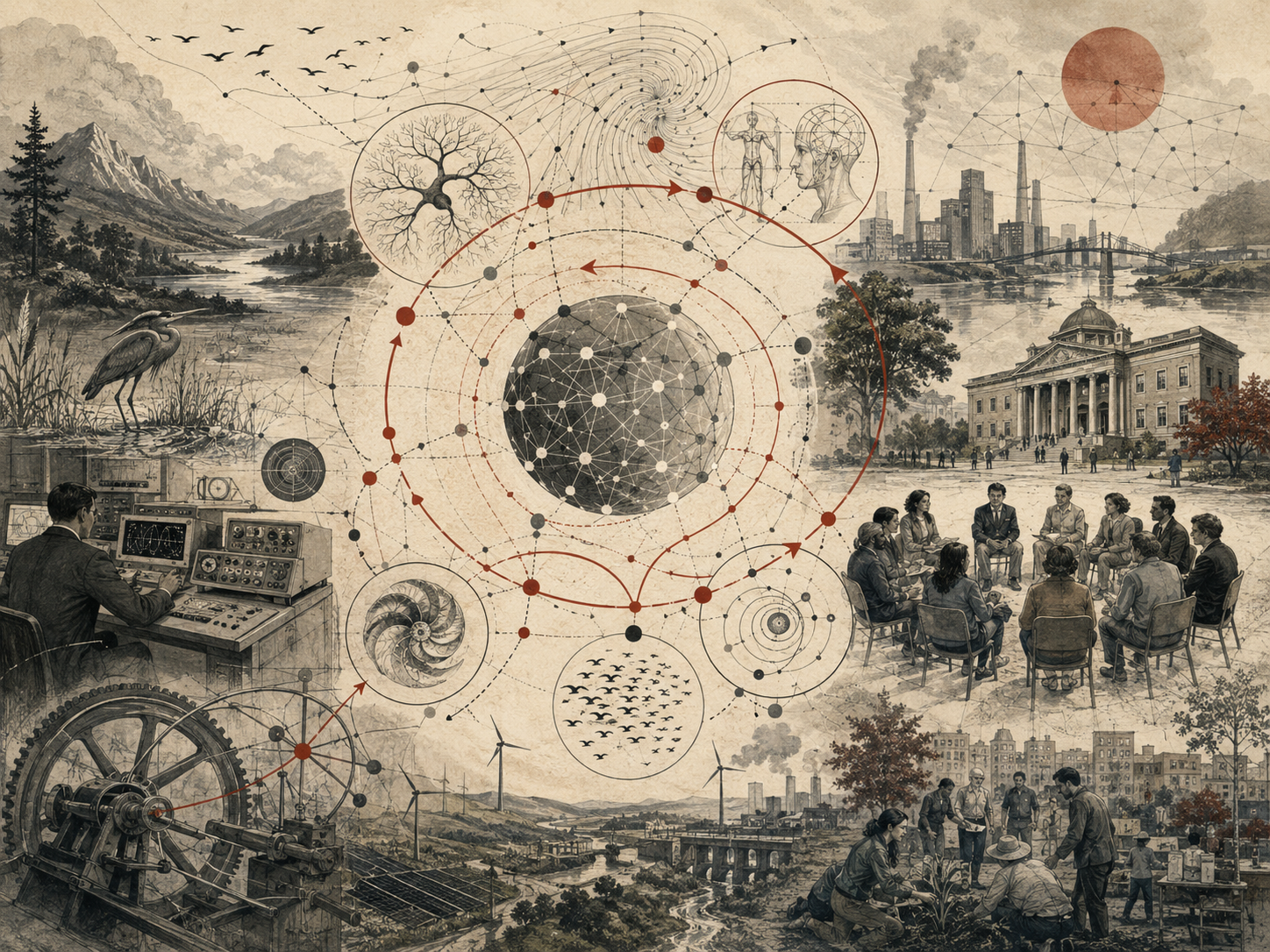
This article traces the intellectual foundations of modern systems thinking. It begins with cybernetics and its concern with feedback, control, communication, and regulation. It then examines general systems theory and its effort to identify organizational principles across biological, social, and technical systems. It shows how systems thinking emerged as a practical, interdisciplinary mode of inquiry that draws from both traditions while extending them into public policy, organizations, ecological systems, technology, infrastructure, AI, sustainability, and governance. The article also addresses the ethical limits of control-oriented thinking and argues that systems insight must be joined to humility, democratic accountability, ecological responsibility, and attention to power.
Why This History Matters for Systems Thinking
The history of cybernetics and general systems theory matters because systems thinking did not emerge from a single discipline. It developed across mathematics, biology, engineering, anthropology, psychology, computer science, ecology, management, economics, public policy, and philosophy. Its core vocabulary — feedback, control, communication, boundary, open system, regulation, adaptation, emergence, hierarchy, self-organization, and learning — comes from multiple intellectual lineages.
Understanding these lineages helps prevent systems thinking from becoming vague. When people use systems language loosely, it can become little more than a synonym for “complex” or “interconnected.” Cybernetics and general systems theory remind us that systems inquiry has sharper questions. How does information move? What feedback loops regulate behavior? What variety must a system absorb? What boundary defines the system? What is open to exchange? What emerges from interaction? What is being controlled? Who controls it? What does the system learn? What consequences are delayed?
This history also helps clarify the tension at the heart of systems thinking. Cybernetics often used the language of control, regulation, and goal-directed behavior. General systems theory often used the language of wholeness, openness, organization, and hierarchy. Systems thinking inherits both: the need to understand feedback and regulation, and the need to respect the integrity, openness, and complexity of whole systems.
| Tradition | Primary concern | Systems-thinking inheritance |
|---|---|---|
| Cybernetics | Communication, control, feedback, regulation, adaptation, purposive behavior. | Feedback loops, information flows, control systems, learning, variety, governance. |
| General systems theory | Wholeness, open systems, organization, hierarchy, interdependence, cross-disciplinary principles. | Boundaries, system levels, openness, emergence, structure, interdisciplinary inquiry. |
| System dynamics | Stocks, flows, delays, feedback structure, simulation, behavior over time. | Dynamic modeling, policy resistance, leverage, scenario testing. |
| Organizational learning | Mental models, shared vision, team learning, institutional memory, feedback use. | Learning organizations, systems leadership, knowledge flow, adaptive capacity. |
| Contemporary systems thinking | Practical diagnosis of complex social, ecological, technological, and institutional systems. | Integrated analysis of feedback, boundaries, emergence, adaptation, power, and ethics. |
The historical traditions also warn against two errors. The first is mechanical reductionism: treating human, ecological, and institutional systems as if they were simple machines to be optimized from above. The second is vague holism: speaking of “the whole” without specifying feedback, boundaries, information, structure, and power. Serious systems thinking must avoid both.
Cybernetics and general systems theory remain useful because modern problems are not merely complicated. They are adaptive. AI platforms learn from users. Climate systems respond to accumulated emissions. Institutions respond to incentives and political pressure. Organizations filter feedback. Infrastructure systems degrade through delayed maintenance. Public trust accumulates and erodes. Digital systems amplify behavior through feedback loops. Understanding this world requires a disciplined language of systems.
Cybernetics: Communication, Control, and Feedback
Cybernetics emerged in the mid-twentieth century as an interdisciplinary study of communication and control in animals, machines, and social systems. Its central insight was that systems regulate behavior through feedback. A thermostat measures temperature, compares it to a desired level, and adjusts heating or cooling. A pilot adjusts course using information about deviation from a target. A living organism regulates temperature, balance, metabolism, and movement. An organization monitors performance and adjusts action. A society develops institutions that respond, adapt, and sometimes fail to learn.
Cybernetics made feedback a general concept. Instead of seeing cause and effect as one-directional, cybernetics emphasized circular causality. An action changes the environment; information about that change returns to the actor or controller; the next action is adjusted. Feedback can stabilize a system, amplify behavior, produce oscillation, or create unexpected consequences depending on delay, information quality, control strength, and system structure.
\text{Action}_{t+1} = f(\text{Goal}, \text{Observed State}_t, \text{Feedback}_t)
\]
Interpretation: Cybernetic systems adjust action by comparing goals with observed system states and feedback.
Cybernetics also changed how people thought about machines and organisms. Machines were no longer only passive mechanisms. Some machines could sense, compare, adjust, and regulate. Organisms could be studied as self-regulating systems. Human communication could be examined in terms of feedback, noise, signal, meaning, and response. Organizations could be analyzed as information-processing systems.
But cybernetics also carried risks. The language of control can become politically dangerous when applied uncritically to human beings, communities, workers, students, patients, or citizens. A system that controls behavior may be efficient, but efficiency is not justice. A feedback system may optimize a target while harming people outside the model boundary. Cybernetic thinking therefore requires ethical interpretation: control by whom, over what, for what purpose, with what accountability, and at whose expense?
Systems thinking inherits cybernetics’ power and its warning. Feedback matters. Information matters. Regulation matters. But control must not become domination. The task is not merely to make systems controllable. It is to make them intelligible, accountable, adaptive, just, and capable of learning.
Norbert Wiener and the Feedback Imagination
Norbert Wiener is one of the central figures in cybernetics. His work connected mathematics, engineering, communication, control, and social reflection. Cybernetics, as he framed it, was concerned with control and communication in animals and machines. This formulation was powerful because it crossed disciplinary boundaries. It suggested that similar feedback principles could appear in mechanical devices, organisms, nervous systems, communication networks, and social systems.
Wiener’s cybernetics emerged in a world shaped by war, automation, anti-aircraft control, communication engineering, and early computing. These contexts matter. Feedback control was not merely a philosophical idea. It was tied to real systems where sensing, prediction, error correction, and response could determine outcomes. Cybernetics developed in relation to technical systems that acted in changing environments.
Wiener also understood that cybernetics had social consequences. Automation could displace labor. Control systems could be used for domination. Communication technologies could reshape society. Technical power required ethical caution. This makes Wiener’s legacy especially relevant today, when AI, algorithmic governance, platform feedback, surveillance systems, robotics, and automated decision-making revive many cybernetic questions in new forms.
\text{Error}_t = \text{Desired State}_t – \text{Observed State}_t
\]
Interpretation: Many cybernetic systems regulate behavior by detecting error between a desired state and an observed state, then acting to reduce the gap.
The feedback imagination is still central to systems thinking. A public agency compares service standards with actual performance. A climate policy compares emissions targets with measured emissions. A platform compares engagement goals with user behavior. A hospital compares care capacity with demand. A school compares learning goals with student outcomes. In each case, the system’s behavior depends on what is measured, how feedback is interpreted, what action is possible, and what goal the system is trying to serve.
Wiener’s legacy is therefore not only technical. It is moral. A cybernetic system can regulate toward worthy goals or harmful goals. It can reduce error, but only relative to the target it has been given. Systems thinking must ask whether the goal itself is just, humane, ecological, and accountable.
W. Ross Ashby and the Law of Requisite Variety
W. Ross Ashby contributed one of the most important cybernetic ideas: the law of requisite variety. In simple terms, a system must have enough internal variety to respond to the variety of disturbances it faces. A regulator that can respond in only one way cannot manage an environment with many different forms of disruption. A rigid organization cannot handle a rapidly changing world. A brittle governance system cannot respond to diverse public needs. A narrow AI safety system cannot manage complex social harms if its response repertoire is too limited.
Requisite variety is a powerful idea because it connects complexity to capacity. Systems fail when the variety of the environment exceeds the variety of the regulator. A public health system needs surveillance, clinical capacity, community trust, supply chains, communication, legal authority, and adaptive decision-making because disease dynamics are varied. A climate adaptation system needs heat response, flood management, grid resilience, housing retrofits, public health planning, ecological restoration, and community governance because climate risks are varied.
V_R \geq V_D
\]
Interpretation: Requisite variety means the response variety \(V_R\) of a regulator must be at least as great as the disturbance variety \(V_D\) it must manage.
This idea is especially relevant for organizations. A centralized hierarchy with limited information may not have enough variety to respond to local conditions. A learning organization increases variety by distributing intelligence, improving feedback, supporting team learning, preserving institutional memory, and enabling local adaptation. A resilient infrastructure system increases variety through redundancy, modularity, flexible response, and diverse pathways. An ecological system increases resilience through biodiversity and functional diversity.
Requisite variety also has justice implications. Communities facing complex risks need resources, rights, information, and authority to respond. If marginalized communities are exposed to high disturbance variety but denied response capacity, the system is unjust by design. Systems thinking must ask not only whether the regulator has enough variety, but who has variety, who lacks it, and who bears the risk when response capacity is inadequate.
Ashby’s insight remains foundational: complexity cannot be managed by oversimplification. A system must either reduce the variety it faces, increase the variety of its responses, or suffer failure. In public systems, the ethical path usually involves building legitimate, distributed, accountable capacity rather than imposing rigid control.
Stafford Beer and Organizational Cybernetics
Stafford Beer extended cybernetic thinking into management and organizational design. He is best known for the viable system model, which examined how organizations maintain viability in changing environments. A viable system must sense its environment, coordinate internal operations, allocate resources, adapt strategically, preserve identity, and regulate conflicts among subsystems. Beer’s work remains important because it treats organizations not as static charts, but as living regulatory systems.
Organizational cybernetics asks whether an organization has the feedback and governance capacity needed to survive, learn, and act coherently. Do operations receive timely information? Can local units adapt? Does coordination prevent fragmentation? Does strategy respond to environmental change? Does the organization preserve identity without becoming rigid? Are feedback loops suppressed by hierarchy? Does the organization have enough variety to manage its environment?
Beer’s work is also historically significant because of Project Cybersyn in Chile during the early 1970s, an ambitious effort to use cybernetic principles and communication systems for economic coordination. Cybersyn remains debated and symbolically powerful because it raises enduring questions about technology, democracy, planning, participation, control, and political power. It shows both the imagination and the danger of cybernetic governance.
\text{Organizational Viability} = f(\text{Operations}, \text{Coordination}, \text{Control}, \text{Intelligence}, \text{Identity})
\]
Interpretation: A viable organization must coordinate operations, regulate performance, sense its environment, adapt strategically, and preserve identity.
Beer’s legacy is valuable for systems thinking because institutions often fail through poor regulatory design. They may collect information but fail to act. They may centralize authority so heavily that local intelligence is lost. They may decentralize without coordination. They may optimize departments while weakening the whole. They may preserve identity so rigidly that adaptation becomes impossible. Organizational cybernetics helps diagnose these failures structurally.
But Beer’s work also demands ethical caution. Organizational viability is not automatically good. A harmful institution can be viable. A surveillance system can be well-regulated. A bureaucracy can preserve itself while failing the public. Systems thinking must therefore ask: viable for what purpose, accountable to whom, and with what consequences?
Organizational cybernetics is strongest when viability is linked to democratic accountability, worker voice, public value, ecological limits, and the capacity for correction.
Bateson, Mead, and Cybernetics as Cultural Inquiry
Cybernetics was not only an engineering tradition. Gregory Bateson, Margaret Mead, and other anthropologists and social thinkers helped bring cybernetic ideas into the study of communication, culture, family systems, ecology, and learning. Their work matters because it moved cybernetics beyond machines and technical control into patterns of relationship, meaning, perception, and social behavior.
Bateson’s work emphasized patterns that connect: communication, learning, feedback, context, recursion, and ecological relationship. He saw mind and communication as relational rather than isolated. Meaning emerged through patterns of difference, response, and context. This broadened cybernetics into a philosophy of relationship and learning. It also influenced family therapy, ecology, anthropology, and later systems thinking.
Mead’s involvement in cybernetic conversations is important because she brought anthropological attention to culture, social organization, and human meaning. If cybernetics studies communication and regulation, then culture itself becomes a field of feedback: norms are transmitted, corrected, reinforced, contested, and adapted. Social systems regulate behavior not only through machines and formal rules, but through meaning, ritual, expectation, status, identity, and interpretation.
\text{Meaning} = f(\text{Signal}, \text{Context}, \text{Relationship}, \text{Feedback})
\]
Interpretation: In social systems, information does not operate as raw signal alone. Meaning depends on context, relationships, interpretation, and feedback.
This cultural branch of cybernetics is essential for responsible systems thinking. Human systems are not only regulatory systems. They are meaning-making systems. A public message may fail not because information is missing, but because trust is absent. A policy may be resisted not because people are irrational, but because it violates lived experience or historical memory. An organization may misunderstand feedback because its culture filters what can be said.
Bateson and Mead help prevent cybernetics from becoming mechanically narrow. Feedback is not only technical; it is social and interpretive. Communication is not only transmission; it is meaning-making. Control is not only regulation; it is power. Learning is not only adaptation; it is transformation of perception.
This tradition remains especially important in public policy, public health, AI governance, environmental communication, organizational learning, and social change. Systems thinking must understand not only signals, but the social worlds in which signals become meaningful.
General Systems Theory: Wholeness, Openness, and Organization
General systems theory developed as an effort to identify principles that apply across different kinds of systems. It resisted the fragmentation of knowledge into isolated disciplines and argued that living, social, and technical systems share certain organizational features. Systems have parts, relationships, boundaries, levels, flows, inputs, outputs, feedback, and emergent properties. The whole is not merely the sum of its parts because relationships among parts matter.
General systems theory was especially important in biology. Living organisms cannot be understood only by reducing them to components. They are organized wholes that exchange matter, energy, and information with their environments. They maintain themselves through processes of regulation, metabolism, growth, adaptation, and differentiation. This biological orientation helped make open systems central to systems thinking.
The theory also encouraged interdisciplinary inquiry. A principle observed in one field might illuminate another, not because all systems are identical, but because similar patterns of organization can appear across domains. Hierarchy, feedback, boundary exchange, differentiation, integration, adaptation, and equilibrium are not limited to one discipline.
\text{System} = \text{Elements} + \text{Relationships} + \text{Boundary} + \text{Environment}
\]
Interpretation: A system is defined not only by its parts, but by relationships among parts, its boundary, and its exchanges with the environment.
General systems theory also shaped the way people think about levels. A cell belongs to a tissue, a tissue to an organ, an organ to an organism, an organism to an ecosystem. A worker belongs to a team, a team to an organization, an organization to an industry, an industry to an economy, an economy to a biosphere. Each level has properties that cannot be fully explained by looking only at lower levels.
The danger of general systems theory is excessive abstraction. If concepts become too general, they can lose diagnostic precision. To say that everything is interconnected is not enough. Serious systems thinking must specify how the system is connected, what flows across boundaries, what feedback loops dominate, what levels matter, what constraints operate, what goals are present, and what power relations shape behavior.
General systems theory remains valuable because it provides the philosophical foundation for interdisciplinary systems inquiry. It teaches that systems must be understood as organized, open, relational wholes.
Ludwig von Bertalanffy and Open Systems
Ludwig von Bertalanffy is one of the central figures in general systems theory. He challenged mechanistic and reductionist approaches by emphasizing organisms as open systems. Living systems maintain themselves not by being closed and static, but by exchanging matter, energy, and information with their environments. They are organized, dynamic, and adaptive.
The concept of open systems is foundational for modern systems thinking. A city is open to migration, capital, food, energy, water, waste, information, and climate risk. An organization is open to labor markets, regulation, public trust, technology, supply chains, and social norms. A digital platform is open to user behavior, advertisers, regulators, infrastructure, data flows, and cultural feedback. An ecosystem is open to energy flows, species movement, climate shifts, nutrient cycles, and human disturbance.
Open systems thinking helps explain why system boundaries are analytical choices rather than fixed realities. If a hospital is studied only as a building, one misses housing, insurance, transportation, workforce pipelines, public health, community trust, and environmental exposure. If a platform is studied only as software, one misses labor, governance, attention markets, social harm, infrastructure, and political economy. Boundaries define what can be seen.
\text{Open System State}_{t+1} = f(\text{Internal Structure}_t, \text{Inputs}_t, \text{Outputs}_t, \text{Environmental Feedback}_t)
\]
Interpretation: Open systems change through internal structure, exchanges with the environment, outputs, and feedback from those exchanges.
Bertalanffy’s open systems perspective also matters for sustainability. Human economies are not closed systems floating above nature. They are open subsystems of the biosphere. They depend on energy, materials, ecological services, water, soil, climate stability, and living systems. Treating the economy as closed encourages ecological blindness. Open systems thinking reveals dependency.
Open systems also challenge simplistic control. If a system is open, interventions may produce effects beyond the boundary originally considered. A policy may shift burdens elsewhere. A technology may create new dependencies. A supply-chain optimization may increase ecological risk. A local improvement may export harm to another community. Systems thinking must therefore track boundary crossings and externalized consequences.
Bertalanffy’s legacy is a reminder that systems are not isolated objects. They live through exchange.
Boulding, Rapoport, and the Search for Common System Principles
Kenneth Boulding and Anatol Rapoport helped extend systems theory into economics, social science, conflict, communication, and interdisciplinary research. They contributed to a broader systems movement that sought common language across fields without collapsing all disciplines into one. Their work reflected a mid-twentieth-century hope that systems concepts could help scholars and practitioners understand complexity across domains.
Boulding’s work is important because he saw systems thinking as a way to organize knowledge across levels. He proposed hierarchies of system complexity, from static structures to clockworks, control systems, open systems, organisms, animals, humans, social organizations, and transcendental systems. The details of any hierarchy can be debated, but the central point remains useful: systems differ in complexity, agency, communication, learning, and self-awareness.
Rapoport’s work connected systems theory to communication, conflict, game theory, and social interaction. He helped show that systems concepts are not limited to physical or biological systems. They also apply to conflict dynamics, cooperation, escalation, strategic interaction, and social behavior. This is especially relevant for governance, diplomacy, institutions, organizational conflict, and collective action.
\text{System Complexity} = f(\text{Organization}, \text{Communication}, \text{Adaptation}, \text{Learning}, \text{Self-Reference})
\]
Interpretation: Systems become more complex as organization, communication, adaptation, learning, and self-reference increase.
The search for common system principles has both value and risk. The value is interdisciplinary learning. A feedback pattern in ecology may illuminate organizations. A boundary problem in biology may illuminate public policy. A coordination problem in game theory may illuminate institutional design. The risk is false equivalence: assuming that systems are the same because they share abstract patterns.
Responsible systems thinking uses analogy carefully. It asks what is similar, what is different, and where the analogy breaks. A city is not a machine. An ecosystem is not a corporation. A human community is not an algorithm. But feedback, communication, adaptation, and structure can still help explain their behavior.
Boulding, Rapoport, and the broader general systems movement helped create the intellectual conditions for modern interdisciplinary systems thinking: a language broad enough to connect fields, but demanding enough to require careful translation.
Systems Thinking as a Practical Synthesis
Systems thinking can be understood as a practical synthesis of cybernetics, general systems theory, system dynamics, ecological thinking, organizational learning, complexity theory, and applied problem-solving. It is less a single theory than a disciplined way of asking questions about relationships, feedback, boundaries, accumulations, delays, adaptation, emergence, leverage, and consequences.
From cybernetics, systems thinking inherits feedback, communication, regulation, and learning. From general systems theory, it inherits openness, boundaries, hierarchy, wholeness, and cross-level organization. From system dynamics, it inherits stocks, flows, delays, simulation, and behavior over time. From ecology, it inherits resilience, interdependence, carrying capacity, biodiversity, and disturbance. From organizational learning, it inherits mental models, dialogue, shared vision, knowledge flow, and institutional memory. From complexity theory, it inherits emergence, adaptation, nonlinear change, and self-organization.
This synthesis is useful because real-world problems do not respect disciplinary boundaries. Climate resilience is ecological, infrastructural, economic, political, cultural, and technological. AI governance is technical, organizational, legal, ethical, economic, and social. Public health is biological, behavioral, institutional, environmental, and informational. Housing affordability is spatial, financial, legal, infrastructural, social, and historical.
\text{Systems Thinking} = \text{Feedback} + \text{Boundaries} + \text{Stocks and Flows} + \text{Emergence} + \text{Learning} + \text{Ethics}
\]
Interpretation: Modern systems thinking integrates feedback, boundaries, accumulations, emergence, learning, and ethical responsibility.
Systems thinking is practical because it changes diagnosis. Instead of asking only what went wrong, it asks what structure made the outcome likely. Instead of asking only which part failed, it asks how relationships among parts produced failure. Instead of asking only how to optimize, it asks what goal the system serves. Instead of asking only what data says, it asks who receives information and who can act. Instead of asking only how to control, it asks how to learn and adapt responsibly.
Systems thinking should not erase the differences among its source traditions. Cybernetics, general systems theory, system dynamics, ecology, and organizational learning each have distinctive histories and methods. But together they provide a strong foundation for analyzing complex systems without reducing them to isolated parts or vague wholes.
Feedback, Boundaries, Emergence, and Adaptation
Four ideas connect cybernetics, general systems theory, and systems thinking especially strongly: feedback, boundaries, emergence, and adaptation. Feedback explains circular causality. Boundaries define what is inside and outside the system for purposes of analysis. Emergence explains how whole-system properties arise from interaction among parts. Adaptation explains how systems change in response to disturbance, learning, and environmental conditions.
Feedback is the cybernetic core. It shows that systems often respond to their own behavior. A policy changes incentives; people respond; the policy’s effects change. A platform ranks content; users react; the ranking system learns from the reaction. A public agency communicates; trust shapes response; response shapes future communication. Feedback makes systems dynamic.
Boundaries are the systems-theory core. Every analysis draws a boundary, but boundaries are not neutral. A housing system may include only construction, or it may include wages, land value, transit, zoning, speculation, credit, public housing, race, displacement, and regional governance. Different boundaries produce different diagnoses. Boundary critique is therefore central to ethical systems thinking.
Emergence occurs when interactions among parts produce properties not visible in the parts alone. Traffic congestion emerges from many individual trips, road capacity, land use, signals, bottlenecks, and behavior. Organizational culture emerges from rules, stories, incentives, leadership, routines, conflict, and memory. Public trust emerges from repeated institutional behavior, not from one communication campaign.
Adaptation is the response of a system to changing conditions. Adaptation can be beneficial, harmful, or defensive. A community may adapt creatively to climate risk. A bureaucracy may adapt to preserve itself. A platform may adapt to maximize engagement despite social harm. A disease system may adapt through mutation. Systems thinking asks what adaptation serves and what it costs.
| Concept | Diagnostic question | Example |
|---|---|---|
| Feedback | How does system behavior influence future behavior? | Trust improves cooperation, which improves outcomes, which builds trust. |
| Boundary | What is included, excluded, and externalized? | A supply chain model may exclude labor conditions or ecological harm. |
| Emergence | What pattern arises from interactions among parts? | Congestion, culture, market bubbles, polarization, and public trust. |
| Adaptation | How does the system respond to disturbance or feedback? | Organizations learn, resist, deny, reorganize, or shift burdens. |
These concepts make systems thinking more than a general interest in complexity. They give analysts a disciplined way to ask how structure, information, relationships, and response generate behavior through time.
Control, Humility, and the Limits of Systems Intervention
Cybernetics introduced powerful language of control, but modern systems thinking must handle that language carefully. Control can mean regulation, guidance, correction, or coordination. It can also mean domination, surveillance, coercion, and manipulation. The same feedback principle that stabilizes a thermostat can be used to manage workers, shape platform behavior, target consumers, monitor citizens, or suppress dissent.
Complex human and ecological systems cannot be treated as simple control problems. They contain meaning, power, values, history, agency, uncertainty, and unintended consequences. Attempts to control such systems from above often produce policy resistance. People adapt around rules. Institutions defend routines. Metrics become targets. Informal systems emerge. Hidden burdens shift elsewhere. The controller becomes part of the system it seeks to control.
Humility is therefore not optional. A systems intervention should begin with the assumption that the system is partially understood. The model is partial. The boundary is contested. Feedback may be delayed. Affected people may know things the analyst does not. The intervention may produce side effects. Learning must continue after action begins.
\text{Responsible Intervention} = \text{Model} + \text{Participation} + \text{Feedback} + \text{Revision} + \text{Accountability}
\]
Interpretation: Systems intervention becomes responsible when modeling is joined to participation, feedback, revision, and accountability.
This does not mean systems should never be regulated. Public health systems need regulation. Infrastructure systems need standards. AI systems need governance. Climate systems need emissions control. Financial systems need oversight. The issue is not whether control exists, but how it is designed, who holds it, who can challenge it, and whether it serves legitimate public purposes.
The best systems thinking moves from command-and-control toward learning-and-accountability. It designs feedback loops that make harm visible, gives affected people voice, revises rules when consequences appear, and recognizes that no model fully contains the system. Control without humility becomes domination. Humility without responsibility becomes passivity. Systems thinking needs both responsibility and restraint.
Cybernetics in the Age of AI and Digital Platforms
Cybernetic questions have returned with new urgency in the age of AI and digital platforms. AI systems classify, predict, recommend, generate, optimize, and adapt. Platforms observe user behavior, rank content, measure engagement, update models, and reshape future behavior. Digital infrastructures create feedback loops between people and machines at enormous scale. Cybernetics is no longer only a historical field. It is embedded in everyday digital life.
An AI recommendation system is a feedback system. It observes behavior, infers preferences, recommends content, receives new behavior, and updates future recommendations. This can help people find useful information. It can also amplify extremity, misinformation, addictive use, social comparison, polarization, or commercial manipulation if the system’s goals and feedback signals are poorly aligned with human wellbeing.
AI governance therefore requires systems thinking. It is not enough to inspect a model in isolation. Analysts must examine data sources, feedback loops, user behavior, incentives, deployment context, institutional goals, monitoring systems, error correction, accountability, and affected communities. A model may perform well on a benchmark while producing harmful system behavior in deployment.
\text{AI System Behavior} = f(\text{Model}, \text{Data}, \text{Feedback}, \text{Incentives}, \text{Users}, \text{Institutional Context})
\]
Interpretation: AI behavior in the real world emerges from models, data, feedback loops, incentives, users, and institutional context.
Digital platforms also illustrate Ashby’s law of requisite variety. A platform facing diverse forms of harm needs diverse response capacity: moderation, user controls, appeal systems, transparency, rate limits, friction, civic integrity measures, community governance, external audits, and legal accountability. A narrow response system cannot manage a high-variety harm environment.
Cybernetics also warns that automated feedback can accelerate harm. When a system learns from its own outputs, it can reinforce bias, misinformation, market distortion, user dependency, or institutional error. Feedback loops that are fast, opaque, and profit-driven require special scrutiny because they can scale consequences before human governance catches up.
The cybernetic age of AI requires a deeper question: not only whether machines can learn, but whether institutions can learn responsibly from what machines do.
Ethics: Power, Control, Surveillance, and Accountability
Cybernetics and systems theory carry ethical stakes because they concern regulation, information, control, and organization. These are never neutral in social systems. A system that gathers information can protect people or surveil them. A feedback loop can support learning or enforce compliance. A control system can stabilize public safety or suppress autonomy. A model can reveal hidden harm or hide responsibility behind technical language.
The ethical question begins with power. Who defines the system goal? Who chooses the boundary? Who controls the information? Who is monitored? Who can contest errors? Who benefits from optimization? Who bears the costs of failure? What values are embedded in the feedback loop? What harms are externalized? What histories are preserved in the system’s stocks?
Cybernetic control can be especially dangerous when applied to marginalized communities, workers, students, patients, migrants, welfare recipients, or politically vulnerable groups. Automated systems may claim neutrality while reproducing unequal surveillance and unequal consequences. Feedback systems may adapt to enforce institutional priorities rather than human dignity. Systems thinking must therefore be explicit about justice.
\text{Ethical Systems Practice} = \text{Transparency} + \text{Voice} + \text{Contestability} + \text{Repair} + \text{Accountability}
\]
Interpretation: Systems involving control, information, and decision-making require transparency, affected voice, contestability, repair, and accountability.
Ethics also requires resisting the seduction of total control. Complex systems are not made healthy by making every behavior visible and adjustable. Human freedom, democratic disagreement, privacy, dignity, ecological limits, and local knowledge matter. A system that optimizes everything may become oppressive if it optimizes toward the wrong goal.
Responsible systems thinking must therefore distinguish learning from surveillance, coordination from coercion, feedback from behavioral manipulation, and regulation from domination. The purpose of systems insight should be repair, resilience, justice, ecological responsibility, and public value — not control for its own sake.
Examples Across Cybernetic and Systems Traditions
Cybernetics, general systems theory, and systems thinking appear across many modern domains. The examples below show how their concepts clarify feedback, communication, boundaries, regulation, adaptation, and ethical consequence.
Thermostats and control systems
A thermostat senses temperature, compares it with a desired state, and adjusts heating or cooling. It is a simple example of feedback control.
Public health surveillance
Disease monitoring becomes cybernetic when signals trigger response. It becomes ethical when response is transparent, equitable, trusted, and accountable.
AI recommendation systems
Platforms observe behavior, recommend content, receive new feedback, and adjust future exposure. The system’s goals determine what behavior is amplified.
Organizational learning
Organizations learn when feedback travels across hierarchy, assumptions can be examined, and decisions change in response to evidence.
Ecological open systems
Ecosystems exchange energy, matter, organisms, and information with their environments. Their behavior cannot be understood through isolated parts alone.
Infrastructure control rooms
Power grids, transit systems, and water networks depend on sensing, feedback, regulation, redundancy, and response variety to remain viable.
Platform governance
Moderation systems need requisite variety because harms differ across contexts, languages, communities, incentives, and adversarial behavior.
Climate feedback loops
Climate systems include reinforcing and balancing feedback, delayed effects, thresholds, and open exchanges among atmosphere, oceans, ice, land, and life.
Across these examples, systems thinking asks how information moves, how feedback changes behavior, what boundaries hide or reveal, what variety the system must handle, and whether the system’s goals are legitimate.
Mathematics, Computation, and Modeling
Cybernetics and systems theory can be modeled through feedback, state variables, information flows, response variety, delays, and adaptation. The purpose of modeling is not to reduce all systems to machines. It is to clarify how feedback and structure generate behavior and how response capacity interacts with disturbance.
A simple feedback-control equation can be written as:
u_t = k(r_t – y_t)
\]
Interpretation: Control action \(u_t\) responds to the difference between a reference goal \(r_t\) and observed output \(y_t\), scaled by control strength \(k\).
A state-update equation can be written as:
x_{t+1} = x_t + f(x_t, u_t, d_t)
\]
Interpretation: A system state \(x\) changes through internal dynamics, control action \(u\), and disturbance \(d\).
A requisite-variety condition can be represented as:
V_R \geq V_D
\]
Interpretation: The response variety \(V_R\) must be sufficient to handle disturbance variety \(V_D\).
A boundary-exchange structure for an open system can be written as:
S_{t+1} = S_t + I_t – O_t + E_t
\]
Interpretation: A system state changes through internal accumulation, inflows, outflows, and environmental exchange \(E_t\).
| Modeling task | Systems question | Example output |
|---|---|---|
| Feedback control | How does the system compare goals with observed state? | Error, correction, overshoot, oscillation, stabilization. |
| Requisite variety | Does response capacity match disturbance variety? | Variety gap, brittleness risk, adaptive capacity score. |
| Open-system exchange | What crosses the boundary? | Inputs, outputs, externalized harm, environmental dependency. |
| Delay analysis | Does feedback arrive too late? | Delayed correction, overshoot, instability, policy resistance. |
| Adaptation modeling | How does the system learn or reorganize? | Learning rate, response diversity, resilience, maladaptation. |
| Ethical boundary review | Who is included, excluded, monitored, or controlled? | Accountability gaps, contestability needs, repair pathways. |
These mathematical forms are useful because they make assumptions explicit. But they must be interpreted carefully. Human and ecological systems include meaning, power, values, uncertainty, and history. A model can clarify feedback; it cannot decide what should be controlled, who should control it, or what purpose the system should serve.
Python Workflow: Feedback, Variety, Adaptation, and Control
The Python workflow for this article models a cybernetic and general-systems scenario with feedback control, disturbance variety, response variety, adaptation, delay, open-system exchange, trust, and accountability. It uses only the Python standard library so it can run without external dependencies. The workflow compares four scenarios: rigid control, delayed feedback, adaptive regulation, and accountable learning system.
# cybernetics_systems_model.py
# Dependency-light professional workflow for cybernetics, general systems theory, and systems thinking.
# Purpose: simulate feedback control, requisite variety, open-system exchange, adaptation, delay,
# trust, accountability, and system performance.
# Uses only Python standard library.

from dataclasses import dataclass
import csv
import os
from statistics import mean

OUTPUT_TABLES = "outputs/tables"

@dataclass
class CyberneticScenario:
    name: str
    periods: int
    initial_state: float
    reference_goal: float
    disturbance_variety: float
    response_variety: float
    feedback_quality: float
    feedback_delay: int
    control_strength: float
    adaptation_rate: float
    openness: float
    accountability_quality: float
    trust_level: float

def ensure_outputs() -> None:
    os.makedirs(OUTPUT_TABLES, exist_ok=True)

def clamp(value: float, low: float = 0.0, high: float = 100.0) -> float:
    return max(low, min(high, value))

def delayed_value(history: list[float], delay: int) -> float:
    if len(history) <= delay:
        return history[0]
    return history[-delay - 1]

def run_scenario(scenario: CyberneticScenario) -> list[dict]:
    state = scenario.initial_state
    response_variety = scenario.response_variety * 100.0
    trust = scenario.trust_level * 100.0
    learning_capacity = 38.0
    state_history = [state]
    rows = []

    for period in range(scenario.periods + 1):
        observed_state = delayed_value(state_history, scenario.feedback_delay)
        error = scenario.reference_goal - observed_state

        variety_gap = clamp(scenario.disturbance_variety * 100.0 - response_variety)

        control_action = clamp(
            abs(error) * scenario.control_strength
            + scenario.feedback_quality * 8.0
            - variety_gap * 0.08
        )

        disturbance_pressure = clamp(
            scenario.disturbance_variety * 9.0
            + scenario.openness * 3.0
            + period * 0.03
        )

        environmental_exchange = scenario.openness * 2.5 - scenario.accountability_quality * 1.4

        correction_direction = 1.0 if error >= 0 else -1.0
        state = clamp(
            state
            + correction_direction * control_action * 0.18
            - disturbance_pressure * 0.20
            + environmental_exchange
        )

        response_variety = clamp(
            response_variety
            + scenario.adaptation_rate * 3.2
            + scenario.feedback_quality * 1.6
            + scenario.accountability_quality * 1.4
            - variety_gap * 0.04
        )

        learning_capacity = clamp(
            learning_capacity
            + scenario.feedback_quality * 1.8
            + scenario.adaptation_rate * 2.2
            + scenario.accountability_quality * 1.6
            - max(0.0, 45.0 - trust) * 0.04
        )

        trust = clamp(
            trust
            + scenario.accountability_quality * 1.9
            + scenario.feedback_quality * 1.0
            - variety_gap * 0.05
            - abs(error) * 0.03
        )

        regulation_quality = clamp(
            100.0
            - abs(scenario.reference_goal - state) * 0.55
            - variety_gap * 0.30
            + response_variety * 0.18
            + learning_capacity * 0.18
            + trust * 0.10
        )

        accountability_index = clamp(
            scenario.accountability_quality * 45.0
            + trust * 0.25
            + scenario.feedback_quality * 20.0
            - variety_gap * 0.15
        )

        rows.append({
            "period": period,
            "scenario": scenario.name,
            "system_state": round(state, 3),
            "observed_state": round(observed_state, 3),
            "reference_goal": round(scenario.reference_goal, 3),
            "error_signal": round(error, 3),
            "control_action": round(control_action, 3),
            "disturbance_pressure": round(disturbance_pressure, 3),
            "response_variety": round(response_variety, 3),
            "variety_gap": round(variety_gap, 3),
            "learning_capacity": round(learning_capacity, 3),
            "trust_index": round(trust, 3),
            "regulation_quality": round(regulation_quality, 3),
            "accountability_index": round(accountability_index, 3)
        })

        state_history.append(state)

    return rows

def write_csv(path: str, rows: list[dict]) -> None:
    if not rows:
        return
    with open(path, "w", newline="", encoding="utf-8") as handle:
        writer = csv.DictWriter(handle, fieldnames=list(rows[0].keys()))
        writer.writeheader()
        writer.writerows(rows)

def summarize(rows: list[dict]) -> list[dict]:
    summary = []

    for scenario_name in sorted(set(row["scenario"] for row in rows)):
        subset = [row for row in rows if row["scenario"] == scenario_name]
        final = subset[-1]
        avg_variety_gap = mean(row["variety_gap"] for row in subset)
        avg_regulation = mean(row["regulation_quality"] for row in subset)
        avg_accountability = mean(row["accountability_index"] for row in subset)
        avg_error = mean(abs(row["error_signal"]) for row in subset)

        if avg_variety_gap <= 15 and avg_regulation >= 65 and avg_accountability >= 60:
            diagnostic = "accountable adaptive regulation"
        elif avg_variety_gap >= 35:
            diagnostic = "response variety insufficient for disturbance variety"
        elif avg_error >= 25:
            diagnostic = "feedback delay or weak regulation creates persistent error"
        else:
            diagnostic = "partial regulation with remaining systems risk"

        summary.append({
            "scenario": scenario_name,
            "final_system_state": final["system_state"],
            "final_response_variety": final["response_variety"],
            "average_variety_gap": round(avg_variety_gap, 3),
            "average_regulation_quality": round(avg_regulation, 3),
            "average_accountability_index": round(avg_accountability, 3),
            "average_absolute_error": round(avg_error, 3),
            "final_learning_capacity": final["learning_capacity"],
            "final_trust_index": final["trust_index"],
            "diagnostic": diagnostic
        })

    return summary

def validate(rows: list[dict]) -> list[str]:
    errors = []
    bounded_fields = [
        "system_state",
        "control_action",
        "disturbance_pressure",
        "response_variety",
        "variety_gap",
        "learning_capacity",
        "trust_index",
        "regulation_quality",
        "accountability_index"
    ]

    for row in rows:
        for field in bounded_fields:
            if row[field] < -0.001 or row[field] > 120.001:
                errors.append(f"{field} outside expected range in {row['scenario']} period {row['period']}.")

    return errors

def main() -> None:
    ensure_outputs()

    scenarios = [
        CyberneticScenario(
            name="Rigid control",
            periods=48,
            initial_state=46.0,
            reference_goal=70.0,
            disturbance_variety=0.72,
            response_variety=0.34,
            feedback_quality=0.34,
            feedback_delay=8,
            control_strength=0.46,
            adaptation_rate=0.18,
            openness=0.48,
            accountability_quality=0.22,
            trust_level=0.42
        ),
        CyberneticScenario(
            name="Delayed feedback",
            periods=48,
            initial_state=46.0,
            reference_goal=70.0,
            disturbance_variety=0.66,
            response_variety=0.46,
            feedback_quality=0.42,
            feedback_delay=10,
            control_strength=0.62,
            adaptation_rate=0.26,
            openness=0.54,
            accountability_quality=0.34,
            trust_level=0.46
        ),
        CyberneticScenario(
            name="Adaptive regulation",
            periods=48,
            initial_state=46.0,
            reference_goal=70.0,
            disturbance_variety=0.62,
            response_variety=0.62,
            feedback_quality=0.66,
            feedback_delay=4,
            control_strength=0.48,
            adaptation_rate=0.62,
            openness=0.58,
            accountability_quality=0.58,
            trust_level=0.58
        ),
        CyberneticScenario(
            name="Accountable learning system",
            periods=48,
            initial_state=46.0,
            reference_goal=70.0,
            disturbance_variety=0.58,
            response_variety=0.70,
            feedback_quality=0.78,
            feedback_delay=3,
            control_strength=0.42,
            adaptation_rate=0.78,
            openness=0.64,
            accountability_quality=0.82,
            trust_level=0.66
        )
    ]

    all_rows = []
    for scenario in scenarios:
        all_rows.extend(run_scenario(scenario))

    validation_errors = validate(all_rows)
    if validation_errors:
        raise ValueError("Validation failed:\n" + "\n".join(validation_errors))

    summary_rows = summarize(all_rows)

    write_csv(os.path.join(OUTPUT_TABLES, "cybernetics_systems_timeseries.csv"), all_rows)
    write_csv(os.path.join(OUTPUT_TABLES, "cybernetics_systems_summary.csv"), summary_rows)

    with open(os.path.join(OUTPUT_TABLES, "validation_report.txt"), "w", encoding="utf-8") as handle:
        handle.write("Validation passed.\n")
        handle.write("Feedback, variety, adaptation, regulation, trust, and accountability outputs completed.\n")

    print("\nCybernetics and systems scenario summary:")
    for row in summary_rows:
        print(
            f"{row['scenario']}: variety gap={row['average_variety_gap']}, "
            f"regulation quality={row['average_regulation_quality']}, "
            f"diagnostic={row['diagnostic']}"
        )

if __name__ == "__main__":
    main()
This workflow shows why cybernetic regulation depends on more than control strength. Rigid control performs poorly when response variety is insufficient, feedback is delayed, trust is low, and accountability is weak. Adaptive regulation improves performance by increasing response capacity and learning. Accountable learning performs best because it combines feedback quality, response variety, adaptation, trust, and accountability.
A fuller repository version can add optional pandas and matplotlib workflows for richer dashboards, Excel workbooks, requisite-variety diagnostics, feedback-delay plots, adaptation scorecards, and accountability indicators while preserving this standard-library script as the default smoke-tested workflow.
R Workflow: Cybernetic and Systems Diagnostics
The R workflow for this article uses base R so it can run without additional package dependencies. It reads the Python-generated cybernetic and systems outputs, creates diagnostic summaries, exports scenario tables, and produces plots for system state, error signal, control action, disturbance pressure, response variety, variety gap, learning capacity, trust, regulation quality, and accountability.
# cybernetics_systems_diagnostics.R
# Base R workflow for cybernetics, general systems theory, and systems thinking.
# Purpose: summarize feedback control, requisite variety, adaptation, trust, regulation, and accountability scenarios.

tables_dir <- "outputs/tables"
figures_dir <- "outputs/figures"

if (!dir.exists(figures_dir)) {
  dir.create(figures_dir, recursive = TRUE)
}

timeseries_path <- file.path(tables_dir, "cybernetics_systems_timeseries.csv")
summary_path <- file.path(tables_dir, "cybernetics_systems_summary.csv")

if (!file.exists(timeseries_path)) {
  stop("Missing cybernetics_systems_timeseries.csv. Run the Python workflow first.")
}

cyber <- read.csv(timeseries_path, stringsAsFactors = FALSE)

last_by_scenario <- do.call(
  rbind,
  lapply(split(cyber, cyber$scenario), function(df) df[nrow(df), ])
)

avg_variety_gap <- aggregate(variety_gap ~ scenario, data = cyber, FUN = mean)
avg_regulation <- aggregate(regulation_quality ~ scenario, data = cyber, FUN = mean)
avg_accountability <- aggregate(accountability_index ~ scenario, data = cyber, FUN = mean)
avg_abs_error <- aggregate(abs(error_signal) ~ scenario, data = cyber, FUN = mean)

names(avg_variety_gap)[2] <- "average_variety_gap"
names(avg_regulation)[2] <- "average_regulation_quality"
names(avg_accountability)[2] <- "average_accountability_index"
names(avg_abs_error)[2] <- "average_absolute_error"

final_fields <- last_by_scenario[, c(
  "scenario",
  "system_state",
  "response_variety",
  "learning_capacity",
  "trust_index",
  "regulation_quality",
  "accountability_index"
)]

names(final_fields) <- c(
  "scenario",
  "final_system_state",
  "final_response_variety",
  "final_learning_capacity",
  "final_trust_index",
  "final_regulation_quality",
  "final_accountability_index"
)

diagnostics <- Reduce(
  function(x, y) merge(x, y, by = "scenario"),
  list(avg_variety_gap, avg_regulation, avg_accountability, avg_abs_error, final_fields)
)

diagnostics$diagnostic <- ifelse(
  diagnostics$average_variety_gap <= 15 & diagnostics$average_regulation_quality >= 65 &
    diagnostics$average_accountability_index >= 60,
  "accountable adaptive regulation",
  ifelse(
    diagnostics$average_variety_gap >= 35,
    "response variety insufficient for disturbance variety",
    ifelse(
      diagnostics$average_absolute_error >= 25,
      "feedback delay or weak regulation creates persistent error",
      "partial regulation with remaining systems risk"
    )
  )
)

write.csv(diagnostics, summary_path, row.names = FALSE)
print(diagnostics)

plot_metric <- function(metric, y_label, title, output_name) {
  png(file.path(figures_dir, output_name), width = 1200, height = 700)
  scenarios <- unique(cyber$scenario)
  plot(
    NA,
    xlim = range(cyber$period),
    ylim = range(cyber[[metric]], na.rm = TRUE),
    xlab = "Period",
    ylab = y_label,
    main = title
  )
  for (scenario_name in scenarios) {
    subset_data <- cyber[cyber$scenario == scenario_name, ]
    lines(subset_data$period, subset_data[[metric]], lwd = 2)
  }
  legend("topleft", legend = scenarios, lwd = 2, cex = 0.8, bty = "n")
  grid()
  dev.off()
}

plot_metric(
  metric = "system_state",
  y_label = "System state",
  title = "System State by Scenario",
  output_name = "system_state_trajectories.png"
)

plot_metric(
  metric = "error_signal",
  y_label = "Error signal",
  title = "Error Signal by Scenario",
  output_name = "error_signal_trajectories.png"
)

plot_metric(
  metric = "control_action",
  y_label = "Control action",
  title = "Control Action by Scenario",
  output_name = "control_action_trajectories.png"
)

plot_metric(
  metric = "response_variety",
  y_label = "Response variety",
  title = "Response Variety by Scenario",
  output_name = "response_variety_trajectories.png"
)

plot_metric(
  metric = "variety_gap",
  y_label = "Variety gap",
  title = "Requisite Variety Gap by Scenario",
  output_name = "variety_gap_trajectories.png"
)

plot_metric(
  metric = "learning_capacity",
  y_label = "Learning capacity",
  title = "Learning Capacity by Scenario",
  output_name = "learning_capacity_trajectories.png"
)

plot_metric(
  metric = "trust_index",
  y_label = "Trust index",
  title = "Trust by Scenario",
  output_name = "trust_trajectories.png"
)

plot_metric(
  metric = "regulation_quality",
  y_label = "Regulation quality",
  title = "Regulation Quality by Scenario",
  output_name = "regulation_quality_trajectories.png"
)

plot_metric(
  metric = "accountability_index",
  y_label = "Accountability index",
  title = "Accountability by Scenario",
  output_name = "accountability_trajectories.png"
)

final_table <- last_by_scenario[, c(
  "scenario",
  "system_state",
  "observed_state",
  "reference_goal",
  "error_signal",
  "control_action",
  "disturbance_pressure",
  "response_variety",
  "variety_gap",
  "learning_capacity",
  "trust_index",
  "regulation_quality",
  "accountability_index"
)]

write.csv(
  final_table,
  file.path(tables_dir, "cybernetics_systems_final_diagnostics.csv"),
  row.names = FALSE
)

print(final_table)
This R workflow helps readers interpret cybernetic and systems behavior as a trajectory. It shows whether the system approaches its goal, whether variety gaps narrow, whether regulation improves, whether trust and learning rise, and whether accountability becomes strong enough to support responsible adaptation. The default version remains portable and dependency-light.
A fuller version can add package-based dashboards, control-response plots, variety heatmaps, delay sensitivity testing, and accountability scorecards through an optional advanced analysis environment. The base R workflow remains the stable reproducible layer.
GitHub Repository
The companion repository for this article should help readers model cybernetic and general-systems concepts through feedback control, requisite variety, open-system exchange, response capacity, delay, trust, accountability, and adaptive regulation using synthetic datasets and reproducible workflows.
Complete Code RepositoryCompanion repository for the article, including cybernetic feedback simulations, requisite-variety diagnostics, open-system exchange examples, adaptive regulation models, Python and R workflow scripts, synthetic datasets, documentation assets, and multi-language scaffolds for systems analysis.
articles/cybernetics-general-systems-theory-and-systems-thinking/
├── python/
│   ├── cybernetics_systems_model.py
│   ├── requisite_variety_diagnostics.py
│   ├── feedback_delay_model.py
│   ├── open_system_exchange_model.py
│   ├── adaptive_regulation_scorecard.py
│   ├── accountability_sensitivity.py
│   └── export_cybernetics_outputs.py
├── r/
│   ├── cybernetics_systems_diagnostics.R
│   ├── feedback_control_visualization.R
│   ├── requisite_variety_tables.R
│   ├── open_system_plots.R
│   ├── adaptive_regulation_summary.R
│   └── export_cybernetics_tables.R
├── julia/
│   ├── nonlinear_feedback_control_model.jl
│   ├── requisite_variety_sensitivity.jl
│   └── open_system_state_update.jl
├── sql/
│   ├── schema_system_states.sql
│   ├── schema_feedback_signals.sql
│   ├── schema_control_actions.sql
│   ├── schema_variety_diagnostics.sql
│   ├── schema_open_system_exchanges.sql
│   ├── schema_scenarios.sql
│   ├── schema_model_runs.sql
│   └── schema_outputs.sql
├── rust/
│   └── cybernetic_system_validator.rs
├── go/
│   └── feedback_control_runner.go
├── cpp/
│   ├── efficient_variety_gap_scan.cpp
│   └── adaptive_regulation_solver.cpp
├── fortran/
│   └── recurrence_feedback_control_model.f90
├── c/
│   └── low_level_feedback_control_kernel.c
├── docs/
│   ├── modeling_principles.md
│   ├── article_notes.md
│   ├── cybernetics_general_systems_framework.md
│   ├── requisite_variety_guide.md
│   ├── open_systems_notes.md
│   ├── python_workflow.md
│   ├── r_workflow.md
│   ├── diagnostic_questions.md
│   ├── ethics_control_and_accountability.md
│   ├── assumptions_and_limitations.md
│   └── responsible_use.md
├── data/
│   ├── synthetic_cybernetic_scenarios.csv
│   ├── synthetic_feedback_signals.csv
│   ├── synthetic_variety_diagnostics.csv
│   ├── synthetic_open_system_exchanges.csv
│   ├── synthetic_control_actions.csv
│   ├── synthetic_model_runs.csv
│   └── synthetic_outputs.csv
├── outputs/
│   ├── README.md
│   ├── figures/
│   └── tables/
└── notebooks/
    ├── python_cybernetics_systems_walkthrough.ipynb
    └── r_cybernetics_visualization_placeholder.ipynb
This repository structure supports the article’s central argument: cybernetics and general systems theory should be analyzed through feedback, communication, control, variety, openness, boundaries, adaptation, trust, accountability, and ethical purpose. The python/ folder supports dependency-light simulation and diagnostics. The r/ folder supports visualization and interpretive summaries. The julia folder supports nonlinear feedback and variety examples. The sql folder defines schemas for cybernetic systems data. The lower-level language folders provide scaffolds for variety-gap scanning, adaptive-regulation solving, recurrence modeling, and low-level feedback-control simulation.
A Practical Method for Cybernetic and Systems Diagnosis
A cybernetic and systems diagnosis examines how feedback, control, information, boundaries, openness, variety, adaptation, and accountability shape system behavior. The method below can support AI governance, platform analysis, organizational learning, public policy, infrastructure planning, public health, environmental monitoring, and institutional design.
1. Define the system boundary
Identify what is included, what is excluded, what crosses the boundary, and what consequences are externalized.
2. Identify the system goal
Ask what the system is explicitly or implicitly trying to regulate, optimize, preserve, or produce.
3. Map feedback loops
Identify how system behavior generates information that shapes future action.
4. Examine information quality
Ask whether feedback is timely, trusted, interpretable, complete, and available to those with authority to act.
5. Identify control actions
Determine what actions the system takes to reduce error, stabilize behavior, adapt, or enforce goals.
6. Assess requisite variety
Compare the variety of disturbances with the variety of available responses.
7. Look for delay and oscillation
Identify where perception, decision, implementation, or learning delays produce overcorrection, underreaction, or instability.
8. Analyze openness and exchange
Track inputs, outputs, dependencies, externalities, environmental feedback, and boundary-crossing effects.
9. Examine power and accountability
Ask who is monitored, who controls the system, who can contest errors, and who bears consequences.
10. Redesign for learning
Improve feedback, response variety, participation, transparency, contestability, repair, and adaptive capacity.
Common Pitfalls
Cybernetics, general systems theory, and systems thinking can be weakened when their concepts are applied mechanically or vaguely. Several patterns are especially common.
- Confusing control with wisdom: a system can be tightly controlled while pursuing harmful goals.
- Ignoring requisite variety: rigid systems fail when disturbance variety exceeds response capacity.
- Drawing boundaries too narrowly: narrow boundaries hide externalized harm, dependency, and affected communities.
- Treating feedback as neutral: feedback reflects what is measured, who measures it, and what the system values.
- Forgetting delay: delayed feedback can cause overshoot, oscillation, and policy resistance.
- Using machine analogies for human systems too literally: people and communities are meaning-making agents, not control components.
- Using systems language without structure: saying “everything is connected” is not enough; the connections must be specified.
- Ignoring power: systems of control, monitoring, and optimization can reproduce surveillance, exclusion, and unequal harm.
The deeper mistake is treating systems thinking as either mechanical control or vague holism. Serious systems work requires structural specificity, ethical accountability, and humility about the limits of intervention.
Why Cybernetics and General Systems Theory Still Matter
Cybernetics and general systems theory still matter because the modern world is increasingly organized through feedback, information, adaptation, and interconnected systems. AI platforms learn from users. Infrastructure networks depend on sensing and response. Public health systems rely on surveillance, trust, and coordination. Climate systems respond to accumulated emissions. Organizations filter feedback through culture and hierarchy. Governance systems struggle with complexity, delay, and legitimacy. These are cybernetic and systems problems.
Cybernetics teaches that feedback and communication shape regulation. General systems theory teaches that organized wholes cannot be understood by isolated parts alone. Systems thinking brings these lessons into practical diagnosis: define boundaries, map feedback, identify stocks and flows, examine information quality, assess response variety, watch delays, understand emergence, and intervene with accountability.
But these traditions must be used carefully. The language of control can become domination. The language of systems can become abstraction. The language of feedback can become surveillance. The language of optimization can hide values. A responsible systems practice must ask not only how systems behave, but who defines their goals, who holds power, who receives information, who can contest decisions, and who bears the consequences.
The enduring value of cybernetics and general systems theory is not that they provide a single master science. It is that they teach disciplined attention to relationships, feedback, organization, communication, adaptation, and purpose. In an age of ecological crisis, AI acceleration, institutional fragility, and complex public problems, that discipline is not optional. It is part of learning how to act responsibly inside systems we do not fully control.
Related Articles
- What Is Systems Thinking?
- Jay Forrester and the Origins of System Dynamics
- Donella Meadows and the Practice of Structural Insight
- Peter Senge and the Learning Organization
- Systems Thinking in AI and Technology
- Intelligent Infrastructure as a System
- The Ethics of Systems Thinking
- Systems Thinking in an Age of Complexity
Further Reading
- Wiener, Norbert. Cybernetics: Or Control and Communication in the Animal and the Machine. MIT Press.
- Wiener, Norbert. The Human Use of Human Beings: Cybernetics and Society. Da Capo Press.
- Ashby, W. Ross. An Introduction to Cybernetics. Chapman & Hall.
- Beer, Stafford. Brain of the Firm. Wiley.
- Beer, Stafford. The Heart of Enterprise. Wiley.
- Bertalanffy, Ludwig von. General System Theory: Foundations, Development, Applications. George Braziller.
- Boulding, Kenneth E. “General Systems Theory — The Skeleton of Science.” Management Science.
- Rapoport, Anatol. General System Theory: Essential Concepts and Applications. Abacus Press.
- Bateson, Gregory. Steps to an Ecology of Mind. University of Chicago Press.
- Meadows, Donella H. Thinking in Systems: A Primer. Chelsea Green Publishing.
- Sterman, John D. Business Dynamics: Systems Thinking and Modeling for a Complex World. Irwin/McGraw-Hill.
- Senge, Peter M. The Fifth Discipline: The Art and Practice of the Learning Organization. Doubleday.
References
- Ashby, W.R. (1956) An Introduction to Cybernetics. London: Chapman & Hall. Available at: https://archive.org/details/introductiontocy00ashb
- Bateson, G. (1972) Steps to an Ecology of Mind. Chicago: University of Chicago Press.
- Beer, S. (1972) Brain of the Firm. London: Allen Lane.
- Beer, S. (1979) The Heart of Enterprise. Chichester: Wiley.
- Bertalanffy, L. von (1968) General System Theory: Foundations, Development, Applications. New York: George Braziller.
- Boulding, K.E. (1956) “General Systems Theory — The Skeleton of Science.” Management Science, 2(3), pp. 197–208. Available at: https://doi.org/10.1287/mnsc.2.3.197
- Medina, E. (2011) Cybernetic Revolutionaries: Technology and Politics in Allende’s Chile. Cambridge, MA: MIT Press. Available at: https://mitpress.mit.edu/9780262525961/cybernetic-revolutionaries/
- Meadows, D.H. (2008) Thinking in Systems: A Primer. White River Junction, VT: Chelsea Green Publishing. Available at: https://www.chelseagreen.com/product/thinking-in-systems/
- Rapoport, A. (1986) General System Theory: Essential Concepts and Applications. Tunbridge Wells: Abacus Press.
- Senge, P.M. (1990) The Fifth Discipline: The Art and Practice of the Learning Organization. New York: Doubleday.
- Sterman, J.D. (2000) Business Dynamics: Systems Thinking and Modeling for a Complex World. Boston: Irwin/McGraw-Hill.
- Wiener, N. (1948) Cybernetics: Or Control and Communication in the Animal and the Machine. Cambridge, MA: MIT Press.
- Wiener, N. (1950) The Human Use of Human Beings: Cybernetics and Society. Boston: Houghton Mifflin.