
Last Updated June 1, 2026
Peter M. Senge helped bring systems thinking into the language of organizational learning. His most influential idea was not simply that organizations should train people better or collect more information. It was that organizations must learn how their own structures produce recurring behavior. They must see feedback loops, mental models, defensive routines, delayed consequences, shared aspirations, team learning, and the deeper patterns that shape performance, trust, adaptation, and change.
Peter Senge and the Learning Organization examines Senge’s contribution to systems thinking through The Fifth Discipline, the concept of the learning organization, and the five disciplines of personal mastery, mental models, shared vision, team learning, and systems thinking. It explains why organizations often fail not because people lack intelligence, but because institutions fragment knowledge, reward local optimization, suppress feedback, punish dissent, and reproduce habits that make learning difficult. Senge’s work remains important because complex organizations cannot adapt by command alone. They need structures that help people think, learn, coordinate, and act together.
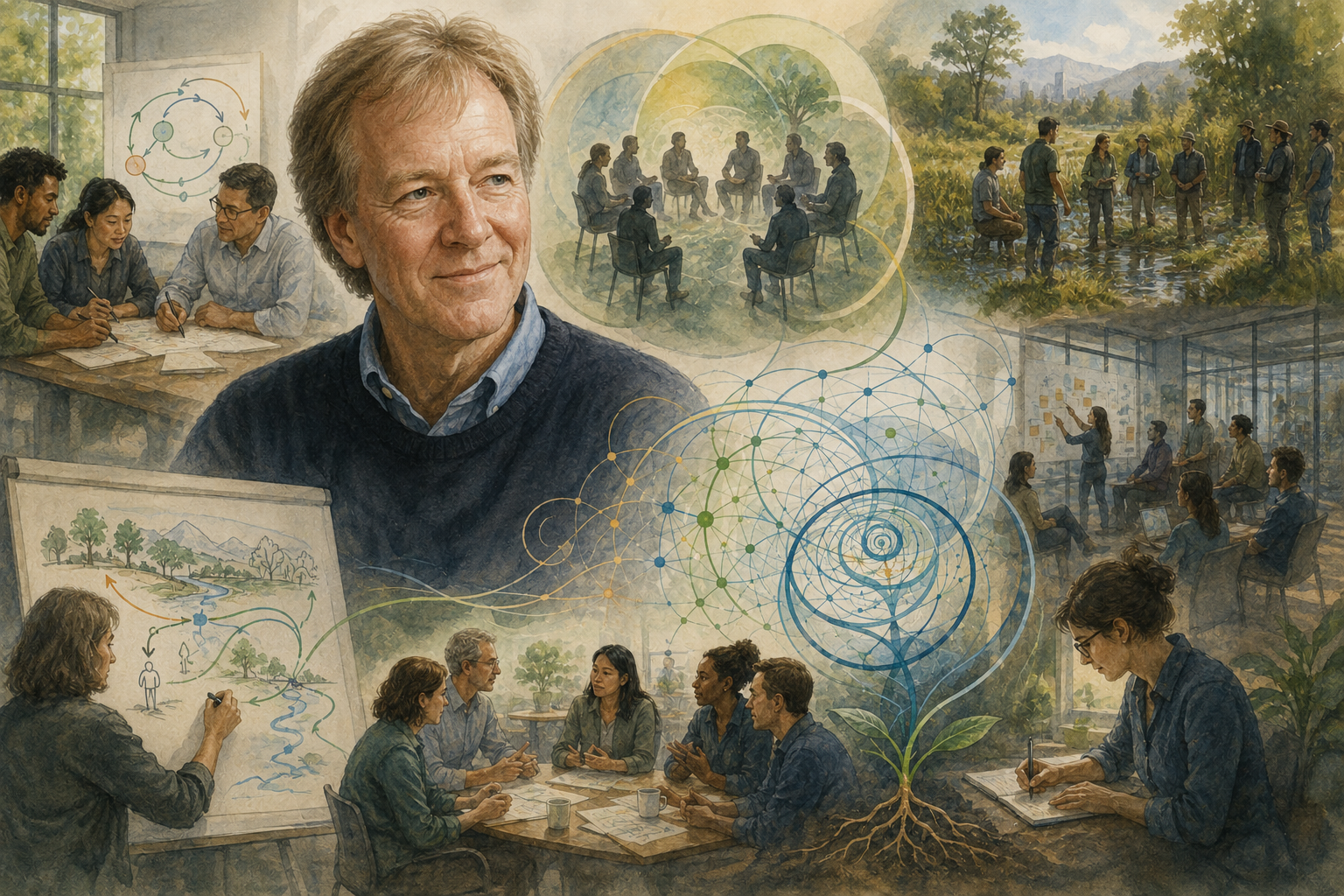
This article explains Senge’s learning organization as a systems-thinking contribution, not as a generic management slogan. It examines the five disciplines, mental models, feedback-rich dialogue, organizational learning barriers, policy resistance, defensive routines, leadership, institutional memory, psychological safety, systems archetypes, knowledge flows, and the ethical limits of organizational adaptation. The central argument is that organizations learn only when feedback can travel, assumptions can be examined, people can speak truthfully, and the organization’s deeper structures can be redesigned.
Why Peter Senge Matters for Systems Thinking
Peter Senge matters because he gave systems thinking a durable organizational language. Before Senge, system dynamics and systems thinking had already been developed through engineering, management science, ecology, cybernetics, public policy, and sustainability work. Senge’s contribution was to ask what it would mean for an organization to learn systemically. He connected feedback thinking to leadership, dialogue, mental models, shared purpose, team learning, and organizational practice.
Senge’s work became influential because organizations repeatedly fail to learn from experience. They collect data but do not change behavior. They hold meetings but avoid difficult truths. They reward departments for local success while the whole organization suffers. They launch initiatives without changing incentives. They blame individuals for problems generated by structure. They mistake busyness for progress. They respond to symptoms while reinforcing the causes of those symptoms.
The learning organization offers a different diagnosis. Organizational learning is not simply training, knowledge management, or professional development. It is the capacity of an organization to perceive reality more accurately, examine its assumptions, learn from feedback, coordinate across boundaries, build shared purpose, and redesign the structures that generate recurring problems.
| Conventional organizational assumption | Senge-style systems question | Why it matters |
|---|---|---|
| If people had better information, they would act better. | What structures shape how information is interpreted and used? | Information often fails when mental models, incentives, and trust are misaligned. |
| Training solves capability problems. | Does the organization reward learning, experimentation, and reflection? | Skill development fails when organizational systems punish learning behavior. |
| Leaders set strategy; others execute. | How does shared vision emerge across the organization? | Complex adaptation requires distributed understanding and commitment. |
| Problems belong to departments. | What cross-boundary system produces the recurring pattern? | Local optimization can damage the larger system. |
| Failure is caused by individual mistakes. | What feedback loops, delays, and routines make mistakes repeatable? | Blame suppresses learning and preserves structure. |
Senge’s systems thinking is especially useful in institutions under stress: public agencies, schools, hospitals, nonprofits, technology organizations, infrastructure systems, universities, climate institutions, and complex firms. These organizations cannot improve simply by issuing orders from the top. They must learn across levels, functions, time horizons, and communities.
His enduring contribution is the claim that organizations must cultivate disciplines of learning. Systems thinking is not a one-time workshop. It is a way of seeing and practicing institutional life.
What a Learning Organization Is
A learning organization is an organization that expands its capacity to create desired results by improving how people think, communicate, coordinate, and learn together. It is not merely an organization with a training department. It is an organization that builds learning into its structure: feedback flows, decision routines, leadership practices, psychological safety, knowledge systems, experimentation, reflection, shared purpose, and accountability.
Senge’s learning organization is based on the recognition that human beings inside institutions operate with partial information. They hold assumptions about cause and effect. They interpret evidence through mental models. They work inside roles, incentives, hierarchies, and routines. They often see only one part of the system. A learning organization creates practices that help people see more of the whole.
This matters because organizations often generate their own blind spots. Departments protect territory. Leaders hear filtered information. Metrics hide lived experience. Staff avoid raising risks because they fear punishment. Success stories are repeated while failures are buried. Short-term performance pressure crowds out reflection. Institutional memory is lost through turnover. Learning becomes accidental rather than designed.
\text{Learning Organization} = \text{Feedback} + \text{Reflection} + \text{Shared Vision} + \text{Mental Model Inquiry} + \text{Systems Thinking}
\]
Interpretation: A learning organization links feedback, reflection, shared purpose, inquiry into assumptions, and systems thinking so that the institution can adapt intelligently.
A learning organization is not conflict-free. In fact, genuine learning often requires conflict to become discussable. People must be able to surface disagreement, uncertainty, failure, and competing interpretations. The issue is not whether tension exists. The issue is whether the organization can turn tension into inquiry rather than defensiveness.
Senge’s concept remains important because many organizations now operate in fast-moving environments: technological change, climate risk, workforce stress, public distrust, supply-chain fragility, regulatory uncertainty, social polarization, and digital transformation. In such environments, organizations that cannot learn become brittle. They repeat old responses to new conditions. They mistake dashboards for understanding. They scale procedures that no longer fit reality.
The learning organization is therefore a systems response to complexity. It builds the capacity to notice, interpret, revise, and act together.
The Five Disciplines
Senge’s learning organization is organized around five disciplines: personal mastery, mental models, shared vision, team learning, and systems thinking. These are called disciplines because they require practice. They are not slogans or values statements. They are habits of attention, communication, reflection, and action that develop over time.
Personal mastery concerns the capacity of individuals to clarify what they care about, deepen their competence, and remain committed to learning. Mental models concern the assumptions, categories, and causal beliefs through which people interpret reality. Shared vision concerns the development of a common sense of purpose that people genuinely own. Team learning concerns collective inquiry, dialogue, and coordinated intelligence. Systems thinking integrates the other disciplines by helping people see interdependence and feedback.
| Discipline | Core question | Organizational risk when weak |
|---|---|---|
| Personal mastery | What are people trying to create, and are they developing the capacity to do it? | Low agency, burnout, compliance without growth, skill stagnation. |
| Mental models | What assumptions shape how people interpret evidence and action? | Blind spots, denial, defensive reasoning, repeated misdiagnosis. |
| Shared vision | What purpose can people commit to together? | Fragmentation, cynical compliance, initiative fatigue, weak alignment. |
| Team learning | Can groups think together better than individuals think alone? | Silos, poor coordination, shallow meetings, hidden disagreement. |
| Systems thinking | What feedback structures generate recurring behavior? | Symptom management, local optimization, policy resistance, short-termism. |
The five disciplines reinforce one another. Systems thinking without personal mastery may become abstract and detached from human development. Personal mastery without systems thinking may become individual self-improvement disconnected from institutional structure. Shared vision without mental model inquiry can become rhetoric. Team learning without psychological safety becomes performance. Mental model work without shared vision can become endless critique without direction.
The strength of Senge’s framework is that it treats organizational learning as both personal and structural. People must develop, but so must the system. Organizations must create conditions in which people can think, learn, speak, and coordinate honestly.
Systems Thinking as the Fifth Discipline
Senge called systems thinking the fifth discipline because it integrates the others. Without systems thinking, the other disciplines can remain fragmented. Personal mastery can become individual aspiration. Shared vision can become motivational language. Team learning can become group process. Mental models can become reflective practice. Systems thinking connects these disciplines to the structures that generate organizational behavior.
Systems thinking asks why problems recur. It looks for feedback loops, delays, accumulations, unintended consequences, and structural patterns. In organizations, this means asking why performance problems persist despite effort, why reforms create resistance, why teams optimize locally, why communication breaks down, why trust declines, and why short-term fixes create long-term cost.
For Senge, systems thinking helps organizations move from event thinking to pattern thinking. A missed deadline is an event. A recurring pattern of late work is more important. A structure of unrealistic workload, unclear priorities, approval bottlenecks, fear of escalation, and delayed feedback may explain the pattern. Systems thinking shifts attention from blame to structure.
\text{Organizational Behavior} = f(\text{Feedback Loops}, \text{Mental Models}, \text{Rules}, \text{Delays}, \text{Information Flows})
\]
Interpretation: Organizational behavior emerges from feedback loops, mental models, rules, delays, and information flows rather than from isolated decisions alone.
The fifth discipline also helps explain why organizations resist learning. If a system rewards speed over reflection, people will not reflect. If leadership punishes bad news, information will be filtered. If departments are rewarded separately, they will optimize separately. If metrics reward visible output but ignore hidden cost, hidden cost will grow. If people are told to innovate but punished for failure, innovation will become symbolic.
Systems thinking therefore changes leadership practice. Leaders must ask not only what people should do, but what system makes certain behavior rational. They must change feedback, incentives, information, routines, goals, and boundaries. The learning organization begins when leaders stop treating structure as background and begin treating it as design.
Mental Models and Organizational Blindness
Mental models are the assumptions, images, categories, beliefs, and causal stories through which people interpret the world. They determine what people notice, what they ignore, what they consider possible, and what explanations feel plausible. In organizations, mental models shape strategy, leadership, hiring, performance assessment, customer understanding, risk perception, innovation, and policy response.
Mental models are necessary. No one can interpret reality without assumptions. The danger is not having mental models; the danger is being unaware of them. When mental models are invisible, people mistake interpretation for fact. Leaders may assume resistance means laziness rather than distrust. Engineers may assume technical feasibility equals social acceptability. Managers may assume productivity is visible output rather than sustainable capacity. Public agencies may assume access exists because a service is formally available.
Senge’s discipline of mental models asks organizations to surface assumptions. What do we believe causes this problem? What evidence would challenge our view? What do frontline staff know that leadership does not? What do communities experience that metrics do not capture? What are we afraid to say? What pattern do we keep explaining away?
\text{Decision} = f(\text{Information}, \text{Mental Model}, \text{Incentive}, \text{Power}, \text{Context})
\]
Interpretation: Decisions are shaped not only by information, but by the mental models, incentives, power relations, and context through which information is interpreted.
Mental model inquiry is difficult because it threatens identity and authority. People are often attached to their explanations. Organizations may protect dominant mental models because they justify existing power. A company may claim that workers resist change while ignoring poor implementation. A school system may blame families while ignoring structural inequality. A platform may blame users while preserving harmful engagement incentives. A public agency may blame low participation while ignoring distrust created by past harm.
A learning organization does not eliminate mental models. It makes them discussable. It creates conditions where assumptions can be tested without humiliation. This requires psychological safety, evidence, dialogue, humility, and leadership willing to be questioned.
Without mental model work, systems thinking becomes shallow. People may draw feedback diagrams while preserving the assumptions that created the problem.
Shared Vision and Organizational Purpose
Shared vision is not a slogan imposed by leadership. It is a collectively held sense of what the organization is trying to create. Senge distinguishes genuine shared vision from compliance. People may repeat a mission statement without feeling commitment. They may follow strategy because they must. A shared vision becomes real when people see their own aspirations connected to the organization’s purpose.
Shared vision matters because complex work requires coordination under uncertainty. Rules and procedures cannot cover every situation. When people understand and care about the deeper purpose, they can make better decisions locally. They can adapt without waiting for permission. They can coordinate across boundaries because they know what the organization is trying to serve.
But shared vision can be misused. Organizations often use vision language to demand loyalty while ignoring working conditions, power, or ethical contradictions. A vision is weak if it asks workers to sacrifice without voice. It is manipulative if it hides exploitation. It is empty if the organization’s incentives contradict it. Shared vision must be connected to rules, resources, accountability, and lived practice.
\text{Shared Vision Strength} = \text{Purpose Clarity} \times \text{Participation} \times \text{Trust} \times \text{Structural Alignment}
\]
Interpretation: Shared vision becomes durable when purpose is clear, people participate in shaping it, trust exists, and organizational structures support the stated purpose.
A learning organization must ask whether its vision is real. Do people understand it? Did they help shape it? Do leaders act consistently with it? Do metrics support it? Does budget follow it? Are trade-offs discussed honestly? Are affected communities included when the organization’s purpose concerns public life? Does the vision change how decisions are made?
Shared vision is a systems concept because goals organize feedback. A system organized around growth will measure, reward, and correct differently from a system organized around wellbeing, safety, care, sustainability, or justice. Senge’s framework reminds organizations that purpose is not decorative. It is structural.
Team Learning, Dialogue, and Collective Intelligence
Team learning is the discipline of groups thinking together. Organizations often assume that putting capable people in a room produces collective intelligence. Senge’s work suggests otherwise. Groups can be less intelligent than their members when hierarchy, fear, status, defensiveness, poor facilitation, rushed agendas, hidden conflict, or weak inquiry distort conversation.
Team learning requires dialogue. Dialogue is not the same as debate, presentation, persuasion, or consensus management. It is a practice of inquiry in which people suspend assumptions, listen for meaning, examine their own thinking, and explore the system together. This does not mean avoiding disagreement. It means using disagreement as information.
Teams fail to learn when they cannot discuss reality. If people avoid naming risk, the organization learns too late. If junior staff cannot challenge senior assumptions, blind spots persist. If departments defend their own metrics, cross-system harm remains hidden. If meetings reward confidence over curiosity, weak ideas survive. If mistakes are punished, the system becomes less intelligent.
\text{Collective Intelligence} = \text{Diverse Knowledge} + \text{Trust} + \text{Inquiry} + \text{Shared Context} – \text{Defensiveness}
\]
Interpretation: Team learning depends on diverse knowledge, trust, inquiry, and shared context; defensiveness reduces collective intelligence.
Team learning is essential in complex systems because no individual sees the whole. Frontline staff may see operational reality. Executives may see strategy and external pressure. Analysts may see patterns in data. Communities may see consequences. Engineers may see technical constraints. Designers may see user experience. Legal teams may see regulatory risk. Learning emerges when these partial views can interact honestly.
Dialogue also helps teams examine mental models. A team that can ask “what are we assuming?” and “what would make us wrong?” is more adaptive than a team that merely reports status. Team learning turns meetings from information transfer into system sensing.
A learning organization therefore treats conversation as infrastructure. The quality of dialogue determines the quality of collective action.
Personal Mastery and Human Development
Personal mastery is the discipline of personal growth, clarity, and commitment to learning. In Senge’s framework, it is not self-help detached from organizational structure. It is the human foundation of learning. Organizations learn through people, and people need space to develop competence, purpose, reflection, and creative tension between current reality and desired future.
Personal mastery asks people to clarify what they are trying to create and to see current reality honestly. Both matter. Vision without reality becomes fantasy. Reality without vision becomes resignation. Creative tension arises when people hold both: the aspiration and the truth of the present condition. This tension can generate learning if the organization supports it.
But personal mastery can be distorted when organizations individualize structural problems. Telling people to develop resilience while workloads are unsustainable is not personal mastery. Asking workers to grow while denying voice, fair pay, rest, safety, or psychological security is not learning. Personal development must not become a way to shift system burdens onto individuals.
\text{Creative Tension} = \text{Vision} – \text{Current Reality}
\]
Interpretation: Personal mastery involves holding a desired future and current reality together so the gap becomes a source of learning rather than denial or resignation.
A healthy learning organization supports personal mastery by creating conditions for growth: meaningful work, feedback, mentorship, psychological safety, autonomy, reflection time, fair expectations, and alignment between individual aspiration and organizational purpose. It also recognizes that learning requires energy. Burned-out people cannot sustain deep learning indefinitely.
Personal mastery is therefore both individual and systemic. Individuals commit to growth, and organizations design conditions in which growth is possible. Senge’s framework is strongest when it refuses to separate the two.
Defensive Routines and Learning Failure
Organizations often fail to learn because they defend themselves from the information they most need. Defensive routines are patterns that protect people or institutions from embarrassment, threat, blame, or loss of control. They may appear as silence, euphemism, blame shifting, excessive process, shallow agreement, metric manipulation, avoidance of conflict, or rituals of consultation without real change.
Defensive routines are systems problems. They are not simply personal cowardice. People become defensive when the organization punishes bad news, rewards certainty, humiliates dissent, protects hierarchy, or turns error into blame. Over time, the organization learns not to learn. People know what cannot be said. They learn how to perform alignment. They protect themselves by withholding information.
Defensive routines are dangerous because they delay feedback. An organization may appear stable while risks accumulate. Staff may see a problem long before leaders hear it. Customers, patients, students, residents, or users may experience harm before metrics reveal it. By the time the organization responds, the stock of distrust, backlog, risk, or harm may already be large.
\text{Learning Failure} = \text{Feedback Suppression} + \text{Defensive Reasoning} + \text{Delayed Correction}
\]
Interpretation: Organizations fail to learn when feedback is suppressed, defensive reasoning protects existing assumptions, and correction arrives too late.
Senge’s learning organization requires making defensive routines discussable. This is difficult because discussing defensiveness often triggers more defensiveness. Leaders play a central role. If leaders punish candor, the system will learn silence. If leaders model inquiry, acknowledge uncertainty, and reward truth-telling, feedback can begin to move.
Defensive routines also have ethical consequences. When organizations suppress feedback, harm falls on others: workers, communities, patients, students, customers, ecosystems, or future generations. Learning failure is not only an internal performance issue. It can become public harm.
A learning organization must therefore protect feedback, especially inconvenient feedback. The harder truth is often the most valuable signal.
Systems Archetypes in Organizations
Senge helped popularize systems archetypes as recurring patterns of system behavior. Archetypes are not rigid templates. They are diagnostic patterns that help people recognize familiar structures: fixes that fail, shifting the burden, limits to growth, success to the successful, tragedy of the commons, escalation, eroding goals, and other recurring dynamics.
Archetypes matter because organizations often believe their problems are unique. The details may be unique, but the structure may be familiar. A “fixes that fail” pattern occurs when a short-term solution relieves a symptom but worsens the underlying problem. “Shifting the burden” occurs when reliance on a symptomatic solution weakens capacity for fundamental change. “Limits to growth” occurs when reinforcing success hits a constraint. “Success to the successful” occurs when early advantage attracts more resources, widening inequality.
| Archetype | Organizational pattern | Learning question |
|---|---|---|
| Fixes that fail | Short-term relief creates long-term cost. | What symptom are we relieving while worsening the cause? |
| Shifting the burden | Dependence on quick fixes weakens fundamental capacity. | What capability are we failing to build? |
| Limits to growth | Success slows as hidden constraints bind. | What constraint now limits the growth loop? |
| Success to the successful | Early advantage attracts resources and widens inequality. | How are resource flows amplifying advantage? |
| Eroding goals | Standards are lowered to close the gap between aspiration and reality. | Where are we adapting expectations downward instead of improving capacity? |
| Escalation | Actors respond to one another in ways that intensify conflict. | What feedback loop turns response into counter-response? |
Archetypes are useful because they turn vague frustration into structural inquiry. Instead of asking “why are people not doing better?” the organization can ask “what archetype are we inside?” This does not solve the problem automatically, but it changes the conversation.
The risk is using archetypes superficially. Naming an archetype is not analysis. The organization still must identify the actual stocks, flows, delays, incentives, power relations, and mental models in its context. Archetypes are starting points for diagnosis, not substitutes for evidence.
Institutional Memory, Knowledge Flow, and Adaptation
Learning organizations require institutional memory. Without memory, organizations repeat mistakes. They lose lessons when people leave. They rediscover known problems. They repeat failed reforms under new names. They misread current issues because history has been erased. Institutional memory is a stock: it accumulates through documentation, relationships, stories, routines, archives, data systems, mentoring, after-action reviews, and cultural practice.
Knowledge flow matters because memory must travel. Lessons trapped in one team do not become organizational learning. Frontline knowledge ignored by leadership does not change strategy. Community feedback stored in reports but not connected to decisions does not produce accountability. Data systems that capture metrics without interpretation may create visibility without understanding.
Organizations often confuse knowledge storage with learning. A knowledge base is useful, but only if people use it. Dashboards are useful, but only if they inform decisions. Reports are useful, but only if they change behavior. Institutional memory becomes learning when it enters feedback loops.
\text{Organizational Learning Capacity} = \text{Memory Stock} + \text{Knowledge Flow} + \text{Feedback Use} + \text{Decision Revision}
\]
Interpretation: Organizational learning depends on accumulated memory, movement of knowledge across boundaries, use of feedback, and actual revision of decisions.
Adaptation requires both memory and openness. Too little memory creates repetition. Too much rigid memory creates path dependence. A learning organization preserves lessons while remaining willing to revise assumptions. It remembers what happened without becoming trapped by old interpretations.
This is especially important in public institutions, infrastructure systems, universities, healthcare organizations, and large technical systems. The consequences of forgetting can be severe: safety failures, repeated inequity, policy churn, lost trust, wasted resources, and organizational burnout. Senge’s learning organization connects knowledge architecture to systems thinking: memory must support adaptation, not merely storage.
Leadership in Learning Organizations
Senge’s view of leadership differs from command-and-control models. In a learning organization, leaders are not simply decision-makers who set direction and demand execution. They are designers, stewards, and teachers. They design learning environments, steward shared purpose, and help people understand the systems in which they work.
Leadership as design means shaping structures: feedback channels, meeting practices, metrics, incentives, decision rights, information flows, learning routines, accountability mechanisms, and spaces for reflection. Leadership as stewardship means holding responsibility for the organization’s purpose and long-term consequences. Leadership as teaching means helping people examine mental models and see system structure.
This does not mean leaders abandon authority. Complex organizations still need decisions, priorities, boundaries, and accountability. But authority must support learning rather than suppress it. A leader who demands certainty in uncertain conditions encourages distortion. A leader who punishes bad news destroys feedback. A leader who rewards local metrics over system outcomes reinforces fragmentation.
\text{Learning Leadership} = \text{Design} + \text{Stewardship} + \text{Inquiry} + \text{Accountability}
\]
Interpretation: Leadership in a learning organization designs structures for learning, stewards purpose, practices inquiry, and maintains accountability.
Learning leadership also requires humility. Leaders must recognize that they do not see the whole system. They need feedback from people closer to operations, communities, users, partners, and critics. They must create conditions where people can speak honestly upward and across boundaries.
Senge’s leadership model remains relevant because many organizations still confuse leadership with control. Control may produce compliance, but it often reduces learning. Learning organizations need leadership that increases the organization’s capacity to perceive, interpret, and adapt.
Ethics: Learning for Whom, Toward What Purpose?
The learning organization is not automatically ethical. An organization can learn how to manipulate customers, avoid regulation, exploit workers, optimize surveillance, reduce accountability, or preserve harmful advantage. Learning capacity is powerful, but power requires purpose. The ethical question is not only whether an organization learns. It is what the organization learns to do, for whom, and with what consequences.
Senge’s framework must therefore be joined to ethical systems thinking. Shared vision should not be used to demand worker sacrifice. Team learning should not become a way to extract unpaid emotional labor. Mental model work should not be used to make people adapt to unjust conditions. Personal mastery should not individualize burnout. Systems thinking should not make harmful systems more efficient.
A learning organization must ask whose feedback counts. Workers, frontline staff, customers, patients, students, residents, users, communities, ecosystems, and future generations may all be affected by organizational decisions. If only senior leaders define learning, the organization may become smarter at preserving its own worldview. Ethical learning requires widening feedback.
\text{Ethical Learning} = \text{Learning Capacity} + \text{Public Purpose} + \text{Voice} + \text{Repair} + \text{Accountability}
\]
Interpretation: Organizational learning becomes ethical when learning capacity is directed toward public purpose, includes voice, supports repair, and remains accountable for consequences.
Ethical learning also requires attention to power. Who can challenge leadership? Who can name harm? Who has access to information? Who benefits from current structures? Who bears the burden of adaptation? What histories shape distrust? What forms of knowledge are dismissed? What harms are treated as externalities?
The learning organization is strongest when learning is not only internal adaptation but responsible participation in larger systems. Organizations exist inside communities, economies, ecosystems, legal structures, supply chains, and public institutions. Their learning should improve not only their own performance, but the systems they affect.
Examples Across Learning Organizations
Senge’s framework applies across many institutional settings. The examples below show how learning-organization principles change diagnosis, feedback, and intervention.
Healthcare systems
Hospitals and clinics learn when safety events, patient experience, staffing pressure, care delays, and frontline knowledge become feedback for structural redesign rather than blame.
Public agencies
Agencies become learning institutions when administrative burden, service failure, public distrust, and community feedback are used to revise rules, processes, and accountability.
Schools and universities
Education systems learn when assessment, student experience, teacher knowledge, equity data, and institutional memory inform pedagogy, support, governance, and long-term development.
Technology organizations
Technology firms learn responsibly when user harms, platform incentives, safety failures, labor concerns, and social consequences reshape product goals and governance.
Infrastructure organizations
Infrastructure agencies learn when maintenance data, worker knowledge, community reports, climate risk, and failure analysis change investment, inspection, and resilience planning.
Climate institutions
Climate organizations learn when emissions data, adaptation experience, frontline community knowledge, ecological feedback, and policy outcomes reshape strategy over time.
Nonprofits and civic organizations
Civic organizations learn when mission, community voice, funding incentives, program outcomes, staff wellbeing, and power dynamics are examined together.
Workplace culture change
Organizations learn culturally when stated values are tested against promotion, workload, conflict, safety, voice, pay, recognition, and everyday decision routines.
Across these examples, learning depends on whether feedback can alter structure. A learning organization does not merely collect lessons. It changes how the system behaves.
Mathematics, Computation, and Modeling
A learning organization can be modeled as a system of feedback loops, knowledge stocks, learning flows, trust, defensive routines, and adaptation capacity. The purpose of modeling is not to reduce organizational life to numbers. It is to clarify how learning accumulates or erodes over time and how structural conditions influence adaptation.
A simple organizational learning stock can be represented as:
L_{t+1} = L_t + \text{Learning Flow}_t – \text{Forgetting Flow}_t
\]
Interpretation: Organizational learning is a stock that grows through feedback, reflection, documentation, and practice, and declines through turnover, suppression, fragmentation, and forgetting.
A feedback-use function can be represented as:
F_t = q_t \cdot s_t \cdot a_t
\]
Interpretation: Feedback use \(F_t\) depends on feedback quality \(q_t\), psychological safety \(s_t\), and authority to act \(a_t\).
A defensive-routine effect can be represented as:
D_t = \alpha B_t + \beta P_t – \gamma S_t
\]
Interpretation: Defensive routines \(D_t\) can rise with blame \(B_t\) and performance pressure \(P_t\), and decline with psychological safety \(S_t\).
A learning-organization capacity score can be represented as:
C = w_sS + w_mM + w_vV + w_tT + w_lL – w_dD
\]
Interpretation: Learning capacity can combine systems thinking, mental model inquiry, shared vision, team learning, institutional memory, and the reduction of defensive routines.
| Modeling task | Learning-organization question | Example output |
|---|---|---|
| Learning stock analysis | Is organizational knowledge accumulating or being lost? | Learning stock, memory loss, documentation quality, turnover impact. |
| Feedback-use modeling | Does the organization convert feedback into changed decisions? | Feedback use index, safety-adjusted learning rate, decision revision rate. |
| Defensive-routine modeling | Where does blame, fear, or hierarchy suppress learning? | Defensive routine index, feedback delay, truth-suppression risk. |
| Team learning diagnostics | Can groups think across boundaries? | Cross-functional learning score, silo friction, dialogue quality. |
| Shared vision analysis | Is stated purpose structurally supported? | Vision alignment, metric alignment, trust-adjusted commitment. |
| Scenario analysis | What happens under compliance, defensive, adaptive, or learning-oriented cultures? | Learning capacity trajectories and system performance comparisons. |
These models should be used with care. Organizational learning includes meaning, power, trust, conflict, skill, history, and culture. Quantitative indicators can support inquiry, but they should not replace dialogue, qualitative evidence, worker voice, community feedback, or ethical interpretation.
Python Workflow: Learning Loops, Mental Models, and Organizational Adaptation
The Python workflow for this article models a learning organization as a dynamic system of feedback quality, psychological safety, mental model inquiry, shared vision, team learning, institutional memory, defensive routines, and organizational adaptation. It uses only the Python standard library so it can run without external dependencies. The workflow compares four scenarios: compliance culture, defensive performance culture, adaptive improvement culture, and learning organization pathway.
# senge_learning_organization_model.py
# Dependency-light professional workflow for Peter Senge and the learning organization.
# Purpose: simulate learning loops, defensive routines, mental model inquiry, shared vision,
# team learning, institutional memory, and adaptive performance.
# Uses only Python standard library.

from dataclasses import dataclass
import csv
import os
from statistics import mean

OUTPUT_TABLES = "outputs/tables"

@dataclass
class LearningScenario:
    name: str
    periods: int
    feedback_quality: float
    psychological_safety: float
    mental_model_inquiry: float
    shared_vision_strength: float
    team_learning_quality: float
    systems_thinking_practice: float
    leadership_support: float
    performance_pressure: float
    blame_tendency: float
    turnover_pressure: float

def ensure_outputs() -> None:
    os.makedirs(OUTPUT_TABLES, exist_ok=True)

def clamp(value: float, low: float = 0.0, high: float = 100.0) -> float:
    return max(low, min(high, value))

def run_scenario(scenario: LearningScenario) -> list[dict]:
    learning_stock = 34.0
    institutional_memory = 42.0
    trust_stock = 48.0
    defensive_routines = scenario.blame_tendency * 60.0
    adaptive_capacity = 36.0
    rows = []

    for period in range(scenario.periods + 1):
        feedback_use = clamp(
            scenario.feedback_quality * 28.0
            + scenario.psychological_safety * 24.0
            + scenario.leadership_support * 16.0
            - defensive_routines * 0.20
        )

        inquiry_strength = clamp(
            scenario.mental_model_inquiry * 24.0
            + scenario.team_learning_quality * 18.0
            + scenario.systems_thinking_practice * 22.0
            - scenario.performance_pressure * 10.0
        )

        shared_alignment = clamp(
            scenario.shared_vision_strength * 28.0
            + trust_stock * 0.18
            + scenario.leadership_support * 14.0
            - defensive_routines * 0.12
        )

        defensive_routines = clamp(
            defensive_routines
            + scenario.performance_pressure * 2.4
            + scenario.blame_tendency * 2.8
            - scenario.psychological_safety * 3.0
            - scenario.mental_model_inquiry * 1.8
            - scenario.leadership_support * 1.5
        )

        learning_flow = clamp(
            feedback_use * 0.22
            + inquiry_strength * 0.24
            + scenario.team_learning_quality * 4.0
            + scenario.systems_thinking_practice * 4.5
            - defensive_routines * 0.08
        )

        forgetting_flow = clamp(
            scenario.turnover_pressure * 5.5
            + defensive_routines * 0.06
            + max(0.0, 50.0 - trust_stock) * 0.04
        )

        learning_stock = clamp(learning_stock + learning_flow - forgetting_flow)
        institutional_memory = clamp(
            institutional_memory
            + learning_flow * 0.35
            + scenario.leadership_support * 1.2
            - scenario.turnover_pressure * 3.2
        )

        trust_stock = clamp(
            trust_stock
            + feedback_use * 0.14
            + shared_alignment * 0.10
            + scenario.psychological_safety * 1.7
            - defensive_routines * 0.10
        )

        adaptive_capacity = clamp(
            adaptive_capacity
            + learning_stock * 0.05
            + institutional_memory * 0.04
            + scenario.systems_thinking_practice * 2.4
            + scenario.team_learning_quality * 2.0
            - defensive_routines * 0.08
        )

        organizational_performance = clamp(
            adaptive_capacity * 0.28
            + learning_stock * 0.22
            + trust_stock * 0.18
            + shared_alignment * 0.14
            + institutional_memory * 0.12
            - defensive_routines * 0.16
        )

        learning_capacity_score = clamp(
            scenario.systems_thinking_practice * 18.0
            + scenario.mental_model_inquiry * 16.0
            + scenario.shared_vision_strength * 16.0
            + scenario.team_learning_quality * 18.0
            + learning_stock * 0.22
            + institutional_memory * 0.12
            - defensive_routines * 0.14
        )

        rows.append({
            "period": period,
            "scenario": scenario.name,
            "feedback_use_index": round(feedback_use, 3),
            "inquiry_strength": round(inquiry_strength, 3),
            "shared_alignment": round(shared_alignment, 3),
            "defensive_routines_index": round(defensive_routines, 3),
            "learning_stock": round(learning_stock, 3),
            "institutional_memory_stock": round(institutional_memory, 3),
            "trust_stock": round(trust_stock, 3),
            "adaptive_capacity": round(adaptive_capacity, 3),
            "organizational_performance": round(organizational_performance, 3),
            "learning_capacity_score": round(learning_capacity_score, 3)
        })

    return rows

def write_csv(path: str, rows: list[dict]) -> None:
    if not rows:
        return
    with open(path, "w", newline="", encoding="utf-8") as handle:
        writer = csv.DictWriter(handle, fieldnames=list(rows[0].keys()))
        writer.writeheader()
        writer.writerows(rows)

def summarize(rows: list[dict]) -> list[dict]:
    summary = []

    for scenario_name in sorted(set(row["scenario"] for row in rows)):
        subset = [row for row in rows if row["scenario"] == scenario_name]
        final = subset[-1]
        avg_learning = mean(row["learning_capacity_score"] for row in subset)
        avg_defensiveness = mean(row["defensive_routines_index"] for row in subset)
        avg_performance = mean(row["organizational_performance"] for row in subset)

        if final["learning_capacity_score"] >= 65 and final["defensive_routines_index"] <= 30:
            diagnostic = "learning organization pathway"
        elif avg_defensiveness >= 50:
            diagnostic = "defensive routines suppress organizational learning"
        elif avg_learning >= 50:
            diagnostic = "partial learning capacity with structural constraints"
        else:
            diagnostic = "low learning capacity"

        summary.append({
            "scenario": scenario_name,
            "final_learning_capacity_score": final["learning_capacity_score"],
            "final_defensive_routines_index": final["defensive_routines_index"],
            "final_adaptive_capacity": final["adaptive_capacity"],
            "final_organizational_performance": final["organizational_performance"],
            "average_learning_capacity_score": round(avg_learning, 3),
            "average_defensive_routines_index": round(avg_defensiveness, 3),
            "average_organizational_performance": round(avg_performance, 3),
            "final_learning_stock": final["learning_stock"],
            "final_institutional_memory_stock": final["institutional_memory_stock"],
            "diagnostic": diagnostic
        })

    return summary

def validate(rows: list[dict]) -> list[str]:
    errors = []
    bounded_fields = [
        "feedback_use_index",
        "inquiry_strength",
        "shared_alignment",
        "defensive_routines_index",
        "learning_stock",
        "institutional_memory_stock",
        "trust_stock",
        "adaptive_capacity",
        "organizational_performance",
        "learning_capacity_score"
    ]

    for row in rows:
        for field in bounded_fields:
            if row[field] < -0.001 or row[field] > 120.001:
                errors.append(f"{field} outside expected range in {row['scenario']} period {row['period']}.")

    return errors

def main() -> None:
    ensure_outputs()

    scenarios = [
        LearningScenario(
            name="Compliance culture",
            periods=48,
            feedback_quality=0.34,
            psychological_safety=0.30,
            mental_model_inquiry=0.24,
            shared_vision_strength=0.36,
            team_learning_quality=0.28,
            systems_thinking_practice=0.22,
            leadership_support=0.34,
            performance_pressure=0.68,
            blame_tendency=0.58,
            turnover_pressure=0.42
        ),
        LearningScenario(
            name="Defensive performance culture",
            periods=48,
            feedback_quality=0.48,
            psychological_safety=0.24,
            mental_model_inquiry=0.30,
            shared_vision_strength=0.42,
            team_learning_quality=0.34,
            systems_thinking_practice=0.32,
            leadership_support=0.42,
            performance_pressure=0.86,
            blame_tendency=0.76,
            turnover_pressure=0.54
        ),
        LearningScenario(
            name="Adaptive improvement culture",
            periods=48,
            feedback_quality=0.66,
            psychological_safety=0.60,
            mental_model_inquiry=0.58,
            shared_vision_strength=0.62,
            team_learning_quality=0.64,
            systems_thinking_practice=0.58,
            leadership_support=0.66,
            performance_pressure=0.50,
            blame_tendency=0.34,
            turnover_pressure=0.30
        ),
        LearningScenario(
            name="Learning organization pathway",
            periods=48,
            feedback_quality=0.78,
            psychological_safety=0.78,
            mental_model_inquiry=0.76,
            shared_vision_strength=0.80,
            team_learning_quality=0.82,
            systems_thinking_practice=0.84,
            leadership_support=0.82,
            performance_pressure=0.42,
            blame_tendency=0.20,
            turnover_pressure=0.22
        )
    ]

    all_rows = []
    for scenario in scenarios:
        all_rows.extend(run_scenario(scenario))

    validation_errors = validate(all_rows)
    if validation_errors:
        raise ValueError("Validation failed:\n" + "\n".join(validation_errors))

    summary_rows = summarize(all_rows)

    write_csv(os.path.join(OUTPUT_TABLES, "senge_learning_organization_timeseries.csv"), all_rows)
    write_csv(os.path.join(OUTPUT_TABLES, "senge_learning_organization_summary.csv"), summary_rows)

    with open(os.path.join(OUTPUT_TABLES, "validation_report.txt"), "w", encoding="utf-8") as handle:
        handle.write("Validation passed.\n")
        handle.write("Learning capacity, defensive routines, trust, memory, and adaptation outputs completed.\n")

    print("\nSenge learning organization scenario summary:")
    for row in summary_rows:
        print(
            f"{row['scenario']}: learning capacity={row['final_learning_capacity_score']}, "
            f"defensiveness={row['final_defensive_routines_index']}, "
            f"diagnostic={row['diagnostic']}"
        )

if __name__ == "__main__":
    main()
This workflow shows how learning capacity depends on more than training. Feedback quality, psychological safety, mental model inquiry, shared vision, team learning, systems thinking, leadership support, defensive routines, and institutional memory interact over time. The model is synthetic, but it gives readers a reproducible way to compare organizations that collect feedback without learning against organizations that build learning into structure.
A fuller repository version can add optional pandas and matplotlib workflows for richer dashboards, Excel workbooks, discipline-level scorecards, defensive-routine sensitivity, team-learning indicators, and institutional-memory diagnostics while preserving this standard-library script as the default smoke-tested workflow.
R Workflow: Learning Organization Indicators and Scenario Visualization
The R workflow for this article uses base R so it can run without additional package dependencies. It reads the Python-generated learning-organization outputs, creates diagnostic summaries, exports scenario tables, and produces plots for feedback use, inquiry, shared alignment, defensive routines, learning stock, institutional memory, trust, adaptive capacity, organizational performance, and learning capacity.
# senge_learning_organization_diagnostics.R
# Base R workflow for Peter Senge and the learning organization.
# Purpose: summarize learning capacity, defensive routines, trust, memory, adaptation, and performance scenarios.

tables_dir <- "outputs/tables"
figures_dir <- "outputs/figures"

if (!dir.exists(figures_dir)) {
  dir.create(figures_dir, recursive = TRUE)
}

timeseries_path <- file.path(tables_dir, "senge_learning_organization_timeseries.csv")
summary_path <- file.path(tables_dir, "senge_learning_organization_summary.csv")

if (!file.exists(timeseries_path)) {
  stop("Missing senge_learning_organization_timeseries.csv. Run the Python workflow first.")
}

senge <- read.csv(timeseries_path, stringsAsFactors = FALSE)

last_by_scenario <- do.call(
  rbind,
  lapply(split(senge, senge$scenario), function(df) df[nrow(df), ])
)

avg_learning <- aggregate(learning_capacity_score ~ scenario, data = senge, FUN = mean)
avg_defensive <- aggregate(defensive_routines_index ~ scenario, data = senge, FUN = mean)
avg_performance <- aggregate(organizational_performance ~ scenario, data = senge, FUN = mean)

names(avg_learning)[2] <- "average_learning_capacity_score"
names(avg_defensive)[2] <- "average_defensive_routines_index"
names(avg_performance)[2] <- "average_organizational_performance"

final_fields <- last_by_scenario[, c(
  "scenario",
  "learning_capacity_score",
  "defensive_routines_index",
  "adaptive_capacity",
  "organizational_performance",
  "learning_stock",
  "institutional_memory_stock"
)]

names(final_fields) <- c(
  "scenario",
  "final_learning_capacity_score",
  "final_defensive_routines_index",
  "final_adaptive_capacity",
  "final_organizational_performance",
  "final_learning_stock",
  "final_institutional_memory_stock"
)

diagnostics <- Reduce(
  function(x, y) merge(x, y, by = "scenario"),
  list(avg_learning, avg_defensive, avg_performance, final_fields)
)

diagnostics$diagnostic <- ifelse(
  diagnostics$final_learning_capacity_score >= 65 &
    diagnostics$final_defensive_routines_index <= 30, "learning organization pathway", ifelse( diagnostics$average_defensive_routines_index >= 50,
    "defensive routines suppress organizational learning",
    ifelse(
      diagnostics$average_learning_capacity_score >= 50,
      "partial learning capacity with structural constraints",
      "low learning capacity"
    )
  )
)

write.csv(diagnostics, summary_path, row.names = FALSE)
print(diagnostics)

plot_metric <- function(metric, y_label, title, output_name) {
  png(file.path(figures_dir, output_name), width = 1200, height = 700)
  scenarios <- unique(senge$scenario)
  plot(
    NA,
    xlim = range(senge$period),
    ylim = range(senge[[metric]], na.rm = TRUE),
    xlab = "Period",
    ylab = y_label,
    main = title
  )
  for (scenario_name in scenarios) {
    subset_data <- senge[senge$scenario == scenario_name, ]
    lines(subset_data$period, subset_data[[metric]], lwd = 2)
  }
  legend("topleft", legend = scenarios, lwd = 2, cex = 0.8, bty = "n")
  grid()
  dev.off()
}

plot_metric(
  metric = "feedback_use_index",
  y_label = "Feedback use index",
  title = "Feedback Use by Scenario",
  output_name = "feedback_use_trajectories.png"
)

plot_metric(
  metric = "inquiry_strength",
  y_label = "Inquiry strength",
  title = "Mental Model Inquiry by Scenario",
  output_name = "inquiry_strength_trajectories.png"
)

plot_metric(
  metric = "shared_alignment",
  y_label = "Shared alignment",
  title = "Shared Vision Alignment by Scenario",
  output_name = "shared_alignment_trajectories.png"
)

plot_metric(
  metric = "defensive_routines_index",
  y_label = "Defensive routines index",
  title = "Defensive Routines by Scenario",
  output_name = "defensive_routines_trajectories.png"
)

plot_metric(
  metric = "learning_stock",
  y_label = "Learning stock",
  title = "Learning Stock by Scenario",
  output_name = "learning_stock_trajectories.png"
)

plot_metric(
  metric = "institutional_memory_stock",
  y_label = "Institutional memory stock",
  title = "Institutional Memory by Scenario",
  output_name = "institutional_memory_trajectories.png"
)

plot_metric(
  metric = "trust_stock",
  y_label = "Trust stock",
  title = "Trust Stock by Scenario",
  output_name = "trust_stock_trajectories.png"
)

plot_metric(
  metric = "adaptive_capacity",
  y_label = "Adaptive capacity",
  title = "Adaptive Capacity by Scenario",
  output_name = "adaptive_capacity_trajectories.png"
)

plot_metric(
  metric = "learning_capacity_score",
  y_label = "Learning capacity score",
  title = "Learning Capacity by Scenario",
  output_name = "learning_capacity_trajectories.png"
)

final_table <- last_by_scenario[, c(
  "scenario",
  "feedback_use_index",
  "inquiry_strength",
  "shared_alignment",
  "defensive_routines_index",
  "learning_stock",
  "institutional_memory_stock",
  "trust_stock",
  "adaptive_capacity",
  "organizational_performance",
  "learning_capacity_score"
)]

write.csv(
  final_table,
  file.path(tables_dir, "senge_learning_organization_final_diagnostics.csv"),
  row.names = FALSE
)

print(final_table)
This R workflow helps readers interpret learning organization capacity as a dynamic pattern. It shows whether feedback use increases, whether defensive routines decline, whether learning and institutional memory accumulate, whether trust improves, and whether adaptation strengthens over time. The default version remains portable and dependency-light.
A fuller version can add package-based dashboards, discipline-level plots, defensive-routine heatmaps, team-learning diagnostics, and institutional-memory scorecards through an optional advanced analysis environment. The base R workflow remains the stable reproducible layer.
GitHub Repository
The companion repository for this article should help readers model Senge-inspired learning organizations through feedback use, mental model inquiry, shared vision, team learning, personal mastery, systems thinking practice, psychological safety, defensive routines, institutional memory, trust, and adaptive capacity using synthetic datasets and reproducible workflows.
Complete Code RepositoryCompanion repository for the article, including learning-organization simulations, five-discipline diagnostics, defensive-routine models, institutional-memory indicators, feedback-use scorecards, Python and R workflow scripts, synthetic datasets, documentation assets, and multi-language scaffolds for systems analysis.
articles/peter-senge-and-the-learning-organization/
├── python/
│   ├── senge_learning_organization_model.py
│   ├── five_disciplines_diagnostics.py
│   ├── defensive_routines_model.py
│   ├── institutional_memory_model.py
│   ├── team_learning_scorecard.py
│   ├── learning_capacity_sensitivity.py
│   └── export_senge_outputs.py
├── r/
│   ├── senge_learning_organization_diagnostics.R
│   ├── five_disciplines_visualization.R
│   ├── defensive_routines_tables.R
│   ├── institutional_memory_plots.R
│   ├── learning_capacity_summary.R
│   └── export_senge_tables.R
├── julia/
│   ├── nonlinear_learning_loop_model.jl
│   ├── defensive_routine_sensitivity.jl
│   └── institutional_memory_thresholds.jl
├── sql/
│   ├── schema_disciplines.sql
│   ├── schema_feedback_events.sql
│   ├── schema_learning_cycles.sql
│   ├── schema_defensive_routines.sql
│   ├── schema_institutional_memory.sql
│   ├── schema_scenarios.sql
│   ├── schema_model_runs.sql
│   └── schema_outputs.sql
├── rust/
│   └── learning_organization_validator.rs
├── go/
│   └── learning_loop_runner.go
├── cpp/
│   ├── efficient_learning_capacity_scan.cpp
│   └── defensive_routine_solver.cpp
├── fortran/
│   └── recurrence_learning_stock_model.f90
├── c/
│   └── low_level_learning_kernel.c
├── docs/
│   ├── modeling_principles.md
│   ├── article_notes.md
│   ├── senge_learning_organization_framework.md
│   ├── five_disciplines_guide.md
│   ├── defensive_routines_notes.md
│   ├── python_workflow.md
│   ├── r_workflow.md
│   ├── diagnostic_questions.md
│   ├── ethics_and_organizational_learning.md
│   ├── assumptions_and_limitations.md
│   └── responsible_use.md
├── data/
│   ├── synthetic_learning_organization_parameters.csv
│   ├── synthetic_five_disciplines.csv
│   ├── synthetic_feedback_events.csv
│   ├── synthetic_defensive_routines.csv
│   ├── synthetic_institutional_memory.csv
│   ├── synthetic_model_runs.csv
│   └── synthetic_outputs.csv
├── outputs/
│   ├── README.md
│   ├── figures/
│   └── tables/
└── notebooks/
    ├── python_senge_learning_organization_walkthrough.ipynb
    └── r_learning_organization_visualization_placeholder.ipynb
This repository structure supports the article’s central argument: Senge’s learning organization should be analyzed through feedback, mental models, shared vision, team learning, personal mastery, systems thinking, psychological safety, institutional memory, defensive routines, and ethical purpose. The python/ folder supports dependency-light simulation and diagnostics. The r/ folder supports visualization and interpretive summaries. The julia folder supports nonlinear learning-loop and threshold examples. The sql folder defines schemas for organizational learning data. The lower-level language folders provide scaffolds for learning-capacity scanning, defensive-routine solving, recurrence modeling, and low-level learning simulation.
A Practical Method for Learning Organization Diagnosis
A Senge-inspired learning organization diagnosis requires moving beyond training audits toward the structures that enable or suppress organizational learning. The method below can support organizational psychology, leadership development, institutional reform, public-sector improvement, knowledge management, and complex systems governance.
1. Identify the recurring learning failure
Describe the pattern: repeated mistakes, initiative fatigue, silo conflict, safety failure, delayed escalation, turnover, distrust, weak innovation, or policy resistance.
2. Map feedback flows
Ask what information is available, who receives it, whether it is trusted, and whether it changes decisions.
3. Examine mental models
Identify assumptions about people, customers, communities, technology, risk, performance, authority, and change.
4. Assess psychological safety
Ask whether people can speak honestly about error, uncertainty, harm, workload, conflict, and risk without retaliation or humiliation.
5. Evaluate shared vision
Determine whether purpose is genuinely shared, structurally supported, and reflected in metrics, budgets, and decisions.
6. Analyze team learning
Look at whether teams practice dialogue, inquiry, cross-boundary learning, and coordinated sensemaking.
7. Identify defensive routines
Map blame, silence, euphemism, metric manipulation, shallow agreement, and avoidance of difficult feedback.
8. Measure institutional memory
Ask whether lessons are documented, transmitted, used, and preserved through turnover and leadership change.
9. Redesign learning structures
Change meetings, metrics, incentives, documentation, decision rights, escalation pathways, and feedback channels.
10. Connect learning to ethical purpose
Ask who benefits from organizational learning, whose feedback counts, and whether learning improves the larger systems the organization affects.
Common Pitfalls
Senge’s ideas can be weakened when the learning organization becomes a slogan rather than a disciplined practice. Several patterns are especially common.
- Confusing training with learning: training builds skills, but organizational learning requires feedback, reflection, structure, and changed decisions.
- Using shared vision as compliance language: vision must be co-owned and structurally supported, not imposed as motivational rhetoric.
- Ignoring mental models: organizations often repeat mistakes because hidden assumptions remain unexamined.
- Suppressing bad news: psychological safety is essential because difficult feedback is often the most valuable signal.
- Rewarding local optimization: departments may meet their targets while damaging the whole system.
- Blaming individuals for structural behavior: repeated problems usually require system redesign, not only individual correction.
- Forgetting institutional memory: organizations lose learning when turnover, weak documentation, and fragmented knowledge erase history.
- Separating learning from ethics: organizations can learn harmful things unless learning is connected to public purpose, voice, and accountability.
The deeper mistake is treating the learning organization as a cultural aspiration rather than a systems discipline for changing feedback, memory, incentives, dialogue, purpose, and institutional behavior.
Why Senge’s Work Still Matters
Peter Senge’s work still matters because organizations remain poor at learning from complexity. They collect data but avoid meaning. They launch change programs while preserving incentives that defeat change. They promote vision while ignoring distrust. They value innovation while punishing failure. They ask individuals to adapt while leaving structures untouched. They respond to symptoms while reproducing the system that creates them.
Senge’s learning organization offers a more serious path. It asks organizations to develop disciplines of learning: personal mastery, mental model inquiry, shared vision, team learning, and systems thinking. It insists that learning is not only information acquisition, but structural adaptation. It connects human development to institutional design. It treats dialogue, feedback, purpose, and system structure as central to organizational capacity.
His work is especially important now because organizations face complex, fast-moving, and ethically loaded conditions: AI adoption, climate risk, public distrust, labor stress, infrastructure vulnerability, institutional inequality, digital transformation, and social fragmentation. Organizations that cannot learn will repeat old patterns faster with better tools. Organizations that can learn may become more adaptive, more accountable, and more capable of serving the systems they inhabit.
The learning organization is not a finished state. It is an ongoing practice. It requires people to see systems, examine assumptions, speak truthfully, build shared purpose, preserve memory, and redesign feedback. Senge’s enduring lesson is that organizations learn when they become capable of seeing themselves as systems — and changing the structures through which they think and act.
Related Articles
- What Is Systems Thinking?
- Jay Forrester and the Origins of System Dynamics
- Donella Meadows and the Practice of Structural Insight
- Systems Thinking in Organizations and Learning
- Mental Models and the Limits of Linear Reasoning
- Learning Organizations and Feedback Awareness
- Cybernetics, General Systems Theory, and Systems Thinking
- The Ethics of Systems Thinking
Further Reading
- Senge, Peter M. The Fifth Discipline: The Art and Practice of the Learning Organization. Doubleday.
- Senge, Peter M. et al. The Fifth Discipline Fieldbook. Doubleday.
- Argyris, Chris and Schön, Donald A. Organizational Learning: A Theory of Action Perspective. Addison-Wesley.
- Argyris, Chris. Overcoming Organizational Defenses. Allyn and Bacon.
- Schön, Donald A. The Reflective Practitioner. Basic Books.
- Edmondson, Amy C. The Fearless Organization. Wiley.
- Sterman, John D. Business Dynamics: Systems Thinking and Modeling for a Complex World. Irwin/McGraw-Hill.
- Meadows, Donella H. Thinking in Systems: A Primer. Chelsea Green Publishing.
- Forrester, Jay W. Industrial Dynamics. MIT Press.
- System Dynamics Society. System Dynamics Resources and Publications.
References
- Argyris, C. (1990) Overcoming Organizational Defenses: Facilitating Organizational Learning. Boston: Allyn and Bacon.
- Argyris, C. and Schön, D.A. (1978) Organizational Learning: A Theory of Action Perspective. Reading, MA: Addison-Wesley.
- Edmondson, A.C. (2019) The Fearless Organization: Creating Psychological Safety in the Workplace for Learning, Innovation, and Growth. Hoboken, NJ: Wiley. Available at: https://www.wiley.com/en-us/The+Fearless+Organization%3A+Creating+Psychological+Safety+in+the+Workplace+for+Learning%2C+Innovation%2C+and+Growth-p-9781119477242
- Forrester, J.W. (1961) Industrial Dynamics. Cambridge, MA: MIT Press.
- Meadows, D.H. (2008) Thinking in Systems: A Primer. White River Junction, VT: Chelsea Green Publishing. Available at: https://www.chelseagreen.com/product/thinking-in-systems/
- Schön, D.A. (1983) The Reflective Practitioner: How Professionals Think in Action. New York: Basic Books.
- Senge, P.M. (1990) The Fifth Discipline: The Art and Practice of the Learning Organization. New York: Doubleday.
- Senge, P.M., Kleiner, A., Roberts, C., Ross, R. and Smith, B. (1994) The Fifth Discipline Fieldbook: Strategies and Tools for Building a Learning Organization. New York: Doubleday.
- Sterman, J.D. (2000) Business Dynamics: Systems Thinking and Modeling for a Complex World. Boston: Irwin/McGraw-Hill.
- System Dynamics Society (n.d.) What Is System Dynamics? Available at: https://systemdynamics.org/what-is-system-dynamics/