
Last Updated June 1, 2026
Public policy is not a simple instrument that moves society from problem to solution in a straight line. It enters a living system of institutions, incentives, laws, budgets, technologies, public trust, administrative capacity, political conflict, social inequality, historical memory, and everyday human behavior. A policy can be well intentioned and still fail if it misunderstands the system it is trying to change. It can reduce one visible problem while creating another. It can improve an agency metric while increasing public burden. It can solve a short-term crisis while weakening long-term capacity.
Systems thinking in public policy asks how policies behave after they enter the world. It asks how people adapt to rules, how institutions interpret mandates, how feedback travels or disappears, how administrative burden shifts costs to the public, how policy delays distort judgment, how trust is built or depleted, and how unintended consequences emerge from the structure of the system. Good public policy is not only a matter of choosing the right goal. It is a matter of designing rules, feedback, capacity, authority, accountability, and learning so public systems can produce durable public value over time.
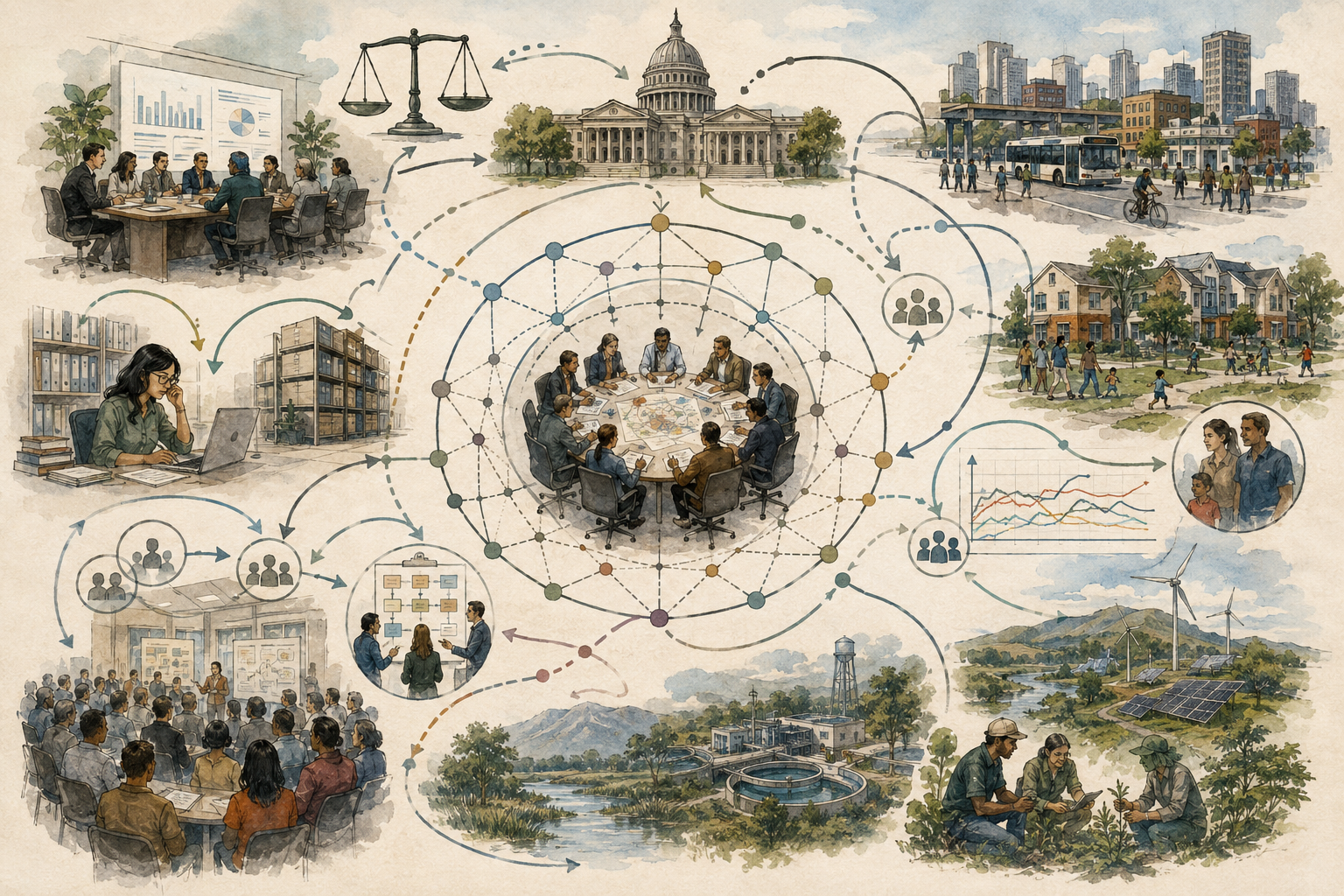
This article examines public policy through systems thinking. It explores policy design, implementation, administrative burden, feedback loops, unintended consequences, public trust, accountability, social equity, capacity, and institutional learning. It shows why policy failure often comes from weak system diagnosis rather than weak intention alone. It also examines the ethical stakes of public policy: who defines the problem, who carries implementation burden, whose feedback is treated as credible, who benefits from policy design, who is harmed by policy delay, and how public systems can be redesigned around dignity, justice, learning, and long-term public value.
Why Systems Thinking Matters for Public Policy
Systems thinking matters for public policy because public problems are rarely isolated. Poverty is connected to housing, health, education, wages, childcare, transportation, disability, discrimination, public benefits, and local labor markets. Climate policy is connected to energy, infrastructure, land use, finance, public trust, labor, trade, and global inequality. Public health is connected to housing, work, schools, transportation, communication, care capacity, food systems, and institutional legitimacy. A policy that addresses only one visible part of a problem may leave the deeper system untouched.
Public policy also matters because it creates behavior. Rules change incentives. Eligibility criteria change access. Documentation requirements change participation. Enforcement changes trust. Subsidies change markets. Performance targets change organizational priorities. Funding formulas change local capacity. Data systems change what institutions can see. A policy is not only a statement of intent. It is a structural signal that reshapes action across a system.
Many policy failures happen because policymakers expect linear effects in nonlinear systems. They assume that more information will change behavior, more enforcement will improve compliance, more funding will improve outcomes, more metrics will improve accountability, or more technology will improve efficiency. Each of these may sometimes be true. But each can fail when the system includes distrust, administrative burden, capacity constraints, fragmented authority, feedback delay, unequal vulnerability, or adaptive behavior.
| Policy challenge | Linear interpretation | Systems-thinking interpretation |
|---|---|---|
| Low program participation | People need more outreach. | Participation depends on trust, burden, eligibility, stigma, access, time, language, and support. |
| Noncompliance | Enforcement is too weak. | Rules may be unclear, burdensome, illegitimate, unaffordable, or misaligned with incentives. |
| Agency backlog | Staff need to process cases faster. | Backlog reflects rule complexity, staffing, rework, appeals, technology, demand, and policy design. |
| Public distrust | Communication is insufficient. | Trust is a stock built or depleted by institutional behavior, fairness, reliability, and repair. |
| Policy reform failure | Implementation was weak. | The policy may not have changed incentives, feedback loops, authority, capacity, or institutional memory. |
| Unintended consequences | The policy had side effects. | The system adapted predictably to the policy’s rules, incentives, and boundaries. |
Systems thinking does not replace legal analysis, economics, political judgment, community knowledge, or ethical reasoning. It connects them. It asks how policy behaves inside a real system, not only how it appears in legislation, theory, or administrative design. It helps public institutions see the relationships that determine whether policy becomes public value or public burden.
Policy as System Intervention
A public policy is a system intervention. It changes rules, resources, authority, incentives, information, rights, obligations, enforcement, or access. Because systems respond, policy design must anticipate feedback. People may comply, resist, adapt, avoid, reinterpret, game, or build workarounds. Institutions may implement policy differently depending on capacity, culture, technology, staffing, political pressure, and administrative memory. The public may respond based on trust, burden, perceived legitimacy, and lived experience.
Policy interventions vary in depth. Some policies change surface behavior by adding a requirement, subsidy, penalty, or program. Others change deeper structure by redesigning goals, authority, funding, feedback loops, institutional capacity, or public participation. Systems thinking asks where a policy intervenes in the system and whether that intervention is deep enough for the problem it addresses.
A policy aimed at symptoms may reduce visible pressure while preserving the behavior-generating structure. A policy aimed at structure changes the conditions that reproduce the problem. For example, emergency rental assistance may prevent immediate eviction, but housing affordability requires deeper structural attention to wages, housing supply, tenant protections, financing, land use, speculation, public housing, and regional inequality. Both levels may be necessary, but they are not the same.
\text{Policy Outcome} = f(\text{Rules}, \text{Incentives}, \text{Capacity}, \text{Feedback}, \text{Trust}, \text{Context})
\]
Interpretation: Policy outcomes emerge from the interaction of formal rules, incentives, institutional capacity, feedback, trust, and context.
Policy as system intervention requires attention to several design questions:
- What behavior does the policy expect from people, institutions, firms, or communities?
- What incentives does the policy create?
- What capacity is required for implementation?
- What burden does the policy shift to the public?
- What feedback will reveal whether the policy is working?
- What actors may adapt around the policy?
- What outcomes are delayed or outside the official evaluation boundary?
- What authority exists to revise the policy when feedback contradicts assumptions?
Good policy design begins by treating implementation and feedback as part of the policy itself. A policy is not complete when it is passed, funded, or announced. It becomes real when it changes system behavior. A systems-oriented policy therefore includes monitoring, revision, participation, accountability, and learning from the beginning.
Problem Definition and Policy Framing
Problem definition is one of the most powerful parts of public policy. Before a policy is designed, someone defines what the problem is, what caused it, who is responsible, what evidence matters, and what kinds of solutions are legitimate. This framing determines the policy space. If unemployment is framed as a skills problem, training becomes central. If it is framed as a labor-market, childcare, transportation, discrimination, health, and regional-investment problem, the solution space expands. If homelessness is framed as individual failure, policy will differ from a frame centered on housing markets, wages, health, trauma, disability, eviction, and public investment.
Systems thinking treats problem definition as a system intervention because framing changes what is visible. A narrow frame may locate failure in individuals, communities, or frontline agencies while hiding structural causes. A broad frame may reveal feedback loops, incentives, histories, and institutions. The problem is not that policymakers must include everything. The problem is that excluded variables often return as policy failure.
Policy frames are rarely neutral. They reflect power, professional training, ideology, institutional convenience, budget constraints, historical narratives, and political interests. The group with the power to define the problem often has the power to define the solution. This makes public participation, community knowledge, and frontline experience essential for serious policy diagnosis.
| Policy issue | Narrow frame | Systems frame |
|---|---|---|
| Food insecurity | People need emergency food assistance. | Wages, housing, food prices, transportation, agriculture, benefits, health, and neighborhood access interact. |
| School absenteeism | Students need stricter attendance rules. | Housing, health, transportation, safety, disability, family work schedules, belonging, and school climate shape attendance. |
| Climate risk | Communities need disaster response. | Land use, infrastructure, emissions, insurance, inequality, adaptation, trust, and governance determine vulnerability. |
| Digital exclusion | People need digital skills. | Access, affordability, disability, language, device quality, service design, and institutional support shape usability. |
| Healthcare access | People need insurance coverage. | Coverage, provider networks, transportation, language, cost, trust, work schedules, and administrative burden interact. |
Systems-oriented problem definition asks:
- Who defined the problem?
- Who experiences the problem differently?
- What history produced the current pattern?
- What feedback loops reproduce the problem?
- What burden does the current system shift to people with less power?
- What policy options become invisible under the dominant frame?
- What would the problem look like if affected people helped define it?
Policy begins with interpretation. A public system cannot solve a problem wisely if it first misdescribes it.
Implementation as System Behavior
Implementation is not the mechanical execution of policy intent. It is system behavior. A law, rule, grant, mandate, or program enters institutions with existing routines, staffing levels, technology, leadership, budgets, professional norms, political pressures, data systems, and public relationships. Implementation depends on these conditions. A policy that looks coherent on paper can become fragmented, burdensome, or ineffective when the implementation system lacks capacity or alignment.
Implementation failure is often blamed on weak execution. Sometimes execution is the issue. But systems thinking asks whether the policy design assumed capacity that did not exist, authority that was unclear, feedback that was unavailable, or cooperation that was never structurally supported. Public workers may be asked to implement complex policy with outdated systems, insufficient staffing, contradictory rules, or no time for learning. Communities may be expected to navigate complexity that policymakers underestimated.
Implementation is also adaptive. Frontline workers interpret policy in real situations. Agencies create guidance. Contractors respond to contract incentives. Local governments adjust to local constraints. Residents learn how to navigate or avoid the system. Advocacy organizations build workarounds. These adaptations can make policy work, but they can also distort it.
\text{Implemented Policy} = \text{Formal Policy} \times \text{Administrative Capacity} \times \text{Local Context}
\]
Interpretation: The policy people experience is shaped by formal design, administrative capacity, and local context.
Implementation systems should be designed with the following in mind:
- Capacity: staffing, training, technology, time, funding, and expertise must match policy complexity.
- Clarity: rules, eligibility, authority, appeals, and responsibilities must be understandable.
- Feedback: implementers and affected people must be able to report what is happening.
- Adaptation: local variation must be anticipated and governed responsibly.
- Burden: the policy must not shift excessive work to the public or frontline staff.
- Memory: implementation lessons must be preserved across teams and administrations.
Implementation is where policy becomes lived reality. If systems thinking is absent from implementation design, policy can fail even when the goal is legitimate and the legislative language is strong. The question is not only whether the policy exists. The question is whether the system can carry it.
Feedback Loops and Policy Learning
Policy should operate as a learning loop. A policy changes the system. The system responds. Feedback reveals effects, failures, burdens, adaptations, and unintended consequences. The institution interprets the feedback and revises the policy. When this loop works, public systems learn. When it fails, policy becomes rigid, performative, or harmful.
Feedback in public policy comes from many sources: public complaints, application data, appeals, court cases, audits, service outcomes, community testimony, frontline workers, performance dashboards, inspections, research studies, media investigations, protests, environmental indicators, health outcomes, and budget patterns. A learning policy system does not treat feedback as noise. It treats feedback as intelligence about how the policy is behaving.
Policy feedback can be positive, negative, direct, delayed, formal, informal, quantitative, qualitative, or political. The challenge is connecting feedback to authority. A public agency may receive repeated complaints but lack authority to change eligibility rules. Frontline workers may see policy failure but have no route to redesign. Communities may provide testimony that is recorded but not acted upon. Data may show disparities without changing budgets. Feedback without authority becomes frustration.
\text{Policy Learning} = \text{Feedback Quality} \times \text{Interpretive Capacity} \times \text{Authority to Revise}
\]
Interpretation: Policy learning requires usable feedback, the ability to interpret it, and authority to revise the system.
Policy feedback can also be distorted. Agencies may report the metrics they are funded to report while excluding public burden. Political actors may select evidence that supports their position. Contractors may report compliance without lived quality. Residents may stop providing feedback if prior feedback was ignored. Frontline workers may soften bad news when blame risk is high. The feedback loop weakens when truth becomes costly.
| Feedback failure | Policy consequence | Systems redesign |
|---|---|---|
| Feedback is delayed. | Harm becomes visible after the policy is entrenched. | Use leading indicators and rapid feedback channels. |
| Feedback is filtered. | Decision-makers receive softened or incomplete signals. | Protect frontline, community, and independent feedback. |
| Feedback lacks authority. | Problems are documented but not corrected. | Connect feedback to revision authority and budget decisions. |
| Feedback is too narrow. | Metrics improve while public burden or inequity rises. | Include burden, distribution, dignity, and trust indicators. |
| Feedback is not remembered. | Institutions repeat the same mistakes. | Build institutional memory and decision records. |
A public policy system learns only when feedback changes future action. If feedback is collected but does not change rules, budgets, guidance, staffing, tools, enforcement, or accountability, the system has listened without learning.
Administrative Burden and Public Access
Administrative burden is one of the most important ways policy systems create exclusion while appearing neutral. A right, benefit, service, or protection may exist formally, but people must learn about it, prove eligibility, gather documents, complete forms, navigate offices or portals, meet deadlines, wait for decisions, correct errors, and appeal denials. These costs are not incidental. They are part of the policy system.
Administrative burden includes learning costs, compliance costs, and psychological costs. Learning costs are the work required to understand what exists and how to access it. Compliance costs include paperwork, documentation, travel, appointments, digital navigation, and time. Psychological costs include stigma, uncertainty, frustration, fear, humiliation, and distrust. These burdens fall unevenly. People with less time, money, language access, disability accommodation, legal knowledge, digital access, or institutional trust face higher barriers.
Policy designers often treat burden as implementation detail. Systems thinking treats burden as policy design. If a policy is difficult to access, the difficulty shapes the outcome. Low participation may not reflect low need. It may reflect high burden. A system that reduces official spending by making access difficult may appear efficient while failing its public purpose.
AB_i = L_i + C_i + P_i
\]
Interpretation: Administrative burden \(AB_i\) for person \(i\) includes learning costs \(L_i\), compliance costs \(C_i\), and psychological costs \(P_i\).
Administrative burden creates feedback loops. High burden reduces participation. Reduced participation may be misread as reduced need. Reduced measured need can reduce funding or political attention. Lower capacity can increase delays, errors, and burden. The system then excludes people while treating exclusion as lack of demand.
| Burden source | How it appears | Policy redesign response |
|---|---|---|
| Complex eligibility | People cannot tell whether they qualify. | Simplify criteria and provide clear, multilingual guidance. |
| Documentation demands | Applicants struggle to prove status, income, residence, or need. | Use data matching, presumptive eligibility, and proportionate verification. |
| Digital-only access | People without devices, broadband, literacy, or accessibility support are excluded. | Provide assisted, offline, mobile, and accessible channels. |
| Long delays | People abandon applications or experience harm before decisions arrive. | Fund staffing, simplify workflows, and use interim support where appropriate. |
| Appeal difficulty | Wrong decisions persist because correction is too costly. | Make appeal rights clear, accessible, timely, and supported. |
Reducing burden does not mean eliminating accountability. It means designing accountability in ways that are proportionate, accessible, dignified, and effective. A policy that prevents misuse by excluding eligible people has not solved the accountability problem. It has shifted harm onto the public.
Unintended Consequences and Policy Resistance
Unintended consequences are not always unpredictable. Many arise because policies change incentives inside adaptive systems. People, organizations, firms, agencies, and communities respond to the policy in ways that policy designers did not fully anticipate. When the system responds by weakening, offsetting, or reversing the intended effect, policy resistance appears.
Policy resistance occurs when a system pushes back against intervention. A rule meant to improve accountability may create paperwork that reduces service quality. A target meant to improve performance may encourage gaming. A subsidy meant to make housing affordable may be captured by rising rents if supply and market power are not addressed. A policing strategy meant to increase safety may reduce trust and cooperation if communities experience it as harmful. An efficiency reform may reduce staffing until capacity becomes fragile.
Unintended consequences often emerge from narrow boundaries. A policy may count agency cost but not public burden, emissions per unit but not total throughput, jobs created but not job quality, service speed but not error rates, enforcement actions but not legitimacy, housing units but not displacement, or digital transactions but not exclusion. What is outside the boundary returns as consequence.
\text{Observed Outcome} = \text{Intended Effect} + \text{Adaptive Response} + \text{Side Effects}
\]
Interpretation: Policy outcomes include intended effects, adaptive responses by actors in the system, and side effects outside the original design boundary.
Common sources of unintended consequences include:
- metrics becoming targets and changing behavior;
- burden shifting from institutions to the public;
- short-term fixes weakening long-term capacity;
- local optimization creating system-wide inefficiency;
- rules creating avoidance, gaming, or informal workarounds;
- benefits being captured by actors with more power or capacity;
- policies ignoring delayed or cumulative effects;
- trust declining when policy feels unfair, opaque, or coercive.
Systems thinking does not assume unintended consequences can be eliminated entirely. Complex systems always involve uncertainty. But policy design can reduce avoidable harm by mapping incentives, testing scenarios, including affected communities, monitoring leading indicators, and building revision mechanisms into policy from the beginning.
A policy that cannot learn from unintended consequences will keep generating them.
Delays, Policy Timing, and Long-Term Effects
Public policy often suffers from timing problems because causes and effects are separated by delay. A policy may impose costs now while benefits appear later. A harmful policy may appear successful before delayed consequences emerge. Prevention may look expensive because the disaster it avoids never happens. Maintenance may be deferred because infrastructure decline is slow. Climate action may be postponed because the worst effects are delayed. Education, public health, housing, ecological restoration, and institutional trust all involve long time horizons.
Delay creates political and administrative risk. Short election cycles favor visible short-term results. Budget cycles favor immediate savings. Media attention favors crisis. Agencies may be evaluated before long-term outcomes can appear. A policy can be abandoned too early or continued too long because feedback timing is misunderstood.
Systems thinking helps policy designers distinguish immediate outputs, intermediate outcomes, and long-term system effects. It also helps identify leading indicators that show whether the system is moving in the right direction before the final outcome appears.
Y_t = f(P_{t-d}, C_t, F_t)
\]
Interpretation: Current public outcomes \(Y_t\) may depend on earlier policy choices \(P_{t-d}\), current capacity \(C_t\), and feedback conditions \(F_t\).
| Policy domain | Delayed effect | Leading indicator |
|---|---|---|
| Early childhood policy | Education, health, income, and wellbeing effects unfold over years. | Access, quality, family stability, developmental supports, attendance, and service continuity. |
| Climate policy | Emissions reductions affect climate risk over long horizons. | Energy mix, cumulative emissions, infrastructure lock-in, adaptation capacity, and exposure reduction. |
| Infrastructure maintenance | Deferred repair creates later failure and higher costs. | Asset condition, maintenance backlog, service interruption, climate exposure, and failure frequency. |
| Public trust | Trust declines and recovers through repeated institutional behavior. | Complaint patterns, participation, appeal rates, service reliability, and follow-through on commitments. |
| Public health prevention | Prevention avoids future illness, cost, and crisis. | Vaccination, screening, exposure reduction, housing stability, food access, and care capacity. |
Policy timing should include adaptive review points. A policy should specify when evidence will be reviewed, which indicators matter, what thresholds trigger revision, and who has authority to change course. Without this, delay can produce both overreaction and underreaction. Policymakers may push harder on a failing approach because the feedback they need has not yet arrived, or they may abandon a useful approach because benefits are delayed.
Time is part of policy design. A policy that ignores delay will misread its own consequences.
Public Trust, Legitimacy, and Compliance
Public trust is not a communication asset added after policy design. It is part of the policy system. People are more likely to comply with rules, participate in programs, share information, accept trade-offs, and cooperate during crisis when institutions are perceived as legitimate, fair, competent, transparent, and responsive. Trust is built through repeated experience, not messaging alone.
Legitimacy matters because public policy depends on more than coercion. Even when government has legal authority, policy works better when people believe the system is fair, understandable, accountable, and oriented toward public purpose. A technically efficient policy can fail if people experience it as arbitrary, disrespectful, burdensome, discriminatory, or opaque.
Trust behaves like a stock. It accumulates through reliability, fairness, transparency, participation, and repair. It declines through broken promises, administrative burden, exclusion, corruption, discrimination, surveillance, and uncorrected harm. A policy may draw on trust the institution did not build, and if it spends that trust irresponsibly, future policy becomes harder.
T_{t+1} = T_t + R_t + F_t + A_t – H_t – B_t – O_t
\]
Interpretation: Public trust \(T\) grows through reliability \(R_t\), fairness \(F_t\), and accountability \(A_t\), and declines through harm \(H_t\), burden \(B_t\), and opacity \(O_t\).
Trust and compliance can form reinforcing loops. Trust supports cooperation. Cooperation improves outcomes. Better outcomes build trust. The reverse is also true. Distrust reduces participation. Lower participation weakens outcomes. Weak outcomes confirm distrust. Enforcement may increase, creating further alienation if experienced as unfair.
| Trust-building policy behavior | Trust-depleting policy behavior |
|---|---|
| Clear rules and accessible explanations. | Confusing procedures and hidden eligibility requirements. |
| Reliable service and timely decisions. | Delays, backlogs, lost documents, and inconsistent treatment. |
| Meaningful appeal and correction. | Wrong decisions that are hard to contest. |
| Participation that affects policy design. | Consultation without visible consequence. |
| Repair after institutional harm. | Denial, defensiveness, or reputational self-protection. |
Policy designers should ask how the policy affects trust. Does it treat people with dignity? Does it make rules understandable? Does it correct errors? Does it reduce burden? Does it show that public feedback matters? Does it preserve institutional memory? Does it build the legitimacy needed for future collective action?
Trust is not soft. It is a hard system condition for effective public policy.
Equity, Distribution, and Structural Vulnerability
Public policy always distributes benefits, burdens, risks, rights, responsibilities, and opportunities. A policy may improve aggregate outcomes while worsening inequality. It may reduce average cost while increasing burden for people with less capacity. It may expand a program while excluding people who cannot navigate the process. It may reduce emissions while increasing energy costs for low-income households. It may make a city more attractive while accelerating displacement.
Systems thinking asks who benefits, who pays, who is exposed, who is protected, and who has authority. Distribution is not a secondary evaluation question. It is part of the system’s behavior. Unequal systems produce unequal policy effects because people and communities enter policy systems with different resources, histories, vulnerabilities, and institutional relationships.
Structural vulnerability refers to the conditions that make some people more exposed to harm or less able to benefit from policy. These conditions include income, housing, health, race, disability, age, immigration status, geography, language, transportation, digital access, legal status, political voice, environmental exposure, and prior institutional harm. A formally neutral policy can reproduce inequality when it ignores unequal starting positions.
\text{Policy Impact}_g = \text{Benefit}_g – \text{Burden}_g – \text{Risk}_g
\]
Interpretation: Policy impact for group \(g\) depends on benefits received, burdens imposed, and risks created or reduced.
| Policy area | Aggregate success metric | Distributional systems question |
|---|---|---|
| Energy transition | Emissions reduced. | Who pays transition costs, who receives subsidies, and who gains energy security? |
| Digital government | Online transactions increased. | Who is excluded by digital access, language, disability, or documentation barriers? |
| Housing policy | Units produced. | Who can afford the units, who is displaced, and who gains neighborhood stability? |
| Public safety | Incidents reduced. | How are enforcement, trust, surveillance, violence, and community legitimacy distributed? |
| Public health | Vaccination or screening rate increased. | Which communities remain underserved and why? |
Equity analysis should be built into policy design, not added after implementation. This includes burden analysis, access analysis, distributional modeling, community participation, historical context, and accountability for correction. Systems thinking helps show that inequity is not merely a difference in outcomes. It is often a feedback structure that compounds advantage and vulnerability over time.
A policy that improves averages while deepening structural vulnerability is not a systems success.
Capacity, Coordination, and Institutional Memory
Public policy depends on institutional capacity. Capacity includes staffing, expertise, funding, technology, legal authority, administrative systems, public trust, community relationships, data infrastructure, maintenance, coordination, and institutional memory. A policy that requires capacity without providing it creates implementation failure. A policy that reduces capacity to save money may create future costs through backlog, error, crisis, and public distrust.
Coordination is also central because many public problems cross institutional boundaries. A housing policy may depend on transportation, schools, health, zoning, finance, climate risk, and regional labor markets. A public-health policy may require coordination among clinics, schools, employers, community organizations, local government, and communications systems. A climate policy may involve energy, land use, industry, insurance, public finance, and adaptation planning.
Institutional memory connects policy across time. Public institutions must remember what they tried, what failed, what communities already said, what assumptions were wrong, what data was misleading, what legal constraints mattered, what political commitments were made, and what repairs remain incomplete. Without memory, policy becomes a cycle of recurring reform.
\text{Policy Capacity} = \text{Staffing} + \text{Knowledge} + \text{Technology} + \text{Authority} + \text{Trust} + \text{Memory}
\]
Interpretation: Policy capacity is multidimensional. Staffing alone is not enough if knowledge, technology, authority, trust, and memory are weak.
Capacity failures often appear as individual or agency failure. Staff miss deadlines. People make errors. Agencies respond slowly. The public becomes frustrated. But the deeper issue may be underfunded administration, outdated technology, high turnover, unclear authority, excessive complexity, or weak knowledge systems.
| Capacity issue | How it appears | Systems redesign response |
|---|---|---|
| Understaffing | Backlogs, delays, errors, burnout. | Align workload with staffing and simplify demand where possible. |
| Weak data systems | Fragmented records, repeated paperwork, poor monitoring. | Build interoperable, privacy-protective, accessible data infrastructure. |
| High turnover | Loss of knowledge, repeated mistakes, onboarding burden. | Preserve institutional memory and improve work-system sustainability. |
| Fragmented authority | Everyone sees the problem, but no one can fix it. | Clarify decision rights and cross-boundary accountability. |
| Weak public trust | Low participation, resistance, avoidance. | Improve reliability, dignity, transparency, participation, and repair. |
Policy systems should be designed with capacity as a central variable. A policy that ignores capacity is not ambitious. It is incomplete.
Policy Redesign and Leverage Points
Policy redesign means changing the structure that produces public outcomes. It is deeper than increasing pressure on the existing system. Pressure asks agencies to process faster, people to comply more, staff to work harder, or communities to adapt. Redesign asks whether rules, incentives, feedback, burden, capacity, goals, authority, and accountability should change.
Systems thinking helps identify leverage points. Some leverage points are shallow: changing forms, adding reminders, increasing enforcement, or improving communication. These can help, but they often leave deeper structures untouched. Deeper leverage points include changing information flows, reducing burden, redesigning incentives, shifting authority, changing funding formulas, building capacity, redefining goals, and revising the mental models that define the problem.
A policy system may need both symptom relief and structural redesign. Emergency aid may be necessary during crisis, but prevention and capacity-building are needed for durable change. Enforcement may be necessary when rights are violated, but trust and legitimacy may require deeper accountability. Digital tools may improve access, but only if the underlying process is redesigned around real users.
| Policy problem | Pressure response | Redesign response |
|---|---|---|
| Low uptake | Increase outreach. | Reduce burden, simplify eligibility, improve trust, and provide assisted access. |
| Backlog | Demand faster processing. | Reduce complexity, fund capacity, prevent rework, and redesign intake. |
| Policy resistance | Increase enforcement. | Analyze incentives, legitimacy, burden, and adaptive behavior. |
| Repeated failure | Launch another reform initiative. | Preserve institutional memory and change the structure that defeated prior reforms. |
| Inequitable outcomes | Add a narrow equity statement. | Redesign distribution, access, participation, funding, and accountability. |
Leverage points should be chosen based on system diagnosis. A communication problem needs communication. A burden problem needs burden reduction. A capacity problem needs capacity. A trust problem needs trustworthy behavior. A coordination problem needs authority and shared accountability. A goal problem needs a deeper debate about what the policy is optimizing.
Policy redesign should be judged by behavior over time. Did participation improve? Did burden decline? Did trust recover? Did disparities narrow? Did agencies coordinate better? Did the same problem stop recurring? Did public capacity grow? If the pattern remains, the redesign may not have reached the structure that matters.
Ethics: Dignity, Burden, and Public Responsibility
Public policy has ethical stakes because it shapes people’s access to rights, resources, safety, health, housing, education, mobility, environmental protection, and democratic voice. A policy can harm people through exclusion, delay, stigma, surveillance, administrative burden, arbitrary rules, underfunding, or failure to learn from known consequences. Ethical policy design requires more than good intent. It requires attention to how the system treats people.
Dignity is central. People should not be forced to prove need through humiliating procedures, navigate inaccessible systems, repeatedly submit information government already has, endure unexplained delays, or carry the cost of institutional confusion. A policy that treats people as suspects, problems, or data points may undermine the public value it claims to serve.
Burden is also ethical. When a policy creates paperwork, waiting, confusion, fear, travel, translation, legal navigation, or digital complexity, that burden is not neutral. It falls harder on people with fewer resources. If burden is used deliberately to reduce participation, the policy has converted administrative design into exclusion. If burden is accidental but uncorrected after feedback, the ethical problem remains.
Ethical systems questions include:
- Who defines the policy problem?
- Who is treated as responsible for solving it?
- Who carries administrative, emotional, financial, or time burden?
- Who benefits from the policy’s structure?
- Who is excluded by process design?
- Whose feedback changes the policy?
- What histories of harm shape trust?
- How are errors corrected?
- What repair is owed when policy causes harm?
- Does the policy strengthen public dignity or merely manage public behavior?
Ethical policy design also requires intergenerational responsibility. Public policies can defer infrastructure maintenance, climate risk, debt, ecological damage, institutional distrust, or social harm into the future. Systems thinking makes this deferral visible. It asks whether present decisions preserve or deplete the capacities future people will need.
Public policy is an exercise of collective responsibility. It should be designed with humility, evidence, participation, accountability, and care for the people who must live inside the systems it creates.
Examples Across Public Policy Systems
Systems thinking applies across public policy domains because every policy enters an adaptive system. The examples below show how the systems lens changes diagnosis and design.
Public benefits
A public benefits policy may aim to support food security, housing stability, healthcare, or income security. A narrow design may focus on eligibility and fraud prevention. A systems design also examines burden, eligible nonparticipation, stigma, digital access, staffing, appeal rights, language access, and trust. The policy should be evaluated not only by improper payment rates, but by whether people with legitimate need can access support with dignity.
Housing policy
Housing policy involves supply, zoning, land value, wages, tenant protections, financing, public housing, homelessness services, transportation, schools, and displacement. A policy that increases units may still fail if affordability, location, ownership, speculation, or tenant stability are ignored. Systems thinking asks how housing markets, institutions, and public rules interact over time.
Climate policy
Climate policy must manage emissions, adaptation, energy systems, infrastructure, land use, finance, labor, public trust, and justice. A carbon-reduction policy that ignores energy burden or employment transition may produce backlash. An adaptation policy that protects property while ignoring renters or low-income communities may deepen vulnerability. Systems thinking connects mitigation, adaptation, equity, and institutional learning.
Public health policy
Public health policy depends on trust, access, communication, care capacity, housing, work conditions, schools, transportation, food systems, and social protection. Information campaigns are not enough when behavior is shaped by structural constraints. Systems thinking asks what conditions make healthy behavior possible and what institutions must do to reduce exposure, vulnerability, and distrust.
Education policy
Education policy often focuses on standards, testing, accountability, curriculum, and funding. A systems view includes housing stability, health, food security, family work schedules, teacher capacity, school climate, segregation, disability support, language access, and community trust. It asks whether accountability improves learning or narrows it.
Digital government
Digital government can improve speed and access, but it can also create exclusion, automation bias, appeal barriers, surveillance, and new forms of burden. Systems thinking asks whether digital tools simplify the public experience or scale an already burdensome process. It also asks how human support, transparency, accessibility, privacy, and contestability are maintained.
Infrastructure policy
Infrastructure policy involves maintenance, climate risk, financing, procurement, engineering, land use, environmental justice, public participation, and long asset lifetimes. Deferred maintenance is a stock-flow problem. A systems approach asks whether the policy builds future resilience or merely postpones visible costs.
Public safety policy
Public safety policy involves violence, trust, enforcement, poverty, trauma, mental health, housing, education, substance use, legitimacy, and community capacity. A narrow enforcement-only frame may ignore feedback between trust, cooperation, legitimacy, and safety. Systems thinking asks how public safety is produced by social and institutional conditions, not only by response after harm occurs.
Across these domains, systems thinking shifts public policy from isolated intervention to structural learning. It asks what the policy changes, what the system does in response, and whether the public outcome improves over time.
Mathematics, Computation, and Modeling
Public policy can be modeled through stock-flow systems, feedback loops, administrative burden indices, trust dynamics, implementation capacity, policy scenario simulations, distributional analysis, and network models. Models do not replace democratic judgment or lived experience. They help make assumptions visible, test policy timing, compare scenarios, and reveal hidden burdens or delayed consequences.
A simple policy feedback model can be represented as:
Y_{t+1} = Y_t + \alpha P_t – \beta B_t + \gamma C_t
\]
Interpretation: Outcome \(Y\) changes through policy effort \(P_t\), administrative burden \(B_t\), and implementation capacity \(C_t\).
Administrative burden can be represented as:
AB_i = L_i + C_i + P_i
\]
Interpretation: Administrative burden for person \(i\) includes learning costs, compliance costs, and psychological costs.
Public trust can be modeled as a stock:
T_{t+1} = T_t + R_t + F_t + A_t – H_t – B_t – O_t
\]
Interpretation: Trust increases through reliability, fairness, and accountability, and declines through harm, burden, and opacity.
Implementation capacity can be represented as:
IC_t = S_t + K_t + D_t + M_t + A_t
\]
Interpretation: Implementation capacity \(IC_t\) includes staffing, knowledge, data systems, institutional memory, and authority.
Distributional impact can be represented as:
DI_g = Benefits_g – Burdens_g – Risks_g
\]
Interpretation: Distributional impact for group \(g\) compares benefits, burdens, and risks.
Policy feedback closure can be represented as:
FC = \frac{Feedback_{\text{acted upon}}}{Feedback_{\text{received}}}
\]
Interpretation: Feedback closure measures the share of received feedback that produces documented action, revision, or structural change.
| Modeling task | Public policy question | Example output |
|---|---|---|
| Administrative burden modeling | Who faces the highest cost of access? | Burden index by group, program, process, or geography. |
| Policy scenario simulation | How do different designs behave over time? | Baseline, enforcement, burden reduction, capacity building, and redesign scenarios. |
| Trust dynamics modeling | Is the policy building or depleting legitimacy? | Trust stock trajectory under different implementation patterns. |
| Distributional analysis | Who benefits and who bears burden? | Benefit, burden, and risk summaries by group or place. |
| Implementation capacity modeling | Can the institution carry the policy? | Staffing, backlog, memory, technology, and authority indicators. |
| Feedback-loop closure | Does feedback change policy design? | Feedback received, acted upon, embedded, and remembered. |
| Network analysis | Where are coordination gaps? | Agency networks, handoff bottlenecks, and authority gaps. |
Policy modeling should be transparent about assumptions. It should state what is included, what is excluded, how burden is measured, how distribution is handled, and what values are embedded in weights or thresholds. A public policy model should support public learning, not conceal political or ethical choices behind technical language.
Python Workflow: Policy Feedback, Administrative Burden, and Scenario Modeling
The Python workflow below turns public policy systems analysis into a small reproducible systems model. It compares four scenarios: baseline administration, enforcement-heavy design, burden-reduction design, and capacity-building public-value redesign. It also includes one-at-a-time sensitivity analysis for the redesign scenario. The script uses only the Python standard library, writes CSV outputs relative to the article folder, and is designed as a clear starting point for companion repository work.
# systems_thinking_public_policy_workflow.py
# Dependency-light workflow for public-policy systems diagnostics:
# administrative burden, implementation capacity, public trust, feedback closure,
# distributional impact, delay, institutional memory, and policy redesign scenarios.
# Writes outputs relative to the article root.

from __future__ import annotations

from dataclasses import dataclass, replace
from pathlib import Path
import csv
from statistics import mean

ARTICLE_ROOT = Path(__file__).resolve().parents[1]
TABLES = ARTICLE_ROOT / "outputs" / "tables"


@dataclass
class PublicPolicyScenario:
    name: str
    policy_effort: float
    enforcement_intensity: float
    learning_cost: float
    compliance_cost: float
    psychological_cost: float
    digital_burden: float
    implementation_capacity_investment: float
    feedback_quality: float
    feedback_closure: float
    public_trust_repair: float
    distributional_equity_capacity: float
    appeal_access: float
    institutional_memory: float
    policy_delay: float
    authority_to_revise: float
    political_pressure: float


def clamp(value: float, low: float = 0.0, high: float = 140.0) -> float:
    return max(low, min(high, value))


def run_scenario(scenario: PublicPolicyScenario, periods: int = 64) -> list[dict[str, object]]:
    policy_outcome_stock = 42.0 + scenario.policy_effort * 10.0
    public_trust_stock = 42.0 + scenario.public_trust_repair * 12.0
    implementation_capacity_stock = 40.0 + scenario.implementation_capacity_investment * 16.0
    institutional_memory_stock = 34.0 + scenario.institutional_memory * 16.0
    distributional_gap_stock = 46.0 - scenario.distributional_equity_capacity * 12.0
    backlog_stock = 44.0 + scenario.learning_cost * 8.0 + scenario.compliance_cost * 8.0
    public_burden_stock = 42.0 + scenario.digital_burden * 10.0 + scenario.psychological_cost * 10.0
    revision_authority_stock = 30.0 + scenario.authority_to_revise * 18.0
    rows: list[dict[str, object]] = []

    delay_steps = max(0, int(round(scenario.policy_delay * 10.0)))
    revision_history: list[float] = [0.0]

    for period in range(periods + 1):
        delayed_index = max(0, len(revision_history) - 1 - delay_steps)
        delayed_revision = revision_history[delayed_index]

        administrative_burden_index = clamp(
            scenario.learning_cost * 16.0
            + scenario.compliance_cost * 18.0
            + scenario.psychological_cost * 15.0
            + scenario.digital_burden * 12.0
            + backlog_stock * 0.07
            + max(0.0, 55.0 - implementation_capacity_stock) * 0.10
            - scenario.appeal_access * 5.0
            - scenario.distributional_equity_capacity * 4.0
            - delayed_revision * 0.04,
            0.0,
            120.0,
        )

        access_score = clamp(
            implementation_capacity_stock * 0.14
            + public_trust_stock * 0.10
            + scenario.appeal_access * 15.0
            + scenario.distributional_equity_capacity * 10.0
            - administrative_burden_index * 0.16
            - distributional_gap_stock * 0.08,
            0.0,
            100.0,
        )

        enforcement_effect = clamp(
            scenario.enforcement_intensity * 14.0
            + scenario.policy_effort * 6.0
            - administrative_burden_index * 0.06
            - scenario.political_pressure * 3.0,
            0.0,
            100.0,
        )

        enforcement_trust_cost = clamp(
            scenario.enforcement_intensity * 8.0
            + administrative_burden_index * 0.08
            + distributional_gap_stock * 0.06
            - scenario.appeal_access * 4.0
            - scenario.public_trust_repair * 3.0,
            0.0,
            100.0,
        )

        feedback_signal = clamp(
            public_burden_stock * 0.10
            + backlog_stock * 0.09
            + distributional_gap_stock * 0.08
            + max(0.0, 55.0 - access_score) * 0.12
            + scenario.feedback_quality * 6.0,
            0.0,
            100.0,
        )

        feedback_acted_upon = clamp(
            feedback_signal * (0.30 + 0.48 * scenario.feedback_closure)
            + scenario.feedback_quality * 8.0
            + scenario.authority_to_revise * 8.0
            + scenario.institutional_memory * 6.0
            - scenario.political_pressure * 5.0
            - scenario.policy_delay * 4.0,
            0.0,
            100.0,
        )

        capacity_flow = clamp(
            scenario.implementation_capacity_investment * 16.0
            + institutional_memory_stock * 0.06
            + feedback_acted_upon * 0.05
            + scenario.authority_to_revise * 5.0
            - administrative_burden_index * 0.06
            - scenario.political_pressure * 3.0,
            0.0,
            100.0,
        )

        learning_flow = clamp(
            scenario.feedback_closure * 12.0
            + scenario.institutional_memory * 10.0
            + scenario.feedback_quality * 8.0
            + feedback_acted_upon * 0.08
            + scenario.authority_to_revise * 6.0
            - scenario.policy_delay * 4.0
            - scenario.political_pressure * 4.0,
            0.0,
            100.0,
        )

        equity_repair_flow = clamp(
            scenario.distributional_equity_capacity * 14.0
            + scenario.appeal_access * 8.0
            + scenario.public_trust_repair * 6.0
            + feedback_acted_upon * 0.06
            - administrative_burden_index * 0.05
            - scenario.political_pressure * 3.0,
            0.0,
            100.0,
        )

        policy_outcome_stock = clamp(
            policy_outcome_stock
            + scenario.policy_effort * 1.3
            + access_score * 0.05
            + enforcement_effect * 0.05
            + capacity_flow * 0.06
            + feedback_acted_upon * 0.05
            - administrative_burden_index * 0.07
            - distributional_gap_stock * 0.06
            - scenario.policy_delay * 0.5,
            0.0,
            120.0,
        )

        public_trust_stock = clamp(
            public_trust_stock
            + scenario.public_trust_repair * 1.2
            + equity_repair_flow * 0.04
            + feedback_acted_upon * 0.04
            + scenario.appeal_access * 0.7
            - enforcement_trust_cost * 0.08
            - public_burden_stock * 0.04
            - scenario.political_pressure * 0.5,
            0.0,
            100.0,
        )

        implementation_capacity_stock = clamp(
            implementation_capacity_stock
            + capacity_flow * 0.10
            + institutional_memory_stock * 0.025
            - backlog_stock * 0.035
            - administrative_burden_index * 0.03,
            0.0,
            120.0,
        )

        institutional_memory_stock = clamp(
            institutional_memory_stock
            + learning_flow * 0.10
            + scenario.institutional_memory * 0.8
            - scenario.policy_delay * 0.5
            - scenario.political_pressure * 0.4,
            0.0,
            120.0,
        )

        distributional_gap_stock = clamp(
            distributional_gap_stock
            + administrative_burden_index * 0.05
            + enforcement_trust_cost * 0.04
            + scenario.political_pressure * 0.4
            - equity_repair_flow * 0.09
            - scenario.distributional_equity_capacity * 0.8,
            0.0,
            100.0,
        )

        public_burden_stock = clamp(
            public_burden_stock
            + administrative_burden_index * 0.09
            + backlog_stock * 0.03
            + enforcement_trust_cost * 0.03
            - equity_repair_flow * 0.05
            - feedback_acted_upon * 0.04
            - scenario.appeal_access * 0.5,
            0.0,
            120.0,
        )

        backlog_stock = clamp(
            backlog_stock
            + administrative_burden_index * 0.07
            + max(0.0, 55.0 - implementation_capacity_stock) * 0.08
            - capacity_flow * 0.10
            - feedback_acted_upon * 0.04,
            0.0,
            120.0,
        )

        revision_authority_stock = clamp(
            revision_authority_stock
            + scenario.authority_to_revise * 1.0
            + feedback_acted_upon * 0.04
            + institutional_memory_stock * 0.025
            - scenario.political_pressure * 0.6,
            0.0,
            100.0,
        )

        revision_flow = clamp(
            scenario.authority_to_revise * 14.0
            + scenario.feedback_closure * 10.0
            + scenario.implementation_capacity_investment * 8.0
            + scenario.distributional_equity_capacity * 8.0
            + feedback_acted_upon * 0.08
            + revision_authority_stock * 0.05
            - scenario.policy_delay * 5.0
            - scenario.political_pressure * 5.0,
            0.0,
            100.0,
        )
        revision_history.append(revision_flow)

        feedback_closure_ratio = clamp(feedback_acted_upon / max(1.0, feedback_signal) * 100.0, 0.0, 120.0)

        public_value_score = clamp(
            policy_outcome_stock * 0.17
            + public_trust_stock * 0.16
            + implementation_capacity_stock * 0.14
            + institutional_memory_stock * 0.13
            + access_score * 0.15
            + revision_authority_stock * 0.10
            + scenario.distributional_equity_capacity * 8.0
            - administrative_burden_index * 0.14
            - public_burden_stock * 0.12
            - distributional_gap_stock * 0.12
            - backlog_stock * 0.08,
            0.0,
            100.0,
        )

        policy_fragility_index = clamp(
            max(0.0, 65.0 - public_trust_stock) * 0.16
            + max(0.0, 65.0 - implementation_capacity_stock) * 0.14
            + administrative_burden_index * 0.15
            + public_burden_stock * 0.14
            + backlog_stock * 0.12
            + distributional_gap_stock * 0.14
            + scenario.policy_delay * 8.0
            + scenario.political_pressure * 8.0
            - revision_authority_stock * 0.10
            - institutional_memory_stock * 0.08,
            0.0,
            100.0,
        )

        rows.append({
            "period": period,
            "scenario": scenario.name,
            "policy_outcome_stock": round(policy_outcome_stock, 3),
            "public_trust_stock": round(public_trust_stock, 3),
            "implementation_capacity_stock": round(implementation_capacity_stock, 3),
            "institutional_memory_stock": round(institutional_memory_stock, 3),
            "revision_authority_stock": round(revision_authority_stock, 3),
            "distributional_gap_stock": round(distributional_gap_stock, 3),
            "public_burden_stock": round(public_burden_stock, 3),
            "backlog_stock": round(backlog_stock, 3),
            "administrative_burden_index": round(administrative_burden_index, 3),
            "access_score": round(access_score, 3),
            "feedback_signal": round(feedback_signal, 3),
            "feedback_acted_upon": round(feedback_acted_upon, 3),
            "feedback_closure_ratio": round(feedback_closure_ratio, 3),
            "enforcement_effect": round(enforcement_effect, 3),
            "enforcement_trust_cost": round(enforcement_trust_cost, 3),
            "public_value_score": round(public_value_score, 3),
            "policy_fragility_index": round(policy_fragility_index, 3),
        })

    return rows


def summarize(rows: list[dict[str, object]]) -> list[dict[str, object]]:
    output: list[dict[str, object]] = []
    for scenario_name in sorted({row["scenario"] for row in rows}):
        subset = [row for row in rows if row["scenario"] == scenario_name]
        final = subset[-1]
        avg_public_value = mean(float(row["public_value_score"]) for row in subset)
        avg_fragility = mean(float(row["policy_fragility_index"]) for row in subset)
        avg_burden = mean(float(row["administrative_burden_index"]) for row in subset)
        avg_trust = mean(float(row["public_trust_stock"]) for row in subset)
        avg_closure = mean(float(row["feedback_closure_ratio"]) for row in subset)

        if float(final["public_value_score"]) >= 65 and float(final["policy_fragility_index"]) <= 35:
            diagnostic = "policy redesign is building durable public value, trust, and capacity"
        elif avg_burden >= 60:
            diagnostic = "administrative burden is overwhelming access and legitimacy"
        elif avg_fragility >= 60:
            diagnostic = "policy design remains fragile under current feedback and capacity conditions"
        elif avg_trust < 45:
            diagnostic = "public trust stock is too weak for durable policy cooperation"
        elif avg_closure < 55:
            diagnostic = "feedback is not closing into revision and institutional learning"
        elif avg_public_value >= 55:
            diagnostic = "partial policy improvement with remaining burden, equity, and trust risks"
        else:
            diagnostic = "weak evidence of durable systems-oriented policy redesign"

        output.append({
            "scenario": scenario_name,
            "final_public_value_score": final["public_value_score"],
            "final_policy_fragility_index": final["policy_fragility_index"],
            "final_policy_outcome_stock": final["policy_outcome_stock"],
            "final_public_trust_stock": final["public_trust_stock"],
            "final_implementation_capacity_stock": final["implementation_capacity_stock"],
            "final_administrative_burden_index": final["administrative_burden_index"],
            "final_feedback_closure_ratio": final["feedback_closure_ratio"],
            "average_public_value_score": round(avg_public_value, 3),
            "average_policy_fragility_index": round(avg_fragility, 3),
            "average_administrative_burden_index": round(avg_burden, 3),
            "average_public_trust_stock": round(avg_trust, 3),
            "average_feedback_closure_ratio": round(avg_closure, 3),
            "diagnostic": diagnostic,
        })

    return output


def one_at_a_time(base: PublicPolicyScenario, delta: float = 0.10) -> list[dict[str, object]]:
    base_score = float(run_scenario(base)[-1]["public_value_score"])
    parameters = [
        "policy_effort",
        "enforcement_intensity",
        "learning_cost",
        "compliance_cost",
        "psychological_cost",
        "digital_burden",
        "implementation_capacity_investment",
        "feedback_quality",
        "feedback_closure",
        "public_trust_repair",
        "distributional_equity_capacity",
        "appeal_access",
        "institutional_memory",
        "policy_delay",
        "authority_to_revise",
        "political_pressure",
    ]

    rows: list[dict[str, object]] = []
    for parameter in parameters:
        for direction in (-1, 1):
            current = getattr(base, parameter)
            revised_value = max(0.0, min(1.0, current + direction * delta))
            revised = replace(base, name=f"{base.name} {parameter} {direction * delta:+.2f}", **{parameter: revised_value})
            revised_score = float(run_scenario(revised)[-1]["public_value_score"])
            rows.append({
                "parameter": parameter,
                "delta": direction * delta,
                "base_value": current,
                "revised_value": revised_value,
                "base_final_public_value_score": round(base_score, 3),
                "revised_final_public_value_score": round(revised_score, 3),
                "score_change": round(revised_score - base_score, 3),
                "absolute_score_change": round(abs(revised_score - base_score), 3),
            })

    return sorted(rows, key=lambda row: float(row["absolute_score_change"]), reverse=True)


def write_csv(path: Path, rows: list[dict[str, object]]) -> None:
    path.parent.mkdir(parents=True, exist_ok=True)
    if not rows:
        raise ValueError(f"No rows to write: {path}")
    with path.open("w", newline="", encoding="utf-8") as handle:
        writer = csv.DictWriter(handle, fieldnames=list(rows[0].keys()))
        writer.writeheader()
        writer.writerows(rows)


def main() -> None:
    scenarios = [
        PublicPolicyScenario("Baseline administration", 0.44, 0.34, 0.58, 0.60, 0.54, 0.52, 0.36, 0.34, 0.26, 0.30, 0.30, 0.36, 0.32, 0.56, 0.28, 0.48),
        PublicPolicyScenario("Enforcement-heavy design", 0.56, 0.76, 0.66, 0.70, 0.62, 0.58, 0.34, 0.28, 0.22, 0.22, 0.24, 0.28, 0.24, 0.52, 0.22, 0.56),
        PublicPolicyScenario("Burden-reduction design", 0.50, 0.26, 0.28, 0.30, 0.28, 0.26, 0.62, 0.62, 0.58, 0.62, 0.66, 0.70, 0.62, 0.30, 0.58, 0.30),
        PublicPolicyScenario("Capacity-building public-value redesign", 0.54, 0.20, 0.20, 0.22, 0.20, 0.18, 0.84, 0.84, 0.84, 0.84, 0.86, 0.86, 0.86, 0.18, 0.86, 0.18),
    ]

    rows: list[dict[str, object]] = []
    for scenario in scenarios:
        rows.extend(run_scenario(scenario))

    write_csv(TABLES / "public_policy_systems_timeseries.csv", rows)
    write_csv(TABLES / "public_policy_systems_summary.csv", summarize(rows))
    write_csv(TABLES / "public_policy_systems_sensitivity_analysis.csv", one_at_a_time(scenarios[-1]))

    print("Public policy systems workflow complete.")
    print(TABLES / "public_policy_systems_timeseries.csv")


if __name__ == "__main__":
    main()
The workflow is intentionally simple enough to inspect. It shows how policy effort, enforcement, learning cost, compliance cost, psychological cost, digital burden, implementation capacity, feedback quality, feedback closure, trust repair, distributional equity, appeal access, institutional memory, policy delay, revision authority, and political pressure interact over time. It also shows why public policy cannot be judged by intent or enforcement intensity alone: a policy can increase pressure while depleting trust, burdening the public, widening distributional gaps, and weakening public value. The model is synthetic and illustrative; it supports disciplined inquiry rather than replacing legal analysis, democratic judgment, community knowledge, or ethical responsibility.
R Workflow: Public Policy Indicators, Distributional Diagnostics, and Feedback Visualization
The R workflow reads the Python-generated time-series and sensitivity outputs, creates public-policy system summaries, and exports base R plots for policy outcome, public trust, implementation capacity, administrative burden, feedback closure, and public value. It uses only base R so it remains portable across simple local environments.
# systems_thinking_public_policy_diagnostics.R
# Base R workflow for public-policy systems summary and scenario visualization.

args <- commandArgs(trailingOnly = FALSE)
file_arg <- grep("^--file=", args, value = TRUE)

if (length(file_arg) > 0) {
  script_path <- normalizePath(sub("^--file=", "", file_arg[1]), mustWork = TRUE)
  article_root <- normalizePath(file.path(dirname(script_path), ".."), mustWork = TRUE)
} else {
  article_root <- getwd()
}

setwd(article_root)

tables_dir <- file.path(article_root, "outputs", "tables")
figures_dir <- file.path(article_root, "outputs", "figures")

if (!dir.exists(tables_dir)) {
  dir.create(tables_dir, recursive = TRUE)
}

if (!dir.exists(figures_dir)) {
  dir.create(figures_dir, recursive = TRUE)
}

timeseries_path <- file.path(tables_dir, "public_policy_systems_timeseries.csv")
sensitivity_path <- file.path(tables_dir, "public_policy_systems_sensitivity_analysis.csv")

if (!file.exists(timeseries_path)) {
  stop(paste("Missing", timeseries_path, "Run the Python workflow first."))
}

data <- read.csv(timeseries_path, stringsAsFactors = FALSE)

last_by_scenario <- do.call(
  rbind,
  lapply(split(data, data$scenario), function(df) df[nrow(df), ])
)

avg_public_value <- aggregate(public_value_score ~ scenario, data = data, FUN = mean)
avg_fragility <- aggregate(policy_fragility_index ~ scenario, data = data, FUN = mean)
avg_burden <- aggregate(administrative_burden_index ~ scenario, data = data, FUN = mean)
avg_trust <- aggregate(public_trust_stock ~ scenario, data = data, FUN = mean)
avg_closure <- aggregate(feedback_closure_ratio ~ scenario, data = data, FUN = mean)

names(avg_public_value)[2] <- "average_public_value_score"
names(avg_fragility)[2] <- "average_policy_fragility_index"
names(avg_burden)[2] <- "average_administrative_burden_index"
names(avg_trust)[2] <- "average_public_trust_stock"
names(avg_closure)[2] <- "average_feedback_closure_ratio"

final_fields <- last_by_scenario[, c(
  "scenario",
  "public_value_score",
  "policy_fragility_index",
  "policy_outcome_stock",
  "public_trust_stock",
  "implementation_capacity_stock",
  "administrative_burden_index",
  "feedback_closure_ratio"
)]

names(final_fields) <- c(
  "scenario",
  "final_public_value_score",
  "final_policy_fragility_index",
  "final_policy_outcome_stock",
  "final_public_trust_stock",
  "final_implementation_capacity_stock",
  "final_administrative_burden_index",
  "final_feedback_closure_ratio"
)

summary_table <- Reduce(
  function(x, y) merge(x, y, by = "scenario"),
  list(avg_public_value, avg_fragility, avg_burden, avg_trust, avg_closure, final_fields)
)

summary_table$diagnostic <- ifelse(
  summary_table$final_public_value_score >= 65 &
    summary_table$final_policy_fragility_index <= 35,
  "policy redesign is building durable public value, trust, and capacity",
  ifelse(
    summary_table$average_administrative_burden_index >= 60,
    "administrative burden is overwhelming access and legitimacy",
    ifelse(
      summary_table$average_policy_fragility_index >= 60,
      "policy design remains fragile under current feedback and capacity conditions",
      ifelse(
        summary_table$average_public_trust_stock < 45,
        "public trust stock is too weak for durable policy cooperation",
        ifelse(
          summary_table$average_feedback_closure_ratio < 55,
          "feedback is not closing into revision and institutional learning",
          ifelse(
            summary_table$average_public_value_score >= 55,
            "partial policy improvement with remaining burden, equity, and trust risks",
            "weak evidence of durable systems-oriented policy redesign"
          )
        )
      )
    )
  )
)

summary_table <- summary_table[order(summary_table$final_public_value_score, decreasing = TRUE), ]

write.csv(
  summary_table,
  file.path(tables_dir, "public_policy_systems_r_summary.csv"),
  row.names = FALSE
)

if (file.exists(sensitivity_path)) {
  sensitivity <- read.csv(sensitivity_path, stringsAsFactors = FALSE)
  sensitivity_ranked <- sensitivity[order(sensitivity$absolute_score_change, decreasing = TRUE), ]
  write.csv(
    sensitivity_ranked,
    file.path(tables_dir, "public_policy_systems_sensitivity_ranked_r.csv"),
    row.names = FALSE
  )
}

plot_metric <- function(metric, label, file_name) {
  png(file.path(figures_dir, file_name), width = 1200, height = 700)
  scenarios <- unique(data$scenario)
  plot(
    NA,
    xlim = range(data$period),
    ylim = range(data[[metric]], na.rm = TRUE),
    xlab = "Period",
    ylab = label,
    main = paste(label, "by Public Policy Scenario")
  )
  for (scenario_name in scenarios) {
    subset_data <- data[data$scenario == scenario_name, ]
    lines(subset_data$period, subset_data[[metric]], lwd = 2)
  }
  legend("topright", legend = scenarios, lwd = 2, cex = 0.75, bty = "n")
  grid()
  dev.off()
}

plot_metric("policy_outcome_stock", "Policy outcome stock", "policy_outcome_trajectories.png")
plot_metric("public_trust_stock", "Public trust stock", "public_trust_trajectories.png")
plot_metric("implementation_capacity_stock", "Implementation capacity stock", "implementation_capacity_trajectories.png")
plot_metric("administrative_burden_index", "Administrative burden index", "administrative_burden_trajectories.png")
plot_metric("feedback_closure_ratio", "Feedback closure ratio", "feedback_closure_trajectories.png")
plot_metric("public_value_score", "Public value score", "public_value_score_trajectories.png")

png(file.path(figures_dir, "final_public_value_scores.png"), width = 1200, height = 700)
barplot(
  summary_table$final_public_value_score,
  names.arg = summary_table$scenario,
  las = 2,
  ylab = "Final public value score",
  main = "Final Public Value Score by Policy Scenario"
)
grid()
dev.off()

print(summary_table)
This workflow supports the article’s central methodological claim: public policy should be evaluated through trajectories, burden, trust, distribution, feedback closure, capacity, and public value, not only through a single output metric. The R outputs help readers compare enforcement-oriented policy with burden-reducing, capacity-building, and learning-oriented redesign.
GitHub Repository
The companion repository for this article should help readers model public policy as a dynamic system of rules, incentives, administrative burden, public trust, implementation capacity, feedback closure, distributional effects, institutional memory, and scenario-based redesign using synthetic datasets and reproducible workflows.
Complete Code Repository
Companion repository for the article, including public policy scenario simulations, administrative burden models, public trust stock-flow examples, implementation capacity diagnostics, feedback closure analysis, distributional impact workflows, Python and R workflow scripts, synthetic datasets, documentation assets, and multi-language scaffolds for systems analysis.
articles/systems-thinking-in-public-policy/
├── python/
│   ├── systems_thinking_public_policy_workflow.py
│   ├── public_policy_feedback_model.py
│   ├── administrative_burden_index.py
│   ├── public_trust_stock_flow.py
│   ├── implementation_capacity_model.py
│   ├── distributional_policy_impact.py
│   ├── policy_delay_simulation.py
│   ├── feedback_closure_diagnostics.py
│   ├── validation_checks.py
│   └── run_all_public_policy_workflows.py
├── r/
│   ├── systems_thinking_public_policy_diagnostics.R
│   ├── public_policy_indicator_visualization.R
│   ├── burden_feedback_policy_diagnostics.R
│   ├── public_trust_trajectory_plots.R
│   ├── distributional_policy_tables.R
│   ├── implementation_capacity_summary.R
│   ├── public_value_scenario_outputs.R
│   └── run_all_public_policy_workflows.R
├── julia/
│   ├── nonlinear_policy_feedback.jl
│   ├── policy_delay_dynamics.jl
│   └── public_value_scenario_model.jl
├── sql/
│   ├── schema_policy_interventions.sql
│   ├── schema_public_programs.sql
│   ├── schema_administrative_burden.sql
│   ├── schema_trust_indicators.sql
│   ├── schema_implementation_capacity.sql
│   ├── schema_feedback_signals.sql
│   ├── schema_distributional_impacts.sql
│   ├── schema_policy_scenarios.sql
│   ├── schema_model_runs.sql
│   └── schema_outputs.sql
├── rust/
│   └── public_policy_diagnostics_cli.rs
├── go/
│   └── public_policy_scenario_runner.go
├── cpp/
│   ├── efficient_policy_burden_scan.cpp
│   └── feedback_delay_solver.cpp
├── fortran/
│   └── recurrence_policy_feedback_model.f90
├── c/
│   └── low_level_policy_feedback_engine.c
├── docs/
│   ├── modeling_principles.md
│   ├── article_notes.md
│   ├── public_policy_systems_framework.md
│   ├── administrative_burden_framework.md
│   ├── public_trust_and_legitimacy.md
│   ├── implementation_capacity_notes.md
│   ├── python_workflow.md
│   ├── r_workflow.md
│   ├── diagnostic_questions.md
│   ├── ethics_and_public_responsibility.md
│   ├── assumptions_and_limitations.md
│   └── responsible_use.md
├── data/
│   ├── synthetic_policy_interventions.csv
│   ├── synthetic_public_programs.csv
│   ├── synthetic_administrative_burden.csv
│   ├── synthetic_trust_indicators.csv
│   ├── synthetic_implementation_capacity.csv
│   ├── synthetic_feedback_signals.csv
│   ├── synthetic_distributional_impacts.csv
│   ├── synthetic_policy_scenarios.csv
│   ├── synthetic_model_runs.csv
│   └── synthetic_outputs.csv
├── outputs/
│   ├── README.md
│   ├── figures/
│   └── tables/
└── notebooks/
    ├── python_public_policy_systems_walkthrough.ipynb
    └── r_public_policy_indicators_visualization_placeholder.ipynb
This repository structure supports the article’s central argument: public policy must be analyzed as a dynamic system of feedback, burden, trust, implementation capacity, institutional learning, and distributional consequence. The python/ folder supports simulation and scenario modeling. The r/ folder supports visualization, indicator diagnostics, and policy interpretation. The julia folder supports nonlinear policy dynamics. The sql folder defines schemas for policy systems data. The lower-level language folders provide scaffolds for diagnostics, burden scanning, feedback-delay solving, recurrence modeling, and low-level policy simulation.
A Practical Method for Systems-Oriented Policy Design
Systems-oriented policy design requires moving from policy intent to system behavior. The method below helps policymakers, analysts, civic organizations, public administrators, and researchers examine how a policy will act inside a real public system.
1. Define the public value
Clarify the deeper public purpose: dignity, access, safety, health, housing, education, sustainability, justice, resilience, democratic participation, or trust.
2. Map the system boundary
Identify the institutions, communities, agencies, firms, laws, funding streams, data systems, historical conditions, and affected groups included in the policy system.
3. Surface the policy frame
Ask what the policy assumes about the problem, who caused it, who must change, and what kinds of solutions are considered legitimate.
4. Identify stocks and flows
Map the stocks being built or depleted: trust, backlog, capacity, infrastructure, public health, ecological resilience, institutional memory, or social vulnerability.
5. Trace administrative burden
Identify learning costs, compliance costs, psychological costs, digital costs, appeal burden, and hidden labor imposed on the public or frontline workers.
6. Map feedback loops
Ask how the system will respond to the policy. What reinforcing or balancing loops will the intervention activate?
7. Test for unintended consequences
Use scenarios to explore gaming, avoidance, burden shifting, inequitable benefit capture, trust depletion, rebound effects, and long-term costs.
8. Analyze distribution
Identify who benefits, who bears burden, who is exposed to risk, and who has authority to shape revision.
9. Build feedback and revision into the policy
Specify indicators, review points, public feedback channels, institutional memory, and authority to change the policy when evidence requires it.
10. Evaluate behavior over time
Track whether the policy changes the system’s trajectory, not only whether it produces short-term outputs.
This method treats public policy as an adaptive learning system. It asks whether the policy is capable of hearing the world it changes.
Common Pitfalls
Public policy systems thinking can fail when analysis remains too narrow, too linear, or too detached from implementation and lived experience. Several pitfalls are common.
- Confusing policy passage with policy success: A policy does not succeed because it exists. It succeeds when the system’s behavior changes in ways that produce public value.
- Ignoring administrative burden: Formal access means little if people cannot navigate the process. Burden is part of policy design.
- Assuming information alone changes behavior: Behavior is shaped by trust, access, incentives, identity, cost, capacity, and institutional history.
- Using metrics that narrow public value: What is measured can become what is optimized. Narrow metrics can hide dignity, equity, burden, quality, and trust.
- Blaming implementation without examining design: Implementation failure may reveal unrealistic policy design, weak capacity, fragmented authority, or poor feedback loops.
- Ignoring delay: Policies with long-term benefits may be abandoned too early, while harmful policies may look successful before delayed costs appear.
- Consulting affected people without sharing authority: Participation becomes symbolic when public feedback cannot change decisions, resources, or accountability.
- Failing to preserve institutional memory: Public systems repeat mistakes when lessons, warnings, and commitments are not retained and used.
The central pitfall is treating public policy as a linear tool rather than a system intervention. Systems thinking asks what the policy will cause the system to do next.
Why Public Policy Requires Systems Thinking
Public policy requires systems thinking because policy acts inside complex social, institutional, ecological, economic, and technological systems. It is shaped by feedback, burden, trust, capacity, incentives, power, memory, and delay. A policy that ignores these dynamics may produce outputs without public value, compliance without legitimacy, efficiency without access, reform without learning, or short-term relief without structural change.
Systems thinking changes the policy question. It asks not only what government should do, but how the system will respond. It asks what assumptions define the problem, what burdens the policy creates, what feedback it will receive, what capacities it requires, what unintended consequences are likely, who benefits, who is harmed, and how the policy can learn over time.
A systems-oriented policy does not pretend uncertainty can be eliminated. It designs for learning. It preserves institutional memory. It includes affected people. It measures burden and distribution. It protects public trust. It builds capacity. It revises itself when evidence shows that the system is behaving differently than expected.
Public policy is one of society’s most powerful tools for shaping shared life. That power requires humility and rigor. A policy system that can learn can become more just, more resilient, and more worthy of public trust. A policy system that cannot learn will keep repeating its failures in new language.
Related Articles
- Systems Thinking and Sustainability
- Systems Thinking in Governance and Public Institutions
- Policy Resistance and Structural Redesign
- Dynamic Complexity and Policy Resistance
- Delayed Feedback and Policy Timing
- Resilience, Thresholds, and Regime Shifts
- Public Health as a System
- Leverage Points and Places to Intervene in a System
Further Reading
- Pressman, Jeffrey L. and Wildavsky, Aaron. Implementation: How Great Expectations in Washington Are Dashed in Oakland. University of California Press.
- Herd, Pamela and Moynihan, Donald P. Administrative Burden: Policymaking by Other Means. Russell Sage Foundation.
- Ostrom, Elinor. Understanding Institutional Diversity. Princeton University Press.
- Ostrom, Elinor. Governing the Commons: The Evolution of Institutions for Collective Action. Cambridge University Press.
- Meadows, Donella H. Thinking in Systems: A Primer. Chelsea Green Publishing.
- Sterman, John D. Business Dynamics: Systems Thinking and Modeling for a Complex World. Irwin/McGraw-Hill.
- Stone, Deborah. Policy Paradox: The Art of Political Decision Making. W. W. Norton.
- Lipsky, Michael. Street-Level Bureaucracy: Dilemmas of the Individual in Public Services. Russell Sage Foundation.
- Moore, Mark H. Creating Public Value: Strategic Management in Government. Harvard University Press.
- Scott, James C. Seeing Like a State: How Certain Schemes to Improve the Human Condition Have Failed. Yale University Press.
References
- Herd, P. and Moynihan, D.P. (2018) Administrative Burden: Policymaking by Other Means. New York: Russell Sage Foundation.
- Lipsky, M. (1980) Street-Level Bureaucracy: Dilemmas of the Individual in Public Services. New York: Russell Sage Foundation.
- Meadows, D.H. (2008) Thinking in Systems: A Primer. White River Junction, VT: Chelsea Green Publishing. Available at: https://www.chelseagreen.com/product/thinking-in-systems/
- Moore, M.H. (1995) Creating Public Value: Strategic Management in Government. Cambridge, MA: Harvard University Press.
- Ostrom, E. (1990) Governing the Commons: The Evolution of Institutions for Collective Action. Cambridge: Cambridge University Press.
- Ostrom, E. (2005) Understanding Institutional Diversity. Princeton, NJ: Princeton University Press.
- Pressman, J.L. and Wildavsky, A. (1973) Implementation: How Great Expectations in Washington Are Dashed in Oakland. Berkeley: University of California Press.
- Scott, J.C. (1998) Seeing Like a State: How Certain Schemes to Improve the Human Condition Have Failed. New Haven, CT: Yale University Press.
- Sterman, J.D. (2000) Business Dynamics: Systems Thinking and Modeling for a Complex World. Boston: Irwin/McGraw-Hill.
- Stone, D. (2012) Policy Paradox: The Art of Political Decision Making. 3rd edn. New York: W. W. Norton.