
Last Updated June 4, 2026
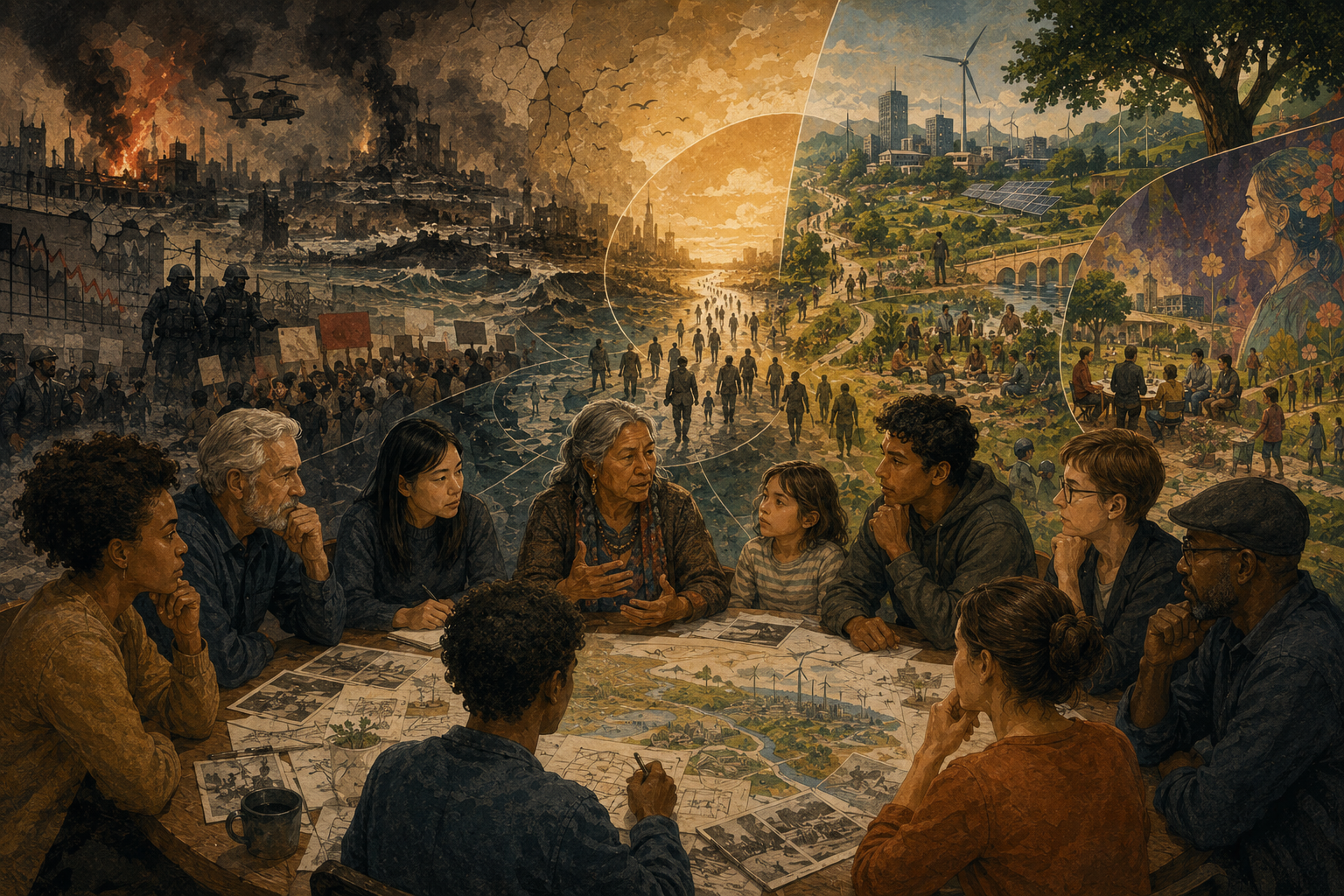
Hope, dread, and the politics of the future examine how societies emotionally, morally, and politically relate to what has not yet happened. Futures thinking is not only analytical. It is affective. People do not approach the future as neutral observers. They approach it through fear, longing, grief, ambition, exhaustion, faith, suspicion, anxiety, imagination, memory, trauma, responsibility, and desire. The future is never merely forecast. It is felt, narrated, weaponized, marketed, resisted, mourned, and hoped for.
Hope and dread are not private emotions alone. They are political forces. Hope can mobilize social movements, sustain climate action, support democratic renewal, encourage repair, and keep long-term responsibility alive. It can also be manipulated into empty optimism, branding, technological salvation, market fantasy, or promises of progress that ask people to endure present harm for a better future that never arrives. Dread can warn societies about real danger, sharpen moral urgency, and reveal the cost of denial. It can also produce paralysis, authoritarian desire, resignation, nihilism, scapegoating, apocalyptic spectacle, or a politics of fear that closes democratic imagination.
The politics of the future is partly a struggle over emotional orientation: what people are encouraged to fear, what they are allowed to hope for, who is blamed for uncertainty, and which futures are treated as worth fighting for.
This article examines hope, dread, and the politics of the future through climate anxiety, disciplined hope, collapse narratives, techno-solutionism, apocalyptic politics, democratic imagination, authoritarian futurism, youth futures, grief, ecological loss, religious and secular visions of time, public communication, strategic foresight, scenario narratives, affective governance, mathematical models of mobilization and paralysis, and reproducible computational workflows for evaluating how hope, fear, agency, trust, polarization, and institutional capacity interact across future pathways.
Main Library
Publications
Article Map
Futures Thinking
Related Topic
Stewardship & Ethics
Related Topic
Risk & Resilience
Related Topic
Institutions & Governance
What Hope and Dread Mean in Futures Thinking
Hope and dread are emotional orientations toward possibility. Hope is not simply optimism. It is a relation to a future that may be difficult, uncertain, and contested but still worth acting toward. Dread is not simply fear. It is a relation to a future perceived as dangerous, overwhelming, morally threatening, or difficult to escape. Both emotions shape judgment, attention, action, and political possibility.
In futures thinking, hope and dread influence what people notice, what they ignore, what they are willing to attempt, and what they consider realistic. A society with no dread may fail to respond to danger. A society with no hope may fail to respond at all. A society with false hope may drift into complacency. A society with manipulated dread may surrender freedom for protection. A society with disciplined hope may confront danger without becoming captive to it.
Hope and dread are not opposites to be simply balanced. They are forms of future attention that can either deepen or weaken responsibility.
| Orientation | Constructive Form | Destructive Form |
|---|---|---|
| Hope | Sustains agency, solidarity, repair, democratic imagination, and long-term work. | Becomes denial, branding, empty optimism, techno-solutionism, or progress myth. |
| Dread | Signals danger, moral urgency, systemic risk, and the need for prevention. | Becomes paralysis, despair, authoritarian fear, scapegoating, or fatalism. |
| Grief | Honors loss and clarifies what must be protected or repaired. | Becomes immobilizing if separated from community and action. |
| Anger | Exposes injustice and energizes accountability. | Becomes destructive if detached from strategy, care, and truth. |
| Trust | Supports collective action and institutional cooperation. | Becomes naive if institutions are unaccountable. |
| Suspicion | Reveals manipulation, false promises, and captured futures. | Becomes conspiracy, cynicism, or refusal of all shared knowledge. |
Hope and dread must therefore be understood as political capacities. They influence whether people can imagine alternatives, tolerate uncertainty, organize collectively, resist manipulation, and remain responsible when the future feels unstable.
The Future as an Affective Field
The future is an affective field: a space of feelings, expectations, fears, promises, anxieties, memories, and projections. People do not experience future possibilities only through evidence. They experience them through cultural narratives, personal histories, family obligations, religious traditions, political identities, media environments, trauma, class position, racial experience, ecological exposure, generational location, and institutional trust.
A climate scientist, a coastal resident, a teenager, a fossil fuel worker, a disabled person dependent on public services, a migrant worker, an Indigenous land defender, a venture capitalist, a public health nurse, and a national security planner may all look at “the future” and see different emotional landscapes. Those differences are not simply psychological. They reflect different relations to power, vulnerability, responsibility, and inheritance.
To govern the future is also to govern feeling: fear, expectation, endurance, urgency, patience, grief, and possibility.
| Future Emotion | Social Source | Political Effect |
|---|---|---|
| Anxiety | Uncertainty, instability, climate risk, economic precarity, technological disruption. | Can motivate preparedness or intensify insecurity and exhaustion. |
| Grief | Ecological loss, cultural erasure, displacement, death, institutional failure. | Can deepen commitment to repair or lead to withdrawal. |
| Hope | Collective action, public trust, credible pathways, social movements, moral vision. | Can sustain difficult work across long time horizons. |
| Dread | Catastrophic risk, authoritarian politics, violence, ecological collapse, abandonment. | Can warn against danger or produce fatalism. |
| Resentment | Perceived loss, inequality, demographic change, status anxiety. | Can be mobilized into reactionary future politics. |
| Wonder | Discovery, art, science, spirituality, ecological relation, imagination. | Can widen possibility and weaken the inevitability of dominant narratives. |
| Exhaustion | Continuous crisis, weak institutions, repeated mobilization, unprocessed loss. | Can reduce participation and create future fatigue. |
Futures thinking that ignores emotion misunderstands political reality. People need credible evidence, but they also need a way to metabolize uncertainty, loss, danger, and possibility without collapsing into denial or despair.
Hope as Political Capacity
Hope is often misunderstood as a cheerful belief that things will turn out well. That kind of optimism is fragile. It collapses when evidence becomes difficult. Political hope is different. It is the capacity to act toward a future that is not guaranteed. It does not require certainty. It requires agency, solidarity, imagination, endurance, and a belief that action can matter even under constraint.
Hope has been central to abolitionist struggles, labor movements, civil rights movements, anti-colonial movements, disability justice, feminist politics, Indigenous resurgence, environmental movements, public health campaigns, peacebuilding, and democratic reform. These movements did not depend on easy optimism. They depended on disciplined, collective, morally grounded hope under conditions of danger and uncertainty.
Hope becomes politically serious when it is connected to action, organization, memory, and strategy.
| Hope Form | What It Enables | Risk if Distorted |
|---|---|---|
| Strategic hope | Links vision to planning, institution-building, and measurable pathways. | Can become technocratic if detached from justice and participation. |
| Moral hope | Sustains commitment to dignity, rights, repair, and human worth. | Can become abstract if not linked to material change. |
| Collective hope | Builds solidarity and shared agency. | Can become exclusionary if only some futures are included. |
| Reparative hope | Connects future possibility with repair of historical harm. | Can be co-opted into symbolic reconciliation without redistribution. |
| Ecological hope | Supports restoration, stewardship, and care for living systems. | Can become green optimism if ecological limits are ignored. |
| Democratic hope | Supports participation, contestation, public learning, and institutional renewal. | Can become naive if power and authoritarian threat are minimized. |
Hope is not the absence of fear. It is the refusal to let fear become the only politically available emotion. Serious hope does not deny danger. It disciplines attention toward what can still be protected, repaired, built, and transformed.
Dread as Warning and Danger
Dread has a necessary function. It tells societies that something matters. It can reveal catastrophic risk, moral failure, institutional decay, ecological danger, democratic erosion, technological abuse, or future abandonment. Without dread, societies may normalize danger. They may delay climate action, ignore public health threats, permit authoritarian drift, underinvest in infrastructure, tolerate mass inequality, or deploy technologies without accountability.
But dread is dangerous when it becomes total. If people believe that the future is already lost, they may withdraw from action. If they believe that catastrophe is inevitable, they may stop distinguishing better from worse pathways. If they believe that threats justify anything, they may accept authoritarian politics. If dread is directed toward scapegoats, it can produce cruelty rather than responsibility.
Dread is useful as a signal, but destructive as a permanent home.
| Dread Pattern | Constructive Use | Destructive Drift |
|---|---|---|
| Climate dread | Signals real danger and need for mitigation, adaptation, and repair. | Can become fatalism or individual anxiety detached from collective politics. |
| Democratic dread | Warns about authoritarianism, violence, corruption, and institutional collapse. | Can become acceptance of emergency powers or permanent fear politics. |
| Technological dread | Identifies risk from AI, surveillance, automation, and digital manipulation. | Can become anti-technical panic or conspiratorial thinking. |
| Economic dread | Reveals insecurity, inequality, debt, and livelihood risk. | Can be redirected into resentment against migrants, minorities, or youth. |
| Geopolitical dread | Warns about war, nuclear risk, resource conflict, and security instability. | Can normalize militarization and permanent suspicion. |
| Cultural dread | Reflects fear of loss, dislocation, identity change, or erasure. | Can be mobilized into reactionary nationalism or exclusion. |
Responsible futures thinking does not suppress dread. It interprets it. It asks what the dread is pointing toward, who benefits from amplifying it, who is being blamed, what agency remains, and what institutions are needed to respond without surrendering democratic life.
Climate Anxiety and Ecological Grief
Climate anxiety and ecological grief are among the defining emotional conditions of contemporary futures thinking. People are not only worried about climate models. They are mourning changing seasons, dying forests, intensified storms, disappearing species, heat exposure, water stress, fire, flood, crop failure, displacement, and the sense that the future has become unstable. These emotions are especially intense among young people, frontline communities, Indigenous peoples, farmers, conservation workers, climate scientists, disaster survivors, and people whose lives are tied closely to land and water.
Climate anxiety can be pathologized when treated only as an individual mental health problem. It is also a rational response to danger and institutional failure. Ecological grief can be misunderstood as sentimental when it is actually a form of moral knowledge: grief reveals attachment, value, and the reality of loss. The ethical task is not to make people feel better by denying danger. It is to create pathways for truth, care, action, repair, and solidarity.
Climate anxiety becomes politically meaningful when it is connected to collective agency rather than isolated fear.
| Emotional Condition | What It Reveals | Responsible Response |
|---|---|---|
| Climate anxiety | Fear about future instability, harm, and institutional failure. | Climate education, public action pathways, community care, policy accountability. |
| Ecological grief | Recognition of real loss in living systems and places. | Ritual, restoration, truth-telling, conservation, land-based repair. |
| Solastalgia | Distress from environmental change in one’s home place. | Place-based adaptation, cultural continuity, community healing. |
| Youth climate distress | Intergenerational betrayal and uncertainty over inherited conditions. | Youth participation, climate policy, education, legal accountability. |
| Frontline exhaustion | Repeated exposure to disaster, neglect, displacement, and rebuilding. | Long-term support, adaptation finance, mental health care, relocation justice. |
| Scientific grief | Distress among researchers observing ecological decline. | Institutional support, public communication, policy translation, peer networks. |
Climate communication must therefore avoid both false reassurance and apocalyptic paralysis. It should tell the truth about danger while preserving agency, justice, and the possibility of meaningful action.
Collapse Narratives and Fatalism
Collapse narratives describe futures of systemic breakdown: climate collapse, civilizational decline, democratic failure, ecological overshoot, economic disintegration, technological catastrophe, war, or social fragmentation. Some collapse analysis is serious and necessary. It can expose fragility, warn against denial, and force institutions to confront systemic risk. But collapse narratives can also become politically dangerous when they turn uncertainty into inevitability.
Fatalism narrows action. If collapse is framed as unavoidable, then mitigation, adaptation, repair, institution-building, and solidarity may appear pointless. Fatalism can also become a privilege. People with resources may prepare private escape routes while vulnerable communities are abandoned. In extreme forms, collapse thinking can normalize survivalism, authoritarianism, eco-fascism, anti-democratic politics, or indifference toward people deemed unlikely to survive.
The problem is not naming danger. The problem is converting danger into destiny.
| Collapse Narrative | Useful Insight | Failure Mode |
|---|---|---|
| Climate collapse | Reveals severe risk from delayed mitigation and adaptation. | Can imply that all pathways are equally doomed. |
| Democratic collapse | Warns about authoritarianism, polarization, corruption, and institutional erosion. | Can produce cynicism and disengagement. |
| Economic collapse | Exposes fragility, inequality, debt, and dependency. | Can fuel scapegoating or anti-democratic resentment. |
| Technological catastrophe | Warns about AI, cyber risk, surveillance, and automation failures. | Can become speculative panic detached from present governance needs. |
| Ecological overshoot | Highlights planetary limits and ecological interdependence. | Can turn into misanthropy or anti-poor population panic. |
| Civilizational decline | Raises questions about institutional resilience and social trust. | Can revive nostalgic, racialized, or authoritarian fantasies. |
A responsible approach treats collapse as a possibility to prevent, soften, prepare for, or survive with dignity—not as a story that excuses abandonment. Even under severe risk, there are still better and worse futures.
Techno-Solutionism and False Reassurance
Techno-solutionism is the belief that technological innovation will solve social, ecological, political, and ethical problems without major changes in power, behavior, institutions, distribution, or values. It often appears as reassurance: climate change will be solved by carbon removal, artificial intelligence will solve governance failures, smart cities will solve urban inequality, digital finance will solve poverty, automation will solve productivity, geoengineering will solve planetary risk, and innovation will make hard political choices unnecessary.
Technology can matter enormously. Clean energy, public health systems, climate modeling, assistive technologies, agricultural innovation, water systems, monitoring tools, and digital infrastructure can support better futures. The problem is not technology itself. The problem is the fantasy that technology can substitute for justice, governance, care, repair, democracy, ecological limits, and public accountability.
False reassurance is politically dangerous because it calms the present by borrowing from the future.
| Techno-Solutionist Promise | What It May Contribute | What It May Hide |
|---|---|---|
| Carbon removal will solve climate change. | May help address residual emissions and atmospheric carbon. | Can delay emissions cuts, land justice, energy transition, and adaptation. |
| AI will improve governance. | Can support analysis, service delivery, monitoring, and decision support. | Can amplify bias, opacity, surveillance, vendor lock-in, and accountability gaps. |
| Smart cities will solve urban problems. | Can improve infrastructure coordination and service monitoring. | Can ignore housing, inequality, displacement, public power, and surveillance risk. |
| Geoengineering will manage climate risk. | May become part of emergency debate under severe risk. | Raises deep governance, justice, consent, and planetary authority problems. |
| Automation will create abundance. | Can improve productivity and reduce dangerous work. | Can deepen labor insecurity, deskilling, inequality, and ownership concentration. |
| Digital inclusion will solve poverty. | Can expand access to information, finance, and services. | Can ignore wages, land, care, public services, and structural inequality. |
Responsible technological hope is not anti-technology. It asks what technology is for, who governs it, who benefits, who is harmed, what it makes irreversible, and whether it strengthens or weakens democratic and ecological responsibility.
Authoritarian Futures and the Politics of Fear
Authoritarian politics often organizes the future around fear. It claims that the future is threatened by enemies: migrants, minorities, dissenters, intellectuals, foreign powers, religious groups, youth movements, workers, feminists, environmentalists, journalists, or imagined internal traitors. It promises restored order, national greatness, cultural purity, security, discipline, and protection from chaos. In this structure, dread is not processed democratically. It is redirected toward targets.
Authoritarian future politics thrives when people feel abandoned, humiliated, economically insecure, culturally disoriented, or distrustful of institutions. It transforms legitimate anxieties into a politics of resentment and control. Instead of addressing structural causes of insecurity, it offers symbolic enemies and centralized authority.
Authoritarian futurism turns fear of uncertainty into obedience.
| Authoritarian Future Device | How It Works | Democratic Counterpractice |
|---|---|---|
| Threat inflation | Exaggerates danger to justify extraordinary power. | Transparent risk assessment, rights safeguards, independent oversight. |
| Scapegoating | Blames vulnerable groups for structural problems. | Anti-racist, rights-based, evidence-grounded public communication. |
| Nostalgic restoration | Promises return to an imagined lost greatness. | Historical honesty and plural democratic memory. |
| Emergency permanence | Normalizes crisis governance and weakened accountability. | Sunset clauses, judicial review, public oversight, civic resistance. |
| Information control | Destroys shared reality through propaganda and distrust. | Public-interest media, education, transparency, institutional trust repair. |
| Masculinized protection | Presents strongman authority as the only defense against chaos. | Care-centered security, democratic resilience, community safety. |
Democratic futures require more than warning against authoritarianism. They must address the real conditions that make fear politically available: inequality, precarity, institutional failure, loneliness, cultural humiliation, ecological insecurity, and loss of trust.
Democratic Imagination and Collective Agency
Democracy requires imagination. People must be able to picture a shared future in which participation matters, institutions can be repaired, conflict can be governed without violence, and public life is more than competition for survival. When democratic imagination weakens, people may still vote, but they may no longer believe that collective action can shape the future.
Collective agency is the belief and capacity that people can act together to change conditions. It is sustained by institutions, movements, public narratives, education, unions, community organizations, faith communities, arts, civic spaces, social trust, and evidence that action produces results. Without collective agency, hope becomes private fantasy and dread becomes isolation.
Democratic futures depend on the emotional infrastructure of agency.
| Democratic Future Capacity | What It Supports | What Weakens It |
|---|---|---|
| Public trust | Cooperation, shared risk management, long-term policy. | Corruption, disinformation, inequality, broken promises. |
| Civic education | Systems thinking, historical memory, participation, media literacy. | Polarization, anti-intellectualism, underfunded schools. |
| Participatory institutions | Deliberation, legitimacy, local knowledge, public ownership. | Token consultation, elite agenda-setting, opaque decisions. |
| Social movements | Pressure, vision, solidarity, accountability. | Repression, burnout, fragmentation, co-optation. |
| Public goods | Shared material basis for future cooperation. | Privatization, austerity, spatial inequality, abandonment. |
| Plural memory | Honest recognition of harm and struggle. | Nostalgia, denial, censorship, historical erasure. |
Democratic imagination does not require consensus about one future. It requires institutions and cultures that allow people to contest futures without dehumanizing one another or surrendering public life to fear.
Youth Futures and Intergenerational Emotion
Youth experience the future differently because they will live longer with consequences created by older generations. Climate change, housing insecurity, student debt, automation, biodiversity loss, public health instability, democratic erosion, and technological surveillance are not abstract long-term issues for young people. They are inherited conditions.
Intergenerational emotion includes anger, betrayal, grief, hope, exhaustion, and determination. Young people may feel that adults have failed to protect the future while asking them to remain optimistic. They may also become powerful future-makers through climate movements, labor organizing, community care, cultural production, public-interest technology, education, legal action, and democratic participation.
Youth hope should not be demanded as emotional labor for adult failure.
| Youth Future Experience | What It Reflects | Responsible Institutional Response |
|---|---|---|
| Climate anxiety | Fear of inherited ecological instability. | Real mitigation, adaptation, education, and youth participation. |
| Economic insecurity | Housing, debt, labor precarity, health costs, unequal opportunity. | Public investment, labor rights, housing policy, social protection. |
| Political distrust | Repeated failure of institutions to act on known problems. | Accountability, transparency, civic power, youth representation. |
| Digital ambivalence | Dependence on platforms alongside surveillance and manipulation. | Data rights, youth protections, public digital infrastructure. |
| Future fatigue | Constant crisis messaging without visible progress. | Actionable pathways, institutional responsiveness, community support. |
| Creative refusal | Rejection of inherited assumptions about work, success, identity, and progress. | Plural futures, democratic experimentation, cultural respect. |
Intergenerational responsibility requires listening to youth not as symbols of the future, but as political actors already living inside the failures and possibilities of long-term governance.
Religion, Myth, and Secular Future Imaginaries
Future politics is shaped by religious, mythic, and secular narratives. Societies imagine the future through apocalypse, redemption, progress, decline, renewal, judgment, salvation, liberation, exile, return, covenant, utopia, revolution, restoration, and catastrophe. These narratives help people interpret uncertainty and suffering. They can provide moral courage, endurance, humility, and responsibility. They can also justify domination, fatalism, purification, conquest, or indifference to earthly repair.
Secular futures also have myths. The myth of endless progress, the myth of market correction, the myth of technological salvation, the myth of national destiny, the myth of civilizational decline, and the myth of innovation as redemption all structure political imagination. The question is not whether societies use myths. They do. The question is whether those narratives deepen responsibility or escape from it.
Future imagination is never purely technical. It is carried by stories about meaning, time, loss, and possibility.
| Future Narrative | Constructive Possibility | Political Risk |
|---|---|---|
| Apocalypse | Reveals moral urgency and danger. | Can normalize fatalism, purification, or violence. |
| Redemption | Supports repair, forgiveness, transformation, and renewed responsibility. | Can become cheap reconciliation without justice. |
| Progress | Encourages learning, institution-building, and improvement. | Can hide extraction, inequality, and ecological limits. |
| Decline | Warns about institutional erosion and lost capacity. | Can fuel nostalgia, nationalism, and authoritarian restoration. |
| Liberation | Supports justice, dignity, and emancipation from domination. | Can become abstract if material conditions are not addressed. |
| Stewardship | Encourages care for land, people, and future generations. | Can become paternalistic if not linked to justice and consent. |
Futures thinking should take symbolic life seriously without becoming captive to myth. It should ask what stories are doing: whom they empower, whom they blame, what action they make possible, and what forms of responsibility they evade.
Media, Narrative, and Future Fatigue
Media environments shape how people feel the future. Continuous crisis coverage, algorithmic outrage, disaster imagery, economic fear, technological hype, war speculation, political scandal, and climate catastrophe can produce attention without agency. People may know more about danger while feeling less able to act. This is future fatigue: emotional exhaustion from constant future threat without credible pathways for response.
Future fatigue is not caused only by too much bad news. It is caused by a mismatch between danger and agency. When institutions communicate risk but fail to act, people lose trust. When media amplify catastrophe but provide little context, people become overwhelmed. When technology platforms reward fear and anger, future politics becomes reactive. When public leaders offer empty optimism, people become cynical.
Future communication must connect truth with agency.
| Communication Pattern | Effect on Future Emotion | Better Practice |
|---|---|---|
| Catastrophe without agency | Creates despair, avoidance, or numbness. | Pair danger with pathways, institutions, and collective action. |
| Optimism without evidence | Creates distrust and complacency. | Use credible progress markers and honest uncertainty. |
| Hype cycles | Overpromises transformation and hides tradeoffs. | Evaluate technologies through governance, justice, and material constraints. |
| Outrage algorithms | Amplify fear, resentment, and polarization. | Strengthen public-interest media and deliberative spaces. |
| Expert abstraction | Distances people from lived consequences. | Use clear language, local context, and affected-community knowledge. |
| Individualized responsibility | Creates guilt without structural change. | Connect personal action to policy, institutions, and collective capacity. |
Public communication about the future should be emotionally honest. It should neither flatten danger nor abandon people inside it. The goal is not comfort. The goal is durable public agency.
Scenario Planning and Emotional Honesty
Scenario planning often presents itself as rational, structured, and analytical. It should be. But scenarios also carry emotional scripts. They tell people what to fear, what to prepare for, what to desire, what to accept, and what to consider possible. A scenario called “managed decline” feels different from one called “democratic repair,” even if some variables overlap. Scenario narratives are never emotionally neutral.
Emotional honesty in scenario planning means acknowledging grief, dread, hope, uncertainty, conflict, loss, and moral stakes without manipulating participants. It means refusing both corporate optimism and apocalyptic spectacle. It means recognizing that people may enter futures work with trauma, distrust, exhaustion, anger, or intergenerational fear. It also means making room for imagination, care, humor, courage, memory, and solidarity.
Good scenarios do not only expand analytical range. They expand emotional and political capacity for action.
| Scenario Practice | Emotional Risk | Responsible Alternative |
|---|---|---|
| Best-case / worst-case framing | Can simplify futures into reassurance or terror. | Use plural pathways with tradeoffs, uncertainty, and agency. |
| Corporate opportunity scenarios | Can convert crisis into market optimism. | Include justice, harm, public value, and affected-community consequences. |
| Doom scenarios | Can overwhelm participants or normalize abandonment. | Use severe-risk scenarios with prevention, adaptation, and solidarity pathways. |
| Neutral expert tone | Can suppress moral stakes and lived experience. | Make values, emotions, and consequences explicit. |
| Innovation futures | Can overvalue novelty and ignore maintenance or repair. | Include care, infrastructure, governance, and social trust. |
| Security scenarios | Can amplify threat perception and justify coercion. | Center human security, rights, public legitimacy, and civilian protection. |
Scenario planning should help people face difficult futures without becoming trapped by dread or seduced by false hope. Its emotional purpose is not motivation alone. It is orientation: helping people understand where they are, what they value, and what they can still do.
Disciplined Hope
Disciplined hope is hope that has passed through evidence, grief, limits, and responsibility. It is not confidence that everything will be fine. It is a commitment to act because outcomes remain open enough to matter. Disciplined hope accepts that some losses are real, some harms are irreversible, some institutions are weak, and some futures are dangerous. It refuses to let those facts become permission for surrender.
Disciplined hope is different from optimism because it does not depend on favorable prediction. It is different from denial because it does not look away from harm. It is different from despair because it does not treat danger as destiny. It is different from motivation rhetoric because it requires strategy, institutions, accountability, and collective work.
Disciplined hope is not the belief that the future will be good. It is the practice of making better futures more possible under conditions of uncertainty.
| Element of Disciplined Hope | Meaning | Practice |
|---|---|---|
| Truthfulness | Hope must begin from reality, not denial. | Use evidence, uncertainty, and historical memory honestly. |
| Agency | Hope requires pathways for action. | Build institutions, movements, strategies, and public capacity. |
| Solidarity | Hope becomes stronger when shared. | Connect personal concern to collective power and mutual care. |
| Repair | Hope must address inherited harm. | Link future possibility to justice, restitution, and restoration. |
| Patience | Long-term work requires endurance. | Build routines, institutions, and cultures that outlast crisis cycles. |
| Accountability | Hope must be answerable to results. | Track progress, learn from failure, revise strategy. |
Disciplined hope is one of the central emotional capacities of futures thinking. It allows societies to face dread without being governed by it and to imagine possibility without lying about danger.
Core Dimensions of the Politics of the Future
Hope, dread, and the politics of the future can be evaluated through several interacting dimensions. These dimensions help explain whether future narratives create agency, denial, paralysis, authoritarian fear, democratic imagination, or disciplined responsibility.
1. Future Agency
Future agency measures whether people believe and experience that collective action can shape outcomes. It depends on institutions, movements, public trust, resources, and visible pathways for change.
2. Truthful Risk Recognition
Truthful risk recognition asks whether future dangers are named honestly without exaggeration, denial, manipulation, or paralysis.
3. Democratic Imagination
Democratic imagination assesses whether people can envision shared futures shaped by participation, rights, repair, public institutions, and plural forms of belonging.
4. Affective Resilience
Affective resilience is the capacity to process anxiety, grief, anger, and uncertainty without collapsing into denial, despair, cruelty, or authoritarian desire.
5. Narrative Accountability
Narrative accountability asks whether future stories are answerable to evidence, history, justice, affected communities, and material consequences.
6. Anti-Fatalism
Anti-fatalism refuses the claim that catastrophe, inequality, authoritarianism, or abandonment is inevitable. It preserves distinctions between better and worse pathways.
7. Anti-Solutionism
Anti-solutionism resists false reassurance from technology, markets, branding, or vague progress narratives that avoid governance, justice, repair, and limits.
8. Disciplined Hope Practice
Disciplined hope practice links future possibility to evidence, agency, solidarity, repair, strategy, accountability, and sustained institutional work.
| Dimension | Core Question | Failure if Ignored |
|---|---|---|
| Future agency | Do people have credible pathways to act? | Hope becomes empty and dread becomes paralysis. |
| Truthful risk recognition | Are dangers named without manipulation? | Denial, panic, or distorted risk politics dominate. |
| Democratic imagination | Can people imagine shared futures beyond fear? | Authoritarian or market futures monopolize possibility. |
| Affective resilience | Can societies process loss and uncertainty? | Grief and anxiety become exhaustion, denial, or resentment. |
| Narrative accountability | Are future stories answerable to evidence and justice? | Hype, doom, nostalgia, and propaganda shape public life. |
| Anti-fatalism | Are better and worse pathways still visible? | Collapse narratives erase moral responsibility. |
| Anti-solutionism | Are false promises challenged? | Technology or markets become excuses for delay. |
| Disciplined hope practice | Is hope connected to action and accountability? | Optimism becomes branding or denial. |
The politics of the future depends on whether societies can feel danger without surrendering to it and feel hope without falsifying reality.
Future Emotion Scenarios
Hope, dread, and future politics can unfold across multiple pathways. These scenarios are not predictions. They are structured ways to examine how emotion, narrative, trust, agency, and institutions interact.
| Scenario | Description | Political Risk | Future-Making Opportunity |
|---|---|---|---|
| Disciplined Hope Democracy | Societies face risk honestly while building public institutions, participation, repair, and adaptive capacity. | Requires sustained trust and institutional performance. | Turns anxiety into durable democratic agency. |
| Apocalyptic Paralysis | Collapse narratives dominate public imagination and people lose faith in action. | Fatalism, withdrawal, survivalism, and abandonment rise. | Severe-risk analysis can be reconnected to prevention and solidarity. |
| Techno-Optimist Delay | Innovation narratives reassure publics while structural problems deepen. | False hope delays climate action, regulation, and public investment. | Technology can be redirected through public governance and justice. |
| Authoritarian Fear Future | Dread is redirected toward enemies and used to justify coercive authority. | Democracy, rights, migrants, minorities, dissent, and public truth weaken. | Human security and democratic repair can challenge fear politics. |
| Future Fatigue Society | Continuous crisis messaging produces exhaustion, cynicism, and disengagement. | People know risks but no longer believe action matters. | Communication can reconnect risk with agency and visible progress. |
| Youth-Led Renewal | Youth movements convert intergenerational anger and anxiety into public action. | Risk of burnout or symbolic inclusion without power. | Expands democratic representation and future-generation accountability. |
| Marketed Hope Regime | Hope becomes a branding device for corporations, governments, or platforms. | Public imagination is captured by managed optimism. | Accountability and independent evaluation can expose empty promises. |
| Reparative Imagination | Hope is grounded in historical repair, ecological restoration, and redistributed authority. | Faces resistance from actors invested in inherited power. | Links future possibility to justice, memory, and structural transformation. |
Scenario analysis shows that emotion is not outside strategy. It is one of the conditions through which strategy becomes possible or impossible.
Strategic Questions
Hope, dread, and future politics should guide strategic questions for governments, public agencies, civil society organizations, universities, media institutions, climate communicators, technology teams, public health systems, philanthropies, and community groups.
| Strategic Question | What It Reveals | Why It Matters |
|---|---|---|
| What future emotion is this narrative producing? | Hope, dread, urgency, denial, exhaustion, agency, resentment, or fatalism. | Emotion shapes political action. |
| Does this future story create agency? | Whether people see credible pathways for action. | Risk communication without agency produces paralysis. |
| Who benefits from this hope? | Whether hope serves public repair or private branding. | False hope can protect power from accountability. |
| Who is being made to feel afraid? | Targets of fear, threat framing, and scapegoating. | Dread can be weaponized against vulnerable groups. |
| What losses are being named? | Whether grief and harm are acknowledged honestly. | Unacknowledged loss returns as distrust or denial. |
| Which futures are treated as unrealistic? | The politics of plausibility and imagination. | Power often hides inside definitions of realism. |
| Does the narrative distinguish better and worse pathways? | Whether fatalism is obscuring responsibility. | Even severe futures contain moral choices. |
| What institutions make hope credible? | Public capacity, law, finance, participation, accountability. | Hope without institutions becomes fragile. |
These questions should be used before public campaigns, scenario workshops, strategy documents, foresight reports, climate communications, technology roadmaps, and risk narratives are released. Future narratives should be accountable to their emotional and political effects.
Limitations and Failure Modes
Analyzing hope and dread carries risks. It can become overly psychological, reducing political and material problems to emotion management. It can also become manipulative, treating public feeling as something to engineer. It can become paternalistic, telling people how they should feel about futures that threaten their homes, bodies, cultures, or descendants. A serious approach must respect emotion as knowledge, not merely as a communications problem.
Another failure mode is forced optimism. Institutions often ask people to remain hopeful without changing the conditions that produce dread. This is especially harmful for youth, frontline communities, marginalized groups, and people repeatedly exposed to institutional failure. Hope should not be demanded from those bearing the greatest burdens. It should be made credible through action, repair, and accountability.
| Failure Mode | Problem | Corrective Practice |
|---|---|---|
| Forced optimism | Demands hope from people facing real harm. | Make hope credible through material action and accountability. |
| Emotion management without power analysis | Treats anxiety as individual weakness rather than structural response. | Connect emotion to institutions, justice, and lived conditions. |
| Manipulative futures communication | Uses hope or fear to secure compliance. | Use transparency, participation, and narrative accountability. |
| Doom performance | Turns catastrophe into identity, spectacle, or status. | Connect severe risk to strategy, prevention, adaptation, and solidarity. |
| Techno-utopian reassurance | Uses innovation to avoid political responsibility. | Evaluate technology through governance, power, justice, and limits. |
| Hope as branding | Turns future language into institutional image management. | Require measurable commitments, independent review, and public accountability. |
| Fear as control | Uses dread to justify authoritarian or exclusionary politics. | Center rights, human security, proportionality, and democratic oversight. |
| Emotional flattening | Reduces complex public feeling to optimism versus pessimism. | Recognize grief, anger, wonder, distrust, exhaustion, courage, and care. |
The goal is not to optimize public mood. The goal is to build emotional and institutional conditions for truthful, just, democratic future-making.
Mathematical Lens: Hope, Dread, Agency, and Mobilization
Mathematical models cannot capture the full moral and emotional life of future politics, but they can help make relationships visible. A simple mobilization model can represent how hope, dread, agency, and trust interact:
M = A(H + D)T
\]
Interpretation: \(M\) is mobilization, \(A\) is agency, \(H\) is hope, \(D\) is constructive dread, and \(T\) is trust. Dread can contribute to mobilization only when people have agency and enough trust to believe action matters.
A paralysis score can be represented as:
P = D(1 – A)(1 – T)
\]
Interpretation: \(P\) is paralysis, \(D\) is dread, \(A\) is agency, and \(T\) is trust. High dread with low agency and low trust can produce withdrawal, fatalism, or numbness.
A false-hope risk score can be written as:
F_h = O – E – R
\]
Interpretation: \(F_h\) is false-hope risk, \(O\) is optimistic promise, \(E\) is evidence, and \(R\) is real institutional responsibility. False hope rises when promise exceeds evidence and accountability.
A disciplined hope score can be represented as:
H_d = E + A + S + R_c + L
\]
Interpretation: \(H_d\) is disciplined hope, \(E\) is evidence, \(A\) is agency, \(S\) is solidarity, \(R_c\) is repair capacity, and \(L\) is learning. Hope becomes durable when connected to action, community, repair, and feedback.
A fear-politics risk score can be represented conceptually as:
F_p = D + S_c + U – R_g
\]
Interpretation: \(F_p\) is fear-politics risk, \(D\) is dread, \(S_c\) is scapegoating intensity, \(U\) is uncertainty, and \(R_g\) is rights-based governance. Fear becomes politically dangerous when uncertainty and scapegoating rise while rights-based governance weakens.
These equations are not emotional laws. They are diagnostic tools for asking whether future narratives produce agency, paralysis, false reassurance, disciplined hope, or fear-based politics.
Computational Modeling for Hope, Dread, and Future Politics
Computational modeling can help examine how public trust, agency, dread, hope, polarization, institutional capacity, narrative accountability, and future fatigue interact. These models should not be used to manipulate public emotion. They should be used to evaluate whether communication and governance create conditions for democratic agency or amplify despair, denial, and fear.
A responsible workflow for hope, dread, and future politics may include:
- Future-emotion profiles: hope, dread, agency, trust, polarization, institutional capacity, future fatigue, and narrative accountability.
- Scenario records: disciplined hope democracy, apocalyptic paralysis, techno-optimist delay, authoritarian fear future, future fatigue society, youth-led renewal, marketed hope regime, and reparative imagination.
- Risk indicators: fatalism, false reassurance, fear politics, scapegoating, future fatigue, manipulated hope, institutional distrust, and agency collapse.
- Strategy options: public agency pathways, participatory scenario design, climate truth with action, media literacy, youth representation, trust repair, and narrative accountability.
- Outputs: mobilization scores, paralysis risk, disciplined hope scores, fear-politics risk, future-fatigue indicators, and reproducibility reports.
The point is not to engineer emotions. The point is to make emotional and political dynamics visible so public institutions can communicate and govern responsibly.
Advanced R Workflow: Comparing Future-Emotion Profiles
The R workflow below compares stylized future-emotion profiles across hope, dread, agency, trust, polarization, institutional capacity, future fatigue, narrative accountability, and repair capacity.
# ------------------------------------------------------------
# R Workflow: Comparing Future-Emotion Profiles
# Purpose:
#   Compare stylized futures by hope, dread, agency, trust,
#   polarization, institutional capacity, future fatigue,
#   narrative accountability, and repair capacity.
#
# Optional dependency:
#   install.packages(c("tidyverse"))
# ------------------------------------------------------------

library(tidyverse)

profiles <- tibble(
  scenario = c(
    "Disciplined Hope Democracy",
    "Apocalyptic Paralysis",
    "Techno-Optimist Delay",
    "Authoritarian Fear Future",
    "Future Fatigue Society",
    "Youth-Led Renewal",
    "Marketed Hope Regime",
    "Reparative Imagination"
  ),
  hope = c(0.78, 0.18, 0.74, 0.30, 0.28, 0.82, 0.80, 0.86),
  dread = c(0.54, 0.90, 0.34, 0.82, 0.76, 0.62, 0.28, 0.50),
  agency = c(0.82, 0.22, 0.42, 0.30, 0.26, 0.86, 0.36, 0.84),
  trust = c(0.72, 0.20, 0.46, 0.28, 0.24, 0.66, 0.34, 0.76),
  polarization = c(0.34, 0.60, 0.48, 0.88, 0.62, 0.44, 0.52, 0.30),
  institutional_capacity = c(0.78, 0.24, 0.46, 0.36, 0.30, 0.72, 0.38, 0.80),
  future_fatigue = c(0.30, 0.82, 0.50, 0.68, 0.90, 0.42, 0.54, 0.28),
  narrative_accountability = c(0.84, 0.28, 0.34, 0.26, 0.32, 0.76, 0.22, 0.88),
  repair_capacity = c(0.76, 0.20, 0.30, 0.24, 0.28, 0.70, 0.26, 0.92)
)

profiles <- profiles %>%
  mutate(
    mobilization_score =
      agency * (hope + 0.55 * dread) * trust,

    paralysis_risk =
      dread * (1 - agency) * (1 - trust),

    disciplined_hope_score =
      0.18 * hope +
      0.18 * agency +
      0.16 * trust +
      0.16 * institutional_capacity +
      0.14 * narrative_accountability +
      0.12 * repair_capacity -
      0.04 * future_fatigue -
      0.02 * polarization,

    fear_politics_risk =
      0.24 * dread +
      0.22 * polarization +
      0.18 * (1 - trust) +
      0.16 * (1 - agency) +
      0.12 * future_fatigue +
      0.08 * (1 - narrative_accountability),

    profile_class = case_when(
      disciplined_hope_score >= 0.65 ~ "Stronger disciplined hope",
      fear_politics_risk >= 0.65 ~ "High fear-politics risk",
      paralysis_risk >= 0.35 ~ "High paralysis risk",
      TRUE ~ "Mixed future-emotion profile"
    )
  ) %>%
  arrange(desc(disciplined_hope_score))

print(profiles)

profiles_long <- profiles %>%
  select(
    scenario,
    hope,
    dread,
    agency,
    trust,
    polarization,
    institutional_capacity,
    future_fatigue,
    narrative_accountability,
    repair_capacity
  ) %>%
  pivot_longer(
    cols = -scenario,
    names_to = "dimension",
    values_to = "value"
  )

ggplot(profiles_long, aes(x = dimension, y = value, fill = scenario)) +
  geom_col(position = "dodge") +
  coord_flip() +
  labs(
    title = "Hope, Dread, and Future Politics Dimensions",
    x = "Dimension",
    y = "Value",
    fill = "Scenario"
  ) +
  theme_minimal(base_size = 12)

ggplot(profiles, aes(x = fear_politics_risk, y = disciplined_hope_score, label = scenario)) +
  geom_point(size = 3) +
  geom_text(nudge_y = 0.02, size = 3) +
  labs(
    title = "Fear-Politics Risk vs Disciplined Hope",
    x = "Fear-Politics Risk",
    y = "Disciplined Hope"
  ) +
  theme_minimal(base_size = 12)

dir.create("outputs", showWarnings = FALSE)
write_csv(profiles, "outputs/future_emotion_profiles.csv")
This workflow helps compare whether future narratives build agency and disciplined hope or drift toward paralysis, false reassurance, fatigue, and fear-based politics.
Advanced Python Workflow: Simulating Hope, Dread, Agency, and Paralysis
The Python workflow below simulates how hope, dread, agency, trust, fatigue, and disciplined hope may change over time under different future-politics scenarios.
# ------------------------------------------------------------
# Python Workflow: Hope, Dread, Agency, and Paralysis
# Purpose:
#   Simulate stylized future-politics scenarios across hope,
#   dread, agency, trust, fatigue, mobilization, paralysis,
#   and disciplined hope.
#
# Optional dependencies:
#   pip install pandas numpy matplotlib
# ------------------------------------------------------------

from pathlib import Path

import numpy as np
import pandas as pd
import matplotlib.pyplot as plt

OUTPUT_DIR = Path("outputs")
OUTPUT_DIR.mkdir(exist_ok=True)

time_steps = np.arange(1, 41)

scenarios = [
    {
        "scenario": "Disciplined Hope Democracy",
        "hope": 0.78,
        "dread": 0.54,
        "agency": 0.82,
        "trust": 0.72,
        "fatigue": 0.30,
        "repair": 0.76
    },
    {
        "scenario": "Apocalyptic Paralysis",
        "hope": 0.18,
        "dread": 0.90,
        "agency": 0.22,
        "trust": 0.20,
        "fatigue": 0.82,
        "repair": 0.20
    },
    {
        "scenario": "Techno-Optimist Delay",
        "hope": 0.74,
        "dread": 0.34,
        "agency": 0.42,
        "trust": 0.46,
        "fatigue": 0.50,
        "repair": 0.30
    },
    {
        "scenario": "Authoritarian Fear Future",
        "hope": 0.30,
        "dread": 0.82,
        "agency": 0.30,
        "trust": 0.28,
        "fatigue": 0.68,
        "repair": 0.24
    },
    {
        "scenario": "Reparative Imagination",
        "hope": 0.86,
        "dread": 0.50,
        "agency": 0.84,
        "trust": 0.76,
        "fatigue": 0.28,
        "repair": 0.92
    }
]

def simulate(profile):
    hope = np.zeros(len(time_steps))
    dread = np.zeros(len(time_steps))
    agency = np.zeros(len(time_steps))
    trust = np.zeros(len(time_steps))
    fatigue = np.zeros(len(time_steps))
    repair = np.zeros(len(time_steps))
    mobilization = np.zeros(len(time_steps))
    paralysis = np.zeros(len(time_steps))
    disciplined_hope = np.zeros(len(time_steps))

    hope[0] = profile["hope"]
    dread[0] = profile["dread"]
    agency[0] = profile["agency"]
    trust[0] = profile["trust"]
    fatigue[0] = profile["fatigue"]
    repair[0] = profile["repair"]

    for t in range(len(time_steps)):
        if t > 0:
            crisis_spike = 0.018 if (t + 1) % 8 == 0 else 0.0
            progress_signal = 0.015 if (t + 1) % 10 == 0 else 0.0
            institutional_failure = 0.014 if (t + 1) % 13 == 0 else 0.0

            dread[t] = np.clip(
                dread[t - 1]
                + crisis_spike
                + 0.010 * fatigue[t - 1]
                - 0.010 * agency[t - 1]
                - 0.008 * trust[t - 1],
                0,
                1.8
            )

            trust[t] = np.clip(
                trust[t - 1]
                + progress_signal
                + 0.010 * repair[t - 1]
                - institutional_failure
                - 0.006 * fatigue[t - 1],
                0,
                1.8
            )

            agency[t] = np.clip(
                agency[t - 1]
                + 0.010 * trust[t]
                + 0.012 * repair[t - 1]
                + progress_signal
                - 0.010 * fatigue[t - 1]
                - 0.006 * dread[t],
                0,
                1.8
            )

            fatigue[t] = np.clip(
                fatigue[t - 1]
                + 0.010 * dread[t]
                + institutional_failure
                - 0.012 * agency[t]
                - 0.010 * trust[t],
                0,
                1.8
            )

            repair[t] = np.clip(
                repair[t - 1]
                + 0.010 * agency[t]
                + 0.008 * trust[t]
                + progress_signal
                - 0.006 * fatigue[t],
                0,
                1.8
            )

            hope[t] = np.clip(
                hope[t - 1]
                + 0.012 * agency[t]
                + 0.010 * trust[t]
                + 0.010 * repair[t]
                - 0.008 * fatigue[t]
                - 0.004 * dread[t],
                0,
                1.8
            )

        mobilization[t] = np.clip(
            agency[t] * (hope[t] + 0.55 * dread[t]) * trust[t],
            0,
            2.5
        )

        paralysis[t] = np.clip(
            dread[t] * (1 - min(agency[t], 1)) * (1 - min(trust[t], 1)),
            0,
            1.8
        )

        disciplined_hope[t] = np.clip(
            0.22 * hope[t]
            + 0.22 * agency[t]
            + 0.18 * trust[t]
            + 0.18 * repair[t]
            - 0.12 * fatigue[t]
            - 0.08 * paralysis[t],
            -1,
            1.8
        )

    rows = []
    for t, h, d, a, tr, f, r, m, p, dh in zip(
        time_steps,
        hope,
        dread,
        agency,
        trust,
        fatigue,
        repair,
        mobilization,
        paralysis,
        disciplined_hope
    ):
        rows.append({
            "scenario": profile["scenario"],
            "time": t,
            "hope": h,
            "dread": d,
            "agency": a,
            "trust": tr,
            "future_fatigue": f,
            "repair_capacity": r,
            "mobilization_score": m,
            "paralysis_risk": p,
            "disciplined_hope_score": dh
        })

    return rows

rows = []
for scenario in scenarios:
    rows.extend(simulate(scenario))

df = pd.DataFrame(rows)

summary = (
    df.groupby("scenario")
    .agg(
        final_hope=("hope", "last"),
        final_dread=("dread", "last"),
        final_agency=("agency", "last"),
        final_trust=("trust", "last"),
        final_future_fatigue=("future_fatigue", "last"),
        final_repair_capacity=("repair_capacity", "last"),
        final_mobilization_score=("mobilization_score", "last"),
        final_paralysis_risk=("paralysis_risk", "last"),
        final_disciplined_hope_score=("disciplined_hope_score", "last")
    )
    .reset_index()
    .sort_values("final_disciplined_hope_score", ascending=False)
)

print(summary)

plt.figure(figsize=(10, 6))
for scenario_name in df["scenario"].unique():
    subset = df[df["scenario"] == scenario_name]
    plt.plot(subset["time"], subset["disciplined_hope_score"], label=scenario_name)

plt.xlabel("Time Step")
plt.ylabel("Disciplined Hope Score")
plt.title("Disciplined Hope Across Future-Politics Scenarios")
plt.legend()
plt.tight_layout()
plt.savefig(OUTPUT_DIR / "disciplined_hope_paths.png", dpi=150)
plt.close()

plt.figure(figsize=(10, 6))
for scenario_name in df["scenario"].unique():
    subset = df[df["scenario"] == scenario_name]
    plt.plot(subset["time"], subset["paralysis_risk"], label=scenario_name)

plt.xlabel("Time Step")
plt.ylabel("Paralysis Risk")
plt.title("Paralysis Risk Across Future-Politics Scenarios")
plt.legend()
plt.tight_layout()
plt.savefig(OUTPUT_DIR / "paralysis_risk_paths.png", dpi=150)
plt.close()

plt.figure(figsize=(10, 6))
for scenario_name in df["scenario"].unique():
    subset = df[df["scenario"] == scenario_name]
    plt.plot(subset["time"], subset["mobilization_score"], label=scenario_name)

plt.xlabel("Time Step")
plt.ylabel("Mobilization Score")
plt.title("Mobilization Across Future-Politics Scenarios")
plt.legend()
plt.tight_layout()
plt.savefig(OUTPUT_DIR / "mobilization_paths.png", dpi=150)
plt.close()

df.to_csv(OUTPUT_DIR / "future_emotion_simulation_paths.csv", index=False)
summary.to_csv(OUTPUT_DIR / "future_emotion_simulation_summary.csv", index=False)
This workflow illustrates how dread can support action when paired with agency and trust, but becomes politically dangerous when agency collapses and fatigue rises.
GitHub Repository
The companion repository for this article contains computational examples for hope, dread, disciplined hope, future fatigue, mobilization, paralysis risk, fear politics, narrative accountability, democratic imagination, repair capacity, and reproducible future-emotion foresight workflows.
Complete Code Repository
The companion code includes Python, R, Julia, SQL, Rust, Go, C++, Fortran, C, documentation, synthetic datasets, outputs, and notebook placeholders for applied hope, dread, and future-politics workflows.
Why This Matters
Hope, dread, and the politics of the future matter because societies do not act on evidence alone. They act through feeling, trust, imagination, memory, identity, and perceived agency. A technically accurate forecast can fail if people feel powerless. A hopeful public campaign can fail if it lacks credibility. A warning can become destructive if it produces paralysis or scapegoating. A promise of innovation can become dangerous if it delays responsibility. A political movement can become authoritarian if it converts fear into obedience.
The future is therefore not only a question of knowledge. It is a question of orientation. Are people being invited into responsibility or manipulated into fear? Are they being offered credible agency or empty optimism? Are they being told the truth about danger or protected from discomfort? Are they being asked to hope without repair? Are they being asked to fear the wrong people? Are they being given institutions that make action possible?
Hope without truth becomes denial. Dread without agency becomes paralysis. Future politics requires both courage and discipline.
This matters especially in an age of climate instability, democratic stress, AI transformation, ecological loss, inequality, migration, geopolitical tension, and institutional distrust. Public imagination is under pressure. People are asked to absorb endless crisis while remaining productive, optimistic, informed, and calm. That emotional demand is unsustainable unless societies build real pathways for collective action and repair.
Disciplined hope offers a way through. It does not promise safety. It does not erase grief. It does not minimize danger. It insists that action remains meaningful because futures are still uneven, contingent, contested, and shaped by institutions, movements, technologies, laws, memories, and choices. It refuses both the complacency of false optimism and the surrender of fatalism.
The politics of the future is ultimately the politics of whether people can still imagine themselves as agents of repair under conditions of uncertainty. Futures thinking should help protect that capacity, not exploit it, exhaust it, or sell it back as branding. Hope is not a mood. It is a public responsibility.
Related Articles
- Futures Thinking
- Future Generations and Long-Term Responsibility
- Future Directions in Strategic Foresight
- Ethics of Futures Thinking
- Colonial Futures and Contested Imagination
- Climate Futures and Environmental Change
- Planetary Boundaries and Future Pathways
- Democratic Futures and Public Participation
- Anticipatory Governance
- Public-Sector Foresight Capacity
- Futures Thinking and Risk Analysis
- Global Governance Futures
Further Reading
- Bloch, E. (1986) The Principle of Hope. Cambridge, MA: MIT Press. Available at: MIT Press.
- Freire, P. (1994) Pedagogy of Hope: Reliving Pedagogy of the Oppressed. New York: Continuum. Available at: Bloomsbury.
- Solnit, R. (2016) Hope in the Dark: Untold Histories, Wild Possibilities. 3rd edn. Chicago: Haymarket Books. Available at: Haymarket Books.
- Scranton, R. (2015) Learning to Die in the Anthropocene: Reflections on the End of a Civilization. San Francisco: City Lights Books. Available at: City Lights Books.
- Stengers, I. (2015) In Catastrophic Times: Resisting the Coming Barbarism. London: Open Humanities Press. Available at: Open Humanities Press.
- Latour, B. (2017) Facing Gaia: Eight Lectures on the New Climatic Regime. Cambridge: Polity. Available at: Polity.
- Klein, N. (2014) This Changes Everything: Capitalism vs. the Climate. New York: Simon & Schuster. Available at: Simon & Schuster.
- Oreskes, N. and Conway, E.M. (2014) The Collapse of Western Civilization: A View from the Future. New York: Columbia University Press. Available at: Columbia University Press.
- Haraway, D.J. (2016) Staying with the Trouble: Making Kin in the Chthulucene. Durham: Duke University Press. Available at: Duke University Press.
- Ahmed, S. (2010) The Promise of Happiness. Durham: Duke University Press. Available at: Duke University Press.
References
- Ahmed, S. (2010) The Promise of Happiness. Durham: Duke University Press. Available at: Duke University Press.
- Bloch, E. (1986) The Principle of Hope. Cambridge, MA: MIT Press. Available at: MIT Press.
- Freire, P. (1994) Pedagogy of Hope: Reliving Pedagogy of the Oppressed. New York: Continuum. Available at: Bloomsbury.
- Haraway, D.J. (2016) Staying with the Trouble: Making Kin in the Chthulucene. Durham: Duke University Press. Available at: Duke University Press.
- Klein, N. (2014) This Changes Everything: Capitalism vs. the Climate. New York: Simon & Schuster. Available at: Simon & Schuster.
- Latour, B. (2017) Facing Gaia: Eight Lectures on the New Climatic Regime. Cambridge: Polity. Available at: Polity.
- Oreskes, N. and Conway, E.M. (2014) The Collapse of Western Civilization: A View from the Future. New York: Columbia University Press. Available at: Columbia University Press.
- Scranton, R. (2015) Learning to Die in the Anthropocene: Reflections on the End of a Civilization. San Francisco: City Lights Books. Available at: City Lights Books.
- Solnit, R. (2016) Hope in the Dark: Untold Histories, Wild Possibilities. 3rd edn. Chicago: Haymarket Books. Available at: Haymarket Books.
- Stengers, I. (2015) In Catastrophic Times: Resisting the Coming Barbarism. London: Open Humanities Press. Available at: Open Humanities Press.