
Last Updated June 3, 2026
Future generations and long-term responsibility examine how present decisions shape people who cannot yet vote, testify, organize, litigate, migrate, inherit, consent, or refuse. Every society makes choices that reach beyond the immediate present: climate policy, public debt, infrastructure, artificial intelligence, education, biodiversity, nuclear risk, land use, water governance, public health, housing, energy systems, technological design, migration policy, and institutional reform. These choices do not end when an election cycle closes, a budget year expires, a quarterly report is filed, or a strategy document is published. They become the inherited conditions of future life.
Long-term responsibility asks whether present institutions are morally, politically, legally, and practically capable of caring about people who are absent from today’s decision-making but deeply affected by today’s choices. It challenges the short time horizons of markets, electoral politics, emergency governance, media cycles, philanthropic funding, project finance, and institutional planning. It also challenges shallow versions of long-termism that speak about distant futures while ignoring present injustice, colonial histories, climate vulnerability, poverty, disability, migration, labor exploitation, racial inequality, gendered care burdens, and ecological harm already unfolding.
The central question is not whether future generations matter. The harder question is how present institutions should act when the people most affected by today’s decisions are not here to defend themselves.
This article examines future generations and long-term responsibility through intergenerational ethics, climate justice, public debt, infrastructure, technology, AI governance, biodiversity, constitutional design, youth participation, Indigenous temporalities, discounting, precaution, reparative responsibility, institutional stewardship, mathematical models of temporal weighting, and reproducible computational workflows for comparing long-term burden, benefit, risk, and adaptive capacity across generations.
Main Library
Publications
Article Map
Futures Thinking
Related Topic
Stewardship & Ethics
Related Topic
Risk & Resilience
Related Topic
Institutions & Governance
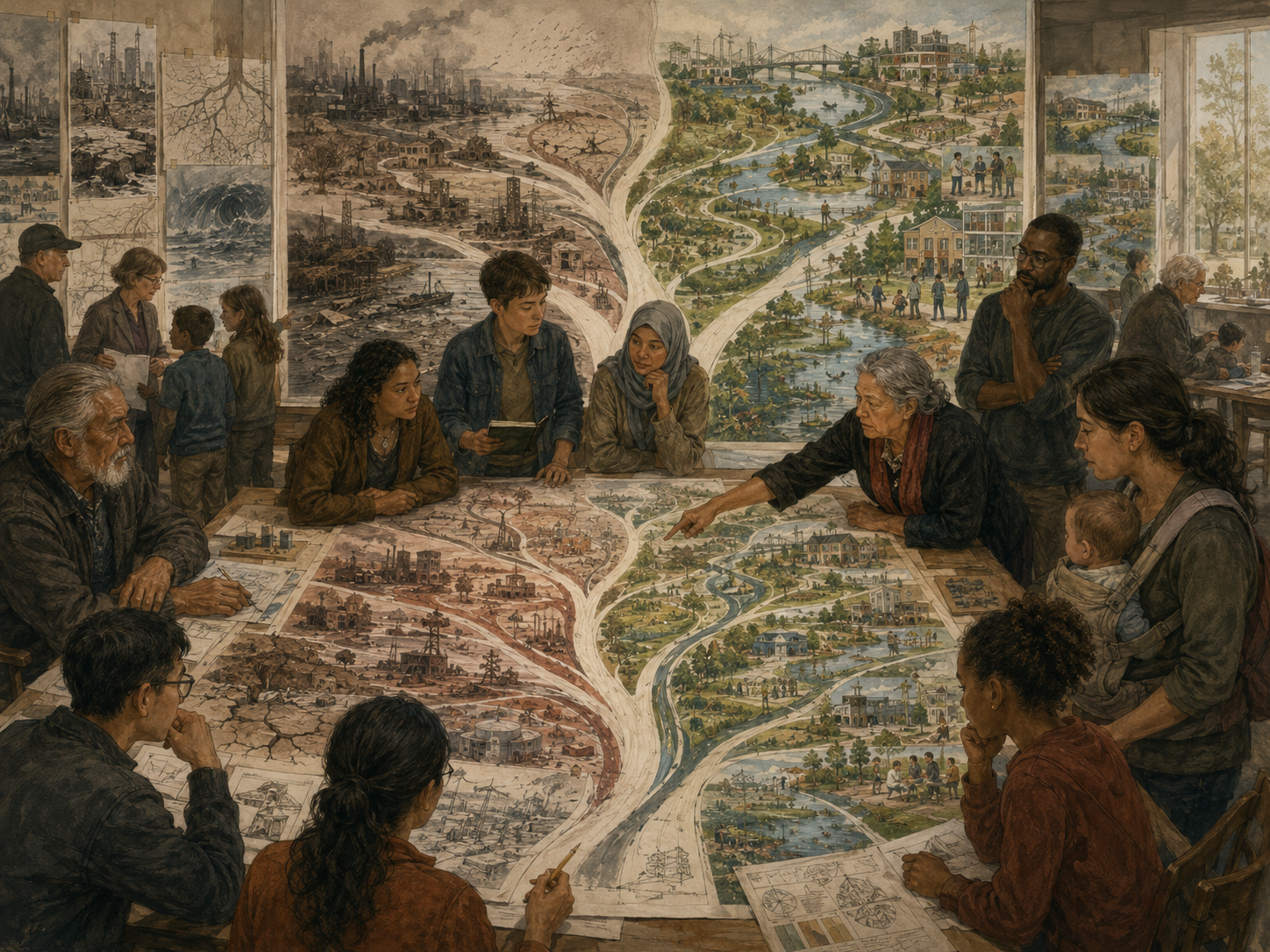
What Long-Term Responsibility Means
Long-term responsibility means that present decision-makers must consider the consequences of their actions for future people, future communities, future institutions, future ecosystems, and the future conditions of human dignity. It is not simply a call to “think ahead.” It is an ethical, political, and institutional demand: present societies should not knowingly create avoidable harm, irreversible loss, ecological collapse, technological lock-in, institutional fragility, or unjust burdens for those who inherit the results.
Responsibility across time is difficult because future generations are absent. They cannot vote in today’s elections. They cannot negotiate today’s contracts. They cannot object to today’s infrastructure siting. They cannot review today’s AI procurement systems. They cannot demand that forests, aquifers, fisheries, languages, public schools, public health systems, or stable climate conditions be protected. Yet they are affected by all of these choices.
Long-term responsibility asks present institutions to govern as trustees, not owners, of the future.
| Domain | Present Decision | Future Consequence |
|---|---|---|
| Climate | Emissions, adaptation, land use, energy systems, climate finance. | Heat exposure, disaster risk, displacement, food stress, sea-level rise, ecological disruption. |
| Infrastructure | Roads, transit, housing, water systems, grids, broadband, public facilities. | Access, resilience, maintenance costs, emissions, spatial inequality, path dependence. |
| Public finance | Debt, taxation, austerity, social investment, climate spending. | Fiscal capacity, public services, inequality, intergenerational burden or benefit. |
| Technology | AI deployment, data governance, automation, surveillance, platform dependence. | Accountability, labor conditions, rights, concentration of power, inherited digital infrastructure. |
| Ecology | Biodiversity protection, restoration, extraction, agriculture, conservation. | Living systems, food security, cultural survival, ecological inheritance. |
| Education | Schools, universities, civic learning, research, workforce systems. | Future capacity for democracy, science, care, innovation, repair, and social trust. |
| Health | Public health systems, prevention, preparedness, care infrastructure. | Future disease resilience, aging support, mental health, disability inclusion, crisis response. |
Long-term responsibility does not mean sacrificing the present for an abstract future. It means recognizing that present injustice and future harm are connected. Communities already facing poverty, pollution, displacement, disability exclusion, racialized policing, unstable housing, weak public services, and climate risk are often also the communities whose descendants inherit compounded harm. A serious ethics of future generations must therefore integrate present justice with long-horizon stewardship.
Why Future Generations Create an Ethical Problem
Future generations create an ethical problem because they are real enough to be harmed, but absent from the institutions that create the harm. They have interests, but no direct political voice. They may inherit benefits from present choices, but they may also inherit damage they did not authorize. They will live inside material, ecological, technological, legal, and institutional systems designed before they arrived.
This creates a representational gap. Democracy is largely organized around present voters. Markets are largely organized around present transactions. Budgets are organized around present fiscal periods. Corporate governance often favors present owners and near-term returns. International negotiations depend on present state interests. Yet the most important consequences of many decisions extend beyond present constituencies.
The ethical difficulty is that future people are vulnerable to present power without being present to contest it.
| Ethical Problem | Why It Matters | Example |
|---|---|---|
| Non-representation | Future people cannot participate directly in present decisions. | Children not yet born inherit climate, debt, infrastructure, and legal systems. |
| Irreversibility | Some harms cannot be fully undone later. | Species extinction, cultural erasure, radioactive contamination, ecosystem collapse. |
| Lock-in | Present systems constrain future choices. | Car-dependent urban form, fossil infrastructure, surveillance architecture, proprietary digital systems. |
| Uncertainty | Future conditions cannot be predicted fully. | Unknown technological consequences, climate tipping points, geopolitical shocks. |
| Distance | Future harms may feel less urgent than present incentives. | Delayed climate impacts, deferred maintenance, underfunded pension systems. |
| Identity problem | Different choices may affect which future people exist. | Population, reproductive, migration, climate, and development decisions shape future societies. |
| Accountability gap | Decision-makers may be gone before harms materialize. | Infrastructure neglect, toxic exposure, public debt, poorly governed AI systems. |
These problems do not make responsibility impossible. They make institutional design essential. Societies need ways to represent future interests, test long-term consequences, prevent irreversible harm, preserve adaptive capacity, and make present decision-makers accountable for foreseeable burdens placed on people who cannot yet respond.
Intergenerational Justice
Intergenerational justice asks what present generations owe to future generations. It is concerned with fair inheritance: climate stability, ecological function, public institutions, knowledge systems, infrastructure, public finance, cultural memory, legal rights, and the basic conditions needed for people to live with dignity. It does not require that every future person inherit a perfect world. It does require that present societies avoid knowingly transferring preventable harm while preserving the capacity for future people to govern their own lives.
Intergenerational justice is not only about long-term survival. It is about freedom, fairness, and capability. Future people should not be trapped by present negligence. They should inherit institutions capable of learning, infrastructure that can be maintained, ecosystems that can sustain life, public knowledge that can be trusted, rights that can be defended, and political systems capable of repair.
Justice across generations means refusing to treat the future as a dumping ground for present convenience.
| Inheritance | Just Transfer | Unjust Transfer |
|---|---|---|
| Climate | Mitigation, adaptation, resilience, loss-and-damage responsibility. | High emissions, delayed adaptation, abandonment of climate-exposed communities. |
| Ecology | Restoration, biodiversity protection, soil, water, forests, oceans. | Extinction, polluted watersheds, degraded lands, ecological overshoot. |
| Public institutions | Trustworthy, accountable, resilient, democratic systems. | Corruption, institutional decay, authoritarian drift, hollowed-out capacity. |
| Infrastructure | Maintained, adaptive, accessible, low-carbon, equitable systems. | Deferred maintenance, unsafe systems, spatial exclusion, stranded assets. |
| Knowledge | Open science, education, cultural memory, public archives. | Disinformation, knowledge enclosure, cultural erasure, inaccessible education. |
| Fiscal capacity | Productive investment, sustainable debt, fair taxation. | Debt without assets, austerity, underinvestment, fiscal fragility. |
| Technological systems | Auditable, contestable, accountable, rights-protecting infrastructure. | Opaque AI, surveillance lock-in, platform dependence, automated exclusion. |
Intergenerational justice must also consider unequal starting points. Some communities inherit wealth, stable institutions, clean environments, and secure rights. Others inherit dispossession, pollution, displacement, underfunded schools, weak health systems, debt, and surveillance. A serious framework for future generations must therefore connect forward-looking responsibility with repair of historical injustice.
Short-Termism and Institutional Time
Short-termism is one of the major enemies of long-term responsibility. It appears when institutions prioritize immediate advantage over durable public value. It is built into electoral cycles, quarterly earnings, budget deadlines, news cycles, grant cycles, crisis response systems, political incentives, procurement rules, and leadership turnover. These systems do not necessarily reward the prevention of future harm. They often reward visible action, near-term savings, symbolic announcements, and avoidance of blame.
Short-termism is not only an individual failure of imagination. It is an institutional design problem. A mayor may know that flood infrastructure matters but face budget pressure. A company may know that data governance matters but face investor expectations. A legislature may know that prevention saves money but fund emergency response instead. A university may value research but depend on short-term grants. A public agency may understand maintenance risk but lack political support for routine investment.
Long-term responsibility requires institutions whose time horizons match the consequences of their decisions.
| Institutional Time Problem | Short-Term Incentive | Long-Term Consequence |
|---|---|---|
| Elections | Visible wins before the next campaign. | Underinvestment in slow-moving risks and future capacity. |
| Markets | Quarterly returns and near-term valuation. | Externalized harm, labor insecurity, ecological damage, fragile systems. |
| Public budgeting | Cutting maintenance, prevention, and invisible capacity. | Higher future costs, infrastructure failure, institutional weakness. |
| Media cycles | Attention to crisis and spectacle. | Neglect of structural risk and slow violence. |
| Grant funding | Project deliverables and short-term metrics. | Weak institutional memory, fragmented programs, unstable public-interest work. |
| Technology deployment | Speed, adoption, scale, competitive advantage. | Unaccountable systems, technical debt, rights risks, irreversible infrastructure. |
Countering short-termism requires more than moral reminders. It requires long-horizon institutions, future-impact assessment, public investment rules, maintenance accounting, climate budgeting, youth participation, independent review, adaptive governance, and legal duties that make future consequences visible inside present decisions.
Climate Change and Future Harm
Climate change is one of the clearest examples of long-term responsibility. Present and past emissions shape future temperature, sea level, extreme weather, food systems, disease ecology, water stress, migration, infrastructure risk, ecosystem function, and public health. Climate harm also exposes the injustice of delayed action: those least responsible often face the greatest vulnerability, while future generations inherit risks intensified by decisions they did not make.
Climate responsibility across generations requires mitigation, adaptation, finance, repair, and institutional transformation. It is not enough to reduce emissions slowly while locking in harm. Nor is it enough to adapt wealthy places while leaving poorer and historically exploited regions exposed. The ethics of climate futures requires attention to historical responsibility, present vulnerability, future exposure, and the rights of those who will inherit climate conditions.
Climate change turns delay into a form of intergenerational harm.
| Climate Responsibility Area | Long-Term Question | Institutional Requirement |
|---|---|---|
| Mitigation | How quickly should emissions fall to avoid transferring avoidable harm? | Carbon budgets, clean energy transition, demand reduction, industrial transformation. |
| Adaptation | Who receives protection from unavoidable climate impacts? | Heat resilience, flood protection, water systems, health preparedness, housing adaptation. |
| Loss and damage | Who repairs harms that cannot be prevented or adapted away? | International finance, accountability, compensation, cultural continuity, relocation justice. |
| Just transition | How can decarbonization avoid reproducing inequality? | Worker protection, regional investment, community ownership, labor rights. |
| Climate migration | How should mobility be governed when climate risk rises? | Legal pathways, receiving-community support, protection, dignity, planning. |
| Future climate rights | What climate conditions are future people entitled to inherit? | Constitutional duties, youth litigation, future-generation institutions, climate accountability. |
Climate futures show why long-term responsibility and present justice cannot be separated. The future climate is already being distributed unequally through present power, historical emissions, colonial extraction, infrastructure investment, and political delay.
Biodiversity, Ecology, and More-Than-Human Futures
Future generations do not inherit only human institutions. They inherit ecosystems: forests, oceans, wetlands, soils, rivers, pollinators, fisheries, microbial systems, species diversity, atmospheric conditions, and the living relationships that make human life possible. Long-term responsibility must therefore extend beyond a narrow human-centered view of the future.
Biodiversity loss, habitat destruction, pollution, soil degradation, ocean acidification, and freshwater stress narrow the world available to future life. Extinction is irreversible. Ecological damage can create cascading consequences across food systems, disease patterns, cultural practices, livelihoods, climate stability, and spiritual relationships to place. Future people inherit not only fewer resources, but diminished worlds of relation and meaning.
Ecological responsibility is intergenerational responsibility because no generation owns the living systems it depends on.
| Ecological Inheritance | Future Risk | Long-Term Responsibility |
|---|---|---|
| Biodiversity | Extinction, ecosystem simplification, loss of resilience. | Habitat protection, restoration, rights-based conservation, ecological corridors. |
| Soil | Erosion, fertility decline, contamination, reduced food security. | Regenerative agriculture, soil monitoring, land stewardship. |
| Water | Aquifer depletion, pollution, scarcity, conflict, health risk. | Watershed governance, water justice, pollution control, demand management. |
| Oceans | Acidification, warming, fisheries collapse, coral loss. | Marine protection, emissions reduction, sustainable fisheries, coastal adaptation. |
| Forests | Deforestation, fire risk, biodiversity loss, carbon release. | Indigenous stewardship, restoration, anti-deforestation policy. |
| Urban ecology | Heat islands, stormwater overload, air pollution, unequal green access. | Tree canopy, wetlands, parks, green infrastructure, environmental justice. |
A future-generation ethics that ignores more-than-human life is too narrow. Human futures depend on ecological futures. The obligation is not simply to leave future people usable resources. It is to preserve the living conditions of dignity, relation, culture, health, and planetary stability.
Public Debt, Investment, and Fiscal Inheritance
Public debt is often discussed as an intergenerational burden. This can be true, but it is incomplete. The ethical question is not simply whether debt exists. It is what debt finances, who benefits, who pays, what assets are created, what risks are reduced, and whether public capacity is strengthened or weakened. Debt used for productive, equitable, climate-safe investment may benefit future generations. Debt used to defer responsibility, enrich narrow interests, finance harm, or avoid fair taxation may transfer unjust burdens.
Similarly, austerity can be framed as responsibility to future generations while actually harming them. Cutting education, public health, maintenance, climate adaptation, research, care systems, and infrastructure may reduce current spending but increase future vulnerability. A society can leave future generations too much debt, but it can also leave them broken bridges, polluted water, weak institutions, underfunded schools, unprepared health systems, and an unstable climate.
Fiscal responsibility should be measured by the quality of inheritance, not by debt numbers alone.
| Fiscal Choice | Possible Future Benefit | Possible Future Harm |
|---|---|---|
| Borrowing for climate adaptation | Reduces future disaster losses and protects communities. | Poorly targeted spending can deepen inequality or create stranded assets. |
| Borrowing for education | Builds human capability and democratic capacity. | Benefits may be unequal if education systems remain exclusionary. |
| Borrowing for infrastructure | Creates durable public assets and resilience. | Debt becomes harmful if projects are extractive, wasteful, or poorly maintained. |
| Tax cuts financed by deficits | May increase short-term income for some groups. | Can reduce future fiscal capacity without building shared assets. |
| Austerity | May reduce visible debt in the short term. | Can erode public health, maintenance, education, and social stability. |
| Preventive public investment | Reduces future harm and strengthens institutional capacity. | Requires political discipline because benefits may be less visible today. |
Future generations inherit balance sheets and bridges, but also public trust, civic capacity, ecological stability, educational opportunity, health systems, and institutional competence. Fiscal ethics must include all of these.
Infrastructure and Path Dependence
Infrastructure is one of the most powerful ways present generations shape the future. Roads, transit systems, ports, housing, water networks, power grids, schools, hospitals, broadband, data centers, flood defenses, and public buildings can last for decades. They influence emissions, access, inequality, land use, public health, economic opportunity, disaster exposure, and institutional maintenance burdens.
Infrastructure creates path dependence. Once a region is designed around highways, low-density development, fossil energy, centralized water systems, or proprietary digital platforms, future choices become constrained. Change remains possible, but the cost of change increases. Long-term responsibility therefore requires careful attention to what kinds of futures infrastructure makes easy, difficult, or impossible.
Infrastructure is a form of time binding: it carries present assumptions into future life.
| Infrastructure Type | Future Lock-In Risk | Responsible Alternative |
|---|---|---|
| Transportation | Car dependence, emissions, congestion, exclusion of non-drivers. | Transit, walking, cycling, accessibility, compact land use. |
| Energy systems | Fossil dependence, stranded assets, unequal reliability. | Clean grids, storage, efficiency, public accountability, demand flexibility. |
| Housing | Sprawl, segregation, heat risk, unaffordability, displacement. | Affordable housing, climate-safe design, anti-displacement policy. |
| Water systems | Aging pipes, contamination, scarcity, flood vulnerability. | Watershed planning, maintenance, green infrastructure, water justice. |
| Digital infrastructure | Vendor lock-in, surveillance, data extraction, exclusion. | Open standards, public digital infrastructure, privacy, accessibility. |
| Coastal defenses | Protection of high-value assets while shifting risk elsewhere. | Equitable adaptation, managed retreat where necessary, community planning. |
Long-term responsibility requires infrastructure planning that accounts for maintenance, climate conditions, accessibility, ecological impacts, technological change, and social equity over the full life of the system, not only the cost of construction.
Technology, AI, and Long-Term Governance
Technology creates future obligations because technical systems can outlast the assumptions under which they were built. Artificial intelligence, biometric databases, predictive policing, welfare automation, hiring algorithms, credit scoring, educational platforms, health data systems, smart-city sensors, cloud infrastructure, and digital identity systems can shape rights, classification, opportunity, surveillance, labor, public services, and institutional behavior far into the future.
The long-term problem is not only whether a tool works today. It is whether future people inherit accountable systems or opaque infrastructure. A model may be deployed quickly, but future communities may live with its classifications, data dependencies, vendor contracts, feedback loops, and institutional biases. Technological lock-in can be especially dangerous when systems are proprietary, hard to audit, difficult to remove, or embedded in critical public functions.
AI governance is intergenerational governance when today’s systems shape tomorrow’s rights, labor, knowledge, and public authority.
| Technology Issue | Long-Term Risk | Responsible Governance |
|---|---|---|
| Data retention | Future misuse, surveillance, re-identification, security breaches. | Data minimization, purpose limits, deletion rights, public oversight. |
| Algorithmic decision systems | Embedded bias, opaque classification, automation of exclusion. | Audits, appeal rights, human accountability, anti-discrimination safeguards. |
| Vendor lock-in | Public institutions depend on private systems they cannot control. | Open standards, procurement safeguards, public digital capacity. |
| Automation | Labor displacement, deskilling, weakened bargaining power. | Worker voice, transition support, job quality, shared productivity gains. |
| AI-generated knowledge | Information pollution, synthetic media, epistemic instability. | Provenance systems, public education, transparency, trusted institutions. |
| Infrastructure energy use | Data centers increase water, energy, and mineral demand. | Environmental accountability, resource limits, clean energy, siting governance. |
Long-term technological responsibility requires designing systems that future people can understand, audit, modify, contest, repair, and retire. A society that cannot remove harmful technologies has not governed them; it has inherited them as infrastructure.
Nuclear Risk, Catastrophic Risk, and Irreversibility
Some risks matter because they are severe, irreversible, or civilization-shaping. Nuclear war, nuclear waste, engineered pandemics, runaway ecological damage, catastrophic climate tipping points, extreme technological misuse, and large-scale institutional collapse pose ethical problems that extend far beyond normal policy tradeoffs. The more severe and irreversible the harm, the stronger the obligation to prevent it.
Catastrophic risk does not erase everyday injustice. Indeed, catastrophic risk often interacts with inequality. Poorer communities, colonized regions, disabled people, migrants, children, older adults, workers, and politically marginalized groups are often less protected in crisis. A responsible long-term framework must therefore combine existential risk reduction with justice, rights, public health, peacebuilding, and democratic accountability.
Irreversibility changes the moral weight of uncertainty. When harms cannot be undone, the burden of justification should be higher.
| Risk Type | Future Consequence | Long-Term Responsibility |
|---|---|---|
| Nuclear war | Mass death, environmental damage, global food disruption, institutional collapse. | Arms control, de-escalation, diplomacy, transparency, command safeguards. |
| Nuclear waste | Hazard persists across time scales far longer than political institutions. | Secure storage, intergenerational communication, long-term monitoring. |
| Pandemic risk | Global mortality, health-system failure, economic and social disruption. | Public health systems, biosafety, surveillance with rights safeguards, preparedness. |
| Climate tipping points | Irreversible or hard-to-reverse Earth system changes. | Precautionary emissions reduction and adaptive planning. |
| Ecological collapse | Food, water, disease, and livelihood destabilization. | Biodiversity protection, restoration, pollution control. |
| AI misuse or systemic failure | Automated harm, security risk, institutional instability, concentrated control. | Governance, audits, alignment with rights, public accountability. |
Catastrophic risk governance must avoid panic, fatalism, and technocratic capture. It should be democratic, rights-aware, transparent where possible, and connected to the lived vulnerabilities of present communities as well as future generations.
Youth Participation and Democratic Representation
Young people are the closest visible representatives of future generations. They will live longer with the consequences of climate change, technological systems, public debt, educational policy, housing markets, public health systems, ecological degradation, and institutional decisions made today. Yet youth are often underrepresented in formal decision-making, especially children and adolescents.
Youth participation is not a substitute for representing all future generations, but it is an important democratic correction. Young people bring a longer temporal stake, different risk perception, and legitimate claims about inherited systems. Youth climate movements, student organizing, public health advocacy, disability justice work, Indigenous youth leadership, and intergenerational litigation all show that future-oriented politics is already present.
Democracy is incomplete when the people who will live longest with a decision have the least power over it.
| Youth Participation Mechanism | Purpose | Risk if Weak |
|---|---|---|
| Youth councils | Give young people formal advisory roles in policy. | Can become symbolic without decision influence. |
| Climate assemblies | Include youth in deliberation on long-term transition. | May be ignored if not linked to formal authority. |
| Education and civic futures | Build capacity for democratic imagination and systems thinking. | Future generations inherit weak civic tools. |
| Youth litigation | Uses courts to defend future-oriented rights. | Judicial success may not translate into implementation. |
| Participatory budgeting | Allows youth input into public investment priorities. | Limited scope may exclude major structural decisions. |
| Intergenerational impact review | Requires policy analysis of youth and future-generation effects. | Can become procedural unless tied to accountability. |
Young people should not be romanticized or made responsible for repairing systems they did not create. Youth participation matters because it expands democratic representation, but adult institutions still carry responsibility for long-term harm and repair.
Indigenous Temporalities and Ancestral Responsibility
Many Indigenous traditions and governance systems offer powerful models of responsibility across generations, land, ancestors, and future life. These models should not be appropriated as decorative inspiration for mainstream sustainability language. They should be understood in relation to sovereignty, land rights, treaty obligations, cultural continuity, ecological stewardship, and self-determination.
Indigenous temporalities often challenge the narrow time horizons of markets, elections, and extractive development. They may understand responsibility as relational: to ancestors, descendants, land, waters, more-than-human beings, language, and community continuity. This differs from approaches that treat the future as a resource to optimize or a risk to manage.
Long-term responsibility is not only about looking forward. It is also about carrying memory, obligation, and relation forward.
| Indigenous Futures Principle | Long-Term Meaning | Institutional Implication |
|---|---|---|
| Land as relation | Land is not merely property or resource. | Future planning must respect sovereignty, treaty rights, sacred sites, and stewardship. |
| Ancestral continuity | Past, present, and future are connected through obligation. | Historical harm cannot be excluded from future planning. |
| Future descendants | Decision-making considers those who will inherit the consequences. | Institutions need long-horizon review and community authority. |
| Ecological reciprocity | Humans owe responsibilities to living systems. | Environmental governance must move beyond extraction and compensation. |
| Language and culture | Cultural survival is part of future survival. | Education, law, and public policy should support living cultural continuity. |
| Self-determination | Communities must govern their own futures. | Participation is insufficient without authority and consent. |
Future-generation ethics should learn from Indigenous long-term governance while respecting Indigenous political authority. The lesson is not to borrow a slogan. It is to transform systems that treat land, time, and future people as external to present power.
Colonial History, Repair, and Future Generations
Long-term responsibility cannot begin from a blank slate. Future generations inherit not only new risks but old harms extended over time. Colonial dispossession, slavery, racial segregation, environmental racism, forced migration, debt dependency, cultural erasure, land theft, extractive economies, and unequal development shape the futures available to descendants. The future is not equally open for all communities.
Without repair, long-term responsibility can become abstract. A society may speak about future generations while refusing to address the historical structures that shape which future generations are protected and which remain exposed. Future-oriented ethics must therefore include reparative responsibility: land return, climate finance, loss and damage, public investment, legal recognition, institutional reform, ecological restoration, debt justice, and cultural renewal.
Repair is future-facing because unaddressed harm becomes inheritance.
| Historical Harm | Future Effect | Reparative Responsibility |
|---|---|---|
| Land dispossession | Loss of sovereignty, wealth, culture, ecological relation. | Land return, treaty enforcement, co-governance, restitution. |
| Slavery and racial capitalism | Intergenerational wealth gaps, labor exploitation, institutional distrust. | Reparations, public investment, labor rights, anti-racist institutional reform. |
| Environmental racism | Inherited pollution, health burdens, climate vulnerability. | Cleanup, health care, monitoring, relocation support, environmental justice. |
| Colonial extraction | Debt dependency, ecological harm, weak public capacity. | Debt justice, climate finance, fair trade, resource sovereignty. |
| Forced assimilation | Language loss, cultural disruption, trauma, institutional harm. | Language revitalization, cultural repair, education reform, truth processes. |
| Border regimes | Unequal mobility, family separation, precarious labor. | Safe pathways, rights protection, mobility justice, status reform. |
A just concern for future generations must ask which future generations are being imagined. Future responsibility that centers only affluent or abstract future people while ignoring descendants of harmed communities becomes morally distorted.
Law, Rights, and Institutions for Future Generations
Some legal and institutional systems have begun to recognize the interests of future generations. These include constitutional environmental rights, ombudspersons or commissioners for future generations, parliamentary committees, climate litigation, rights of nature, public trust doctrines, intergenerational impact assessments, youth lawsuits, and long-term strategy requirements. These mechanisms vary in strength, but they all respond to the same problem: ordinary institutions often fail to represent long-term consequences.
Legal recognition alone is not enough. Future-generation institutions need authority, resources, independence, access to information, public legitimacy, and the ability to influence decisions. A future generations office that can only advise may be useful but limited. A constitutional duty without enforcement may become symbolic. A climate target without budget alignment may fail in practice.
Future generations need institutional representation, not only moral recognition.
| Institutional Mechanism | Function | Key Design Question |
|---|---|---|
| Future generations commissioner | Reviews policy for long-term consequences. | Does the office have independence, investigative power, and influence? |
| Constitutional environmental rights | Protects environmental conditions for present and future people. | Can courts enforce the right, and who has standing? |
| Public trust doctrine | Treats certain resources as held in trust for the public. | Does the doctrine include future interests and ecological integrity? |
| Intergenerational impact assessment | Requires analysis of long-term effects before decisions. | Is the assessment binding or merely procedural? |
| Youth and citizen assemblies | Creates deliberative input on long-term issues. | Does deliberation influence actual policy? |
| Long-term budgeting rules | Aligns budgets with climate, infrastructure, and social investment. | Do fiscal rules distinguish harmful debt from productive investment? |
| Rights of nature | Recognizes ecological entities as rights-bearing or legally protected. | Who represents the ecosystem and how are conflicts resolved? |
Future-generation institutions must avoid becoming symbolic guardians with no power. The goal is not simply to create a new office, report, or statement. The goal is to change how decisions are made.
Precaution, Reversibility, and Adaptive Governance
Long-term responsibility requires decision-making under uncertainty. Future conditions cannot be fully known. Climate systems, technological systems, social systems, geopolitical systems, and ecological systems can behave unpredictably. This uncertainty does not eliminate responsibility. It changes the standards for responsible action.
Precaution matters when potential harms are severe, irreversible, or widely distributed. Reversibility matters because future people should not be locked into systems they cannot change. Adaptive governance matters because institutions must learn as conditions change. Together, these principles help present decision-makers avoid both paralysis and reckless confidence.
The more irreversible the harm, the stronger the obligation to slow down, test assumptions, preserve alternatives, and build accountability.
| Governance Principle | Purpose | Example |
|---|---|---|
| Precaution | Avoid severe or irreversible harm under uncertainty. | Higher scrutiny for geoengineering, toxic chemicals, nuclear systems, high-risk AI. |
| Reversibility | Preserve future freedom to modify or undo systems. | Modular infrastructure, sunset clauses, data deletion, open standards. |
| Redundancy | Prevent single-point failure. | Backup water systems, distributed energy, public health reserves. |
| Monitoring | Detect emerging harm early. | Climate indicators, infrastructure sensors, public health surveillance with rights safeguards. |
| Trigger points | Define when policy must change. | Adaptive pathways for sea-level rise, drought, housing stress, ecological thresholds. |
| Accountability | Make decision-makers answerable for long-term consequences. | Audits, public reporting, legal duties, independent review. |
Adaptive governance is not the same as indefinite delay. It means acting with humility, monitoring consequences, preserving future options, and correcting course before harm becomes irreversible.
Core Dimensions of Long-Term Responsibility
Long-term responsibility can be evaluated through several interacting dimensions. These dimensions help assess whether institutions are treating future generations as morally relevant, politically represented, ecologically situated, and practically protected. They should shape the full policy cycle: problem framing, evidence, modeling, participation, budgeting, implementation, monitoring, and revision.
1. Future Representation
Future representation asks whether people who cannot participate directly are still considered through youth participation, future-generation institutions, impact assessments, legal rights, and long-horizon review.
2. Intergenerational Equity
Intergenerational equity evaluates whether benefits, burdens, risks, debts, assets, and capacities are fairly distributed across time rather than shifted onto future people.
3. Ecological Stewardship
Ecological stewardship asks whether present decisions preserve climate stability, biodiversity, water, soil, forests, oceans, and the living systems future generations depend on.
4. Institutional Durability
Institutional durability examines whether public systems, laws, knowledge institutions, infrastructure, and democratic capacity are strong enough to support future adaptation and repair.
5. Precaution and Reversibility
Precaution and reversibility evaluate whether institutions avoid irreversible harm and preserve future freedom to revise, remove, or repair present systems.
6. Reparative Continuity
Reparative continuity connects future-generation responsibility to historical justice, recognizing that unresolved harm becomes inherited vulnerability.
7. Adaptive Learning
Adaptive learning asks whether institutions monitor consequences, revise assumptions, learn from failure, and adjust pathways as conditions change.
8. Public Legitimacy
Public legitimacy assesses whether long-term decisions are transparent, participatory, accountable, contestable, and trusted by the people asked to support them.
| Dimension | Core Question | Failure if Ignored |
|---|---|---|
| Future representation | Are absent future people represented in present decisions? | Short-term interests dominate unchallenged. |
| Intergenerational equity | Are burdens and benefits fairly distributed across time? | Future people inherit debt, risk, decay, and preventable harm. |
| Ecological stewardship | Are living systems protected for future life? | Ecological loss becomes irreversible inheritance. |
| Institutional durability | Will future people inherit functioning institutions? | Public capacity erodes while responsibilities grow. |
| Precaution and reversibility | Can future generations revise or escape present systems? | Technological, ecological, and infrastructure lock-in intensifies. |
| Reparative continuity | Does future responsibility address inherited injustice? | Long-term ethics becomes abstract and unequal. |
| Adaptive learning | Can institutions update pathways as reality changes? | Plans become brittle and outdated. |
| Public legitimacy | Are long-term decisions transparent and accountable? | Future-oriented policy loses trust and democratic support. |
Long-term responsibility is strongest when it turns moral concern for the future into institutional practice, public accountability, and material protection.
Scenario Planning for Future Generations
Scenario planning can help institutions think across long time horizons, but only if it is designed ethically. Many scenarios focus on organizational strategy, market uncertainty, geopolitical shifts, or technological disruption. A future-generation lens asks a different set of questions: what inheritance does each scenario create, who bears long-term risk, which choices are reversible, what ecological thresholds are crossed, and whether future people retain meaningful freedom.
Future-generation scenario planning should include more than optimistic and pessimistic narratives. It should include maintenance scenarios, institutional decay scenarios, repair scenarios, climate injustice scenarios, ecological threshold scenarios, technological lock-in scenarios, youth-led governance scenarios, and long-horizon public investment scenarios. It should evaluate not only plausibility, but inheritance quality.
Scenarios for future generations should ask what kind of world each pathway leaves behind.
| Scenario Design Element | Future-Generation Question | Better Practice |
|---|---|---|
| Time horizon | Does the scenario extend far enough to reveal delayed consequences? | Use multiple horizons: 10, 25, 50, 100 years where appropriate. |
| Impact categories | Does the scenario assess inherited assets and burdens? | Track climate, debt, infrastructure, ecology, rights, health, and institutions. |
| Distribution | Which future communities inherit benefit or harm? | Use intergenerational and intragenerational equity analysis together. |
| Reversibility | Can future people change course? | Score technological, infrastructure, legal, and ecological lock-in. |
| Participation | Do youth and affected communities shape the scenarios? | Use deliberative, participatory, and community-led scenario design. |
| Stress testing | What happens under climate, fiscal, health, or technological shock? | Include robustness, redundancy, and adaptive trigger analysis. |
| Implementation | Are scenario insights linked to budgets and decisions? | Connect scenarios to investment rules, policy review, and accountability. |
Scenario planning for future generations should not become speculative storytelling detached from power. It should change decisions, budgets, laws, infrastructure, and institutional incentives in the present.
Future Generation Scenarios
Future generations and long-term responsibility can unfold across multiple pathways. These scenarios are not predictions. They are structured ways to test whether institutions preserve future freedom, shift burdens forward, repair inherited harm, or create durable public capacity.
| Scenario | Description | Long-Term Risk | Responsibility Opportunity |
|---|---|---|---|
| Stewardship State | Institutions adopt long-term budgeting, climate accountability, future-generation review, and public investment rules. | Can become bureaucratic if not democratically accountable. | Builds durable governance for future people. |
| Short-Term Extraction | Present actors maximize growth, profit, political wins, and resource use while deferring costs. | Future generations inherit ecological harm, debt, inequality, and weak institutions. | Public backlash may create pressure for structural reform. |
| Climate Repair Pathway | Mitigation, adaptation, loss-and-damage finance, just transition, and restoration are treated as intergenerational duties. | Implementation requires sustained finance and political legitimacy. | Links climate justice with future-generation responsibility. |
| Technological Lock-In | AI, surveillance, digital identity, and platform infrastructure become embedded without sufficient accountability. | Future people inherit opaque systems they cannot contest or remove. | Public digital infrastructure and technology rights become central. |
| Deferred Maintenance Crisis | Infrastructure, public health, education, and ecological systems are neglected until failure becomes visible. | Future costs rise while institutional trust declines. | Maintenance becomes recognized as a moral and fiscal duty. |
| Reparative Intergenerational Compact | Long-term responsibility includes land, climate, racial, ecological, and fiscal repair. | Faces resistance from actors benefiting from inherited inequality. | Connects future generations to justice for harmed communities now. |
| Youth-Led Democratic Renewal | Youth movements, assemblies, litigation, and civic institutions reshape long-term policy. | Can be symbolic if not linked to power. | Expands democratic representation across time. |
| Institutional Time Collapse | Crises overwhelm planning capacity and short-term emergency governance becomes permanent. | Future-oriented decision-making erodes under continuous disruption. | Creates urgency for resilience, redundancy, and anticipatory governance. |
Scenario analysis shows that the future is not only inherited. It is institutionally produced. The quality of that inheritance depends on whether present systems can discipline short-term power and act with responsibility toward people who cannot yet speak.
Strategic Questions
Long-term responsibility should guide strategic questions for governments, firms, universities, foundations, public agencies, cities, infrastructure authorities, climate institutions, technology teams, health systems, financial institutions, and civil society organizations.
| Strategic Question | What It Reveals | Why It Matters |
|---|---|---|
| Who will inherit the consequences of this decision? | Future stakeholders and burden distribution. | Absent people are often the most affected. |
| What costs are being deferred? | Hidden debt, maintenance, ecological harm, health risk, or institutional fragility. | Deferred costs often become future injustice. |
| What options are future people losing? | Lock-in, irreversibility, and path dependence. | Future freedom matters alongside present benefit. |
| What benefits are being created for future people? | Assets, capabilities, resilience, knowledge, infrastructure, ecological repair. | Not all debt or spending is harmful if it builds durable public value. |
| Which communities inherit compounded harm? | Connection between present inequality and future vulnerability. | Intergenerational justice must be distributional. |
| Who represents future interests in the process? | Institutional design and democratic legitimacy. | Moral concern without representation is weak. |
| Can the decision be revised or reversed? | Adaptive capacity and humility under uncertainty. | Irreversible decisions require stronger justification. |
| What would repair require? | Historical responsibility and structural obligation. | Future responsibility must include inherited injustice. |
These questions should not sit in an appendix after a decision has been made. They should shape the decision from the beginning.
Limitations and Failure Modes
Future-generation language can fail in several ways. It can become symbolic, paternalistic, abstract, technocratic, or politically selective. Institutions may speak about future generations while ignoring young people alive now. They may use future generations to justify austerity while underinvesting in the public systems those generations need. They may speak about distant existential risk while ignoring climate-exposed communities, racial injustice, disability exclusion, colonial harm, and public health crises in the present.
Long-termism can also become elite futurism. If future-generation ethics is controlled by wealthy institutions, technology firms, security planners, or distant experts, it may prioritize speculative futures while overlooking lived vulnerability. A serious framework must avoid treating future people as an abstraction useful for present power.
| Failure Mode | Problem | Corrective Practice |
|---|---|---|
| Symbolic future-generation language | Institutions invoke the future without changing decisions. | Create enforceable duties, review mechanisms, and budget alignment. |
| Austerity disguised as responsibility | Debt reduction is prioritized while public capacity erodes. | Distinguish harmful debt from productive investment and deferred maintenance. |
| Elite long-termism | Distant futures are emphasized while present injustice is minimized. | Integrate future responsibility with present justice and repair. |
| Technocratic future guardianship | Experts claim authority to speak for future people without accountability. | Use democratic oversight, youth participation, and public deliberation. |
| Model overconfidence | Long-term projections are treated as certainty. | Use scenario diversity, sensitivity analysis, humility, and adaptive governance. |
| Intergenerational abstraction | Future generations are imagined as generic and equal. | Analyze race, class, coloniality, disability, gender, geography, and vulnerability. |
| Legal symbolism | Rights or duties exist but lack enforcement. | Give institutions resources, standing, review power, and implementation authority. |
| Future washing | Organizations use long-term language for branding while continuing harmful practice. | Require transparent metrics, independent audits, and consequences. |
Future-generation ethics must be judged by institutional change, not rhetorical concern. The test is whether present decisions actually protect future people, preserve future freedom, and repair inherited harm.
Mathematical Lens: Discounting, Burden, and Future Claims
Mathematical models can help reveal how present institutions value future people, but they cannot decide ethical questions by themselves. Their value lies in making hidden assumptions visible.
A simple discounted future value model can be written as:
V = \sum_{t=0}^{T} \delta_t B_t
\]
Interpretation: \(V\) is the total value of a pathway, \(B_t\) is benefit or harm at time \(t\), and \(\delta_t\) is the weight assigned to that time period. A low future weight makes distant harms appear less important, even when they are severe.
An intergenerational burden score can be represented as:
I = D + E + M + L – A
\]
Interpretation: \(I\) is inherited burden, \(D\) is debt without productive assets, \(E\) is ecological damage, \(M\) is deferred maintenance, \(L\) is technological or infrastructure lock-in, and \(A\) is adaptive capacity left to future people.
A future freedom score can be written as:
F = R + C + K + G – P
\]
Interpretation: \(F\) is future freedom, \(R\) is reversibility, \(C\) is civic and institutional capacity, \(K\) is knowledge inheritance, \(G\) is ecological and social resilience, and \(P\) is path dependence.
A justice-sensitive intergenerational model can add distributional inequality:
J = \sum_{g=1}^{G} w_g (B_g – H_g) – \lambda \sigma_H
\]
Interpretation: \(J\) is justice-sensitive inheritance, \(B_g\) and \(H_g\) are benefits and harms for group \(g\), \(w_g\) is the moral weight assigned to that group, \(\sigma_H\) is inequality in harm, and \(\lambda\) is the penalty for unequal burden.
A precautionary concern score can be represented as:
P_c = S \cdot U \cdot I_r \cdot (1 – R_v)
\]
Interpretation: \(P_c\) is precautionary concern, \(S\) is severity, \(U\) is uncertainty, \(I_r\) is irreversibility, and \(R_v\) is reversibility. Severe, uncertain, irreversible harms require stronger safeguards and accountability.
These equations do not replace moral judgment. They help expose how assumptions about time, risk, inequality, reversibility, and adaptive capacity shape what present institutions call responsible.
Computational Modeling for Long-Term Responsibility
Computational modeling can support long-term responsibility by comparing future burdens, benefits, risks, and adaptive capacities across generations. It can help institutions test whether a pathway creates durable public value or simply shifts costs forward. It can also reveal distributional inequities that aggregate scores hide.
A responsible workflow for future generations may include:
- Intergenerational profiles: climate burden, debt burden, infrastructure maintenance, ecological inheritance, institutional capacity, technological lock-in, adaptive capacity, and future representation.
- Scenario records: stewardship state, short-term extraction, climate repair, technological lock-in, deferred maintenance, reparative compact, youth-led renewal, and institutional time collapse.
- Risk indicators: climate delay, ecological threshold risk, debt without assets, infrastructure decay, AI lock-in, public health underinvestment, and institutional fragility.
- Strategy options: future-generation review, climate budgeting, maintenance accounting, public investment, youth assemblies, legal duties, adaptive pathways, and reparative finance.
- Outputs: inherited burden scores, future freedom scores, intergenerational equity tables, precaution scores, stewardship capacity scores, and reproducibility reports.
Computational tools should make long-term obligations more visible, not create the illusion that future ethics can be solved by a spreadsheet.
Advanced R Workflow: Comparing Intergenerational Responsibility Profiles
The R workflow below compares stylized future-generation profiles across climate burden, debt burden, infrastructure condition, ecological inheritance, institutional capacity, technological lock-in, adaptive capacity, and future representation.
# ------------------------------------------------------------
# R Workflow: Comparing Intergenerational Responsibility Profiles
# Purpose:
#   Compare stylized futures by inherited burden, future freedom,
#   stewardship capacity, and intergenerational equity.
#
# Optional dependency:
#   install.packages(c("tidyverse"))
# ------------------------------------------------------------

library(tidyverse)

profiles <- tibble(
  scenario = c(
    "Stewardship State",
    "Short-Term Extraction",
    "Climate Repair Pathway",
    "Technological Lock-In",
    "Deferred Maintenance Crisis",
    "Reparative Intergenerational Compact",
    "Youth-Led Democratic Renewal",
    "Institutional Time Collapse"
  ),
  climate_burden = c(0.34, 0.88, 0.24, 0.54, 0.62, 0.30, 0.38, 0.76),
  debt_without_assets = c(0.32, 0.76, 0.42, 0.60, 0.72, 0.36, 0.40, 0.70),
  infrastructure_decay = c(0.28, 0.70, 0.34, 0.56, 0.92, 0.32, 0.36, 0.82),
  ecological_damage = c(0.30, 0.84, 0.22, 0.48, 0.66, 0.26, 0.34, 0.78),
  institutional_capacity = c(0.82, 0.38, 0.76, 0.46, 0.34, 0.84, 0.78, 0.28),
  technological_lock_in = c(0.36, 0.62, 0.42, 0.90, 0.58, 0.34, 0.40, 0.72),
  adaptive_capacity = c(0.84, 0.36, 0.82, 0.48, 0.32, 0.86, 0.80, 0.30),
  future_representation = c(0.80, 0.24, 0.72, 0.38, 0.28, 0.86, 0.88, 0.22)
)

profiles <- profiles %>%
  mutate(
    inherited_burden_score =
      0.18 * climate_burden +
      0.14 * debt_without_assets +
      0.16 * infrastructure_decay +
      0.18 * ecological_damage +
      0.14 * technological_lock_in +
      0.10 * (1 - institutional_capacity) +
      0.06 * (1 - adaptive_capacity) +
      0.04 * (1 - future_representation),

    future_freedom_score =
      0.20 * institutional_capacity +
      0.20 * adaptive_capacity +
      0.16 * future_representation +
      0.14 * (1 - technological_lock_in) +
      0.12 * (1 - infrastructure_decay) +
      0.10 * (1 - ecological_damage) +
      0.05 * (1 - climate_burden) +
      0.03 * (1 - debt_without_assets),

    responsibility_class = case_when(
      inherited_burden_score >= 0.70 ~ "High inherited burden",
      future_freedom_score >= 0.70 ~ "Stronger long-term stewardship",
      TRUE ~ "Mixed intergenerational pathway"
    )
  ) %>%
  arrange(desc(future_freedom_score))

print(profiles)

profiles_long <- profiles %>%
  select(
    scenario,
    climate_burden,
    debt_without_assets,
    infrastructure_decay,
    ecological_damage,
    institutional_capacity,
    technological_lock_in,
    adaptive_capacity,
    future_representation
  ) %>%
  pivot_longer(
    cols = -scenario,
    names_to = "dimension",
    values_to = "value"
  )

ggplot(profiles_long, aes(x = dimension, y = value, fill = scenario)) +
  geom_col(position = "dodge") +
  coord_flip() +
  labs(
    title = "Intergenerational Responsibility Dimensions",
    x = "Dimension",
    y = "Value",
    fill = "Scenario"
  ) +
  theme_minimal(base_size = 12)

ggplot(profiles, aes(x = inherited_burden_score, y = future_freedom_score, label = scenario)) +
  geom_point(size = 3) +
  geom_text(nudge_y = 0.02, size = 3) +
  labs(
    title = "Inherited Burden vs Future Freedom",
    x = "Inherited Burden",
    y = "Future Freedom"
  ) +
  theme_minimal(base_size = 12)

dir.create("outputs", showWarnings = FALSE)
write_csv(profiles, "outputs/intergenerational_responsibility_profiles.csv")
This workflow is intentionally stylized. It helps compare whether a pathway leaves future people with burdens, options, institutions, ecological capacity, and democratic representation—or merely postpones consequences.
Advanced Python Workflow: Simulating Long-Term Burden and Stewardship
The Python workflow below simulates how inherited burden, future freedom, institutional capacity, ecological damage, and adaptive capacity can evolve under different long-term governance pathways.
# ------------------------------------------------------------
# Python Workflow: Long-Term Burden and Stewardship Simulation
# Purpose:
#   Simulate stylized future-generation scenarios across inherited
#   burden, future freedom, ecological damage, institutional capacity,
#   and adaptive capacity.
#
# Optional dependencies:
#   pip install pandas numpy matplotlib
# ------------------------------------------------------------

from pathlib import Path

import numpy as np
import pandas as pd
import matplotlib.pyplot as plt

OUTPUT_DIR = Path("outputs")
OUTPUT_DIR.mkdir(exist_ok=True)

time_steps = np.arange(1, 51)

scenarios = [
    {
        "scenario": "Stewardship State",
        "burden": 0.34,
        "future_freedom": 0.78,
        "institutional_capacity": 0.82,
        "ecological_damage": 0.30,
        "adaptive_capacity": 0.84,
        "future_representation": 0.80
    },
    {
        "scenario": "Short-Term Extraction",
        "burden": 0.82,
        "future_freedom": 0.30,
        "institutional_capacity": 0.38,
        "ecological_damage": 0.84,
        "adaptive_capacity": 0.36,
        "future_representation": 0.24
    },
    {
        "scenario": "Climate Repair Pathway",
        "burden": 0.38,
        "future_freedom": 0.76,
        "institutional_capacity": 0.76,
        "ecological_damage": 0.24,
        "adaptive_capacity": 0.82,
        "future_representation": 0.72
    },
    {
        "scenario": "Technological Lock-In",
        "burden": 0.64,
        "future_freedom": 0.42,
        "institutional_capacity": 0.46,
        "ecological_damage": 0.48,
        "adaptive_capacity": 0.48,
        "future_representation": 0.38
    },
    {
        "scenario": "Reparative Intergenerational Compact",
        "burden": 0.32,
        "future_freedom": 0.84,
        "institutional_capacity": 0.84,
        "ecological_damage": 0.26,
        "adaptive_capacity": 0.86,
        "future_representation": 0.86
    }
]

def simulate(profile):
    burden = np.zeros(len(time_steps))
    freedom = np.zeros(len(time_steps))
    institution = np.zeros(len(time_steps))
    ecology = np.zeros(len(time_steps))
    adaptation = np.zeros(len(time_steps))
    representation = np.zeros(len(time_steps))
    stewardship = np.zeros(len(time_steps))

    burden[0] = profile["burden"]
    freedom[0] = profile["future_freedom"]
    institution[0] = profile["institutional_capacity"]
    ecology[0] = profile["ecological_damage"]
    adaptation[0] = profile["adaptive_capacity"]
    representation[0] = profile["future_representation"]

    stewardship[0] = (
        0.22 * freedom[0]
        + 0.22 * institution[0]
        + 0.20 * adaptation[0]
        + 0.16 * representation[0]
        - 0.12 * burden[0]
        - 0.08 * ecology[0]
    )

    for t in range(1, len(time_steps)):
        short_term_pressure = 0.010 if (t + 1) % 6 == 0 else 0.0
        climate_shock = 0.014 if (t + 1) % 10 == 0 else 0.0
        repair_window = 0.012 if (t + 1) % 12 == 0 else 0.0

        burden[t] = np.clip(
            burden[t - 1]
            + short_term_pressure
            + 0.010 * ecology[t - 1]
            - 0.012 * adaptation[t - 1]
            - 0.010 * representation[t - 1],
            0,
            1.8
        )

        ecology[t] = np.clip(
            ecology[t - 1]
            + climate_shock
            + 0.008 * burden[t]
            - 0.014 * adaptation[t - 1]
            - 0.010 * institution[t - 1],
            0,
            1.8
        )

        institution[t] = np.clip(
            institution[t - 1]
            + 0.010 * representation[t - 1]
            + 0.008 * adaptation[t - 1]
            - 0.008 * burden[t]
            - 0.006 * short_term_pressure,
            0,
            1.8
        )

        adaptation[t] = np.clip(
            adaptation[t - 1]
            + 0.010 * institution[t]
            + repair_window
            - 0.010 * ecology[t]
            - 0.006 * burden[t],
            0,
            1.8
        )

        representation[t] = np.clip(
            representation[t - 1]
            + 0.008 * institution[t]
            + repair_window
            - 0.006 * short_term_pressure,
            0,
            1.8
        )

        freedom[t] = np.clip(
            freedom[t - 1]
            + 0.010 * adaptation[t]
            + 0.008 * institution[t]
            + 0.006 * representation[t]
            - 0.012 * burden[t]
            - 0.010 * ecology[t],
            0,
            1.8
        )

        stewardship[t] = np.clip(
            0.22 * freedom[t]
            + 0.22 * institution[t]
            + 0.20 * adaptation[t]
            + 0.16 * representation[t]
            - 0.12 * burden[t]
            - 0.08 * ecology[t],
            -1,
            1.8
        )

    rows = []

    for t, b, f, i, e, a, r, s in zip(
        time_steps,
        burden,
        freedom,
        institution,
        ecology,
        adaptation,
        representation,
        stewardship
    ):
        rows.append({
            "scenario": profile["scenario"],
            "time": t,
            "inherited_burden": b,
            "future_freedom": f,
            "institutional_capacity": i,
            "ecological_damage": e,
            "adaptive_capacity": a,
            "future_representation": r,
            "stewardship_score": s
        })

    return rows

rows = []

for scenario in scenarios:
    rows.extend(simulate(scenario))

df = pd.DataFrame(rows)

summary = (
    df.groupby("scenario")
    .agg(
        final_inherited_burden=("inherited_burden", "last"),
        final_future_freedom=("future_freedom", "last"),
        final_institutional_capacity=("institutional_capacity", "last"),
        final_ecological_damage=("ecological_damage", "last"),
        final_adaptive_capacity=("adaptive_capacity", "last"),
        final_future_representation=("future_representation", "last"),
        final_stewardship_score=("stewardship_score", "last")
    )
    .reset_index()
    .sort_values("final_stewardship_score", ascending=False)
)

print(summary)

plt.figure(figsize=(10, 6))
for scenario_name in df["scenario"].unique():
    subset = df[df["scenario"] == scenario_name]
    plt.plot(subset["time"], subset["inherited_burden"], label=scenario_name)

plt.xlabel("Time Step")
plt.ylabel("Inherited Burden")
plt.title("Inherited Burden Across Long-Term Futures")
plt.legend()
plt.tight_layout()
plt.savefig(OUTPUT_DIR / "inherited_burden_paths.png", dpi=150)
plt.close()

plt.figure(figsize=(10, 6))
for scenario_name in df["scenario"].unique():
    subset = df[df["scenario"] == scenario_name]
    plt.plot(subset["time"], subset["future_freedom"], label=scenario_name)

plt.xlabel("Time Step")
plt.ylabel("Future Freedom")
plt.title("Future Freedom Across Long-Term Futures")
plt.legend()
plt.tight_layout()
plt.savefig(OUTPUT_DIR / "future_freedom_paths.png", dpi=150)
plt.close()

plt.figure(figsize=(10, 6))
for scenario_name in df["scenario"].unique():
    subset = df[df["scenario"] == scenario_name]
    plt.plot(subset["time"], subset["stewardship_score"], label=scenario_name)

plt.xlabel("Time Step")
plt.ylabel("Stewardship Score")
plt.title("Stewardship Score Across Long-Term Futures")
plt.legend()
plt.tight_layout()
plt.savefig(OUTPUT_DIR / "stewardship_score_paths.png", dpi=150)
plt.close()

df.to_csv(OUTPUT_DIR / "long_term_responsibility_simulation_paths.csv", index=False)
summary.to_csv(OUTPUT_DIR / "long_term_responsibility_simulation_summary.csv", index=False)
This workflow illustrates a core principle: future responsibility improves when inherited burden and ecological damage fall while institutional capacity, adaptive capacity, representation, and future freedom rise together.
GitHub Repository
The companion repository for this article contains computational examples for future generations, long-term responsibility, intergenerational justice, stewardship capacity, inherited burden, future freedom, climate responsibility, technological lock-in, public investment, adaptive governance, and reproducible long-horizon foresight workflows.
Complete Code Repository
The companion code includes Python, R, Julia, SQL, Rust, Go, C++, Fortran, C, documentation, synthetic datasets, outputs, and notebook placeholders for applied future generations and long-term responsibility workflows.
Why This Matters
Future generations and long-term responsibility matter because every society is already governing the future, whether it admits it or not. Climate delay governs the future. Infrastructure neglect governs the future. Public debt without public assets governs the future. Ecological destruction governs the future. Data systems govern the future. Education policy governs the future. Housing policy governs the future. Institutional decay governs the future. The question is not whether present decisions will shape tomorrow. They will. The question is whether they will do so with justice, humility, accountability, and care.
Future people are politically vulnerable. They inherit systems they did not design, contracts they did not sign, emissions they did not release, technologies they did not approve, debts they did not authorize, and ecological losses they cannot reverse. This vulnerability creates a duty for present institutions. It also creates a warning: a society that cannot protect future people will often fail to protect vulnerable people now.
Long-term responsibility is not a luxury for stable times. It is a condition of serious governance.
The challenge is to avoid two failures. One failure is short-termism: sacrificing the future for immediate advantage. The other failure is abstract futurism: speaking about distant generations while ignoring present injustice and historical harm. A serious ethics of future generations must hold both together. It must protect future people while repairing the unequal conditions already being passed forward.
Future responsibility requires institutions that can see beyond immediate incentives: climate budgets, maintenance accounting, youth participation, public investment, ecological restoration, legal rights, future-generation review, transparent AI governance, democratic deliberation, and adaptive pathways. It requires a politics capable of treating care, repair, and stewardship as public obligations rather than sentimental language.
The future is not an empty horizon. It is an inheritance being built now. Long-term responsibility asks whether that inheritance will be livable, just, democratic, repairable, and worthy of those who will receive it.
Related Articles
- Futures Thinking
- Colonial Futures and Contested Imagination
- Hope, Dread, and the Politics of the Future
- Future Directions in Strategic Foresight
- Ethics of Futures Thinking
- Climate Futures and Environmental Change
- Planetary Boundaries and Future Pathways
- Infrastructure Futures
- Health Futures and Public Systems
- Anticipatory Governance
- Public-Sector Foresight Capacity
- Law, Regulation, and Emerging Futures
Further Reading
- Rawls, J. (1971) A Theory of Justice. Cambridge, MA: Harvard University Press.
- Parfit, D. (1984) Reasons and Persons. Oxford: Oxford University Press.
- Jonas, H. (1984) The Imperative of Responsibility: In Search of an Ethics for the Technological Age. Chicago: University of Chicago Press.
- Weiss, E.B. (1989) In Fairness to Future Generations: International Law, Common Patrimony, and Intergenerational Equity. Tokyo: United Nations University.
- Gosseries, A. and Meyer, L.H. (eds) (2009) Intergenerational Justice. Oxford: Oxford University Press.
- Caney, S. (2014) ‘Two kinds of climate justice: Avoiding harm and sharing burdens’, Journal of Political Philosophy, 22(2), pp. 125–149.
- Gardiner, S.M. (2011) A Perfect Moral Storm: The Ethical Tragedy of Climate Change. Oxford: Oxford University Press.
- United Nations (2024) Declaration on Future Generations. Available at: https://www.un.org/en/summit-of-the-future/declaration-on-future-generations.
- Future Generations Commissioner for Wales (no date) Well-being of Future Generations Act. Available at: https://www.futuregenerations.wales/about-us/future-generations-act/.
- Organisation for Economic Co-operation and Development (OECD) (2025) Building Anticipatory Capacity with Strategic Foresight in Government. Available at: https://www.oecd.org/en/publications/building-anticipatory-capacity-with-strategic-foresight-in-government_d7eb0bb6-en.html.
References
- Caney, S. (2014) ‘Two kinds of climate justice: Avoiding harm and sharing burdens’, Journal of Political Philosophy, 22(2), pp. 125–149.
- Future Generations Commissioner for Wales (no date) Well-being of Future Generations Act. Available at: https://www.futuregenerations.wales/about-us/future-generations-act/.
- Gardiner, S.M. (2011) A Perfect Moral Storm: The Ethical Tragedy of Climate Change. Oxford: Oxford University Press.
- Gosseries, A. and Meyer, L.H. (eds) (2009) Intergenerational Justice. Oxford: Oxford University Press.
- Jonas, H. (1984) The Imperative of Responsibility: In Search of an Ethics for the Technological Age. Chicago: University of Chicago Press.
- Organisation for Economic Co-operation and Development (OECD) (2025) Building Anticipatory Capacity with Strategic Foresight in Government. Available at: https://www.oecd.org/en/publications/building-anticipatory-capacity-with-strategic-foresight-in-government_d7eb0bb6-en.html.
- Parfit, D. (1984) Reasons and Persons. Oxford: Oxford University Press.
- Rawls, J. (1971) A Theory of Justice. Cambridge, MA: Harvard University Press.
- United Nations (2024) Declaration on Future Generations. Available at: https://www.un.org/en/summit-of-the-future/declaration-on-future-generations.
- Weiss, E.B. (1989) In Fairness to Future Generations: International Law, Common Patrimony, and Intergenerational Equity. Tokyo: United Nations University.