Design Thinking

Design thinking is a human-centered approach to innovation and problem solving. Originally developed within design and engineering disciplines, it has expanded into fields such as business strategy, public policy, education, and organizational development.

The core premise of design thinking is that effective solutions emerge from a deep understanding of human experiences and needs. Rather than beginning with technical constraints or existing systems, the process begins with empathy for users and stakeholders.

Design thinking typically follows an iterative cycle that includes understanding user needs, defining problems, generating ideas, prototyping solutions, and testing them in real-world contexts. This process encourages experimentation, rapid learning, and continuous refinement.

Because many contemporary challenges involve complex social and technological systems, design thinking has become a widely used framework for addressing problems that lack clear definitions or predetermined solutions. By combining creative ideation with systematic experimentation, design thinking enables organizations to explore innovative approaches while remaining grounded in real-world user experiences.

Editorial illustration of a diverse design group gathered around a large research table with systems maps, community models, ecological plans, stakeholder figures, feedback diagrams, and institutional sketches.

The Future of Design Thinking

The future of design thinking depends on whether the field can mature beyond workshops, canvases, rapid ideation, and innovation language into a serious practice for working with complexity, power, evidence, artificial intelligence, public value, and long-term stewardship. This article argues that design thinking’s next phase must remain human-centered while becoming more systems-aware, community-accountable, ethically grounded, data-literate, AI-governed, ecologically responsible, and institutionally durable. It examines the movement from users to publics, from prototypes to learning systems, from creativity to governance, and from novelty to responsible change. The article also explores AI-assisted design research, design justice, public-sector innovation, implementation capacity, risk, resilience, climate responsibility, and professional design education. The future of design thinking will be less about methods as rituals and more about design as disciplined public responsibility.
Editorial illustration of a diverse community group and design practitioners gathered around a planning table with public service models, transit systems, civic maps, stakeholder diagrams, and community outcome pathways.

Design Thinking for Social Impact and Public Value

Design thinking for social impact and public value examines how human-centered methods can serve civic, institutional, community, environmental, and mission-driven goals without reducing social problems to simple innovation exercises. This article argues that public value is broader than user experience, adoption, or organizational efficiency. It includes access, dignity, fairness, legitimacy, accountability, trust, sustainability, burden reduction, participation, and long-term stewardship. The article explores problem framing, community authority, co-design, power, justice, systems change, service delivery, policy implementation, evidence, data, public learning, evaluation, scaling, ethical safeguards, and impact measurement. It shows how design thinking becomes more responsible when it connects lived experience to systems, governance, implementation capacity, and repair, while remaining honest about the limits of design in the face of structural inequality and institutional power.

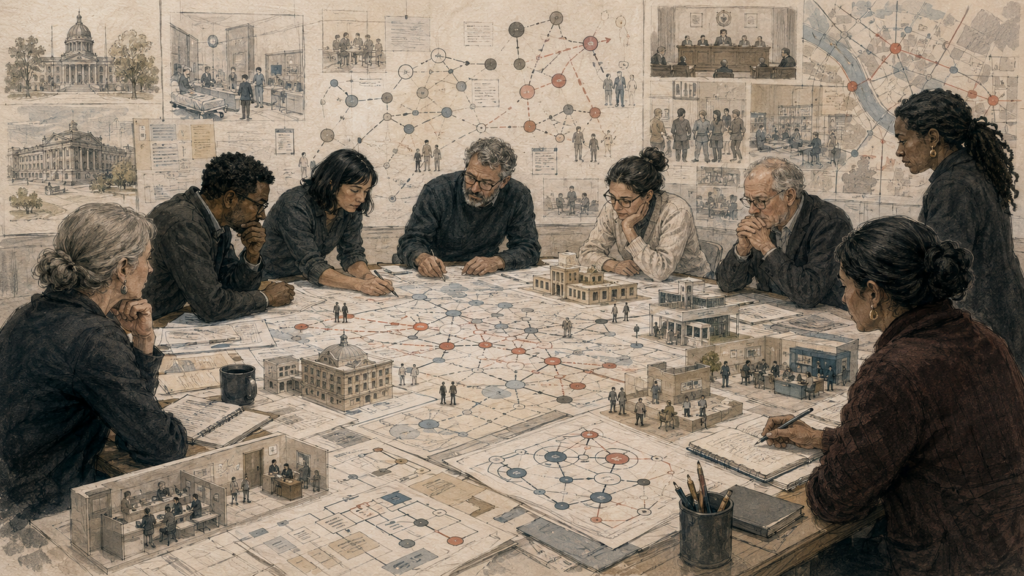
Editorial illustration of a diverse group studying institutional systems, public buildings, service environments, stakeholder networks, governance diagrams, and organizational pathways across a large research table.

Design Thinking for Complex Institutions

Design thinking for complex institutions examines how human-centered methods must change when problems are shaped by rules, authority, budgets, data systems, professional cultures, public trust, and long-term implementation constraints. This article argues that institutional design cannot rely only on empathy interviews, workshops, prototypes, or journey maps. Complex institutions require systems thinking, governance analysis, stakeholder mapping, policy awareness, organizational psychology, burden analysis, and learning infrastructure. The article explores problem framing, decision rights, frontline repair work, service systems, backstage infrastructure, data systems, ethics, unequal burden, prototyping, implementation, resistance, incentives, evaluation, and institutional absorption. It shows how design thinking becomes more serious when it asks not only what people need, but what the institution must change in order to deliver public value, accountability, access, dignity, and lasting institutional capacity.

Editorial illustration of a design research team studying data maps, AI-assisted pattern analysis, stakeholder evidence, interview sketches, systems diagrams, and prototype environments across a large research table.

Design Thinking, Data Systems, and AI-Assisted Research

Design thinking increasingly depends on data systems and AI-assisted research because human-centered inquiry now takes place across complex digital, institutional, behavioral, and informational environments. This article examines how design teams can connect interviews, contextual inquiry, analytics, service logs, survey data, prototype feedback, research repositories, semantic search, and AI-assisted synthesis into a more disciplined evidence system. It argues that AI should support research rather than replace human interpretation, participant knowledge, or ethical judgment. The article explores mixed-methods design intelligence, metadata, provenance, knowledge systems, research pipelines, validation, bias risk, privacy, public-sector applications, service design, behavioral data, and institutional learning. It shows how design thinking becomes stronger when evidence is traceable, findings are validated, uncertainty is documented, and AI-generated outputs remain accountable to human experience.

Editorial illustration of a diverse group gathered around a design research table with equity diagrams, stakeholder maps, accessibility scenes, power relationships, and community portraits.

Ethics, Power, and Inclusion in Design Thinking

Ethics, power, and inclusion are central to design thinking because human-centered methods can still reproduce exclusion when power remains unnamed. This article examines how design processes define problems, recruit participants, interpret evidence, allocate authority, test prototypes, and measure success. It argues that empathy, workshops, and user research are not enough unless affected people have real influence, accessibility is designed from the beginning, and harms can be detected, challenged, and repaired. The article explores design justice, disability access, administrative burden, participation, co-design, public policy, AI, behavioral power, service design, governance, and accountability. It shows how ethical design thinking moves beyond representation toward shared power, transparent trade-offs, responsible measurement, and repair. Design becomes more serious when it asks who benefits, who carries burden, and who can change the outcome.

Editorial illustration of a strategic design team studying systems maps, stakeholder scenes, organizational models, decision pathways, feedback loops, and long-term planning diagrams across a large research table.

Design Thinking and Strategy

Design thinking strengthens strategy by grounding strategic choices in human evidence, disciplined inquiry, prototyping, and learning. Strategy is not only a plan, slogan, or roadmap; it is a set of choices about where to focus, whom to serve, what value to create, what capabilities to build, and what trade-offs to accept. This article explains how design thinking helps organizations move beyond abstract ambition by connecting strategy to lived experience, service delivery, behavioral adoption, implementation readiness, ethics, power, public value, and strategic measurement. It examines human-centered strategy, problem framing, insight translation, strategic prototyping, portfolio design, service systems, behavioral strategy, public and institutional strategy, data and AI, and learning governance. The result is a more adaptive model of strategy, one that treats uncertainty as something to test rather than deny.

Editorial illustration of a design team studying behavioral pathways, decision points, user environments, feedback loops, stakeholder scenes, and prototype interventions across a large research table.

Design Thinking and Behavioral Design

Design thinking and behavioral design belong together because human-centered design must account for action, not only experience. People often intend to complete a task, use a service, change a habit, attend an appointment, or follow through on a goal, yet behavior is shaped by friction, timing, trust, memory, social norms, cognitive load, and institutional context. This article explains how behavioral design extends design thinking by diagnosing target behaviors, identifying barriers, testing interventions, and designing environments that make beneficial action easier without manipulation. It examines choice architecture, nudges, defaults, reminders, service friction, public policy, digital systems, AI-assisted behavioral design, ethics, equity, and measurement. The result is a more precise model of design practice, one that treats behavior as situated, measurable, ethically constrained, and shaped by the systems people navigate.

Editorial illustration of a service design team studying journey pathways, touchpoints, service counters, stakeholder interactions, backstage processes, and systems diagrams across a large research table.

Service Design in Design Thinking

Service design extends design thinking from individual touchpoints to the full experience of a service as it unfolds across time, channels, people, policies, technologies, and organizational systems. This article explains how service design connects human-centered research with operational delivery by examining user journeys, frontstage interactions, backstage workflows, service blueprints, staff roles, data dependencies, handoffs, recovery pathways, and governance. It shows why services fail when organizations polish interfaces without redesigning the systems that support them, and why trust, accessibility, procedural dignity, burden reduction, and staff sustainability must be treated as core design outcomes. The article also examines service prototyping, public services, digital and AI-assisted services, service measurement, and implementation. The result is a more complete model of design thinking, one that makes services clearer, more reliable, more equitable, and more accountable.

Editorial illustration of a diverse community group and design practitioners gathered around a large table covered with shared sketches, neighborhood models, stakeholder maps, civic scenes, and participatory design pathways.

Co-Design and Participatory Design

Co-design and participatory design expand design thinking beyond observation, empathy, and feedback by asking who has authority to define problems, shape alternatives, interpret evidence, and influence implementation. This article examines co-design as shared inquiry and participatory design as a democratic tradition concerned with power, representation, access, labor, community knowledge, and institutional accountability. It explains how meaningful participation differs from consultation or workshop theater, why affected people should help shape problem framing and synthesis, and how participatory methods can improve prototypes, services, public systems, AI governance, and organizational innovation. It also considers ethics, inclusion, design justice, measurement, and the limits of participation when institutions seek legitimacy without sharing real influence. The result is a more accountable model of design practice, one that treats stakeholders not as passive users but as interpreters, critics, collaborators, and co-authors of systems that affect their lives.

Scroll to Top