Design Thinking

Design thinking is a human-centered approach to innovation and problem solving. Originally developed within design and engineering disciplines, it has expanded into fields such as business strategy, public policy, education, and organizational development.

The core premise of design thinking is that effective solutions emerge from a deep understanding of human experiences and needs. Rather than beginning with technical constraints or existing systems, the process begins with empathy for users and stakeholders.

Design thinking typically follows an iterative cycle that includes understanding user needs, defining problems, generating ideas, prototyping solutions, and testing them in real-world contexts. This process encourages experimentation, rapid learning, and continuous refinement.

Because many contemporary challenges involve complex social and technological systems, design thinking has become a widely used framework for addressing problems that lack clear definitions or predetermined solutions. By combining creative ideation with systematic experimentation, design thinking enables organizations to explore innovative approaches while remaining grounded in real-world user experiences.

Editorial illustration of a design team evaluating multiple implementation sites, prototype outcomes, systems diagrams, feedback pathways, measurement charts, and learning cycles across a large research table.

Design Evaluation, Learning, and Outcome Measurement

Design evaluation, learning, and outcome measurement turn design thinking from a creative method into a disciplined practice of inquiry, accountability, and improvement. Good design work does not end with a prototype, workshop, or launch. It asks whether an intervention changed experience, reduced friction, improved access, strengthened trust, or produced unintended consequences. This article examines how teams can evaluate design outcomes through mixed methods, usability evidence, stakeholder feedback, service metrics, behavioral indicators, implementation learning, and long-term institutional effects. It emphasizes that measurement should not flatten human experience into simplistic dashboards or vanity metrics. Instead, design evaluation should connect qualitative insight with credible evidence, helping teams learn what worked, what failed, for whom, under what conditions, and why. Outcome measurement becomes most valuable when it supports ethical adaptation, not performative success claims.
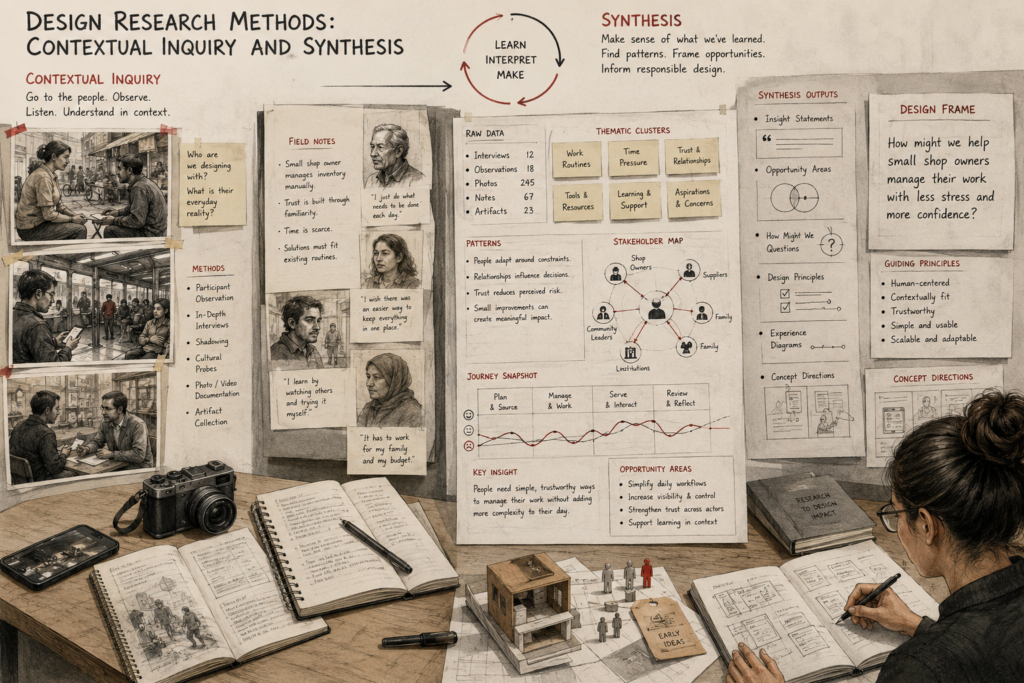
Editorial illustration of a design research workspace showing contextual inquiry, field notes, stakeholder interviews, thematic clustering, journey mapping, synthesis outputs, and concept directions.

Design Research Methods: Contextual Inquiry and Synthesis

Design research methods give design thinking its empirical foundation by grounding decisions in lived experience rather than assumption, preference, or abstract strategy. Contextual inquiry places researchers inside real environments where people work, learn, seek care, navigate services, use tools, and make decisions under practical constraints. Instead of asking only what users say they need, it observes what they actually do, where systems break down, and how routines, spaces, technologies, policies, and relationships shape behavior. Synthesis then turns raw evidence into usable insight through affinity mapping, journey analysis, pattern recognition, problem framing, and opportunity identification. This article examines contextual inquiry and synthesis as disciplined practices for understanding complexity, surfacing hidden needs, and translating qualitative evidence into better design choices. It emphasizes careful listening, ethical interpretation, and the responsibility to represent people’s experiences without reducing them to simplistic user personas.

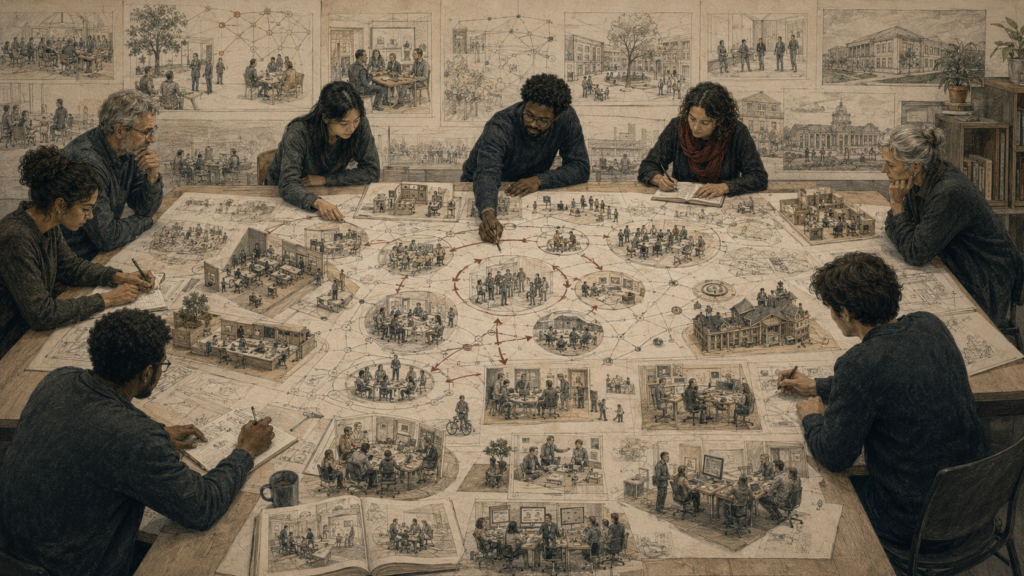
Editorial illustration of a diverse team studying organizational systems, workplace scenes, collaboration models, stakeholder maps, feedback loops, and innovation pathways across a large research table.

Design Thinking and Organizational Innovation

Design Thinking and Organizational Innovation examines how design thinking functions as a serious method of inquiry, experimentation, and institutional learning rather than a shallow language of corporate creativity. The article argues that innovation depends not only on ideas, but on problem framing, user research, systems awareness, prototyping, testing, and the organizational capacity to revise assumptions under uncertainty. It situates design thinking within a broader intellectual history, connects it to human-centered research and implementation, and addresses critiques related to power, ethics, and institutional limits. It also includes a mathematical lens for modeling design value under constraint, along with advanced R and Python workflows that show how organizations can evaluate innovation portfolios, compare competing priorities, and make prototype decisions more transparent, rigorous, and auditable.

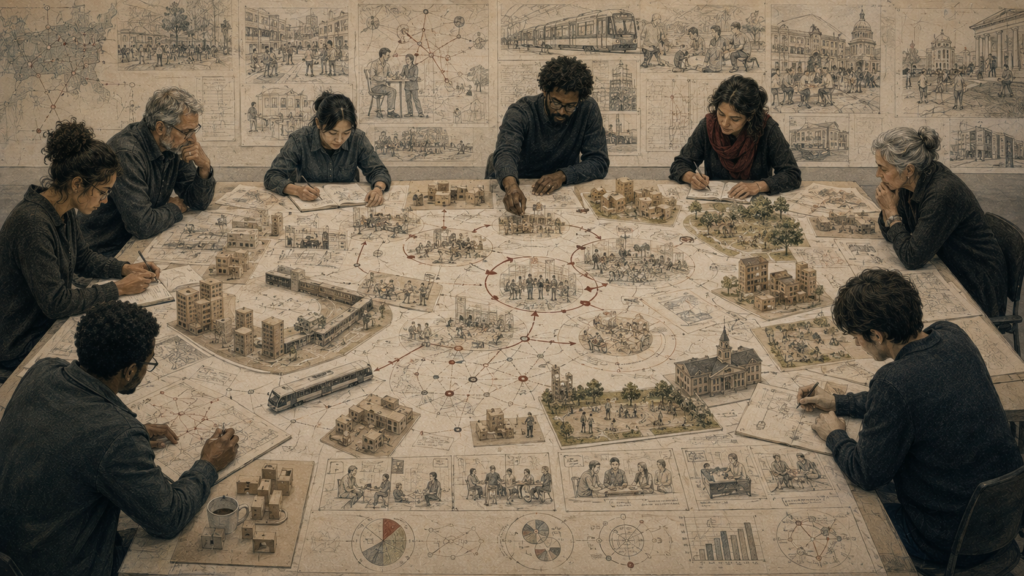
Editorial illustration of a public policy design team studying civic maps, community scenes, transit systems, institutional buildings, stakeholder diagrams, public service models, and feedback pathways.

Design Thinking in Public Policy

Design Thinking in Public Policy examines how human-centered design methods can improve the development, testing, and implementation of public programs, services, and regulatory systems. The article argues that policy failure often arises not only from political disagreement or weak analysis, but from poor problem framing, inaccessible service design, hidden administrative burdens, and insufficient attention to lived experience. It situates design thinking within the complexity of government, connects it to systems thinking, behavioral insights, democratic governance, and institutional learning, and addresses the ethical and political limits of applying design methods to public life. It also includes a mathematical lens for modeling public-policy trade-offs, along with advanced R and Python workflows for evaluating policy pilots, comparing competing public priorities, and analyzing uncertainty before large-scale implementation.

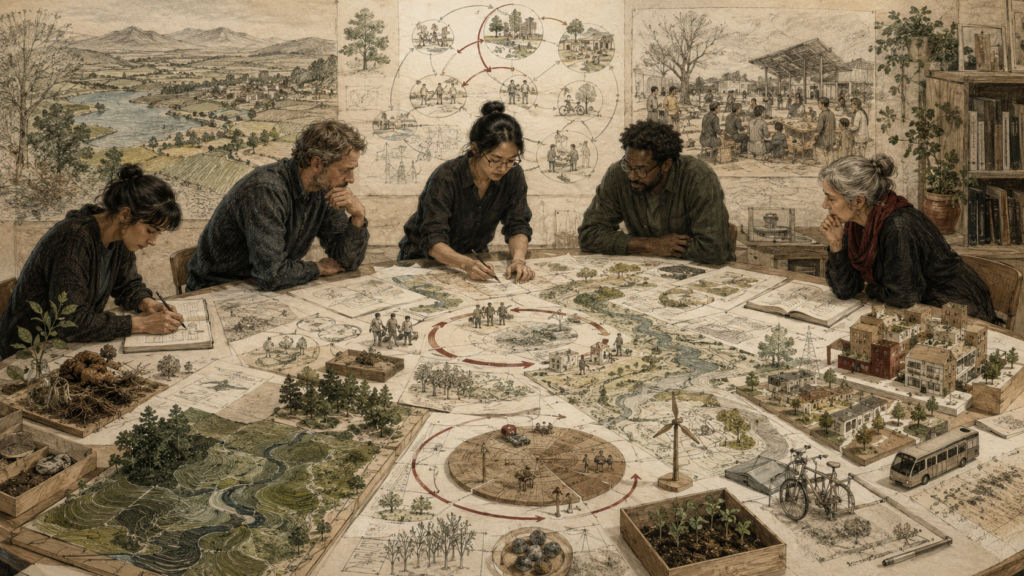
Editorial illustration of a design team working around a large table filled with ecological maps, community sketches, circular planning diagrams, landscape models, renewable infrastructure, gardens, transit, and sustainable settlement designs.

Design Thinking for Sustainability

Design Thinking for Sustainability examines how design thinking can be used to address ecological, social, and economic challenges within systems shaped by planetary limits, institutional constraints, and human behavior. The article argues that sustainability failures often arise not only from weak technology, but from poor system design, inaccessible transitions, behavioral friction, and insufficient attention to adoption, equity, and implementation. It connects design thinking to sustainability science, systems thinking, circular design, regenerative approaches, urban infrastructure, and long-horizon ecological responsibility. It also includes a mathematical lens for modeling sustainable design trade-offs, along with advanced R and Python workflows for evaluating sustainability concepts, comparing ecological and institutional priorities, and analyzing uncertainty before large-scale implementation.

Editorial illustration of a design team studying a large systems map filled with human-centered sketches, stakeholder scenes, feedback loops, model environments, network diagrams, and circular design pathways.

Design Thinking and Systems Thinking

Design Thinking and Systems Thinking examines how human-centered design and structural systems analysis can be integrated to address complex social, organizational, and ecological problems. The article argues that many interventions fail because they improve a local touchpoint while leaving the deeper structures of incentives, information flows, feedback loops, and institutional rules unchanged. It situates design thinking and systems thinking as complementary methods: one focused on lived experience, framing, prototyping, and iteration, the other focused on leverage points, delays, adaptation, and long-run system behavior. It also includes a mathematical lens for modeling intervention trade-offs, along with advanced R and Python workflows for comparing design-system interventions, identifying leverage under competing priorities, and analyzing uncertainty before committing to large-scale system redesign.

Editorial illustration of a design team working around a large table covered with prototype models, rollout pathways, systems maps, implementation diagrams, and scaled deployment clusters.

Implementation and Scaling in Design Thinking

Design Thinking and Systems Thinking examines how human-centered design and structural systems analysis can be integrated to address complex social, organizational, and ecological problems. The article argues that many interventions fail because they improve a local touchpoint while leaving the deeper structures of incentives, information flows, feedback loops, and institutional rules unchanged. It situates design thinking and systems thinking as complementary methods: one focused on lived experience, framing, prototyping, and iteration, the other focused on leverage points, delays, adaptation, and long-run system behavior. It also includes a mathematical lens for modeling intervention trade-offs, along with advanced R and Python workflows for comparing design-system interventions, identifying leverage under competing priorities, and analyzing uncertainty before committing to large-scale system redesign.

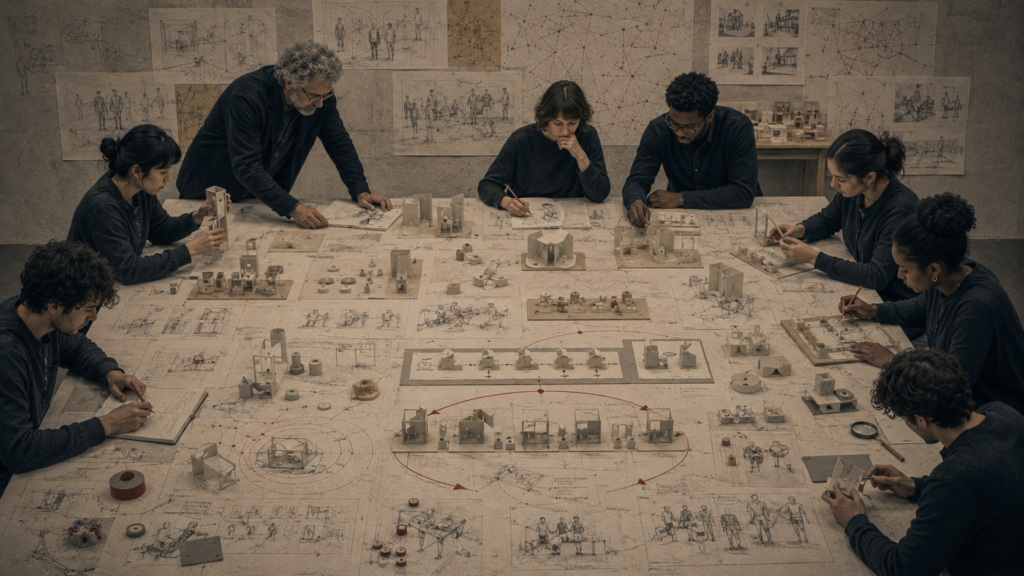
Editorial illustration of a design studio table covered with prototype models, testing sequences, sketches, feedback pathways, validation diagrams, and revision cycles.

Testing and Validation in Design Thinking

Testing and Validation in Design Thinking examines how design ideas are evaluated through evidence, observation, and iterative learning rather than intuition alone. The article argues that testing is not a final checkpoint or simple quality-control step, but a serious method of inquiry through which prototypes encounter real users, institutional conditions, and the practical limits of their own assumptions. It explores usability, desirability, feasibility, viability, behavioral observation, testing in organizational and public contexts, and the role of validation in reducing overconfidence and improving judgment. It also includes a mathematical lens for modeling evidence and uncertainty, along with advanced R and Python workflows for comparing tested concepts, clarifying validation criteria, and analyzing how design judgments shift when early evidence remains incomplete.

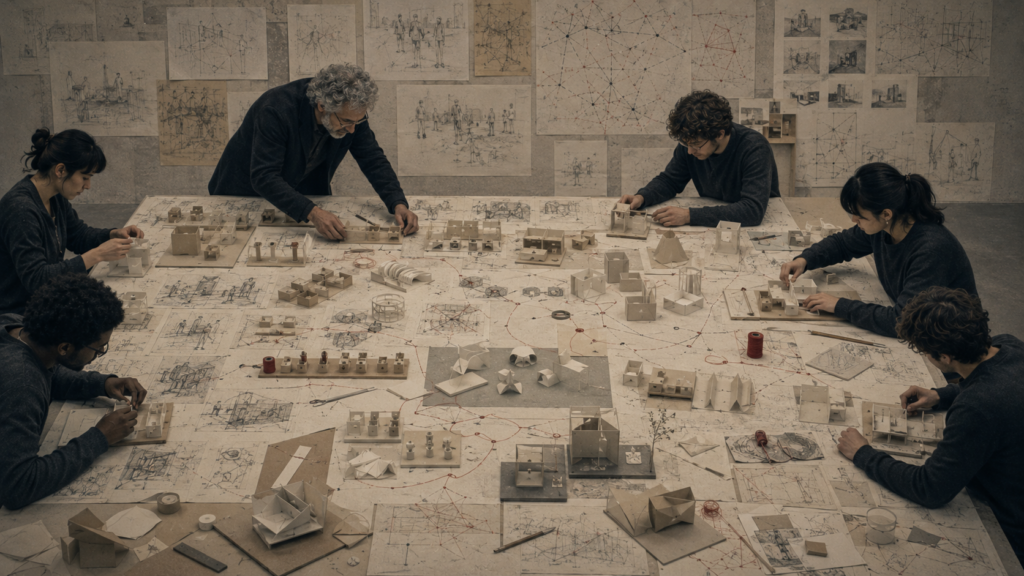
Editorial illustration of a design studio table covered with paper prototypes, model variations, sketches, tools, feedback paths, and iterative design diagrams.

Prototyping in Design Thinking

Prototyping in Design Thinking examines how ideas are transformed into tangible experiments that can be explored, questioned, and revised before major commitments are made. The article argues that prototyping is not simply an early making step or unfinished version of a final solution, but a serious method of learning under uncertainty. It explores low- and high-fidelity prototypes, prototyping as experimental inquiry, service and system prototypes, rapid iteration, organizational learning, and the limits of prototyping when complex institutional conditions remain unresolved. It also connects prototyping to judgment, bias, and reflective practice, showing how prototypes help expose hidden assumptions and improve collective reasoning. The article includes a mathematical lens for modeling learning value, along with advanced R and Python workflows for comparing prototype portfolios and analyzing uncertainty in early-stage design decisions.

Scroll to Top