
Last Updated May 28, 2026
Design thinking for social impact and public value asks how human-centered design can serve more than organizational growth, product adoption, or service efficiency. It asks how design methods can help communities, institutions, civic systems, nonprofits, public agencies, educators, researchers, health systems, environmental organizations, and mission-driven coalitions respond to problems that affect people’s lives, rights, dignity, access, wellbeing, and future possibilities.
Social impact design is not simply design for “good causes.” It is design under conditions of inequality, constraint, institutional complexity, contested values, uneven power, limited resources, and long-term consequence. Public value is not the same as user satisfaction or customer experience. It includes legitimacy, fairness, access, trust, accountability, ecological responsibility, democratic participation, burden reduction, rights protection, and the capacity of institutions to serve people over time.
Design thinking can contribute to social impact when it helps people understand lived experience, reveal institutional burden, frame problems more honestly, test interventions before scaling them, include affected communities, and learn from evidence. It can also fail when it turns structural problems into workshop exercises, treats participation as symbolism, measures success too narrowly, or allows powerful institutions to define “impact” without sharing authority with the people most affected.
Main Library
Publications
Article Map
Design Thinking
Related Topic
Stewardship & Ethics
Related Topic
Institutions & Governance
Related Topic
Sustainable Development
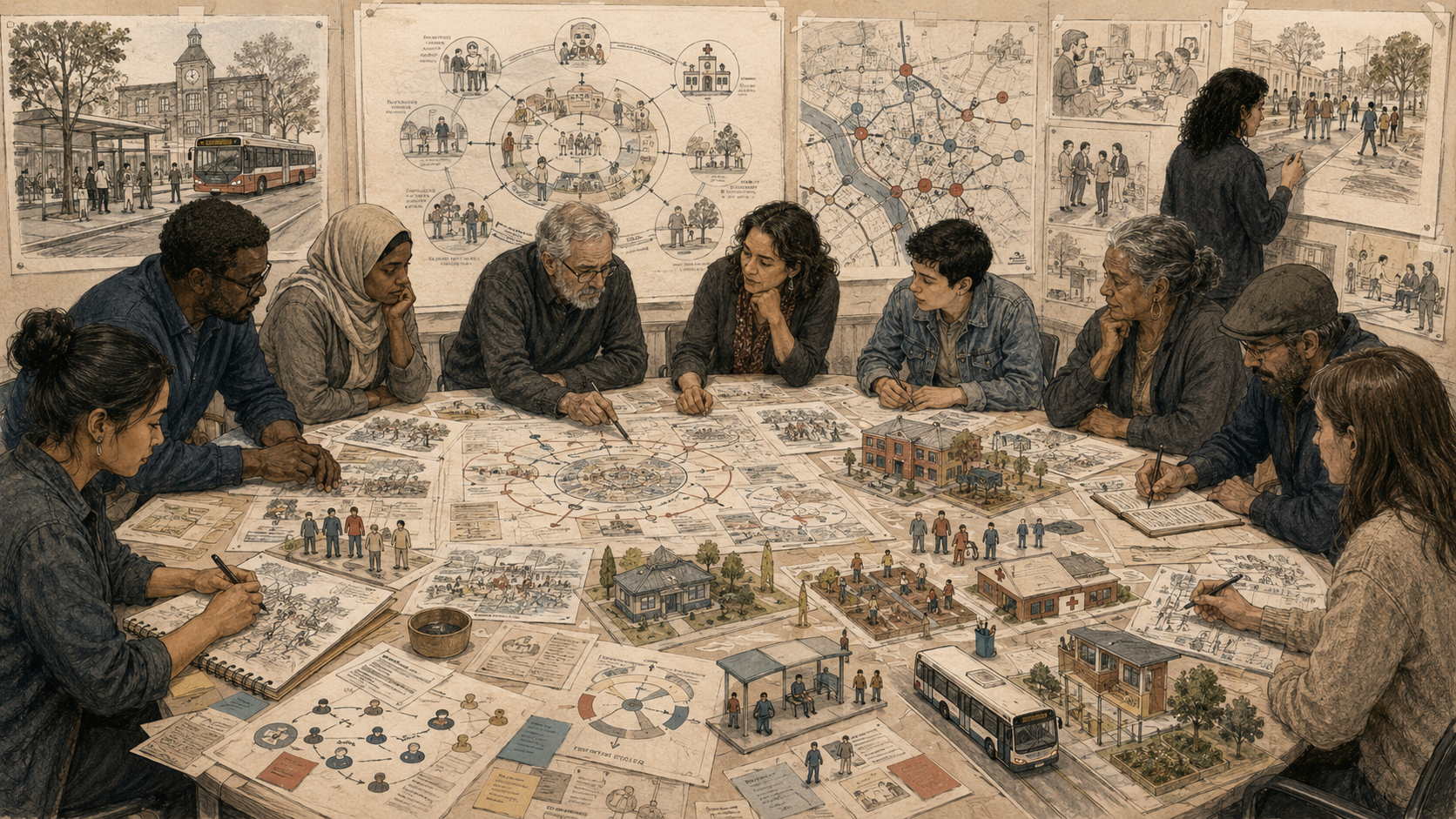
The question is therefore not whether design thinking can be used for social impact. It already is. The harder question is whether it is being used responsibly. Does it shift power or merely collect stories? Does it reduce burden or repackage it? Does it build public value or merely improve institutional image? Does it confront unequal systems or smooth their interfaces? Does it create learning, accountability, and repair?
Design thinking for social impact and public value is strongest when it connects human experience to systems change. It combines research, participation, service design, institutional analysis, ethics, policy awareness, data systems, evaluation, and long-term stewardship. It treats people not as users to be optimized, but as members of communities, publics, ecosystems, institutions, and histories. It asks how design can support dignity, justice, resilience, inclusion, and responsible collective action.
Design thinking for social impact and public value connects directly to what design thinking is, human-centered problem solving, empathy and stakeholder research, problem framing, contextual inquiry and synthesis, co-design and participatory design, service design, public policy, complex institutions, ethics, power, and inclusion, evaluation, learning, and outcome measurement, and data systems and AI-assisted research.
What Design Thinking for Social Impact and Public Value Means
Design thinking for social impact and public value applies human-centered, systems-aware, participatory, and evidence-based design methods to problems where the goal is not merely adoption, efficiency, or market success, but improved human, social, civic, institutional, or ecological outcomes. It asks how design can support access, wellbeing, trust, dignity, justice, resilience, learning, and collective responsibility.
This work often takes place in public agencies, schools, universities, health systems, nonprofits, civic institutions, philanthropic programs, humanitarian organizations, local communities, environmental initiatives, and cross-sector partnerships. It may address housing access, food systems, healthcare delivery, climate resilience, disability inclusion, public benefits, education pathways, community safety, digital access, civic participation, infrastructure, unemployment, environmental monitoring, or institutional trust.
| Conventional design goal | Social impact and public value goal |
|---|---|
| Improve user experience. | Improve access, dignity, trust, fairness, outcomes, and burden distribution. |
| Increase adoption. | Ensure the intervention is appropriate, legitimate, inclusive, and beneficial. |
| Reduce friction. | Reduce harmful burden while preserving rights, safety, accountability, and care. |
| Optimize conversion. | Strengthen public value, participation, wellbeing, and institutional responsibility. |
| Prototype quickly. | Prototype responsibly with safeguards, consent, context, and repair pathways. |
| Scale what works. | Scale what is effective, equitable, accountable, governable, and sustainable. |
| Measure satisfaction. | Measure outcomes, burden, equity, legitimacy, trust, and long-term consequences. |
The phrase “social impact” can become vague if it is not tied to specific people, systems, and outcomes. Public value can also become abstract if it is not connected to evidence and accountability. Design thinking helps by asking concrete questions: Who is affected? What burden do they carry? What outcome matters? What system produces the problem? Who has authority? What evidence is needed? What harms must be prevented? What would count as responsible improvement?
Social impact design is therefore both practical and ethical. It is practical because it helps teams move from broad ideals to testable interventions. It is ethical because the people affected by social problems are not simply users of a service; they are members of publics whose lives, rights, opportunities, and communities are shaped by design decisions.
Why Social Impact Requires a Different Design Ethic
Social impact problems are not neutral design challenges. They are shaped by inequality, institutional history, law, public budgets, geography, culture, race, class, disability, language, gender, age, citizenship status, environmental exposure, political power, and trust. A design process that ignores these conditions may produce elegant interventions that fail or cause harm.
Design thinking often begins with empathy, but social impact work requires more than empathy. Empathy can help designers listen, but it does not automatically redistribute authority. It can generate insight, but it can also extract stories without changing conditions. It can reveal pain, but it does not by itself create rights, resources, governance, or repair. Social impact design must therefore move from empathy to accountability.
| Design habit | Risk in social impact work | Stronger practice |
|---|---|---|
| Empathy interviews | Stories are extracted without shared power or material change. | Use participatory framing, consent, reciprocity, and feedback loops. |
| Rapid prototyping | People become test subjects for interventions that affect access, dignity, or safety. | Use risk review, safeguards, informed participation, and repair pathways. |
| Journey mapping | Burden is visualized but not reduced. | Connect journey evidence to authority, resources, policy, and implementation. |
| Innovation language | Structural injustice is reframed as a creativity problem. | Name power, history, rights, and institutional accountability. |
| Stakeholder workshops | Powerful actors dominate interpretation. | Design facilitation so affected people can influence framing and decisions. |
| Impact metrics | Success is narrowed to what funders or institutions can easily count. | Use mixed methods, disaggregated outcomes, burden measures, and community-defined value. |
| Scaling | A promising pilot expands before equity, governance, and long-term effects are understood. | Scale only after evidence, implementation capacity, accountability, and context are tested. |
The ethical center of social impact design is responsibility. Designers must ask who benefits, who decides, who pays, who participates, who is exposed to risk, who can object, who can appeal, and who receives repair when harm occurs. These questions are especially important when design work is conducted by institutions with more power than the communities they serve.
Design thinking becomes worthy of social impact work only when it treats affected people as sources of knowledge, agency, authority, and accountability—not merely as data sources for better solutions.
Public Value Beyond User Experience
Public value is broader than user experience. A service may be easy to use but still unfair. A platform may be efficient but still extractive. A program may satisfy participants but fail to reach excluded groups. A policy tool may reduce administrative cost while increasing burden on families, frontline workers, or community organizations. A public innovation may appear successful in a pilot while weakening trust, accountability, or long-term stewardship.
Public value asks whether a design contributes to a legitimate public purpose. That purpose may include wellbeing, fairness, access, safety, learning, participation, ecological resilience, accountability, or institutional trust. Public value also requires attention to process: how decisions were made, whose voices mattered, whether evidence was transparent, and whether people could challenge or repair harm.
| Public value dimension | Design question | Evidence needed |
|---|---|---|
| Access | Who can actually use, reach, understand, and benefit from the service? | Completion, non-use, language access, disability access, channel access, and support needs. |
| Equity | Do benefits and burdens differ across groups? | Disaggregated outcomes and qualitative accounts from affected groups. |
| Dignity | Does the design treat people with respect, clarity, and care? | Participant narratives, complaint data, observation, and service recovery evidence. |
| Legitimacy | Do people understand and trust the purpose, process, and decision rules? | Trust measures, public feedback, participation records, and transparency review. |
| Accountability | Can errors be corrected and harms repaired? | Appeal pathways, escalation data, repair outcomes, and governance records. |
| Effectiveness | Does the intervention improve the outcome it claims to improve? | Outcome data, comparison groups, longitudinal evidence, and implementation data. |
| Sustainability | Can the intervention be maintained without shifting costs or harm elsewhere? | Budget, staffing, maintenance, environmental, and institutional capacity evidence. |
| Learning | Does evidence lead to adaptation over time? | Decision logs, evaluation cycles, updated designs, and public reporting. |
This distinction matters because design thinking is sometimes imported into social impact work through the language of user-centered innovation. That language can be helpful, but it can also be too narrow. A person applying for housing assistance, navigating a public health system, seeking disability accommodations, or participating in climate adaptation is not simply a “user.” They are a person encountering institutions, rights, obligations, risks, histories, and public systems.
Design for public value must therefore connect usability to justice, service quality to legitimacy, and innovation to responsibility.
Problem Framing in Social Impact Work
Problem framing determines what kind of social impact work becomes possible. If a city frames homelessness as a shelter-navigation problem, it may design better referral tools while leaving housing supply, eviction, income insecurity, mental health support, zoning, and rental markets untouched. If a school frames absenteeism as student motivation, it may miss transportation, caregiving, disability support, safety, housing instability, and institutional trust. If a health system frames missed appointments as patient behavior, it may ignore scheduling, cost, work constraints, language access, transportation, and fear.
Design thinking can help reframe problems, but only if it resists institution-centered definitions. Social impact problems are often named by organizations with the power to fund, measure, and govern interventions. A responsible design process asks whether the people most affected would define the problem differently.
| Institution-centered frame | Public-value frame |
|---|---|
| People do not use the service. | The service may be inaccessible, distrusted, burdensome, unsafe, or poorly matched to lived realities. |
| Communities are hard to reach. | The institution may lack trusted relationships, language access, reciprocity, or legitimacy. |
| Users fail to comply. | The rules may be confusing, punitive, inequitable, or disconnected from material constraints. |
| Programs do not scale. | The system may lack governance, funding, implementation capacity, or local adaptation. |
| Residents lack awareness. | Communication may be too late, too technical, too mistrusted, or delivered through the wrong channels. |
| Behavior change is needed. | The environment, incentives, defaults, risk, access, and social conditions may need redesign. |
| Impact is hard to prove. | The theory of change, evidence system, baseline, outcome horizon, or community-defined value may be weak. |
A stronger social impact frame includes at least six layers: lived experience, structural conditions, institutional process, power relationships, outcome evidence, and implementation capacity. Lived experience reveals how people encounter the issue. Structural conditions reveal why the issue persists. Institutional process shows how organizations contribute to the problem. Power relationships show who defines and controls change. Outcome evidence shows whether intervention matters. Implementation capacity shows whether change can last.
A good frame does not make the problem smaller just to make it designable. It makes the problem clear enough to act responsibly.
Communities, Participation, and Shared Authority
Social impact design depends on participation, but not all participation is equal. People may be informed, consulted, interviewed, invited to workshops, asked to react to prototypes, involved in co-design, included in governance, or given real decision authority. These are different levels of power. A process should name honestly which level it is using.
Participation becomes meaningful when affected people influence problem framing, evidence interpretation, design priorities, trade-offs, implementation decisions, and evaluation. It becomes symbolic when institutions collect input but retain all authority, interpret evidence alone, and proceed with decisions that participants cannot meaningfully shape.
| Participation level | What happens | Public-value concern |
|---|---|---|
| Inform | The institution shares information about a decision or service. | Useful for transparency, but not participation by itself. |
| Consult | People provide feedback, stories, or preferences. | Feedback may not influence decisions unless pathways are clear. |
| Test | People react to prototypes or service changes. | Testing must avoid exposing participants to unmanaged risk. |
| Co-design | Affected people help shape ideas, priorities, and prototypes. | Requires time, support, compensation, accessibility, and influence. |
| Co-govern | Affected people help make decisions and monitor outcomes. | Requires shared authority, accountability, and institutional commitment. |
| Community-led design | Communities define problems, priorities, process, and success criteria. | Institutions must support without taking over or extracting legitimacy. |
Shared authority also requires infrastructure. Participation should not depend on who has free time, professional language, digital access, transportation, childcare, or comfort in institutional settings. It may require compensation, translation, disability access, meeting formats, community intermediaries, flexible scheduling, trauma-informed facilitation, plain-language materials, and feedback showing how participation affected decisions.
The most important test is not whether people were invited. It is whether their involvement changed the work.
Power, Justice, and Burden
Design decisions distribute power and burden. They determine who must prove eligibility, who waits, who travels, who fills out forms, who is believed, who receives support, who must appeal, who bears uncertainty, who receives repair, and who is excluded before the institution even notices. Social impact design must therefore treat burden as a central design variable.
Burden is not only inconvenience. It can be time, paperwork, digital access, emotional stress, stigma, translation work, repeated explanations, childcare, transportation, financial cost, documentation, uncertainty, surveillance, fear, and the labor of navigating institutions. Burden often falls most heavily on people with the least power to challenge it.
| Burden type | How it appears | Design response |
|---|---|---|
| Administrative burden | Forms, documents, eligibility proof, repeated verification, and procedural complexity. | Simplify requirements, reduce duplication, provide assistance, and clarify rights. |
| Cognitive burden | Confusing language, unclear steps, uncertainty, and decision complexity. | Use plain language, status clarity, guided support, and accessible communication. |
| Emotional burden | Fear, stigma, shame, mistrust, frustration, or feeling judged. | Design for dignity, care, trauma awareness, and respectful recovery. |
| Access burden | Digital divide, disability barriers, transportation, language, channel limits, or location. | Provide multi-channel access, disability support, translation, and assisted pathways. |
| Coordination burden | People must connect agencies, providers, documents, appointments, or services themselves. | Design handoffs, case support, data-sharing safeguards, and institutional coordination. |
| Appeal burden | People must challenge errors through opaque or difficult processes. | Create clear reasons, appeal rights, escalation, correction, and repair. |
| Community burden | Community organizations fill gaps created by underperforming institutions. | Fund, support, and share authority with community partners rather than exploiting them. |
Justice-oriented design asks whether a process reduces burden for those most affected or merely makes the institution’s work easier. It also asks who has the authority to define harm. People experiencing a system may identify harms that institutional metrics do not capture: fear, shame, disrespect, confusion, loss of trust, repeated exposure, surveillance, or having to tell painful stories again and again.
Design thinking for social impact must therefore connect empathy to structural analysis. Listening matters, but the purpose of listening is not to produce better personas. It is to change the conditions that produce avoidable harm.
Systems, Portfolios, and Long-Term Change
Social impact problems rarely have single-point solutions. They involve systems: housing systems, food systems, education systems, health systems, care systems, labor markets, justice systems, climate systems, digital infrastructure, public finance, and civic institutions. A single service improvement may help, but it may not change the system conditions that reproduce the problem.
A systems approach does not mean trying to solve everything at once. It means understanding relationships, feedback loops, constraints, dependencies, incentives, and leverage points. It also means using portfolios of interventions rather than relying on one heroic solution. A portfolio might include service improvements, policy changes, community partnerships, data infrastructure, public communication, behavioral supports, governance reforms, funding changes, and long-term evaluation.
| Portfolio layer | Example design contribution | Public-value purpose |
|---|---|---|
| Immediate service repair | Simplify access, improve support, clarify steps, reduce waiting, and fix handoffs. | Reduce immediate burden and restore basic functionality. |
| Community partnership | Work with trusted local organizations and compensate participation. | Build legitimacy, trust, and contextual knowledge. |
| Policy adjustment | Revise eligibility, documentation, exceptions, or procedural rules. | Address structural sources of burden. |
| Data and learning system | Track outcomes, burden, equity, non-use, and repair. | Make invisible harm visible and actionable. |
| Governance reform | Create review, accountability, escalation, and community advisory structures. | Ensure decisions can respond to evidence and public concern. |
| Capacity building | Invest in staff, tools, training, accessibility, and maintenance. | Make change durable rather than pilot-dependent. |
| Long-term systems learning | Use evaluation to adapt interventions and retire ineffective approaches. | Build institutional learning over time. |
Portfolio thinking is especially important because social impact work often happens under uncertainty. Teams may not know which intervention will work, which partnership will hold, which policy interpretation will be feasible, or which conditions will change. A portfolio allows learning across multiple coordinated efforts instead of betting everything on one program.
Design thinking contributes by making each intervention concrete, testable, participatory, and evidence-linked. Systems thinking contributes by ensuring those interventions are connected to the larger conditions that shape impact.
Service Design, Policy, and Institutional Delivery
Many social impact goals are delivered through services and policies. People encounter public value through forms, appointments, eligibility rules, caseworkers, websites, letters, call centers, schools, clinics, community organizations, payment systems, outreach efforts, and appeals. A policy may look just on paper but become burdensome in delivery. A service may appear efficient internally but remain inaccessible to the people it is meant to support.
Service design helps make delivery visible. It maps the frontstage experience people see and the backstage work institutions perform. Policy analysis helps explain why certain steps exist, what rules are fixed, where discretion exists, and where reform may be needed. Social impact design requires both.
| Delivery layer | Social impact question |
|---|---|
| Policy rule | Does the rule advance public value, or does it create avoidable exclusion and burden? |
| Eligibility process | Can people understand, prove, and complete the process without excessive burden? |
| Communication | Is the language clear, accessible, timely, multilingual, and respectful? |
| Service channel | Can people access support online, in person, by phone, through community partners, or through assisted pathways? |
| Backstage workflow | Can staff deliver the service without hidden labor, duplication, or conflicting systems? |
| Data system | Does the system support accurate records, privacy, interoperability, and learning? |
| Appeal and repair | Can errors be challenged, corrected, explained, and repaired? |
| Evaluation | Does the institution learn from outcomes, burden, feedback, and unintended effects? |
The connection between policy and service is crucial. A design team may be asked to improve a service interface when the real problem is a policy rule. It may be asked to improve outreach when the real problem is mistrust. It may be asked to improve completion when the real problem is documentation burden. It may be asked to create a digital solution when the real need is assisted access.
Design thinking for public value must therefore follow the experience into the institution. It should ask what frontstage failure reveals about backstage systems, and what backstage systems reveal about policy, governance, and resource choices.
Evidence, Data, and Public Learning
Social impact design depends on evidence, but evidence must be interpreted carefully. Quantitative data can show scale, distribution, trends, access, completion, cost, and outcomes. Qualitative research can show meaning, trust, fear, dignity, confusion, hidden burden, and lived constraints. Community knowledge can reveal histories, relationships, and forms of harm that institutional data misses. Frontline staff can reveal workarounds and delivery failures. Evaluation can show whether interventions improve outcomes over time.
Data systems can strengthen public value when they make harm visible, support learning, and hold institutions accountable. They can also weaken public value when they enable surveillance, misclassification, automated exclusion, or overconfidence in what is easy to measure.
| Evidence source | What it can show | What it can miss |
|---|---|---|
| Community research | Lived experience, trust, history, needs, values, and local priorities. | May be underpowered if participation is not supported or representative. |
| Administrative data | Eligibility, usage, completion, timing, outcomes, and demographic patterns. | Non-users, informal burden, mistrust, misclassification, and excluded groups. |
| Service analytics | Drop-off, channel use, task completion, support demand, and error patterns. | Reasons behind behavior and people who never enter the tracked system. |
| Frontline evidence | Workarounds, repair labor, exception cases, and operational constraints. | May reflect staff position without fully capturing community experience. |
| Prototype testing | Usability, comprehension, feasibility, and early response. | Long-term adoption, real-world constraints, institutional capacity, and equity effects. |
| Outcome evaluation | Whether the intervention changed measurable conditions. | Mechanisms, lived meaning, unintended harms, and long-term system effects. |
| AI-assisted synthesis | Patterns across large bodies of text, feedback, or documents. | Minority signals, source context, uncertainty, bias, and unsupported inference. |
Public learning requires evidence to be connected to decisions. If evidence remains in reports, dashboards, or research repositories without changing budget, policy, staffing, governance, or implementation, then the institution has documented the problem rather than learned from it.
Responsible evidence systems should track source, method, date, participant group, limitations, consent, interpretation, decision linkage, and follow-up outcomes. Public value depends not only on what evidence is collected, but on whether evidence can change what institutions do.
Evaluation, Outcomes, and Impact Measurement
Impact measurement in design thinking must be handled carefully. Social impact work often faces pressure to prove results quickly, satisfy funders, justify programs, or produce visible success stories. But social outcomes may take time. They may depend on many actors. They may be affected by context. They may require qualitative interpretation. They may involve trade-offs between efficiency, equity, dignity, trust, and long-term resilience.
Good evaluation begins with a theory of change: how the intervention is expected to produce impact, for whom, under what conditions, and with what risks. It also includes a theory of harm: how the intervention could fail, exclude, burden, stigmatize, surveil, misclassify, or shift costs onto others.
BurdenTime, forms, documents, uncertainty, emotional stress, coordination, and appeal effort.Burden must be measured from the participant perspective, not only institutional process time.
| Evaluation domain | Example measures | Interpretive caution |
|---|---|---|
| Reach | Who participates, who is served, and who remains outside the intervention. | High participation may still exclude the most burdened groups. |
| Access | Completion, channel use, language access, disability access, and support needs. | Completion does not prove low burden or dignity. |
| Outcome | Health, education, housing, employment, wellbeing, safety, resilience, or other target outcomes. | Attribution may be difficult in complex systems. |
| Equity | Disaggregated outcomes across groups, places, channels, and access needs. | Average improvement may hide worsening disparities. |
| Trust | Perceived fairness, clarity, responsiveness, and willingness to reengage. | Trust is shaped by history and cannot be reduced to satisfaction. |
| Implementation | Staff workload, fidelity, adaptation, cost, capacity, and maintenance. | Failure may reflect weak support, not weak design intent. |
| Learning | Evidence review, design changes, policy changes, and public reporting. | Measurement is weak if it does not lead to action. |
Impact measurement should include stop, pivot, and scale criteria. Before scaling, teams should define what evidence would justify expansion, what evidence would require redesign, and what evidence would require stopping. This is especially important when an intervention affects access, rights, health, housing, safety, public benefits, education, employment, or environmental exposure.
Evaluation should not only ask whether the intervention worked. It should ask who it worked for, who it missed, who carried burden, what changed institutionally, and what must be repaired or adapted.
Implementation, Scaling, and Stewardship
Social impact design is incomplete without implementation and stewardship. A good prototype is not a public value outcome. A successful pilot is not the same as durable change. Many social impact efforts fail because they are designed as projects rather than as long-term responsibilities. They launch with energy, funding, and attention, then weaken when ownership, maintenance, staffing, governance, or learning systems are missing.
Implementation asks whether the intervention can be delivered. Scaling asks whether it can be expanded responsibly. Stewardship asks whether it can be maintained, monitored, repaired, and adapted over time. Public value requires all three.
| Lifecycle stage | Design question | Failure mode |
|---|---|---|
| Prototype | Can the idea work in a limited, responsible test? | The prototype tests desirability but ignores governance, staff, policy, or risk. |
| Pilot | Can the intervention work under more realistic conditions? | The pilot depends on exceptional people, temporary funding, or special permissions. |
| Implementation | Can the institution deliver the intervention reliably? | Ownership, staffing, data systems, or training are insufficient. |
| Scaling | Can the intervention expand without losing quality, equity, or accountability? | Context differences, capacity gaps, or unintended harms are ignored. |
| Stewardship | Can the intervention be maintained, evaluated, and adapted? | The design becomes stale, underfunded, ungoverned, or unresponsive. |
| Repair | Can people challenge errors and receive correction? | Harms are documented but not repaired. |
Stewardship is especially important in social impact work because harm may emerge after launch. A service may work at first but become underfunded. A policy tool may improve access for one group while creating burden for another. A digital pathway may expand reach while excluding people without stable internet. An AI-assisted system may speed triage while increasing opacity. A community partnership may become extractive if resources and authority are not shared.
Design thinking for public value should therefore include maintenance plans, funding models, governance owners, feedback loops, appeal pathways, monitoring, disaggregated evaluation, and sunset criteria. A social impact design is not finished when it launches. It is only beginning its public life.
Risks, Failure Modes, and Ethical Safeguards
Design thinking can improve social impact work, but it can also create risks. The language of innovation can make unequal systems seem more responsive than they are. Participation can be used to legitimize decisions already made. Prototypes can expose vulnerable people to poorly governed experiments. Metrics can reward visible outputs rather than meaningful outcomes. AI-assisted tools can summarize public voices while erasing minority signals or context.
Responsible social impact design should include ethical safeguards from the beginning. The level of safeguard should match the stakes. A low-risk communication prototype may need lightweight review. A redesign affecting benefits, health, housing, policing, immigration, disability services, education access, or environmental risk requires stronger governance, consent, legal review, community accountability, and repair mechanisms.
| Failure mode | How it appears | Safeguard |
|---|---|---|
| Impact theater | Design language creates the appearance of social change without material improvement. | Use outcome evidence, burden measures, and public accountability. |
| Participation washing | People are invited but cannot influence decisions. | Name participation level, document influence, and share decision authority where appropriate. |
| Extraction | Communities provide stories, labor, or legitimacy without reciprocal benefit. | Use compensation, reciprocity, community ownership, and transparent use of evidence. |
| Pilot dependency | Success depends on temporary resources or exceptional staff. | Assess absorption capacity before scaling. |
| Metric capture | Teams optimize what is easiest to count. | Use mixed methods, community-defined value, and disaggregated outcomes. |
| Burden shifting | Efficiency gains for institutions create more work for people or community partners. | Conduct burden audits and measure total system burden. |
| AI overreach | AI tools summarize, classify, or prioritize without adequate review. | Require provenance, validation, bias review, human judgment, and appeal pathways. |
| Scaling harm | A local success expands into contexts where it does not fit. | Use context review, adaptation, monitoring, and stop criteria. |
Ethical safeguards should not be treated as barriers to innovation. They are part of responsible innovation. They protect people, improve trust, reduce failure, and help teams learn before harm becomes institutionalized.
Social impact design should be ambitious, but ambition without accountability is not public value.
Critiques and Limits
Design thinking has real limits in social impact work. Some problems require law, redistribution, public investment, labor protections, reparative justice, community power, democratic accountability, or structural reform. Design methods can help reveal these needs, but they cannot replace them. A better form cannot solve poverty. A better app cannot solve housing scarcity. A workshop cannot solve institutional racism. A prototype cannot substitute for political will.
There is also a danger that design thinking makes structural problems feel manageable by reframing them as solvable through creativity. This can be useful when it helps teams act, but harmful when it hides power. Social impact work must be careful not to reduce political and ethical problems to user experience problems.
| Limit | What can go wrong | Responsible stance |
|---|---|---|
| Design solutionism | Complex injustice is reduced to a design challenge. | Name structural causes and connect design work to policy, power, and resources. |
| Overpromising impact | Teams claim social change before outcomes are known. | Use careful evidence, uncertainty, and longitudinal evaluation. |
| Institutional capture | Design serves the organization’s image more than affected people. | Use independent evaluation, community accountability, and transparent reporting. |
| Short-term project logic | Funding cycles reward pilots rather than stewardship. | Design for maintenance, ownership, and long-term learning. |
| Participation without power | Engagement becomes symbolic. | Share authority where possible and be honest where authority is limited. |
| Evidence without action | Research documents harm that institutions do not repair. | Connect evidence to decision rights, budget, implementation, and repair. |
| Neutrality myth | Design is presented as neutral despite unequal consequences. | Make values, trade-offs, and affected groups explicit. |
These limits do not make design thinking irrelevant. They make it more demanding. Social impact design should not claim to solve everything. It should help institutions and communities understand problems more honestly, act more responsibly, test interventions more carefully, learn from evidence, and build public value over time.
The best social impact design knows when to design, when to organize, when to advocate, when to govern, when to evaluate, and when to admit that a problem requires more than design.
Cross-Pillar Connections
Design thinking for social impact and public value sits at the intersection of multiple fields. Stewardship and ethics provide the moral language of responsibility, dignity, care, justice, and intergenerational obligation. Institutions and governance provide the language of legitimacy, authority, accountability, and public decision-making. Sustainable development connects social impact to poverty, capability, ecological limits, resilience, and long-term wellbeing.
Public policy connects design to rules, rights, implementation, administrative burden, and public value. Service design connects impact to delivery systems, touchpoints, staff roles, and backstage infrastructure. Behavioral design helps explain how environments shape action. Data systems and AI-assisted research provide evidence infrastructure, but also raise privacy, bias, and accountability questions. Co-design and participatory design offer methods for sharing interpretive authority.
| Related field | Contribution to social impact design |
|---|---|
| Stewardship & Ethics | Responsibility, dignity, justice, care, intergenerational accountability, and public purpose. |
| Institutions & Governance | Authority, legitimacy, accountability, decision rights, and institutional trust. |
| Sustainable Development | Human wellbeing, poverty reduction, capability, ecological constraint, and long-term resilience. |
| Public Policy | Rules, rights, administrative burden, implementation, and collective decision-making. |
| Service Design | Frontstage and backstage delivery, journey mapping, staff work, handoffs, and recovery. |
| Behavioral Design | Friction, defaults, motivation, trust, choice architecture, and follow-through. |
| Data Systems & Analytics | Measurement, evidence, dashboards, disaggregated outcomes, learning, and accountability. |
| Artificial Intelligence Systems | AI-assisted research, decision support, bias risk, governance, transparency, and human oversight. |
The larger lesson is that social impact design cannot be owned by design alone. It requires ethics, policy, governance, community knowledge, data, evaluation, implementation, and long-term stewardship. Design thinking contributes by turning these domains into concrete practices of inquiry, participation, prototyping, testing, and learning.
Public value emerges when these practices are connected to power, evidence, and accountability.
Mathematical Lens: Modeling Public Value and Social Impact
Public value can be modeled as a weighted relationship among access, equity, dignity, legitimacy, accountability, outcomes, sustainability, and learning:
PV_i = w_aA_i + w_eE_i + w_dD_i + w_lL_i + w_cC_i + w_oO_i + w_sS_i + w_rR_i
\]
Interpretation: Public value for intervention \(i\) increases with access, equity, dignity, legitimacy, accountability, outcomes, sustainability, and learning capacity.
Social impact readiness should also account for feasibility and risk. An intervention may have high public value but low readiness if authority, funding, governance, implementation capacity, or trust are weak:
IR_i = \alpha PV_i + \beta F_i + \gamma G_i + \delta T_i – \lambda R_i – \mu B_i
\]
Interpretation: Impact readiness increases with public value, feasibility, governance, and trust, but decreases with risk and burden.
Burden reduction should be modeled separately so that institutional efficiency does not hide external cost:
BR_g = B_{g,0} – B_{g,1}
\]
Interpretation: Burden reduction for group \(g\) is the difference between baseline burden and post-intervention burden.
These models are not substitutes for judgment. They are tools for making assumptions visible. They help teams ask whether an intervention has high public value but weak feasibility, strong outcomes but unequal burden, high adoption but low legitimacy, or promising short-term results but weak stewardship.
R Workflow: Public Value and Impact Portfolio Analysis
The R workflow below models a portfolio of social impact design interventions using public value, access, equity, burden reduction, legitimacy, feasibility, governance, implementation risk, and learning capacity. It is designed as a practical decision-support example, not an automated social-impact decision model.
# Install packages if needed.
# install.packages(c("tidyverse", "scales"))

library(tidyverse)
library(scales)

impact_options <- tibble(
  intervention = c(
    "Assisted access pathway",
    "Community-led research council",
    "Plain-language eligibility redesign",
    "Mobile outreach and navigation support",
    "Burden audit and repair protocol",
    "Public value dashboard",
    "Participatory budgeting prototype",
    "AI-assisted public comment synthesis"
  ),
  access = c(8.8, 7.6, 8.4, 9.0, 8.2, 6.8, 7.8, 6.6),
  equity = c(8.6, 9.0, 8.0, 8.8, 9.2, 7.2, 8.6, 7.0),
  dignity = c(8.4, 8.8, 8.6, 8.2, 8.8, 6.8, 8.0, 6.6),
  legitimacy = c(7.8, 9.2, 7.6, 8.0, 8.6, 7.4, 9.0, 6.8),
  accountability = c(7.6, 8.8, 7.4, 7.6, 9.0, 8.2, 8.4, 6.4),
  outcome_strength = c(8.0, 7.4, 7.8, 8.2, 8.0, 7.0, 7.6, 6.8),
  sustainability = c(7.2, 6.8, 8.0, 6.6, 7.6, 7.4, 6.4, 6.8),
  learning_capacity = c(7.6, 8.2, 7.4, 7.2, 8.8, 9.0, 7.8, 7.6),
  feasibility = c(7.2, 6.2, 8.0, 6.6, 7.0, 7.6, 5.8, 6.8),
  governance_strength = c(7.0, 7.4, 7.2, 6.6, 8.0, 8.2, 6.8, 6.2),
  implementation_risk = c(5.8, 6.8, 4.8, 6.6, 5.6, 5.4, 7.2, 7.6),
  burden_risk = c(4.8, 5.6, 4.2, 5.8, 4.0, 5.2, 6.4, 7.0)
)

scores <- impact_options %>%
  mutate(
    public_value_score =
      0.15 * access +
      0.16 * equity +
      0.13 * dignity +
      0.13 * legitimacy +
      0.14 * accountability +
      0.13 * outcome_strength +
      0.08 * sustainability +
      0.08 * learning_capacity,
    impact_readiness =
      0.34 * public_value_score +
      0.20 * feasibility +
      0.18 * governance_strength +
      0.12 * learning_capacity -
      0.08 * implementation_risk -
      0.08 * burden_risk,
    stewardship_need =
      0.30 * implementation_risk +
      0.25 * burden_risk +
      0.18 * (10 - governance_strength) +
      0.15 * (10 - sustainability) +
      0.12 * (10 - learning_capacity),
    recommended_action = case_when(
      public_value_score >= 8.2 & impact_readiness >= 7.2 ~ "pilot_with_public_learning",
      public_value_score >= 8.2 & impact_readiness < 7.2 ~ "build_governance_before_pilot",
      stewardship_need >= 6.4 ~ "risk_and_stewardship_review",
      feasibility >= 7.5 & public_value_score >= 7.6 ~ "implement_with_evaluation",
      TRUE ~ "develop_evidence_and_participation"
    )
  ) %>%
  arrange(desc(impact_readiness))

print(scores)

portfolio_summary <- scores %>%
  group_by(recommended_action) %>%
  summarize(
    interventions = n(),
    mean_public_value = mean(public_value_score),
    mean_impact_readiness = mean(impact_readiness),
    mean_stewardship_need = mean(stewardship_need),
    .groups = "drop"
  ) %>%
  arrange(desc(mean_public_value))

print(portfolio_summary)

ggplot(scores, aes(x = stewardship_need, y = impact_readiness, size = public_value_score, label = intervention)) +
  geom_point(alpha = 0.75) +
  geom_text(check_overlap = TRUE, vjust = -0.8, size = 3) +
  labs(
    title = "Social Impact Portfolio: Readiness vs Stewardship Need",
    x = "Stewardship need",
    y = "Impact readiness",
    size = "Public value"
  ) +
  theme_minimal(base_size = 12)

write_csv(scores, "social_impact_public_value_scores.csv")
write_csv(portfolio_summary, "social_impact_portfolio_summary.csv")
This workflow helps teams compare interventions without reducing social impact to one metric. Public value, readiness, risk, and stewardship need must be considered together. An intervention with high public value may need governance and capacity work before it is responsibly piloted.
Python Workflow: Social Impact Scenario Simulation
The Python workflow below simulates uncertainty in a social impact portfolio. It estimates which interventions remain strong when scores for access, equity, dignity, legitimacy, accountability, feasibility, governance, implementation risk, and burden risk vary.
# Install packages if needed:
# pip install pandas numpy matplotlib scipy

import numpy as np
import pandas as pd
import matplotlib.pyplot as plt

options = pd.DataFrame({
    "intervention": [
        "Assisted access pathway",
        "Community-led research council",
        "Plain-language eligibility redesign",
        "Mobile outreach and navigation support",
        "Burden audit and repair protocol",
        "Public value dashboard",
        "Participatory budgeting prototype",
        "AI-assisted public comment synthesis"
    ],
    "access": [8.8, 7.6, 8.4, 9.0, 8.2, 6.8, 7.8, 6.6],
    "equity": [8.6, 9.0, 8.0, 8.8, 9.2, 7.2, 8.6, 7.0],
    "dignity": [8.4, 8.8, 8.6, 8.2, 8.8, 6.8, 8.0, 6.6],
    "legitimacy": [7.8, 9.2, 7.6, 8.0, 8.6, 7.4, 9.0, 6.8],
    "accountability": [7.6, 8.8, 7.4, 7.6, 9.0, 8.2, 8.4, 6.4],
    "outcome_strength": [8.0, 7.4, 7.8, 8.2, 8.0, 7.0, 7.6, 6.8],
    "sustainability": [7.2, 6.8, 8.0, 6.6, 7.6, 7.4, 6.4, 6.8],
    "learning_capacity": [7.6, 8.2, 7.4, 7.2, 8.8, 9.0, 7.8, 7.6],
    "feasibility": [7.2, 6.2, 8.0, 6.6, 7.0, 7.6, 5.8, 6.8],
    "governance_strength": [7.0, 7.4, 7.2, 6.6, 8.0, 8.2, 6.8, 6.2],
    "implementation_risk": [5.8, 6.8, 4.8, 6.6, 5.6, 5.4, 7.2, 7.6],
    "burden_risk": [4.8, 5.6, 4.2, 5.8, 4.0, 5.2, 6.4, 7.0]
})

def score_options(df):
    result = df.copy()

    result["public_value_score"] = (
        0.15 * result["access"] +
        0.16 * result["equity"] +
        0.13 * result["dignity"] +
        0.13 * result["legitimacy"] +
        0.14 * result["accountability"] +
        0.13 * result["outcome_strength"] +
        0.08 * result["sustainability"] +
        0.08 * result["learning_capacity"]
    )

    result["impact_readiness"] = (
        0.34 * result["public_value_score"] +
        0.20 * result["feasibility"] +
        0.18 * result["governance_strength"] +
        0.12 * result["learning_capacity"] -
        0.08 * result["implementation_risk"] -
        0.08 * result["burden_risk"]
    )

    result["stewardship_need"] = (
        0.30 * result["implementation_risk"] +
        0.25 * result["burden_risk"] +
        0.18 * (10 - result["governance_strength"]) +
        0.15 * (10 - result["sustainability"]) +
        0.12 * (10 - result["learning_capacity"])
    )

    result["portfolio_priority"] = (
        0.42 * result["public_value_score"] +
        0.30 * result["impact_readiness"] -
        0.18 * result["stewardship_need"] +
        0.10 * result["equity"]
    )

    result["recommended_action"] = np.select(
        [
            (result["public_value_score"] >= 8.2) & (result["impact_readiness"] >= 7.2),
            (result["public_value_score"] >= 8.2) & (result["impact_readiness"] < 7.2), result["stewardship_need"] >= 6.4,
            (result["feasibility"] >= 7.5) & (result["public_value_score"] >= 7.6)
        ],
        [
            "pilot_with_public_learning",
            "build_governance_before_pilot",
            "risk_and_stewardship_review",
            "implement_with_evaluation"
        ],
        default="develop_evidence_and_participation"
    )

    return result.sort_values("portfolio_priority", ascending=False)

baseline = score_options(options)
print("Baseline social impact portfolio scores:")
print(baseline)

np.random.seed(42)
n_simulations = 10000
score_columns = [
    "access",
    "equity",
    "dignity",
    "legitimacy",
    "accountability",
    "outcome_strength",
    "sustainability",
    "learning_capacity",
    "feasibility",
    "governance_strength",
    "implementation_risk",
    "burden_risk"
]

records = []
top_interventions = []

for simulation_id in range(n_simulations):
    simulated = options.copy()

    for col in score_columns:
        simulated[col] = np.random.normal(
            loc=options[col],
            scale=0.55
        ).clip(1, 10)

    scored = score_options(simulated).reset_index(drop=True)
    top_interventions.append(scored.iloc[0]["intervention"])

    for rank, row in scored.iterrows():
        records.append({
            "simulation_id": simulation_id,
            "intervention": row["intervention"],
            "public_value_score": row["public_value_score"],
            "impact_readiness": row["impact_readiness"],
            "stewardship_need": row["stewardship_need"],
            "portfolio_priority": row["portfolio_priority"],
            "rank": rank + 1
        })

simulation_df = pd.DataFrame(records)

winners = (
    pd.Series(top_interventions)
    .value_counts(normalize=True)
    .rename("probability_top_intervention")
    .reset_index()
)

winners.columns = ["intervention", "probability_top_intervention"]
winners["probability_top_intervention"] *= 100

stability = (
    simulation_df
    .groupby("intervention")
    .agg(
        mean_public_value=("public_value_score", "mean"),
        mean_impact_readiness=("impact_readiness", "mean"),
        mean_stewardship_need=("stewardship_need", "mean"),
        mean_portfolio_priority=("portfolio_priority", "mean"),
        sd_portfolio_priority=("portfolio_priority", "std"),
        median_rank=("rank", "median"),
        mean_rank=("rank", "mean"),
        best_rank=("rank", "min"),
        worst_rank=("rank", "max")
    )
    .reset_index()
    .sort_values(["median_rank", "mean_rank"])
)

print("\nProbability each intervention ranks first:")
print(winners)

print("\nPortfolio stability:")
print(stability)

plt.figure(figsize=(10, 6))
plt.bar(winners["intervention"], winners["probability_top_intervention"])
plt.xticks(rotation=25, ha="right")
plt.ylabel("Probability of ranking first (%)")
plt.title("Social Impact Portfolio Stability Under Uncertainty")
plt.tight_layout()
plt.show()

baseline.to_csv("social_impact_baseline_scores.csv", index=False)
winners.to_csv("social_impact_portfolio_winners.csv", index=False)
stability.to_csv("social_impact_portfolio_stability.csv", index=False)
simulation_df.to_csv("social_impact_simulation_records.csv", index=False)
This workflow helps teams avoid treating a single ranking as certainty. Social impact work is uncertain, context-dependent, and value-laden. Simulation can show which interventions are robust, which are fragile, and which require more evidence, governance, or stewardship before moving forward.
GitHub Repository
The companion repository will provide a reproducible technical workspace for exploring the modeling, simulation, documentation, and implementation ideas associated with this article. The article folder is organized for multi-language social impact, public value, burden, governance, evaluation, and portfolio-analysis workflows and includes folders for Python, R, Julia, C++, Fortran, C, Rust, Go, SQL, notebooks, documentation, raw data, processed data, and outputs.
Complete Code Repository
This repository folder contains companion materials for modeling social impact, public value, access, equity, dignity, legitimacy, accountability, burden reduction, implementation risk, stewardship need, participation, evidence quality, and portfolio uncertainty across multiple technical environments.
The repository structure is designed to support reproducible social impact design analysis rather than isolated code examples. The language-specific folders allow the same public-value, burden, equity, governance, implementation-risk, and portfolio-readiness logic to be explored across statistical, scientific, systems, and database workflows. The documentation and data folders help preserve assumptions, stakeholder definitions, outcome measures, public-value criteria, participation records, and validation protocols so that social impact judgments remain transparent and reviewable.
| Folder | Purpose |
|---|---|
python/ |
Social impact scoring, public-value modeling, uncertainty simulation, portfolio analysis, burden-risk analysis, and evaluation support. |
r/ |
Public-value analysis, impact portfolio scoring, burden and equity visualization, and reporting workflows. |
julia/ |
Numerical modeling and high-performance simulation for impact portfolios and public-value scenarios. |
cpp/, c/, rust/, go/ |
Systems-oriented command-line scoring tools, validation utilities, and reproducible implementation components. |
fortran/ |
Scientific-computing examples for numerical social impact and public-value modeling. |
sql/ |
Schemas for interventions, public-value criteria, stakeholder burden, governance, evaluation, and analytical queries. |
notebooks/ |
Exploratory analysis, teaching materials, public-value demonstrations, and impact portfolio review workflows. |
docs/ |
Method notes, model cards, data dictionaries, reproducibility guidance, ethics review, burden audit, participation protocol, and evaluation documentation. |
data/raw/ |
Original or synthetic source data used for social impact and public-value examples. |
data/processed/ |
Cleaned, transformed, model-ready, or scored public-value and impact data outputs. |
outputs/ |
Generated figures, tables, reports, uncertainty results, portfolio diagnostics, and model outputs. |
Conclusion
Design thinking for social impact and public value is not a softer version of innovation. It is a more demanding one. It asks design teams to work with human experience, institutional complexity, community knowledge, systems change, ethics, evidence, governance, implementation, and long-term stewardship. It asks whether design improves real conditions, not merely whether a solution is attractive, usable, or fundable.
Social impact design begins with people, but it cannot stop at empathy. It must follow lived experience into the systems that produce harm and possibility: policies, services, budgets, data systems, professional routines, power relationships, environmental conditions, and public institutions. It must ask who defines the problem, who interprets evidence, who carries burden, who decides, who benefits, and who can demand repair.
Public value gives design thinking a broader standard of success. A design should not only work for the immediate user. It should strengthen access, dignity, fairness, legitimacy, accountability, sustainability, learning, and trust. It should reduce avoidable burden. It should make institutions more capable of serving people over time. It should be evaluated not only by adoption, but by consequence.
The promise of design thinking in social impact work is that it can turn large public problems into concrete, participatory, testable, and learnable interventions. The danger is that it can make deep injustice look like a solvable workshop challenge. The difference lies in ethics, power, evidence, and governance.
Design thinking serves social impact best when it is humble about what design alone can do, serious about the systems that shape people’s lives, and committed to public value beyond appearance, efficiency, or innovation theater.
Related articles
- What Is Design Thinking?
- Human-Centered Problem Solving
- Empathy and Stakeholder Research in Design Thinking
- Problem Framing in Design Thinking
- Design Research Methods: Contextual Inquiry and Synthesis
- Co-Design and Participatory Design
- Service Design in Design Thinking
- Design Thinking in Public Policy
- Design Thinking for Complex Institutions
- Ethics, Power, and Inclusion in Design Thinking
- Design Evaluation, Learning, and Outcome Measurement
- Design Thinking, Data Systems, and AI-Assisted Research
- Implementation and Scaling in Design Thinking
- Design Thinking and Strategy
- Design Thinking and Organizational Innovation
Further reading
- Costanza-Chock, S. (2020) Design Justice: Community-Led Practices to Build the Worlds We Need. Cambridge, MA: MIT Press. Available at: https://designjustice.mitpress.mit.edu/.
- Design Justice Network (n.d.) Design Justice Network Principles. Available at: https://designjustice.org/read-the-principles.
- Meadows, D.H. (1999) Leverage Points: Places to Intervene in a System. Available at: https://donellameadows.org/archives/leverage-points-places-to-intervene-in-a-system/.
- Nesta (2020) Using Collective Intelligence to Solve Public Problems. Available at: https://www.nesta.org.uk/report/using-collective-intelligence-solve-public-problems/.
- Nesta (n.d.) Centre for Collective Intelligence. Available at: https://www.nesta.org.uk/project/centre-collective-intelligence/.
- OECD (2017) Systems Approaches to Public Sector Challenges: Working with Change. Paris: OECD Publishing. Available at: https://www.oecd.org/en/publications/systems-approaches-to-public-sector-challenges_9789264279865-en.html.
- OECD (2019) Public Value in Public Service Transformation. Available at: https://www.oecd.org/en/publications/public-value-in-public-service-transformation_47c17892-en.html.
- OECD Observatory of Public Sector Innovation (n.d.) Service Design. Available at: https://oecd-opsi.org/guide/service-design/.
- UNDP Global Centre for Public Service Excellence (2014) Design Thinking for Public Service Excellence. Available at: https://www.undp.org/publications/designthinking-public-service-excellence.
- UNDP (n.d.) Systems & Portfolios. Available at: https://www.undp.org/systems-portfolio.
References
- Costanza-Chock, S. (2020) Design Justice: Community-Led Practices to Build the Worlds We Need. Cambridge, MA: MIT Press. Available at: https://designjustice.mitpress.mit.edu/.
- Design Justice Network (n.d.) Design Justice Network Principles. Available at: https://designjustice.org/read-the-principles.
- Meadows, D.H. (1999) Leverage Points: Places to Intervene in a System. Available at: https://donellameadows.org/archives/leverage-points-places-to-intervene-in-a-system/.
- Nesta (2020) Using Collective Intelligence to Solve Public Problems. Available at: https://www.nesta.org.uk/report/using-collective-intelligence-solve-public-problems/.
- Nesta (n.d.) Centre for Collective Intelligence. Available at: https://www.nesta.org.uk/project/centre-collective-intelligence/.
- OECD (2017) Systems Approaches to Public Sector Challenges: Working with Change. Paris: OECD Publishing. Available at: https://www.oecd.org/en/publications/systems-approaches-to-public-sector-challenges_9789264279865-en.html.
- OECD (2019) Public Value in Public Service Transformation. Available at: https://www.oecd.org/en/publications/public-value-in-public-service-transformation_47c17892-en.html.
- OECD Observatory of Public Sector Innovation (n.d.) Service Design. Available at: https://oecd-opsi.org/guide/service-design/.
- OECD Observatory of Public Sector Innovation (n.d.) Systems Approaches. Available at: https://oecd-opsi.org/work-areas/systems-approaches/.
- UNDP Global Centre for Public Service Excellence (2014) Design Thinking for Public Service Excellence. Available at: https://www.undp.org/publications/designthinking-public-service-excellence.
- UNDP Global Centre for Public Service Excellence (2014) Social Innovation for Public Service Excellence. Available at: https://www.undp.org/publications/social-innovation-public-service-excellence.
- UNDP (n.d.) Systems & Portfolios. Available at: https://www.undp.org/systems-portfolio.