
Last Updated May 28, 2026
The future of design thinking will not be defined by better workshops, more polished canvases, or faster ideation sessions. It will be defined by whether design thinking can mature into a serious practice for working with complexity, power, evidence, institutions, artificial intelligence, ecological limits, and public value. The next phase of design thinking must move beyond the familiar language of empathy, ideation, prototyping, and testing into a deeper discipline of systems learning, responsible experimentation, participatory governance, and long-term stewardship.
Design thinking became influential because it gave organizations a practical way to center human experience, reframe problems, prototype ideas, and learn through iteration. Those contributions still matter. But the problems now facing institutions, communities, governments, researchers, educators, health systems, businesses, and civic infrastructures are rarely simple user-experience problems. They are systemic problems shaped by climate risk, social inequality, institutional distrust, digital infrastructure, data governance, AI systems, political polarization, administrative burden, labor conditions, public accountability, and ecological constraint.
The future of design thinking therefore requires a shift in scale and seriousness. It must move from designing products and services to designing conditions for learning, accountability, trust, resilience, and repair. It must understand that people are not only users or customers. They are workers, residents, patients, students, citizens, caregivers, community members, researchers, publics, and participants in systems that shape their lives. It must recognize that design decisions distribute burden, authority, visibility, risk, and benefit.
Main Library
Publications
Article Map
Design Thinking
Related Topic
AI Systems
Related Topic
Institutions & Governance
Related Topic
Stewardship & Ethics
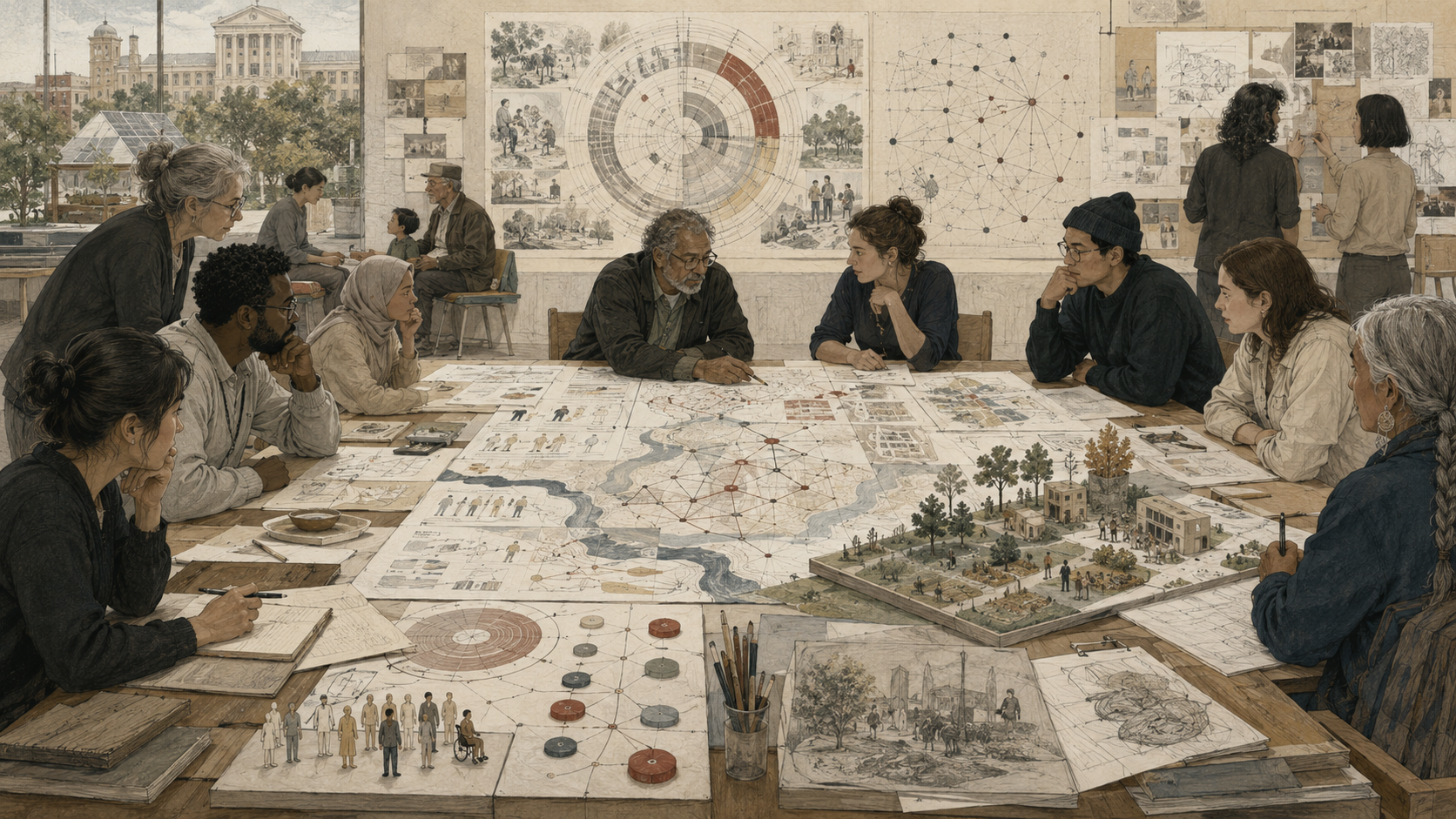
This does not mean abandoning the core practices of design thinking. Human-centered inquiry, problem framing, prototyping, testing, and iteration remain essential. But they must be expanded. Human-centered inquiry must become community-centered, institutionally literate, and power-aware. Prototyping must include policy, governance, data systems, service ecosystems, and AI safeguards. Testing must include equity, burden, trust, public value, and long-term consequences. Iteration must become organizational and institutional learning, not simply product refinement.
The future of design thinking is not one method. It is a convergence: human-centered design, systemic design, service design, participatory design, design justice, responsible AI, public-value evaluation, implementation science, organizational learning, sustainability, and governance. Its promise is not that design can solve every problem. Its promise is that design can help people and institutions ask better questions, see systems more clearly, test change more responsibly, include affected communities more meaningfully, and learn before harm becomes permanent.
The future of design thinking connects directly to what design thinking is, human-centered problem solving, problem framing, contextual inquiry and synthesis, co-design and participatory design, service design, design thinking and strategy, ethics, power, and inclusion, data systems and AI-assisted research, complex institutions, social impact and public value, public policy, and organizational innovation.
What the Future of Design Thinking Means
The future of design thinking is the movement from a general innovation method toward a more rigorous practice for responsible change in complex systems. It is not a rejection of the design-thinking tradition. It is an expansion of its purpose, scale, ethics, evidence base, and institutional responsibility.
In its familiar form, design thinking often begins with people’s needs, reframes problems, generates ideas, prototypes solutions, and tests them. In the future, that process will remain useful, but it will be insufficient unless it also asks: What system produces this problem? Who has power to define it? Who carries the burden? What evidence is missing? What institutions must change? What harms could be created? What must be governed? What must be maintained? What would responsible learning look like over time?
| Earlier design-thinking emphasis | Future design-thinking emphasis |
|---|---|
| Empathy for users | Community knowledge, lived experience, power, dignity, and structural context. |
| Problem statements | Problem framing across systems, institutions, history, incentives, and evidence. |
| Ideation | Portfolio design, scenario exploration, responsible experimentation, and constraint-aware strategy. |
| Prototyping | Prototyping services, policies, workflows, data systems, governance models, and AI safeguards. |
| Testing | Testing usability, equity, burden, trust, safety, accountability, and long-term consequences. |
| Implementation | Institutional absorption, operational capacity, stewardship, evaluation, and learning systems. |
| Innovation | Public value, sustainability, justice, institutional trust, and responsible systems change. |
This future is already visible in the way design is being asked to operate. Designers are working on climate adaptation, healthcare systems, public benefits, organizational transformation, AI-assisted research, civic services, learning platforms, digital infrastructure, community participation, and institutional change. These are not problems that can be solved by better brainstorming alone. They require design thinking to become more analytical, more ethical, more interdisciplinary, and more accountable.
The future of design thinking is therefore not “design thinking plus technology.” It is design thinking plus systems, evidence, governance, justice, and stewardship.
Why Design Thinking Must Change
Design thinking must change because the conditions around design have changed. The method became widely known in an era when organizations were seeking more creative, human-centered alternatives to top-down planning, technical product development, and rigid strategy processes. That need remains, but the stakes are higher now. Design decisions increasingly affect public systems, AI-mediated services, civic trust, ecological futures, health systems, educational access, labor conditions, and data infrastructures.
A workshop-centered approach can help people collaborate, but it cannot by itself govern AI risk. A user journey can reveal pain points, but it cannot by itself reform administrative burden. A prototype can test a concept, but it cannot by itself create implementation capacity. A persona can humanize a user group, but it can also flatten difference and erase power. A successful pilot can inspire, but it can also fail when scaled into a different institutional context.
| Pressure reshaping design thinking | Why it matters | Design implication |
|---|---|---|
| AI and automation | Design decisions now shape automated systems, decision support, research synthesis, and data interpretation. | Design must include governance, validation, transparency, bias review, and human judgment. |
| Climate and ecological limits | Design choices affect material systems, infrastructure, adaptation, biodiversity, and intergenerational responsibility. | Design must move beyond user desirability into planetary and long-term consequences. |
| Institutional distrust | People often encounter design through institutions they do not trust. | Design must address legitimacy, accountability, participation, and repair. |
| Social inequality | Design can reduce burden or shift it onto people with less power. | Design must include justice, accessibility, disaggregated evidence, and burden analysis. |
| Complex public problems | Many challenges cross agencies, sectors, systems, and communities. | Design must work through portfolios, partnerships, and systems learning. |
| Data-intensive services | Services now depend on records, platforms, analytics, classification, and interoperability. | Design must understand data quality, privacy, provenance, and institutional learning. |
| Implementation failure | Good ideas often fail because organizations cannot absorb them. | Design must include capability building, ownership, funding, governance, and maintenance. |
The future of design thinking requires humility. Design cannot replace law, politics, labor organizing, public investment, community power, democratic accountability, or scientific expertise. But it can help connect those domains to concrete human experience. It can help institutions learn from people affected by their decisions. It can make hidden burden visible. It can test change before scaling. It can translate complexity into actionable portfolios. It can support better forms of public learning.
Design thinking must change because it is being asked to operate where consequences are larger than customer experience.
From Workshops to Institutional Capability
One of the most important shifts in the future of design thinking is the move from workshops to capability. Workshops can be useful. They can bring people together, create shared language, visualize systems, generate ideas, and build momentum. But workshops are not transformation. They are moments inside a larger institutional process.
Design thinking becomes serious when organizations build the capability to research, frame, prototype, test, implement, evaluate, and learn continuously. That capability requires skilled people, evidence systems, governance pathways, decision rights, data infrastructure, facilitation methods, ethics review, implementation support, and leadership that can act on what design work reveals.
| Workshop-centered design | Capability-centered design |
|---|---|
| A short event produces ideas. | A sustained practice produces evidence, prototypes, decisions, and learning. |
| Participants map pain points. | The institution maps burden, authority, incentives, data systems, and implementation constraints. |
| Innovation is episodic. | Learning is embedded in routines, governance, and evaluation cycles. |
| Design depends on external facilitators. | Design capacity is distributed across teams, communities, and institutional roles. |
| Outputs are canvases, notes, and concepts. | Outputs include policies, service changes, workflows, prototypes, evidence logs, and decision records. |
| Success is energy and alignment. | Success is responsible implementation, public value, burden reduction, and institutional learning. |
Capability-centered design also changes how design work is funded and governed. Instead of treating design as a one-time engagement, institutions need design infrastructure: research repositories, insight-management systems, evaluation methods, data governance, accessibility review, participatory processes, implementation playbooks, and mechanisms for revisiting decisions after launch.
The future belongs to organizations that stop treating design thinking as a workshop format and start treating it as a learning system.
From Users to Publics, Communities, and Systems
The language of “users” helped design thinking move away from purely internal or technical views of innovation. It reminded organizations that real people encounter products, services, systems, and institutions. But the term “user” is not always sufficient. A person navigating healthcare, public benefits, education, housing, justice, climate adaptation, or workplace systems is not only a user. They may be a rights-holder, patient, resident, student, worker, caregiver, citizen, community member, or person affected by institutional power.
The future of design thinking must therefore use richer categories of human relationship. It must ask not only what a user wants to do, but what position a person occupies in a system. Does the person have choice? Are they required to participate? Can they exit? Can they appeal? Do they understand the rules? Are they being monitored? Are they being asked to disclose sensitive information? Are they carrying hidden burden? Do they have power to shape the design?
| Human role | Design concern |
|---|---|
| User | Usability, accessibility, clarity, support, and task completion. |
| Customer | Value, service quality, trust, choice, and experience. |
| Resident or citizen | Rights, public accountability, participation, legitimacy, and procedural fairness. |
| Patient | Care, safety, dignity, privacy, continuity, and clinical consequences. |
| Student | Learning, belonging, access, advising, assessment, and developmental support. |
| Worker | Labor, autonomy, workload, surveillance, safety, and professional judgment. |
| Community member | Collective memory, trust, place, culture, power, and shared outcomes. |
| Affected public | Indirect consequences, risk distribution, public value, and long-term stewardship. |
This shift also changes research. Future design research must combine interviews, contextual inquiry, surveys, analytics, administrative data, service blueprints, ethnography, participatory methods, archival memory, frontline knowledge, and community-defined evidence. It must look beyond active users to non-users, excluded groups, people who abandon processes, and people harmed by systems they never chose to use.
Design thinking began by reminding institutions to see people. Its future depends on seeing people in relation to power, place, history, systems, and responsibility.
Systemic Design and Complexity
Systemic design is likely to become one of the central directions for the future of design thinking. It extends design practice from individual products and services toward the relationships, feedback loops, incentives, behaviors, policies, infrastructures, and institutional patterns that produce outcomes. It recognizes that many problems cannot be solved by improving one touchpoint because the touchpoint is only the visible surface of a deeper system.
Systemic design does not mean trying to design an entire system from above. Complex systems resist complete control. The goal is not mastery. The goal is better intervention: identifying leverage points, understanding relationships, testing change carefully, learning across contexts, and creating conditions for adaptation.
| Design-thinking question | Systemic-design expansion |
|---|---|
| What do users need? | What system conditions shape people’s needs, choices, burdens, and opportunities? |
| How might we solve this problem? | How is this problem produced, reproduced, measured, governed, and maintained? |
| What prototype should we test? | Which intervention, at which leverage point, can be tested safely and learned from? |
| What did users prefer? | What changed in behavior, burden, trust, access, outcomes, and institutional capability? |
| How do we scale? | How do we adapt across contexts without erasing local conditions or multiplying harm? |
Future design thinking will use more systems maps, causal-loop diagrams, actor-network analysis, service ecosystems, evidence repositories, portfolio methods, scenario planning, and adaptive evaluation. But the tools are not the point. The point is to understand that human experience is shaped by interconnected systems.
The danger is that systemic design can become abstract, diagram-heavy, and disconnected from lived experience. The strongest future practice will connect systems thinking to grounded research, community authority, implementation reality, and ethical responsibility.
AI-Assisted Design and Human Judgment
Artificial intelligence will reshape design thinking, but it should not replace design judgment. AI can help summarize research, cluster themes, search repositories, generate alternative concepts, simulate scenarios, support accessibility review, analyze feedback, draft service scripts, translate materials, and compare design options. Used well, AI can expand the capacity of design teams to explore, synthesize, and document evidence.
Used poorly, AI can also flatten lived experience, reproduce bias, invent unsupported conclusions, obscure source evidence, accelerate shallow solutionism, create surveillance risks, and make design work appear more certain than it is. The future of design thinking must therefore treat AI as an assistive research and reasoning infrastructure, not as an authority over human experience.
| AI-assisted design use | Potential value | Required safeguard |
|---|---|---|
| Research synthesis | Summarizes large volumes of interviews, notes, service logs, and feedback. | Maintain source traceability, human review, minority-signal protection, and uncertainty notes. |
| Idea generation | Expands solution space and creates alternative design directions. | Check feasibility, ethics, context, accessibility, and local appropriateness. |
| Scenario modeling | Explores possible consequences across conditions or stakeholder groups. | Document assumptions and avoid treating simulations as predictions. |
| Accessibility support | Tests language, readability, channel fit, and assistive-technology considerations. | Validate with disabled users, accessibility experts, and real-world testing. |
| Public feedback analysis | Detects themes across open comments, surveys, or participatory input. | Prevent majority dominance, preserve dissent, and include community interpretation. |
| Service personalization | Adapts support pathways, information, or recommendations. | Govern privacy, consent, fairness, appeal, and human oversight. |
| Design documentation | Creates decision logs, research summaries, and implementation artifacts. | Separate evidence, interpretation, speculation, and AI-generated content. |
The future designer will need AI literacy, but not because design should become automated. Designers will need to know how AI systems are trained, how they fail, how bias appears, how hallucinations happen, how privacy can be compromised, how data provenance matters, and how human judgment remains necessary. The most important AI skill in future design thinking may be knowing when not to use AI.
AI can make design faster. The future of design thinking depends on making it wiser.
Data, Evidence, and Learning Infrastructure
Design thinking has often emphasized qualitative insight, visual synthesis, and rapid learning. Future design thinking will need stronger evidence infrastructure. As design work moves into public systems, AI-assisted research, institutional strategy, health, education, social impact, and sustainability, teams must be able to trace evidence, document assumptions, preserve context, measure outcomes, and learn over time.
This does not mean replacing qualitative understanding with dashboards. It means combining forms of evidence responsibly. Interviews show meaning and lived experience. Observations reveal behavior and context. Service data shows patterns and drop-off. Administrative data shows reach and outcomes. Surveys show distribution. Community knowledge reveals trust, history, and local context. Evaluation shows whether interventions work and for whom.
| Evidence need | Future design-thinking practice |
|---|---|
| Traceability | Link insights to research sources, participants, dates, methods, and limitations. |
| Disaggregation | Analyze outcomes and burden across groups, channels, places, and access needs. |
| Provenance | Document where data came from, how it was transformed, and what it cannot show. |
| Interpretation | Separate participant evidence, researcher interpretation, AI synthesis, and decision rationale. |
| Learning loops | Create review cycles that connect evidence to design changes, policy changes, and implementation. |
| Evaluation | Define baseline, outcome measures, stop criteria, pivot criteria, and scale criteria. |
| Repository design | Maintain research, prototypes, decisions, assumptions, risks, and results in reusable knowledge systems. |
Future design teams will increasingly need research operations, data governance, knowledge architecture, reproducible workflows, and evidence standards. This is especially important when AI tools are used to synthesize research or when design insights influence institutional decisions.
Design thinking has always been about learning. Its future requires learning systems that are transparent, accountable, and durable.
Ethics, Power, Justice, and Burden
The future of design thinking must be more honest about power. Design is not neutral. Design methods decide whose experiences are studied, whose voices are centered, whose problems are framed as legitimate, whose burdens are measured, whose risks are tolerated, whose futures are imagined, and whose participation is treated as optional.
Ethical design thinking must go beyond consent forms and inclusion language. It must examine power, burden, access, dignity, representation, extraction, accessibility, labor, privacy, safety, repair, and the politics of decision-making. It must ask whether participation changes outcomes or merely legitimizes decisions already made.
| Ethical question | Why it matters for the future |
|---|---|
| Who defines the problem? | Problem framing often reflects institutional power rather than lived reality. |
| Who participates? | Participation can exclude people with less time, access, language support, trust, or safety. |
| Who benefits? | Design can improve institutional efficiency while leaving affected people burdened. |
| Who carries risk? | Vulnerable groups may be exposed to experimental or under-governed interventions. |
| Who can object? | People affected by a design need channels for refusal, appeal, correction, and repair. |
| Who owns knowledge? | Research can extract stories and community knowledge without reciprocity or authority. |
| Who maintains the design? | Unmaintained designs can create harm after the project team leaves. |
The future of design thinking will need to learn from design justice, disability justice, participatory research, community organizing, public ethics, and critical data studies. It will need stronger practices for compensating participation, documenting influence, designing feedback loops, sharing authority, and measuring burden reduction.
The ethical future of design thinking is not simply more inclusive design. It is accountable design.
Climate, Planetary Responsibility, and Design for Repair
The future of design thinking must also confront ecological limits. Human-centered design is incomplete if it ignores the living systems that make human futures possible. Climate change, biodiversity loss, pollution, resource extraction, water stress, land use, infrastructure vulnerability, and environmental injustice require design thinking to become more ecological, more place-based, and more long-term.
Design for the future cannot only ask whether something is desirable, feasible, and viable. It must ask whether it is regenerative, repair-oriented, materially responsible, energy-aware, resilient, just, and compatible with ecological reality. A product, service, or system that is convenient but extractive is not a future-ready design.
| Traditional lens | Planetary design lens |
|---|---|
| User need | Human need within ecological systems and intergenerational responsibility. |
| Market viability | Material, social, environmental, and institutional sustainability. |
| Service efficiency | Resource use, emissions, resilience, maintenance, and environmental justice. |
| Rapid scaling | Appropriate scaling that accounts for place, capacity, and ecological consequences. |
| Innovation | Repair, adaptation, sufficiency, circularity, care, and responsible transition. |
Design thinking has tools that can help: participatory research, systems mapping, service redesign, prototyping, scenario exploration, and iterative learning. But those tools must be connected to science, local knowledge, environmental monitoring, policy, infrastructure, and stewardship. Climate adaptation, for example, is not only a technical problem. It is a design problem, a governance problem, a justice problem, and a long-term learning problem.
The future of design thinking must be capable of designing not only for people today, but for communities, ecosystems, and generations that inherit the consequences of present decisions.
Public Value, Governance, and Institutional Trust
As design thinking moves deeper into public services, civic institutions, AI systems, healthcare, education, sustainability, and social impact, governance becomes central. The question is no longer only whether a design works. It is whether the design is legitimate, accountable, transparent, equitable, maintainable, and capable of public learning.
Public value expands the standard of design success. A design may be usable but unfair. It may be efficient but unaccountable. It may be popular with current users but exclusionary toward non-users. It may produce measurable outcomes while increasing burden on frontline workers or marginalized communities. It may be technologically impressive but publicly illegible.
| Public-value criterion | Future design-thinking question |
|---|---|
| Legitimacy | Can people understand why the design exists and how decisions are made? |
| Accountability | Can errors be challenged, corrected, and repaired? |
| Transparency | Are rules, evidence, assumptions, and trade-offs visible? |
| Equity | Are benefits and burdens distributed fairly across groups? |
| Trust | Does the design repair or deepen institutional trust? |
| Participation | Do affected communities influence framing, design, evaluation, and governance? |
| Stewardship | Can the design be maintained, monitored, improved, and retired responsibly? |
Future design thinking must therefore work with governance: decision rights, review bodies, accountability channels, risk registers, data stewardship, community participation, maintenance ownership, public reporting, and escalation pathways. Without governance, design thinking can generate compelling prototypes that institutions cannot responsibly sustain.
The future of design thinking is inseparable from the future of institutional trust.
Design Education and Professional Practice
Design education will need to change if design thinking is to meet future demands. Students and practitioners need more than creative confidence and facilitation skills. They need systems literacy, research methods, data literacy, AI literacy, accessibility, ethics, public-value reasoning, organizational change, implementation planning, and evaluation.
The future design thinker may work less like a workshop facilitator and more like an interdisciplinary translator. They will need to move between lived experience and institutional structure, qualitative research and quantitative evidence, service design and policy, AI tools and human judgment, strategy and implementation, ethics and operations, systems maps and frontline realities.
| Future educational area | Why it matters |
|---|---|
| Research methods | Designers must know how to gather, interpret, validate, and document evidence. |
| Systems thinking | Complex problems require attention to relationships, feedback, incentives, and leverage points. |
| Data literacy | Design increasingly depends on analytics, administrative data, research repositories, and evaluation. |
| AI literacy | AI-assisted research and design require governance, validation, and critical judgment. |
| Ethics and justice | Design decisions distribute power, burden, visibility, risk, and benefit. |
| Governance | Design work must connect to decision rights, accountability, implementation, and public trust. |
| Implementation | Designers must understand how ideas become durable practice inside organizations and institutions. |
| Evaluation | Design teams must know whether interventions work, for whom, and with what unintended consequences. |
Professional practice will also need to become more collaborative. Future design thinking will require partnerships with domain experts, community leaders, data scientists, policy experts, engineers, lawyers, accessibility specialists, public servants, educators, clinicians, ecologists, organizational psychologists, and evaluation researchers.
The next generation of design thinking will be less proprietary and more interdisciplinary. Its credibility will depend not on owning a method, but on connecting methods responsibly.
Future Skills for Design Thinkers
Future design thinkers will need a broader skill set than the conventional design-thinking toolkit. Empathy, facilitation, synthesis, ideation, prototyping, and storytelling remain important, but they must be joined by deeper technical, ethical, organizational, and analytical capabilities.
| Future skill | What it enables |
|---|---|
| Systems diagnosis | Understanding how policies, incentives, infrastructures, relationships, and feedback loops produce outcomes. |
| Power analysis | Identifying who defines problems, who decides, who benefits, and who carries burden. |
| Evidence synthesis | Combining qualitative research, quantitative data, community knowledge, and evaluation findings. |
| AI governance literacy | Using AI-assisted design responsibly with source traceability, bias review, and human oversight. |
| Service and policy literacy | Connecting human experience to rules, workflows, delivery systems, and institutional constraints. |
| Participatory practice | Designing processes where affected people influence framing, interpretation, and decisions. |
| Implementation planning | Translating prototypes into ownership, staffing, funding, training, maintenance, and governance. |
| Evaluation design | Measuring access, burden, equity, trust, outcomes, and unintended consequences. |
| Stewardship | Maintaining, adapting, retiring, or repairing designs over time. |
These skills change the identity of design thinking. The future practitioner is not only a creative facilitator. They are a researcher, translator, systems learner, ethical reviewer, implementation partner, and steward of consequences.
That is a more demanding role, but also a more meaningful one.
Risks and Failure Modes
The future of design thinking is not automatically positive. As design thinking expands into systems, AI, public services, and social impact, it can also become more dangerous if practiced superficially. The method’s language can be used to make organizations appear human-centered without changing power. AI can accelerate weak research. Participation can become symbolic. Systems maps can become abstractions. Public-value language can become branding. Innovation can become a substitute for accountability.
| Future failure mode | How it appears | Safeguard |
|---|---|---|
| AI-accelerated superficiality | Teams generate insights, personas, and concepts quickly without grounded evidence. | Require source traceability, human review, validation, and participant interpretation. |
| Systems theater | Complex diagrams create the appearance of sophistication without changing decisions. | Connect systems maps to intervention portfolios, ownership, evaluation, and governance. |
| Participation washing | Affected communities are consulted but not given influence. | Name participation level, document influence, compensate labor, and share authority where possible. |
| Innovation capture | Design methods serve institutional reputation more than public value. | Use independent evaluation, public reporting, and community accountability. |
| Metric capture | Teams optimize what is measurable while ignoring dignity, trust, burden, or exclusion. | Use mixed methods, disaggregated evidence, and community-defined value. |
| Prototype harm | High-stakes systems are tested on vulnerable people without safeguards. | Use ethics review, consent, monitoring, stop criteria, and repair pathways. |
| Implementation collapse | Good ideas fail because ownership, funding, staffing, or maintenance is missing. | Assess institutional absorption before scaling. |
| Design solutionism | Structural problems are reframed as creativity problems. | Name law, power, funding, politics, rights, and structural conditions explicitly. |
The future of design thinking will be judged by whether it can avoid these failures. The field will need stronger standards of evidence, ethics, governance, and accountability. It will need to become less enchanted with process and more serious about consequence.
The greatest risk is not that design thinking becomes obsolete. It is that design thinking remains popular while becoming shallow.
Cross-Pillar Connections
The future of design thinking is deeply connected to other knowledge domains. Artificial intelligence systems will shape how research is synthesized, how services are personalized, how decisions are supported, and how risk is governed. Institutions and governance will determine whether design work can become legitimate, accountable, and durable. Stewardship and ethics will provide the language of responsibility, dignity, justice, and care.
Data systems and analytics will support evidence infrastructure, evaluation, and learning. Risk and resilience will help design teams anticipate failure, adaptation, and recovery. Sustainable development will connect design to poverty, health, education, climate, equity, and intergenerational wellbeing. Organizational psychology will explain culture, resistance, leadership, motivation, and implementation. Public policy will connect design to law, rules, administrative burden, and collective decision-making.
| Related field | Contribution to the future of design thinking |
|---|---|
| Artificial Intelligence Systems | Responsible AI, research synthesis, decision support, human oversight, bias review, and governance. |
| Data Systems & Analytics | Evidence infrastructure, measurement, repositories, dashboards, evaluation, and learning systems. |
| Institutions & Governance | Legitimacy, accountability, decision rights, public trust, policy, and institutional authority. |
| Stewardship & Ethics | Responsibility, dignity, justice, care, repair, and intergenerational obligation. |
| Risk & Resilience | Failure modes, stress testing, adaptation, recovery, uncertainty, and system renewal. |
| Sustainable Development | Human wellbeing, ecological constraint, public value, equity, resilience, and long-term futures. |
| Organizational Psychology | Culture, motivation, leadership, resistance, teams, learning, and change behavior. |
| Public Policy | Rules, rights, administrative burden, implementation, public value, and accountability. |
The future of design thinking will be interdisciplinary or it will be inadequate. The method’s strength is not that it replaces other disciplines. Its strength is that it can connect them around human consequences, systems learning, and responsible action.
Mathematical Lens: Modeling Future Design Readiness
Future design readiness can be modeled as a weighted relationship among human-centered strength, systems literacy, evidence quality, ethical maturity, AI governance, implementation capacity, public value, stewardship capacity, and risk:
FDR_i = w_hH_i + w_sS_i + w_eE_i + w_mM_i + w_aA_i + w_cC_i + w_pP_i + w_tT_i – w_rR_i
\]
Interpretation: Future design readiness for initiative \(i\) increases with human-centered quality, systems literacy, evidence quality, ethical maturity, AI governance, implementation capacity, public value, and stewardship capacity, but decreases with unmanaged risk.
AI-assisted design maturity can be modeled separately:
AIM_i = \alpha G_i + \beta V_i + \gamma Q_i + \delta P_i + \theta O_i – \lambda U_i
\]
Interpretation: AI-assisted design maturity increases with governance, validation, data quality, provenance, and oversight, while decreasing with uncertainty or unmanaged model risk.
Stewardship readiness can be represented as:
SR_i = \eta O_i + \kappa F_i + \mu M_i + \rho L_i + \sigma R_i
\]
Interpretation: Stewardship readiness depends on ownership, funding, maintenance, learning routines, and repair pathways.
These models are not intended to automate design decisions. They help teams make assumptions visible. A future design-thinking initiative may be highly desirable but weak in governance, rich in data but poor in community authority, strong in AI capability but weak in validation, or promising in prototype form but fragile in stewardship.
R Workflow: Future Design-Thinking Portfolio Analysis
The R workflow below models future design-thinking initiatives using human-centered quality, systems literacy, evidence quality, ethics, AI governance, implementation capacity, public value, stewardship, and risk. It is a decision-support example rather than an automated ranking system.
# Install packages if needed.
# install.packages(c("tidyverse", "scales"))

library(tidyverse)
library(scales)

future_options <- tibble(
  initiative = c(
    "AI-assisted research repository",
    "Community-led systems design lab",
    "Public value evaluation framework",
    "Climate resilience service portfolio",
    "Design governance and ethics board",
    "Institutional learning infrastructure",
    "Participatory AI service prototype",
    "Stewardship and repair playbook"
  ),
  human_centered_quality = c(7.6, 9.0, 7.8, 8.2, 7.6, 7.4, 7.8, 8.4),
  systems_literacy = c(7.4, 8.8, 8.0, 9.0, 7.8, 8.4, 7.6, 8.2),
  evidence_quality = c(8.6, 7.8, 8.8, 8.0, 7.6, 9.0, 7.4, 7.8),
  ethical_maturity = c(7.4, 9.0, 8.2, 8.4, 9.2, 7.8, 7.2, 8.8),
  ai_governance = c(8.4, 6.8, 6.6, 6.2, 7.8, 7.2, 8.0, 6.4),
  implementation_capacity = c(7.2, 6.4, 7.8, 6.8, 7.0, 7.6, 6.2, 7.4),
  public_value = c(7.8, 9.2, 8.8, 9.0, 8.4, 8.2, 7.6, 8.8),
  stewardship_capacity = c(7.0, 7.2, 8.0, 7.4, 8.0, 8.2, 6.4, 8.8),
  unmanaged_risk = c(6.2, 5.4, 4.8, 5.8, 4.6, 5.0, 7.2, 4.4)
)

scores <- future_options %>%
  mutate(
    future_design_readiness =
      0.13 * human_centered_quality +
      0.14 * systems_literacy +
      0.13 * evidence_quality +
      0.14 * ethical_maturity +
      0.11 * ai_governance +
      0.11 * implementation_capacity +
      0.14 * public_value +
      0.10 * stewardship_capacity -
      0.10 * unmanaged_risk,
    stewardship_need =
      0.30 * unmanaged_risk +
      0.20 * (10 - stewardship_capacity) +
      0.18 * (10 - implementation_capacity) +
      0.14 * (10 - ethical_maturity) +
      0.10 * (10 - evidence_quality) +
      0.08 * (10 - systems_literacy),
    portfolio_priority =
      0.42 * future_design_readiness +
      0.22 * public_value +
      0.16 * ethical_maturity +
      0.12 * systems_literacy -
      0.08 * stewardship_need,
    recommended_action = case_when(
      future_design_readiness >= 7.8 & stewardship_need <= 4.6 ~ "advance_with_governed_pilot",
      future_design_readiness >= 7.8 & stewardship_need > 4.6 ~ "strengthen_stewardship_before_scale",
      ai_governance < 7.0 & str_detect(initiative, "AI") ~ "ai_governance_required_before_pilot",
      ethical_maturity < 7.5 ~ "ethics_and_power_review_required",
      implementation_capacity < 6.8 ~ "build_absorption_capacity",
      TRUE ~ "develop_with_learning_metrics"
    )
  ) %>%
  arrange(desc(portfolio_priority))

print(scores)

portfolio_summary <- scores %>%
  group_by(recommended_action) %>%
  summarize(
    initiatives = n(),
    mean_readiness = mean(future_design_readiness),
    mean_public_value = mean(public_value),
    mean_stewardship_need = mean(stewardship_need),
    .groups = "drop"
  ) %>%
  arrange(desc(mean_public_value))

print(portfolio_summary)

ggplot(scores, aes(x = stewardship_need, y = future_design_readiness, size = public_value, label = initiative)) +
  geom_point(alpha = 0.75) +
  geom_text(check_overlap = TRUE, vjust = -0.8, size = 3) +
  labs(
    title = "Future Design-Thinking Portfolio: Readiness vs Stewardship Need",
    x = "Stewardship need",
    y = "Future design readiness",
    size = "Public value"
  ) +
  theme_minimal(base_size = 12)

write_csv(scores, "future_design_thinking_scores.csv")
write_csv(portfolio_summary, "future_design_thinking_portfolio_summary.csv")
This workflow helps teams compare future-facing design initiatives without reducing judgment to a single score. A strong future design-thinking portfolio should balance public value, ethical maturity, systems literacy, evidence quality, AI governance, implementation capacity, and stewardship.
Python Workflow: Scenario Simulation for the Future of Design Thinking
The Python workflow below simulates uncertainty across a future design-thinking portfolio. It estimates which initiatives remain strong when assumptions about systems literacy, evidence quality, ethical maturity, AI governance, public value, implementation capacity, stewardship, and unmanaged risk vary.
# Install packages if needed:
# pip install pandas numpy matplotlib scipy

import numpy as np
import pandas as pd
import matplotlib.pyplot as plt

options = pd.DataFrame({
    "initiative": [
        "AI-assisted research repository",
        "Community-led systems design lab",
        "Public value evaluation framework",
        "Climate resilience service portfolio",
        "Design governance and ethics board",
        "Institutional learning infrastructure",
        "Participatory AI service prototype",
        "Stewardship and repair playbook"
    ],
    "human_centered_quality": [7.6, 9.0, 7.8, 8.2, 7.6, 7.4, 7.8, 8.4],
    "systems_literacy": [7.4, 8.8, 8.0, 9.0, 7.8, 8.4, 7.6, 8.2],
    "evidence_quality": [8.6, 7.8, 8.8, 8.0, 7.6, 9.0, 7.4, 7.8],
    "ethical_maturity": [7.4, 9.0, 8.2, 8.4, 9.2, 7.8, 7.2, 8.8],
    "ai_governance": [8.4, 6.8, 6.6, 6.2, 7.8, 7.2, 8.0, 6.4],
    "implementation_capacity": [7.2, 6.4, 7.8, 6.8, 7.0, 7.6, 6.2, 7.4],
    "public_value": [7.8, 9.2, 8.8, 9.0, 8.4, 8.2, 7.6, 8.8],
    "stewardship_capacity": [7.0, 7.2, 8.0, 7.4, 8.0, 8.2, 6.4, 8.8],
    "unmanaged_risk": [6.2, 5.4, 4.8, 5.8, 4.6, 5.0, 7.2, 4.4]
})

def score_options(df):
    result = df.copy()

    result["future_design_readiness"] = (
        0.13 * result["human_centered_quality"] +
        0.14 * result["systems_literacy"] +
        0.13 * result["evidence_quality"] +
        0.14 * result["ethical_maturity"] +
        0.11 * result["ai_governance"] +
        0.11 * result["implementation_capacity"] +
        0.14 * result["public_value"] +
        0.10 * result["stewardship_capacity"] -
        0.10 * result["unmanaged_risk"]
    )

    result["stewardship_need"] = (
        0.30 * result["unmanaged_risk"] +
        0.20 * (10 - result["stewardship_capacity"]) +
        0.18 * (10 - result["implementation_capacity"]) +
        0.14 * (10 - result["ethical_maturity"]) +
        0.10 * (10 - result["evidence_quality"]) +
        0.08 * (10 - result["systems_literacy"])
    )

    result["portfolio_priority"] = (
        0.42 * result["future_design_readiness"] +
        0.22 * result["public_value"] +
        0.16 * result["ethical_maturity"] +
        0.12 * result["systems_literacy"] -
        0.08 * result["stewardship_need"]
    )

    result["recommended_action"] = np.select(
        [
            (result["future_design_readiness"] >= 7.8) & (result["stewardship_need"] <= 4.6), (result["future_design_readiness"] >= 7.8) & (result["stewardship_need"] > 4.6),
            (result["ai_governance"] < 7.0) & result["initiative"].str.contains("AI"),
            result["ethical_maturity"] < 7.5,
            result["implementation_capacity"] < 6.8
        ],
        [
            "advance_with_governed_pilot",
            "strengthen_stewardship_before_scale",
            "ai_governance_required_before_pilot",
            "ethics_and_power_review_required",
            "build_absorption_capacity"
        ],
        default="develop_with_learning_metrics"
    )

    return result.sort_values("portfolio_priority", ascending=False)

baseline = score_options(options)
print("Baseline future design-thinking portfolio scores:")
print(baseline)

np.random.seed(42)
n_simulations = 10000
score_columns = [
    "human_centered_quality",
    "systems_literacy",
    "evidence_quality",
    "ethical_maturity",
    "ai_governance",
    "implementation_capacity",
    "public_value",
    "stewardship_capacity",
    "unmanaged_risk"
]

records = []
top_initiatives = []

for simulation_id in range(n_simulations):
    simulated = options.copy()

    for col in score_columns:
        simulated[col] = np.random.normal(
            loc=options[col],
            scale=0.55
        ).clip(1, 10)

    scored = score_options(simulated).reset_index(drop=True)
    top_initiatives.append(scored.iloc[0]["initiative"])

    for rank, row in scored.iterrows():
        records.append({
            "simulation_id": simulation_id,
            "initiative": row["initiative"],
            "future_design_readiness": row["future_design_readiness"],
            "stewardship_need": row["stewardship_need"],
            "portfolio_priority": row["portfolio_priority"],
            "recommended_action": row["recommended_action"],
            "rank": rank + 1
        })

simulation_df = pd.DataFrame(records)

winners = (
    pd.Series(top_initiatives)
    .value_counts(normalize=True)
    .rename("probability_top_initiative")
    .reset_index()
)

winners.columns = ["initiative", "probability_top_initiative"]
winners["probability_top_initiative"] *= 100

stability = (
    simulation_df
    .groupby("initiative")
    .agg(
        mean_readiness=("future_design_readiness", "mean"),
        mean_stewardship_need=("stewardship_need", "mean"),
        mean_priority=("portfolio_priority", "mean"),
        sd_priority=("portfolio_priority", "std"),
        median_rank=("rank", "median"),
        mean_rank=("rank", "mean"),
        best_rank=("rank", "min"),
        worst_rank=("rank", "max")
    )
    .reset_index()
    .sort_values(["median_rank", "mean_rank"])
)

print("\nProbability each initiative ranks first:")
print(winners)

print("\nPortfolio stability:")
print(stability)

plt.figure(figsize=(10, 6))
plt.bar(winners["initiative"], winners["probability_top_initiative"])
plt.xticks(rotation=25, ha="right")
plt.ylabel("Probability of ranking first (%)")
plt.title("Future Design-Thinking Portfolio Stability Under Uncertainty")
plt.tight_layout()
plt.show()

baseline.to_csv("future_design_thinking_baseline_scores.csv", index=False)
winners.to_csv("future_design_thinking_portfolio_winners.csv", index=False)
stability.to_csv("future_design_thinking_portfolio_stability.csv", index=False)
simulation_df.to_csv("future_design_thinking_simulation_records.csv", index=False)
This workflow helps teams avoid overconfidence. Future-facing design work involves uncertainty, competing values, institutional constraints, and emerging technologies. Simulation can reveal which initiatives are robust, which depend on optimistic assumptions, and which require stronger governance before moving forward.
GitHub Repository
The companion repository will provide a reproducible technical workspace for exploring the modeling, simulation, documentation, and implementation ideas associated with this article. The article folder is organized for multi-language future design-thinking, systemic design, AI-assisted research, ethics, public value, evidence, stewardship, and portfolio-analysis workflows and includes folders for Python, R, Julia, C++, Fortran, C, Rust, Go, SQL, notebooks, documentation, raw data, processed data, and outputs.
Complete Code Repository
This repository folder contains companion materials for modeling future design readiness, systems literacy, evidence quality, ethical maturity, AI governance, implementation capacity, public value, stewardship capacity, unmanaged risk, and portfolio uncertainty across multiple technical environments.
The repository structure is designed to support reproducible future-oriented design analysis rather than isolated code examples. The language-specific folders allow the same future-readiness, public-value, AI-governance, stewardship, risk, and portfolio-priority logic to be explored across statistical, scientific, systems, and database workflows. The documentation and data folders help preserve assumptions, model logic, governance criteria, evidence definitions, risk registers, and validation protocols so future design-thinking judgments remain transparent and reviewable.
| Folder | Purpose |
|---|---|
python/ |
Future design-readiness scoring, uncertainty simulation, AI-governance review, stewardship analysis, and portfolio diagnostics. |
r/ |
Future design-thinking portfolio analysis, visualization, public-value scoring, and readiness reporting. |
julia/ |
Numerical modeling and high-performance simulation for future design scenarios. |
cpp/, c/, rust/, go/ |
Systems-oriented command-line scoring tools, validation utilities, and reproducible implementation components. |
fortran/ |
Scientific-computing examples for numerical readiness and scenario modeling. |
sql/ |
Schemas for initiatives, readiness criteria, AI governance, stewardship, risk, and analytical queries. |
notebooks/ |
Exploratory analysis, teaching materials, design-futures demonstrations, and portfolio review workflows. |
docs/ |
Method notes, model cards, data dictionaries, AI governance protocol, ethics review, stewardship guidance, and reproducibility documentation. |
data/raw/ |
Original or synthetic source data used for future design-thinking examples. |
data/processed/ |
Cleaned, transformed, model-ready, or scored future design-readiness data outputs. |
outputs/ |
Generated figures, tables, reports, uncertainty results, portfolio diagnostics, and model outputs. |
Conclusion
The future of design thinking depends on whether it can grow beyond its most familiar forms. The method’s legacy is valuable: it helped organizations take human experience seriously, reframe problems, prototype possibilities, and learn through iteration. But the next generation of challenges demands more. Design thinking must now work with systems, AI, institutions, governance, ethics, evidence, sustainability, public value, and long-term stewardship.
This future is not about making design thinking more complicated for its own sake. It is about making design thinking responsible enough for the problems it now touches. When design affects public services, health systems, education, climate adaptation, AI-mediated decisions, institutional trust, community participation, and social impact, the stakes are too high for shallow empathy, performative participation, rapid prototyping without safeguards, or innovation language without accountability.
The strongest future design thinking will remain human-centered, but it will no longer treat human experience as isolated from systems. It will be participatory, but honest about power. It will use AI, but keep human judgment and governance central. It will rely on evidence, but not reduce public value to metrics. It will prototype, but with ethics and repair. It will scale, but only with stewardship and context. It will innovate, but not confuse novelty with progress.
Design thinking’s future is not guaranteed. It can become a shallow management ritual, an AI-accelerated content machine, or an innovation brand detached from consequence. Or it can become a serious civic, institutional, ecological, and ethical practice for learning how to change systems responsibly.
The path forward is clear: less theater, more evidence; less extraction, more participation; less solutionism, more systems learning; less speed without accountability, more stewardship; less design as performance, more design as responsibility.
Related articles
- What Is Design Thinking?
- Human-Centered Problem Solving
- Empathy and Stakeholder Research in Design Thinking
- Problem Framing in Design Thinking
- Design Research Methods: Contextual Inquiry and Synthesis
- Co-Design and Participatory Design
- Service Design in Design Thinking
- Design Thinking and Strategy
- Ethics, Power, and Inclusion in Design Thinking
- Design Thinking, Data Systems, and AI-Assisted Research
- Design Thinking for Complex Institutions
- Design Thinking for Social Impact and Public Value
- Design Thinking in Public Policy
- Design Thinking and Organizational Innovation
- Design Evaluation, Learning, and Outcome Measurement
Further reading
- Costanza-Chock, S. (2020) Design Justice: Community-Led Practices to Build the Worlds We Need. Cambridge, MA: MIT Press. Available at: https://designjustice.mitpress.mit.edu/.
- Design Council (n.d.) Systemic Design Framework. Available at: https://www.designcouncil.org.uk/our-resources/systemic-design-framework/.
- Design Council (n.d.) The Design Value Framework. Available at: https://www.designcouncil.org.uk/our-resources/the-design-value-framework/.
- Design Justice Network (n.d.) Design Justice Network Principles. Available at: https://designjustice.org/read-the-principles.
- Meadows, D.H. (1999) Leverage Points: Places to Intervene in a System. Available at: https://donellameadows.org/archives/leverage-points-places-to-intervene-in-a-system/.
- National Institute of Standards and Technology (2023) Artificial Intelligence Risk Management Framework (AI RMF 1.0). Available at: https://www.nist.gov/itl/ai-risk-management-framework.
- Nesta (2020) Using Collective Intelligence to Solve Public Problems. Available at: https://www.nesta.org.uk/report/using-collective-intelligence-solve-public-problems/.
- OECD (2017) Systems Approaches to Public Sector Challenges: Working with Change. Paris: OECD Publishing. Available at: https://www.oecd.org/en/publications/systems-approaches-to-public-sector-challenges_9789264279865-en.html.
- OECD Observatory of Public Sector Innovation (n.d.) Innovation Portfolios. Available at: https://oecd-opsi.org/work-areas/innovation-portfolios/.
- OECD Observatory of Public Sector Innovation (n.d.) Service Design. Available at: https://oecd-opsi.org/guide/service-design/.
References
- Costanza-Chock, S. (2020) Design Justice: Community-Led Practices to Build the Worlds We Need. Cambridge, MA: MIT Press. Available at: https://designjustice.mitpress.mit.edu/.
- Design Council (n.d.) Systemic Design Framework. Available at: https://www.designcouncil.org.uk/our-resources/systemic-design-framework/.
- Design Council (n.d.) The Design Value Framework. Available at: https://www.designcouncil.org.uk/our-resources/the-design-value-framework/.
- Design Justice Network (n.d.) Design Justice Network Principles. Available at: https://designjustice.org/read-the-principles.
- Meadows, D.H. (1999) Leverage Points: Places to Intervene in a System. Available at: https://donellameadows.org/archives/leverage-points-places-to-intervene-in-a-system/.
- National Institute of Standards and Technology (2023) Artificial Intelligence Risk Management Framework (AI RMF 1.0). Available at: https://www.nist.gov/itl/ai-risk-management-framework.
- Nesta (2020) Using Collective Intelligence to Solve Public Problems. Available at: https://www.nesta.org.uk/report/using-collective-intelligence-solve-public-problems/.
- OECD (2017) Systems Approaches to Public Sector Challenges: Working with Change. Paris: OECD Publishing. Available at: https://www.oecd.org/en/publications/systems-approaches-to-public-sector-challenges_9789264279865-en.html.
- OECD (2019) Public Value in Public Service Transformation. Available at: https://www.oecd.org/en/publications/public-value-in-public-service-transformation_47c17892-en.html.
- OECD Observatory of Public Sector Innovation (n.d.) Innovation Portfolios. Available at: https://oecd-opsi.org/work-areas/innovation-portfolios/.
- OECD Observatory of Public Sector Innovation (n.d.) Service Design. Available at: https://oecd-opsi.org/guide/service-design/.
- UNDP Global Centre for Public Service Excellence (2014) Design Thinking for Public Service Excellence. Available at: https://www.undp.org/publications/designthinking-public-service-excellence.