
Last Updated May 10, 2026
AI ethics, human rights, and public accountability concern the conditions under which artificial intelligence systems can be designed, deployed, governed, challenged, and corrected in ways that protect human dignity, equality, autonomy, democratic legitimacy, and public trust. AI systems do not merely process data. They increasingly shape access to work, education, healthcare, housing, credit, public benefits, policing, migration, speech, cultural visibility, administrative burden, environmental protection, and institutional decision-making. When these systems are used by states, platforms, employers, schools, hospitals, banks, insurers, courts, or infrastructure operators, their ethical consequences become public consequences.
Ethics is often treated as a soft supplement to technical design, but in AI systems it is a structural requirement. A model can be accurate and still be unjust. A system can be efficient and still violate dignity. A workflow can be automated and still evade accountability. Human rights give AI ethics a stronger public language because they connect technical systems to recognized claims: nondiscrimination, privacy, due process, freedom of expression, access to remedy, bodily integrity, labor rights, democratic participation, and protection from arbitrary or unequal power.
Public accountability matters because AI systems often operate through institutions that already possess power. A public agency, hospital, university, employer, insurer, platform, or bank does not merely “use” an AI tool. It uses that tool within a field of authority, dependence, expectation, and consequence. A person denied housing, flagged for fraud review, ranked lower in search, misclassified by a health-risk model, or routed into administrative delay may experience the system not as innovation but as institutional power made harder to see.
Main Library
Publications
Article Map
Artificial Intelligence Systems
Related Topic
Institutions & Governance
Related Topic
Data Systems & Analytics
Related Topic
Risk & Resilience
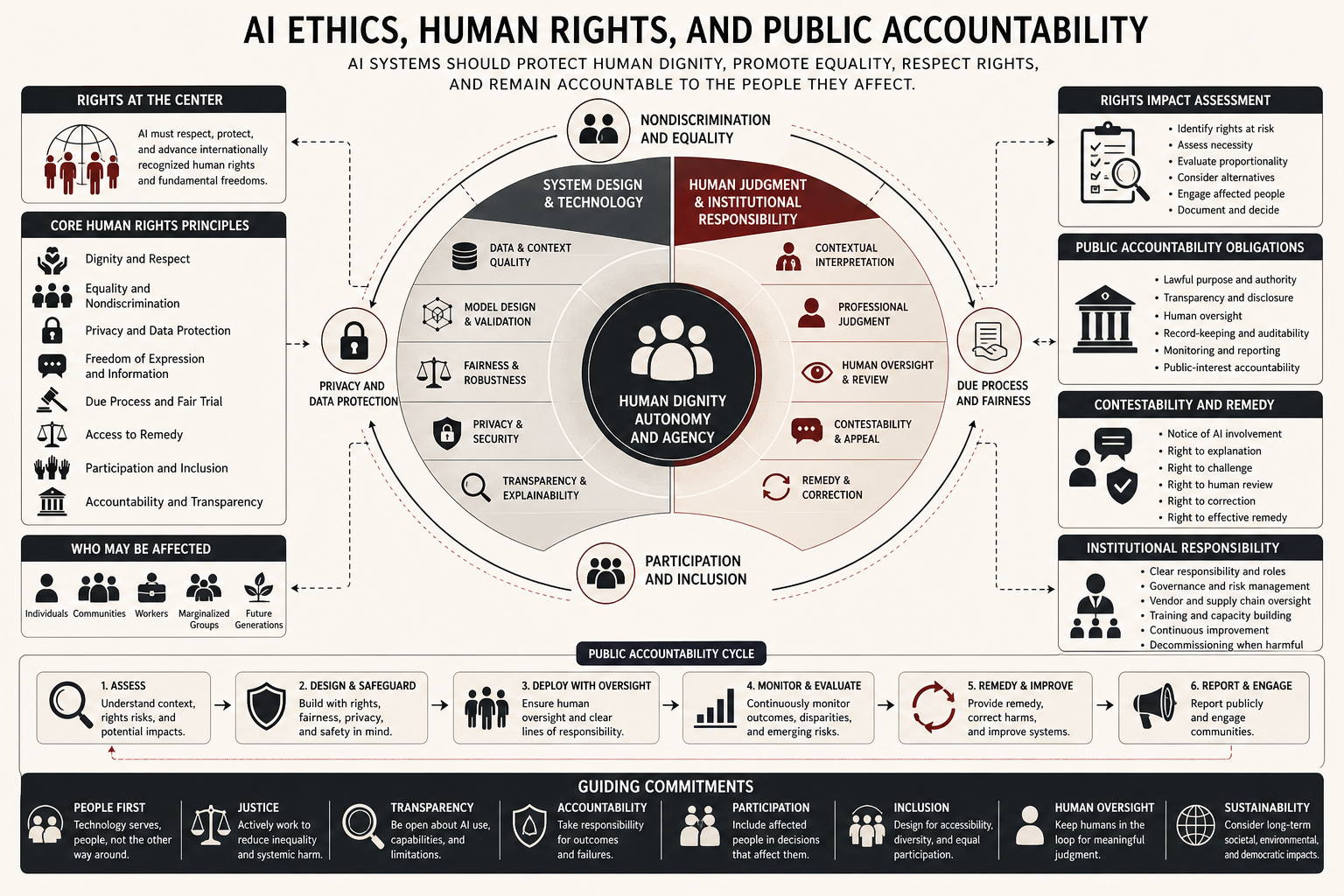
This article develops AI Ethics, Human Rights, and Public Accountability as an advanced article within the Artificial Intelligence Systems knowledge series. It explains rights-based AI governance, human dignity, autonomy, nondiscrimination, privacy, due process, public-sector accountability, impact assessment, transparency, contestability, remedy, stakeholder participation, auditability, democratic oversight, institutional responsibility, and structural inequality. Selected Python and R examples appear here, while the full GitHub repository contains expanded computational scaffolding for rights-impact scoring, accountability monitoring, SQL governance schemas, public-interest documentation, audit templates, and reproducible notebooks.
Why AI Ethics Matters
AI ethics matters because AI systems increasingly mediate power. They decide what information is visible, which cases are prioritized, whose risk is scored, whose speech is amplified, whose application is flagged, whose benefits are delayed, whose medical needs are predicted, whose neighborhood is surveilled, and whose labor is measured. These are not merely technical outputs. They are social decisions encoded into computational workflows.
The ethical problem is intensified when AI systems are presented as objective. Statistical models can inherit the inequalities of the societies that produce their data. A system trained on historical patterns may reproduce exclusion while appearing neutral. A scoring model may intensify administrative burden for already marginalized communities. A risk model may treat poverty, geography, disability, immigration status, race, gender, language, age, or social vulnerability as indirect signals, even when explicit protected attributes are removed.
AI ethics therefore cannot be reduced to abstract principles. It must examine who benefits, who is burdened, who is watched, who is excluded, who can appeal, who bears error, who controls the system, and who is publicly accountable. Rights-based AI governance insists that affected people are not merely data subjects, users, applicants, patients, students, workers, or consumers. They are rights-bearing persons.
Ethics also matters because AI systems can normalize institutional decisions that would otherwise invite scrutiny. A human decision-maker who denies a service, flags a household, screens out a candidate, or prioritizes one community over another may be expected to provide reasons. When the same decision is mediated by a model, dashboard, ranking system, or workflow automation, the reasons may become less visible. Ethical governance restores the basic demand that consequential power must be explainable, reviewable, and accountable.
The most important ethical question is not whether an AI system has good intentions behind it. The more serious question is whether the system preserves dignity, fairness, autonomy, participation, and remedy when deployed into real institutions.
Foundations of Rights-Based AI Governance
Rights-based AI governance begins from the premise that AI systems must be evaluated against human dignity, equality, freedom, privacy, due process, participation, and remedy. These standards are not optional add-ons. They are public constraints on the use of technical power.
Ethics_{\mathrm{AI}} \neq Performance_{\mathrm{AI}}
\]
Interpretation: AI ethics cannot be reduced to benchmark performance. It includes rights, dignity, fairness, accountability, participation, and remedy.
Rights-based governance shifts the question from “Can the system work?” to “Should the system be used in this context, under what conditions, with what safeguards, and with what accountability?” This is especially important in public-sector and high-impact settings, where AI may affect welfare, liberty, healthcare, education, housing, employment, migration, policing, or democratic participation.
A rights-based approach requires several commitments:
- Legitimate purpose: the system should serve a clearly defined and lawful public or institutional purpose.
- Necessity: AI should be used only where it is genuinely needed and appropriate.
- Proportionality: the system’s risks and burdens should not exceed its legitimate benefits.
- Nondiscrimination: the system should not produce unjustified disparate harm.
- Transparency: affected people should know when AI materially shapes decisions.
- Contestability: people should be able to challenge decisions and correct errors.
- Remedy: valid harms should produce correction, redress, and system change.
- Public accountability: institutions should be answerable for design, deployment, outcomes, and failures.
Rights-based governance does not reject technical evaluation. It places technical evaluation inside a broader public framework. Accuracy, calibration, robustness, explainability, and security matter because they affect people. But they do not settle the ethical question alone. A technically strong system may still be inappropriate if it expands surveillance, weakens due process, concentrates power, or imposes disproportionate burden on vulnerable people.
AI Ethics as a Rights Framework
AI ethics becomes more concrete when it is connected to rights. Rights provide a vocabulary for claims that should not depend solely on corporate discretion, professional benevolence, or technical optimization. They define minimum expectations for how people should be treated when institutions use systems that classify, rank, predict, monitor, recommend, or automate.
A rights framework helps distinguish between general concerns and enforceable public stakes. Fairness becomes connected to nondiscrimination. Transparency becomes connected to notice and explanation. Human oversight becomes connected to due process. Privacy becomes connected to autonomy, dignity, and protection from surveillance. Accountability becomes connected to remedy, auditability, and institutional responsibility.
| AI Ethics Principle | Rights-Based Interpretation | Governance Requirement |
|---|---|---|
| Fairness | Protection from unjustified disparate treatment, disparate impact, exclusion, or burden. | Disparity monitoring, bias assessment, public justification, and corrective action. |
| Transparency | Ability to know when AI is used and how it materially affects decisions. | Notice, explanation, documentation, and public reporting where appropriate. |
| Accountability | Institutional responsibility for design, deployment, harm, correction, and oversight. | Named owners, audit trails, appeals, incident reporting, and remedy procedures. |
| Privacy | Protection from excessive collection, inference, surveillance, retention, and secondary use. | Data minimization, purpose limitation, access control, retention rules, and privacy review. |
| Human oversight | Protection from unreviewable or arbitrary automated power. | Meaningful review, override authority, escalation, and contestability. |
| Safety | Protection from foreseeable physical, psychological, economic, social, or institutional harm. | Risk assessment, monitoring, safeguards, incident response, and decommissioning criteria. |
Note: Rights-based governance does not replace technical work. It gives technical work a public purpose and a standard of accountability.
This framework is especially important because AI ethics can otherwise become rhetorical. An organization may claim that a system is fair, transparent, or responsible without specifying who can verify those claims, who can challenge them, and what happens when the system harms people. Rights-based governance requires a practical answer.
Human Dignity, Autonomy, and Agency
Human dignity means that people should not be reduced to data points, behavioral profiles, risk scores, productivity metrics, or predicted probabilities. AI systems can support human flourishing when they expand access, improve safety, reduce administrative barriers, or help institutions serve people better. They can undermine dignity when they classify, surveil, manipulate, exclude, or discipline people without meaningful explanation or recourse.
Autonomy concerns the ability of people to understand, deliberate, choose, refuse, and participate in decisions that affect them. AI systems can weaken autonomy when they manipulate attention, exploit vulnerability, personalize pressure, obscure choices, or make decisions so opaque that people cannot respond.
Agency_{\mathrm{human}} = f(Notice, Explanation, Choice, Contestability, Remedy)
\]
Interpretation: Human agency in AI-mediated systems depends on notice, explanation, meaningful choice, contestability, and remedy.
Agency is not protected by disclosure alone. A person may be told that AI is used but still lack any practical power. Meaningful agency requires institutional design: accessible explanations, real alternatives, human review, appeal rights, and correction mechanisms.
Dignity also requires limits on classification. Not every human situation should be converted into a score. Not every behavior should be monitored. Not every choice should be optimized by predictive systems. AI governance should ask whether a system respects people as persons capable of reasoning, contesting, participating, and changing, or whether it fixes them into categories that shape their future without their knowledge or voice.
Nondiscrimination, Structural Inequality, and Algorithmic Harm
AI systems can produce discriminatory outcomes even when designers do not intend discrimination. Historical data may encode unequal treatment. Proxy variables may reproduce protected categories indirectly. Measurement systems may undercount marginalized communities. Feedback loops may intensify disadvantage. Error rates may differ across groups. Administrative systems may impose greater burdens on those with fewer resources to contest decisions.
Nondiscrimination requires more than removing explicit attributes from a dataset. It requires examining outcomes, contexts, proxies, institutional history, and cumulative burden.
\Delta_g = \left| Error_g – Error_{\mathrm{ref}} \right|
\]
Interpretation: Group disparity \(\Delta_g\) measures how far the error rate for group \(g\) differs from a reference error rate.
But quantitative disparity is not the whole ethical question. Some harms are not captured by error rates alone. A false fraud flag in a public benefits system may impose hunger, eviction risk, stress, stigma, or bureaucratic burden. A false academic-risk score may alter a student’s educational pathway. A biased hiring screen may reduce opportunity before a person ever learns they were excluded.
Ethical AI governance must therefore evaluate both measurable disparities and lived consequences. A system can appear statistically acceptable while still imposing unequal friction, humiliation, delay, surveillance, or uncertainty. Disparate burden matters because harm is not only a final outcome. It can also be the cost of navigating the system.
Structural inequality also means that the same error may not have the same effect on every person. A delayed payment, denied application, or mistaken risk flag may be inconvenient for one person and catastrophic for another. Rights-based governance should therefore consider vulnerability, dependence, historical disadvantage, language access, disability, geography, economic precarity, and the availability of remedy.
Privacy, Surveillance, and Informational Power
Privacy is not merely secrecy. It is a condition of autonomy, dignity, association, freedom of thought, and protection from arbitrary power. AI systems can transform ordinary data collection into behavioral inference, predictive classification, and surveillance at scale.
Privacy risks include:
- collection of excessive data;
- secondary use beyond the original purpose;
- inference of sensitive attributes;
- linkage of records across systems;
- continuous monitoring of workers, students, patients, or citizens;
- exposure of personal data through generated outputs;
- lack of meaningful consent;
- weak retention, deletion, or access controls.
P_{\mathrm{info}} = f(Data, Inference, Access, Retention, Use)
\]
Interpretation: Informational power increases with data volume, inferential capacity, access, retention, and the scope of downstream use.
Privacy protection requires data minimization, purpose limitation, access control, secure retention, deletion rules, privacy impact assessment, and limits on surveillance-intensive applications.
AI systems intensify privacy risk because they can infer what was not directly collected. A system may infer vulnerability, health status, financial distress, political orientation, family structure, productivity, emotional state, or migration risk from indirect patterns. This makes privacy governance inseparable from power governance. The question is not only whether data were collected lawfully, but what institutional power the data enable.
Due Process, Contestability, and Remedy
Due process requires that consequential decisions be understandable, reviewable, and challengeable. AI systems threaten due process when decisions are automated, opaque, rapid, probabilistic, or distributed across vendors and agencies.
Contestability is central. Affected people should be able to ask:
- Was AI used?
- What decision did it influence?
- What data or evidence shaped the outcome?
- Was the evidence accurate?
- Was the model appropriate for this context?
- Was the decision reviewed by a human with authority?
- Can the decision be appealed?
- Can the record be corrected?
- What remedy is available?
C = P(Review) \times P(Correction \mid \mathrm{Valid\ Challenge})
\]
Interpretation: Contestability depends on access to review and the likelihood that a valid challenge produces correction.
Remedy is essential. An appeal process that cannot correct decisions, repair records, compensate harms, or trigger system change is not meaningful accountability. It is procedural theater.
Due process also requires intelligibility. Explanations should not be so technical that affected people cannot understand them, nor so vague that they cannot act. A useful explanation identifies the decision, the AI system’s role, the relevant evidence, the main reasons, the available review pathway, and the possible remedy. The purpose of explanation is not merely to disclose. It is to make challenge possible.
Public Accountability and Democratic Oversight
Public accountability is required when AI systems affect public rights, public services, democratic participation, or collective life. Public institutions have duties that cannot be outsourced to vendors or hidden behind technical complexity. If a public agency uses AI to allocate benefits, identify risk, prioritize inspections, detect fraud, manage policing, screen housing, or influence education, it remains accountable for the system’s design, deployment, consequences, and failures.
Public accountability includes:
- public notice of AI use in high-impact domains;
- clear responsibility for deployment and oversight;
- rights-impact assessment before use;
- procurement transparency;
- vendor accountability;
- public reporting of risks and safeguards;
- independent audit where appropriate;
- community participation;
- appeal and remedy procedures;
- democratic review of controversial applications.
Assess \rightarrow Disclose \rightarrow Consult \rightarrow Govern \rightarrow Monitor \rightarrow Remedy \rightarrow Report
\]
Interpretation: Public accountability requires assessment, disclosure, consultation, governance, monitoring, remedy, and reporting.
Public accountability is especially important for marginalized communities because they often bear the greatest burden of surveillance, administrative suspicion, predictive policing, welfare automation, credit exclusion, environmental risk, and institutional error.
Democratic oversight does not mean that every technical detail must be voted on. It means that consequential public uses of AI should not be hidden inside procurement contracts, vendor claims, or administrative discretion. Public institutions should be able to explain why AI is being used, what alternatives were considered, what safeguards exist, what outcomes are being monitored, and how affected communities can challenge or influence the system.
Stakeholder Participation and Community Voice
Participation is often missing from AI governance. Systems are commonly designed by technical teams, procured by administrators, reviewed by lawyers, and deployed into communities that had little meaningful voice in the process. Rights-based governance requires more than expert review. It requires attention to the people who will live with the consequences.
Stakeholder participation should include affected communities, frontline workers, domain experts, civil society organizations, accessibility advocates, privacy specialists, and people who understand the operational realities of the institution. Participation is especially important when AI systems affect people who already face structural disadvantage.
Participation can improve governance in several ways:
- it identifies harms that technical teams may not anticipate;
- it reveals administrative burdens hidden from policy designers;
- it improves the quality of explanations and appeal procedures;
- it helps define unacceptable uses;
- it strengthens public legitimacy;
- it creates pressure for remedy rather than symbolic accountability.
Participation should not be performative. A listening session that cannot change the system is not meaningful participation. A public consultation with inaccessible materials, short deadlines, technical jargon, or no feedback loop may reproduce exclusion. Responsible participation requires time, accessibility, transparency, and a documented pathway from community input to governance decisions.
Human Rights Impact Assessment
Human rights impact assessment examines how an AI system may affect rights before, during, and after deployment. It should not be a static compliance checklist. It should be a structured inquiry into power, harm, safeguards, alternatives, and remedy.
A human rights impact assessment should ask:
- What rights may be affected?
- Who may be harmed?
- Are marginalized or vulnerable groups disproportionately affected?
- Is the system necessary and proportionate?
- What alternatives were considered?
- What data are used, and are they appropriate?
- What errors are foreseeable?
- What human oversight exists?
- How can people contest decisions?
- What remedy is available?
- How will outcomes be monitored?
- When should the system be paused or withdrawn?
R_{\mathrm{rights}} = \alpha S + \beta P + \gamma V + \delta I – \eta M
\]
Interpretation: Rights risk may increase with severity \(S\), probability \(P\), vulnerability \(V\), and institutional power \(I\), while decreasing with mitigation strength \(M\).
This framing is not a substitute for law, ethics, or public deliberation. It is a way to make risk factors visible and comparable.
Human rights impact assessment should also be iterative. A pre-deployment assessment may identify foreseeable risks, but real-world monitoring may reveal different harms. Appeal patterns, complaints, disparities, false positives, false negatives, accessibility barriers, and community feedback should update the assessment over time. The assessment should become part of governance, not a document archived after launch.
Governance, Monitoring, and Institutional Responsibility
Ethical AI governance requires institutional responsibility. Organizations should be able to answer who approved the system, who monitors it, who can pause it, who handles appeals, who corrects records, who investigates harm, who reports incidents, and who is accountable to affected people.
Governance controls should include:
- rights-impact assessment;
- data protection and privacy review;
- bias and disparate-impact monitoring;
- accessibility review;
- public-interest review for high-impact systems;
- human oversight and escalation procedures;
- appeal and remedy mechanisms;
- audit trails and decision records;
- vendor accountability clauses;
- incident reporting;
- decommissioning criteria.
Monitoring indicators should include:
- error rates by group and context;
- appeal rates;
- successful appeal rates;
- time to remedy;
- complaint patterns;
- data correction requests;
- human override rates;
- disparate burden indicators;
- privacy incidents;
- accessibility failures;
- public reporting completeness.
Ethical governance is not achieved when a system is launched. It is achieved, if at all, through continuous institutional responsibility.
The deploying institution remains responsible even when a vendor supplies the model, platform, or analytics service. Procurement cannot outsource public accountability. Contracts should require documentation, audit rights, incident notification, data-protection commitments, model-update transparency, performance monitoring, and support for appeals or public reporting where appropriate.
Common Failure Modes
AI ethics failures often arise when organizations treat ethics as messaging rather than governance. Principles may be published, but authority, budget, monitoring, and remedy may be absent. The following failure modes are especially common in high-impact AI systems.
| Failure Mode | Description | Likely Consequence | Governance Response |
|---|---|---|---|
| Principle without enforcement | Ethical values are stated but not linked to authority, controls, or accountability. | Ethics becomes reputational language rather than operational practice. | Create owners, thresholds, audits, incident procedures, and remedy mechanisms. |
| Transparency without power | People are told AI is used but cannot meaningfully challenge the decision. | Disclosure becomes symbolic and does not protect agency. | Pair notice with explanation, review, appeal, correction, and remedy. |
| Fairness as metric-only | Quantitative metrics are used without examining lived burden or institutional context. | Measurable disparity may improve while structural harm remains. | Combine metrics with qualitative review, community input, and burden analysis. |
| Vendor accountability gap | The deploying institution relies on vendor claims without sufficient oversight. | Responsibility becomes fragmented when harm occurs. | Require audit rights, documentation, monitoring, incident notification, and procurement review. |
| Appeal without remedy | Appeals exist but rarely correct decisions, repair records, or change systems. | Contestability becomes procedural theater. | Track correction rates, remedy time, recurrence, and system-level change. |
| Public-sector opacity | High-impact systems are deployed without public notice or meaningful reporting. | Democratic oversight is weakened. | Use public registers, impact assessments, community consultation, and reporting. |
| Disparate administrative burden | The system imposes paperwork, delay, or verification burdens unevenly. | Already vulnerable people bear greater practical harm. | Monitor burden, delay, appeal access, and language or accessibility barriers. |
Note: Ethical AI governance fails when principles are separated from institutional authority, public accountability, and remedy.
Limits and Open Problems
AI ethics faces several open problems. First, principles are often easier to publish than to enforce. Many organizations adopt values such as fairness, transparency, and accountability without creating budgets, authority, monitoring, or remedy mechanisms. Second, technical fairness metrics can conflict with one another and may not capture lived harm. Third, transparency can be incomplete or performative if affected people cannot act on the information provided.
There is also a power problem. AI systems are often deployed by institutions with far more resources than the people affected by them. A person denied benefits, flagged by a risk model, screened out of a job, or subjected to surveillance may lack legal knowledge, technical expertise, time, money, or institutional access. Accountability must therefore be designed for unequal conditions, not idealized users.
Finally, there is a democratic legitimacy problem. Some AI systems should not be deployed merely because they are technically feasible. Public deliberation is necessary when AI affects fundamental rights, public services, surveillance, policing, education, healthcare, or democratic participation.
Another unresolved problem is the gap between individual remedy and structural repair. Correcting one case may not fix the policy assumptions, data pipelines, institutional incentives, or vendor systems that produced the harm. Rights-based governance should therefore distinguish between remedy for affected people and reform of the system that caused the harm.
Mathematical Lens
A model-mediated decision can be represented as:
d = g(f_{\theta}(x),c,h)
\]
Interpretation: A final decision \(d\) depends on model output \(f_{\theta}(x)\), decision context \(c\), and human or institutional judgment \(h\).
Rights risk can be represented as:
R_{\mathrm{rights}} = P(H) \times I(H)
\]
Interpretation: Rights risk combines the probability of harm \(P(H)\) with the impact of harm \(I(H)\).
Group disparity can be represented as:
\Delta_g = \left| Outcome_g – Outcome_{\mathrm{ref}} \right|
\]
Interpretation: Group disparity measures how far the outcome for group \(g\) differs from a reference outcome.
Contestability can be represented as:
C = P(Notice) \times P(Review) \times P(Remedy \mid \mathrm{Valid\ Challenge})
\]
Interpretation: Contestability depends on notice, access to review, and the probability of remedy when a challenge is valid.
Public accountability can be represented as:
A_{\mathrm{public}} = \alpha T + \beta R + \gamma O + \delta M + \eta P_s
\]
Interpretation: Public accountability may increase with transparency \(T\), remedy \(R\), oversight \(O\), monitoring \(M\), and public participation \(P_s\).
Residual ethical risk can be represented as:
R_{\mathrm{ethical,residual}} = R_{\mathrm{ethical,inherent}}(1-G_{\mathrm{controls}})
\]
Interpretation: Residual ethical risk is the remaining risk after governance controls reduce inherent ethical risk.
A disparate burden measure can be represented as:
B_g = Delay_g + Cost_g + Complexity_g + Error_g
\]
Interpretation: Burden for group \(g\) may include delay, cost, procedural complexity, and error exposure.
Variables and System Interpretation
| Symbol or Term | Meaning | Typical Type | System Interpretation |
|---|---|---|---|
| \(d\) | Decision | classification, approval, denial, ranking, recommendation | Institutional outcome shaped by AI, humans, policy, and context |
| \(f_{\theta}(x)\) | Model output | score, prediction, recommendation, generated answer | AI-generated input into the decision process |
| \(c\) | Context | legal, social, institutional, historical, operational setting | Conditions that determine the meaning and consequences of AI use |
| \(h\) | Human or institutional judgment | review, policy judgment, expert assessment | Human responsibility for interpreting and acting on AI outputs |
| \(R_{\mathrm{rights}}\) | Rights risk | risk score | Expected harm to rights, dignity, equality, privacy, or due process |
| \(P(H)\) | Probability of harm | probability estimate | Likelihood that a rights-relevant harm occurs |
| \(I(H)\) | Impact of harm | severity estimate | Magnitude of harm if it occurs |
| \(\Delta_g\) | Group disparity | difference measure | Unequal outcomes across groups or communities |
| \(B_g\) | Group burden | burden indicator | Delay, complexity, cost, or error burden experienced by group \(g\) |
| \(C\) | Contestability | procedural index | Ability of affected people to obtain notice, review, correction, and remedy |
| \(A_{\mathrm{public}}\) | Public accountability | governance score | Institutional capacity for transparency, oversight, monitoring, remedy, and participation |
| \(G_{\mathrm{controls}}\) | Governance controls | control effectiveness | Strength of ethical, legal, technical, and institutional safeguards |
Note: Rights-based AI governance requires evaluating technical behavior, institutional power, social context, affected communities, public accountability, and remedy together.
Worked Example: AI in Public Benefits Administration
Suppose a public agency uses an AI system to prioritize fraud review or eligibility verification in a benefits program. The system does not directly terminate benefits, but it flags cases for additional review. In practice, flagged people may experience delays, document burdens, stress, stigma, or temporary loss of essential support.
A narrow technical review might ask whether the model predicts historical fraud labels accurately. A rights-based review asks a larger set of questions. Were the historical labels themselves biased? Are low-income, disabled, immigrant, elderly, rural, or non-English-speaking applicants more likely to be flagged? Are people notified that AI influenced the review? Can they challenge the evidence? How quickly are errors corrected? Does the system impose greater burden on people least able to navigate bureaucracy?
The rights-risk framing is:
R_{\mathrm{rights}} = P(H) \times I(H)
\]
Interpretation: Even if the probability of harm appears moderate, the impact may be severe when benefits, food, housing, healthcare, or family stability are affected.
A contestability requirement can be represented as:
C = P(Notice) \times P(Review) \times P(Remedy \mid \mathrm{Valid\ Challenge})
\]
Interpretation: The system is not accountable unless affected people receive notice, can obtain review, and can secure remedy when the challenge is valid.
The agency should conduct a rights-impact assessment, monitor disparate burden, preserve decision records, provide accessible explanation, create a time-bound appeal process, and report aggregate outcomes publicly. If the system repeatedly burdens vulnerable groups or produces invalid flags, the appropriate response is not merely model tuning. It may require policy change, suspension, or withdrawal.
The public benefits example also shows why “the AI did not make the final decision” is not enough. If the system shapes who receives scrutiny, who experiences delay, who must produce documents, and who bears the stress of administrative suspicion, it materially affects rights and dignity. Governance should examine influence, not only formal final authority.
Computational Modeling
Computational modeling can make rights-based governance more concrete. A rights-impact workflow can combine severity, probability, vulnerability, institutional power, and mitigation strength. A disparity-monitoring workflow can compare outcomes, appeals, remedies, and resolution times across groups. A governance schema can preserve records for impact assessment, public reporting, audit, and remedy.
The examples below are intentionally lightweight so the article remains readable and WordPress-friendly. The GitHub repository extends the same logic into SQL schemas, public-accountability documentation templates, impact-assessment templates, audit checklists, monitoring summaries, and reproducible notebooks.
These workflows are not substitutes for ethics, law, or democratic deliberation. Their purpose is to make governance visible. Rights impact, disparity, burden, appeal access, remedy rates, and time to correction should be measured because unmeasured harm is easier to ignore.
Python Workflow: Rights-Impact and Accountability Scoring
"""
AI Ethics, Human Rights, and Public Accountability Mini-Workflow

This example demonstrates:
1. synthetic AI use-case inventory
2. rights-impact scoring
3. governance-control scoring
4. residual ethical-risk estimation
5. public-accountability prioritization

It is educational and uses synthetic data.
"""

from __future__ import annotations

import pandas as pd


use_cases = pd.DataFrame({
    "use_case": [
        "public_benefits_review",
        "student_risk_prediction",
        "clinical_triage_support",
        "hiring_screening",
        "content_recommendation",
        "infrastructure_maintenance_prioritization"
    ],
    "harm_probability": [0.35, 0.30, 0.25, 0.40, 0.45, 0.20],
    "harm_impact": [0.90, 0.75, 0.85, 0.80, 0.55, 0.60],
    "vulnerability_exposure": [0.90, 0.70, 0.65, 0.75, 0.50, 0.45],
    "institutional_power": [0.95, 0.75, 0.85, 0.70, 0.60, 0.80],
    "governance_control_strength": [0.45, 0.50, 0.65, 0.40, 0.55, 0.60]
})

use_cases["inherent_rights_risk"] = (
    0.30 * use_cases["harm_probability"] +
    0.30 * use_cases["harm_impact"] +
    0.20 * use_cases["vulnerability_exposure"] +
    0.20 * use_cases["institutional_power"]
)

use_cases["residual_rights_risk"] = (
    use_cases["inherent_rights_risk"] *
    (1 - use_cases["governance_control_strength"])
)

use_cases["risk_band"] = pd.cut(
    use_cases["residual_rights_risk"],
    bins=[0, 0.20, 0.35, 1.00],
    labels=["low", "moderate", "high"],
    include_lowest=True
)

priority = use_cases.sort_values("residual_rights_risk", ascending=False)

print(priority)
This workflow treats rights impact as a governance-prioritization problem. The highest-risk use cases are not necessarily the most technically complex. They are the ones where probability of harm, severity, vulnerability, institutional power, and weak safeguards combine.
R Workflow: Disparity and Remedy Monitoring
# AI Ethics, Human Rights, and Public Accountability Diagnostics
#
# This educational workflow simulates:
# - AI-assisted decisions
# - group outcome differences
# - appeal rates
# - remedy rates
# - time to remedy

set.seed(42)

n <- 1200

records <- data.frame(
  case_id = 1:n,
  group = sample(
    c("Group A", "Group B", "Group C"),
    n,
    replace = TRUE,
    prob = c(0.50, 0.30, 0.20)
  ),
  ai_assisted_decision = sample(
    c(0, 1),
    n,
    replace = TRUE,
    prob = c(0.25, 0.75)
  ),
  adverse_outcome = sample(
    c(0, 1),
    n,
    replace = TRUE,
    prob = c(0.78, 0.22)
  ),
  appealed = sample(
    c(0, 1),
    n,
    replace = TRUE,
    prob = c(0.88, 0.12)
  ),
  remedy_provided = 0,
  remedy_days = round(rgamma(n, shape = 3, scale = 6))
)

records$remedy_provided[records$appealed == 1] <- sample(
  c(0, 1),
  sum(records$appealed == 1),
  replace = TRUE,
  prob = c(0.65, 0.35)
)

outcome_rate <- aggregate(adverse_outcome ~ group, data = records, FUN = mean)
appeal_rate <- aggregate(appealed ~ group, data = records, FUN = mean)

remedy_rate <- aggregate(
  remedy_provided ~ group,
  data = subset(records, appealed == 1),
  FUN = mean
)

time_to_remedy <- aggregate(
  remedy_days ~ group,
  data = subset(records, remedy_provided == 1),
  FUN = mean
)

monitoring <- merge(outcome_rate, appeal_rate, by = "group")
monitoring <- merge(monitoring, remedy_rate, by = "group")
monitoring <- merge(monitoring, time_to_remedy, by = "group")

names(monitoring) <- c(
  "group",
  "adverse_outcome_rate",
  "appeal_rate",
  "remedy_rate",
  "mean_remedy_days"
)

print(monitoring)
This workflow treats remedy as part of fairness. It is not enough to monitor adverse outcomes. Institutions should also monitor who appeals, who receives remedy, and how long remedy takes.
GitHub Repository
The article body includes selected computational examples so the conceptual and mathematical argument remains readable. The full repository contains expanded computational infrastructure for rights-impact scoring, disparity and remedy monitoring, public-accountability schemas, SQL governance tables, Rust and Go examples, Julia sensitivity analysis, TypeScript validation, C++ scoring, documentation templates, and reproducible notebooks.
From Ethics to Public Accountability
AI ethics, human rights, and public accountability show why responsible AI cannot be reduced to private principles, technical optimization, or voluntary fairness statements. AI systems now shape public life. They affect dignity, opportunity, privacy, due process, speech, labor, health, education, welfare, security, and democratic legitimacy. The ethical question is therefore also an institutional question: who has power, who is affected, who can challenge, who receives remedy, and who is answerable?
The central lesson is that rights-based AI governance must be practical. It must appear in procurement, design, documentation, impact assessment, monitoring, appeals, audits, public reporting, and decommissioning. A system that cannot be explained, challenged, corrected, or publicly justified should not be trusted merely because it is accurate or efficient.
This article also shows why accountability must move from individual claims to institutional structure. It is important that affected people can challenge decisions, but it is not enough. Institutions must learn from those challenges, repair recurring causes, report patterns, and change systems when harm is structural. Rights-based AI governance requires both individual remedy and public responsibility.
Within the Artificial Intelligence Systems knowledge series, this article belongs near Human Oversight, Contestability, and AI Accountability, AI, Expertise, and Human Judgment, AI Security, Misuse, and Adversarial Threats, Calibration, Uncertainty, and Probability in AI Systems, Model Monitoring, Drift, and AI Observability, and AI Governance and Regulatory Systems. It provides the rights-based accountability layer for understanding how AI systems should be constrained by human dignity, democratic legitimacy, public oversight, and remedy.
Related Articles
- Artificial Intelligence Systems
- Human Oversight, Contestability, and AI Accountability
- AI, Expertise, and Human Judgment
- AI Security, Misuse, and Adversarial Threats
- Calibration, Uncertainty, and Probability in AI Systems
- Model Monitoring, Drift, and AI Observability
- AI Governance and Regulatory Systems
Further Reading
- UNESCO (2021) Recommendation on the Ethics of Artificial Intelligence. Available at: https://www.unesco.org/en/artificial-intelligence/recommendation-ethics
- NIST (2023) Artificial Intelligence Risk Management Framework. Available at: https://www.nist.gov/itl/ai-risk-management-framework
- Council of Europe (2024) Framework Convention on Artificial Intelligence and Human Rights, Democracy and the Rule of Law. Available at: https://www.coe.int/en/web/artificial-intelligence/the-framework-convention-on-artificial-intelligence
- European Union (2024) Artificial Intelligence Act, Article 27: Fundamental Rights Impact Assessment. Available at: https://artificialintelligenceact.eu/article/27/
- OECD (2019) Recommendation of the Council on Artificial Intelligence. Available at: https://legalinstruments.oecd.org/en/instruments/oecd-legal-0449
- United Nations (1948) Universal Declaration of Human Rights. Available at: https://www.un.org/en/about-us/universal-declaration-of-human-rights
- European Union Agency for Fundamental Rights (2020) Getting the Future Right: Artificial Intelligence and Fundamental Rights. Available at: https://fra.europa.eu/en/publication/2020/artificial-intelligence-and-fundamental-rights
References
- Council of Europe (2024) Framework Convention on Artificial Intelligence and Human Rights, Democracy and the Rule of Law. Available at: https://www.coe.int/en/web/artificial-intelligence/the-framework-convention-on-artificial-intelligence
- European Union (2024) Artificial Intelligence Act, Article 27: Fundamental Rights Impact Assessment. Available at: https://artificialintelligenceact.eu/article/27/
- European Union Agency for Fundamental Rights (2020) Getting the Future Right: Artificial Intelligence and Fundamental Rights. Available at: https://fra.europa.eu/en/publication/2020/artificial-intelligence-and-fundamental-rights
- NIST (2023) Artificial Intelligence Risk Management Framework (AI RMF 1.0). National Institute of Standards and Technology. Available at: https://www.nist.gov/itl/ai-risk-management-framework
- OECD (2019) Recommendation of the Council on Artificial Intelligence. Organisation for Economic Co-operation and Development. Available at: https://legalinstruments.oecd.org/en/instruments/oecd-legal-0449
- UNESCO (2021) Recommendation on the Ethics of Artificial Intelligence. Available at: https://www.unesco.org/en/artificial-intelligence/recommendation-ethics
- United Nations (1948) Universal Declaration of Human Rights. Available at: https://www.un.org/en/about-us/universal-declaration-of-human-rights