Risk & Resilience

Risk and resilience research examines how complex systems anticipate, absorb, and adapt to shocks and disruptions. Modern societies face a wide range of systemic risks, including climate hazards, financial instability, geopolitical conflict, and technological disruption.

Risk analysis focuses on identifying potential threats and evaluating their likelihood and consequences. Resilience thinking extends this perspective by examining how systems respond when disruptions occur.

Resilient systems are characterized by redundancy, adaptability, and the capacity to recover from disturbance without losing core functionality. Understanding these dynamics is essential for designing institutions, infrastructure, and governance systems capable of navigating uncertainty and long-term systemic change.

Editorial systems illustration showing crisis-exposed communities, fragile services, displacement, and climate stress on one side; resilient development, functioning services, and recovery pathways on the other; with a central planning forum linking risk, poverty, and fragility.

Risk, Poverty, and Development Fragility

Risk, poverty, and development fragility belong together because poverty is not only low income. It is reduced capacity to absorb shocks without irreversible loss. This article examines poverty as a resilience problem, showing how multidimensional deprivation, insecure livelihoods, weak services, institutional fragility, conflict, displacement, climate stress, food insecurity, water risk, and thin household buffers make development gains vulnerable to reversal. It explains how shocks amplify poverty through debt, asset loss, health decline, school interruption, migration pressure, and weakened public trust. It also argues that resilient development requires more than growth: it depends on social protection, service continuity, livelihood security, climate adaptation, institutional legitimacy, community voice, and public systems designed to prevent crisis from becoming long-term developmental scarring.


Editorial systems illustration showing environmental monitoring as resilience infrastructure, with satellites, sensors, community observation, damaged monitoring gaps, functioning data systems, and a central adaptive-governance forum.

Environmental Monitoring as a Foundation of Resilience

Environmental monitoring is a foundation of resilience because systems cannot respond well to conditions they cannot see. This article examines monitoring as the observational layer beneath early warning, preparedness, adaptation, ecological protection, and accountable governance. It explains how satellites, sensors, field observation, community knowledge, weather stations, stream gauges, air-quality networks, biodiversity surveys, soil data, coastal monitoring, and environmental dashboards turn changing conditions into usable public knowledge. It also shows why monitoring must be connected to action: data only strengthens resilience when it is timely, reliable, interpretable, community-validated, ethically governed, and linked to warnings, maintenance, restoration, public-health protection, and adaptive policy. Monitoring does not eliminate uncertainty, but it reduces blindness, reveals hidden stress, exposes thresholds, and makes resilience claims testable before disruption becomes crisis.

Editorial systems illustration contrasting water insecurity, drought, flooding, contamination, and unequal access with water-secure resilience, ecological buffers, sanitation, treatment systems, agriculture, and community governance.

Water Security, Drought, Flood, and Resilience

Water security, drought, flood, and resilience are inseparable because water stress moves quickly beyond hydrology into livelihoods, health, food systems, infrastructure, ecosystems, governance, and public trust. This article explains why water security is broader than supply, requiring reliable access, safe quality, flood protection, drought preparedness, ecological buffers, fair allocation, and institutional capacity. It examines how drought accumulates as slow-moving systemic risk, how flooding creates acute disruption, and how water quality connects scarcity and excess to public health. It also explores agriculture, livelihoods, inequality, fragile contexts, and the public legitimacy of water governance. Sustainable water resilience depends not only on pipes, pumps, reservoirs, and flood defenses, but also on restored watersheds, social protection, transparent governance, maintenance, sanitation, and justice-centered planning under increasingly variable climate conditions.

Editorial systems illustration showing Earth at the center of a planetary-boundaries framework, surrounded by climate, biodiversity, water, oceans, land, pollution, and human systems, with a global governance forum in the foreground.

Planetary Boundaries and Global System Risk

Planetary boundaries and global system risk belong together because the planetary boundaries framework identifies the Earth-system conditions that make long-term human flourishing possible. This article examines the framework as a risk-and-resilience model, showing how climate change, biosphere integrity, land-system change, freshwater change, nutrient flows, ocean acidification, atmospheric processes, and novel entities shape the safe operating space for humanity. It explains why boundary transgression is not simply environmental damage, but a source of cascading risk across food systems, water security, public health, infrastructure, migration, finance, governance, and geopolitical stability. The article also emphasizes justice, responsibility, monitoring, and Earth-system resilience, arguing that durable human development requires transforming food, water, energy, material, and governance systems so they remain compatible with the living planetary systems that sustain them.

Editorial systems illustration contrasting degraded, fragmented ecosystems with biodiverse, connected living systems, centered on a diverse ecological-resilience forum examining restoration, food webs, habitat corridors, soil, water, and justice.

Biodiversity Loss and Ecological Resilience

Biodiversity loss and ecological resilience belong together because biodiversity is not simply a catalogue of species. It is one of the living foundations through which ecosystems function, adapt, recover, reorganize, and continue supporting life under changing conditions. This article explains how genetic diversity, species diversity, functional diversity, habitat connectivity, ecological memory, and ecosystem integrity shape resilience. It examines how biodiversity loss weakens ecological redundancy, narrows adaptive capacity, destabilizes food webs, reduces recovery pathways, and increases vulnerability to climate stress, pollution, invasive species, fragmentation, and overexploitation. It also connects biodiversity decline to food systems, water security, public health, livelihoods, justice, Indigenous and local knowledge, governance, and measurement, arguing that biodiversity protection is not a separate environmental concern but a foundation of long-term social, ecological, and systemic resilience.

Editorial systems illustration contrasting grid fragility, outages, cyber risk, climate hazards, and cascading lifeline failures with resilient energy systems, microgrids, distributed storage, repair crews, and community protection.

Energy Security, Grid Fragility, and Resilience

Energy security, grid fragility, and resilience belong together because modern societies depend on electricity and fuel systems for nearly every essential function. This article examines energy systems as lifeline infrastructure, showing how outages can cascade into water-service failure, communications disruption, medical vulnerability, transport breakdown, food spoilage, emergency-response delays, and public-health risk. It explains why grid resilience requires more than routine reliability: energy systems must withstand climate hazards, aging infrastructure, cyber threats, fuel disruption, load growth, digital dependence, and interdependent infrastructure failure. The article also emphasizes energy justice, critical-load protection, affordability, microgrids, distributed energy, resilient transition planning, and public accountability, arguing that sustainable energy security depends on preserving critical energy services under disruption while building cleaner, fairer, and more adaptive systems.

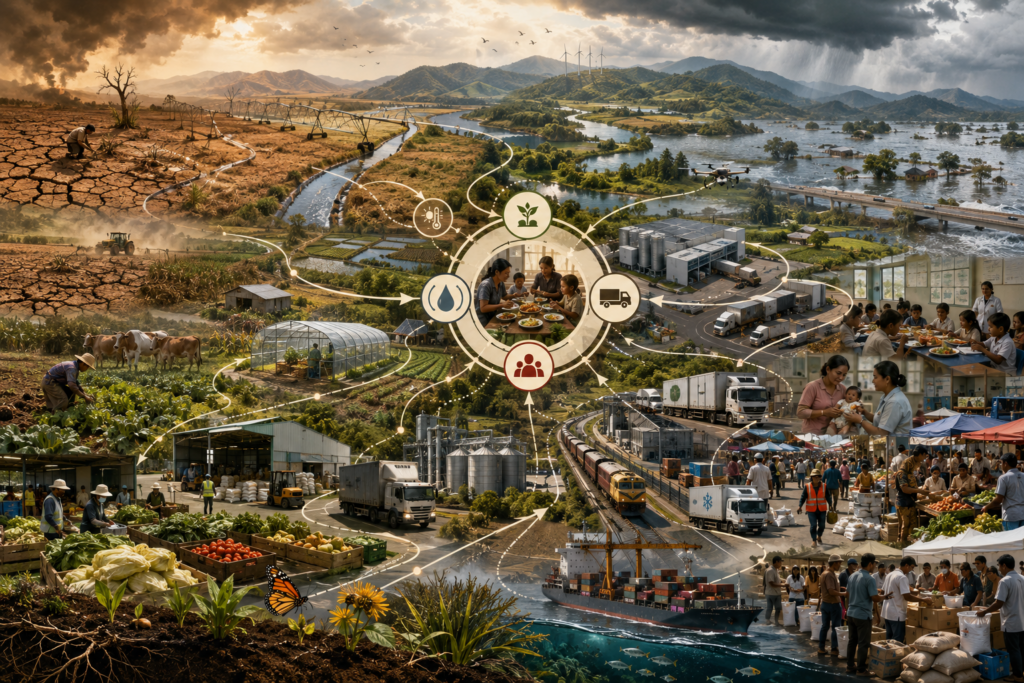
Editorial sustainability illustration showing farms, drought, flooding, logistics, markets, food access, public health, and ecological buffers connected across a resilient food system.

Food System Fragility and Resilience

Food system fragility and resilience must be understood across the full chain from ecological foundations to household access. Food systems are not only agricultural systems; they are interconnected ecological, logistical, economic, labor, infrastructural, institutional, and social systems whose stability depends on production, storage, transport, affordability, nutrition, public protection, and governance. This article explains how climate pressure, water stress, ecological degradation, input dependency, logistics disruption, price volatility, inequality, household vulnerability, and weak institutions can turn localized strain into wider food insecurity. It also shows why resilience requires more than higher yields: resilient food systems need diversity, ecological buffers, storage, market access, social protection, nutritional safeguards, fair labor, adaptive governance, and enough redundancy to prevent stress from becoming hunger, malnutrition, and systemic instability.

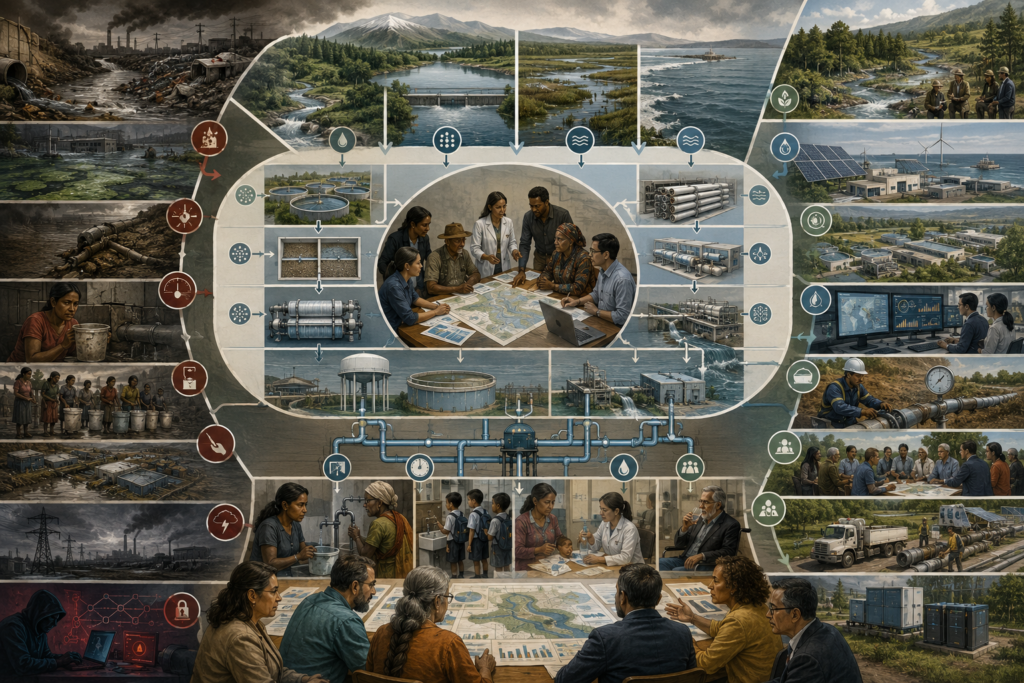
Editorial systems illustration showing a full drinking-water supply chain from protected watersheds, desalination, treatment, storage, monitoring, and distribution to households, schools, clinics, and public governance.

Clean Drinking Water, Desalination, and Water-Supply Resilience

Clean drinking water, desalination, and water-supply resilience belong together because safe water depends on more than finding enough water. This article examines potable-water security across the full source-to-tap chain: source protection, treatment, filtration, disinfection, desalination, wastewater reuse, distribution networks, household access, affordability, water-quality monitoring, energy dependence, brine management, and public governance. It explains why drinking-water resilience is a public-health function, not only an engineering challenge. A system may have rivers, aquifers, reservoirs, or coastlines and still fail if contamination is unmanaged, pipes leak, treatment systems are weak, desalination is energy-intensive, or households cannot afford service. The article argues that resilient water systems must provide safe, reliable, affordable, and accountable drinking water under stress while protecting ecosystems, public trust, and vulnerable communities.

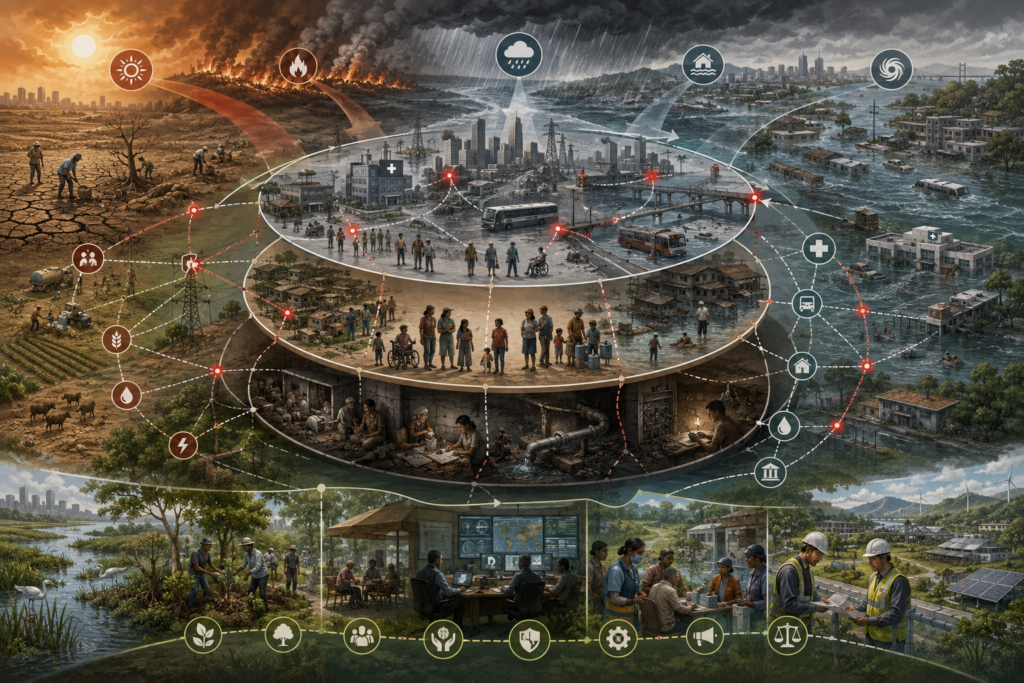
Editorial illustration showing climate hazards interacting with exposed communities, infrastructure, ecological buffers, and public systems to produce systemic vulnerability and cascading climate risk.

Climate Risk and Systemic Vulnerability

Climate risk is not only a problem of extreme weather. It becomes systemic when hazards such as heat, drought, wildfire, heavy rainfall, and flooding move through exposed infrastructure, unequal communities, degraded ecosystems, fragile public institutions, and limited adaptive capacity. This article explains climate risk through the interaction of hazard, exposure, and vulnerability, then expands that frame to show how climate stress can cascade across energy, water, food, housing, transport, health, finance, and governance systems. It argues that climate resilience requires more than technical adaptation to weather extremes. It requires reducing structural vulnerability, restoring ecological buffers, strengthening public institutions, protecting exposed communities, and pursuing climate-resilient development that addresses inequality before hazards become systemic harm.

Scroll to Top