Risk & Resilience

Risk and resilience research examines how complex systems anticipate, absorb, and adapt to shocks and disruptions. Modern societies face a wide range of systemic risks, including climate hazards, financial instability, geopolitical conflict, and technological disruption.

Risk analysis focuses on identifying potential threats and evaluating their likelihood and consequences. Resilience thinking extends this perspective by examining how systems respond when disruptions occur.

Resilient systems are characterized by redundancy, adaptability, and the capacity to recover from disturbance without losing core functionality. Understanding these dynamics is essential for designing institutions, infrastructure, and governance systems capable of navigating uncertainty and long-term systemic change.

Editorial systems illustration contrasting a tightly optimized, fragile system with a resilient system built around slack, redundancy, modularity, repair capacity, backup pathways, and coordinated public planning.

Efficiency, Slack, and Resilience in System Design

Efficiency, slack, and resilience belong together because modern systems are often optimized for ordinary conditions while being underprepared for disruption. This article examines the design tension between lean performance and survivability under stress, showing how systems can become fragile when they remove buffers, spare capacity, redundancy, inventory, staffing, maintenance, modularity, diversity, and institutional room to adapt. It explains why efficiency is not the enemy of resilience, but becomes dangerous when it minimizes visible cost while transferring hidden risk to workers, households, suppliers, public agencies, ecosystems, and future recovery budgets. The article argues for resilient efficiency: system design that reduces true waste while preserving the slack, fallback pathways, repair capacity, public trust, and justice needed to protect essential functions when volatility becomes structural.


Editorial illustration showing nested adaptive cycles across ecosystems, cities, infrastructure, communities, and governance, with growth, conservation, release, and reorganization represented across social-ecological scales.

Adaptive Cycles and Panarchy in Social-Ecological Systems

Adaptive cycles and panarchy explain how social-ecological systems persist, become rigid, break down, reorganize, and transform across time and scale. Rather than treating change as linear or uniform, the adaptive-cycle framework describes recurring phases of growth, conservation, release, and reorganization. Panarchy extends this model by showing how local, regional, national, and global cycles interact through faster and slower processes of disturbance, memory, renewal, and constraint. This article examines why resilience is dynamic rather than static, how conservation can become rigidity, how release can create danger and possibility, and why reorganization is never socially neutral. It explores cross-scale interaction, resilience traps, institutional learning, ecological memory, inequality, and justice-centered transformation. Sustainable resilience depends not only on persistence, but on the capacity to learn, reorganize, and renew what matters.

Editorial systems illustration contrasting locked-in fossil, infrastructural, and social systems with a more just and adaptive future, centered on a diverse planning forum examining pathways, feedback loops, and transformation options.

Path Dependence, Lock-In, and Resilience Traps

Path dependence, lock-in, and resilience traps explain why systems often remain stuck in vulnerable, unjust, or unsustainable arrangements even when risks are visible. This article examines how past decisions, sunk investments, infrastructure, institutional routines, political power, social dependence, technological standards, and ecological feedbacks can narrow future options and preserve harmful pathways. It shows why resilience is not always positive: some systems are resilient in maintaining pollution, exclusion, poverty, fossil-fuel dependence, degraded ecosystems, or maladaptive development. The article argues that escaping lock-in requires more than awareness or incremental reform. It requires viable alternatives, adaptive governance, public legitimacy, just transition support, reversibility, coalition-building, and transformative capacity. True resilience is not simply the ability to endure; it is the ability to leave damaging pathways behind and move toward more just, livable, and sustainable futures.

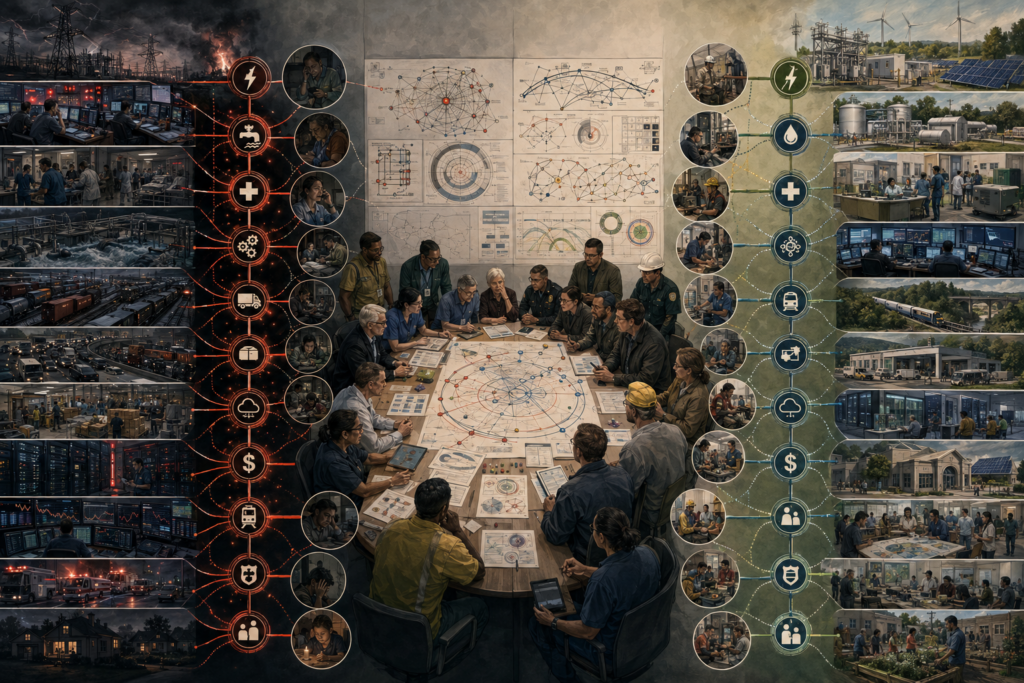
Editorial systems illustration showing a central resilience-planning forum surrounded by interconnected sectors, with cascading infrastructure and social failures on one side and buffered, adaptive resilience pathways on the other.

Nonlinearity and Shock Propagation

Nonlinearity and shock propagation explain why disruption rarely spreads in smooth, proportional, or predictable ways. This article examines how small shocks can produce large consequences when systems contain thresholds, feedback loops, tight coupling, critical nodes, hidden stress, unequal exposure, and interdependent infrastructure. It shows why the size of the initiating event is only part of the story: consequences depend on the condition and architecture of the system through which the shock travels. A minor disturbance can cascade through energy, water, health, food, transport, finance, digital systems, ecosystems, and public institutions when buffers are weak and dependencies are dense. The article argues that resilience requires more than predicting hazards. It requires containment capacity, modularity, redundancy, monitoring, adaptive governance, public trust, and justice so local disruption does not become systemic breakdown.

Editorial systems illustration contrasting tightly coupled catastrophe risk with safer resilience design, centered on a diverse analysis forum examining failure pathways, dependencies, buffers, redundancy, and fallback capacity.

Tight Coupling and the Logic of Catastrophic Failure

Tight coupling explains why some failures become catastrophic before people, institutions, or automated systems have enough time to interrupt them. This article examines how rigid sequencing, narrow operating margins, time compression, limited substitution, hidden dependencies, interactive complexity, and critical-node dependence can turn local disruption into rapid system-wide failure. Drawing on normal accident theory, infrastructure interdependence, digital automation, supply chains, healthcare, energy, and water systems, it shows why catastrophe is often caused not only by what fails, but by how quickly failure travels. The article argues that resilience requires more than stronger components or better procedures. It requires buffers, modularity, redundancy, fallback capacity, adaptive authority, manual workarounds, public trust, and justice so that essential systems have enough room to diagnose, contain, reroute, repair, and protect people before disruption outruns response.

Editorial illustration showing a resilient urban-regional system with modular infrastructure, backup pathways, distributed energy, wetlands, transport alternatives, and planners coordinating containment of local disruption.

Redundancy, Modularity, and System Resilience

Redundancy and modularity are foundational features of resilient systems because they help prevent local disruption from becoming systemic breakdown. Redundancy provides alternate pathways, backup components, spare capacity, substitute functions, and reserve resources when primary systems fail. Modularity contains disruption by organizing systems into semi-separated parts so that failure does not propagate freely across the whole. This article explains why systems optimized only for efficiency often remove the very capacities needed under stress, and why resilience depends on structure as much as response. It examines backup diversity, pathway diversity, spare capacity, containment, coupling, dependency concentration, restoration capacity, governance coordination, and justice-centered design. Together, redundancy and modularity allow systems to degrade gracefully, preserve essential functions, and recover without allowing one failure to become a wider crisis.

Editorial illustration showing a central infrastructure failure spreading through power, water, hospitals, transport, communications, ports, neighborhoods, and governance systems, with planners and community representatives coordinating resilience.

Cascading Failures in Interdependent Systems

Cascading failures occur when disruption in one system propagates across connected infrastructures, institutions, ecosystems, and communities. A power outage can affect water treatment, healthcare, transport, communications, finance, and emergency response; a flood can become a logistics failure, public-health crisis, economic shock, and governance problem. This article explains why interdependence changes the character of risk, how hidden dependencies and critical nodes turn local failure into systemic crisis, and why resilience requires more than strengthening individual assets. It examines dependency mapping, containment capacity, modularity, redundancy, cross-sector coordination, restoration speed, essential-function continuity, and justice-centered planning. Cascading failure reveals that modern systems do not fail only through direct damage. They fail through relationships, and resilient systems are those that can preserve core functions while preventing disruption from compounding across the wider network.

Editorial sustainability illustration showing feedback loops, delayed response, cascading risk, governance planning, resilient wetlands, strained infrastructure, and unequal community exposure.

Feedback Loops, Delay, and Instability in Risk Systems

Feedback loops, delay, and instability explain why risk systems rarely behave in simple, immediate, or proportional ways. In sustainable systems, actions change conditions, those conditions shape future actions, and delayed responses can turn well-intended control into overshoot, oscillation, or cascading failure. This article examines balancing and reinforcing feedback, why response timing matters, and how ecological, infrastructural, institutional, and social systems can amplify stress across connected domains. It shows how power disruption can affect water treatment, hospitals, communications, transport, food distribution, governance, and community safety, while delayed information and weak signals make intervention harder. The article argues that resilience requires more than reacting to events. It depends on understanding system behavior over time, strengthening stabilizing feedback, preserving margins, improving monitoring, and governing before reinforcing dynamics push risk beyond control.

Editorial sustainability illustration showing a stable, well-coordinated urban and ecological system transitioning across a threshold into flooded, strained, and cascading system breakdown, with governance teams and affected communities visible in the foreground.

Thresholds, Tipping Points, and System Breakdown

Thresholds, tipping points, and system breakdown explain why sustainable systems can appear stable while hidden stress quietly accumulates beneath the surface. Many ecological, infrastructural, institutional, and socio-economic systems do not fail gradually. They absorb pressure until a critical boundary is crossed, stabilizing feedbacks weaken, and the system reorganizes into a harder-to-reverse state. This article examines how thresholds differ from tipping points, why breakdown often appears sudden even when its causes are long in the making, and how cascading impacts can move across power, water, health care, transport, food systems, governance, and communities. It argues that resilience requires more than recovery after disruption. Sustainable systems must preserve margins, monitor weak signals, understand interdependence, and act before ordinary stress pushes critical systems into regimes where adaptation becomes far more difficult.

Scroll to Top